
Documentary Review: All Hail the Founding Foodie — “Julia”

The first time Julia Child appeared on TV, it was on “Educational Television” in Boston in the 1960s. She was to plug her culture-shifting new cookbook, “Mastering the Art of French Cooking.” But what she was most concerned about was having something plugged in for her. She needed a hot plate, and the malnourished TV operation at WGBH wasn’t sure they could provide one.

It was for a book talk program, after all. But she insisted, in that bizarre, fluty/fruity, patrician-accented voice, that it was simply a must.

And when she showed up, a lifelong member of the production crew there recalls, she made an omelet, live on the show. She brought the ingredients, her own pan and walked the program host and the viewing audience through the mesmerizing, mouth-watering process of how to make one perfectly.

No one had an omelet pan in greater Boston,” that crew member marvels. And if Boston, of all places, didn’t, how many could there have been in all of America?

That’s the country and culinary sophistication that Julia Child, ex-OSS agent-handler and office clerk, rare female graduate of Paris’s famed Le Cordon Bleu cooking academy and new New Englander walked into on that set. A nation of tinfoil-covered TV dinners, SPAM hors d’oeuvres and “convenience” eaters was about to have its taste buds and its mind blown.

That culture shock is the great take-away from the fun and fascinating new documentary, “Julia.” Here’s a film, opening in a nation overrun with cooking shows and entire TV networks devoted to food and a whole section of society labeling itself “foodies.” And bless her big, butter-basted heart, here’s the woman changed it.

Interviewing friends and relatives, chefs from America and France and the World’s Chef, Spanish-born José Andrés, professional acquaintances and TV cooks who followed her, “Julia” digs deeper into Child than the delightful, fictionalized “Julie & Julia” of a few years back, and captures a true pioneer in her element.

Yes, we see that first omelet on the primitive TV of the Kennedy “Camelot” era. We see the accidents, the improvising, the unflappable chattering on that made her “inimitable,” until, well everyone from comedians to cooks to anybody you met on the street could offer a fair imitation of PBS’s first superstar.

“Save the liver!”

Yes, she stumbled into the Dan Aykroyd “Saturday Night Live” sketch in the ’70s, laughed, and proceeded to show it to dinner guests on video for years afterward, a bit of gory, affectionate mockery she wholly embraced.

The film starts with a bracing montage of Julia cooking-on-TV moments and quotes — “I find that if people are not very interested in food, I’m not very interested in them.” — set to Jimi Hendrix’s “Let Me Stand Next to Your Fire.” It takes in her upper class upbringing in Pasadena, her Smith College education and the start of World War II.

That’s where she jumped into government clerical work, and eventually made her way to the OSS, which would morph into the CIA. That’s where she met and fell in love with her greatest influence, the dashing epicurean Paul Child — her tour guide to the finer things, her champion, her TV cue card writer and biggest fan.

Co-directors Betsy West and Julie Cohen are covering a lot of familiar ground in this Sony Classics/CNN Films production, so they make quick work of it. There was already a definitive PBS documentary, and “Julie & Julia” skipped through her life with no less than Meryl Streep putting everyone else’s Julia Child impersonation to shame.

The co-directors of “RBG” come closest to breaking new ground in recalling Child’s old fashioned, ignorant homophobia, something she (like Fred Rogers, as we saw in his documentary) abandoned the moment she learned better. But even Child’s twilight years — bristling at the “farm to table” fuss of those who followed her, refusing to slow down or give up her various TV gigs, her battles with PBS, which took her for granted in ways they never did her fellow Founding Icon, Mister Rogers — have a triumphant air as showcased here.

Here was a “broad” with moxie, staying power and charisma. There would be no dimming of the light, just an ABC’s “Good Morning, America” gig, endless chat show appearances and one last PBS series with Jacques Pepin as a victory lap for the Woman Who Changed Eating in America when no one thought that could be done.

Rating: PG-13 for brief strong language/sexual reference, and some thematic elements

Cast: Julia Child, José Andrés, Ina Garten, Danièle Mazet-Delpeuch, Jacques Pepin, Charles Gibson, Ruth Reichl

Credits: Directed by Julie Cohen and Betsy West. A Sony Pictures Classics release.

Running time: 1:35

Posted in Reviews, previews, profiles and movie news | Comments Off on Documentary Review: All Hail the Founding Foodie — “Julia”

Movie Preview: Red State sickos serve up the “Red Pill”

Weird, twisted stuff coming our way in December. Kathryn Erbe’s in it, and Tonya Pinkins (who wrote and directed it) and Ruben Blades.

Posted in Reviews, previews, profiles and movie news | Comments Off on Movie Preview: Red State sickos serve up the “Red Pill”

Movie Preview: Netflix finances a Jane Campion Western with Cumberbatch as a villain, Kirsten Dunst and Jesse Plemons — “The Power of the Dog”

My two cents, this is a much better bang for the buck route for Netflix to travel.

I understand that they won’t have access to a lot of Big Action content as Disney and others point their product to proprietary streaming services. But most Netflix actioners suck.

Their best films have been the awards contending dramas. Go for prestige, limit your expenditures on Big Ticket action pics. If you want Big Action, put it out in series form.

This Jane Campion (“The Piano,” “Bright Star”) adaptation of a Thomas Savage novel comes out Nov. 17 and looks like a contender.

Posted in Reviews, previews, profiles and movie news | Comments Off on Movie Preview: Netflix finances a Jane Campion Western with Cumberbatch as a villain, Kirsten Dunst and Jesse Plemons — “The Power of the Dog”

Movie Preview: Joaquin Phoenix, Gabby Hoffman, “C’mon C’mon”

The latest from Mike Mills, who directed “Thumbsucker” and “Beginners” and “20th Century Women” is also about family, and is this time a New York tale told in black and white.

Phoenix is back to doing interesting work. Good to see Gabby Hoffman finding her way back in the door this past year or two.

This one drops Nov. 19.

Posted in Reviews, previews, profiles and movie news | Comments Off on Movie Preview: Joaquin Phoenix, Gabby Hoffman, “C’mon C’mon”

Documentary Preview: Forensics researchers look for Our Military’s Missing in Action — “To What Remains”

A little patriotism, a little science, a righteous mission — giving families closure.

Abramarama is missing the boat, not releasing this in time for Veteran’s Day, or more appropriately, Memorial Day.

“To What Remains” is due out in December.

Posted in Reviews, previews, profiles and movie news | Comments Off on Documentary Preview: Forensics researchers look for Our Military’s Missing in Action — “To What Remains”

The perfect “Bond Villain” boat?

I’ve seen some mega-yachts in my time, in Marina Del Rey and Fort Lauderdale and Barcelona, etc.

This strikes me as a villain’s yacht tender waiting to be cast.

It’s what the super rich heavy steps onto after 007 has shot down his helicopter.

“Look after Mr. Bond,” the baddie always says. “See that some harm comes to him.”

Posted in Reviews, previews, profiles and movie news | Comments Off on The perfect “Bond Villain” boat?

Netflixable? A Japanese generation looks back as it realizes “We Couldn’t Become Adults”

Generational ennui and existential angst is pretty much universal. But today’s Around the World with Netflix offering puts it in a uniquely Japanese context.

“We Couldn’t Become Adults” is based on a popular novel published in the island country, whose boom years are decades past and whose population is shrinking as marriage is delayed, suicide it up, immigration limited and calamities economic, cultural, seismic and nuclear buffet it. Japan, social observers tell us, is struggling with an existential crisis.

Yoshihiro Mori’s film of Moegara’s novel isn’t about narcissistic infantilism and economic stagnation, two glib labels flung at the phenomenon. It’s about one man’s journey from his teens to almost 50, a post-“salaryman” worker bee and his depression at becoming as “ordinary” as everybody else, when that was the country’s middle class goal for half a century.

In an opening scene, Sato (Mirai Miriam) trips and tumbles into a trash pile with a homeless man. The other man’s drunken fury suggests they have history, especially when the guy (Shinohara Atsushi) cries “I’ve got nothing! You’ve all left me behind!” (in dubbed English, or Japanese with subtitles).

Sato’s downcast look lets us know that this fellow isn’t far from the mark. He just doesn’t realize how little life has to offer a still-employed/not-homeless 45 year-old who never thought he’d end up this “ordinary.”

Sato’s a graphic designer who can afford one nice item of clothing — a trench coat — keep a decent apartment and buy all the cigarettes he dramatically smokes between glances at his latest cell phone.

But he has a question most everyone who hits 45 asks. Is this all there is? Is this as good as it gets?

The film takes us on a meandering journey through Sato’s past — 2015 to 1995, a tale told in chapters dated and titled, i.e. 1995, “Reach Out of the Dark.” That was the year he jumped from packing cakes for shipment to landing a job, with no skills or experience, working with Photoshop and the other tools of a modern computerized graphic designer’s trade.

New Millennium Eve in 1999 might have been the most pivotal of all. That’s when “she” (Ito Sairi) ditched him, with just a “I’ll bring the CDs next time!” as her parting words. Kaori was the One Who Got Away.

Mori’s film boils Sato’s life down into the workaholism that is the Japanese brand, revisiting the early days when his Great Love, met when they were teen pen pals, could yank him out of work for a day of rental car driving and sight-seeing.

The many points in time our hero revisits ensure that the story isn’t simplistic enough to suggest an abrupt day when it all went wrong. And Charles Dickens and Rod Serling covered that “job became more important than living life” ground long before this.

What we see instead are the waypoints to ennui, that “ordinary” and lonely life that Sato figured he wasn’t destined to lead. He wanted to be a novelist, but overwork and its steady soul-sucking impact on the psyche, after-hours karaoke and a vain effort to “settle down” with a woman (Yuko Oshima) who was never going to be The One Who Got Away defeated him.

The episodic structure shows the people Sato left behind at the dead end cake shipping job, and the devolution of a fellow idealist and boss (Higashide Masahiro) who once punched-out a bullying, cheapskate TV news director (Japanese TV news is big on animated graphic recreations of items in the day’s news) for barking, one time too many, to “take 30% off the bill!” By the end of his storyline, which is close to the film’s beginning, that boss has sold out, “started over” and become as ordinary as everybody else.

“I can’t laugh at other people’s misfortune any more,” another character says, capturing the resignation of middle age in a single sentence.

That episodic structure — bopping from 2011 to 1998, 2007 to 1995 and so on — makes the film hard to follow, although the sad drift from hope to shrugging, solitary despair is clear, first scene to last.

And if you miss the connections, Mori summarizes them all in the final sequences, another way “We Couldn’t Become Adults” tests the viewer’s patience.

The film’s depiction of tech hints at its role in crushing the life out of people. Love letters replaced by beepers replaced by the constant distraction of a cell phone. Progress.

I’ve seen the source novel’s title translated as “Not Everybody Gets to Grow Up,” which seems a fairer way to look at Sato’s journey. He attends corporate celebrations and retirement parties for firms because his company is doing the graphics that decorate these extravaganzas. A drunken mid-level manager bellows “Live each day like it’s your last!” and you get the feeling that Japan cuts loose and celebrates in a way that defies the practical low-risk savers (another reason people put off marriage) that is the national identity.

His live-in lover leans on Sato to marry in 2011, which he dismisses with a blend of fatalism and commitment phobia, wrapped up in his personal ethos.

“A lot of people are getting married after the (Tōhoku) earthquake,” tsunami and Fukushima nuclear disaster. “So ordinary.

The film takes so much in — gay bars and a workmate crush, first-time sex in a “Love Hotel” — that it tends to wander. The women in it are perpetually in the background, forever waiting for men to grow up, make things easier, make up their damned minds or move on. Sexist and patriarchal? Yes it is.

Even without that, “Adults” isn’t the easiest watch on Netflix.

But I’ll bet a lot of people can connect with the weary disappointment with life that Moriyama (“Love Strikes”) conveys with every head-shaking drag off a cigarette. We feel you, man.

Rating: TV-MA, sex, nudity, smoking, some violence

Cast: Mirai Moriyama, Ito Sairi, Higashide Masahiro, Yuko Oshima, Shinohara Atsushi

Credits: Directed by Yoshihiro Mori, scripted by Ryo Takada, based on a novel by Moegara. A Netflix release.

Running time: 2:04

Posted in Reviews, previews, profiles and movie news | Comments Off on Netflixable? A Japanese generation looks back as it realizes “We Couldn’t Become Adults”

Movie Preview: Of ISIS and Fatima, “The Lady of Heaven”

An historical epic about a daughter of Muhammed, “the Prophet,” sort of the Virgin Mary of Islam, according to Wikipedia, at least.

Modern day Middle Eastern turmoil sets up this “Did I ever tell you the story” tale of a seventh century woman of influence in a religion whose extremist segments put the poisonous “P” in “patriarchy.”

Could be informative, if supernaturalish. Could be propaganda.

This one opens in select cinemas Dec. 10.

Posted in Reviews, previews, profiles and movie news | 1 Comment

Movie Review: “The Pebble and the Boy” puts Modern Mods on Motorscooters on a quest to Brighton

If the Brits didn’t invent “nostalgia,” you can bet your bollocks they perfected it.

Case in point, “The Pebble and the Boy,” a sentimental comedy about a college lad who takes his Dad’s old Lambretta scooter from Manchester to Brighton to scatter the his father’s ashes.

The old man was a Mod, and as they’ve said over the decades and say again many times in the film, “Once a Mod, always a Mod.” Brighton was the Mods’ Mecca.

The 20ish kid isn’t a “Mod,” per se — sort of Mod adjacent, sporting the ’80s fashions now called “Casual Classics” (Izod, Fila, Fred Perry and Sergio Tacchini sportswear). That makes him a “Module,” he’s told.

The son, John (Patrick McNamee) meets Dad’s Mod support system, people who got on their Vespas, Lambrettas and what not back in the ’80s during the Mod Revival. John later runs into an OMG — Original Mod Gangsta (just made that up, copyright pending) — from the ’60s, when Mods and Rockers took their fashion (pre-preppy vs. leather) and music (The Beatles, Who, et al vs. rockabilly) and two-wheeled (scooters vs. motorcycles) clashes to the streets for brawls.

So “Pebble and the Boy” is modern kids nostalgic for ’80s Mods who were mimicking ’60s Mods. That Mod Mobius loop is nostalgia perfected.

The film takes its title from a song by Paul Weller of The Jam, a punk era outfit with Mod in its DNA. Most North Americans might only recall this culture through the movie “Quadrophenia” and by that famous Beatles press conference quote when Paul McCartney refused to take sides in the Mods vs. Rockers conflict.

“We’re Mockers,” he quipped.

“Pebble” is contrived, obvious and kind of a geezer’s wish fulfillment fantasy in its depiction of a new generation embracing the fashion, music and motor-scooters of their parents and grandparents. I see the British press mostly lambasted the film. The British press can blow it out their Lambrettas. I found it just as contrived and obvious, but cute and fun enough to get by.

John figures he’s been to his dad’s funeral and that’s the end of it. His mother (Christine Termarco), who long ago divorced his dad and remarried, certainly hopes so.

But that’s before John pokes around Dad’s wardrobe, his record collection (The Jam, Paul Weller, etc.) and newspaper clippings (Mods protest Thatcher, etc.). And that’s before the slightly-damaged Lambretta is delivered from the police impound lot. Dad died on it. Fila-favoring John decides he’ll take the urn and the blinged-out scooter to Brighton, and live out a little adventure as a last tribute.

He has to make a break for it, over his mother’s objections. When he breaks down as we knew he would, Mum points him to the first connection in his dad’s old Mod/scooter support system. But the repairer is set to keep John there until he can be taken home. The man’s Mod-mad daughter (Sacha Parkinson) has other ideas.

The first laugh in the movie comes when we see the simpler-than-simple stunt Nicola, who goes by “Nickers” (tee hee), pulls to make their getaway. Parkinson, of TV’s “Coronation Street” and “Mr. Selfridge,” provides a lot of the laughs in “The Pebble and the Boy.” She’s a manic pixie Mod girl.

As they make their way South towards a beachside ashes-scattering and Paul Weller concert (Dad had tix), they run into the Mods’ traditional rivals — leather-clad bikers — meet up with other Mod-friends of Dad’s and take on a third scooter companion — leering, Mod-mocking Logan (Max Boast). His Mod Mum (Patsy Kensit of “Absolute Beginners”) and Dad (Ricci Hartnett) figure he could learn a thing or two from the pilgrimage.

Every so often, John loses the will or his nerve. Bullies, would-be scooter thieves and beer busts test him. Nickers is there to badger him back on-task, whatever it takes. Almost.

“I’m not the kind of girl who gets shagged in the alley…Not in daylight, anyway.”

Road comedies are universal cinematic comfort food, and this one wears that label easily. The leads are engaging, the “obstacles” not-wholly undemanding and the whole enterprising Mod and modest — just light enough to skip from plot contrivance to contrivance.

It may not be as instructive to the UK generations who grew up with this cultural phenomenon. But to outsiders who missed even the early 2000s scooter revival, it’s a trip. The wheels, the slang, the camaraderie, the soundtrack (songs by The Jam, Paul Weller, Style Council, The Chords) and even the “You look like a deck chair” fashion statements are revelatory and fun.

Rating: unrated, some violence, put smoking, alcohol and profanity

Cast: Patrick McNamee, Sacha Parkinson, Christine Termarco, Max Boast, Ricci Hartnett and Patsy Kensit.

Credits: Scripted and directed by Chris Green. A NOW Films release.

Running time: 1:41

Posted in Reviews, previews, profiles and movie news | Comments Off on Movie Review: “The Pebble and the Boy” puts Modern Mods on Motorscooters on a quest to Brighton

Movie Review: A Frenchman in New York, dismayed by “That Cold Dead Look in Your Eyes (Tex Yeux Mourants)”

One of the many metrics my web server provides at the end of every day’s readership is a list of the most common search phrases that bring first-timers to this site. One that stands out is the phrase X, Y or Z movie-title “explained.”

I get a lot of that SEO traffic because I tend to go into more detail than most anybody else reviewing movies these days. Not “spoilers” so much as details — dialogue quoted, interpretations, plot points.

And if you’re coming here to have Onur Tukel’s bizarre mental meltdown tale, “That Cold Dead Look in Your Eyes,” “explained,” I’m not sure I’m going to have an answer.

But let’s start typing and see if the details bring the intent of the quirky filmmaker who gave us “The Misogynists” and “Richard’s Wedding” into focus.

“Cold Dead Look” is a sometimes hallucinatory sci-fi/zombie picture plunge into guilt and remorse. We watch a fellow who’s girlfriend has kicked him out on a Life in New York death spiral. His love life, his living situation, his job, his motorcycle and his psyche are pounded by all comers in a paranoid, stricken black and white nightmare.

Tukel creates a Francophone bubble for this story, a film set largely among French speaking expats in New York city.

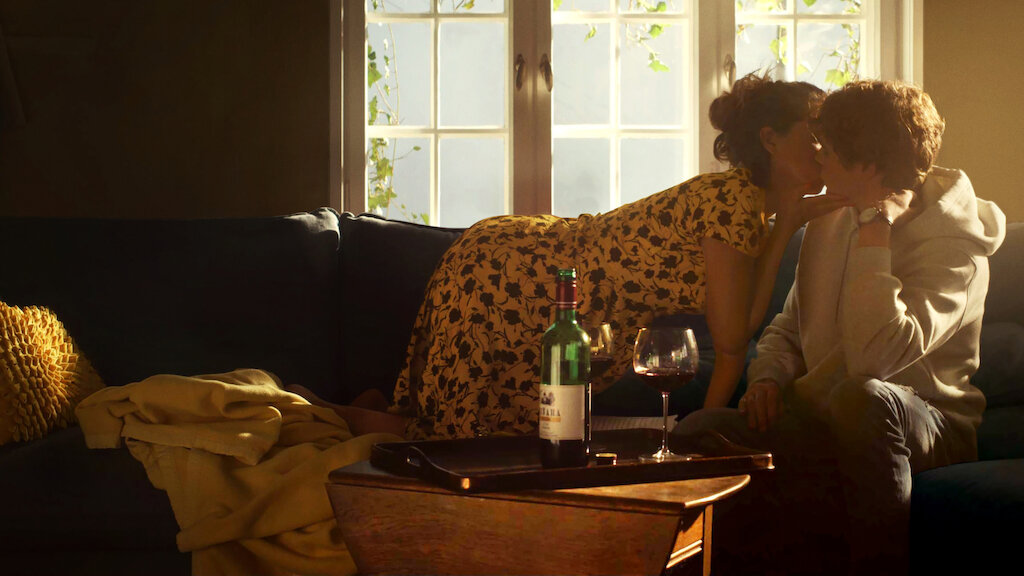
Lovers Marie (Nora Arnezeder) and Leonard (Franck Raharinosy) cuddle and chat and love-language each other over a couple of scenes, shot in color. The apartment is Marie’s, and as we meet them, she is decorating it with the photos of her father, a once-famous photographer.

We come back to this color “flashback” timeline many times in the film. But for the story of Leonard’s breakdown, the film becomes, like the still photos — black and white.

We see Leonard at work, in a dying French restaurant where his cooking is insulted, sauces compared to “puss oozing from sores” or “tastes like prostate cancer.” Leonard is driving every customer the place once had away, and the furious waitress (Barbara Beddouk) is sure the owner (Max Casella) is going to figure that out any minute now.

Marie is similarly “over” Leonard, giving him the “I want you gone when I get back” (in French, with English subtitles) as she leaves.

Panhandlers and tough looking characters get in his face about money or his motorcycle.

And then the once-famous photographer (Alan Ceppos) shows up, firmly puts Leonard in his place and proceeds to crash at Marie’s apartment, fill it with gay men he photographs in the nude and clog the toilet, which he refuses to unclog himself.

“These hands…are for making ART!”

Periodically, we see this electronic gadget with a flashing “I” light — on walls, power poles, in Andy the restaurateur’s office. “Super high speed Internet” is all anyone’s being told about it. “Theta waves” that aren’t good for you is the whispered word among the public.

As Leonard flashes back to moments of truth with Marie and senses this world closing in around him, as he hallucinates an ability to lay his hands on people, rolling their eyes into the white-showing backs of their heads in zombie-like convulsions, we figure he’s buying into the conspiracy theory as well.

Whatever else he’s going for, Tukel manages to thoroughly disorient the viewer. An obscenely sarcastic street mime, all these New Yorkers speaking French, this French-speaking panhandler needing money to get back to Brooklyn, shots of Leonard on The Battery on the greyest, loneliest New York day imaginable.

Leonard’s despair crosses into desperation as he wrestles with the reason he and Marie broke up and pauses, mid-plunge, to see what rock bottom looks like down below.

He can fantasize an alternate reality where his transgression never happened and love is his, but the most “real” reality might be the world where his touch is literally toxic — with food, with other people.

All that said, I can’t say I liked “That Cold Dead Look in Your Eyes.” Appreciated the attempt, sure. It’s a disintegration that isn’t viewed and considered at arm’s length. We’re IN it with Leonard. We just can’t decide if we want to be, or if we like him any more than the people abusing him at every turn.

And being that close, we can tell what’s happened, but not what’s happening now or what will happen in the future.

Maybe the “Theta waves” get in the way.

Rating: unrated, nudity, horror violence, profanity

Cast: Franck Raharinosy, Nora Arnezeder, Alan Ceppos, Candice Jean-Jacques, Barbara Beddouk and Max Casella.

Credits: Scripted and directed by Onur Tukel. A Darkstar release.

Running time: 1:31

Posted in Reviews, previews, profiles and movie news | Comments Off on Movie Review: A Frenchman in New York, dismayed by “That Cold Dead Look in Your Eyes (Tex Yeux Mourants)”