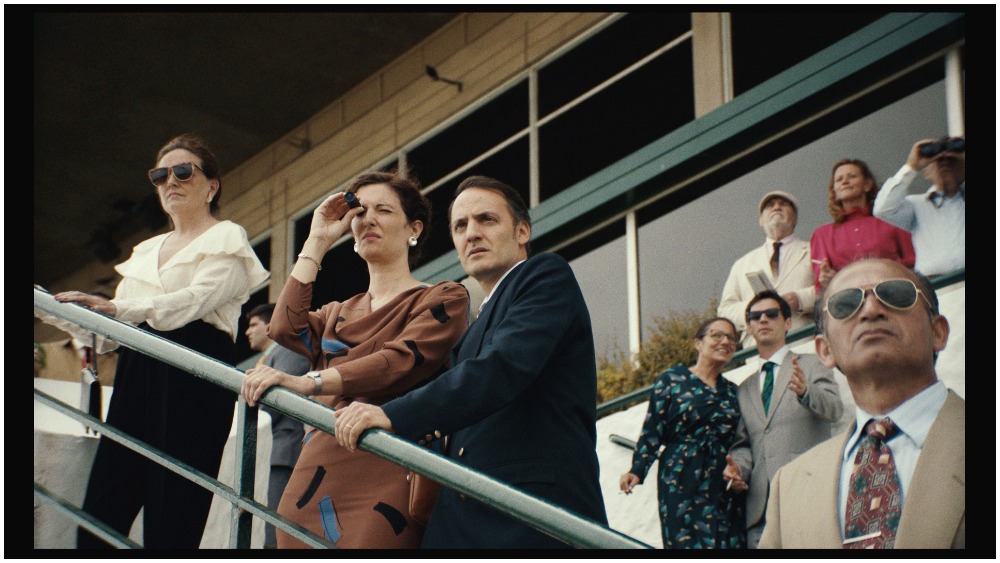
Next Screening? Asian Horror set in America — “Repossession”

This Dec. 21 release is set in the Asian-American community of “the world’s most expensive city.”

That would be San Fran. Seriously creepy looking, very “Ring” and “Parasite” in tone.

Posted in Reviews, previews, profiles and movie news | Comments Off on Next Screening? Asian Horror set in America — “Repossession”

Netflixable? Durable Western “The Ballad of Lefty Brown” gives Fonda a curtain call, Bill Pullman a star vehicle

Here’s one of those “upend your expectations, pardner” Westerns of the modern mold, a movie about a “sidekick” forced to take over the story when the hero gets bushwhacked.

“The Ballad of Lefty Brown” isn’t about a famous gunslinger, lawman, desperado or rancher who “tamed the West.” Lefty (Bill Pullman) isn’t the sort who’d provide fodder for the dime novels favored by the young sidekick (Diego Josef) he takes on for his “revenge quest,” the sort of thing a man’s gotta do when a man’s pardner is killed right before his eyes.

Writer-director Jared Moshe’s genre “oater” didn’t merit much of a theatrical release (if any) when it turned up on DirecTV, thanks to production studio A24’s shortcomings when it comes to distribution and promotion. But as it’s on Netflix, let’s see if it’s worth hunting down.

Pullman’s character is a limping, slow-talking geezer with mutton chops and a funny, high-mileage hat. Lefty Brown isn’t bad at tracking, but he was never much with a six-gun. Even a rifle isn’t going to get him close to the target with his “old man” eyesight. Given a choice, he’s packing a shotgun.

He isn’t all that tough, and when it comes to chasing rustlers, he’s better at tracking than he is about sneaking up on anybody. The bad hombres are always getting the drop on him.

As he nearly botches an arrest in the opening scene, he’s asked the question that’s implied throughout this somber, violent sagebrush saga.

“Lefty, aren’t you a little gray to be making these mistakes?”

But Lefty’s never had to be the lead, the go-to-guy. He’s always been content to be in the shadows of legendary Montana rancher Edward Johnson (Peter Fonda, in one of his last roles). Lefty is “loyal.” And with Johnson bound for the Senate, Lefty might be just the guy to leave in charge of the ranch. Or not, if Mrs. Johnson (Kathy Baker, fierce) has any say in the matter.

“‘Loyal’ is not the same thing as ‘capable.'”

But somebody’s got to run the place, and most of the other hands are tinhorns, or close to it. None of them are seasoned enough to go after the rustlers who grab a few horses, Edward reasons. That’s why he and Lefty are all alone, tracking and reminiscing, when a horse thief with a rifle (Joe Anderson) unloads on them from a safe distance.

Edward is dead, and if Lefty hadn’t played dead, he’d never have gotten the body back to the ranch. The new widow isn’t impressed with him, or his promise.

“I’m’o GIT that sumbitch, or die tryin’!”

He takes off on his own, with nobody’s blessing, stumbles into a trigger-happy tinderfoot (Josef), who’s armed, loaded with dime novels, and horseless. And they’re off on their quixotic quest to bring bad men to some sort of justice — formal or “rough” justice.

That’s a running thread through “The Ballad,” Lefty’s reluctance to rush a hanging, killing the accused without a trial. Others are content to mete out their cowboy posse form of law enforcement. But not Lefty, and not his old friend Marshal Tom Harrah (Tommy Flanagan of “Gladiator” and TV’s “Sons of Anarchy” and Westworld”).

As obstacles traditional and new cross their path, one would hope they’d all listen to the governor (Jim Caviezel) and “let the Army handle it,” seeing as how somebody murdered a Senator-elect. But that’s not the Way of the West, is it?

Moshe, who hasn’t gotten a movie or TV project up and in the public eye in the years since “Lefty” was finished in 2017, stages a decent shootout and his DP captures stunning vistas around Bannack, Montana, the setting and the filming location.

The plainly-right-handed Pullman makes “Lefty” just the sort of simple old cuss you underestimate, a fellow who “couldn’t find his ass with both hands,” Marshal Harrah grouses.

The story drifts off into “that never happened” territory, and the waypoints and characters start to resemble a collection of cliches — this one crawled into a bottle, then a “spittoon” to collect coins to buy the bottle, that one’s armed to the teeth but wholly unprepared for that first shoot-out.

But the cast is a game lot, with Pullman, Baker, Flanagan and Caviezel standing out. And there’s only so many times one can watch and re-watch the classics of the genre without craving a fresh take on the comfort food-familiar themes.

“Lefty,” while not nearly as good as “The Sisters Brothers” or “Old Henry,” to name two recent exemplars of the genre, is a perfectly passable “horse opera” and a fine vehicle for the ever-underappreciated Mr. Pullman — who rides well, wears the hat and not the other way’round, and carries off a limp and a squint with the best of them.

Rating: R for violence and some language

Cast: Bill Pullman, Tommy Flanagan, Kathy Baker, Diego Josef, Peter Fonda and Jim Caviezel

Credits: Scripted and directed by Jared Moshe. A Dish Networks film on Netflix.

Running time: 1:51

Posted in Reviews, previews, profiles and movie news | Comments Off on Netflixable? Durable Western “The Ballad of Lefty Brown” gives Fonda a curtain call, Bill Pullman a star vehicle

THANKSGIVING BOX OFFICE: “Encanto” edges “Afterlife,” “Gucci” sells, “Resident Evil” is evicted

Here’s yesterday’s tally, which will probably be reflected by the entire holiday weekend, in terms of “standings.”

Figures via Exhibitor Relations

1. ENCANTO ($5.8M) 2. GHOSTBUSTERS: AFTERLIFE ($5.3M) 3. HOUSE OF GUCCI ($3.4M) 4. ETERNALS ($1.6M) 5. RESIDENT EVIL ($1M)

Posted in Reviews, previews, profiles and movie news | Comments Off on THANKSGIVING BOX OFFICE: “Encanto” edges “Afterlife,” “Gucci” sells, “Resident Evil” is evicted

Movie Preview: “Matrix 4” further “Resurrections?”

That one adds a little bit to what we already know is coming Christmas Day. Below is still the song that sells this movie, IMHO. “White Rabbit” resurrected FTW.

Posted in Reviews, previews, profiles and movie news | Comments Off on Movie Preview: “Matrix 4” further “Resurrections?”

Netflixable? French comedy “Spoiled Brats (Pourris gâtés)” doesn’t “Teach them a lesson”

An exasperated Monaco developer wants to teach his lazy, insufferable “Spoiled Brats” a lesson by pretending they’ve lost it all in what turns out to be a tepid remake of the Mexican comedy “We Are the Nobles.”

It’s a plot the predates the screwball Hollywood comedies of the ’30s, the idea of the rich being brought low and figuring out they’re not any better than the rest of us by becoming “the rest of us.” Despite scoring a few laughs at the expense of the louche, lazy louts of the Batek clan, the lesson to be taught is watered town, the “teachable moments” a mere string of pulled punches. It feels as if several of the story’s necessary steps have been skipped.

In gambling terms, in trying to switch up this “classic” formula, writer-director Nicholas Cuche left a lot of laughs at the table.

Gérard Jugnot stars as patriarch Francis, one of Monaco’s wealthiest builders. There’s a hint he’s largely self-made, a Polish emigrant who worked his way to riches. But his kids had no such struggle. Aside from losing their mother young, the vain clothes-horse Stella (Camille Lou), free-spending, free-eating Philippe (Artus) and hippy womanizer Alexandre (Louka Meliava) wanted for nothing.

To a one they’re rude, selfish and naive to the way the world works and where the money always comes from.

Dad’s heart-attack scare — over Stella’s shallow pursuit of an Argentine playboy (Tom Leeb), Philippe’s idiotic idea for an app/company that has employees wear and break-in your pricy shoes for you and Alexandre’s bedding of not just the wife of his latest university president, but the man’s daughter as well, and in Francis’s mountainside mansion — should be a wake up call.

Two months later, his scheme goes into motion. Their accounts are locked, the house is raided, the Ferraris and Lambos impounded and the kids whisked away by their father, who admits the “fraud squad” is on his tail.

He takes them to a long-abandoned family villa, tosses their cell phones and says they must lay low until he can straighten all this out. But as none of them have any money and he’d be recognized, even in Marseilles, they’ll have to go out and find jobs.

After a tirade of insults –“Fat ISN’T an insult! “No? Neither is MORON!” — they are sent out into the world, babes in the marketplace, selling their idle lives as “qualifications” for jobs they and no one else feels they deserve.

Portly Philippe winds up pedaling a pedicab. Stella — waited on hand and food her entire life — is taken on as a waitress at a restaurant where side-hustle servant Matthias (Joffrey Verbruggen).

Alexandre?

Well, he sleeps in, declares ” I refuse to let myself be exploited!” (all of this is in French with English subtitles) and tries to live off the land, “to take what nature (freely) gives.” Right.

Dad will stay in and fix up the old house, suggesting “I’ve fed you your entire lives. Now it’s your turn!” Alexandre will eventually join Dad in his re-plastering, re-plumbing and painting project.

Each will learn what it’s like to be on the other end of that indulged master-servant lifestyle to which they’re grown accustomed.

Only they don’t. Not really.

Cuche’s script shortchanges each character, so that Stella’s lesson, the most complete, is barely work an “incomplete” grade. There’s a tiny bit of learning and virtually no struggle.

The “obvious” directions this could have gone — Phillipe pedaling himself into shape, Alexandre contributing to society rather than leeching off it, Stella getting down off her high horse and seeing through her gold-digging fiance, are either discarded as ideas or soft-sold.

There’s precious little that’s funny in any of it as the story takes its big “Let’s do things REALLY different” turn in the third act.

Lou (of several French TV series and the movie “Play”) has the most screen time and most promising character arc. The script lets her down.

The single-named Artus has a few funny moments and the most interesting “his real talent” revelation in Phillippe. But so much of that is skipped over we can’t figure out how exactly he’s managing his “transition.”

It’s all gaudy and glitzy enough, with lovely Monaco scenery — Lamborghinis for all! — as its backdrop.

But our filmmaker seems to have been seduced by all that and forgotten his point, if he ever had one. What fun is taking away the rich’s money if they don’t “learn” from the experience?

Rating: TV-14, sex without nudity

Cast: Gérard Jugnot, Camille Lou, Artus, Louka Meliava, Tom Leeb and François Morel

Credits: Scripted and directed by Nicolas Cuche, based on the Mexican comedy “We Are the Nobles,” director and story by Gary Alazaraki. by A Netflix release.

Running time: 1:35

Posted in Reviews, previews, profiles and movie news | Comments Off on Netflixable? French comedy “Spoiled Brats (Pourris gâtés)” doesn’t “Teach them a lesson”

Documentary Review: Remembering the Athlete as Icon and Activist — “Citizen Ashe”

Generations before Colin Kaepernick took a knee, not all that long after Jackie Robinson retired, and shortly after Althea Gibson broke the color barrier in tennis, Arthur Ashe took to the world’s most famous tennis tourneys, brought his game to Apartheid South Africa and had a hand in inventing what it means to be an Activist Athlete.

The new documentary “Citizen Ashe” reminds us not only in his role in shaping the racial debate in America, but of his own journey, from reserved, private and non-confrontational champion to a quiet, compelling and forceful activist for social justice and well-spoken/outspoken critic of injustice.

Filmmakers Rex Miller and Sam Pollard track that journey through Ashe’s career, when he was repeatedly profiled in the media as “one of the greatest we have ever produced,” as CBS reporter Charles Kuralt put it, a lone Black face in the “white country club, white suited white guys” world of tennis.

The fact that grew up in the Richmond, Virginia and later St. Louis of the 1950s and ’60s, and other Black athletes were speaking out and acting out — at the 1968 Olympics, in the NBA — and Ashe wasn’t got him labeled “an Uncle Tom” by the likes of Kareem Abdul Jabbar. It’s a little shocking to remember the Elder Statesman of American Sport, as Jabbar now is, calling his contemporary “Arthur Ass” for not speaking out in the ’60s and early ’70s.

But as his playing career wound down and opportunities presented themselves to take high profile stands, Ashe collected his thoughts, picked his spots and became everything his critics never expected him to be and more.

Jabbar, one of the most widely-quoted m sports figures on the subject of race and racism in America, is conspicuously absent from “Citizen Ashe.” That points to the film’s narrow focus (not a lot of interview subjects), the privacy of Ashe and lingering grudges (or in Jabbar’s case, embarrassment) held by his contemporaries.

Where “Citizen Ashe” excels is in getting at the essence and the origins of the man’s character. Growing up, as he put it, in “Civil War-obsessed Richmond,” the son of a playground caretaker with the city’s public works department, he learned the game on the now-famous public courts of Virginia’s capital.

He was mentored by Althea Gibson’s coach, Robert Walter Johnson, and attended Johnson’s summer tennis camps in Lynchburg, Va. all through his childhood.

He got his game from Johnson and his discipline from his father, who held a public works job in a segregated city that openly celebrated its role as the Capital of the Confederacy.

Once he got good and started playing tournaments, Ashe faced racism as a teen, both in Richmond and elsewhere as the family relocated to St. Louis to improve his prospects. A lifetime of “first Black man” to do this or that in tennis began as he starred at UCLA, won the first ever U.S. Open (as an amateur), and later titles at the Australian Open and Wimbledon, and became not just the first Black man to play on the U.S. Davis Cup team, he became its first Black team captain, riding John McEnroe’s racket to glory in the ’80s.

He was president of the Association of Tennis Professionals, his sport’s union, in the ’70s, maybe the first hint that “Uncle Tom” wasn’t a fair label.

“Citizen Ashe” is more interested in the Ashe’s activism as his tennis career wound down. But we get a great taste of his game and assessment of his skills from the likes of Donald Dell (his agent), Billie Jean King and others. There’s plenty of interview footage of Ashe explaining the way he rethought his serve and volley style to beat hated rival Jimmy Connors at Wimbledon in 1975, his last burst of tennis glory, an “old man” beating the “punk” on his sport’s grandest stage.

Ashe said of his reluctance to speak out and act out, “That’s not my way.” He was kept clear of the Vietnam War and any compulsion to speak out on that by not being drafted, something his brother Johnnie (seen in the film) attributes to Johnnie’s service, and signing up for a second tour to keep his sibling from being drafted out of the same family.

Ashe’s entre to activism came through South Africa, openly supporting the widening boycotts that pressured the Apartheid regime, agreeing to go there but only on his integrated terms.

He only spoke out about AIDS years after he contracted the disease, and only when the intensely private man was about to be “outed” as having it (he apparently contracted it from a blood transfusion) by a news report. It became another cause, one he worked on until he died, in 1993.

Although “Citizen Ashe” covers the highlights of a life and career that has drifted from the public consciousness in the nearly 30 years since his death, it doesn’t get all that close to its subject. We meet and hear from his wife and brother, a Civil Rights activist friend here, and childhood friend there.

There’s a lot more in-depth information on his Wikipedia page, frankly. Most CNN Films docs have a surface-skimming quality to them.

But the timeliness of the film and the need to remember him seems obvious in “Citizen Ashe.” His statue now stands on Richmond’s famous “Monument Avenue,” which formerly honored a lot of the Old Dominion’s “heroes” of the Confederacy.

The Colin Kaepernicks don’t emerge in a vacuum. They’re a part of a continuum, thanks to the issues they speak out about (or in Kaepernick’s case, release a “statement” or Tweet about) never going completely away thanks to the glacial pace of “progress” in America.

Rating: unrated

Cast: Arthur Ashe, Donald Dell, Jeanne Moutoussamy-Ashe, Johnnie Ashe, Harry Edwards, Billie Jean King, and John McEnroe

Credits: Directed by Rex Miller and Sam Pollard. A Magnolia/CNN Films release.

Running time: 1:34

Posted in Reviews, previews, profiles and movie news | Comments Off on Documentary Review: Remembering the Athlete as Icon and Activist — “Citizen Ashe”

Peckinpah Alert! His Series “The Westerner” is now on Roku

It’s more familiar to film buffs than it is to the generation that still watches old TV Westerns on assorted cable, streaming and Grit TV channels. And to us, it’s attained cult status, a “Prisoner” or “Black Adder” but beloved because it gave a career to the filmmaker who’d eventually make “Ride the High Country,” “The Wild Bunch” and “The Getaway.”

The Westerner” was Sam Peckinpah’s graduation from writing an episode, here and there, for TV series created by and run by others — a “Rifleman” here, several “Gunsmokes” there.

And SOMEbody over at Roku must be a fan. Seems like every month there’s an obscure early Sam Peckinpah film or now, this formative series which put him not just on the screenplay page, but behind the camera, working out the brawny, simple style he’d film with and the violence he’d explore as a theme, a flinty element of the American “Western” character.

The show was rare, even in its day, a half-hour Western drama. Peckinpah learned to pack a lot of information in every shot and use as few set-ups as possible until he got to the generally violent payoffs.

He built the show around an actor he befriended, Brian Keith, and paired the man with a dog damn near as big as he was — Brown. And he populated the supporting cast with grizzled veterans of Western movies and TV — Dub Taylor and Arthur Hunnicutt, Karl Swenson, R.G. Armstrong and John Dehner and John Anderson. Hell, even the dog, “Spike,” was famous. He’d played “Old Yeller.”

The series made Keith better known and gave big boosts to future stars (Robert Culp) and Peckinpah mainstays like Warren Oates (he’s in the series pilot, “Jeff”) and Slim Pickens.

Right from that opening episode, we see Peckinpah pack as much “story” as possible in a long establishing shot, a camera panning over the lowlifes of a remote saloon where Jeff (Diana Millay), a barmaid and singer, is under the thumb of some Brit ex-boxer (Geoffrey Toone).

As the first shot of the series has Dave Blassingame (Keith) fussing at Brown to keep up as he has some “killing” to do, we know what’s coming.

If you want to know where America’s fetishing of firearms comes from, the best place to start is the TV Westerns of the late ’50s and early ’60s — Blassingame’s “inherited” Winchester with a scope stood out even from Chuck Conners’ Wincehster on “The Rifleman” and the shortened “Mare’s Leg” Winchester Steve McQueen’s Josh Randall wore like a pistol on “Wanted: Dead or Alive.”

Before the pilot episode is over, Blassingame’s soft, sentimental side will be laid out as he tries to talk Jeff into leaving with him, his toughness will come to the fore as the boxer beats the daylights out of him before he gets the upper hand on him and a Native American bartender will be killed in a shootout, and pretty much forgotten as Blassingame takes stock of what Jeff has put him and others through by the closing credits.

Every episode is minimalist, archetypal and derivative. Dave tries to “save” a “fallen woman” (“Stagecoach”). Dave comes close to a mob hanging for a murder he didn’t commit (shades of “The Ox-Bow Incident”), Dave is “tested” by the temptation of a prospector’s “Treasure” (reminiscent of “Treasure of the Sierra Madre”) and so on.

Dave is a Western “type” who defies type, a man of uncertain “moral compass” and a lot less predictable. Even the dog sets us up for “Lassie” heroics, leaping through a glass window to “save” Dave, only to be more interested in devouring the villains’ victuals than untying Dave’s hands.

The dog is so big it’s nothing for him to put paws on a table and sample Dave’s drink for him. And he’s so big Dave and others are not all that interested in stopping him.

The violence is plentiful and artfully-staged and filmed, but no more explicit than the standards of the day would allow.

It’s a pity there was only one season of the show. But if it hadn’t ended, Peckinpah wouldn’t have quickly graduated to directing features. He and Keith went off to do Peckinpah’s film directing debut, “The Deadly Companions,” with Maureen O’Hara, the spring after this show was canceled.

As it was, the 13 episodes now on Roku (or Amazon, or other streamers you may prefer) stand like the early short films of Chaplin or Keaton, the formative and instructive (to fans) works of a future master, learning his craft, one three or four-day shoot at a time.

Rating: unrated, pretty violent for a 1960 TV series

Cast: Brian Keith, Warren Oates, Diana Millay, Dub Taylor, Katy Jurado, John Dehner, R.G. Armstrong, John Anderson, Karl Swenson, Slim Pickens.

Credits: Created and mostly-written by Sam Peckinpah, often directed by Sam Peckinpah. Now on Roku TV.

Running time: 13 @:25 minutes each.

Posted in Reviews, previews, profiles and movie news | Comments Off on Peckinpah Alert! His Series “The Westerner” is now on Roku

Movie Review: Latvia’s Oscar submission, “The Pit (Bedre)” — Portrait of the Artist as a Disturbed Child


The “inciting incident” in the Latvian drama “The Pit (Bedre)” is so chilling that we judge the kid committing it instantly and in the harshest terms. There’s a younger child, a little girl, literally in a pit, and he’s doing a Latvian “eenie, meenie minie moe” about whether he’ll help her get out.

Markus, played by Damir Onackis, is a dead-eyed, soulless monster. He doesn’t speak up when the child’s frantic mother (Inese Kucinska-Lauksteine) bursts in on his grandmother Solveiga’s (Dace Eversa) community choir practice, looking for her missing child.

When he and Grandma are confronted later, after little Emily’s been saved, he doesn’t give away any emotion. And Solveiga seems quick to take offense at the accusation, and quicker to chew out the kid because “I have to LIVE here,” (in Latvian or “Lettish,” with English subtitles).

His whole family is so hands-off in their dealings with him we have just a moment to wonder if he’s some eastern branch of the Children of the Damned. He talks back, screams “I HATE it here” and sees no real repercussions. But he’s living with Grandma for a reason. His artist-father has died. His mother isn’t in the picture, and the 10 year-old from Riga is stuck in a village where everybody knows everybody else’s business.

His family has secrets, and perhaps even a reputation.

Even Markus’s one passion, drawing, gets him labeled. His pictures are “violent” and suggest “a warped mind.”

But fleeing the little girl’s bullying brother one day, he stumbles into an elderly recluse living on the edge of town. Grandma sometimes sends things to “Sailor” (Indra Burkovska) and has Markus deliver them. Once the fear and mutual mistrust abate, the kid sees the stained glass Sailor used to create, and sailor figures out the child is gifted enough to draw faces that could be transformed into windows.

Markus has a secret mentor who teaches him how to cut glass and thread the “lead veins” that hold it together. But the incident in “The Pit” hangs over him and threatens to cut off this one outlet, the one normal thing in his seriously disrupted life.

Director and co-writer Dace Puce (“Manny”) beautifully depicts small town provincialism and the ways families with “history” can be trapped by it, hemmed in by judgmental neighbors, unable to bury the past because they know their neighbors know, and haven’t forgotten.

Markus is portrayed as both a troubled loner and an observer. Whatever the Latvian equivalent of “Little pitchers have big ears” is, that’s him. He knows what others say about him, hears the scheming of little Emily’s mother and feels the blows of Grandma and others’ efforts to shed him.

He catches hints of the abusive, drunken fights mechanic Uncle Roberts (Egons Dombrovskis) has with the cowering wife (Agata Buzek) he wants to have a baby with. The kid wonders what his great Uncle Alberts (Aigars Vilims) is sneaking around behind his son’s back for.

The script serves up many puzzles, including the original inciting incident. It’s a film not so much intent on solving every one, but on showing what all these secrets and all this “history” and psychological baggage does to the sensitive boy, and the myopic ways small towns deal with square pegs, especially those who might be a danger.

The “misunderstood artist” may be a big fat metaphor at the heart of it all, but it is an apt and moving one.

Puce finds fear and a disheartening, misdirected fury in all this, and pathos in its resolution. And she does it in a subtle but provocative drama that may not make the Best International Feature Oscar field, but is still one of the best pictures of 2021.

Cast: Damir Onackis, Indra Burkovska, Dace Eversa, Inese Kucinska-Lauksteine, Agata Buzek and Egons Dombrovskis

Credits: Directed by Dace Puce, scripted by Jana Egle, Monta Gagane, Peteris Rozitis and Dace Puce. A Film Movement+ release (Dec. 17)

Running time: 1:47

Posted in Reviews, previews, profiles and movie news | Comments Off on Movie Review: Latvia’s Oscar submission, “The Pit (Bedre)” — Portrait of the Artist as a Disturbed Child

Classic Film Review: A Forgotten Madcap Gem with Farley, Shelley, Sheldon, Hans and Elisha — “Behave Yourself!” (1951)

Boy, you think you know all the “madcap” Hollywood farces, and then something like 1951’s “Behave Yourself!” pops up, begging to differ.

It’s got Farley Granger (“Strangers on a Train,” “Rope”), cast against type, Shelley Winters playing comedy and every mug in Hollywood in a supporting cast for the ages.

Hans Conreid playing an assassin? William Demarest as a police chief named O’Ryan who calls everybody — not just his fellow Irish cops — “O” this or that?

Sure, Sheldon Leonard, Elisha Cook Jr. and Lon Chaney Jr. were already old hands at playing heavies. But here’s a picture that captures 1950s-70s film and TV’s quintessential nebbish, Marvin Kaplan, as a gangster — a bespectacled bad guy who calls women “goyulls.”

An earlier generation of critic described Granger’s turn, as a hapless fellow mixed-up with mobsters and the cops over a “trained” dog and a mob handover that goes awry, as “a poor-man’s Cary Grant.” Fair enough.

But we can’t call writer-director George Beck “a poor man’s Howard Hawks.” Because Beck only directed one movie, for starters. The direction here shows little flare for doing anything with the camera — the odd funny closeup. The man was making his first feature, working with a lean RKO budget and filming a movie dependent on a trained dog, so cut him some slack.

Beck was a screenwriter for film and later TV, specializing in “story” credits. Movies like Bob Hope’s “Boy, did I Get a Wrong Number!” and the 1930s gangster comedy “Everybody’s Doing It” got their plots from Beck. And while Frank Tarloff got the story credit here, the complexity of a farce with this many moving parts had to have Beck’s input.

This mug (Leonard, the mean barkeep in “It’s a Wonderful Life”) drops off a doggie cage at the Union Station luggage counter. He leaves a note. The dog is “trained.” Walk him on Wilshire Blvd. “and he’ll lead you to your contact.” Cook, in almost every film noir worth seeing (“Maltese Falcon,” etc.) picks the “luggage” up.

But before he and his gang have a chance to figure out how this is supposed to work, the dog takes a liking to the pushover in the next phone booth over. That’s mild-mannered Bill (Granger). The dog follows Bill home.

As it happens to be his anniversary and the voluptuous wife (Winters) and her shrewish mother (Margalo Gillmore) won’t “ever let me forget” forgetting it, Bill lets wife Kate think the adorable Welsh terrier, Archie, is her gift.

Yes, “Archie” is Cary Grant’s real first name. “Coincidence?” No such thing in a screenplay.

Bill finds the dog an irritant and a real Kate-blocker. This is upsetting, as she’s bought a new nighty and “the neckline might be kinda low.”

“You got the furniture for it!” he reassures her. “She’s got the shape the WORLD should be in,” he tells somebody else. The “hubba hubba” is always implied.

Bill looks for a missing dog ad, finds one and tries to figure out a way to give the dog back to the rightful (mob) owner, who insists “My little goyull’s been crying her eyes out.” How can he hand over the dog without losing face and catching hell from the women back home?

He stops by the listed address to try and explain. But one mug has already been knifed by another. As Bill leaves his business card with every person he meets, that’s how he gets hauled off by the cops, led by Demarest’s O’Ryan, who keeps calling him “O’Denny.”

The mistakes and the lies start to pile up as Bill tries to hide his tracks from “my mother-in-law.” This, at least, the cops believe.

“Yeah, I had a coupla those myself.”

The mobsters go to the trouble of getting him a look-alike dog that’ll fool his wife.

“Sex” Conreid’s “Gillie the Knife” asks his boss, Fat Freddy (Francis L. Sullivan)?

“Sex?” the rotund Brit sighs. “Ah, the fires of YOUTH.” Gillie was just asking if they got the right gender for their replacement Archie, pal.

Gillie the Knife, Fat Freddy, Pinky, Shortwave Bert, Pete the Pusher and Max the Umbrella — they just don’t name movie mugs the way they used to.

Granger is in a role that has him manhandled by cops and gangsters, getting upstaged by a dog, fainting at near death experiences and sputtering like a madman to LA’s finest, because Bill’s figured out that dog is “the kiss of death” and that all these bodies turning up where he goes have to be connected to that canine. This is way out of Granger’s comfort zone.

Winters is shrill and manic and in fine, um, “form,” something the leering script and characters repeatedly point out.

And any picture that has Conreid as a comical Cockney killer is going to get my attention, especially one that has him catering to the blustering, bloated Sullivan (“Great Expectations,” “Oliver Twist”) in a bubble bath.

Clocking in at 81 minutes, there’s no time for anything to go seriously awry in this script. Funny character actors saying funny lines at a pretty funny clip is a can’t-miss formula. Beck doesn’t so much direct his players doing his lines as stay out of their way.

And that’s enough. It’s a shame he never got the chance to direct again, because “Behave Yourself!” suggests he’d have developed more than just a knack for it. He had a gift.

Rating: “approved,” TV-PG today

Cast: Farley Grainger, Shelley Winters, William Demarest, Sheldon Leonard, Elisha Cook, Jr., Francis L. Sullivan, Marvin Kaplan and Hans Conreid

Credits: Scripted and directed by George Beck. An RKO release, now streaming on Tubi, Amazon, elsewhere

Running time: 1:21

Posted in Reviews, previews, profiles and movie news | Comments Off on Classic Film Review: A Forgotten Madcap Gem with Farley, Shelley, Sheldon, Hans and Elisha — “Behave Yourself!” (1951)

Netflixable? “A Boy Called Christmas” stands out from the streaming Holiday Offerings

At last Netflix releases a family holiday movie worth watching this year. I was beginning to lose hope.

“A Boy Called Christmas” continues the streamer’s run of good luck with tales that reset the Christmas myth, finding new origin stories for Santa. Like the animated “Klaus” this British (Studio Canal) production finds whimsy and delight in making up new ways give the world St. Nick, ways that have nothing to do with a real-life saint, Clement Clarke Moore or Coca-Cola ads.

A director with the animated delight “Monster House” in his credits (Gil Kenan), and “Best Exotic Marigold Hotel” and “Mamma Mia!” screenwriter Ol Parker attracted an A-list cast that includes Oscar winners Maggie Smith, Jim Broadbent and Sally Hawkins, with Kristen Wiig and Toby Jones to ice the cake. That team and this cast and top drawer production design make “Boy” a “can’t-miss” kid-friendly favorite that doesn’t miss.

It’s a “Princess Bride” inspired retelling of That First Santa that features no less than Dame Maggie, as a “tactless” and “very very old” aunt relating a story to three sad, motherless kids who aren’t shy about interrupting to make sure the tale’s various dark turns don’t “trigger” them into thinking about their recently-deceased mother.

“There’s no WAY to get to a ‘happy ending’ from here,” one moppet complains, at one point. That’s OK, Auntie assures them. Not all endings are happy, and “nothing ever ends.”

She tells of a Finland before from a time before the world knew about or celebrated Christmas. Nikolas (Henry Lawfull) is a fresh-faced lad, son of a poor woodcutter, who saves a mouse from Dad’s (Michiel Huisman) angry axe so that he can teach the critter to talk.

“Moms always told me, ‘If you believe in something, you’re halfway there.”

Eventually, the mouse does pipe up, with the comically querulous voice of Stephen Merchant.

“Why would you teach me to talk if you’re never going to listen?”

This is after the kid’s aunt (Kristen Wiig, a GREAT villainess) comes to look after him while Dad’s off on a quest for the comically-overwigged King (Broadbent). Aunt Carlotta kicks the kid and the mouse out of the house, so there’s nothing for it but to trek through the snow towards “The Far North,” in search of what the father and his quest crew are looking for — proof of Elfhelm, a fabled town of elves.

Their journey gets easier when the kid removes an arrow from a reindeer who obligingly provides transport. Let’s call him…Blitzen. But the quest grows more complicated when they run across actual elves, including the downcast Father Topo (Toby Jones). The elf-queen (Sally Hawkins) is in a mood.

This movie had me from the moment Dame Maggie trots down the snowy, decorated street to her duties baby sitting. Seeing a National Treasure cover ground that fast, at 86, is impressive. And the production design — by “Paddington” veteran Gary Williamson — is just exquisite, start to finish.

Pythonesque touches pop up as the gloom-and-doom “We’re all miserable” king finds his rhetorical question about what they can do about it answered by not-quite-compliant peasants.

“A health care system?” “A living wage?”

Little kids who’ve lost their parents aren’t the only ones who might be “triggered” here.

Merchant brings an offhanded wit to his mutterings as the mouse, and Hawkins (“The Shape of Water”) is gloriously cast against type as a heavy, and shockingly scary in the part.

But she’d have a ways to go to be as wickedly fun as Wiig, who is at her very best in a tiny part, the “wicked aunt” who serves the boy Nikolas some seriously dubious soup.

“What’s it made with,” he wants to know? Aunt Carlotta’s scary eyes glitter at her punch line.

“Love!”

“Boy Called Christmas” peaks a bit early and sticks around too long after that climax. The movie doesn’t exactly “stick the landing.”

But in a winter of dull holiday romances and seriously unimaginative seasonal slop, this one tickles and delights and is at least good enough to put off that “Christmas Story” rerun you know you’re getting around to, because that after-all is a tradition.

Rating: PG, violence, some disturbing images

Cast: Maggie Smith, Henry Lawfull, Jim Broadbent, Kristen Wiig, Joel Fry, Michiel Huisman, Toby Jones and Sally Hawkins.

Directed by Gil Kenan, scripted by Ol Parker and Gil Kenan, based on the Matt Haig book. A Studio Canal film on Netflix.

Running time: 1:46

Posted in Reviews, previews, profiles and movie news | Comments Off on Netflixable? “A Boy Called Christmas” stands out from the streaming Holiday Offerings