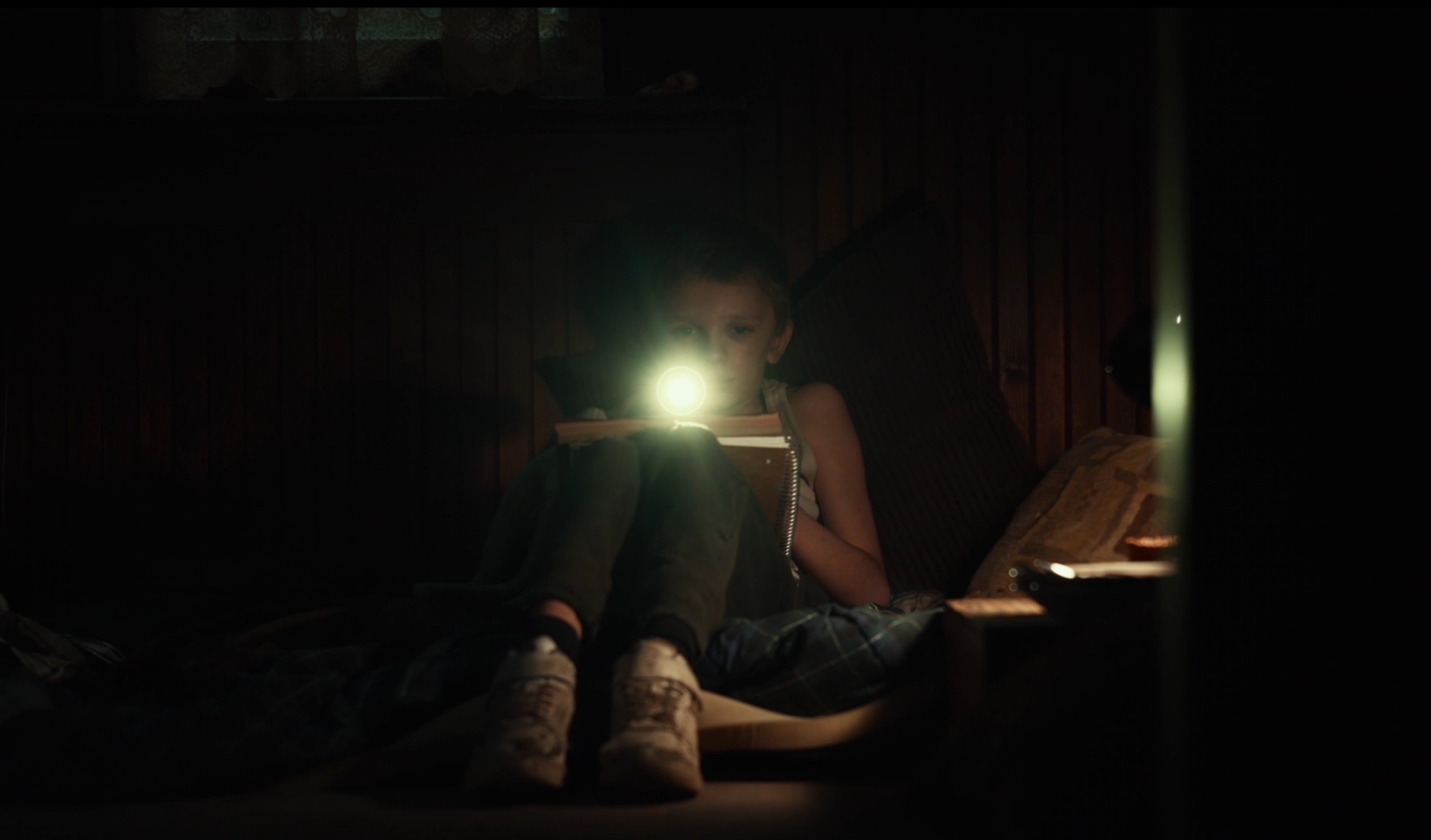
This is kind of Roald Dahl dark, only not for kids. Three eras of Brit-folks involved in/trapped in “The House,” animated in felt and wool, cotton and paper and whatnot, stop-motion.
Helena Bonham Carter, Matthew Goode, Miranda Richardson and Marcos Cocker are among those providing the voices in this parable of home ownership.
Review to come in the wee hours. Weird and kind of wild, and grimly funny. Especially if you’re a homeowner.
“I’m Not in Love” is a forlorn, lovelorn and woebegone romantic comedy has little interest in going for laughs, which isn’t necessarily a bad thing. Here, there’s just not enough heart or story to make up the shortfall that the viewer feels, first scene to last.
The director and writers of 2006’s “Someone Else” return to the basic plot of that rom-com — a commitment-phobic guy has his moment of truth — and have no better luck this time round.
Al Weaver of Brit TV’s “Grantchester” and “Press” stars as Rob, a lad with lifelong issues with women, which we’re meant to gather was caused when his Dad left him when he ditched his “unstable” Mum.
“I don’t WANT to stay with Mum.”
“No one does.”
Thirty years later, Rob is three years into a live-in relationship with Marta (Cristina Catalina), unwilling or unable to commit, even though we can see that they have little in common.
She prays before going to sleep. He’s an atheist. She’s 38 and ready for marriage, or at least a baby. He’s not.
“Maybe you’re just a nicer person than me,” London nutritionist Rob speculates.
“That’s what my friends tell me.”
She has her no-nonsense bestie Lena (Sinead Matthews), he has his “mates” — married Tony (John Henshaw) and Sunil (Sunil Patel), neither all that happy, and carefree womanizer Chris (Morgan Watkins). None of them are all that much help, with Chris and Lena filling the bill of “toxic to the relationship” sounding boards.
With Rob mooning over one who got away, and others who Chris tries to set him up with, or much younger women who throw themselves at him, this looks like “hard times for lovers,” as the old song goes.
Co-writers Radha Chakraborty and Col Spector (he also directed it) seem as undecided about Rob as he is about settling down. Is he fundamentally decent, a heel or just “damaged?” Meeting his mother (Tessa Peake-Jones), we’re expected to lean towards the latter. I mean, he’s almost 40 and his self-involved mother refuses to remember or accept his lifelong nut allergy, to the point where she’s literally and thoughtlessly shoving a forkful of Waldorf Salad in his face.
Marta comes off as passive until it’s almost too late for her to speak up for herself.
And chinless, stubble-bearded, wimpy and indecisive Rob having women all but lining up for him is a British twist on the male wish-fulfillment fantasy that has to be seen to be disbelieved.
As undecided as the filmmakers are, Weaver doesn’t do enough to tip the scales towards “Let’s root for this bloke.”
So we’ve left with an indecisive movie about an indecisive leading man, a movie I’ll spare you from by saying decide to skip it. Kind of wish I had.
Rating: unrated, some profanity, sexual situations
Cast: Al Weaver, Cristina Catalina, Morgan Watkins, Tessa Peake-Jones, Sinead Matthews
Credits: Directed by Col Spector, scripted by Radha Chakraborty and Col Spector. A Gravitas Ventures release.
Dark, twisted and a tad bizarre, the film adaptation of the French farce “Dear Mother” goes places no Hollywood production would dare.
Any movie whose entire later acts concern the efforts of her self-absorbed son, his wife and his veterinarian best friend to get a snapshot of that son’s 80 year-old mother’s vagina is going to be “out there,” and Laurent Lafitte‘s film is that.
This Around the World With Netflix production, the directing debut of star Lafitte (“Elle,” “Tell No One”), whom the credits make sure to remind us is a member of the legendary “Comedie francaise,” may be uneven and a little sluggish out of the gate, with some of the silly simply not translating or not coming across. But you will laugh, if only occasionally. There’s no denying that.
Lafitte plays Jean-Louis, an attorney in a brittle, “Do you still love me?” marriage with Valerie (KarinViard) that leaves him unsatisfied and lost.
No, that transvestite hooker in the park who he bumps into, says “I don’t think that’s my…style” (in French with English subtitles) is no help.
Then something happens at the gym, on the exercise treadmill. He’s not seeing his pulse register there. His pal Michel (Vincent Macaigne), a veterinarian, wants to rush him to the hospital — after stumbling through his animal medical bag for something that will let him hear his friend’s heartbeat.
“You heart isn’t beatiing.”
“Is it SERIOUS?”
“It’s…worrying.”
But Valerie, noting that her husband is ambulatory, thinks a visit to her “holistic guru and life coach,” Margaux (Nicole Garcia) is in order. Margaux SEES things, senses them.
“You life is in a python’s belly,” she says, getting to the “heart” of the matter. “How can the python throw you up?”
He’s got mommy issues, she figures. And to get his heart to beat again, he’s got to resolve those…and fetch Margaux a photo of Mom’s genitals. That entails a lot of kvetching, a lot of lies, trickery and begging. First and foremost, though, Jean-Louis has to visit the seemingly sweet little old lady (Hélène Vincent) he hasn’t seen or even talked to on the phone for four years.
Working from a script adapted by actor/playwright Sébastien Thiery from his own play, Lafitte swings and misses at more laughs than he should, considering the whole “Comedie francaise” connection. Jean-Louis keeps referring to his unhappy life as “a farce.” But farce’s are quick, and “Dear Mother” is not.
The set-ups for big laughs are laboriously spoiled by the slack pacing. But as the lies pile up and the veterinarian’s efforts to “just get a smear” from Brigitte, and she doesn’t fall for the “Neighbor’s Day” stunt (everybody walks around nude, hoping Mom will join on), well, we didn’t bring that Polaroid for nothing.
“I’ve always loved you, Brigitte.”
The unexpected laughs are what worked for me, though perhaps others will find more mirth in the droll, deadpan and not-quite-kinky set-ups — the dream sequences in which Jean-Louis imagines himself reeling in his mother by their shared umbilical cord, for instance.
Comedy is the most subjective genre, and to each her or his own. “Dear Mother” didn’t quite get there for me. But if you give it a try, you must stick with it through the credits. Polaroid snaps take a full minute to develop, remember?
Rating: TV-MA, sex, full frontal nudity, etc.
Cast: Laurent Lafitte, Karin Viard, Vincent Macaigne, Hélène Vincent and Nicole Garcia
Credits: Directed by Laurent Lafitte, scripted by Sébastien Thiery, based on his play. A StudioCanal film on Netflix.
You can see some of the themes and interests of future Oscar-nominated writer-director (“Minari”) Lee Isaac Chung in his debut feature, a quiet immersion in the open wound that is post-genocide Rwanda.
A film festival darling of 2007, “Munyurangabo” takes us on an understated but fraught journey, a young Tutsi man’s quest for revenge on the Hutu who murdered his father. Along the way, he finds himself ensnared in the touch-and-go “embrace” of his best friend’s Hutu family, which can’t set aside its prejudices, testing the friendship on this already tense quest.
Munyurangabo (Jeff Rutagengwa), who mercifully goes by “Ngabo,” is a tall, thin street vendor-hustler in Kigali, sharing the work and the profits of their sales with his pal Sangwa (Eric Ndorunkundiye).
One day, Ngabo swipes a machete from a stall in the street market where they work. It’s a totem of obvious power for this haunted young man, and that isn’t lost on us either. This cheap (Chinese) import was the weapon of choice in the 1994 blood-letting Hutu nationalists unleashed on the Tsutsi minority, with some 800,000 people murdered.
One of those killed in that way was Ngabo’s father. Without a lot of overt discussion, he decides he now has his mission. He’s going back to where his father was killed and avenge himself on the man he knows killed him.
Sangwa goes along, and as he’s the one who takes most of the money and gets the backpack they’ll need for the journey, he’s key to Ngabo’s plans.
But first, they’ll hitchhike to Sangwa’s village. He left his family three years before. When they get there, we see why. His mother (Narcicia Nyirabucyeye) welcomes their prodigal son with open arms, hand-feeding him as if the teen was still a small child. But Sangwa’s father (Eric Ndorunkundiye) isn’t so welcoming. He shames the boy for leaving.
“And who is this you’ve brought with you,” he wants to know (in Kinyarwanda with English subtitles)?
Dad warily eyes the “sad-looking” Ngabo, eventually questioning him. Mom declines to share the family meals with him. Their son’s friend doesn’t put much effort into helping hoe the family’s fields, and when he’s confronted, we see him nervously fondling the machete handle.
As a short visit stretches to days, Ngabo and the father keep us on edge, and Ngabo’s impatience with his sentimental, homesick friend grows so much that he says the quiet part out loud.
“Did you forget we’re on our way to kill a man??”
Chung, working with Rwandan film students, lets us see early glimpses of what would become his style — long stretches when images alone, and subtle performances, do all the storytelling for him.
There’s a jarring long poem recited by a man (Edouard B. Uwayo) who sizes Ngabo up and seems to guess his quest, a poem that sums up Rwanda’s horror and shame in explicit ways the film generally avoids.
Chung goes to such effort to avoid melodrama — predictable, artificial or over-the-top confrontations — that “Munyurangabo” never alters its sedate, almost somnambular pacing. That’s a gripe I had with “Minari” as well, even though the Oscar-nominated drama has many more incidents and more standard issue dramatic moments.
But this debut feature shows the promise that “Minari” realized and is certainly worth checking out. Just as we’ve seen precious few movies about the Korean immigrant experience in rural America, there haven’t been many movies at all about the reconciled and unreconciled people and strife of Rwanda.
Rating: unrated, violence
Cast: Jeff Rutagengwa, Eric Ndorunkundiye, Jean Marie Vianney Nkurikiyinka, Narcicia Nyirabucyeye and Edouard B. Uwayo
Credits: Directed by Lee Isaac Chung, scripted by Samuel Anderson and Lee Isaac Chung. A Film Movement release.
The Brazilian lockdown drama “The Pink Cloud” can pretty much be reduced to the simplest mathematics of all.
How much credit do you give this film, finished in 2019, for “anticipating” the pandemic and what life under a long lockdown might be like? A bit? A lot? Now subtract how much of a bummer it would be to relive that via a science fiction relationship story.
Writer-director Iuli Gerbase’s debut feature beat “Locked Down,” “The End of Us” and other actual pandemic-inspired movies to the punch simply because she thought of what that sort of life would be like before it actually happened. There are things she anticipates that are right on the money, and elements of that life that don’t match the reality of what most of the world went through.
And she doesn’t fret about how, if no one can go outside without near-instant death, the electricity and water will stay on, food will be grown and harvested and who exactly installs the “tubes” that shove boxes of food right through your window. Nor does she dwell on how one puts that tube through your window without the deadly “pink cloud” getting inside.
Drones? OK. Kudos for all that.
But as the depression of confinement that goes from months to years sets in on screen, the viewer might rightly wonder if sitting through this no-longer-a-fantasy is good for one’s mental health.
A mysterious “pink cloud” appears in the sky. Civil defense sirens wail, and Giovana (Renata de Lélis) and Yago (Eduardo Mendonça) interrupt those post-coital bliss to rush inside and “close all windows.” She thought “It must be a joke,” but now they know better.
She’s in her mother’s house with a guy she “just met,” a chiropractor, just two attractive thirtysomethings with a little food and a lot of time on their hands.
But her tweenage sister (Helena Becker) is stuck in the home of where she was having a playdate with friends. His very elderly Dad (Girley Paes) is trapped with his day shift caregiver. And Giovana’s schoolteacher friend Sara (Kaya Rodrigues) is all alone. Facetime is no substitute for human contact.
Relatively speaking, our new “couple” are pretty well off. But as the days drag on into weeks and “I hope this goes away soon” becomes a forgotten dream, she sees a neighbor scrawl “The Cloud Won’t Kill Me” on his window, before jumping out of it, and the “couple” go from playing house to getting to know each other.
“If we stay locked in here for years, will we want children?” (in Portuguese with English subtitles).
“Do you want to raise a CHILD locked in here?”
They push each other’s buttons, take on role-playing games, do anything they can think of to relieve the boredom and keep things “fresh.” And they’re no damned good at it.
Gerbase conjures up a humorless, dystopian take on a dystopia most of us lived through. The depression is predictable and palpable, and yeah we recognize it. But the actors can only do so much to make it intriguing, sexy or biting enough to want to revisit it.
At some stage the points Gerbase earns for prescience run up against the monotony, the need to pick a fight just to juice up the one-on-one drama. And then there’s the heart-sinking peek at “What this might have looked like had a total lockdown lasted years?”
The sci-fi crucible that runs our couple through the life-cycle of a relationship in which the participants have to admit, “No relationship is like this,” becomes a grind — tedious and testing in its own way. The movie runs out of points to make long before a conclusion we easily anticipate arrives.
And without arriving at anything profound, we’re back to that original equation. We’ve done this. Who wants to spend another 104 minutes reliving it?
Rating: R for sexual content/nudity, some language and brief drug use
Cast: Renata de Lélis, Eduardo Mendonça, Helena Becker, Girley Paes and Kaya Rodrigues
Credits: Scripted and directed by Iuli Gerbase. a Blue Fox release.
Sentimental and sympathetically-acted, actor-director Chiwetel Ejiofor’s “The Boy Who Harnessed the Wind” immerses us in Third World subsistence farming and the struggle just to have enough to eat in poor, corrupt countries in the developing world.
This Around the World with Netflix film, based on a true story, takes us to rural Malawi in Africa and introduces us to customs, rituals and the difficulties of life that is lived, harvest to harvest.
But when you title your film “Boy Who Harnessed the Wind,” you’re giving away the climax, unless you realize that you cannot make that your climax. Ejiofor’s movie teases and never lets us forget exactly where it’s heading. And it uses an almost unforgivable amount of its running time taking us where we know it is going.
William (Maxwell Simba) is a young teen growing up in Wimbe, a village where the corn is grown by hand and survival is measured in the baskets of dried maize you have in your larder. His father Trywell (Ejiofor, of “Twelve Years a Slave”) works the land he bought with his brother. But as the film opens, that brother dies. Trywell’s control over how the land is cultivated and guarded against flooding is in jeopardy.
Still, he’s got a couple of bright kids. Older daughter Annie (Lily Banda of TV’s “Deep State”) is waiting to get into college. Their mother (Aïssa Maïga of the French films “Paris J’taime” and “Cache”) insists on it. William is on a similar track. It’s just that their local school isn’t free, and Dad’s “after the harvest” isn’t going to cover tuition that’s due now.
Ejiofor teases “the solution” to their problems before all those problems — government corruption and indifference, drought and flood cycles, lumber exploitation, a romance tugging Annie off her path — are laid out in exacting and somewhat laborious detail.
William is the in-demand tinkerer in Wimbe. Everybody brings their radios to him to fix. And as he rummages through a nearby junkyard, we see the wheels turning in his head as he picks up this old battery or that half-broken water pump. Someday he’s going to discover the word “dynamo,” but we can already see the lightbulb flickering on and off over his head.
Ejiofor milks the cascading crises piling up on this family for all they’re worth. When Trywell looks at his boy and informs him “No one is coming to help us, you have to be a man, now” (in English and Chichewa with English subtitles), we can see William straining at the bit, dying to try out his big idea on his old man.
That spoiler-title and long, teasing storytelling style hamper the film, making “Boy Who Harnessed the Wind” a classic 90 minute movie hidden 113 minute one, and the story arc a classic wait-too-late-to-get-to-the-point melodrama. The “Eureka” moment should have come earlier, perhaps written into a race against the clock to make things work before people starve, or an exploration of how life was forever changed by this Big New Thing.
The “Boy” here has the reins, has the wind and starts to piece together what he’ll need for his harness. Ejiofor needed to let him have it and find more of a movie out of what came afterwards.
Rating: TV-PG, violence
Cast: Chiwetel Ejiofor, Maxwell Simba, Aïssa Maïga and Lily Banda
Credits: Scripted and directed by Chiwetel Ejiofor, based on the book by William Kamkwamba and Bryan Mealer. A Netflix release.
A pasty-faced, red ball-capped, pickup truck-driving Tennessean dumps a truckload of red rubber balls into a river, drives down the road, removes a sniper rifle with a Confederate flag sticker on it, and pops those calls from a great distance as target practice.
When next we see him, he’s in prison, his public defender is trying to get something — ANYthing — out of him. The FBI doesn’t even know his name, because “Amos Otis” wasn’t just the name of a 1970s pro baseball player, it’s the name of the owner of the pickup, an African American man who died some days before.
“Who is Amos Otis?” is a long-winded and dull Jeremiad about assassination, its motivations and the historic implications of killing a “divisive” and “destructive” American president who was destined to end American democracy, but didn’t.
Yes, writer-director Greg Newberry has concocted a stumbling, monotonous “What if somebody killed Trump?” parable.
The inmate (Josh Katawick) asks his attorney (Rico Reid) even asks his attorney for one thing — “an orange.” A Nazi/racist gun nut sold the guy the rifle, he’s taken a beating in jail, and bomb threats delay his trial.
Once the witness is brought to trial, as the country descends into call-out-the-National-Guard unrest, with many “dancing in the streets” at the murder, and supporters of the dead president rioting in fury, “Amos Otis” takes a turn into “The Twilight Zone.”
A prosecutor frets that “All he needs is one ‘X-Files’ fan.” Perhaps a few “flux capacitor/Marty McFly” cracks will upend the man’s arguments before the jury. The defendant blurting out events set to occur in a few days can be “stricken from the record,” but might they make his “Terminator” case?
There’s a deeply unsettling premise and historical argument at the heart of “Who is Amos Otis?” Mainstream from as “The Assassination Bureau” to “The King’s Man,” a famous Martin Landau episode of “The Twilight Zone,” even a Stephen Sondheim musical have dabbled with the assassin’s hope to alter history, for better or worse, with a bomb, poison or a gun.
How would America’s future differ if this or that key figure today died? More to the point, if “The Catcher in the Rye” can inspire murders, how dangerous is it for a movie — even one with a science fiction premise, to consider assassination as a societal, historical and global force for change?
Sondheim’s “Assassins” wasn’t revived on Broadway until after Donald Trump left office. Kathy Griffin wrecked her career by holding up a fake bloody Trump head on camera. I once stopped a newspaper where I worked from running a photo of the then-president with a sniper’s bullseye superimposed over it — for a book review. You have to be seriously tone deaf or cloistered to not realize the mere suggestion of that is dangerous, could earn you a visit from the Secret Service, and is not helpful.
Putting a smug and twisted “Thank you for your service” in here is more suited to an “own the wingnuts on Twitter” post than a serious movie.
Science fiction and “alternate history” have engaged in this moral, ethical and “butterfly effect” discussion before, but never with a guy wearing a red “America Strong Forever” cap, and never with the veiled subject of this thought exercise still storming about, holding fascist rallies as his political backers prep for a possible coup while an attorney general dithers away the urgent need to prosecute him.
If any of this played into Gravitas Ventures’ decision to distribute “Amos Otis,” then good for them for at least having the debate. But the best argument for releasing “Who is Amos Otis?” might be the end product itself. Tedious courtroom scenes, flat acting, sermonizing speeches, under-explained “explanations” of the technology needed — nobody is likely to stick with this to the end.
The planetary reboot of the pandemic — thanks, anti-vaxxers/anti-maskers/morons — means that most major movie releases have been yanked off the schedule of what is already a traditionally slow month at the box office.
“The 355” and “Scream” and “Old Guys Get Kicked in the Crotch” (“Jackass”) are about the only wide opening films to come our way this month.
As expected, the mediocre women-in-action thriller “The 355” opened with a fizzle. $4.8 million isn’t all that.
That just edged “The King’s Man,” which opened Christmas and isn’t doing all that well, either. It’s earned $74 million worldwide, another $3.27 million of that coming this weekend.
“The Matrix” remains a corpse, rotting through another $1.86 million. It did better overseas, about $35 million in north America, another $90 abroad. It lost about a third of its screens.
On the upside, “Sing 2” pulled in another $11-12 million. That pushes it over $100 million. It will pass “Encanto” by month’s end. Disney’s latest has lost most of its screens and peaked out just over $112 domestically.
“American Underdog” cleared $2.41 million this weekend. It will probably finish its run at month’s end with about $26 million. Not awful, but not all that.
“West Side Story” did about $1.4 million.
“Ghostbusters: Afterlife” added another $1.14.
“Licorice Pizza” earned just over $1 million, and is losing screens. One thing that helps underperformers like it is the fact that major releases have pulled out of January. It’ll stick around, even in its weakened state, until Oscar nominations are announced.
That goes for “Licorice,” “C’mon, C’mon,” “West Side Story” and “House of Gucci,” which eeked over the $50 million mark at long last this weekend.
Figures are coming through via Exhibitor Relations and Box Office Pro.
The winner of the weekend, of course? “Spider-Man: No Way Home” pulled in another $33 million and change. I tellya, that Willem Dafoe/Alfred Molina fanbase will not be denied.
A mystery torn from the pages of Scandinavian history, “Margrete: Queen of the North” becomes a taut and tense tale in the hands of Danish director Charlotte Sieling.
The filmmaker takes us back to an age when the mechanical clock had just been invented and serves up a classic “ticking clock” thriller of Byzantine intrigues, schemes and power-grabs in the early days of the Kalmar Union. “Margrete,” a “fiction inspired by real events,” is a history lesson wrapped in a damned entertaining movie.
For a stretch during the 14th through the early 16th centuries, the ever-warring Nordic states of Norway, Denmark and Sweden were ruled as one, largely thanks to the machinations and diplomatic wheeling and dealing of Queen Margrete.”Margrete” shows the lengths that queen was willing to go to in order to preserve her peaceful “perfect” union.
We meet Margrete (Queen Margaret I ) of Denmark on a battlefield, a child who watches her father King Valdemar wash the blood off his hands and off the signet ring that symbolizes his power. She grabs it for safe keeping. Even then, she had her eyes on a prize.
Over 40 years later, Margrete, “the greatest and most pious regent The North has ever known,” is in her glory. Trine Dyrholm plays the ruler and matriarch with a wily and self-satisfied but high-minded air, a woman who stands among the nobles of three nations at court and persuades them that this union has kept the peace, but that they all need to pitch in for an “army so strong the Germans will never dare attack us (in Danish).”
The “Teutonic Order” of Prussia has designs on their territories, the self-same invaders who worried Russia’s Ivan the Terrible a century later.
Margrete and her version of England’s various archbishop “chief ministers,” the ever-scheming head of the church, Peder (Søren Malling) who helped her see her dreams of “peace” and “prosperity” through unity come true. Her only son died some years before, but she adopted her great nephew Erik (Morten HeeAndersen) and as regent rules this new alliance with Erik as King.
Her answer to the Teutonic threat? Marry Erik to an English princess and form an alliance with England. The film’s creepiest scene introduces us to this little girl, Philippa, reciting her greetings at court to her much-older intended, in French. Paul Blackthorne brings an arched-eyebrow cunning to William Bourcier, the English crown’s negotiator on her behalf.
But just as these plans are set to fall into place, the Norwegian third of the alliance brings in a man claiming to be her son, the “dead” Olaf (Jakob Oftebro), with the Norwegians backing his claim to the throne over Erik.
Margrete and we in the audience smell a rat. As it was rumored she’d had the boy killed 15 years before, how could this be? If that was true, will she have to admit her guilt? If not, will she “recognize her own child,” if indeed this could be her long lost son?
Dyrholm lets us see the wheels turning as she tries to buy time, to keep a lid on all of this, and to figure out who is behind this sudden and sure-to-be-divisive appearance.
She’ll need a trusted noble (Simon J. Berger) and her favorite pirate named Roar (Linus James Nilsson), and maybe the aid of a hostage she rescued from the pirate’s clutches, Astrid (Agnes Westerlund Rase) whom she’s made a lady in waiting.
Can they uncover what’s really happening, reveal any plot and plotters that may be involved before the union breaks into factions and the whole enterprise dissolves, inviting foreign invasion?
Sieling, who directed the Danish drama “The Man,” as well as episodes of “Homeland” and ironically, “Queen of the South” in Hollywood, keeps the “public trial” of the would-be heir quiet and suspenseful and the behind-the-scenes scheming calm, deliberate and believable.
No one wants to be labeled a “tyrant” in this union. They’re all very concerned with appearances. Margrete keeps her own counsel, weighing and wondering, questioning and maneuvering. But Peder’s right when he says (the film is in Danish, Swedish, German, Norwegian and English) “His presence alone stirs chaos.”
The acting demonstrates a desire for self-control amongst the veteran statesman and woman, with all the fireworks coming from the newly-threatened king and the life-on-the-line man on trial, the would-be king.
Screen veteran Dyrholm (“A Royal Affair,” “In a Better World”) gives Margrete human layers beneath all that stoic statecraft. Dyrholm’s performanace maintains the story’s mystery, as if she herself is only warily asking questions she may not want the answers to.
And Sieling, who co-wrote the script, turns the third act into a nerve-wracking hunt for spies and treachery in an alliance that’s unraveling almost too fast for the “truth” to set anybody free, or send the villains to the gallows.
It all makes for a more riveting “what might have happened” mystery, a history lesson with a caveat and a damned entertaining one at that.
Rating: unrated, violence and nudity
Cast: Trine Dyrholm, Søren Malling, Morten Hee Andersen, Agnes Westerlund Rase, Jakob Oftebro, Simon J. Berger and Linus James Nilsson
Credits: Directed by Charlotte Sieling, scripted by Jesper Fink, Maya Ilsøe and Charlotte Sieling. A Samuel Goldwyn release.