Movie Review: Tim Roth wanders and drinks towards “Sundown” on Mexico’s Costa Grande

Few movies have ever made as an abrupt a turn as Mexican filmmaker Michel Franco’s “Sundown,” a downbeat melodrama about dissipation, its causes and its consequences.

It features a performance of perfectly poker-faced ennui by Tim Roth, a desperate breakdown and meltdown from Charlotte Gainsbourg and a sobering portrait of the seemingly sleepy but dangerous Mexico beyond the gates of its fortified resorts.

And when it flips, from a Tennessee Williams sojourn, getting lost in booze and languor in a foreign clime into something more climactic, it will make your head spin.

A family is vacationing at a posh Mexican resort. Alice (Gainsbourg) and the drinking-age kids (Albertine Kotting McMillan, Samuel Bottomley) are trying to settle into the siesta atmosphere of Aculpoco.

Neil (Roth) is way ahead of them. He seems lost in his own thoughts, adrift and bored and patiently waiting on that next hand-delivered Dos Equis or marguerita. The one “active” thing he does is notice 20ish Colin’s (Bottomley) budding alcohol problem.

A call makes Alice violate her “no cell phones/no work” policy. “START PACKING.”

Her mother’s going to the hospital and they have to fly home to Britain. They don’t even make it to the airport before the second call comes in.

And they don’t all get on the plane together because Neil, whom she thanked for coming, lost his passport. Weeping and yelling Alice & Co. board. Neil promises to locate his passport or procure a new one and get home ASAP.

But he doesn’t ask to go back to their hotel. “Hotel” is all he tells the driver, and thus he’s deposited at a waterfront dive. “Call me you need anything” is the driver’s broken-English offer to help with “chicas” or what not. That won’t be the last come-on, sales pitch or arm-twist the non-Spanish speaking Neil will face in the coming days.

His blank-faced response is both passive and dismissive. He’s not hearing you, or not listening. He’s got his head in the shade, his feet in the surf and another Dos Equis working. He’s not talking, not even to Alice, whose incessant calls and then “ding ding ding” text messages when he doesn’t answer speak to her frantic state.

“I need your help with the decisions.

More empty promises of “”I’ll do my best,” more Dos Equis.

Whatever’s going on, Neil won’t engage in it. Whoever among the locals — who can seem predatory, even the fetching bodega owner Berenice (Iazua Larios) who comes on to him — has him “marked,” he’s not concerned.

Even when events go sideways, Neil reacts with a Zen, or zoned-out calm.

Franco, who made “After Lucia” and “Chronic,” does two things to wrong-foot the viewer, little “revelations” I won’t give away. Suffice it to say that the relationships between one and all and the delayed hints at what might drive Neil’s passive response to everything around him and all that happens have rich payoffs and contribute to the film’s sense of misdirection and surprise.

“Sundown” lulls you into thinking it’s one thing, taking on the perfect “Leaving Las Vegas” tone of a sad, solitary man who has checked out. And then it trips you up, even as its anti-hero never breaks his ambling, “whatever” stride.

Roth underplays Neil to the point where we read layers of meaning into his passivity. The actor never lets us see the man concerned or even wholly-engaged in whatever befalls him or those around him. “What is Neil’s game,” we wonder? “What’re his priorities?” Or “What is Neil’s tragic secret?”

Like the master big screen poker player than he is, Roth never ever shows his cards.

And Franco, managing the not-easy feat of making “Mexico away from the resorts” so languidly, liquidly attractive, and yet tragically dangerous, has delivered the first wholly original, instantly memorable movie of 2022.

Rating: R for sexual content, violence, language and some graphic nudity

Cast: Tim Roth, Charlotte Gainsbourg, Iazua Larios and Henry Goodman

Credits: Scripted and directed by Michel Franco. A Bleecker Street release.

Running time: 1:23

Posted in Reviews, previews, profiles and movie news | Comments Off on Movie Review: Tim Roth wanders and drinks towards “Sundown” on Mexico’s Costa Grande

Netflixable? Glossy Turkish “Love Tactics” recycles Hollywood rom-com tricks

A deep bow of respect to the folks who cooked up “Love Tactics ( Ask Taktikleri),” a shiny and somewhat modern Turkish romantic comedy that, via Netflix, might show the world how Turkey itself is somewhat modern and shiny. This is a great idea.

And who, outside of Turkey, has ever seen a Turkish rom-com?

The conceit here was to take a tale from Turkish literature, the romance of Asli and Kerem, and pile every Hollywood romance and rom-com cliche on top of it, just for love and laughs.

Have the characters, naturally a perfect match who are courting each other as a dare/to-prove-a-point (“How to Lose a Guy in Ten Days,” “Think Like a Man” etc), joke about the “cliches” of romance and romantic movies. And then have them fall for those cliches, because people (in the movies) always do.

We don’t just see tableside fiddle serenades. We get the full “Ghost” making pottery come-on, “The Ugly Truth” about getting a woman into a hot air balloon.

It’d be hysterical if two of the most gorgeous actors in Turkish TV and cinema, Demet Ozdemir, Sükrü Özyildiz, cracked jokes and pointed out where these ideas came from. Turkish audiences might be (or might not be) as familiar with the romances of Mathew McConaughey and Kate Hudson as the rest of us.

Alas, there aren’t nearly enough jokes to make the “comedy” part of the rom-com truth in advertising. The producers seem intent on getting the same message across as that jarring Super Bowl ad for Turkish Airlines. Turkey is “Westernized,” “secular,” sexy and fun. And if we shove the Turkish flag into the background of more scenes than one can count, maybe foreigners will buy in.

Turkish TV star Ozdemir is Asli, the man-wise/man-wary designer at a seriously sexy clothing company. She also writes a blog, in secret. It’s called “Love Tactics,” and that’s where she shares her “truisms” about men — online, and not just with the just-ghosted colleague who slept with a guy on the first date.

“Men rule the world, women rule men and hormones rule women,” she declares, because feminism hasn’t wholly taken root there. “A woman desires to be loved…A man desires comfort,” and is thus “always looking for the next conquest.”

So let’s play a game. She’ll lure some hapless guy into a trap to prove a point, and drive traffic to her blog.

Kerem (Özyildiz, a veteran of Turkish TV and film, little of it exported) is similarly sure of himself with the opposite sex. A cocky ad-man who wants that clothing firm’s account, he’s sure enough of his ability to not just “pick someone up,” but that he can “make her fall in love with me,” that he, too, will take a dare from his mates (in Turkish with subtitles, or dubbed).

Kemer and Asli plot their schemes, but then coincidences and misunderstandings, “jealousy” and what not complicates their “Never call him/her back right away” “tactics.”

The “cute” stuff never quite gets the job done and the jokes are too few to make an impact, even if the romance kind of clicks in that “They’re so gorgeous they belong together” way.

Looking at their credits, each actor’s been in rom-coms in Turkey before, so while the genre might be “New Girl” level new in that corner of the Islamic world, even Turkish viewers will have other films/shows to compare this to.

It’s not the least bit original, which is no cardinal sin. But without the laughs, “Love Tactics” plays like a travelogue with kissing. Turkey looks posh and affluent and inviting. It’s just that you can’t say the same about these two, and without that there’s no “rooting for them,” the one absolute must in any romantic comedy.

Rating: TV-MA, adult situations, alcohol, sexual discussions

Cast: Demet Ozdemir, Sükrü Özyildiz

Credits: Directed by Emre Kabakusak, scripted by Pelin Karamehmetoglu. A Netflix release.

Running time: 1:38

Posted in Reviews, previews, profiles and movie news | 1 Comment

Ivan Reitman: 1946-2022

Ivan Reitman didn’t direct a lot of films, just 20 features over a career that spanned over 40 years.

But his imprint on screen comedy was enormous, launching actors to stardom and fellow filmmakers who followed in his irreverent, sweet and distinctly Canadian sensibilities style to reshape the way we looked at the big screen and laughed in his heyday.

Ivan, directly of “Ghostbusters” and “Dave,” father of Jason and producer of “Up in the Air,” died over the weekend. He was 75.

“Meatballs” was the movie that really announced him to the world, a fact sort of lost in the way he made this goofy, sexist, post hippy and definite summer camp comedy the perfect vehicle to launch Bill Murray’s stardom.

He tried making more sophisticated movies here and there, but dopey comedies we’re his specialty — Arnold Schwarzenegger and Danny DeVito as “Twins,”

I think “Dave” was his best film, with the ensemble farce “Ghostbusters” easily the most popular and most durable. He loved long enough to see his son Jason make an inferior, mostly humorless “Requel.”

It’s east to look over that filmography and see a lot of big name cast/high concept crap in there, with most of his finished features earning poor reviews, and for good reasons.

But I dare say most of us have a soft spot for his work, for the punchlines, the pre-meme “memes” he added to the culture.

And there’s a lot to be said for his brand of juvenilia, the dopey Peter Pans who never grew up (Murray, mostly) and the silliness of the situations he created.

Jason Reitman made “Juno” and “Up in the Air” before losing his mojo. Harold Ramis out Reitmanned Reitman with “Groundhog Day.” But neither of them, or the legions like them, could have had success without the groundwork Ivan laid in the ’80s, the stars he created or got funny work from.

Posted in Reviews, previews, profiles and movie news | Comments Off on Ivan Reitman: 1946-2022

Movie Review: A Lonely Woman is Granted her one wish — Love — “Abigail Harm”

After last year’s Oscars announced the “arrival” of director Lee Isaac Chung, those clever celluloid archivists at Film Movement rounded up the Korean-American filmmaker’s earlier works and released them as DVDs and on Film Movement+.

Seeing “Munyurangabo,” “Abigail Harm” and “Lucky Life” could give away the style, tropes and ensemble that Chung would call on for “Minari,” his most personal film, a drama about family, culture shock and the Korean-American immigrant experience in rural Wisconsin.

“Abigail Harm,” a modern day fairytale of romance, love and loneliness in an empty/not-entirely-empty New York, features future “Minari” co-star Will Patton as a wounded stranger who grants a lonely woman who reads to the blind (Amanda Plummer) a wish for saving him from pursuers. Patton also narrates the film in self-consciously arty voice over.

“It is when she is face to face with someone that she feels most alone.”

“Self-consciously arty” applies to the film as well. It’s a somber, downbeat and slow meditation on love and loneliness, and one can see the patient storytelling style that has become Chung’s trademark on this 2012 release.

We meet Abigail as she goes about her routine, making visits to blind clients, reading from books and newspapers and sorting through their mail, if they so desire.

The picture’s tone is set in its abrupt but quiet open. Abigail reads aloud a long passage from “Alice in Wonderland.”

Burt Young plays a tetchier “new client” who insults her voices and barks/pleads, “Left to right, OK? Left to right” about how he wants to experience his daily newspaper.

Abigail is also fielding calls from the nursing home where her father is “always going in and out.” She won’t be browbeaten into another “emergency” visit.

“It has nothing to do with how much I love him or don’t love him.”

She walks through the seemingly empty city, wandering abandoned apartment buildings or along disused piers. Abigail “spends her days never being seen by anyone,” our narrator admits, a play on the fact that there is no one in the streets, and her clients can’t see.

And then the narrator shows himself. He’s got a gash in his gut, he’s manic and somewhat panicked. And he pleads “Please, hide me!”

When she does, and when the danger has passed, this disheveled stranger prattles on and on about this and that in rushed stream of consciousness whisper. He wants to repay her, and cash won’t do.

“Have you ever been in love? I can arrange it.”

And that’s how, on one of her daily rambles, she stumbles across the naked, silent young Japanese man (Tetsuo Kuramochi). Abigail drapes a wrap over him, takes him home and proceeds to feed him and talk to this silent stranger, beaming all the while.

What Chung and co-writer Samuel Gray Anderson give us is a truncated relationship, the highs, lows and abrupt breaks and make-ups of a love affair, much of it with only one character talking.

It’s freighted with slender, sometimes obvious metaphors, and whispered about via narration.

“Abigail Harm” is somewhat pretentious and entirely too slow and self-conscious to be of more than passing interest to a casual film fan. And even the cognoscenti might find the labor to plumb its meaning spoils any joy that could spin out of another Amanda Plummer eccentric.

Of the three features Chung made leading up to “Minari,” this is by far the dullest. Munyurangabo” was a fascinating and ambitious debut, but the films — years apart — that followed were internalized bores, lacking incident or much in the way of dramatic tension or novelty — “film festival movies” that could only exist in the rarified air of film fanatic gatherings.

Perhaps that’s why film festival goers were so bowled over by “Minari,” as it has far more incident, drama and pathos than his earlier films. It’s Chung’s great leap forward. Watch “Abigail Harm” only if you want to see how far he had to leap.

Rating: unrated, nudity, sex

Cast: Amanda Plummer, Tetsuo Kuramochi, Burt Young and Will Patton.

Credits: Directed by Lee Isaac Chung, scripted by Samuel Gray Anderson and Lee Isaac Chung. A Film Movement release.

Running time: 1:20

Posted in Reviews, previews, profiles and movie news | Comments Off on Movie Review: A Lonely Woman is Granted her one wish — Love — “Abigail Harm”

Movie Preview: Life force Keke Palmer joins Jordan Peele’s Creepoverse for “Nope”

Here’s the TV commercial for this summer release.

Yup, “Nope” looks cryptic and creepy and big and outdoorsy. Daniel Kaluuya costars, with Steven Yuen and Donna Mills and horror mainstay Michael Wincott.

Love that Keke.

Posted in Reviews, previews, profiles and movie news | Comments Off on Movie Preview: Life force Keke Palmer joins Jordan Peele’s Creepoverse for “Nope”

Netflixable? Can lightning strike twice for “Tall Girl 2?”

Well, at least they kept “the cute.” Some of it, anyway.

The sequel to the glib and engaging “Tall Girl,” telling of the trials and tribulations of a towering beauty at her Louisiana high school settled on a theme — self-doubt — and added a few cast members.

But “Tall Girl 2” never manages to surprise as it skips semi-merrily down the same primrose path as its predecessor.

Jodi (Ava Michelle) is still tall, still a bit awkward and clumsy. But those traits only come out as she’s rehearsing for the spring musical. She’s landed the lead in “Bye Bye, Birdie.” She high fives her way down the hallway every day. Insecure kids come to her for advice.

And a lot of people are still talking about her big Homecoming Dance speech.

She’s still with Dunk (Griffin Gluck), still mad at Swedish exchange-hunky/dorky Stieg (Luke Eisner), still pals with aspiring designer Fareeda (Anjelika Washington), still in a heated rivalry with mean girl Kimmy (Clara Wilsey), still getting self-absorbed advice from her shorter beauty-pageant contestant older sister (Sabrina Carpenter).

“Harper! This is not ABOUT you!” “I always forget that.”

We know pretty much everything that’s coming here, from anxiety attacks over her big role on the stage, more rivalry from back-stabbing Kimmy, a contrived break-up with Dunk, a possible new love interest. Only now that’s this voice in her head sewing one doubt after the other about her self-worth, her acting, her place in life, the works.

Oh that’s nothing, says Harper. Everybody has that.

“It’s just a horrible part of life that never goes away…like Maroon Five.”

That’s pretty much what we come back for, why sequels are cinematic comfort food. We know what we’re getting, and we like the clever quips, the funny-cute parents (Angelina Kinsey from “The Office,” and Steve Zahn).

Maybe some viewers check into this movie for affirmation, and in what almost passes for an edgy scene, the drama teacher/director of the play challenges Jodi’s victimhood.

“Being tall’s not a real problem!” Lady, didn’t you see the first film?

We did. And “The Kissing Booth” movies and other teen rom-coms that Netflix has all but cornered the market on. Thus, the lack of any real surprises. What’s worse, even the “mean” characters have their edges rubbed off.

I’m pretty sure they dubbed Michelle’s singing voice (few of us can sing well enough to carry a movie about doing a high school musical).

As in the first film, Carpenter, Kinsey, Wilsey and Zahn carry it. The leads are OK, but kind of weak, and their relationship is some sort of short male wish fulfilment fantasy.

About the best one can say about “TG2” is that in addition to never surprising and never moving us emotionally, it never offends.

Rating: TV-PG

Cast: Ava Michelle, Griffin Gluck, Anjelika Washington, Sabrina Carpenter, Luke Eisner, Clara Wilsey, Angelina Kinsey and Steve Zahn.

Credits: Directed by Emily Ting, scripted by Sam Wolfson. A Netflix release.

Running time: 1:44

Posted in Reviews, previews, profiles and movie news | Comments Off on Netflixable? Can lightning strike twice for “Tall Girl 2?”

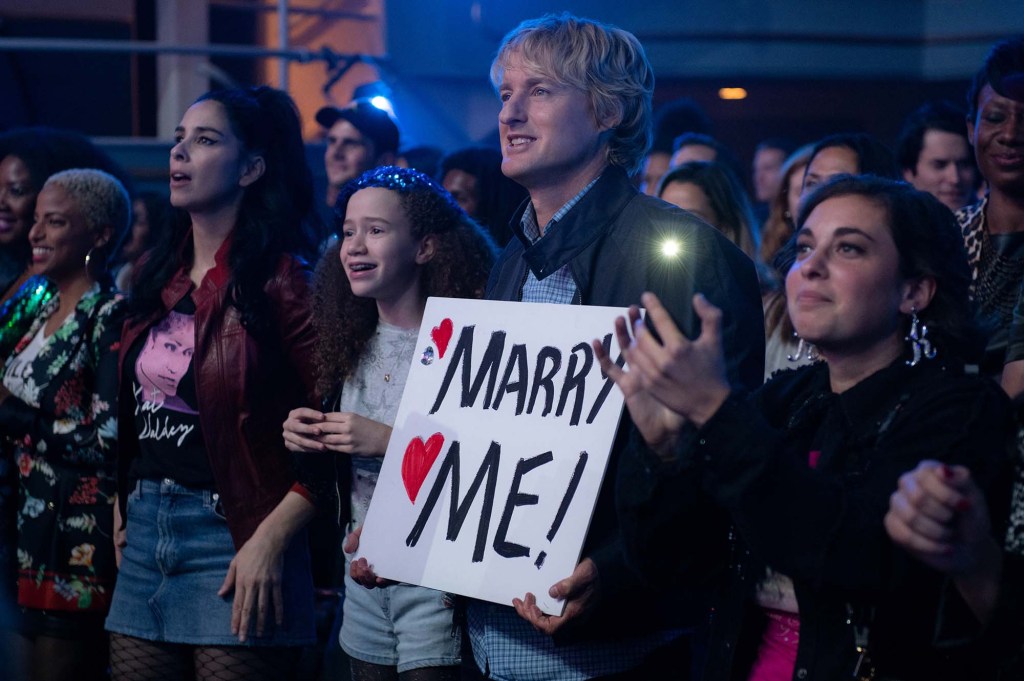
BOX OFFICE: “Marry Me” tries a trial separation, “Death” barely floats

It’s not Valentine’s Day yet, but the big room com released this weekend — almost all ROM and no com — is already being called a flop.

Marry Me” is sweet and it plays, but it didn’t manage much on Thursday night or Friday and looks to be an $8 million opening weekend. Maybe VDay Monday will turn it around.

But Jennifer Lopez isn’t box office any more, and she and Owen Wilson are much older than the rom-com movie going demographic. Light charm like this may be more of a streaming ready movie than anything that will pull couples into theaters during a pandemic.

“Death on the Nile” is doing better, a movie that is ok but not remotely as much fun as “Murder on the Orient Express.”

There’s money on the screen, very convincing digital effects, riverboat and scenery to go with the stunning costumes and less expensive cast. It is on track to open with @$13 million ($12.8), against a $90 million budget. It earned another $20.7 million overseas.

“Blacklight” bombed, pulling in $3.6 million.

“Jackass Forever” will be in a race with “Marry Me” for second place — $8 million and change ($8.05 million).

E

Posted in Reviews, previews, profiles and movie news | Comments Off on BOX OFFICE: “Marry Me” tries a trial separation, “Death” barely floats

“One Love?” Paramount may have found its Bob Marley for a Bio pic — Kingsley Ben-Adir

Recognize him? “High Fidelity” and “Peaky Blinders,” and he was Obama in “The Comey Rule” on TV. He was Malcolm X in “One Night in Miami.”

Can he sing? Play guitar? Look great in dreads?

Deadline.com broke the story, which is thin on details, but landing your lead after a long search is a big step.

Love the idea of this picture. A fascinating, iconic figure who T shirts still outsell Che.

Posted in Reviews, previews, profiles and movie news | Comments Off on “One Love?” Paramount may have found its Bob Marley for a Bio pic — Kingsley Ben-Adir

Classic Film Review: Surviving Stalin’s Purges from “Within the Whirlwind” (2009)

A phrase that become a Twitter trend during the Trump Era pops to mind when watching “Within the Whirlwind” and recalling what the Russians under Stalin did to their own people to placate the paranoia of a megalomaniac.

“The cruelty’s the point.”

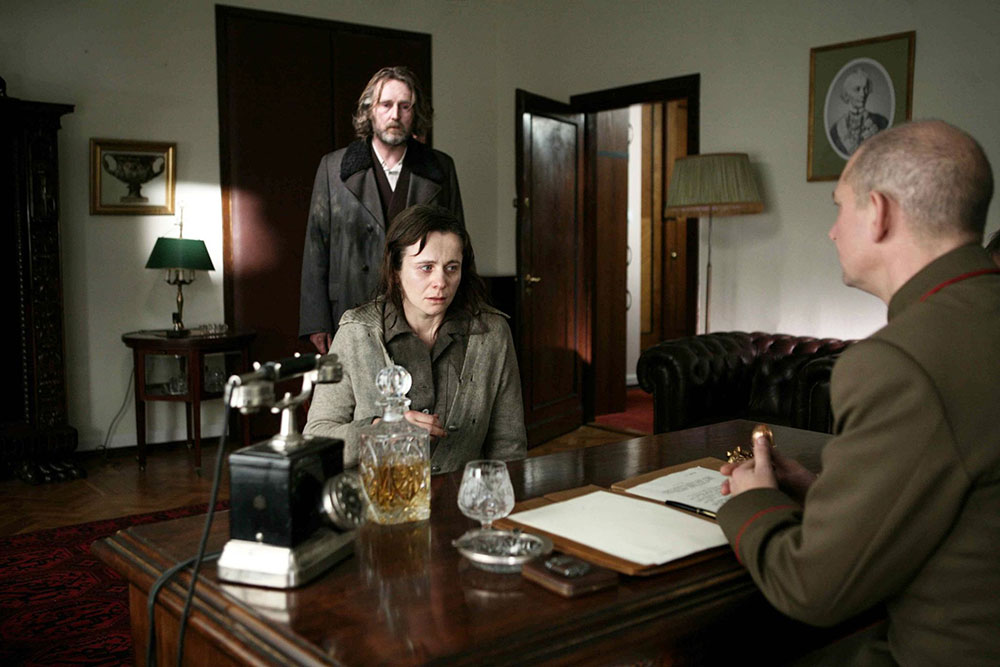
A story about the vast purges of “intellectuals” and anybody smart enough to recognize a diminutive despot in the making, the first of the millions sent to Soviet gulags in one flimsy “legal” pretext after another, this unjustly ignored Marleen Gorris (“Antonia’s Line”) gem contains perhaps the finest performance of Emily Watson‘s career.

Never heard of the movie or her performance in it (in 2009)? Talk about “snubbed.”

Watson (“The Theory of Everything,” “A Royal Night Out,” “Chernobyl”) plays Evgenia Ginzburg, a passionate teacher of Russian literature and poetry at Kazan University when we meet her, a lady with vast reservoirs of memory for the works of Pushkin and the other greats of the Russian canon.

A mother of two boys, married to the university newspaper editor (Benjamin Sadler), she is also a Communist Party member in good standing, and a true believer. Any bit of unsettling news husband Pavel passes on from Moscow gets a considered look, and an unworried response from Evgenia.

“I don’t know, but I’m sure they know what they’re doing.”

Pavel is weighing facts and seeing signs as he tosses her latest “story” on the Party’s sanctioned food and manufacturing production figures in the bin.

Sure enough, they see a respected colleague (Pierce Quigley) abruptly arrested in front of them, hauled away for his possible association with Stalin’s biggest boogeyman, the Red intellectual Leon Trotsky. Everybody had best distance themselves from their “Trotskyite” friend, and quick.

When Pavel lets his wife know he’s apologized to local Party bosses for her “association,” Evgenia is livid. Soviet rewriting of history, something we’re seeing in America as I type this, is in full swing. Evgenia’s “crime” is that she didn’t “suspect” Yevlov, the colleague, that she didn’t rat out this Party endorsed friend before anybody knew Stalin’s goons were going to accuse him.

The idealistic Evgenia won’t repeat this act of contrition in front of the myopic, officious apparatchik who has a confession for her to sign. She figures she has rights. She has people she can appeal to.

She lacked “political vigilance” about the already rewritten history of this Yevlov’s rise? She’ll show them.

But damned if the smirking goon from the capital Beylin (Ian Hart) doesn’t take an instant disliking to this “arrogant” and smart member of the “elite.” Appeals and assurances from others disappear as she’s put on trial, where she outlawyers the ignorant mugs assigned to judge her. “Tell me, who am I suppose to have ‘terrorized?'”

That, or course, seals her fate. Ten years in a camp it is. That’ll teach her to be smarter, to have ideals, to insult deplorable men with authority.

Evgenia finds herself torn from her family, renounced by her save-my-own-skin husband, denounced by comrades she tried to help and stuffed in a cattle car with scores of other freezing, starving women on her way to Siberia.

Much of Gorris’s film is standard Gulag/concentration camp horror — the brutal labor conditions of a lumber camp, the subfreezing weather, the “400 grams of bread a day” diet, the rape culture of the callous, hair-trigger guards.

Evgenia lives, cut off from home, desperate for any word of Kazan from strangers from other camps she stumbles into. She keeps her own and others’ spirits up by telling stories from literature and reciting poems from memory in the barracks. She loses the last shred of “The investigators made a mistake” idealism that many shared when they first boarded that train.

As women walk off into the woods to die, or starve and give up, the cynicism of the history-altering state settles in among them all. How did you end up here?

“That was a long time ago,” is their mantra. “And it never happened, anyway.”

Watson doesn’t oversell the “pluck” of Ginzburg, whose memoir this is based on. She portrays the woman as smart, logical and naive, someone who figures reason, truth and the law will protect her.

She shows us the exterior ordeal and interior suffering of a woman who figures she has to survive this sentence (as if the Party is bound to keep its promise about the length of political prison sentences) for her children. She has to try and protect her sanity and her dignity, resisting the sex-for-food come-ons of the monsters who guard them.

Watson lets us see the layer of callouses and scabs that crust over this woman’s once hopeful heart. It’s a magnificent performance.

Hart makes a perfectly vile impression as the kommissar who makes it his business to put this Jewish academic in her place. And Ulrich Tukur shines as a (pre-war) doctor of German descent, imprisoned because of his lineage, but necessary to the camp and thus tolerated as he treats his patients with compassion and firmly defends them from being worked and starved to death.

“Within the Whirlwind” doesn’t break much new ground in historical terms or its depiction of the Reign of Terror that the purges were, or in its assessment of how quickly people succumb to inhumanity — in how they treat others, in how they think of themselves.

But it’s a hidden gem, one of Gorris’s best and a high water mark for an actress nominated for Oscars for “Hilary and Jackie” and “Breaking the Waves,” and an Emmy nominee for “Chernobyl.”

Rating: unrated, violence, including rape

Cast: Emily Watson, Agata Buzek, Ulrrich Tukur, Pierce Quigley and Ian Hart.

Credits:Directed by Marleen Gorris, scripted by Nancy Larson, based on the memoir by Eugenia Ginzburg. A Corinth Films release.

Running time: 1:40

Posted in Reviews, previews, profiles and movie news | Comments Off on Classic Film Review: Surviving Stalin’s Purges from “Within the Whirlwind” (2009)

Movie Review: There’s no “Help” for this inert melodrama

Some movies are slow. Some manage a kind of languid torpor. And there’s “Help,” which might be described as “inert.”

It’s a disastrously undramatic debut feature from writer-director and bit “character” in the film Blake Ridder, who is also distributing it.

It takes forever for something — ANYthing — to happen. And when that something does, it’s no help. This corpse just lies there, a trio of attractive actors in an odd “menage” thriller variation filled with what’s meant to be menace, but which is merely a collection of awkward pauses, mostly the product of the most inept editing this side of student cinema competitions.

A pointless prologue lets us see leading lady Grace (Emily Redpath) get dumped by a callous American beau — via phone. Grace, a forensics researcher, decides a pop-in visit on her friend Liv (Sarah Alexandra Marks) is in order. It’s her man Ed’s (Louis James) birthday.

They chat, awkwardly. Grace is imposing, but there’s no being rude. They are, after all, British. She settles in for a weekend into what appears to be a perfectly passable relationship. But thanks to her forensics background, Grace can’t but notice blood stains here and there.

And then there’s the on-the-spectrum oddball neighbor (Ridder) who greeted Grace’s arrival with a warning.

“It’s bad.”

Anyway, Grace sits and they all catch up. At some point, somebody says “I think it’s time you met Polly.” That’s odd, and we’re invited to ponder the idea that Grace is somehow unstuck in time, that the movie’s events are unfolding out of order.

Because, you and I know we saw Grace come into the house when no one answered the door. And she chatted and coo’d at the cute little Jack Russell, whom she called “Polly” by name. They’ve met.

But no. That appears to be simple editing incompetence. And nobody told the writer-director about it to fix it. That’s never a good sign.

It’s kind of all downhill from there, with revelations that will surprise no one, violence and schemes and escalations that are nothing the least bit interesting.

Not to get any meaner than I’ve been up to now, but there’s a reason this dog is self-distributed. And the word “delusional” explains it.

Rating: unrated, sexual situations

Cast: Emily Redpath, Louis James, Sarah Alexandra Marks, Blake Ridder

Credits: Scripted and directed by Blake Ridder. A Ridder release.

Running time: 1:36

Posted in Reviews, previews, profiles and movie news | Comments Off on Movie Review: There’s no “Help” for this inert melodrama