
Movie Review: Coming of age above the Russian Arctic Circle — “The Whaler Boy (Kitoboy)”

There are a few elements of writer-director Philip Yuryev’s “The Whaler Boy” that are off-putting enough to warrant addressing them straight off.

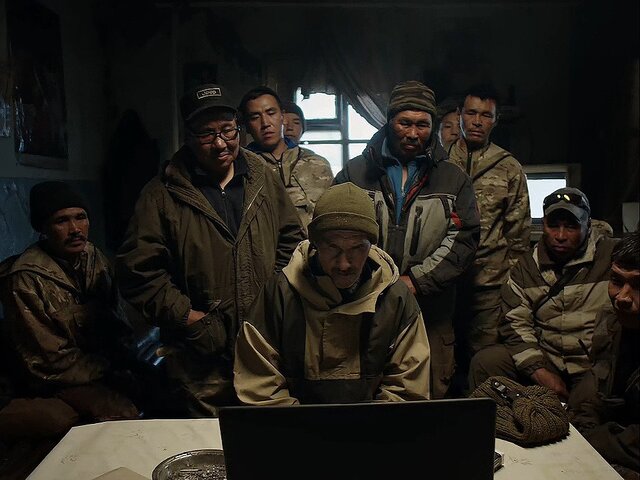
It opens with a luridly-detailed behind-the-scenes look at an online sex-chat brothel, a scene that goes on longer than anybody other than the prurient would think necessary. We only figure out its relationship to the native lads of a Bering Straight village when we see them gathered around a laptop, lapping up the poses of HollySweet999.

This boys’ coming-of-age/obsession-with-sex-chat-hostess drama all but erases women from their world. It’s not enough that the unsophisticated local teens get lost in porn. They aren’t given the chance, in this story, to relate to real women — mothers, peers, etc. — in their midst.

If there’s a morality tale in the dangers of falling into objectified, fantasy women who exist only on a screen, it’s told without the young men confronted by the reality of their lives, their prospects and how members of the opposite sex fit into their world.

Then there’s the subsistence killing that the menfolk here do to keep one and all alive — hunting whales in motorized skiffs. That’s also detailed and bloody and won’t be to every taste.

Yuryev’s debut feature introduces us to Leshka and Kolyan, two young fellows from Chukotka (far Eastern Siberia) who pitch in on the whale hunts, have learned how to break down the carcass and are the ones designated to deliver meat to various neighbors too old to hunt or make the trek down to the beach to share in the catch.

Lyoshka or “Leshka” (Vladimir Onokhov) lives with someone like that, his elderly grandfather (Nikolay Tatato), a whimsical sort who is always warning the kid (in Russian, with English subtitles) “I’m dying soon, maybe this summer.” He’s serious.

There’s not much to do in their Arctic summer — just whale hunting, whale filleting and aimless rides on their shared motorbike with Kolyan (Vladimir Lyubimtsev). But the menfolk there have discovered sex sites on the Internet, and one American site and American “hostess” (Kristina Asmus) leaves the two teens lost in lust.

Kolyan affects a more worldly air — based on having seen this sort of content before. But poor Leshka is just gone. He sneaks off to borrow the community laptop, cranks up the family generator and tunes in. He talks to the screen, not realizing she can’t hear him. Not that she talks. She just poses and pouts and fields comments and slips off for “private chats” for paying customers.

Leshka goes down this rabbit hole so deep he’s sure Kolyan is “cheating” with her, creating a rift that will end with blows. He’s hapless with the gorgeous blonde hooker (Maria Chuprinskaia) the locals fly into town. Yeah, that’s a little “off-putting” too.

And as he pines away, wondering how far “Detroit” is, studying phrases in English to use to chat with “HollySweet999,” he makes note of the local lore of people who fled from here across the Bering Straight to Alaska, America, with its “cities” and “big buildings,” it’s “McDonald’s” and its lusty online sex workers.


Yuryev’s film is on its firmest footing in scenes capturing village life, the routines of a whale-based diet/economy. He doesn’t go into documentary-level detail, although we see a local dance (an instrumental rock combo is flown in) and the like. There’s little social life to speak of. And I was unclear as to who exactly paid to fly in a hooker, just as the film left me unsure of exactly how the locals get by, survive and what they do for money. Totally state supported?

Yuryev is much more interested in the pubescent parts of the tale — teen titillation, masturbation, an online obsession that upsets the natural order of this world — than in the above-the-Arctic-Circle world itself.

The third act is an odd odyssey that sends Leshka in search of his fantasy girl and pushes the picture into parable territory. It’s warmer than much of what came earlier, but it’s warmth with a brittle edge.

There’s merit in this story, which takes its hero on a circular path back to what anchors him in his world. But the novelty of the setting and the characters doesn’t mean we give the storyteller, who gets lost in the sordid sexual side of life above the Arctic Circle, a pass.

There’s acknowledging this technological “change” that even the most remote parts of the world are seeing, and nothing wrong with recognizing that hormones rage even in the land of the Midnight Sun. What Yuryev does, more often than is necessary, is wallow in it. And when he does, it’s not just “The Boy Whaler” who seems lost.

Rating: unrated, nudity, sex, whale hunting, violence

Cast: Vladimir Onokhov, Vladimir Lyubimtsev, Nikolay Tatato and Kristina Asmus

Credits: Scripted and directed by Philipp Yuryev. A Film Movement+ release (Jan. 14).

Running time: 1:33
Posted in Reviews, previews, profiles and movie news | Comments Off on Movie Review: Coming of age above the Russian Arctic Circle — “The Whaler Boy (Kitoboy)”

Netflixable? Grumpy loner longs to be “1000 Miles from Christmas ( A mil kilómetros de la Navidad)”

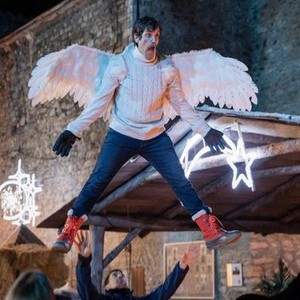
Here’s one last “Around the World with Netflix” holiday offering for 2021. Better yet, think of “1000 Miles from Christmas” as the first holiday film of 2022. Let’s get an early start — 360 days before Christmas — on the tidal wave of Christmas movies to come with a Spanish farce set in the snow, scenic Pyrenees of España’s far north.

It’s a time-honored holiday take on a formula that’s worked for much of the history of cinema, a “fish out of water” comedy in which an outsider comes in to a strange locale — often a business — and stumbles into the local way of doing things. There are hints of “The Coca-Cola Kid,” “The Efficiency Expert” and even episodic TV (an “Andy Griffith Show” episode) in this tale of an auditor who hates Christmas sent to go over the books of a candy factory in a mountain village.

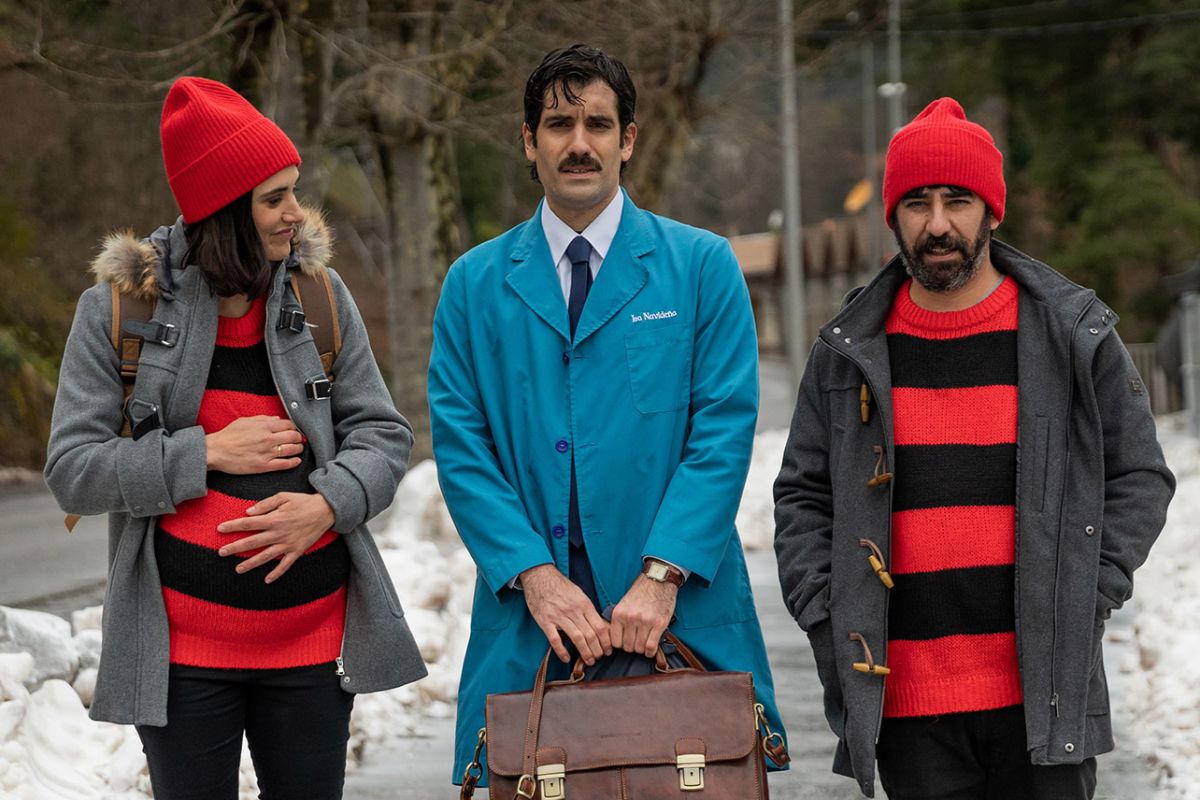
The hook here is that Raúl (Tamar Novas of “The Goya Murders,” “Eye for an Eye”) builds his year-end around a Cuban holiday, a play where he can be “1000 kilometers from Christmas,” a holiday he’s long loathed. And just before that annual flight, his boss has shipped him off to a town that feeds Spain’s seasonal sweet tooth with famous fudge and marzipan. Valverde is so seriously into Christmas that the whole town is engaged in a Guinness Book of World Records attempt at creating the larging “living” Nativity scene.

You’d think there’d be more laughs in that set-up, a lovelorn loner with legitimate beefs about Christmas (we see death, divorce, betrayal and other trauma he’s associated with the holiday since childhood) forced to cope with quirky locals, the view out every window a decorated, snowy holiday card, an infectiously upbeat workforce and a cute stage manager (Andrea Ros) staging the Nativity who quickly figures out he’s “The Grinch.”

Sadly, a chuckle here and there is all this Álvaro Fernández Armero (“Blinkers,” “If I Were a Rich Man”) holiday rom-com manages.

Raúl arrives with a bang — or an accident. He crashes into Nativity sets that clog the streets. He stays at a B & B where the rooms are named Balthazar, Melchior and Gaspar, after “The Three Wise Men.”

And La Navidad, the candy factory, is practically run by elves, everybody’s so giddy about the work and the Christmas season. Bubbliest of all is the owner’s son, Mateo (Peter Vives).

Raúl and Paula have their “meet cute,” which isn’t all that cute, when he crashes into her set. He’s up against an entire town’s “infectious” love of a holiday, people who at least laugh when they call him “Grinch,” a boss with a deadline and a plane ticket that represents another.

And those “books” he’s looking at? You guessed it. There are complications.

There’s a lot of “you guessed its” here, which I won’t give away.

What matters is that there are plenty of places where easy laughs could be found and just aren’t.

A sample of the humor — an expectant couple are named María José (Mar del Hoyo) and José María (Raúl Jiménez). That’s a real knee-slapper, that is.

Novas, who has a Clive Owen vibe (maybe it’s the mustache), manages a brittle sarcasm that plays but would play better with funnier put-downs. He’d be a fan of this or that about the holiday, he insists, “but I’m not six years old.”

Those assertions usually are followed by a flashback to his assorted holiday traumas, none of which play as amusing.

The gorgeous setting and can’t-miss formula — city slicker needs to slow down, find peace and joy and love, have a little marzipan — make you root for “1000 Miles from Christmas” to close that gap. It never does.

Late arrival for this year’s holidays, or early arrival for next year’s, “1000 Miles” misses the mark by miles and miles.

Rating: TV-PG

Cast: Tamar Novas, Andreas Ros, Peter Vives, Mar del Hoyo, Raúl Jiménez

Credits: Directed by Álvaro Fernández Armero scripted by Francisco Arnal and Daniel Monedero. A Netflix release.

Running time: 1:42

Posted in Reviews, previews, profiles and movie news | Comments Off on Netflixable? Grumpy loner longs to be “1000 Miles from Christmas ( A mil kilómetros de la Navidad)”

Classic Film Review: Claudette Colbert is a prisoner of WWII in “Three Came Home”

“Three Came Home” is a fascinating curio from a Hollywood and America on the cusp of change.

This 1951 POW drama was the first to cover ground that “A Town Like Alice,” the movie and later TV series, the series “Tenko” and the 1990s Bruce Beresford/Glenn Close film “Paradise Road” recreated — stories about the Western women, wives of European, Australian and British foreign service personnel kept prisoner by the Japanese after their invasion of most of the South Pacific at the outset of the war.

What we see in Jean Negulesco’s 1951 film is a hint of the end of the old Hollywood studio system, a mostly-sound-stage bound “on location” production, acting that dates from that same “last days before The Method” era and America’s on-screen softening of attitudes towards the hated enemy of just a few years before.

It’s a bit old-fashioned, but there’s much to recommend this Oscar-nominated production even today.

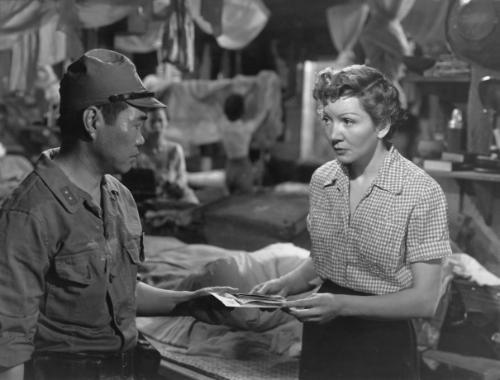
Based on a memoir by Agnes Newton Keith, already a published author (“Land Below the Wind”) when the war broke out, it briefly sketches in the British Empire bubble Keith (Claudette Colbert), an American married to British forestry manager Harry (Patric Knowles) lived in until the Japanese attacked Pearl Harbor and seized Hong Kong, The Philippines, Singapore, Java and their corner of North Borneo, Sandakan.

There’s the Pearl Harbor news on the wireless, which only their little boy (Mark Keunig) hears on the day it happens, the concerned “Do you really think they’ll come?” from Agnes, and Harry’s stiff-upper-lip, “It’s liable to get a little rough out here” calm and sense of duty in the face of the inevitable.

The Japanese commander put in charge of their district, Col. Suga, is played by Sessue Hayakawa, giving us the first version of the commandant he’d play in “Bridge on the River Kwai.” He’s an American-educated fan of Mrs. Keith’s writings and her seeming “understanding of Orientals.”

As husband and wife are separated and Agnes is forced to raise their sometimes sickly boy under brutal, starvation conditions, she deals with mostly lower level brutes in the Japanese chain of command. But Col. Suga wants her to autograph her book for him, is eager to share stories of his children back in Japan, and makes overt gestures of gentility (“Tea?”) in sharp contrast to the privation Keith is living under.

Their barracks, with her the lone American among crusty Brits, can be fractious. Agnes is desperate for any news of her husband, any chance to see him or meet with him via passed notes. The film captures nerve-racking efforts to rendezvous with Harry, and in a scene that begins giddy and turns starkly real, has randy Australian POWs try to woo the women through the barbed wire, getting so carried away we know the Japanese will find out and there’ll be reprisals.

Colbert’s performance has more Old Hollywood glamour about it than the stoic suffering of Keith’s situation would suggest — flawless makeup and clean costumes for the adoring close-ups. She was a leading lady who knew how to crane her neck in the clinches with her leading man, moments framed more naturally by later generations of directors.

The Romanian born Negulesco, a former painter and stage decorator, learned his craft in the 1930s but was entering his most productive period when he made “Three Came Home,” which came after “Three Strangers” and before “Three Coins in the Fountain.” It’s a film of sympathetic performances and workmanlike craft — nothing fancy.

The film has plenty of evidence of the racial attitudes of the day, and the pre-war days it depicts. The women in the camp freely mock their captors — the ones who don’t speak English, anyway. But the racial caricatures of war films shot during and immediately after WWII are mostly gone.

The Japanese soldiers are quick to anger, quick to slap or point a bayonetted rifle, but also polite enough to say “Thank you” in a sort of “This war will last ten years” effort to just get along in this situation.

I was surprised by the frank addressing of attempted assault, with the Japanese officers furiously trying to pretend their cultural practice of turning captives into “comfort woman” wasn’t happening.

And I was struck by the niche the always-dignified Hayakawa was forced to carve out for himself with this performance, a villain with an urbane, Westernized and “reasonable” side. Col. Suga becomes a screen paragon of “Well, they’re our allies in the Far East, now” American/Japanese relations. We can’t have him come off as a sadistic brute, can we?

Keith’s memoirs about her time in these camps, from privation to liberation, have been the anchor account for pretty much every factual and fictional recreation of that experience to be put on the screen. And while there was only so far this “on location” (some of it) depiction was going to go in 1950-51, Colbert and Negulesco and the cast do a decent job of remembering “life reduced to one simple, stubborn purpose — to keep alive.”

“Three Came Home” manages to be both of its time and ahead of its time in that regard, a dated Hollywood classic well worth referring back to as the seed from which many more more grimly realistic versions of that “women prisoners of war” experience would sprout.

Rating: unrated, violence

Cast: Claudette Colbert, Patrick Knowles, Florence Desmond, Sylvia Andrew, Mark Keunig, Howard Chuman and Sessue Hayakawa.

Credits: Directed by Jean Negulesco, scripted by Nunnally Johnson, based on the memoir by Agnes Newton Keith. A Twentieth Century Fox release now on Tubi, Amazon, etc.

Running time: 1:46

Posted in Reviews, previews, profiles and movie news | Comments Off on Classic Film Review: Claudette Colbert is a prisoner of WWII in “Three Came Home”

Movie Review: James McAvoy and Claire Foy hunt for “My Son”

A low-budget Belgian thriller of a few years back becomes a lean if not wholly logical James McAoy vehicle of the same title in “My Son,” which has him and Claire Foy playing divorced parents frantically searching for their missing child.

Writer-director Christian Carion’s original film was notable for its spare plot and pace, both credited to the picture’s much-hyped, rushed six day shooting schedule. Here that hype has been shifted to the talented McAvoy, who the producers have told British newspapers “improvised” most of his performance.

Such backstories are usually neither here nor there, just part of the selling/”myth building” of another variation of “Taken” or “Ransom” or any film about a child’s kidnapping. But it helps explain the oddly disorienting character McAvoy plays, a man who keeps us off-balance because of the impulses we see him act on and the mysteries he keeps about who he is and what he’s capable of.

Edmond Murray is no Liam Neeson “Taken” cliche, no chap “with particular skills” that he can apply to this situation. Or IS he? We aren’t meant to figure that out.

Edmond dashes home, bleary-eyed, from whatever part of the world his vague “oil industry” construction/consulting job has taken him to. His “wee boy” was snatched from a camp he was attending in the gloom of early winter. And when Edmond gets there, authorities are dragging the lake beside that camp.

His ex, Joan (Foy, of “The Crown” and “The Girl in the Spider’s Web”), is devastated.
His questions — veering from sympathetic to accusatory — are no comfort. Yes, she checked out the people who run the “astronaut/astronomy” camp. Yes, the idea for the camp may have come from her current beau (Tom Cullen). No, little Ethan (aged seven) didn’t want to come.

The police officer in charge (veteran character actor Gary Lewis) is the first to use the word “kidnapping.” His questions of Edmond are just as personal, just as barbed as the ones Edmond asked of Joan. They’re about his work, the “dangerous” places he sometimes has to perform it. Yes, they’d like to search his phone.

Edmond’s guarded helplessness takes an abrupt turn when he talks, for the first time, with Joan’s new man. Frank seems removed from all this, relieved he has the sort of job (a builder) where he can take the time off to “be there” for Joan, quick to medicate Joan to calm her down and callously eager to show off the plans for the house he plans to build for them, a house that Edmond instantly realizes “has no room for my wee boy.”

As we’ve seen in McAvoy performances from “Filth” to “Split,” he likes delivering the shocking, sudden flip-out. It starts with a “Are ye f—–g KIDDING me?” It climaxes with a beating and his arrest. If Edmond had any prayer of interesting the police in his new, concocted-on-the-spot “theory,” the copper isn’t having it.

“You’re in no position to tell me how to conduct this investigation right now.”

Joan’s unsettling underreaction to that beating speaks volumes. His “I’ve never KNOWN you to take a pill in your life” doesn’t excuse him or his behavior.

“You don’t KNOW me any more.”

The plot unravels in much more conventional ways after that, serving up a mystery with a solution that’s entirely too common in movies these days, a solution that’s arrived at in equally conventional “movie” ways.

But McAvoy keeps us wrong-footed, pretty much to the “Wait, what just happened?” (think about it) finale. There’s an exhausted brittleness to the relationship he and Foy conjure up and a genuine sense that a lot of what happens is what two desperate people leap into doing, without much forethought, on the spot. They’re grasping at anything that might get them their wee boy back.

Carion’s film has a gloriously foggy and rainy pall, and he stages the tense third act pursuit with enough verve to remind us he’s not a bystander in all this. “Improvised” or not, this is most certainly his brisk walk through the same movie he filmed four years ago in the Low Countries.

It’s not “Taken,” but that’s one of the chief appeals in McAvoy’s character and his performance of him. He ensures we don’t necessarily know what’s coming because he’s damned good at making us think he doesn’t know either.

Rating: R for language throughout and some violence.

Cast: James McAvoy, Claire Foy, Tom Cullen and Gary Lewis

Credits: Directed by Christian Carion, scripted by Christian Carion and Laure Irrmann, based on Carion’s 2017 film. An STX release on Roku.

Running time: 1:30

Posted in Reviews, previews, profiles and movie news | Comments Off on Movie Review: James McAvoy and Claire Foy hunt for “My Son”

Netflixable? Blood, guts, smokes and the muddy morass of pre-Civil War Spain — “Gun City”

I’m guessing you have to know a lot more about the pre-history of the Spanish Civil War than I did going into “Gun City,” a sprawling multi-character muddle film noir take on those years titled “La sombra de la Ley” in Spain.

I know a little of that history, just enough to be just lost enough to not get much more out of than “Damn, they were trigger happy in 1921 Barcelona” and “Boy, those Catalans sure could suck down those cancer sticks!”

It’s a lumbering “ticking clock” detective tale/historical drama so slow and obsessed with “style” that it never gets going. Here’s the Hollywood film this Luis Tosar (“Eye for an Eye,” just seen in “The Vault”) brought to mind — “Mulholland Falls.” Like that one, it’s a murky tale of corruption, unclear alliances, of fedoras, trench coats, tommy guns and cigarettes — oh so many prop cigarettes.

Here’s what we know about early 1920s Spain in general and Barcelona in particular. It was a powder keg, a country swirling down the drain for the umpteenth time thanks to an idiot, high-handed king, a broken government, corrupt police and a newly-ruinous war in Spain’s last African colony.

A trainload of arms is ambushed and hijacked and the local cops are in so deep with mobsters they have know way of knowing if the mob or the “anarchists” organizing the strikes that are crippling an already invalid state are behind it.

Enter the big brooding bruiser nicknamed “The Basque.” Aníbal Uriarte silently strolls in from Madrid, barges in on the “Information Bureau” (police detective) chief Rediu (Vicent Romero) and his goons and starts riding along for “round ups,” witnessing torture and participating in extra-judicial murders.

“Welcome to Barcelona,” the cops growl as the Inspector “tests” his new “help” by ordering him to get his hands bloody. Rediu complains about the strikes, and the “more work” coming the police department’s way, with “fewer men” do carry it out. We wonder just what “work” means, in this context.

Toughest of the police toughs under Inspector Rediu is the cold-eyed killer (Ernesto Alterio) nicknamed “Tisico,” aka “T.B.” He’s quick to turn to violence, quick to suspect fellow cops of taking more than their fair share of shakedown money and sadistic to one and all.

The big local club owner and mob boss is The Baron (Manolo Solo), who dabbles in porn and sex trafficking and keeps his star stripper/singer/dancer, the sultry Lola (Adriana Torrebejano) under his thumb. Might the Baron have his hand in arms dealing?

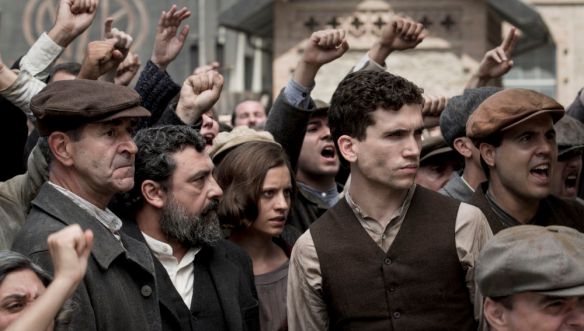
And then there are the allied leftists and labor organizers led — barely — by Salvador Ortiz (Paco Tous). Young hotheads among his strikers want to meet the constant threats from factory owners and the repression, extra-legal violence of the cops with violence. At least his daughter, Sara (Michelle Jenner) is still all about “peaceful protests.” Until, that is, the cops murder a young woman in her movement.

The Basque must hide his hand, pick his spots to intervene (rape seems to be one place he draws the line), sniff around for answers and promise cooperation, loyalty and/or help to this or that faction as he races — ever so slowly — to locate the cache of military arms that could embolden whoever has them to start a civil war.

The actual Spanish Civil War didn’t erupt until another circuitous decade had passed, with changes in government and a fascist alliance with the army, the wealthy and the Catholic Church. It’s easy to feel the strain that director Dani de la Torre and screenwriter Patxi Amezcua went through to wrestle a coherent “Yojimbo” version of real Catalan/Spanish history out of this.

Tosar is our tour guide through all this. But as his “Basque” is a man of few — VERY few — words, that’s not a natural role for the character to play. There are too many other figures — military governors, a police commissioner, etc. — who further muddy up the associations, alliances and loyalties.

What does fit is the “Yojimbo” play-everybody-off-against-everybody-else model that the script toys with. The classic samurai film built on this plot was remade as a Bruce Willis/Walter Hill thriller, “Last Man Standing” back in the ’90s.

Tosar’s Basque doffs his jacket and joins in with a striker/strike-breaker brawl. But we can’t tell who he’s beating up, which side he’s on. This happens time and again, right up to the finale.

There are lustrous period settings (Santiago de Compostela doubled for 1920s Barcelona) and costumes, and showy bits of circling camera work to take in the sights, and the skin, of our star dancer character. There’s even a “Bonnie & Clyde” tin Lizzie car chase and Patty Hearst “political” bank robbery that the characters manage to sneak in between smokes.

The performances are of passing interest, but Tosar gives us little to grab hold of and while Jenner provides much of the passion of the piece, many others — especially Toerrebejano — are given short shrift.

Perhaps, as the no-help-at-all closing titles fill us in on the “true” aftermath of this somewhat “true” story, the filmmakers felt more bound to “facts” than this stylized, violent formula noir lets on.

“Gun City” doesn’t do either the true or the film noir riff on it enough justice to matter.

Rating: TV-MA, bloody violence, sexual assault, near nudity and lots and lots of smoking

Cast: Luis Tosar, Michelle Jenner, Vicente Romero, Manolo Solo, Adriana Torrebejano, Paco Tous, José Manuel Poga and Ernesto Alterio

Credits: Directed by Dani de la Torre, scripted by Patxi Amezcua. A Netflix release.

Running time: 2:06

Posted in Reviews, previews, profiles and movie news | Comments Off on Netflixable? Blood, guts, smokes and the muddy morass of pre-Civil War Spain — “Gun City”

RIP Quebecoise filmmaker Jean-Marc Vallée, director of “Dallas Buyers Club,””Wild,” “Big Little Lies” and “Sharp Objects” was 58

A filmmaker of rare sensibilities, a genuine “actor’s director” who helped Matthew McConaughey and Jared Leto win Oscars, and after “Wild,” became Reese Witherspoon’s go-to filmmaker for her acclaimed cable series “Big Little Lies,” then “borrowed” by Amy Adams for “Sharp Objects,” Jean Marc Vallée has passed away suddenly, the apparent victim of a cold weather heart attack in rural Quebec.

He was just 58.

Vallée gained notice with the Canadian indie dramedy “C.R.A.Z.Y.” in the early 2000s, and became a marquee filmmaker with “The Young Victoria,” a glittering Emily Blunt star vehicle and bio-pic of Queen Victoria.

The Jake Gyllenhaal dramedy “Demolition” stands out among his credits, although I can’t see a film or series that Vallee had a hand in that wasn’t thought-provoking, challenging and very very good.

He nimbly transitioned to limited series work, the most popular form of filmed storytelling these days and the surest source of employment for directors, and had a couple of projects in the works at the time of his sudden demise, in a cabin outside of Montreal. He won an Emmy for directing “Big Little Lies” and was nominated for an Oscar for “Dallas Buyers Club.”

An awful thing, and a real loss to cinema.

Posted in Reviews, previews, profiles and movie news | Comments Off on RIP Quebecoise filmmaker Jean-Marc Vallée, director of “Dallas Buyers Club,””Wild,” “Big Little Lies” and “Sharp Objects” was 58

Netflixable? “Lulli” is a Brazilian who shows us “What a Med Student Wants”

Today’s Around the World with Netflix offering is a first year residents med school comedy from Brazil. “Lulli” borrows its premise from the “What Women Want/What Men Want” mind-reading comedies. But in situations and dialogue, in Portuguese or in English, cast and crew find laughs hard to come by over the course of their 90 minute “journey of self-discovery.”

“Lulli” (Larissa Manoela) is a driven, self-absorbed and bubbly redheaded pixie who has a hard time listening, she explains in the film’s opening narration.

“Listen closely,” she says. Because straight away, we hear her med student boyfriend Diego (Vinícius Redd) fret about not just his uncertainty about medicine (surgery) as a chosen profession, but his problems with them as a couple and some all-too-obvious health symptoms he’s been having of late.

Lulli, raised by a widowed mom, determined to be the star of the class and dismissive of his fading affections, if not his medical career doubts, doesn’t hear him. Then she lets him have some of her salad.

As Diego seizes up, as an ambulance is hastily-called, she blurts out “How come you never told me you were allergic to shrimp?”

“I told you a thousand times,” he gasps.

OK, he’s exaggerating and yes, maybe they’ve reached the “tuned-out” part of the relationship. But that’s his final straw.

“We’re done.

Lulli’s narcissism plays out making rounds, distractedly “treating” patients while their head resident (Paula Possani) tries to keep everyone focused on a different patient so that they absorb these teachable moments. She misses clues patients give her and her fellow residents as they make their diagnostic quiz rounds. Lulli is headstrong and cocky, if empathetic. We’re waiting for her to accidentally kill somebody.

But no. It’s a patient stuck in an MRI who is her undoing. She ignores the thunder storm power failure procedures, ignores warnings from Diego, and bolts into the scanner room to “free” the “trapped” patient. Diego chases her. And both of them get a life-altering shock when the power surges back on.

Diego loses short term memory. He forgets that he’s broken up with his “beloved.” Lulli? She touches somebody, and hears their thoughts.

Her best friend in med school Vanessa (Amanda de Godoi) may tell her what she wants to hear, but her inner thoughts are more damning. Patients, Lulli discovers, lie about their drinking, their contact with cats, lots of things that might help speed up a diagnosis. She starts to impress her supervisor and her classmates, especially the re-smitten Diego.

“It was like watching ‘House!'”

Confessing to Vanessa only gets her admonished — at first.

“That only happens in the movies!” Right. To Mel Gibson (“What Women Want”) or Taraji P. Henson (“What Men Want”).

One obvious place “Lulli” could have produced laughs is when she realizes her once-dated/now platonic pal is gay. Another is when her friend forces her to see a tarot card reader. Only one of those kicks up a giggle.

The rest is just a lot of scenes of a cute and perky redhead medical resident and her supporting cast not being funny.

Rating: TV-14, adult situations, profanity

Cast: Larissa Manoela, Vinícius Redd, Amanda de Godoi, Sergio Malheiros, Paula Possani

Credits: Directed by César Rodrigues, scripted by Renato Fagundes and Thalita Rebouças. A Netflix release.

Running time: 1:30

Posted in Reviews, previews, profiles and movie news | Comments Off on Netflixable? “Lulli” is a Brazilian who shows us “What a Med Student Wants”

Classic Film Review: Powell, Pressburger and Lean — “One of Our Aircraft is Missing (1942)”

“One of Our Aircraft is Missing” has plenty that labels it as dated, a combat film of simple set-ups, primitive effects, plucky characters and attitudes easily seen as morale-boosting propaganda today.

But what’s striking about this early production of The Archers, as the productions of co-writers/directors Michael Powell and Emeric Pressburger were branded, is its stark modernity, a lean story told with artful touches and unfussy performances, all in a film that was produced at the tail end of “The Darkest Hours” of World War II.

That mid-war (1942) pedigree, the lack of a musical soundtrack, un-subtitled conversations in Dutch and German and workmanlike “keep calm and carry on” professionalism of those playing a trained and drilled bomber crew make this one of the most striking combat films made in the thick of the last World War.

The story the filmmakers, years away from their “Red Shoes/Black Narcissus” technicolor glories, cooked-up was another variation of that classic “behind enemy lines” quest first served up in ancient Greece by Xenophon in “Anabasis.” It’s the Allied airmen flipside of Archers’ German sub crew quest of the more action-packed, more entertaining and timeless, “The 49th Parallel,” their previous film. An RAF bomber crew bails out over Holland, and has to find its way to the coast and possible Royal Navy rescue. In “Parallel,” the fleeing submariners must threaten, coerce and shoot their way to neutral America. In “Aircraft,” the British aircrew must depend on the enterprise of the defiant, friendly, “Let’s have some wine, first” Dutch.

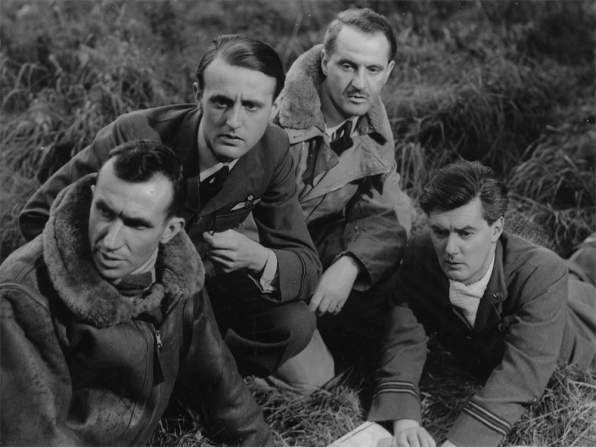
Godfrey Tearle, Eric Portman, Bernard Miles, Hugh Burden, Hugh Williams and Emrys Jones are identified, right in the opening credits, as the various specialists in the aircrew — from pilots and navigator to “observer” and radioman.

There’s an old soldier/rear-gunner (Tearle), a “diplomat” turned pilot (Burden) who speaks a little Dutch, a footballer/radio operator (Jones), a working class front gunner (the great character actor Miles), the officious co-pilot (Portman of “49th Parallel”) and an actor-turned-navigator (Williams).

They get their twin-engined Wellington off the ground, make a little small talk about what Stuttgart, their target this night, is like, note the topography passing underneath them, cope with flak, futilely shoot at German spotlights and dip down low to hit their target.

But they don’t clear the city without getting hit, and eventually limping along on even one engine won’t work.

“Stand by to abandon aircraft! Stand by to abandon aircraft!”

We see the process of bailing out, through gun emplacement hatches or bomb bay doors, and hear the ironic sounds of the sputtering single engine sputtering back to life and continuing on, crewless, back to England.

On the ground, one member of the crew is separated from the rest. Dutch children inexplicably chasing all the family livestock (cattle, big and sheep) through the woods find them.

Thus does their escape odyssey begin.

A huge gathering of women led by the English-speaking schoolteacher Els (Pamela Brown) debate what to do and how to do it. There’s a testy interrogation of the “prove, beyond a reasonable doubt, that you are who you say you are variety.”

They’re disguised and led off, en masse, with the women (the “actor” dresses in drag for “my finest performance”) bicycling along with them as cover. The Brits portray their Dutch as still allies, worthy of liberation.

” Do you think that we Hollanders who threw the sea out of our country will let the Germans have it? Better the sea.”

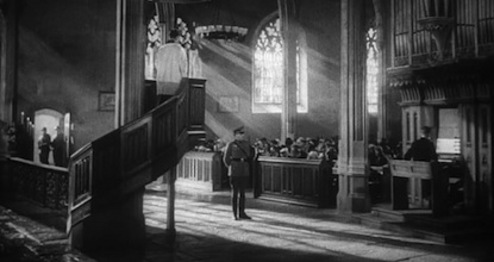
They’re hidden in plain sight in a Catholic church service, something a couple of the Protestant Brits bicker about. They cope with a Dutch “Quisling,” a traitor (Robert Helpmann) who advocates collaborating with the Germans, and see a judgmental priest (future star Peter Ustinov) point to the error of his ways.

And they end up in the hands of another defiant Dutchwoman (Joyce Redman), who passes a mid-war assessment of Nazi era Germans that stings and rings true even today.

“They’re an unhappy people. I would rather be a Dutchman in Holland than any German soldier. They want to believe that somebody’s their friend, and that’s the whole trick.”

Thanks to a brisk script and the masterful editing of future director David Lean, “Aircraft” clips along, serving up genuine suspense, dashes of wit and limited bravado as the combatants put themselves in the hands of people who risk their lives to save them.

There are better prints of it than I saw, which impacts the airborne scenes more than those on the ground. The soundtrack is the first thing to go on older, unrestored copies of films of that era, and even in the inaccurate “quiet” of the notoriously noisy bombers, the dialogue is murky.

The film has entirely too much day-for-night footage to pass modern muster. That serves the film’s propaganda purposes. The crew can plainly see where they are, and bomb targets with pinpoint accuracy in the dark. The RAF bombed at night to avoid German fighters, and bombed cities because they were easier to find and hit that specific factories, railyards and the like. Even if they missed, they destroyed Germans and German infrastructure.

The footage of the “crippled” Wellington plainly shows both engines operating, and the optical effects — mimicking anti-aircraft fire, flak and tracers — is if anything slightly more primitive than in “The Dam Busters,” which came out over a decade later.

But Powell and Pressburger get fine, buttoned-down performances from one and all, and make great use of East Anglia locations — windmills, a Cathedral, rivers and woods — to create a convincing Holland.

And their scriptural problem solving, how to get these lads from A to B, is endlessly inventive, maintaining suspense and making the Dutch the true heroes of the piece.

That’s perhaps the most optimistic thing about this early 1942 production (it was released that July). Before Stalingrad, before El Alamein, before America’s impact could be felt and the tide truly turned, this film is shot through with the sense that “there’ll be blue birds over, the white cliffs of Dover” and that Europe will be liberated, even though the only one pushing that line as inevitable was Churchill.

As corny as it can seem, and the film generally avoids that sentiment on an overt level, this upbeat-in-the-face-of-adversity is kind of astonishing to take in now, given the speed at which gloom and doom about resurgent fascism spreads through Western Civilization these days.

As with “The 49th Parallel,” Powell and Pressburger show us that dated, “old fashioned” World War II movies can and sometimes do have a lot to say to later generations beyond a simple history lesson.

Rating: approved, some violence

Cast: Godfrey Tearle, Eric Portman, Pamela Brown, Bernard Miles, Hugh Burden, Joyce Redman, Hugh Williams, Emrys Jones, Robert Helpmann and Peter Ustinov

Credits: Scripted and directed by Michael Powell and Emeric Pressburger. Produced by The Archers for British National, available on Tubi, Amazon, etc.

Running time: 1:22

Posted in Reviews, previews, profiles and movie news | Comments Off on Classic Film Review: Powell, Pressburger and Lean — “One of Our Aircraft is Missing (1942)”

Gregory Peck’s finest two hours and nine minutes premiered 59 years ago today

Posted in Reviews, previews, profiles and movie news | Comments Off on Gregory Peck’s finest two hours and nine minutes premiered 59 years ago today

Classic Film Review: Billy Wilder’s “Kiss Me, Stupid (1964)” reconsidered

There’ve been a few attempts, over the decades, to rewrite the history of Billy Wilder’s 1964 clunker “Kiss Me, Stupid.”

It’s “underrated” thanks to a winning Dean Martin as “Dino” kperformance, worth re-assessing because of a risque late scene Wilder was forced to edit out, somehow worthy of elevation because of its satiric intent.

I’d always missed it, and it’s safe to say that the reason it never fell into “classic” TV reruns rotation is that it’s a serious stumble, and not nearly as entertaining as the run of Wilder/I.A.L. Diamond hits — “Some Like It Hot,” “The Apartment,” “One, Two Three” and “Irma la Douce”– that preceded it.

Let me say two things at the outset of this “reconsideration.” First, my favorite Wilder film, one that grows in stature and delirium with each re-viewing, is “One, Two, Three,” a Cold War spoof that was cute when it came out, with its satire and broad lampooning of capitalism and totalitarian socialism (communism) stinging more, the laughs landing harder with every passing year.

A manic, screwball farce with James Cagney’s staccato bark paced by Aram Khachaturyan’s “Sabre Dance?” Film comedy doesn’t get any funnier than that.

And secondly, I had to chase “Kiss Me, Stupid” with a Christmas Eve re-watching of “The Apartment” just to get the foul taste of the flop out of my mouth.

The most ingenious thing in “Kiss Me, Stupid,” is Wilder’s assistance in helping Martin perfect the most comically popular version of himself, the persona that would give his late career TV host years their bounce. Playing “Dino,” a “pop star,” Vegas mainstay and actor on his way to do a movie “with me, Frank Sinatra, Sammy Davis, Jr., and Joey Bishop – it’s called “Little Women”.” When he adds Bing Crosby, we know that’s a “Robin and the Seven Hoods” riff.

Martin is a stumble-on-stage-for laughs drinker with drunk jokes and leering womanizer gags at the ready.

“I have an amazing mother, you know. She’s 85 years old and she don’t need no glasses…she drinks right out of the bottle.

Rim-shot.

Dino’s act, interrupting his crooning rendition of Gershwin’s “‘S’Wonderful” in front of a leggy Vegas chorus-line, would be repeated by Dean Martin, ad nauseum, for most of the late 60s through the ’70s. It’s funny and “new” here, the peak moment of “Kiss Me, Stupid,” and it’s over just as the opening credits end.

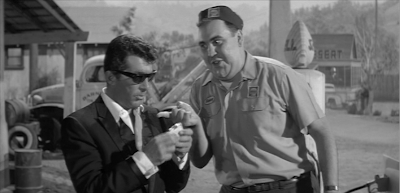
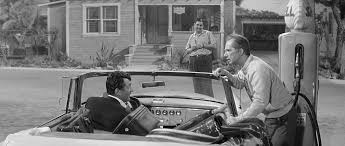
The plot had cobwebs all over it long before Wilder and collaborator I.A.L. Diamond, adapting an Italian play, started typing it. Dino leaves Vegas in his Dual Ghia convertible, bound for LA and the start of filming. But he gets detoured into tiny dirt-road Climax, Nevada.

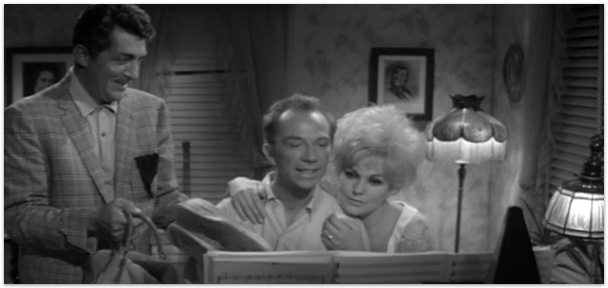
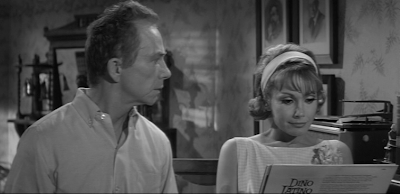
That’s where a wily mechanic (Cliff Osmond) conspires with his songwriting partner, the local piano teacher and church organist (Ray Walston) to waylay him so that they can pitch their mostly-inane/wholly-derivative songbook to a captive (a sabotaged car) audience.

The “wrinkle” in all this is that for their scheme to work, they have to satiate the incurable womanizer with “some action.” As Dino is put up in piano teacher Orville’s house, he’s sure to put the moves on Orville’s wife Zelda (Felicia Farr). And as Orville’s already insanely jealous and suspicious of her, that’ll never do.

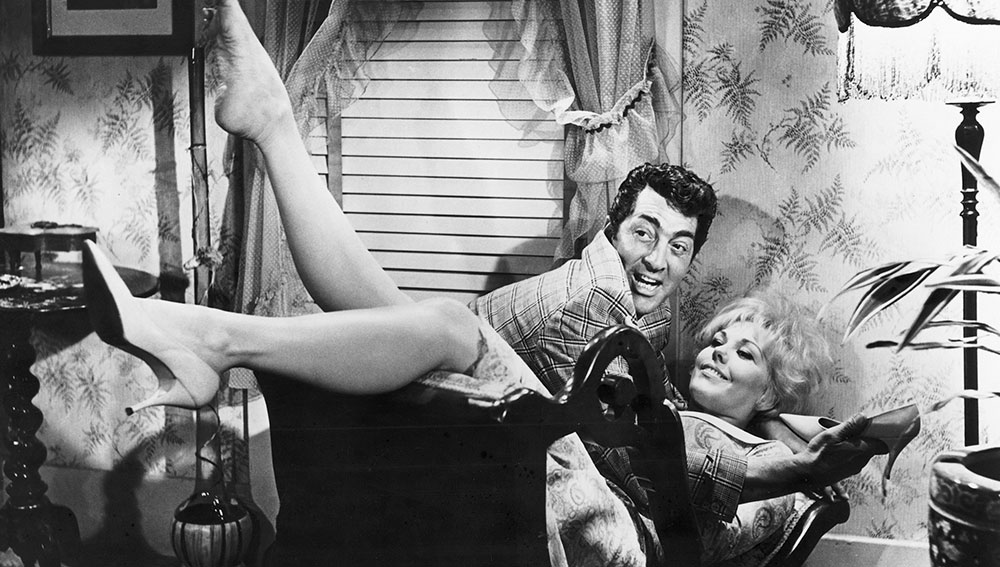
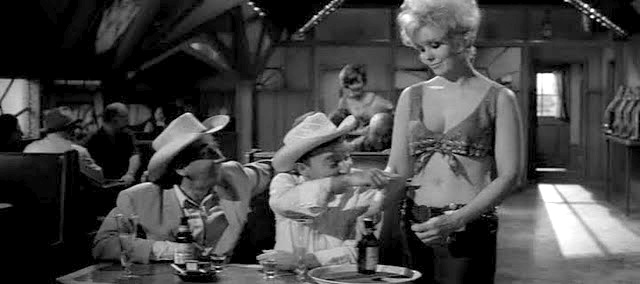
Mechanic Barney recruits cocktail waitress Polly the Pistol (Kim Novak, slatternly slinging an amusing gum-snapping accent) to pretend to be Zelda, and Orville picks a marriage-threatening fight with his wife to send her “home to mother.”

The way’ll be clear for Dino to make his move, and for the song-pitchers to make theirs. So they think.

The sexuality in this movie was fairly daring for the time, even considering Wilder’s previous film (“Irma la Douce”) was about hookers in Paris. It’s implied that Polly puts out for a price, although she makes it clear she ain’t “easy.”

The comedy is pitched broad and low for a Wilder farce — lots of leering from guys (Osmond, Walston and Martin) who know how to mug. It’s as if they know the zingers need some help to land.

 “I need another Italian song like a giraffe needs a strep throat… If it weren’t for Venetian blinds, it’d be curtains for us!”

The best joke in it sounds like one Martin made up on the spot, at a police roadblock.

“What’sa matter? That Sinatra kid missing again?”

Although there’s a chuckle here and there, everything about “Stupid” seems hoary and moldy and dated before a camera ever rolled. It’s self-aware enough to recognize that tumbleweed Tin Pan Alley wannabe songsmiths were a thing of the past in a post-Beatles-and-Dylan young singer-songwriter age. But the transition was so rapid that “Kiss Me, Stupid” had no hope of a shelf life, even back then.

The partner-swapping stuff may have seemed “daring,” but the way it’s played here is tacky, not titillating.

It’s not until you reach into the film’s history and realize there were casting issues which contribute to its clunkiness that all becomes clearer.

Peter Sellers had the Walston role, and had a heart attack a few weeks into filming. Walston was a funny man, at home in musicals on stage and screen. But the singing wasn’t what made the character, and Wilder stupidly had him dubbed with another singer’s voice in any event. Walston was never in Sellers’ class as a comic. How would Martin have played off Sellers? It might not have worked at all, but we’ll never know.

Novak is game, and aside from Martin, the best player in the picture. But it’s a superficial turn in a role that demanded more Shirley MacLaine vulnerability. Marilyn Monroe and Jayne Mansfield were both set to play the part which delays, death and a pregnancy prevented. MacLaine was pitched the “Zelda” role, initially. Mrs. Jack Lemon, aka Farr, got the role.

All the detailed, contrast-rich black and white cinematography guaranteed was that future HDTV generations would notice how poorly the makeup hides how bad everybody’s skin was.

The Catholic Legion of Decency condemned the film, everybody kvetched about the “bad taste” of it all. But the satiric target — American mores — is broad and the laughs just don’t land.

The thing that’s obvious watching “Kiss Me, Stupid” now is that the passage of time and shifting of societal mores aside, “restored” scene or not, the damned thing just doesn’t play. It’s two hours and five minutes of compromised comedy that never finds a rhythm or a reason it needed to be filmed.

Rating: approved, quite racy and sexual for its time

Cast: Dean Martin, Kim Novak, Ray Walston, Felicia Farr and Cliff Osmond, with Barbara Pepper, Mel Blanc, John Fiedler and Howard McNear.

Credits: Directed by Billy Wilder, scripted by Billy Wilder and I.A.L. Diamond, based on a play by Anna Bonacci.

Running time: 2:05

Posted in Reviews, previews, profiles and movie news | Comments Off on Classic Film Review: Billy Wilder’s “Kiss Me, Stupid (1964)” reconsidered