Movie Review: A strikingly unaffected performance in an aimless ramble — “Italian Studies”

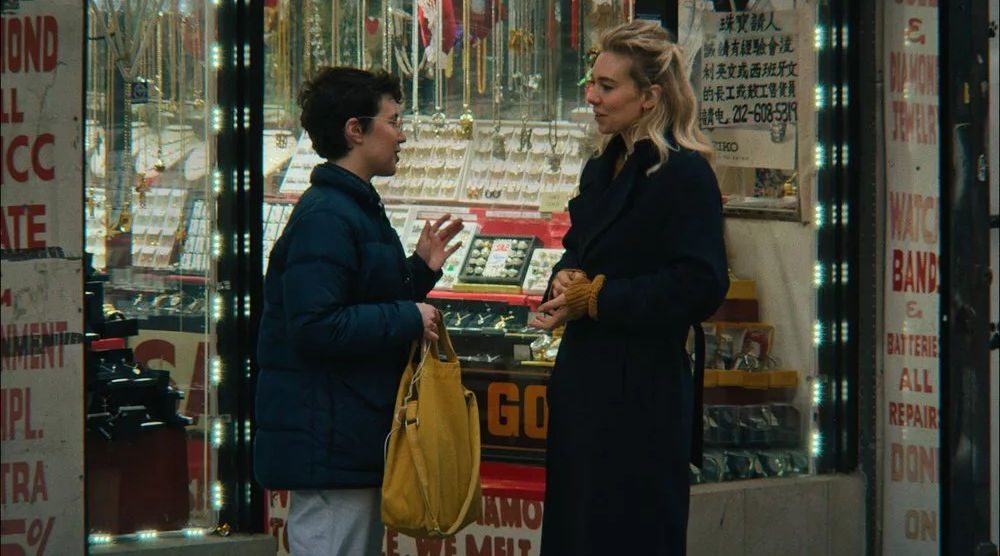
It begins with that socially awkward moment, a “Do you remember me?” that quickly transitions from embarrassment to “triggered” for the 30ish writer Alina. A Londoner whose latest collection of short stories, “Italian Studies,” has gained her a measure of fame, she’s wrong-footed and rattled by that simple question.

Hanging around a recording studio, listening to a very young woman put down backing tracks in that baby dollish imitation Ariana style, Alina ducks outside to bum a smoke. And the barely-out-of-her-teens young woman who provides it opens the door on a blank spot in her life.

It was in New York, remember? You came with Simon. “You don’t remember Simon? How’s that possible?”

Alina struggles, admits confusion and wonders, “Wait, was that when I lost my dog?”

“Italian Studies” is an ambling, almost aimlessly wandering flashback of a movie, an immersive yet arm’s-length recollection of the time the writer’s mind went blank after ducking into a Manhattan hardware store and forgetting her the tiny poodle she left tied up outside.

Writer-director Adam Leon (“Tramps”) drops Vanessa Kirby (“Pieces of a Woman”) into an alien milieu, a woman of looks and means and fame who has so lost her bearings she can’t feed herself, can’t get back into the place she where she seems to remember she’s staying.

Young Orthodox men on the make harass her on the street. “Are you Jewish?”

“I…I don’t know.”

Every encounter, including the come-on of 20ish weed dealer and Sea Papaya hot-dog hustler Simon (Simon Brickner) begins oddly and continues awkwardly because Alina can’t disconnect, can’t remember entirely who she’s supposed to be and cannot find her footing in the conversation, the city or her reality.

She stops in a library to read a bit from her book, chuckling at lines she forgot she wrote, and distractedly autographs it. That gets her into an argument with a patron who wants to stop her from defacing public property. She steps into a bodega and tries to beg-without-begging for some ramen noodles. There’s privilege and desperation in this simple “I forgot my purse” (and most everything else) encounter. She can’t sweet-talk-from-a-beautiful-woman her way into her hotel room either, and sleeps in the stairwell.

Not that she looks like it on her perfectly-put-together walk through the next day.

The way I read her ramble is that all Alina has to fall back on is her process, one thing she remembers she did and that might retrieve some of her reality. She’s a writer. She talks to people, young people apparently. So that’s what she does, asking questions like “Have you ever been in love?” She engages in conversation after conversation, cadges drinks in a club and hears out the passions and anxieties of a generous sampling of 20ish New Yorkers.

Leon’s filming strategy is to overhear some of this — capturing a conversation from across the street at times. He mostly focuses on his movie’s reason for existence — he talked “It” girl Vanessa Kirby into doing this — and she lets us see a woman struggling to recover who she is, what her own passions are, what she remembers that pisses her off. Being called “unoriginal,” for starters.

None of it adds up to much of a movie. “Italian Studies” is more an experimental collection of filmed conversations, filmed docu-drama style, interspersed with clips of a gorgeous blonde wandering New York. But because it stars Vanessa Kirby…

Rating: unrated, smoking, drug use, profanity

Cast: Vanessa Kirby, David Ajala, Simon Brickner, Maya Hawke

Credits: Scripted and directed by Adam Leon. A Magnolia release.

Running time: 1:21

Posted in Reviews, previews, profiles and movie news | Comments Off on Movie Review: A strikingly unaffected performance in an aimless ramble — “Italian Studies”

Netflixable? Basque town dreams of becoming “The Little Switzerland”

Doggone it, this comedy should have worked better, ticked-over like a fine Swiss watch.

The Little Switzerland,” an Around the World with Netflix farce from Spain, is about a mountainous Basque town long frustrated in its efforts to be recognized and governed by Basques. A solution to their identity and self-determination crisis falls in their lap when they discover they’re the burial place of legendary Swiss hero William Tell.

“The apple fellow?” Si. The apple fellow.

It’s no longer “We are NOT Spain,” it’s “We are NOT Basque,” and “Damned if we aren’t SWISS.” We’re set up for a culture clash comedy among the national identity obssed/proud — sometimes violently so — Basques swallowing that pride to take up yodeling. Tell me that’s not hilarious, at least on its surface.

But five credited screenwriters throw one monkey wrench after another into a lean and comically promising narrative — subplots about a love triangle, a spy, competing “identity” agendas, dogmatic efforts at sabotage, ETA (the Basque version of the IRA) bombs and a gun smuggling priest. The picture grinds its gears, time and again, losing what’s “funny” in favor of all sorts of distractions, all of them humdrum when compared to the Big Idea that this is supposed to be built around.

The TV reporters have shown up in tiny Telleria for what they expect will be a real celebration. The town will finally be recognized as Basque and “NOT Castilian.” The mayor (Ramón Barea) is swelling with pride. Representatives from Madrid and the autonomous Basque capital of Vitoria-Gasteiz have negotiated, the Basque president is due to speak.

Only he doesn’t. The two government entities made a backroom “deal.” The always-ignored village, in dire need of a new high school, a snow plow and repairs to its ancient cathedral, got screwed-over again.

But at that same moment two grad students in archeology, Yolanda and Gorka (Maggie Civantos, Jon Plazaola) show up. They’re here to do a little work in that academically picked-over church, which dates from Romanesque times. Clumsy Yolanda crashes through the floor into an ancient crypt. Clumsier Gorka and the priest (Secun de la Rosa) join her and there it is, inscribed in Latin on the burial chamber.

This “city of Tell” that they live in? It was named for “the apple fellow.” It must have been Swiss, a canton of the Helvetica Confederation . They should be calling themselves Swiss and their town “Tellstadt.”

A legation goes to Switzerland, shedding their traditional Basque txapela cap for Tyrolean. “You don’t speak our languages, you don’t share our customs, you are not Swiss,” they are told. Not that they hear this.

“I speak a little Swiss — Nestle, Rolex…RIiiiicola!”

Next thing we know, Telleria is thrown into a tizzy of a makeover — from flags and outfits to wines and changing the size of their beer steins. They even do an online promotional music video. Spaniards aren’t natural yodelers, and apparently, neither are the Basques.

All of this stuff leads to in-town in-fighting, lots of swearing and “We won’t stand for this” (in Spanish and Basque, or dubbed English) by the pro-Spain and pro-Basque factions.

The foul-mouthed priest figures he needs to unload the cache of machine guns hidden in his church before the ever-neutral/hide-your-money-from-the-taxman Swiss take over.

All of that stuff is funny, or on the cusp of it. The love triangle involving Gorka, who is the mayor’s son BTW, and his old love Nathalie (Ingrid García Jonsson) and new “work partner” Yolanda, isn’t.

The faintly-menacing priest and aged locals who have a lot of experience building bombs and setting guard shacks on fire — the guards are now in ornamental, Papal “Swiss Guard” uniforms — give the picture an edge. They’re making Irish comedies poking fun at the IRA. Why not mock ETA and the whole Basque identity thing?

But every time we get a hint of just what the very particular Spanish Basque must do to “adapt our cuisine” and “adjust our schedules” (no siestas, for starters) and how irked they are about it, the picture wanders off subject into a romance that is so clumsily set up and under-motivated that we never invest in it.

It’s no fault of the cast, who are — younger and older — game and able to wring at least a grin out of a few scenes that might have otherwise fallen flat without their efforts.

Show us more outrage over the loss of tapas, jamon and rioja wines! Fight about the headwear, the rich culture that gave the world Picasso and Cervantes forced to embrace the simple chocolatier cuckoo-clock making-bankers!

“The Little Switzerland” could have been a new “Mouse that Roared,” “Coca Cola Kid” or “Local Hero.” What this culture clash comedy isn’t is a lot more promising than what it is.

Rating: TV-MA, lots and lots of profanity, implied violence

Cast: Maggie Civantos, Jon Plazaola, Ingrid García Jonsson, Secun de la Rosa, Kandido Uranga, Enrique Villén and Ramón Barea

Credits: Directed by Kepa Sojo, scripted by Kepa Sojo, Sonia Pacios, Jelen Morales, Daniel Monedero and Alberto López. A Netflix release.

Running time: 1:26

Posted in Reviews, previews, profiles and movie news | Comments Off on Netflixable? Basque town dreams of becoming “The Little Switzerland”

Movie Review: Amateurish, clunky “The Contrast” revives a 235 year-old stage comedy

The Contrast” is a slight, slim comedy of manners that is widely considered the “first American comedy,” as it was written and produced on the stage in 1787, and George Washington was among its first fans.

It’s an arid, dry romance about almost-marrying a cad, a plot Jane Austen would recognize, writing as she did on the other side of the Atlantic. That timeworn scenario is updated for a new film that is easily the most amateurish, excruciating dud I’ve sat through since my days helping judge student film competitions.

“Contrast” reminds one that a movie can indeed be “instantly awful,” with the proof here coming from the incompetently-selected, almost-unreadable font for the opening credits. The fact that those credits plug the play that is the film’s source material as dating from “1778” and not “1787” tells you all you need to know.

Nobody even bothered to proofread the GD opening credits.

The setting — the blandest piece of flat California farm country (I’m guessing)– is revealed behind those credits. The players are almost to a one, dull and unskilled. And the writing? It’s a daft blend of contemporary concerns saddled to a 235 year-old “arranged” marriage story, complete with an 18th century style love-letter that gives away the caddish groom’s taste for one of the bridesmaids.

“For lady you deserve this state, nor would I love at a lower rate,” why it’s enough to make a lady take the vapors! “But at my back I will always hear times’ winged-chariot hurrying near.”

Well, that’s sure to infuriate the bride (Joy Villa), about to marry the rich cad (Lee Donahue) to please her marry-for-money Dad (Lance E. Nichols). Will it be enough to make her follow her heart? This guy promises security and a lifetime of cheating. What Maria (Villa) wants is “butterflies.”

Jermain Hollman plays an Army Colonel, sibling to a bridesmaid (Deanna Rashell), who rolls up and is instantly smitten with the bride-to-be.

And director Sean Dube pops up as a Brit-accented debt collector who buddies up to our would-be groom for all-too-obvious reasons.

The Royall Tyler Inn, taking its name from the judge and playwright who wrote “The Contrast” way back in 1787, is where the wedding is to take place. Curiously, for all this trouble, nobody seems to have checked it out in advance, raised an eyebrow that its driving range (golf) and shooting range (skeet) are one in the same, that its staff consists of one surly, lazy nephew of the owner and that the bride and groom have been booked into a cramped attic room.

I could go on, but nobody’s going to read this, much less rent the movie it’s about. Suffice it to say, every clumsy bit of mugging, every tin-eared line, every new scene is its own reason to groan.

If the 235 year-old play this is based on is as bad as this production, I think I’ve discovered the origins of the phrase “George Washington slept here.”

Rating: unrated, PGish

Cast: Joy Villa, Jermain Hollman, Lee Donahue, Lance E. Nichols, Deanna Rashell, Thahn Ta and Sean Dube.

Credits: Directed by Sean Dube and Presley Paras, scripted by Chris Johnson, based on a play by Royall Tyler. A Mill Creek release.

Running time: 1:22

Posted in Reviews, previews, profiles and movie news | Comments Off on Movie Review: Amateurish, clunky “The Contrast” revives a 235 year-old stage comedy

Movie Review: Mickey Rourke sends troops to fight Nazis…and witches in “Warhunt”

When it comes to casting your B or C movie, it always helps to have a “name” you can use to get the thing funded. Here’s a hot hack for that process. Give Mickey Rourke an eyepatch and a check and he’s there.

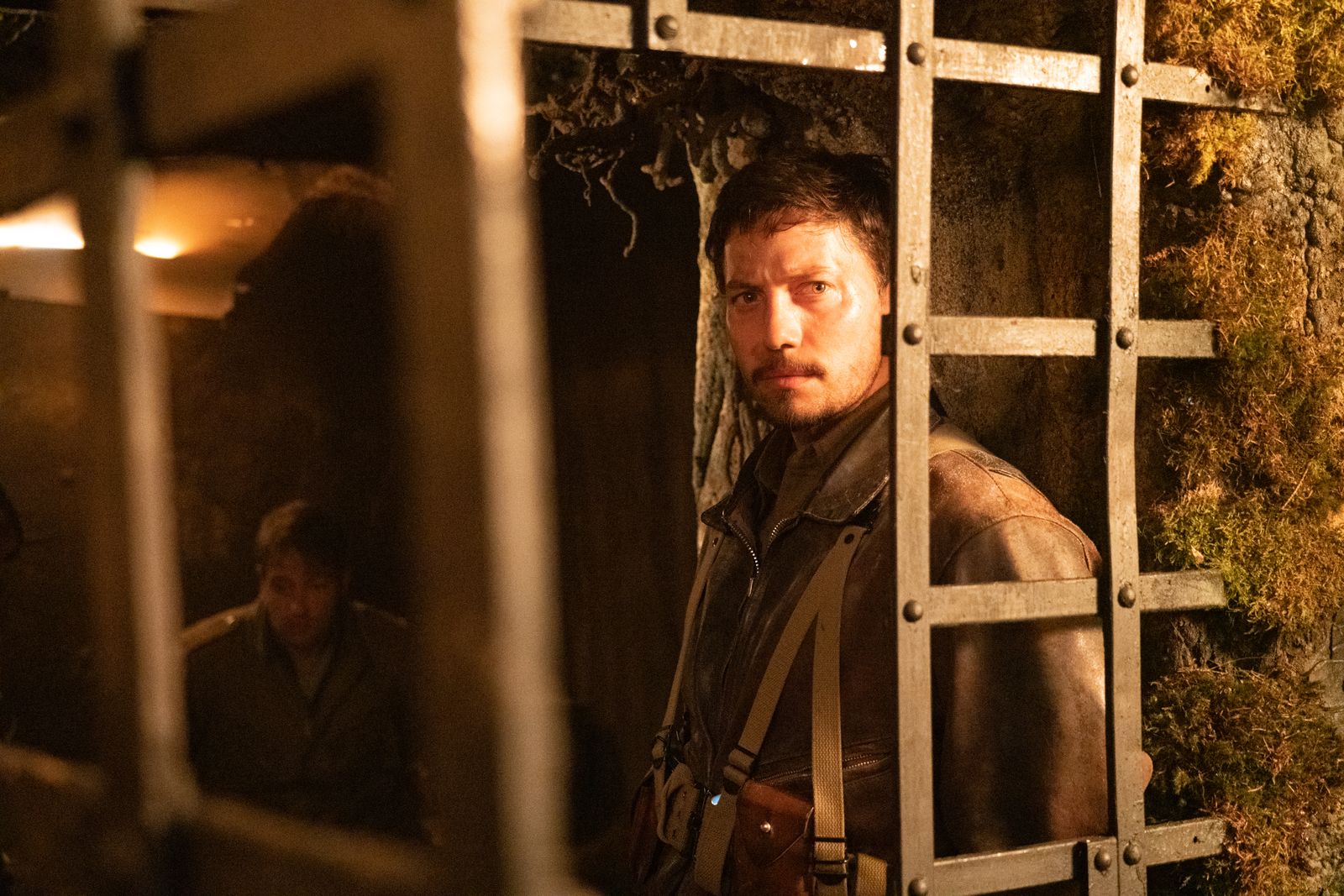
In “Warhunt,” Rourke plays an American Army major who sends his crack squad into the Black Forest in Germany to retrieve lost film footage.

We all know that Rourke looks like no WWII officer we’ve ever seen — black leather jacket off the rack, long hair with the face of a lifetime of hard living and the third best plastic surgeons money can buy. But as his soldiers, including Jackson Rathbone as his personal representative in the field and Robert Knepper as the Sgt. who leads the veteran troop, are about to tangle with witches, Rourke probably shrugged that off, as did the production team.

That’s about as attentive to detail as this Latvian production was going to get. Check out the oversized wristwatch Rourke wears, the tape recorder officials back at HQ listen to, etc. Anachronisms weren’t anybody’s pressing concern.

The troops, led by Sgt. Bower (Knepper). are to parachute into the Black Forest to “rescue” a previous airlifted squad brought down there. But a murder of crows — or something like that — brings down their plane as well. They find German soldiers hung upside down, here and there, see stick figures and hear the sirens’ song of assorted weird sisters (Lou Hassen and Anna Paliga among them).

And they can’t navigate their way through all this or get to the survivors of the other squad because something is making them hike in circles. That’s why the major sent the surveyor Walsh (Rathbone) with them. He’s handy not just with a compass, but with a solar compass.

What can go wrong?

The dialogue is peppered with “This ain’t no opera” and “What’sa matter, Walsh? Forget to get shot?”

Inexplicably, Rourke’s Major decides he’s going to “get my boots a little dirty,” and doesn’t need an airlift to join the fray.

There have been Nazi zombie movies and the like for decades now. “Warhunt” seems to have been dreamed up as a no-budget variation on an “Overlord” theme.

The action beats are mostly mundane, there are captures and escapes and the payoff isn’t worth anything we’ve sat through leading up to it. “Warhunt” is never wholly incompetent, never “so bad it’s good” or anything of the sort. Even by the lowered standards of “a C-movie starring Mickey Rourke,” it’s never more than a waste of 90 minutes.

Rating: R for violent content, language and some sexual references

Cast: Mickey Rourke, Jackson Rathbone, Robert Knepper, Lou Hassen and Anna Paliga

Credits: Directed by Mauro Borrelli, scripted by Mauro Borrelli, Reggie Keyohara III and Scott Svatos. A Saban Films release.

Running time: 1:36

Posted in Reviews, previews, profiles and movie news | Comments Off on Movie Review: Mickey Rourke sends troops to fight Nazis…and witches in “Warhunt”

Netflixable? Would it land a laugh in Mexico? “This is Not a Comedy (El comediante)”

Kudos to whatever outsourced functionary working for Netflix who changed the title of the Mexican film “El comediante” to “This is Not a Comedy” for Norte Americano consumption. That’s truth in advertising. And I’m just guessing here, but I’ll bet she made that switch after watching it.

There’s a scene in this rambling, shapeless, shrug of a movie about a hapless and mopey “comic” who gets his script — OK, it’s a disorganized “idea” for a script — critiqued by “Cannes prize winner” Atom Egoyan. The Canadian director of “Sweet Hereafter” and “Ararat” is played by some Euro-accented actor named Thorsten Englert.

“That doesn’t sound like a movie to me,” he says to Gabriel, the comic we see few people laughing at in his stand-up bits. “It sounds like an anecdote.

As the actor playing Egoyan is speaking to the co-director, co-writer and star of “This is Not a Comedy,” Gabriel Nuncio, that moment has a “meta” quality. Because if nobody else alerted this cabron to this simple fact, at least he scripted somebody into his movie to state the obvious.

“Not a Comedy” follows Sad Sack “Gabo” through desultory stand-up sets, which might have a laugh or two about his “loca” girlfiend — Leyre (Cassandra Ciangherotti). Not that such laughs are captured on camera.

She’s a ukulele-playing flake from Madrid who insists she’s about to be taken off by aliens. And she doesn’t take being mocked from the stage well. Perhaps if the bit had actually been funny she’d have been more forgiving.

Gabo is broke, can’t pay his bills, has this cute other friend (Adriana Paz) who is ready to have a baby, but who wants his “sperm” and “nothing else” (in Spanish, with English subtitles).

“But I could be a daddy!”

He has the hope of getting his “not a comedy” screenplay critiqued by Atom Egoyan as part of this competition. A friend controls the script selection process, and finally, a spot opens up.

“What happened to the other writer?”‘

“He died. The jerk.”

“Not a Comedian” follows Gabo through his days, visiting a dying uncle he hasn’t seen in years, correcting every single person who thinks he moved to Mexico City from Monterrey. Tampico?

He has to lie when he speaks with the uncle who dies after chatting for less than a minute. The uncle’s last words were “notes” on the dope’s script — “Make sure it has a happy ending.”

Everybody he meets gives him notes on that unwritten script, except for the locksmith he keeps calling when he locks himself out. Mr. Locksmith offers furniture re-arranging tips because Gabo’s feng shui is all effed up.

To prove himself to the sperm-craving friend, Gabo impulsively adopts a dog, which he names something “offensive.”

To prove himself to Atom Egoyan, and doesn’t accept the critique. “I disagree.”

I got next to nothing out of this movie, which features dream sequences of Gabo re-imagining his script in sci-fi terms, taking into account what Leyre babbles on about. There’s a gay breakup he’s forced into the middle of, and a ritualistic lakeside funeral he takes in.

He tinkers with his stage act, which doesn’t perk up as Gabo adds music and a puppet to his routine. This Nuncio fellow may be a laugh riot in Viejo Mexico. If so, pretty much everything that would prove that is lost in translation.

If there was a chance at a saving grace in “El comediante,” it might have been in talking the real Atom Egoyan into playing an arrogant and “Cannes award-winner” version of himself. They couldn’t even manage that.

Take the title at its word.

Rating: TV-MA, adult situations

Cast: Gabriel Nuncio, Cassandra Ciangherotti, Adriana Paz, with Thorsten Englert as Atom Egoyan.

Credits: Directed by Rodrigo Guardiola and Gabriel Nuncio, scripted by Gabriel Nuncio and Alo Valenzulea. A Netflix release.

Running time: 1:46

Posted in Reviews, previews, profiles and movie news | Comments Off on Netflixable? Would it land a laugh in Mexico? “This is Not a Comedy (El comediante)”

Movie Review: “Old Strangers” reunite for a Creature Feature

Old Strangers,” a thriller awkwardly resembling a “creature feature,” and even more awkwardly labeled a “thriller,” falls somewhere on the student film/relatives-wrote-me-checks-so’s-I-could-make-a-movie spectrum of ineptitude.

The fact that it’s listed as the third film, stretching back over 15 years, of writer, director and producer Nick Gregorio, just doubles down on disheartening. It’s not scary. It’s poorly-acted. There are no-budget-film continuity blunders. Why-oh-why was this picked up for release?

It’s about three college pals — Ted Evans, Madeleine Humphries and Colton Eschief Mastro — who celebrate the end of quarantine by meeting up at a cabin at Big Bear Lake, the over-filmed mountain forestland well inland from LA.

Mikey (Evans) is “kind of more of an IN-doorsman,” Sarah (Humphries) has an Only Fans page devoted to people willing to pay to see her feet and Danny (Mastro) is the one who allegedly has outdoor skills.

They fill the quiet forest with blithering banter, hike in the few spots that show any hint of snow (a radio ski report underscores the drive up) and stumble into what they take to be “insect” eggs, or “somebody’s art project.

It isn’t. Somebody gets stung. And not heeding the plea “Don’t TOUCH it” means “If this is a horror movie, YOU’RE dying first.”

“I think my favorite moments are when we get a tiny taste of effects “explaining” where these “eggs” came from, and a moment when Sarah (Humphries) scrunches up her eyes to concentrate ever-so-hard so that she can remember every “clue” from the scattered (flashback) bits of foreshadowing so that she can understand it all.

Bless her heart.

Rating: unrated, graphic violence, profanity

Cast: Ted Evans, Madeleine Humphries and Colton Eschief Mastro.

Credits: Scripted and directed by Nick Gregorio. A Gravitas Ventures release.

Running time: 1:02

Posted in Reviews, previews, profiles and movie news | Comments Off on Movie Review: “Old Strangers” reunite for a Creature Feature

Classic Film Review: The Michael Caine that Got Away — “A Shock to the System (1990)”

It came and it went, without most anyone noticing.

“A Shock to the System,” a deliciously dark comedy in a minor, murderous key, is one of the many minor gems on Michael Caine’s cinema resume.

But what those of us old enough to recall seeing it in a theater was how lucky we were. The distribution was haphazard, at best, and we only knew about it because Siskel & Ebert championed it from the bully pulpit of whatever TV show they were doing at the time.

Caine plays Graham Marshall, a Brit in American marketing, a husband in a dysfunctional marriage and a man with a murderous interior life.

The Jan Egleson film, based on a Simon Brett novel, opens with Graham in the basement of his rail-commute Jersey suburb, grabbing a pipe to steady himself as he turns on a light, and getting a serious jolt.

It’s like an epiphany to him. Here he is, on his umpteenth attempt to restart the power after his monied ditz of a wife (Swoosie Kurtz) has popped it off with her latest stairmaster, trapped in a big mortgage with two giant poodles, depending on a long-overdue promotion to get right.

And when that promotion doesn’t come, that epiphany takes shape in his interior monologues.

“He’d always fancied himself a sorcerer.”

It’s 1990, and the younger subordinate (Peter Riegert) with computer tracking ideas he barely understands gets promoted over Graham. The “vibrant and youthful” Benham is always going on and on about his sailboat, popular and a bit of a kiss-up. Until the promotion. Graham’s very bad day includes hearing his old boss and confidante (John McMartin) is out, and that instead of using his shiny gold lighter to torch old George’s cigars, it’s Benham who expects that form of kowtowing.

Graham is in no mood to be panhandled on the subway, and a rash moment has him shoving a homeless man in front of a train. He thinks. He can’t be sure that even happened.

But when the spendthrift wife brown-noses the new boss for him, and cluelessly crosses some other line, Graham’s murder-my-way-to-the-life-I-deserve spree begins.

Elizabeth McGovern is the fetching office assistant who lets him know, in no uncertain terms, that she’d welcome the pink-hued Great Brit twice her age’s advances.

And Will Patton is the curious, not-entirely-overmatched cop who asks a few questions after the first mysterious death in Graham’s life, and gets more blunt after the next.

“You know, sudden death hasn’t been all that bad to you.”

Seeing this film again, decades later, one might be struck by Graham’s tendency to go nuclear — loud bursts of Michael Caine barking at the wife, the new boss. He’s a dangerous character from the start, and if we’re rooting for him, it’s because Graham is played by Michael Caine. There’s just enough “plotting” in his interior monologues, and the grin he wears when he gets the phone called “news” of his wife’s death is wicked fun.

The script has a jerky quality, as does the film. Riegert’s evil-new-boss character is painted in subtle shades that make him a fitting, if perhaps not-entirely-deserving object of Graham’s wrath. The whole Caine/McGovern thing is believable, thanks to her efforts. It’s still icky on several levels.

“Shock” is the lone highlight of Egleson’s resume, novelist Simon Brett is strictly a genre writer and screenwriter Andrew Klavan morphed into a sort of right wing crank, author of the anti-abortion screed “Gosnell” and host of podcasts.

But the film came along at a time when Caine had lost his box office/leading man status, adrift in “Dirty Rotten Scoundrels,” “Mr. Destiny” and “Noises Off” flops, almost a decade before his “Cider House Rules” comeback. The reason Siskel & Ebert championed it is still relevant. Given anything at all interesting to play, the man always delivered the goods.

As Caine’s working life winds down — He’s not REALLY doing “Now You See Me 3,” is he? — “Shock” is worth dropping in on to remember Caine’s work ethic, his willingness to take chancy material and attempt to elevate it and the fact that he so often succeeded.

Rating: R, violence, profanity, smoking, sexual situations

Cast: Michael Caine, Elizabeth McGovern, Swoosie Kurtz, Peter Riegert, John McMartin and Will Patton.

Credits: Directed by Jan Egleson, scripted by Andrew Klaven, based on a novel by Simon Brett. A Corsair release on Tubi, Amazon etc.

Running time: 1:28

Posted in Reviews, previews, profiles and movie news | Comments Off on Classic Film Review: The Michael Caine that Got Away — “A Shock to the System (1990)”

Today’s DVD Donation? Is “Sobo” up for “Wheel of Fortune and Fantasy?”

Today’s Roger DVDseed donation — in which I donate a disc to a public library I pass by, spreading fine cinema across America, one disc at a time — is a movie I just reviewed, now on BluRay via Film Movement.

Wheel of Fortune and Fantasy” is one of two films by Japanese auteur Ryûsuke Hamaguchi released last year. The longer “Drive My Car,” about an actor/director rehearsing a play in the Japanese hinterlands, reconsidering his life and marriage on daily rides to the theater in which a young chauffeur is contracted to drive his beloved Saab 900 Turbo, is getting a lot of Best International Feature Oscar buzz. But the shorter “Wheel” makes a fine companion piece and introduction to Hamaguchi’s slow, talky and contemplative cinematic style.

Today’s lucky library? It’s the newly-built version of the small-town library I grew up with. South Boston — the one in Virginia — was a provincial tobacco-and-textiles town when I lived there. Culture was pretty hard to come by.

But after school, I could duck into an oasis of books, and a collection of magazines that I tore through once I discovered the film reviews of Pauline Kael, Stanley Kauffman and (in book collections) Andrew Sarris.

Many of the movies they reviewed might not be remotely accessible in that pre-Internet, pre-DVD, pre-VHS era. The local cinema was closed for years at a time, but re-opened intermittently enough for me to get bitten by the movie buff bug. Visiting the library afforded me the chance to read interesting criticism about all the movies small towns like mine would never see…until technology intervened.

So, as I say in all of these “donate a DVD to a library” posts, we all owe libraries a lot, me more than most. Pay’em back in DVDs.

Let’s hope somebody here in “Sobo” checks out this new BluRay and a little light bulb goes off for them the way it did for me.

Posted in Reviews, previews, profiles and movie news | Comments Off on Today’s DVD Donation? Is “Sobo” up for “Wheel of Fortune and Fantasy?”

Netflixable? A Dominatrix is dead? Alyssa Milano’s on the case, and “Brazen” about it

We’ve figured out where the murder mystery/thriller “Brazen” is going long before our heroine finds herself in the presence of the murderer in the “explain it all” talk talk talk finale. Truth be told, there aren’t a lot of surprises in this slow-pokey Alyssa Milano star vehicle for Netflix.

When you’ve cast the beautiful “Charmed” and “Insatiable” alumna as a murder mystery novelist whose sister, a school teacher who moonlighted as an on-line dominatrix and was murdered, there’s plenty for the viewer to take for granted.

The novelist will somehow wrangle a way to “contribute” to the case, preferably with the hot police detective neighbor (Sam Page of TV’s “The Bold Type”), even if it’s the D.C.P.D. we’re talking about and not some suburban “Murder, She Wrote” sheriff’s dept. And considering what her sister (Emilie Ullerup) was up to in her spare time, in her spare room/streaming video studio, you can pretty much start the countdown on when Milano will vamp up in vinyl and give a whip and a push-up bra a workout.

Perhaps the biggest surprise to “Brazen” is that Milano, director Monika Mitchell and three credited screenwriters tried to get something lurid and sexy out of a movie with a Hallmark Channel (TV-14) rating. Failing to accomplish that is no surprise at all.

Novelist Grace Miller has “an instinct for motivation, it’s why my books are so successful.” Her specialty?

“You make a fortune writing about women getting murdered,” her sister Kathleen cracks. Sis has barely summoned Grace “home” for a planning session on a child custody fight she’s about to wage and Grace has barely flirted the evening away with hunky/handyman Det. Ed (Page) who lives next door, when Grace walks in to find Kathleen dead on the floor.

The gulping, wordless meltdown Milano plays in that scene is her best acting in the movie and perhaps the most defensibly logical moment in it. It’s how anyone would act.

Much less logical is the way she tries to arm-twist that detective and his partner (Malachi Weir of TV’s “Billions”) into letting her in on their investigation. Even if their boss (Alison Araya) is a fan, Grace the fiction writer rules herself out with her reasoning for inclusion.

“It’s real, and it’s personal.”

“Brazen” proceeds thenceforth from three points of view. We follow the cops and Grace following her “instincts” to serve them up a list of suspects (the ex husband, any creep who knew the real identity of online dominatrix Desiree, as her sister called herself). And occasionally we see what the web-savvy is up to, a person fond of hoodies and capable of charging in on a victim mid-“session” for the attacks.

Victim’s cause of death? “Strangulation.”

Every attempt in the script to make this all seem logical plays like cut-rate Agatha Christie — dated, quaint and a tad ludicrous. And Milano’s Grace, given the lines she delivers and the mostly-obvious (or contrived) clues she uncovers, is no Hercule Poirot or Miss Marple.

Still, our star isn’t just TV famous. She’s a Twitter activist with a huge fan base. The instinct to “Let’s build a murder mystery around her for Netflix” is defensible. Maybe she’ll come off better in one with more charm, intrigue and edge to it next time. Titling a thriller about a dead dominatrix “Brazen,” and working for aTV-14 rating? Might as well be making a “Christmas prince” movie for the gift card channel.

Rating:TV-14

Cast: Alyssa Milano, Sam Page, Malachi Wier, Emilie Ullerup

Credit: Directed by Monika Mitchell, scripted by Edithe Swenson, Donald Martin, Suzette Couture. A Netflix release.

Running time: 1:36

Posted in Reviews, previews, profiles and movie news | Comments Off on Netflixable? A Dominatrix is dead? Alyssa Milano’s on the case, and “Brazen” about it

Classic Film Review: Is “Slap Shot (1977)” still “The Greatest Sports Movie” of them all?

It’s been accepted wisdom for much of my adult life that “Slap Shot” is “the greatest sports movie of all time.”

A rude, bloody and irreverent 1970s story of minor league hockey, it was the last time director George Roy Hill teamed up with his on-screen alter ego, Paul Newman. As their other two collaborations were “Butch Cassidy and the Sundance Kid” and “The Sting,” this sports comedy is in good company.

Hill made “A Little Romance” and took a shot at “Slaughterhouse Five” and “The World According to Garp,” so if he’s “underrated” among that era’s top directors, it’s not because he wasn’t trying.

“Slap Shot,” which I hadn’t seen in years — my first exposure to it was when I was projectionist for a screening at the huge, carbon-arc/16mm projector auditorium at my undergrad school — remains a great snap shot of late ’70s American “malaise.” It’s set in fictional Rust Belt Charlestown in the heart of hockey country. Smoke stacks fill the (Johnstown, Pa.) skyline, Old Style signs decorate the bars.

And the Charlestown Chiefs are the only pro game in town, a Federal League team that’s seen better days. Newman plays Reggie Dunlop, the grey-haired player-coach of a losing team, a seen-it-all skater transitioning to “the front office,” his general manager (Strother Martin) assures him.

But the young-yet-jaded “star” of the team, Ned Braden (Michael Ontkean) is the one who sees the writing on the wall. When word gets out that “the mill is closing,” the Chiefs are not long for this world.

Reg is slow to catch on, missing the GM’s phone chats about selling this or that — the team bus, for instance. Braden and a couple of others may have slim hopes of getting called up to the NHL. But for most, in a down economy, even blue collar job options seem delusion.

“Back to the f—–g Chrysler plant!”

The womanizing Reg — Jennifer Warren plays his big-haired hairdresser wife, the one he can’t let himself divorce — comes up with a plan. He plants a rumor (M. Emmett Walsh plays the local sports columnist) that “some retirement community in Florida” wants the team. All it’ll take is a winning streak, a spike in attendance and finding out who actually owns this damned team, and maybe that rumor will come true.

Avid fans of “Slap Shot” know what’s coming, what to wait for in the story. It’s the arrival of The Hansons, three dopey, bespectacled arrested-development Canadian brothers (Jeff Carlson, Steve Carlson and David Hanson) who join the club, cheerlead from the bench and slotcar race in their hotel room.

“I wonder if they show ‘Speed Racer’ here?”

They tape aluminum foil onto their fists and patiently wait for coach to stop saying “These guys are RE—ds!” and give them them the “OK guys, show us what you got.”

Turns out, they’re just the goons this team was looking for. Brawls, cheap shots, penalties and wins follow, with only Braden resisting this sudden change in their fortunes.

“I’m not gonna ‘goon it up’ for you.”

I never realized this was the debut of screenwriter Nancy Dowd, who scripted “Coming Home,” “Swing Shift” and the Richard Dreyfuss horse track comedy “Let It Ride” over the course of a career in which she was often uncredited for her rewrites “(Ordinary People”) or wrote under a male nom de plume (“Let It Ride”).

The nom de plume thing becomes more understandable when you dive into the films. You can’t just blame the boys-will-be-boys director for something you can see in a lot of her scripts. Dowd had a gift for reducing women characters to “types.” The sexism of “Slap Shot,” with the ex who won’t hear of a reconciliation, the “I’ve been sleeping with women” side piece wife (Melinda Dillon, of “Close Encounters,” “Christmas Story” and Newman’s “Absence of Malice”) of an opponent, the smart, crusty and not-as-tough-as-she-looks spouse (Lindsay Crouse, who would marry pre-fame playwright/screenwriter David Mamet later that year) Braden dismisses. Dowd wrote interesting female characters, but had a real gift for women who didn’t measure up to the male ones.

“Slap Shot” proved so tempting to imitate that you can see pieces of it in decades of sports comedies to follow — “Major League,” “Bull Durham,” “Semi Pro,” “The Replacements.” There’s even a whiff of it in the whole owner/coach dynamic of “Ted Lasso.”

But what smacks you right in the face watching this beloved, overlong and uneven picture now are how it reliant it is on slurs for laughs.

Sure, it was a different era. And at least, with its hockey milieu and all-white Rust Belt towns settings, they aren’t racial slurs. It took a long time for most of America to abandon the homophobic and mentally-challenged language that this film pounds away at. I always take into account that my hero James Garner’s Jim Rockford drops the “f-slur” in the pilot of his 1970s TV series when considering “how far we’ve come” in such instances.

But Hill & Co. RELY on these phrases for more of the film’s humor than most of us remember. Sure, there’s a goofy small-city TV interview-with-the-French Canadian goalie (Yvon Barrette) to kick things off. Mooning fans of opposing teams from the windows of the team bus is a timeless laugh. And the damned Hanson Brothers are a hoot in every way and in every scene.

A referee threatens/warns the Hansons about what won’t be tolerated, but makes the mistake of doing it during the national anthem.

“I’m listening to the f—–g song!

Much of the humor is shock-value profanity. We’d never heard Paul Newman talk like this in a movie, and it could be bracing and hilarious.

Other laughs come from Reggie’s play-the-angles manipulations, and the Godawful plaids and brown-leather leisure suits fashions on display. Probably not as funny back then? Sure.

But strip away the slurs and a lot what you/we have laughed at in this comedy over the decades is gone.

And watching it now, the clunkiness of the plot and the meandering story-telling style are thrown into sharper relief. It was hard to chase guys (or have them chase the camera) on the ice when the 35mm cameras weighed that much. There’s one dazzling bit of skating/fight choreography early on, and everything that follows seems geared to hiding just how fast — or slow — the cast (most of them) were on skates.

Crouse would go on to work with Newman again (“The Verdict”) and star in the films of her then husband (“House of Games”). Dillon would make a bigger mark in the films she made following “Slap Shot,” ones in which she was allowed to keep her shirt on. Walsh became one of the most beloved character curmudgeons of the cinema, and Paul Dooley — as a manic play-by-play man calling an on-ice/in-the-stands fight — was immortalized in “Breaking Away” and “Popeye.”

I became a bigger hockey fan after seeing “Slap Shot,” and going to a college hockey power for grad school, I became a lot more discriminating about the action and how games were depicted. Frankly, “Cutting Edge” and other later films had better skating (and editing). For me, the all-time best hockey movie is “Miracle.”

And I’m still waiting for something to surpass “Bull Durham” as the savviest, silliest and most gloriously sentimental sports movie of them all. Real-life jock turned director Ron Shelton, and Costner, Robbins, Sarandon & Co. managed a lot more laughs than “Slap Shot” with nary a “fa—t” or “re—d.”

That film is aging pretty well. But the more time passes, the more this “Slap Shot” seems wide of the net.

Rating: R, violence, nudity, profanity, homophobic slurs

Cast: Paul Newman, Michael Ontkean, Lindsay Crouse, Strother Martin, Jennifer Warren, Jerry Houser, Brad Sullivan and Melinda Dillon.

Credits: Directed by George Roy Hill, scripted by Nancy Dowd. Now on Amazon, Tubi, etc.

Running time: 2:03

Posted in Reviews, previews, profiles and movie news | Comments Off on Classic Film Review: Is “Slap Shot (1977)” still “The Greatest Sports Movie” of them all?