Movie Review: Karen Gillan has a clone problem — “Dual”

Writer-director Riley Stearns picked up on something that he was able to cash in on in casting Karen Gillan in “Dual,” his dark sci-fi thriller about a future when cloned “replacements” take over for the dying. Although he had to — no doubt — be delicate in bringing it up, the Scottish Gillan’s deadpan-to-the-point-of-flat turns when she’s voicing “American” roles in Hollywood films (“Jumanji,” “Guardians of the Galaxy”) made her perfect for the dual roles in this film.

Sounding like an automata seems to come naturally to her.

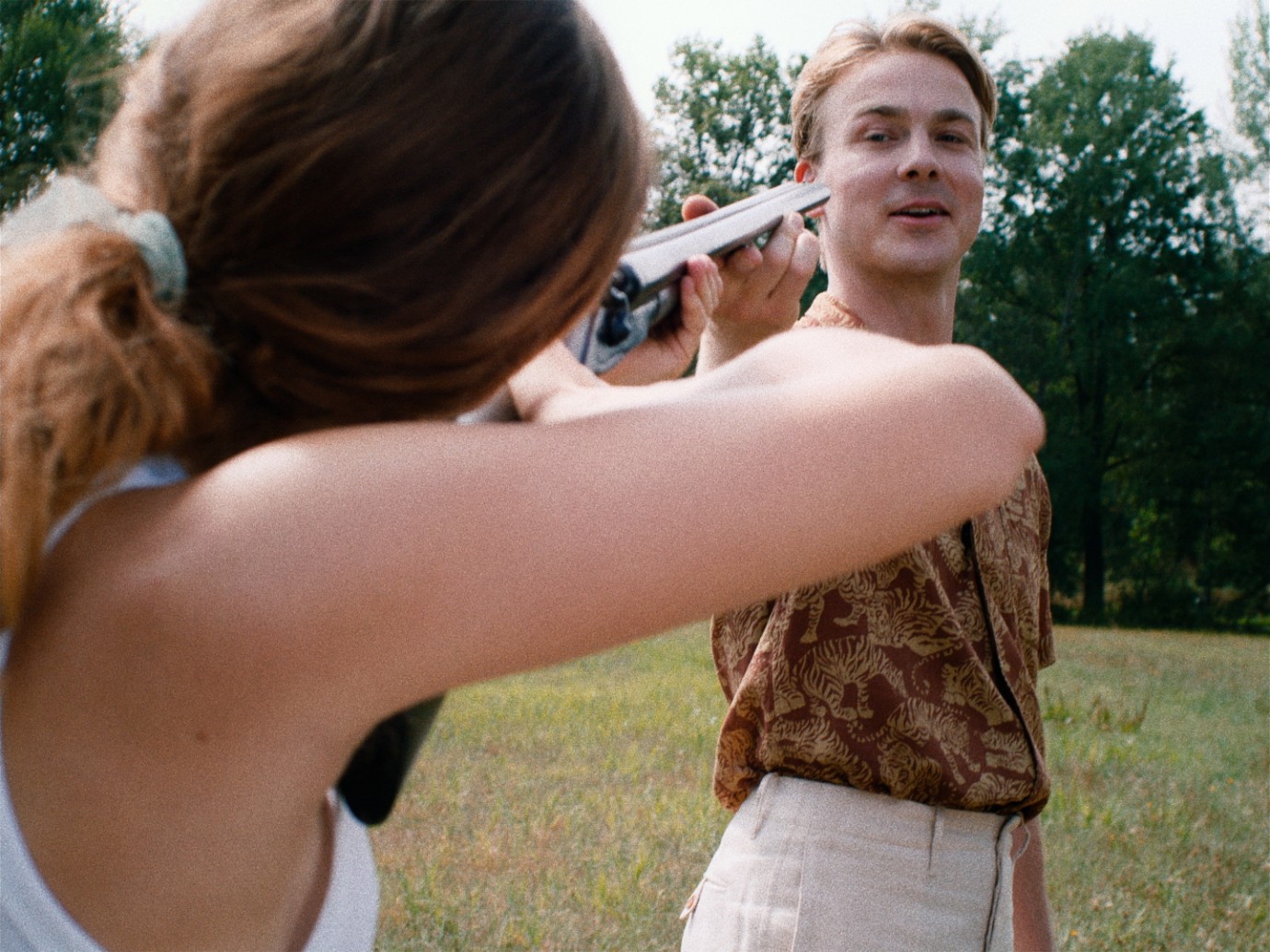
That’s the way almost everyone comes off in “Dual,” whose title is both literal — a company is creating duplicates, who spend “imprinting” time with their dying”originals” — and a pun. When both versions of the same person want to carry on living, the duplicates have rights, among them the right to trial by combat. The winner gets to live the original’s life. The loser dies by the other’s hand.

Filmed in Finland, with a number of British accents in support, almost every character comes off as the way movies and TV depict “on the spectrum.” To a one, they’re blank-faced, with emotionless voices, even when given the worst possible news by the flat-British-accented doctor (June Hyde) who confirms what Sarah’s already heard from her unemotional husband (Beaulah Koale).

“You’re dying.”

Even Sarah’s controlling, martinet of a mother (Maija Paunio) seems like a clone that hasn’t learned to raise or even modulate her voice as she’s criticizing her almost-estranged daughter’s eating and everything else.

Sarah’s own social-signals awkwardness extends to “reading” her chilly husband, who keeps finding reasons to be away from home for work, his distracted, deflecting video calls home making the viewer and Sarah suspicious. Has he checked out of the marriage?

Sarah’s bizarre choice to spend all she has and much of her future earnings based on a sales pitch that ends with “You may be dying, but don’t let that affect those you love most” says more about her lack of sales resistance than her empathy. Who’d want to spare pain to those two?

Her husband taking to her clone during the “imprinting” break-in period isn’t comforting, either.

How will she, her replacement and her “loved ones” take the news that she has gone into remission, that she wants to “decommission” her clone and go back to the way things were? Not well.

And for the first almost only time in the movie, Sarah shows something like emotion herself.

“I’m gonna f—–g ABORT you!”

A few things here point to the black comedy intentions of “Dual.” One is that punned title. Another is the uniformly flat way everybody washes the emotions out of their performances. A third might be the way Aaron Paul, playing the personal combat trainer Sarah hires to get her through her mortal combat with her physical twin, pronounces “cache,” as in “cache of weapons,” as “cachet.”

Granted, personal trainers are rarely English majors with minors in French. But come on.

A running gag — if you can call it that — is the sneaking feeling that this is all some sort of bank-account emptying scam. Sarah is not just payinf a clone to carry on her life in her stead, at no benefit to herself. She’s got to hire a lawyer familiar with “duplicate” law when she “goes into remission,” and pay to support the duplicate up until the day of their televised combat. And she’s got to shell out for a trainer to teach her how to kill her replacement.

That’s some next level legal extortion.

But a couple of one-liners and a single jokey scene aside, “Dual” doesn’t play as dark comedy. Having too many characters vocalize in the same monotone may imply that the duplicates win a lot more of these duels than you think. It also makes for a film dominated by intentionally dull, emotionless and unfunny performances.

An opening “duel” starring single-scene actor Theo James has higher B-movie stakes, more emotion and more suspense than any of what follows.

It’s not the trickiest plot to decipher long before the finale. But the big hang-up for me was the chilly disconnect of it all. There is nobody to relate to. That makes the movie’s muddled message a chore to plow through and its payoff more of a shrug that the sharp slap it could have been.

Rating: R for violent content, some sexual content, language and graphic nudity

Cast: Karen Gillan, Beaulah Koale, Maija Paunio, Theo James and Aaron Paul.

Credits: Scripted and directed by Riley Stearns. An RLJE release.

Running time: 1:35

Posted in Reviews, previews, profiles and movie news | Comments Off on Movie Review: Karen Gillan has a clone problem — “Dual”

Movie Preview: “The Internet’s scariest horror game?” “We’re All Going to the World’s Fair”

Newcomer Anna Cobb stars in his Jane Schoenbrun tale, a vlogged experience, a shared terror opening April 22.

Posted in Reviews, previews, profiles and movie news | Comments Off on Movie Preview: “The Internet’s scariest horror game?” “We’re All Going to the World’s Fair”

Movie Review: An Iranian Family and their Dog “Hit the Road” in this Darkly Comic Odyssey

Any road trip with a small child might turn out to be a trial. But if the kid is as manic as the little Iranian boy in “Hit the Road,” there’s no doubt about it.

He is wound-up, loud, blurting a dozen thoughts and a hundred questions an hour, crawling over the seats, hiding the family cell phone, playing with the dog in the back, distracting the driver and driving his 50ish father out of his mind.

“Punk,” “little fart” and “little s–t” he calls this hyperactive four year old fruit of his loins. He’s only half-kidding. The kid’s doting mother just pleads, “Can you just shut up?

But the boy is only four, with the vocabulary of a poet, or a wit.

“BLISS!” he shouts into the wind, standing up with the sunroof open as they cross one arid vista after another.

He won’t give back the phone without a fight. “If I don’t answer my calls, people will worry!”

Dad, in a cast and denied any hope of taking a nap, even when they park to take a nap, makes threats that are to be taken seriously. Sort of.

“Before I die, here is my last will and testament!” the little imp announces.

As amusing as he is, if everybody’s a little frazzled, a bit on edge and occasionally morose in the debut feature of Panan Panahi, we think we see the cause. But of course we don’t know the half of it. This isn’t a straightforward “road comedy.”

Mom (Pantea Panahiha) is worried that “We’re being followed,” (in Farsi with English subtitles). Every time the subject of “leaving” or leave-taking comes up, the older son/driver (Amin Simiar) pouts, snaps or storms off.

Dad (Hasan Majuni) is the one doing most of the wrangling and question answering duties with their irrepressible youngest, played by Rayan Sarlak as if every take begins just after a fresh belt of Red Bull. That’s because Dad is the one clinging to a sense of humor, for the annoying kid’s sake.

They’ve sold their house, we gather, and their car. This one is borrowed. The oldest son is in a jam and heading for the border. And little Jessy, their adorable dog in the back, is sick.

Every single one of those facts must be kept from the kid, who is so easily distracted — every toilet break or roadside stop becomes a frenetic, got-to-see-everything adventure — maybe they can pull it off.

They pass a peloton of bicycle racers, and the child so distracts one of the riders and his brother the driver, that they knock the poor fellow down. Giving him a lift means Dad’s going to poke at the guy’s “role model, on the bike and in life,” Lance Armstrong.

“Dishonest prick…”

A random woman comes up and snips a lock of older brother’s hair. A sheepskin most be bartered for, directions must be botched, getting them lost. And the kid drives most everybody they meet to some level of distraction.

He’s our distraction, too. Panahi makes this kid — an adorable moppet…when he’s sleeping (probably) — not so much the center of attention, but someone the characters and the viewer can focus on when things get heavy and sad. Which they do.

Perhaps the father is in denial about what this trip represents. His wife may be on the verge of tears, grasping at moments stolen with her oldest son. But Dad is looking to pass on advice, just to lighten the mood.

“Whenever you kill a cockroach, don’t throw him down the toilet,” he tells his oldest. “Remember, his parents sent him into the world with lots of hope!”

All along the way, we see stunning Iranian vistas and hear Iranian pop — bubbly or sad — as characters lip-sync to the radio.

Panahi spins all this into a road comedy with a bittersweet aftertaste, letting us laugh out loud at the travel companion from Hell — or at least “The Ransom of Red Chief” — while wistfully reminding us of loss and leave-takings, the helpless desperation of running afoul of an authoritarian state, the very foundations of heartbreak.

Rating: unrated, smoking, profanity

Cast: Pantea Panahiha, Hasan Majuni, Rayan Sarlak and Amin Simiar

Credits: Scripted and directed by Panah Panahi. A Kino Lorber release.

Running time: 1:34

Posted in Reviews, previews, profiles and movie news | Comments Off on Movie Review: An Iranian Family and their Dog “Hit the Road” in this Darkly Comic Odyssey

Next screening? “The Northman,” a he-man among Vikings

This is one of those spring titles I’ve been looking forward to. Bloody Vikings. Alexander Skarsgard and Nicole Kidman reunite for this, with Anya Taylor-Joy, Ethan Hawke and Claes Bang along for good measure.

“The Northman,” from the director of “The Lighthouse” and “Witch,” is in theaters Friday. Here’s a sample.

Posted in Reviews, previews, profiles and movie news | Comments Off on Next screening? “The Northman,” a he-man among Vikings

Movie Preview: Rebel Wilson is a cheerleader headed back to school — to finish “Senior Year”

The new look Rebel Wilson stars in this “in a coma for 20 years” comedy about a cheerleader (“Cheer CAPTAIN.”) who has an accident, wakes up, and wants to go back and finish school…at 37.

Looks raunchy and rude and vintage Rebel. May 13 on Netflix.

Posted in Reviews, previews, profiles and movie news | Comments Off on Movie Preview: Rebel Wilson is a cheerleader headed back to school — to finish “Senior Year”

Movie Preview: “Paws of Fury: The Legend of Hank” unites Samuel L and Michael Cera…in animated form

Lot of fun voices on this martial arts/critters comedy, which opens July 15.

Posted in Reviews, previews, profiles and movie news | Comments Off on Movie Preview: “Paws of Fury: The Legend of Hank” unites Samuel L and Michael Cera…in animated form

Netflixable? “Yaksha: Ruthless Operations” gives Spy Games Koreans vs. the Rest of Asia Twist

A potboiler of a spy game thriller, “Yaksha: Ruthless Operations” is far more revealing about the state of rivalries in Asia than virtually anything to come out of the Far East of late.

It’s a tale of South Korean spies running rampant in Shenyang, a Chinese city close to the North Korean border. They’re shooting it out with North Korean operatives and Chinese security officials left and right in a place that’s presented as a kind of Wild West of Asian espionage.

The stakes for the South Koreans could not be higher, with an armed, unstable and belligerent dictatorship right across the Demilitarized Zone, a rogue state propped-up by the Oligarchical People’s Republic right behind them.

But the guys the Koreans really have it in for, the ones nobody trusts, are the Japanese. I guess World War II and the decades of Japanese occupation and genocidal oppression that preceded it aren’t exactly forgotten on the Peninsula.

The film director (“The Prison”) and co-writer Hyeon Na gives us is a pulpy, gonzo espionage story of mutual mistrust, old grudges, beatings, torture, kidnapping and summary executions. And all those acts are committed by the “good guys.”

As the leader of this “Black Ops” team, nicknamed Yaksha (Sol Kyung-gu) tells the naive, disgraced prosecutor (Park Hae-soo) sent from Seoul to “investigate” this operation, “Justice” is something they pursue with an “any means necessary” ethos.

Yaksha is the name of a “violent demon” in Buddhist/Asian mythology. We’ve seen this trigger-happy goon murder a “mole” in his operation in the opening scene. We’ve got a whiff of lawyer Ji-hoon’s idealism, losing a key high profile prosecution because of laws his own team broke. Now, Ji-hoon is the innocent abroad, checking out the methods of spies who have no compunction about putting a bullet in some suspect’s head.

“Don’t worry. He’s North Korean.

As it turns out, this spy squad operating out of a travel agency (Dong-kun Yang, Jinyoung Park, Jae-rim Song, Lee El) isn’t interesting in being interfered with. Yaksha beats the hell out of the lawyer at first provocation. They kidnap and drug and honey-trap him and call the Chinese cops. Then they kick him around some more.

But as they’re on the same side, it’s OK, as soon they’re back to sharing drinks and working on this missing North Korean insider they hope to help defect.

Logic takes a severe beating in this action romp. Yaksha and his minions keep on beating on and cursing Ji-hoon, almost to the closing credits.

“I told you to LAY LOW you self-righteous ass—e!”

Characters may joke about how little “real” spying is like “James Bond” and “Mission: Impossible.” But that’s what’s served up here, Korean style.

No Occidentals turn up. This is strictly an “Asian Century” affair, a struggle for primacy in an ascendant East. Characters switch from Korean to Mandarin to Japanese (with subtitles), and occasionally to English if they want a threat to REALLY land.

There are “sleeping with the enemy” violations. Nobody is shy about torturing anyone, even the daughter of the would-be defector.

And lurking over all this mayhem is Ozawa, aka “D-7,” the dapper Japanese manipulator/spy played with sinister sex appeal by veteran character actor Hiroyuki Ikeuchi. Long before the film’s action climax underscores this, we’re thinking “Bond villain.” With his sword-wielding underlings, Ozawa is a force even the supposedly dominant Chinese can’t figure out how to foil.

Filmed in Korea, Hong Kong and Taiwan, “Yaksha” has lurid red light district fights and embassy heists, laugh-out-loud insults and the funniest use of “drones” as a plot device of any espionage thriller.

The story’s over-the-top nonsensical. Treacherous characters “explain” their motivations, often in mid-brawl, in scene after scene. But the players are game, with the Korean veteran Sol and Ikeuchi standing toe to toe with panache and great presence.

If you think you know what “ruthless operations” look like in the West, prepare to have your eyes opened to how such matters are settled in the exotic, brutal East by the undercover demon they call “Taksha.”

Rating: TV-MA, graphic violence, smoking, profanity

Cast Sol Kyung-gu, Park Hae-soo, Dong-kun Yang, Jinyoung Park, Jae-rim Song, Lee El and Hiroyuki Ikeuchi.

Credits: Directed by Hyeon Na, scripted by Hyeon Na and Sang-hoon Ahn. A Netflix release.

Running time: 2:06

Posted in Reviews, previews, profiles and movie news | Comments Off on Netflixable? “Yaksha: Ruthless Operations” gives Spy Games Koreans vs. the Rest of Asia Twist

Movie Preview: “Lightyear,” the final trailer

This animated action comedy allows Pixar to go back to the “Toy Story” well and pretend that they aren’t.

It’s impressive, but looks overfamiliar. “Lightyear” comes out in June.

This was one of several kiddie films trailers attached to “Sonic 2,” and I would have preferred to slap a “Paws of Fury: The Legend of Hank” one up here. But Nickelodeon/Paramount have it in theaters, and not up on Youtube. The sillies.

Posted in Reviews, previews, profiles and movie news | Comments Off on Movie Preview: “Lightyear,” the final trailer

Movie Review: A duffer sneaks onto the links as “The Phantom of the Open”

Few cultures make a religion out of embracing eccentrics the way the Brits do. They like to see themselves as history’s plucky underdogs, and they’re always on the lookout for another example of unlikely glory, somebody underestimated but determined to have a go at it.

That expression “taking the piss” out of this elite or that competence made Monty Pythoners rich, and made the names of Eddie the Eagle or Boris the Johnson.

Maurice Flitcroft’s bizarre claim to fame was being labeled “The Worst Golfer in the World.”

“I’m not the world’s worst golfer,” he’d protest to every TV interviewer who introduced him thus, which added to his charm.

A Manchester native and shipyard crane operator, he became a twinkling presence in a stuffy, starchy rich man’s sport by stumbling into a loophole in the entry process of the most hallowed golf tournament of them all, The British Open.

“The Phantom of the Open” tells his story, how he stumbled across golf coverage on the family’s new telly, saw the prize money available, and facing “redundancy” layoff at the Vickers Shipyard in Barrow-in-Furness, decided to “have a go” at the sport — at 46.

Mark Rylance brings his quiet “Dunkirk” stoicism and “Bridge of Spies” whimsy to Flitcroft, an underdog born to be underestimated, but a man of uncommon — if delusional — persistence.

Flitcroft’s adoring wife (Sally Hawkins) may indulge his latest fancy. His twin sons (Chrisian Lees and Jonah Lees) may take inspiration from his “aim for the stars” and live “the dream” ethos, and pursue their disco dancing dreams because of him.

But working class blokes like him get the “old chum” brushoff by golf club snobs. And the only way for a working man to learn the game in that pre-Youtube/pre-VCR age was from a book, “practicing” on a beach, in power line easements or in his backyard.

He is plainly out of his dept and not very good, no matter how many times he figures “I’m just a whisker away.” But the man has his mind made up.

“I quite fancy lifting the old Claret Jug.”

Welsh actor (“The Fundamentals of Caring”) turned director Craig Roberts and actor-turned-screenwriter Simon Farnaby (“Paddington 2”) keep their eyes on the cute and find delight even in the in the sadly sentimental parts of this story.

Hawkins’ character Jean is the one who assures Maurice “It’s your turn,” that after providing for and raising their family, he deserves this indulgence. She lets us see the “reality” she won’t break to him about the dire financial straits this might put them in.

His oldest stepson (Jake Davies), college-educated and an executive at the shipyard, might feel ashamed at Dad’s antics.

But cheap golf clubs can be bought by mail, and Maurice’s sketchy mate Cliff (Mark Lewis Jones) is always there to provide golfing kit from various “sources.” Cliff need never use the phrase “fell off a truck” because it’s implied.

And then there’s the first golfer Maurice meets in his first ever golf club locker room as he’s about to play his first round ever. The club was Royal Birkdale, the event was the 1976 British Open, and the foreign fellow also trying to get comfortable in this alien environment was Seve Ballesteros, who is relieved to find a British golfer who speaks Spanish, and who is willing to dispense golf and life advice to the youngster, who just beams.

“I hope your golf is as good as your Spanish!”

“The Phantom of the Open” has plenty of moments like that, on and off the links. Maurice’s twins impishly pull one over on the officials by taking turns caddying, drawing gobsmacked looks from the rest of Maurice’s golfing foursome. Found out, Maurice is politely confronted, but declines to “retire” from the course.”

And that British Open, infamous for producing “the worst score ever” recorded at an open championship, wasn’t the end of the story. Oh no. “Banned” Maurice continued his “practice practice, that’s the way to success” regimen, “wooorkin’ on me pootin’,” donning disguises and posing as a French pro just to get another whack at the Claret Jug.

Flitcroft became famous, an object of almost pitiable fun in the press. But working class strangers cheer him on with “Don’t let the bastards get you down.”

Roberts and the production team pepper the soundtrack with bubbly pop — ABBA, Leo Sayer, “Build Me Up, Buttercup,” Louis Prima — underscoring the “lark” nature of it all. Flitcroft’s hallucinatory hopes for golf glory may be twee and generically surreal, but they can’t help but tickle.

They cast a perfect comic foil in Rhys Ifans, as the infuriated Scottish guardian of the Open, the game “we invented” and decorum that Maurice fakes his way into.

And through it all, Rylance anchors the proceedings in a sort of dazed, askance reality, a clever-enough fellow with a “have a go” can-do spirit, no matter what the “wankers” in charge say.

He makes this “phantom” a grand anti-hero in a film that only hints at the dark days — layoffs, national decline and the vigorously pursued class wars of Thatcherism — breaking out all around him. This may not be Rylance’s greatest film, the stakes being as low as they are. But his impersonation is both uncanny — stay through the credits — and adorable.

He makes “The Phantom of the Open” a delight for duffers and non-duffers alike, a grand goof on a still-elitist sport and the sort of comedy worth a sip or two of claret afterwards with or without the jug.

Rating: PG-13 for some strong language and smoking

Cast: Mark Rylance, Sally Hawkins, Jonah Lees, Christian Lees, Jake Davies and Rhys Ifans

Credits: Directed by Craig Roberts, scripted by Simon Farnaby, based on the book by Scott Murray. A Sony Pictures Classics release.

Running time: 1:46

Posted in Reviews, previews, profiles and movie news | Comments Off on Movie Review: A duffer sneaks onto the links as “The Phantom of the Open”

Netflixable? Ballerinas flirt with self-destruction — again — “Dancing on Glass”

It’s safe to say that ballet doesn’t recruit every fresh generation dancers from the movies about the art form, which all try to show the insane level of self-sacrifice and many go out of their way to depict it as the most self-destructive culture in the arts.

From “The Red Shoes” to “Black Swan,” dance comes off as a literally back-stabbing, injurious and maddening calling for any girl who takes it up and falls under its spell.

“Dancing on Glass” is a Spanish take on that theme that adds little new to the messaging but gives us enough of “Giselle,” the ballet that is its focus that it clocks in as the longest.

The “girls” gather at the National Classic Ballet to hear the news from company director Norma (Mona Martínez). There will be a new prima ballerina, and it will be Irene.

She (María Pedraza) is a curly-headed redhead whose pragmatic parents and older sister aren’t the most supportive. There’s instant resentment from the rest of the company, the bitchy male dancers and especially diva-in-the-making Ruth (Olivia Baglivi).

And the reason they need a new leading lady is that the previous one died. Nobody wants to talk about it. But anway, yaaaaay Irene.

Fortunately, there’s a newcomer to the company, Aurora (Paula Losada), an introvert, daughter of a single-mom ex-dancer (Marta Hazas), who pushes her.

Aurora wears her long black hair just so. She averts her eyes and turns her head to avoid showing us her full face. She is a beautiful, expressive dancer with a large port wine stain covering one cheek.

Irene soon realizes she has a confidante and Aurora a mentor as they begin to work on “Giselle,” each playing her part and “”angry spoiled brat” Ruth pouting, and worse.

Something tells us this isn’t going to end with mere curtain calls.

The “glass” of the title has three meanings here. There are glass figurines that one character collects, fragile and breakable and dangerous to pick up or step on when they’re broken. There’s the glass that venal dancers might use to sabotage a rival’s feet, a dancer’s livelihood, in the company shower.

And there’s the exultant, liberating dancing on the water that Irene and Aurora experience when they visit a secret quarry to escape, be by themselves and share their fears and hopes.

The leads are interesting, but never beguiling or c

The story’s lean through line is cluttered by distractions — a young man, a semi-nude performance art/dance piece staged in a nightclub, a blush of first love, an accident, family complications and the callous manipulations of the taskmaster Norma.

“There’s no prima ballerina who can maintain friendships,” she counsels Irene (in Spanish, with subtitles, or dubbed into English). “You have to consider this production a matter of life and death.”

And there it is, that Big Theme of Dance Movies, the one that undoes so many heroines, struggling to transcend toe shoes and the Earthbound stage to experience and relate the ethereal, overwhelmed by a pursuit of perfection (vomiting to stay thin), paranoid to what rivals might do to undercut you.

Generous samples of “Giselle” at the end aside, there’s little that’s new here, which is no cardinal sin. But the picture’s meandering story told at a quiet, balletic pace rob it of much of the intensity that such Warning Labels for Ballet movies thrive on.

Rating: TV-MA, injuries, self-harm, nudity, profanity

Cast: María Pedraza, Paula Losada, Mona Martínez, Iria Del Río, Olivia Baglivi and Marta Hazas.

Credits: Directed by Jota Linares, scripted by Jorge Naranjo. A Netflix release.

Running time: 2:17

Posted in Reviews, previews, profiles and movie news | Comments Off on Netflixable? Ballerinas flirt with self-destruction — again — “Dancing on Glass”