Movie Review: A Robot Might Provide or Deny “The Last Spark of Hope”

Almost all science fiction is in the business of world-building, creating a landscape, setting, period in time or even “universe” where the story takes place. Dystopias engage in world-destroying.

The Polish thriller “The Last Spark of Hope” manages to serve up an arresting, bleak and bitter setting for The End, and do it on a tiny budget — production design exquisitely manages to do more with less.

Throw in a very clever conceit — the limitations of Asimov’s “Laws of Robotics” and the trap of password-protected AI that can’t “prove that you’re not a robot” — and you’ve got the makings for a tight and downbeat “Twilight Zone” episode, or a drawn-out and just as downbeat feature film.

It’s a minimalist post-apocalyptic tale of life after Life on Earth has been canceled. The planet has been so polluted, disease-ridden, pillaged and climate-changed that the fat cats fled it in rockets and the list of those left behind survivors may be down to just this lone 20something in the middle of Poland.

“We were like the Titanic,” Eva narrates (dubbed into English). “Only we knew we were headed towards an iceberg…but nobody wanted to slow down.”

Her army commander father left Eva (Magdalena Wieczorek) on a mountain top, above the “contaminated zone” symbolized by the nuclear power plant in the valley below. It’s still functioning, even though there might be nobody around to use the electricity or pay the bill.

Eva reaches out via radio to “anyone” who might be out there, broadcasting the same thing she spray paints on buildings in the abandoned plant and town nearby — her GPS coordinates — “50 degrees, 8 minutes north, 18 degrees, 51 minutes east.” So far, nobody has made contact.

During The Climate War, Eva’s dad left her with an armed guardian robot named Arthur, who was designed and used as a deadly border defender against climate refugees. Arthur has his limits but can be engaged in wordplay puzzles. Eva jokes with it, even offers to “marry” Arthur, but to no avail.

“Don’t sweat it, Arthur.”

“Robots do not sweat.”

Eva’s solitary existence has her sleeping and working on a “base” consisting of shipping containers, with occasional gas-masked foraging in the nearby town, versions of which we’ve seen in decades of post-apocalyptic thrillers, from “The Omega Man” to “Zombieland” and beyond.

The twist here is the day Eva forgets there’s been a password change at base. Arthur politely demands a password when she returns. She doesn’t have it. He was placed here to protect Eva, but if she can’t give the password, she can’t return to base where safety, food, water and oxygen generators that allow her to tank up when she enters The Contamination Zone for more food are kept.

She can’t survive without that password, or without finding some way around the robot who demands it.

Writer-director Piotr Biedron’s feature filmmaking debut has Eva try compassion, logic and subterfuge to get past this password restriction. His script and his direction of it lacks urgency some of the time, and he could have used “The Martian” as his template for maintaining that and getting creative in Eva’s “work the problem” dilemma.

But the austere production design is so arid it’ll leave your mouth dry. My benchmark for dystopias that show us the ugliest future possible on a budget is 1990’s “Hardware,” and “The Last Spark of Hope” matches that in look and tone.

Wierczorek’s forlorn performance is augmented by an mournful electronic Lukasz Pieprzyk musical score that fits the mood perfectly. And Biedron announces himself as a movie-maker to watch with a solid sci-fi parable that measures up to “good” even if it doesn’t come close to “great.”

Rating: R, violence, profanity

Cast: Magdalena Wieczorek

Credits: Scripted and directed by Piotr Biedron. A Saban Films release.

Running time: 1:29

Posted in Reviews, previews, profiles and movie news | Tagged , , , , , , | Comments Off on Movie Review: A Robot Might Provide or Deny “The Last Spark of Hope”

Movie Review: Viola Davis is a (literally) Embattled President trying to Survive “G20”

When it comes to action pictures, there’s “So bad that it’s good” and whatever the hell “G20” amounts to. So bad that it’s not godawful?

The idea of Oscar winner Viola Davis, aka “The Woman King,” as a two-fisted, combat vet “badass” president who can handle firearms and choke out a bad guy or snap the sumbitch’s neck isn’t far-fetched.

Sure, we’ve seen all those “Olympus has Fallen” movies and bought into Harrison Ford barking “Get OFF my plane!” in “Air Force One.”

But “G20” lurches between absurd and silly as a terrible, four-writer script ticks off pandering checkboxes even as it hits on a few scary truisms about life and politics in 2025.

Corrupted and treasonouns Secret Service agents in on a conspiracy? OK. Crypto-creeps ponzi scheming the global economy? Never saw that coming. Sexist Brits and brave, reliable South Koreans heads of state? There’s no stretch there.

Director Patricia Riggen earned her big break with “Under the Same Moon,” graduated to bigger budgeet fare with “The 33” and cut her teeth on action with “Tom Clancy’s Jack Ryan.” Here, she directs traffic, ensures the brawls have their payoffs and tries to maintain her dignity between one contrived twist, character revelation and bloody one-on-one throwdown after another.

Davis plays new President Danielle Sutton, someone who rode a famously photographed bit of Fallujah heroism into politics and the White House, about to face her first big G20 summit.

It’ll be held in a resort in South Africa, where she’ll make her pitch for a save-sub-Saharan Africa from starvation via financing from the world’s richest economies.

But she’s got this rebellious teen daughter (Marsai Martin) who keeps outsmarting her Secret Service detail, and whatever cajoling she’ll have to do with allies (Douglas Hodge plays the PM of the UK) and international rivals, keeping that 17 year-old under control will be a distraction for her, her First Man (Anthony Anderson) and the hostile press.

There’s something afoot in the security for this high-profile summit. Private contractors have been hired, and a murderous prologue showed us the head of the Pax Security operation (New Zealander Anthony Starr of “The Boys” and “Guy Ritchie’s The Covenent”) killing somebody over a huge crypto-currency transaction.

Are you ready for a planet-shaking international incident, an “inside job” involving the highest profile hostages, crypto and a murderous, technologically omnipotent mob of mercenaries?

Wife, mother and “badass” President Sutton will have to run, hide, shoot and fight her way through this gang of roided up crypto bro commandos to save herself, her fellow leaders, the world’s economy and save face with that impossible but cunning teenage daughter Serena, who gripes that “All you ever try to do is make yourself look good!”

The bad guys play AI “deep fake” games in twisting the words of the world leaders while Sutton and her trusty Secret Service bodyguard and trainer (Ramón Rodríguez) kicj, punch, stab, shoot and choke their way through a multinational mob of mercenaries.

“You get around, DON’T you girl?” the smirking Aussie Rutledge (Starr) cracks on the walkie talkies after Sutton has plunged into a body count that greatly changes the odds.

“I’ll get around to you, too,” says the tough broad POTUS.

Whatever nonsense the narrative serves up involving laundry shoots, an impossibly tech savvy teen and the like, the movie isn’t served by the lack of dramatic weight on the bad guy side. Hitchcock preached “Good villains make good thrillers,” but Starr is no Gary Oldman (“Air Force One”), or even a Rick Yune (“Olympus has Fallen”). He’s more of a Jason Clarke (“White House Down”) or Tim Black Nelson (“Angel has Fallen”).

That points to where the cash WASN’T spent on this actioner. Rodriguez (TV’s “Will Trent”) and Anderson and Clark Gregg (as the barely present vice president) are the other “names” in the cast. Perhaps Amazon/MGM never intended “G20” as a theatrical release, because that crew, surrounded by never lesser-knowns, screams “TV movie.”

But Davis delivers, the fights are visceral and even if the bigger “stunts” are laugh-out-loud riduculous, even if the four screenwriters deserved a WGA paddling over much of their scripted “problem solving” (A laundry shoot? Go figure.), “G20” isn’t bad to the point of awful even if it isn’t so bad it’s “good.”

Rating: R, bloody violence

Cast: Viola Davis, Anthony Starr, Marsai Martin, Ramón Rodríguez,
Sabrina Impacciatore, Douglas Hodge, Elizabeth Marvel, MeeWha Alana Lee, Clark Gregg and Anthony Anderson.

Credits: Directed by Patricia Riggen, scripted by Caitlin Parrish, Erica Weiss, Logan Miller and Noah Miller. An MGM release on Amazon Prime.

Running time: 1:51

Posted in Reviews, previews, profiles and movie news | Tagged , , , , , , , , | Comments Off on Movie Review: Viola Davis is a (literally) Embattled President trying to Survive “G20”

Classic Film Review: Cabot, Sanders and Tierney fight Nazis by Proxy in Africa — “Sundown” (1941)

“Sundown” is a lightly regarded “all-star” action picture that gets lost in the history of that cinematically storied year, 1941.

When “Citizen Kane,” “The Maltese Falcon,” “How Green Was My Valley,” “Sullivan’s Travels,””High Sierra,” “The 49th Parallel,” “Sergeant York,” “Meet John Doe” and “The Lady Eve” come out the same year, it’d be pretty hard to make anybody’s Top Ten list.

But “Sundown” is an American WWII movie from just before Pearl Harbor, one where “Germans” and “Nazis” are never mentioned, butin which the World War has reached into East Africa and British colonialists must contend with Italians and Nazis arming restless native proxies to tie down British forces.

It collected three Oscar nominations for its score, art direction and cinematography. The settings are just underfilmed enough — New Mexico — to be striking and “alien” looking, passably doubling for East African deserts.

The film was directed by Henry Hathaway, who’d one day earn John Wayne his Oscar (“True Grit”). It doesn’t “erase” Africans from an African story, goes easy on the racist patronizing that was common in American films of the day, and gave work to African American actors like Dorothy Dandridge, Emmett Smith and Jeni Le Gon even if the Islamic African villain role was reserved for veteran heavy Marc Lawrence, appearing in not-quite-blackface.

And “Sundown” is built around a top-flight cast — Gene Tierney, Bruce Cabot and George Sanders, with screen legends Harry Carey and Cedric Hardwicke in key supporting roles and nice showcases for veteran character players Reginald Gardiner and Joseph Calleia.

An independent woman (Tierney) flies into a remote corner of Kenya and “Somaliland” and is welcomed like the local shaker and mover she is. But her place in the story isn’t clear for the first act, which settles in on a remote outpost where the Canadian Crawford (Cabot) is district commissioner, a beneficent and curious do-gooder whose military counterpart (Gardiner) is intent on curbing his plans to explore and make contact with a troublesome tribe, the Senshi.

That earns a brusque visit by army Major Coombes (Sanders) whose orders are to “replace you, old boy” and to find out who is arming the Senshi via capturing one of those rifles they’re now using to shoot their neighbors and the Brits with.

An Arab trader (Lawrence) is getting those guns in, and is behind plots to ambush the local British garrison and take over this corner of Somaliland/Kenya. He and whoever is supplying him must be outed and foiled.

That’s how the region’s queen of trade, Zia (Tierney, immortalized as “Laura”) figures in. Half-French, Western educated, she inherited her father’s trading post empire and now is walking a tightrope between rival factions — Allied and Fascist — hoping to throw in with “the winners.”

The natives are, um, restless, with the ghostly rumor that one of the “six white men” in this African troop’s outpost will “meet his death” on this night. Will it be Crawford, Lt. “Roddy” (Gardiner), Coombes, the jovial Italian history teacher turned army officer and now “prisoner of war” (Joseph Calleia, terrific) or the Dutch mineralogist (Carl Esmond) whose country fell to the Germans the year before? Or might it be the “White (elephant) Hunter” Dewey, played by veteran Western star Harry Carey?

The action is well-handled even if the script struggles to reach for deeper meaning in the existential struggle between fascists, colonialists, the colonized and “Christianity” in all of this.

Tierney is showcased in all manner of belly dancer wear as Zia, who is respected by the Natives, ogled by the Brits and doted over by the Italian who knew her as a child.

“King Kong” veteran Cabot is properly stoic and idealistic, Sanders was well on his way to becoming the droll, bitchy wit famed for acrid put-downs in every movie that followed his turns as “The Saint,” “The Falcon” — “Laura,” “All About Eve” and “A Shot in the Dark” included. The laconic Carey adds credibility to his long in-country “hunter” who has seen it all and anticipated the changes in the wind.

But what remains striking about this aging actioner are the beautiful screen compositions of cinematographer Charles Lang. Principals and supporting players walk from inky darkness into pools of light at Crawford’s high-pitched thatch “hut,” in caverns or skulking about canyons others gather around a campfire.

It’s a lovely looking black and white film, and it demonstrates why Lang thrived during Hollywood’s Golden Age, and went on to light and shoot such classics as “Sabrina,” “Charade” and “Some Like it Hot.”

The deserts, augmented with process shots and fortress sets, show the work of three-time Oscar winning art director/production designer Alexander Goltzen (“Touch of Evil,” “Spartacus,” “The Beguiled,” “Play Misty for Me”).

“Sundown” may not make enough of the idea that fascism must be fought, even in sleepy backwaters like this corner of Africa. An epilogue/sermon by someone (Cedric Hardwicke) recognizing the sacrifices necessary to make every corner of the world safe for decent people doesn’t deliver the punchy pathos of similar moments in “Casablanca,” for instance.

But there’s something to be said for a movie that gives voice to the irony of a war being fought “everywhere,” where even the combatants can’t figure out the import of struggling over a place so out of the way that each day’s gin’n tonic time can’t come soon enough.

“Best part of the day, sundown. Nothing more to do in a place where there’s nothing to do anyway.”

Wait until Gene Tierney shows up.

Rating: TV-PG, violence

Cast: Bruce Cabot, Gene Tierney, George Sanders, Harry Carey,
Joseph Calleia, Reginald Gardiner, Marc Lawrence, Dorothy Dandridge, Jeni Le Gon, Carl Esmond, Emmett Smith and Cedric Hardwicke.

Credits: Directed by Henry Hathaway scripted by Barré Lyndon and Charles G. Booth, based on Lyndon’s novel. A United Artists release streaming on Tubi, et al

Running time:

Posted in Reviews, previews, profiles and movie news | Comments Off on Classic Film Review: Cabot, Sanders and Tierney fight Nazis by Proxy in Africa — “Sundown” (1941)

Netflixable? Dutch cops try to free “iHostage” from an Apple Store

At some point in the police procedural “iHostage” the viewer is obliged to fight off the urge to look up the Dutch translation for “Yeah, and?” Let me save you the trouble. It’s “Ja, en?”

The film is a solid, fact-based thriller about a real-life hostage situation from a couple of years back.

It’s polished and professionally handled as it somewhat expertly takes us from inside an Amsterdam Apple store where a lone customer (Marcel Hensma) is being held by a somewhat inept creep in camo, to the police on the scene, then the command center where decisions are made and the “hostage negotiators” are on the (iPhone) with the perpetrator, and inside an Apple Store storage closet where an alert “Genius” store employee has hidden three customers with himself.

The stakes are high enough — with more customers hiding on an upper floor, the disgruntled hostage taker (Soufaine Moussouli) firing his semi-automatic weapon and claiming this bomb strapped to his chest will take out this building and make a mess of the entire city square where it’s located.

But director and co-writer Bobby Boermans’ film is impersonal and dry in the extreme. We get a barely a glimpse of anybody’s personal/interior life and the cops are by-the-book, ably juggling every contingency, with the chief (Louis Talpe) only losing his cool when an “influencer” posts info online that could get a lot of people killed.

The villain’s mysterious, a touch mad but dull. We meet a cocky hostage negotiator (Loes Haverkort) who brags that her perp “will crumble if we wear him down” (in Dutch with subtitles, or dubbed into English) and a crackerjack SWAT commando nicknamed “Double Zero” and we see another member of the DSI unit ripped away from his family for work.

And we spend a little time in that closet with fearful, even complaining customers and their “Genius” savior (Emmanuel Ohene Boafo), who can’t believe what ingrates some people are, given the circimstances.

There’s just enough suspense to tide the tale over, but opportunities for a deeper dive into characters, the aggravation of dealing with Apple (the company runs all its stores by remote control from New York), the hostage taker’s grievances, etc. are skipped-over or passed-by.

No characters really pop and there’s little room for pathos, humor or anything else.

Sometimes, being right on the money with “reality” isn’t enough to get a compelling movie out of a perilous situation. So what we’re left with is “Ja, en?”

Rating: TV-MA, violence, profanity

Cast: Soufiane Moussouli, Loes Haverkort, Marcel Hensma, Louis Talpe and Emmanuel Ohene Boafo

Credits: Directed by Bobby Boermans, scripted by Bobby Boermans and Simon DeWaal. A Netflix release.

Running time: 1:42

Posted in Reviews, previews, profiles and movie news | Tagged , , , , , , , | Comments Off on Netflixable? Dutch cops try to free “iHostage” from an Apple Store

Movie Review: Ambitious “Sinners” fails to transcend genre

“Black Panther,” “Creed” and “Fruitvale Station” director Ryan Coogler sets his sights on horror with “Sinners,” a sprawling Depression Era tale of race, religion and “The Devil’s Music,” the blues.

Coogler immerses us in the early ’30s South where a couple of Black WWI vets who became Chicago gangsters return to their hometown with swagger and the guns to back it up to open a juke joint. The trip into “erased” history, violence and reminders of the cross cultural “melting pot” — Black entrepreneurs, a Chinese grocery, Jewish ice vendors — that reached even small town Mississippi is fascinating.

But hanging over these twin brothers (Michael B. Jordan) and their dreams for an old saw mill they want to buy from a klansman is the memory of the movie’s opening scene, a bloodied young bluesman (Miles Caton), clutching the remains of his resonator (steel) guitar, facing his preacher-father (Saul Williams) in the pulpit.

“You keep dancin’ with the Devil, one day he’s gonna come home with you.”

From the look of things, that’s exactly what happened. And whatever promise the picture makes as it unfolds, it’s still got to end up there, where a hundred and sixty earlier and far less ambitious films finished.

Preacher Boy Sammy may sing in church on Sundays. But Saturday nights are for the blues. That’s why he’s the first man his cousins, Smoke and Stack (Jordan) look up when they roll back into town. A juke joint’s got to have a headliner. And legendary harmonic player Delta Slim (Delroy Lindo) can’t carry the load alone.

The Chinese grocers (Li Jun Li and Yao) can provide the catfish and side dishes. And the twins have brought their own booze, “Irish beer,” in a truck from Chicago, which they’re prepared to defend with their Colt 45s.

Old acquaintances (Omar Benson Miller) must be renewed and recruited. They have to get the word out to folks working cotton fields all day. The white power structure looms in the background. And one brother has an old lover (Hailee Steinfeld) to contend with, adding to their complications. But grand opening night is sure to be filled with music, drink, socializing and sex .

That instant success at Club Juke can only be interrupted by race. A trio of Scotch-Irish bluegrass “mountain music” players led by Remmick (Jack O’Connell) would love to join in and mingle their shared musical heritage. But “inviting” them or even shooing them away in means trouble.

The performances are top drawer, with Jordan and Lindo and Steinfeld crackling and newcomer Caton singing and playing with an authenticity it’s hard to fake.

Coogler introduces themes, agendas and histories in collision with this film. But once “Sinners” transitions from Black history at a crossroads into straight-up horror, nothing much is made of the Big Ideas in this ungainly mashup of “Ma Rainey’s Black Bottom,” “Crossroads” and “From Dust Til Dawn.”

The narrative narrows and surviving the night’s mayhem is treated in Tarantino/Rodriguez wish-fulfillment-fantasy strokes as machine guns and grenades, racists and “haints” or whatever those Irish-accented Carolina mountaineers crooning “Wild Mountain Thyme” turn out to be takes over.

After the care taken to place this story in time and set it in motion, that played to me as a terrible letdown. You build your picture up to “American Saga” length and this is the payoff?

Since “Black Panther” and “Creed,” there’s barely a trace of “Fruitvale Station” Coogler in his built-to-be-blockbusters recent films. But I still felt let down by the third act of “Sinners,” almost embarrassed for a filmmaker with big “Mudbound” ideas abandoned and flippant, absurdly over-the-top crowd-pleasing slaughter served-up instead.

Rating: R, gruesome, gory violence, sex, profanity

Cast: Michael B. Jordan, Miles Caton, Jayme Lawson, Omar Benson Miller, Hailee Steinfeld, Jack O’Connell, Andrene Ward-Hammond, Li Jun Li, Yao and Delroy Lindo.

Credits: Scripted and directed by Ryan Coogler. A Warner Bros. release.

Running time: 2:17

Posted in Reviews, previews, profiles and movie news | Tagged , , , , | Comments Off on Movie Review: Ambitious “Sinners” fails to transcend genre

Movie Review: Animating a footware farce about talking “Sneaks” turns out as you’d expect

The last thing you want to sense in an animated movie for children is cynicism, filmmakers and financiers who make no effort to hide their desire to turn over an easy buck by selling something to kids.

The “Space Jam” movies reeked of that, product placement (the NBA, Looney Tunes characters) masquerading as “movies.”

There’s plenty of cynicism in the trippy bore “Sneaks,” a film that tries to tap into “sneaker culture” and the hoop dreams attached to footwear, especially among inner city African American youth.

It’s not the Converse, Nike and Adidas jokes and plugs alone that make this Briarcliff Entertainment enterprise dubious. But there’s so little entertainment value that throwing a long list of famous, semi-farmous and used-to-be-famous voices at it looks and sounds like desperation. Which it is.

A couple of animation filmmakers with Disney credentials — writer and co-director Rob Edwards scripted the delightful “Princess and the Frog” — and a production that hired a “Sneaker Culture Consultant” turned out a modestly animated quest about two designer sneakers separated from each other and their rightful owner, a baller with “dreams,” in the big city.

Anthony Mackie voices Ty, half of the pair of Alchemy 24s (with sister Maxine (Chloe Bailey) that teen baller Edson (Swae Lee) hopes will help him make his mark on the basketball court. A hulking villain, The Collector (Laurence Fishburne) with a thing for designer athletic footwear steals the pricey shoe Edson could only acquire by winning a contest.

Maxine is to be put on display in a high-rise flat packed with rare shoes and a sea of Converse boxes. Ty, stumbling around until he hooks up with J.B. (Martin Lawrence), the sort of streetwise shoe that hangs from electrical wires in cities and towns all over America, can guide him through uptown towards his goal.

A Greek chorus of hanging sneakers comments on the quest as Ty and J.B. venture through a shoe underworld of dumpsters and nightclubs, where they mix with stilettos and swells from other strata of society. They even encounter a Brit-accented Broadway type in sneaker form.

“Perhaps you saw me in ‘The Taking of the Shoe.’ ‘Twelfth Nike?’ Much Adidas about Nothing?”

Rats must be fought off, skateboards and buses ridden and clues collected to track down Maxine.

Meanwhile, Maxine and other “collected” shoes await their fate as The Collector fights with The Forger (Roddy Ricch) for legitimacy in a world of stolen, half-shredded, worn-out and even counterfeit footwear.

“Sneaker culture consultant.” Right.

There’s barely a chuckle in any of it. The shoes “look” right, but no effort was made to make the eyes even “Cars” expressive, and that’s a low bar.

I kept thinking of the indie animated stinker “Tugger: The Jeep 4×4 Who Wanted to Fly,” another product placement in search of an animated story that would sell it to kids. I strained to make out the voice actors, who include Macy Gracy and Keith David.

And I kept a close eye on my watch. Because time stops when you’re grinding through a cynical bore like “Sneaks.”

Rating: PG

Cast: The voices of Anthony Mackie, Laurence Fishburne, Macy Gray, Swae Lee, Ella Mai, Amira McCoy, Roddy Ricch, Keith David and Martin Lawrence

Credits: Directed by Rob Edwards and Christopher Jenkins, scripted by Rob Edwards. A Briarcliff Entertainment release.

Running time: 1:32

Posted in Reviews, previews, profiles and movie news | Comments Off on Movie Review: Animating a footware farce about talking “Sneaks” turns out as you’d expect

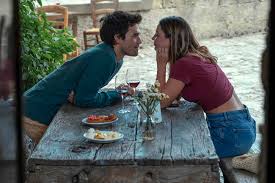
Movie Review: “A Wedding Banquet” remake shows us Just How Far We’ve Come

More charming than amusing, chosing sentiment over “edge,” the Andrew Ahn remake of Ang Lee’s 1993 queer cinema classic “The Wedding Banquet” gives the viewer time to reflect on just how much American and world culture have changed in the past 30+ years.

Lee’s film, about a gay Chinese-American who marries a female tenant renting an apartment from him as a way of appeasing and fooling his traditional Chinese family, seems positively demure now. The characters are tentative, dreading “coming out” and going to great extremes to ensure that they don’t have to.

Ahn (“Driveways”) gives his film hip cachet in casting Bowen Yang, Lily Gladstone, Kelly Marie Tran and Joan Chen in lead roles. He recognized that the comic possibilities of fooling relatives in The Old Country (Korea, this time) are exhausted, and moved beyond that as gracefully as he could.

If his picture lacks the understated delight that the original “Banquet” provided and fails to find many laughs in that promising cast, he at least charts the journey from gay “stereotypes” to gay “archetypes.”

Gladstone and Tran play Lee and Angela, a long-paired lesbian couple struggling to conceive via In Vitro fertilization. Yang and Hang Gi-chan are Chris and Min, the gay couple renting the garage apartment in the house Lee inherited from her father.

Lee, a “professional” lesbian (activist, organizer, etc) and “worm” scientist Angela are feeling the psychological and financial strain of trying to have a baby. Chris and Min have other issues, with older Chris having put-off finishing his Phd — “Queer Theory takes the joy out of being queer!” — and quick to rebuff Min’s proposal.

Min’s a perpetual student, an artist in cloth and a Korean citizen. Is the marriage for a Green Card? The fact that his homophobic grandfather will cut him off from the family fortune should he come out worries Chris more than it does Min.

Why not fake-marry Angela instead? Appease Zoom-call businesswoman granny (Youn Yuh-jung), get that Green Card and provide the family cash necessary for Angela and Lee to finally have a baby?

The movie introduces this epiphany and that jolting turn of events every bit as abruptly as that description implies.

Old friends Angela and Chris get weepy drunk over this idea and wake up naked. And then Granny shows up and the whole scheme struggles to get on its feet.

Casting Yang, famed for his bitchy, adenoidal put-downs, promises more laughs than this “Wedding Banquet” delivers. The first forty minutes are deathly dull. Then the fake marriage plot is set in motion and things pick up a bit for at least part of the remainder of the film.

Yang and Hang have little chemistry, in contrast with Tran and Gladstone, who click as a couple and make the buy-in easy.

Ahn’s efforts to deepen the Taiwan/America cultural contrast of the original film by mixing up Chinese and Korean and Native American characters (Bobo Lee plays Chris’s lesbian hipster cousin) comes to almost nothing — a hint of cuisine, a drag vamp on Chinese dragon costumes, a little Korean customs and Chinese culture bashing.

Screen legend Chen (“Twin Peaks,” “The Last Emperor,””Marco Polo,” “Didi”) is a breath of fresh air as Angela’s overbearing, over-sharing mother, a woman “all-in” on the who PFLAG super-supportive Mom thing, which infuriates her fuming daughter. Chen and Youn (“Minari”) almost set off sparks and suggest another promising angle Ahn didn’t choose to develop.

The few antic bits play. The rush to “de-queer” the house when Granny is coming shows DVDs, CDs and the Elliot (formerly Ellen) Page autobiography grabbed and hidden, along with a Lilith Faire concert poster.

“The Indigo Girls are surprisingly popular in Korea!”

But this “Banquet” never gets up a head of steam, never unravels into anything fun. Yang ensured that they’d have enough zingers to make the trailer funny. The film itself is more recognizably human and considered, while lacking any comic edge or sense that the romantic stakes are high.

When the climax lurches into the anti-climax, it’s hard to see what much of the fuss of any of this would have been about, when even the most transgressive moments have lost their sting.

But that’s just the final confirmation of shifts in the culture. “Coming Out” stories are passe, and half-heartedly flipping their twists won’t change that, no matter how much pushback the reactionary culture seems to embrace at the moment.

Rating: R, nudity, alcohol abuse, profanity

Cast: Bowen Yang, Lily Gladstone, Kelly Marie Tran, Hang Gi-chan, Bobo Lee, Youn Yuh-jung and Joan Chen.

Credits: Directed by Andrew Ahn, scripted by Andrew Ahn, based on the screenplay to “The Wedding Banquet” by James Schamus. A Bleecker Street release.

Running time: 1:42

Posted in Reviews, previews, profiles and movie news | Tagged , , , , , | Comments Off on Movie Review: “A Wedding Banquet” remake shows us Just How Far We’ve Come

Man, is “Sneaks” trippy, or what?

A kiddie comedy about that special pair of sneakers who carry a young baller’s dream, separated by “The Collector,” with one Sneaker seeking his mate…

You’d expect to hear the voice of Martin Lawrence in it, but Anthony Mackie and Lawrence Fishburne?

I may not review it because it isn’t all that. (OK, I did review it.)

But with a “Sneaker Culture” consultant/tour guide listed in the credits, it’s the nuttiest idea to turn into a kiddie cartoon. Or one of the nuttiest.

Posted in Reviews, previews, profiles and movie news | Comments Off on Man, is “Sneaks” trippy, or what?

Netflixable? Slow and stumbling “Squad 36” takes its sweet time getting to all the Cop Picture Cliches

“Squad 36” is a ponderous Parisian police procedural that never seems to get out of its own way. Staggering from cliche to contrivance, there’s little doubt what climax the stock characters who inhabit it are headed to, and that there’ll be an anti-climax after that.

Dirty cops, dangerous gangs, intrasquad romance and police who take care of their own, it’s a French variation of that tried and true hook of American cop pictures since “Colors.” That truism “The police are just another gang” bears repeating as much of the world seems indoctrinated to the “Law & Order/Bluebloods” myth of those who “protect and serve.”

It’s a milieu where French actor turned writer-director Olivier Marchal (“Rogue City”) has found a home. Perhaps he’s too comfortable in that home for his own good.

We meet the titular six-member Anti-Crime Ssquad as Sami (Tefix Jallab), Vinny (Guillaume Pottier), Walid (Youssef Ramal), biker Hanna (Juliette Dol), Richard (Soufiane Guerrab) and Antoine (Victor Belmondo) chase canny and tough-looking mob figure Karim (Jean-Michel Correia) all over the rainy streets of Paris.

A couple of things leap to mind in this opening sequence. Why are they pursuing this armed gangster, when they won’t arrest him? Why have Hanna — the lone woman on the team — lose control of her bike so that star Belmondo (the grandson of you-know-who) can take over?

And aren’t ALL police squads “anti-crime?”

Sami is the on-task boss of them all, answering to an impatient, CYA/C-his-A higher up (Yvan Attal). But Antoine is meant to be the “colorful” one. He’s seeing Hanna on the sly. And he takes out his over-the-top aggression on foes in underground, no-holds-barred brawling for bucks.

That’s what gets Antoine kicked out to the suburbs to “a department with less confrontation.” His colleagues may insist he got a raw deal, but we know better.

Months later, when members of the squad turn up dead and one goes missing, Antoine is lured back into this lurid world of nightclubs, overlapping jurisdictions, suspect cops and suspect mobsters. Because come what may, cops take care of their own.

Adapting a novel by Michel Tourscher, Marchal fills the screen with assorting police units with varying agendas with Antonoine running afoul of some and secretly supported by others.

The violence can be sudden and random and visceral. But once we get past the “cop in fight club” first act, the narrative settles into duller shoe-leather police work, following this tip, making that contact, working outside the law because the insiders don’t want him messing around in all this.

“You mind your own business and there won’t be any repercussions” is as menacing in French (with subtitles) as it is dubbed into English.

I like the suggestions of and open displays of corruption — stealing cash from an evidence locker, higher-ups shuffling wayward cops from job to job like pedophile priests.

At least in French cop movie funerals they don’t trot out bagpipes.

But when a picture bogs down into talky, relationshippy middle-acts like this one, the viewer gets ahead of it. The big mystery is easily guessed, and early. Characters don’t have motives or relationships that aren’t contrived, simply ordained by screenwriterly convenience.

Belmondo is convincingly tough and flinty, but has a generic screen presence that suggests “supporting player with a famous last name.”

Correia, as the 50ish mobster, brings weight and charisma and layers to his role. Everybody else here is just a cog in the clumsy collective presented here, cops and killers doing what they do the way they’ve done it in hundreds of pictures just like this, many of them better than the sedentary “Squad 36.”

Rating: TV-MA, bloody violence, nudity, profanity

Cast: Victor Belmondo,
Tewfik Jallab, Yvan Attal, Juliette Dol,
Soufiane Guerrab,
Jean-Michel Correia,
Lydia Andrei, Guillaume Pottier and Youssef Ramal

Credits: Directed by Olivier Marchal, scripted by and Olivier Dujois and Olivier Marchal, based on a novel by Michel Tourscher. A Netflix release.

Running time: 2:08

Posted in Reviews, previews, profiles and movie news | Comments Off on Netflixable? Slow and stumbling “Squad 36” takes its sweet time getting to all the Cop Picture Cliches

Movie Review: Alt Future “Daddy” tests determine who achieves Fatherhood

There’s ambition and a dollop of intellectual heft to the indie dramedy “Daddy.” Even if it misplaces characters, shortchanges its goals and fails to deliver much in the way of a satisfying conclusion, you can appreciate the attempt and the effort involved.

Arch, dry and dark, it’s an alt-future version of “testing” a quartet of candidates in their suitability for fatherhood. Toxic masculinity, religious dogmatism, hapless, hope-for-the-best slacking and daddy dilettantism come into play in co-writers/co-directors/co-stars’ Neal Kelley and Jono Sherman‘s not-quite-funny satire.

Jeremy (Sherman) sits for an AI interview with FRANN, the Fatherhood Research Aptitude Neural Network, who gives him a word association test to determine his fitness for fathering. Somehow, he hems and haws and insists “I’m ready, I’m TOTALLY ready” his way past this first quiz.

That means he gets to go on a Dept. of Procreating’s fatherhood retreat, where his final fitness will be determined.

Hapless, “fatherhood is a feeling” Jeremy is parked in a remote, mountain valley house with guitar playing cynic and possible INCEL Mo (Pomme Koch), piously religious and married Andrew (Kelley), and paranoid, pushy biz bro Sebastian (Yuriy Sardorov of “Argo” and TV’s “Chicago P.D.”).

They’re deprived of their cellular devices and dropped off. They meet and wait for their “monitor” to show up and evaluate them. They wait some more. And then they start to wonder if they’re simply being “watched” to decide if they’re fit to be fathers.

A couple of guys have a touchy edge, one uses his religion as comfort and rationalization for how he behaves and Jeremy just sort of steps into it and wings it as they prep meals, play cards, chat and make up their own DIY exercises (save your baby from a mugger and/or an earthquake) using a baby doll they figure was left there for that purpose.

They’re starting to fray, tensions are flaring and Sebastian’s bossy paranoia has put them all on edge. And then a “lost” woman (Jacqueline Toboni) shows up.

The performances work even if the deadpan “jokes” never quite land.

“I’m a runner.”

“Oh. I used to run track.” Pause. “800 meters.” Pause.

“OK.”

The dumbest Battle of Waterloo discussion/allegory ever is passed over for a debate about whether they should stay, try to hike out or whether indeed they’re being “watched.”

The players make their assorted character “types” somewhat distinct caricatures. But the choices the script has characters abruptly make or nonsensically dismiss doesn’t give the narrative manuevering room to settle someplace interesting.

The payoff is kind of predictable, and not in a good way.

But it’s worth dipping into the many “Daddy” issues here just to figure out what our first-time writer-directors were trying to say, even if they never actually say it.

Rating: unrated, profanity

Cast: Yuriy Sardorov, Neal Kelley, Jono Sherman, Pomme Koch and Jacqueline Toboni.

Credits: Scripted and directed by Neal Kelley and Jono Sherman. An Anchor Bay release (streaming)

Running time: 1:38

Posted in Reviews, previews, profiles and movie news | Comments Off on Movie Review: Alt Future “Daddy” tests determine who achieves Fatherhood