

Movie Review: Rickards and Lucas tag team for “Queen of the Ring”

“Queen of the Ring” is a two-fisted crowd-pleasing biopic of pioneering “lady wrestler” Mildred Burke, the “Kansas Cyclone” who rose from dropping men to the mat at county fairs and carnivals to become the first Million Dollar Female Athlete as she transformed wrestling from a male-only sport.

The film lets Emily Bett Rickards graduate from TV superhero supporting roles (“Arrow,” “The Flash”) to leading lady in a star turn that shows her credible in the clenches, a perfectly believable 1930s-50s “kick ass,” an era where women didn’t kick much of anything.

This generally historical “true story” by Ash Avildsen, the son of “Rocky” director John G. Avildsen, may frustrate as often as it delights. But the movie is in the same league as “A League of Their Own” in celebrating women breaking through in a male sport known more for its cartoonish heroes (“faces”) and villains (“heels”) and their scripted “stories” played out in the ring.

These pioneers didn’t just force states to accept women competing in such bouts. They integrated another corner of American sport Black female performances as they became a great draw in during and after World War II.

Mildred Bliss (Rickards) is a frustrated waitress and short-order cook at her mother’s (Cara Buono of “Stranger Things”) Kansas diner, a single mom with dreams of bigger things. She’s become a wrestling fan, and as fading “face” turned “heel” Billy Wolfe (Josh Lucas) is a regular at local fairs and at her diner, she begs him to train her and make her a star.

“Too small,” he huffs. Female wrestling is illegal in much of the country. “Fixed” or not, wrestling is a physically demanding, injurious grind, and “life under the lights” isn’t easy money or easy living.

Even if “controversy creates cash,” there’s only so far one can go as a carnival sideshow attraction. But Billy watches her pin one of the skinnier wrestlers under his tutelage and takes her on. The Kansas Cyclone is soon dropping and pummeling men her weight and larger at fairs all over the South and Midwest.

Billy finds himself smitten, and not just with their burgeoning success. It’s a shame he’s an opportunistic, abusive womanizer. Mildred, never taking her eyes off the prize, maintains the partnership, takes the abuse and even marries the guy once they’ve built something big and getting bigger.

She knows community property law.

Avildsen the Younger immerses in the domestic messiness of all this, in between eager new recruits (Francesca Eastwood, Kaily Farmer, Marie Avgeropoulos) joining up, inspired by “Milli’s” bravado, fame and lifestyle. A “business” marriage to an in-and-out-of-the-ring “heel” isn’t all its cracked up to be, with him bullying her and his son and assistant promoter (Tyler Posey) falling in love with the leading lady of wrestling.

That’s where the film frustrates. Mildred endures abuse, and we’re told more than once how she’s not “allowed” to do what she’s doing in much of the country. We see no signs of her being repressed and denied the chance to perform via sexism. No cops show up to “stop the show.” This denies us seeing another obstacle for her for overcome and another reason to root for her.

Avildsen co-wrote the script, which goes out of its way to fudge or just avoid the issue of “time.” Years go by, characters age, a World War erupts mid-story (and is never mentioned) and we aside from anachronistic music and the passing model years of cars — some in colorized archival footage — we only have a firm grasp of one date — the 1954 title defense bout that turned into a “shoot” — off-script, no holds barred, aka a “real” fight — that frames the story.

Meanwhile, every new woman to approach Billy must be sized-up and shown in her own training montage. Events in the ring don’t always match the historical record as the movie meanders through these events and the era that spawned them.

And bringing in “Gorgeous George” Raymond (Adam Demos, miscast), while historically defensible — he and Mildred were contemporaries and pals — feels shoehorned in and mishandled.

Walton Goggins, cast as early wrestling “tycoon” Jack Pfefer, is a waste of the most colorful member of this ensemble.

But Rickards is quite good — muscular enough to be convincing in the lifts and drops, sexy enough to sell the sex appeal of this corner of wrestling. And Lucas is often at his best as a heel — comical or otherwise.

Whatever its sluggish pace and stumbling grasp of time, “Queen of the Ring” still manages to be a fine vehicle for making a case for women’s equality in a period piece that more than gives this sport and that period in time its due.

Rating: PG-13, domestic abuse, violence, profanity

Cast: Emily Bett Rickards, Josh Lucas, Tyler Posey, Kailey Farmer, Francesca Eastwood, Adam Demos, Marie Avgeropoulos and Walton Goggins

Credits: Directed by Ash Avildsen, scripted by Alton Ramsay and Ash Avildsen, based on the Mildred Burke biography by Jeff Leen. A Sumerian release.

Running time: 2:20

Posted in Reviews, previews, profiles and movie news | Tagged , , , , | Comments Off on Movie Review: Rickards and Lucas tag team for “Queen of the Ring”

Movie Review: A Chinese Cop and Robber bromance — “Hunt the Wicked”

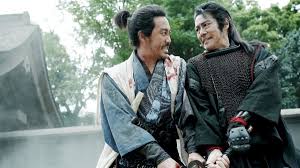
“Hunt the Wicked” is a dopey, cheesy cop-teams-with-a-robber shoot’em-up, punch’em-down, kick’em-where it hurts thriller from China.

A serious read on it has to note its tale of official corruption, with a mayor secretly running a narcotics empire under the noses of the citizens who elected him with the cops who work for him turning a blind eye.

It features a laughably theatrical version of police work — with in-the-dark cops emptying the over-production-designed office for assault convoys on the merest of hunches, with such onslaughts often turning into ambushes.

The characters are arch archetypes to a one — intrepid “hero” police captain (Miao Xie), the trusted and noble lieutenant (Jing Gu) who crushes on him, the violent thief (Andy On) masterminding a take-down of this drug empire and his deadly and fetching “honey” (Hong Shuang), a sniper, always two steps ahead of the police.

The polluted water of the fictional Wusili City is a subtext here, as we see heroes and villains diving into the brownest effluent imaginable and the lying mayor (Andrew Lin Hoy) even drinking it to brag about how he cleaned the river/bay up.

He vomits afterwards, and makes the aide who suggested the stunt pay for his stupidity.

But taking all this new designer drug, whose kinky chemistry professor inventor (Anson Leung) is nabbed and worse in the opening scene, smuggling drugs in cakes of ice (meant to be fish) and supervillain meeting with his peers via a Bond villain lair Zoom call seriously is an exercise in futility.

The fights are what fans will show up for, and they’re decent if not remotely genre redefining.

But there’s another subtext here that’s pretty easy to pick up on, and that might be unintentional, which makes it all the more entertaining.

These two foes really get in each other’s faces. I mean CLOSE up. Once they’ve established that they aren’t going to kill each other, their clenches take on a homoerotic quality.

The rogueish robber Wei Yun-zhou is always asking Capt. Huang to dinner. “Why don’t you eat with me?” in Mandarin Chinese with English subtitles. As we’ve seen the workaholic captain repeatedly refuse food from his adoring lieutenant, it’s notable that yes he will have a bite, thank you very much.

When Wei Yun-zhou later has him tied up, he slices off a bit of sushi that has the cop eat off his knife blade. Wicked sexy.

That suggests an interesting direction that this dull, formulaic and contrived thriller might have taken, the road from foes to bros to “We have so much in common” and “You have a taste for fine food” and picking out wedding china. Not that they call it that in China.

Rating: unrated, violence

Cast: Andy On, Miao Xie, Jing Gu, Hong Shuang, Andew Lin Hoy

Credits: Directed by Suiqinag Huo, scripted by
Ma Lao. A Well Go USA/HI-YAH! release.

Running time: 1:43

Posted in Reviews, previews, profiles and movie news | Comments Off on Movie Review: A Chinese Cop and Robber bromance — “Hunt the Wicked”

Movie Review: Marvel’s New “A” Team earns its asterisk — “Thunderbolts*”

It takes a solid hour to get going, and pretty much as long to identify its characters. Good luck if you buy a ticket and show up without more background than you typically need to know for a comic book adaptation.

And it finishes with a pulled-punch, because it can’t bear to call a villain a villain and wants to make the point that sometimes we have to “work with” evil.

The jokes don’t really land, and for what it’s worth, if you’ve seen the trailers, you’ve heard the punchlines.

The stakes are low as “death” seems permanently impermanent in this corner of the Marvel Universe. At least Scarlett Johannson had the good sense to cash in, punch out and move on.

Here the Oscar-in-her-future leading lady is adequate at fight choreography — no more — and the supporting cast is mostly lesser lights who could stand a little character development and build-up so that they “grow” a little more charisma in our minds, at least, over the two hours and six minutes of Marvel’s “Thunderbolts*.”

But say this much for Marvel’s rebooting of its “Super Friends” segment of the comic book action fantasy marketplace. “Thunderbolts*” earn their asterisk.

This impromptu “team” meets as they’re each summoned to a fortified mountain “vault” to TCB for an embattled and corrupt CIA chief (Julia Louis-Dreyfus) who is trying to cover her pre-impeachment “human testing” and off-the-books “ops” from a dogged Congressman (Wendell Pierce), a feat which she might just manage thanks to her amoral/follow-orders aide (Geraldine Viswanathan, co-star of the best “COVID” comedy “Seven Days,” and “Blockers.” pretty bland here).

So Yelena Belova (Florence Pugh), still mourning the death of her Black Widow sister (Scarlett Johansson), “dime store Captain America” John Walker (Wyatt Russell, son of Goldie and Kurt), and the vanishing superheroine/assassin we learn is named “Ghost” (Hannah John-Kamen) all show up to deal with an files-stealing interloper on orders from CIA chief Valentina Allegra de Fontaine (Dreyfus).

They figure out the crooked appointee at CIA has lured them into a trap. But they can’t quite figure out who the hapless dude in the pajamas — “Bob” (Lewis Pullman) — is and why he’s here.

As they escape, aided eventually by Yelena’s Soviet super soldier Dad, Alexei (David Harbour), the Red Guardian who now drives an ancient Lincoln stretch limo, they’re pursued by The Winter Soldier himself, Bucky Barnes (Sebastian Stan), now a Congressman who figures he can throw in with them and bring down this corrupt spy boss in a post-Avengers universe.

Because the spy boss has a new “secret weapon.” Think “human testing” and “confused guy in his pajamas.”

It’s a cutesie “anti-hero” superhero riff that never really delivers, despite having a few fights — fewer than usual — and the requisite explosions (probably less than were contracted for). They throw in some existential angst, about loneliness and the generational disconnect that has many wondering “Why carry on?”

Heroes and villains ponder this.

One problem with “Thunderbolts*,” a moniker the various “super serum” superheroes cannot agree on (thus the asterisk), is the unfamiliarity of the characters and most of the actors playing them. Even people deep into Marvel have been sharing homework on this project online as it was cast and cobbled together.

Another serious shortcoming is the villain, whose pajamas hint at how he’s able to get into their dreams and heads, taking them back to ugly moments pretty much every character in this has experienced or instigated. He makes the leap to global menace in a flash.

“Everyone here has done bad things,” Yelena rationalizes. But that’s no reason to stop trying to do good.

Harbour tries to make Russian accents comical again, an uphill struggle. Russell takes a shot at making his biggest role memorably unpleasant. He’s Captain America as “an a—ole,” more than one character surmises.

Others are left with little to play, with Dreyfus particularly misused — teetering on comical, relying on that Cruella-streak of white in her hair to do the heavy lifting on her villainy. Other players lack the throw-weight to give the picture gravitas and its villains or heroes color beyond what’s on the scripted page.

It’s all something of a jumble, with even its “kumbaya “messaging muddled in a murk of competing story agendas.

As someone who’s not a fan of most of the Marvel movies that have come off the assembly line in recent years. I’ll admit to appreciating one cool “new” effect — human beings and superhuman beings turned into Hiroshima “shadows” in the wink of a “god” supervillain’s eye.

But with Pugh featuring in most of the close-ups in a film story that’s really going nowhere but “sequels,” one never shakes the feeling that an actress of her already-impressive stature should have taken Johansson’s lead and limited her commitment to this piffile to one, two or three lucrutive and perhaps limited appearances.

Giving her a kicky blonde dye-job and a shapeless jump suit and letting her throw punches that don’t impress anyone feels like a waste, as this not-jokey-enough superhero punchout is plainly beneath her even if she never lets on that she thinks that.

Rating: PG-13 for strong violence, profanity, thematic elements, some sexual and drug references.

Cast: Florence Pugh, Sebastian Stan, Wyatt Russell, Julia Louis-Dreyfus, Hannah John-Kamen,
Geraldine Viswanathan, Lewis Pullman, Wendell Pierce, and David Harbour

Credits: Directed by Jake Schreier, scripted by Eric Pearson and Joanna Kalo, based on assorted Marvel comics and Marvel comic characters. A Marvel Studios release.

Running time: 2:06

Posted in Reviews, previews, profiles and movie news | Tagged , , , , , | Comments Off on Movie Review: Marvel’s New “A” Team earns its asterisk — “Thunderbolts*”

Documentary Preview: Astronaut, Glass Ceiling Breaker, Heroine, Queer Icon — “Sally” Ride

This overdue bio-doc hits National Geographic on June 16, and rolls onto streamers Disney+ and Hulu June 17.

Posted in Reviews, previews, profiles and movie news | Comments Off on Documentary Preview: Astronaut, Glass Ceiling Breaker, Heroine, Queer Icon — “Sally” Ride

Netflixable? German soldier loses her son in “Exterritorial” territory — the U.S. Embassy

Welcome to the golden age of America as Outlaw State, as depicted in international action cinema.

“Exterritorial” has Americans as treasonous allies, corrupt drug smugglers and heartless bureaucrats — kidnapping children and Belarussian refugees, selling “intel” to common enemies and working overtime to silence the German woman led into their trap, all characters wearing the uniforms and saluting and/or working for the “interests” of the old red, white and blue.

Writer-director Christian Zübert (“Tour de Force” was his) reads the realpolitik zeitgeist and only pulls his punches at the end of this solid but formulaic action pic built around a German single mother with “special skills.”

Jeanne Goursaud graduated from Eastwood’s “The 15:17 to Paris” and the German combat mini-series set in “Kabul” to play Sara, an Afghan combat veteran with PTSD issues and a little boy whose American GI father died while they were deployed together in Afghanistan.

Six year-old Josh (Rickson Guy da Silva) never knew his African-American father. But he’s got dual citizenship. When a security company job prospect is dangled in front of “ex-Special Forces”” Sara, she jumps at the chance to apply for an H-1 visa at the consulate in Frankfort.

Scroll through a few international news headlines to guess how that goes.

But blonde, beautiful and brawny Sara never even gets to the interview. Josh goes missing from an embassy playroom, and Sara “causes a disturbance” trying to get consolate officials and even the German police to help find him.

Might this be another triggered moment for Sara, whose combat flashbacks give us a taste of what she survived in Afghanistan? Is Josh real, or imagined? The CCTV video in the consulate makes even her wonder.

But Sara’s combat-wary eyes picked-up on some sketchy characters and possibly sketchy behavior. Next thing we know, she climbs out a window and begins parkouring her way through the vast complex — picking locks, smashing cameras, busting heads, frantic to find her kid.

Sara smashes in on a “guest quarters” Russian-speaker (Lera Abova) who claims to be a hostage there, trapped in limbo because of U.S. doubts about her refugee status and perhaps Russian pressure on the Russian-friendly U.S. administration. But Irina, or Kira as we come to know her to be just brings up “how crazy” this all sounds and “Why would anyone want to kidnap your son?”

I mean, the kid’s half-black. It’s not like the U.S. is welcoming anybody who doesn’t look like Sara these days.

There are villains and disparate schemes and we and Sara fear we can’t trust any guard (Kayode Akinyemi) security chief (Dougray Scott) or consul general (Annabelle Mandeng) drawing an American government paycheck.

The fights are furious, and any time Sara puts her hair up, we know there’s another one coming. Goursaud is credible in the fights, and the even more fashion runway-ready Abova (“Anna”) isn’t. So naturally she’s the one with mad computer hacking skills.

They click well enough as an action duo that you wish they had more scenes together.

The scripted schemes don’t unravel easily, until the “talking villain” finale reveals all.

That makes “Exterritorial” more “solid than surprising, and even that “solid” footing grows more slippery with each implausible escape or too-convenient plot twist.

Why DO they keep leaving our Teutonic tyro ALONE in a room?

But if you’re an American watching international thrillers on Netflix, here’s a taste of what the future looks like — German villains are passe, and even Russian and Arabic ones may become rarer. Americans in and out of uniform, are the bad guys. The harder sell in such movies may be the concept that people still want to emigrate here.

Rating: TV-MA, lots of violence, some profanity

Cast: Jeanne Goursaud, Lera Abova, Dougray Scott,
Kayode Akinyemi and Annabelle Mandeng.

Credits: Scripted and directed by Christian Zübert. A Netflix release.

Running time: 1:49

Posted in Reviews, previews, profiles and movie news | Tagged , , , , , | Comments Off on Netflixable? German soldier loses her son in “Exterritorial” territory — the U.S. Embassy

Classic Film Review: “The Return of Martin Guerre,” the Original “Deep Fake”(1982)

Before he became the French poster boy for “sexual predator,” Gerard Depardieu was the unlikeliest screen sex symbol of his era. Burly to the point of huge, played a soulful “Cyrano” and took on Jean Valjean in a TV version of “Les Miserables,” co-starred in the Hollywood hit “Green Card” and other screen romances.

The film that “made” him was probably Claude Berri’s classic mid-80s folk fable “Jean de Florette.” But the movie that launched him as an international star and romantic lead was “The Return of Martin Guerre,” a 1982 film, a Medieval period piece based on a true story that has fascinated France and Europe, novelists and playwrights ever since it came to light.

If we can separate the art and artist from the creep who made it — something Woody and Polanski’s fans have done for decades — it’s still worth revisiting, a story as beloved as that of Robin Hood and William Tell, but more truth than folklore in this case.

Filmed in the Pyrnees on the Franco-Spanish border, the same region where the true sixteenth century story is set, based on a 1940s novel that imagined what the wife in this story was thinking, Daniel Vigne’s best and most famous film is a gloriously detailed and immersive period piece that lets us believe a woman could be deserted by a disinterested husband and be fooled when he “returns” a more robust, considerate and sexual partner years later.

And if Bertrande (Nathalie Baye) wasn’t actually “fooled,” she gives us hints about why she’d never “tell.”

Via flashbacks, we meet her and the boyish, ungainly Martin (Bernard-Pierre Donnadieu) on their wedding day, witness the colorful ceremony and the solemn discussion of the dowry she’d bring to the marriage, and have a courtside seat for the consummation ritual, as it was practiced back then.

The marriage is “cursed,” Bertrande remembers, with the village mocking Martin’s inability to do his husbandly duties. Even casting out the “demons” that curse them (Jean-Claude Perrin plays the helpful, in-their-business priest) doesn’t wholly “cure” their love life.

As Martin dislikes farmwork and is mistrusted even by members of his own family, nobody could have been shocked when he disappeared.

Years later, he (Depardieu) returns — just as tall, but no longer stooped, a brawny, outgoing soldier returned from the wars. He knows everybody in the village and a lot about the lives there. He remembers faces, fields, relationships and quirks. Only a few are even the least bit reluctant to embrace him as who he says he is, including Bertrande.

“The bird’s back in the nest,” the villagers of Artigat chant to them (in French with English subtitles). “Tonight they will not rest!”

But this story is being related to a parlimentary magistrate (Roger Planchon), a man of reason and a questioner with an ear for detail and missteps. He’s been summoned because there’s some doubt as to who Martin is. That doubt was raised the moment Martin talked about money. And the doubters are led by his greedy uncle (Maurice Barrier).

Is this all about money, or is Martin who he says he is?

“NEVER was a husband so maligned!” the accused bellows.

This story has been novelized, filmed and even turned into a stage musical and inspired many a TV episode about a “stranger” knowing way too much about this family or that town (Mayberry, for instance). So it’s not as if everybody forgot William Tell shot the apple off his son’s head.

But our three screenwriters — including director Vigne — use the tale as a portal to the rise of compassion, humanism and romantic love, with “law,” harsh as it was, enforced via investigation and “due process.”

Depardieu is in fine bluster, but the movie’s shortcomings only became obvious when Jodie Foster and Richard Gere tackled the material with an American Civil War backdrop in 1993’s “Sommersby.” Depardieu and Baye don’t get across the lust and longing ache that Gere and especially Foster did.

Perhaps the director — whose only other well-known credit, “One Woman or Two” (with Depardieu and Sigourney Weaver) was infamous upon release — wasn’t up to getting this out of the actors.

Perhaps Baye was put off by a co-star whose sexual boorishness and worse with female co-stars went back more decades than French courts and co-star accusations have established.

Depardieu would get a few shots in Hollywood and never make much of a mark beyond “Green Card.” Baye would go on to play the mother of another infamous faker in the Leo DiCaprio, Tom Hanks and Steven Spielberg comic thriller “Catch Me If You Can.”

And their “Martin Guerre” still works, with Medieval settings and costumes legitimizing its depiction of Medieval trial practices and the rule of law even reaching into the farthest corners of France. It has modern mores and values transported backwards through time to find a moment when “identity” and “justice” and “facts” could be debated, even at a local level, thanks to social evolution and pre-Age of Reason means of inquiry.

Our parlimentarian seems geniunely concerned about delivering justice and genuinely curious about what really happened, with or without church concerns about “violating the marriage bed.” Very modern.

Keen-eyed viewers will find very young versions of the great French character actors Dominique Pinon (“Delicatessen”) and Tchéky Karyo (“La Femme Nikita,” “The Way”) in small roles. And film buffs will marvel over a well-made period piece and a star caught on the rise before he became infamous for being on the make, even when such attentions were plainly unwelcome.

Rating: TV-PG, sex, violence

Cast: Gerard Depardieu, Nathalie Baye, Roger Planchon, Maurice Barrier,
Isabelle Sadoyan, Rose Thiéry, Jean-Claude Perrin, Dominique Pinon and Tchéky Karyo

Credits: Directed by Daniel Vigne, scripted by Jean-Claude Carrière, Daniel Vigne and Natalie Zemon Davis, based on a novel by Janet Lewis. A European National release, now owned by Cohen Media Group, streaming on Tubi, et al.

Running time: 1:52

Posted in Reviews, previews, profiles and movie news | Tagged , , , , , | Comments Off on Classic Film Review: “The Return of Martin Guerre,” the Original “Deep Fake”(1982)

Movie Review: Juggling career, offspring and Elderly Parents demands “Relative Control”

Teri Polo of the “Meet the Parents” franchise takes on a far more realistic parental management situation in “Relative Control,” a light dramedy about all the juggling that goes on when one’s parents, love life, career and adult but adrift kids pile on to put the “age” into “middle age.”

Screenwriter Charlene Davis serves up a collection of “Whoa, been THEREs” that will make you grin or cringe. And if you haven’t “been there,” take her and her characters’ advice. You will.

Polo plays Sara, a corporate mergers and acquisitions lawyer in The Incorporation State — Delaware. Fiftysomething, her career is about to hit a peak as a big client signs on to help her keep a predatory buy-and-strip concern from taking over their company.

But Sara’s the only child her aged parents (Patrick McDade and Alice Schaerer) can depend on. Their “favorite,” her sister, moved to Florida and checked out of parental care duty. Sara’s the one who has to endure her ex-police chief dad’s endless “emergency” calls about whatever “crisis” his beloved right wing TV “news” is hyping today. Increasingly forgetful Mom isn’t much help.

And then Dad buys that motorized easy chair which keeps putting him in the hospital. He didn’t read the instructions. Sara gets the dreaded “He’s going to need a lot more CARE” lecture from the medical professionals.

Her unemployed son (Ryan Saviano) fled to the West coast to try and launch a sports statistical analysis career. He and her aide at work (Nicholas Delany) could swap stories on what a “control freak” Sara is.

Not delegating work, dropping everything and dashing out of meetings to see about every “there’s immigrants at the BORDER” panic attack her old man has, trying to manage her kid and dodging the neglected personal life that the flirtatious ex-classmate doctor (Jeff Mark) offers to change — it’s all coming to a head.

The narrative is a collection of mini crisises — short meetings, “sabotage” at work, increasingly dire medical issues, son Eric flying back and forth cross country to help (On whose dime?), Sara’s own neglected health — any one of which will be recognizably triggering to anybody over 40.

The stakes may be too personal and too inevitable to be high — selling a house that her parents allowed to be termite infested and the like. And the resolution has a whiff of “It’ll all work out” pie-in-the-sky fantasy built in.

But Polo carries this lecture on family end-of-life-decisions, the martyred child who ends up doing all the heavy lifting while another keeps her distance and learning to “let go” of those pieces of work and micromanaging kids and parents with ease and style.

And if you can’t identify with any of this, give yourself time. It’ll come.

Rating: unrated

Cast: Teri Polo, Patrick McDade, Jeff Mark, Ryan Saviano, Alice Schaerer and Nicholas Delany.

Credits: Directed by Dafna Yachin, scripted by Charlene Davis. A Gravitas Ventures release.

Running time: 1:49

Posted in Reviews, previews, profiles and movie news | Tagged , , , , , , , , , , | Comments Off on Movie Review: Juggling career, offspring and Elderly Parents demands “Relative Control”

Documentary Preview: “Bono” in Black and White — “Stories of Surrender”

A different backing ensemble, with strings. A few hits. A few stories.

Could be revealing, or another venture that gives the haters the fodder they need to go on living.

Apple TV+, May 30.

Posted in Reviews, previews, profiles and movie news | Comments Off on Documentary Preview: “Bono” in Black and White — “Stories of Surrender”

Movie Review: An Austro-Hungarian Aristocrat’s Daughter falls for “The Chambermaid”

The last days of the Austro-Hungarian Empire are the setting of “The Chambermaid,” a same sex/class-crossing romance that blossoms in World War I era Prague.

This sumptuous Czech/Slovak co-production, performed in Czech, Slovakian, Hungarian and German, is “Downton Abbey” with more explicit sex, nudity and unfiltered glimpses at all the messy bodily functions servants clean up to keep the posh — Germans in this case — in the comfort to which they figure they’re entitled.

Anka (Dana Droppová) is a blonde teen in the provinces, the “bastard” child of a mother who has just remarried. Her gruff stepdad reads an ad in a paper seeking a chambermaid in the city, and next thing Anka knows, that’s her fate — a long coach ride into Prague where she’ll join the staff of the home of the German aristocrats whom she’s always to address as “Milady” (Zuzana Mauréry) and “Milord” (Karel Dobrý).

All-knowing senior housekeeper Liza (Vica Kerekes) is her guide into this world, where the male servants relish their piggish power over the women just as Milord dallies, at his convenience, with Liza.

Kristina the cook (Anna Geislerová) is from the same village as Anka, so there’s no escaping that “bastard” label here. Not that the rich family of nags and slappers that they work for care.

Oldest daughter Resi (Radka Caldová) has picked up on her parents’ cruelty Bullied herself by a mother determined to not be “stuck” with her, with Anka forced to “get the books” for Resi at dinner so that she can eat with one under each armpit to keep her elbows nobly at her side, Resi pushes around Anka because she can.

And then she rethinks her as a co-conspirator. Anka is the one she confides in about the young man (Cyril Dobrý) her parents have decided is a suitable mate. But what can she expect on her wedding night? Her mother’s explained the facts of married life under a repressive patriarchy.

“You’ll understand after your first beating.”

But “What is Gustav going to do with me?” is a question Anka can only answer cryptically. “What all men do.” Her orders are to “find out” and report back to her mistress. Anka promptly submits to an over-attentive manservant (Lukas Pelc) and relates what she’s learned.

“It’s endurable.”

Demonstrating the delicate points of love-making bonds the two girls. And no Gustav brutality or sudden war can break that.

Director and co-writer Mariana Cengel-Solcanská — she made “Scumbag” with Droppová and Pelc — keeps the focus on the two women in a romance of exacting attention to period detail. This is the world of she-who-scrubs-the -bloody-sheets and she-who-must-empty-chamber-pots-into-the-city-sewers.

Rural folkways and superstition are called on before any doctor is summoned over a pregnancy — wanted or unwanted.

Droppová manages the open-faced innocence we’re expected to buy into in Anka, a child who resolves to grow up — fast — when she falls for a young woman just as trapped as she is, only in luxury and an unpleasant if not downright abusive marriage.

The women are stoic, shrinking from conflict and all-but-resigned to their fates, and the men prone to ruling this house with varying degrees of power over them. Caldová plays the subtlest story arc even as her character is making what seems like the shortest journey. Kerekes lets us see the “dreamer” in the delusional Liza, and Geislerová is flinty and no-nonsense in the flesh as Kristina, who won’t “curse” a hated husband headed into battle but who will tell you what she won’t do, step by step.

The plot of this “true story” is as melodramatic as any “Upstairs/Downton” soap opera, with just a light sprinkling of the ethnic resentments of an ungainly, teetering, multi-cultural empire that’s backed itself into an imperialist conflagration that will shatter empires, norms, borders and class distinctions.

The love affair will be tested. The consequences of a world war will be brought home as surely as the consequences of love affairs and politics rest uneasily under this belle epoque mid-city garden home’s roof.

But it all gloriously glides by, an upended city world of dinner parties and Strauss waltzes at the piano, a too-trusting aristocrat who leaves it to servants to “burn this” or that possible “state secret,” and a way of life in the provinces barely impacted by the ever-shifting borders and the end of travel by stagecoach.

Rating: unrated, nudity, sex, some violence

Cast: Dana Droppová, Radka Caldová, Vica Kerekes, Lukas Pelc,
Zuzana Mauréry, Anna Geislerová, Cyril Dobrý and Karel Dobrý

Credits:Directed by Mariana Cengel-Solcanská, scripted by Mariana Cengel-Solcanská and Hana Lasicová . An Omnibus Entertainment release.

Running time: 1:54

Posted in Reviews, previews, profiles and movie news | Comments Off on Movie Review: An Austro-Hungarian Aristocrat’s Daughter falls for “The Chambermaid”

Netflixable? A mad bomber plots a “Bullet Train Explosion”

A 1975 Japanese thriller titled “Bullet Train,” about a high-speed passenger train with a bomb on board, one that will explode if the train slows beyond a triggered speed, inspired the bomb-on-a-bus thriller “Speed,” its sequel and lots of imitators.

It was a the biggest Japanese disaster pic of its era, excluding movies starring a giant monster from beneath the atom-bomb-tested sea. So of course it inspired a sequel. It just took 50 years to get around to doing it.

“Bullet Train Explosion” references the original film’s “incident” as it hurls a cast of cast of dozens if not hundreds and modern CGI effects at that still-somewhat-plausible scenario- – a murderous bomber holds both the train and the entire country hostage as the sleek, streamlined locomotive and passenger cars hurtle towards their doom.

There are suspenseful stretches and vigorous “work the problem” exercises blended into ludicrous twists and the odd dash of Bugs Bunny Physics in this self-serious thriller built on classic disaster movie bones.

We meet the vast array of characters — uniformed personnel of the Hayabusa 60 that sets out from remote Aomori to Tokyo, technicians of the railroad’s control center, the suits at Tokyo HQ, and select passengers from the 300+ souls riding the rails this fateful day.

Tyuyoshi Kusanagi of “Doomsday: The Sinking of Japan” stars as white-gloved conductor Takaichi, whose attention to detail and crisp salutes aren’t sinking in fast enough with his subordinate, Fujii (Hanata Hosoda).

“This is is a serious job, you know,” he scolds in subtitled Japanese, or dubbed into English.

The train’s driver is a just-as-meticulous young woman, Mastumoto (Non) who sits in the cockpit alone, reciting her various safety and start-up protocols aloud as they set off.

A huge high school field trip, a scandalized politician (Machiko Ono), an “unemployed rich man” influencer (Jun Kaname) and a sketchy guy with a bulky bag and wearing a respiratory mask are among the paying passengers.

The train gets under way. The bomber phones HQ with threats and a demand — 100 billion yen (702 million in dollars, a figure tariff-shrinking by the hour). How serious is this bomber? A freight train is blown up with an identical bomb to get the point.

As the people in charge scramble to respond, politics interferes and the passengers are abruptly made aware of their plight. Some panic, cast blame and insult the “Sugar Mama” politoc. And one takes matters into his own hands. The ransomer wants “all of Japan” to pitch on this? Fine. Let’s set up a Go Fund Me page. All those kids on “Insta” spread the word.

Meanwhile, an audacious “rescue plan” is cooked up at HQ. How do you defuse a bomb you haven’t located on a fast moving train? What might plan B be?

One of the cute touches here is somewhat jarring if this is the way these trains, which have been around since the early ’60s, are operated. Officials communicaste with land lines with flashing red lights, a situation room features models and ancient and simple what-train-is-where display board and wind-up stopwatches are used to time speeds and operations suggest that the world’s onetime digital electronics leader is still running its rail network in an analog world.

“Tradition?” No money for upgrades? Union rules? It is to laugh. And perhaps that’s meant to be a joke, as the film itself is so old fashioned as to be creaky.

The picture’s turn towards “Give me a break” nonsense roars in with the third act. Before that, we’re treated to a few too many scenes of cool-headed professionals performing their professional duty professionally.

But the odd moving moment, acknowledgement of “duty” and comically absurd throw-down over what decision should be made and by whom enlivens the proceedings, even if it doesn’t come close to overwhelming the intentional or unintentional silliness of stiff actors playing all this so very seriously.

Rating: TV-14, violence, blood

Cast: Tsuyoshi Kusanagi, Non, Machiko Ono, Daisuke Kuroda,
Jun Kaname, many others

Credits: Directed by Shinji Hiruchi, scripted by Kazuhiro Nakagawa and Norichika Ôba. A Netflix release.

Running time: 2:14

Posted in Reviews, previews, profiles and movie news | Tagged , , , , , | Comments Off on Netflixable? A mad bomber plots a “Bullet Train Explosion”