Movie Review: A Welsh whimsy about a crank and his robot — “Brian and Charles”

“Brian and Charles” is a “bloke builds a robot” comedy that’s so cute you want to pinch its inanimate cheeks until they’re red.

A mockumentary that pays homage to British tinkering, Welsh eccentrics and the lesson Dad always taught you about how to deal with bullies, it’s a little daft, a little sweet and exceptionally twee.

Co-stars David Earl and Chris Hayward, expanding their short film of the same title, co-wrote this adorable, folksy and feel-good comedy as a star vehicle for themselves. That’s true even though Hayward spends the movie hidden under a Larry David manikin head, his upper torso tucked in a washing machine fuselage, his speech sounding like he was the high-bidder on “Who gets Stephen Hawking’s Voice Box?”

A film crew is following solitary tinkerer Brian (Earl, of Ricky Gervais’ “After Life”) around his cluttered, isolated Plaxgreen Cottage as he shows off ditzy inventions like an Egg Belt, a pine cone bag and his “cuckoo clock,” a flying machine sans wings that he’s sure he can get airborne over his home village, giving everyone the time any time they deign to look up.

“I got so much goin’ on up ‘ere,” he brags to the filmmakers, who keep their cackling off the soundtrack to maintain the air of professionalism.

One day Brian gets the hare-brained notion that he can build a robot, and “72 hours” later, there it is. Except it won’t power up. It looks like David Byrne’s Huge Suit, fresh out of a washing machine box and being worn by Herman Munster. But if it won’t work, “nice laugh, isn’t it?”

It’s the bin for him.

That is, until a lightning storm rumbles through and Brian finds himself coming home to a “plastic pal that’s fun to be with,” a robot who is plainly sentient and learning as fast as he can read…books.

Brian has no wifi, apparently, otherwise the front-loader who agrees to the name “Charles” would plow through toddlerhood and adolescence a lot faster than he does in this light, brisk comedy.

Brian decides to keep his new friend to himself, which Charles bristles at. It’s not just that the village wouldn’t understand. There’s this bully (Jamie Michie) of a neighbor with his brutish brood to be avoided at all costs.

Naturally, he and they cannot be avoided forever. Brian faces his moment of truth. Perhaps Charles will as well.

Sight gags like Charles dressing up in a DIY hula skirt to “walk” to Honolulu, once he’s seen it on the telly, or donning shower curtains and a hat that make him look like an Italian monsignor, abound.

And situations include Charles matter-of-factly fixing Brian up with the equally awkward and lonely Hazel (Louise Brealey, terrific) the way unfiltered little kids do.

Earl makes a pleasant eccentric as the lead, a sort of on-the-spectrum/not-quite-social Nick Frost. Who doesn’t love Nick Frost?

It’s all of a piece, and just as charming and engrossing as a silly mockumentary about a robot maturing from boot-up to rebellious teen can be. No, Wales doesn’t come off as anything but grey and repressed and backward. But whatever “Brian and Charles” don’t do for Welsh tourism they more than make up for in warm, goofy entertainment value.

Rating: PG for language, mild violence, and smoking

Cast: David Earl, Chris Hayward, Louise Brealey and Jamie Michie

Credits: Directed by Jim Archer, scripted by David Earl and Chris Hayward. A Focus Features release.

Running time: 1:30

Posted in Reviews, previews, profiles and movie news | Comments Off on Movie Review: A Welsh whimsy about a crank and his robot — “Brian and Charles”

Movie Review: A “Jumanji” comedy for College Pals with issues — “Gatlopp”

Well here’s a pleasant surprise.

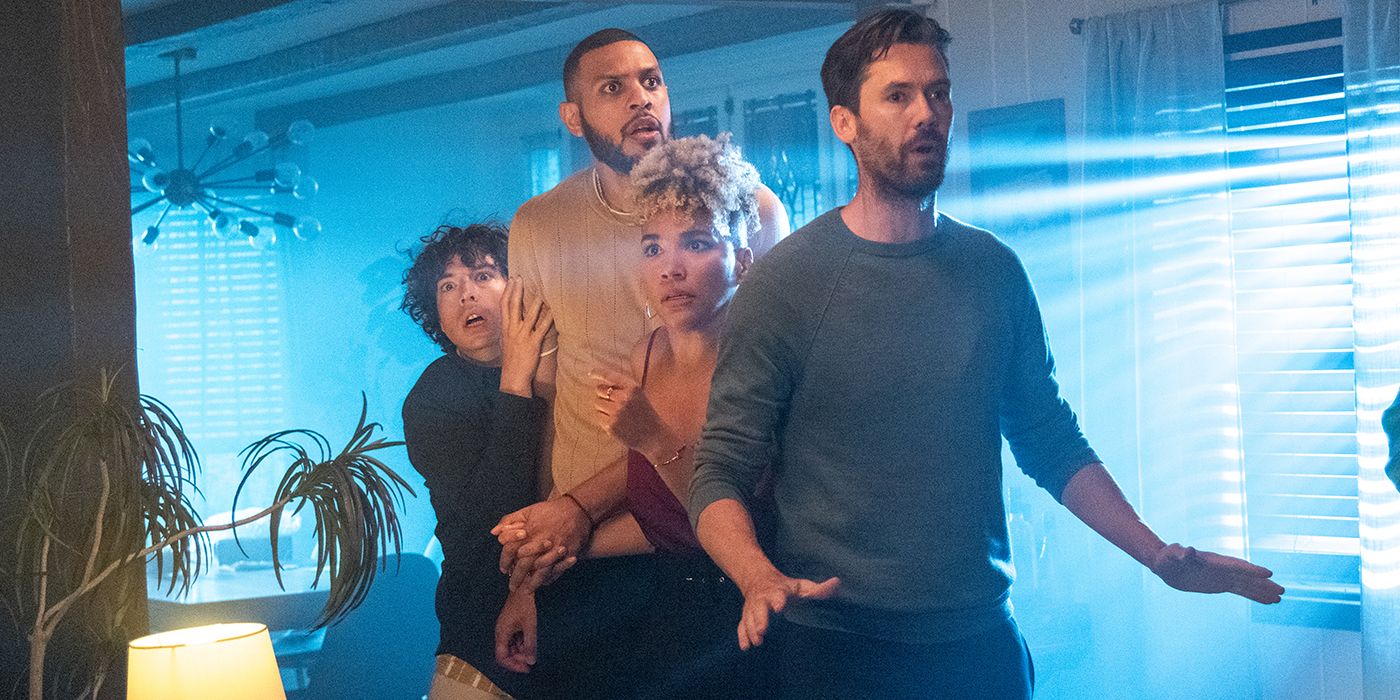
“Gatlopp” might be a supernatural board game comedy plainly inspired by “Jumanji,” with the players trapped “in” this supernatural game until it finishes and they face up to their “issues.” But the script has flashes of wit and a dash of pathos, and the cast throw themselves into this no-budget indie’s mania with gusto. So it generates laughs and a moment or two of sad self-examination, and best of all, it plays.

Jim Mahoney (“The Orville”), who scripted the darkly-adorable holiday cartoon “Klaus” for Netflix, wrote and stars in this story of four friends-since-college pals kind of collectively hitting the wall, even though Paul (Mahoney) seems to be the real basket case of their quartet.

Samantha (Emmy Raver-Braveman of TV’s “Umbrella Academy”) is a brusque, embattled, over-scheduled TV producer. Troy (Sarunas J. Jackson, best-known for TV’s “Insecure”) is a tall, handsome actor trying to piece together a career that hasn’t really hit. And Cliff (Jon Bass of TV’s “Miracle Workers: Oregon Trail”) is still doing clubwork — DJing, “promotions” and the like, obviously stuck in some sort of college-era rut.

But Paul is the one whose house just sold, whose marriage just ended. He’s got to move into the Venice bungalow Cliff must have inherited. He’s not handling it well, so that’s where they all gather, at the scene of over a decade of parties and good times, just to console him.

A clever touch — Cliff has a “Mistakes Wall” covered with Polaroids of all his friends at their drunken worst at various parties. That includes a shot of Cliff, passed out, his mates having given him a “Braveheart” face-paint job.

“FREEDOM!”

Paul might not be in the mood for this, seeing as how his cheating ex (Shelley Hennig) is badgering him to sign the divorce papers and we’ve just seen him download his bile on the happy, eyes-on-the-future couple buying their old home. Good rant, by the way.

But Cliff’s counting on him and everybody else, so bottom’s up. And by the way, there was this board game with the Swedish word for “gauntlet,” “Gatlopp,” as its title, that was tucked into this credenza Cliff just acquired. Let’s play and drink and “test our knowledge of the world!”

The others are reluctant, but the concentric circles board is unfolded, the die is rolled and the cards flipped over as they skip right past the rules and dive in.

Whoopsie.

Innocuous questions turns seriously personal, the drinking turns into a “drinking game” as wrong answers get “punished.” And then the punishment turns ugly.

Shrieks of “This isn’t HAPPENING” are greeted with a card that says “This is happening.”

And as they’re debating whether this scenario is more “Black Mirror,” “Hitchcock” or “Outer Limits,” first blood is drawn.

Mahoney and director Alberto Belli (Netflix’s “Casa de Flores,” “House of Flowers”) tell the story with flashbacks and teleportations. Sometimes, the game takes them back to pivotal moments from their past. Other times they’re hurled onto some ’80s Jazzercise challenge TV show to DIY a routine…or die.

That’s the implication, that if they don’t finish “by sunrise” they’re goners. And that’s a warning. Watch what you say.

“Go to HELL, Paul!” could send somebody off in a poof, and getting him back is just as easy. Only he’s a bit singed, now.

The energy of the cast sells the longtime-nature of the relationships, and even smaller roles — Hennig as the shallow, manipulative ex-wife and Jon Ales as the shallower, 50something rich foreign douche she’s taken up with — stick and find a laugh or two.

“Gatlopp” can show its budget and feel a little malnourished, here and there. And the emotional moments are mostly superficial cliches, with a trite, tried and true familiarity.

But no cut-rate, scratch-the-emotional-surface “Jumanji” knock-off should play this cute, funny and sweet.

Rating: unrated, violence, sexual situations, profanity, alcohol abuse

Cast: Jim Mahoney, Emmy Raver-Lampman, Sarunas J. Jackson, Jon Bass, Shelley Hennig and Jon Ales.

Credits: Directed by Alberto Belli, scripted by Jim Mahoney. An XYZ release, on demand June 23.

Running time: 1:21

Posted in Reviews, previews, profiles and movie news | Comments Off on Movie Review: A “Jumanji” comedy for College Pals with issues — “Gatlopp”

Classic Film Review: They should’ve known better than to try and Nic Cage a Classic — “The Wicker Man” (1973)

One of the definitions of a “classic” film is one that should never, ever be remade.

Forget what Coppola said about movies being like operas, with new generations of artists taking their shot at interpreting classic texts. He’d be the first to bitch if somebody pitched Paramount on a new “Godfather” trilogy.

In Hollywood, where “intellectual property” and “rights” are everything, they’ve flirted with “Casablanca” and “Gone With the Wind,” and that upstart Spielberg fellow had the temerity to take Coppola at his word and attempt his own “West Side Story.”

Horror classics are particularly prone to remake. But in the case of the best of them, Hollywood should recognize how resistant some stories are to this urge. Whatever your fondness for TV’s “Bates Motel,” does anyone remember the remake of “Psycho?” Or “The Wicker Man,” infamously brought back from the dead as a Nicolas Cage vehicle (2006) that lives on only in a sort of “awful movies” purgatory in most fans’ minds?

Watching the original anew reminds us that you should never touch any iconic story with a “big reveal” at the end. Once you know who Norman Bates’ mama is, you can’t unknow it.

Whatever spoiler title screenwriter Anthony Shaffer (“Frenzy,” “Sleuth,” the 1970s “Death on the Nile”) chose to pin on David Pinner’s novel “Ritual,” until you actually see “The Wicker Man” in the film, you have no idea what its purpose is, even if the metaphor in it grows more obvious every time our protagonist, a brittle and fragile Scottish police sergeant (Edward Woodward) opens his pious, Christian mouth.

The first thing that strikes you in the film’s opening credits is a reminder of how the Brits long-revered the word and the writer who writes it. It is billed as “Anthony Shaffer’s ‘The Wicker Man.'” Sure, it’s based on Pinner’s novel. Robin Hardy directed it, one of only three films he managed, one of which was a disastrous revisiting of the material, “The Wicker Tree,” which was based on his own novel in a “Wicker” vein.

Shaffer, a barrister and advertising copy writer who turned to novels, plays and then screenplays, is the artist most responsible for this compact and still-creepy-after-all-these-years horror parable.

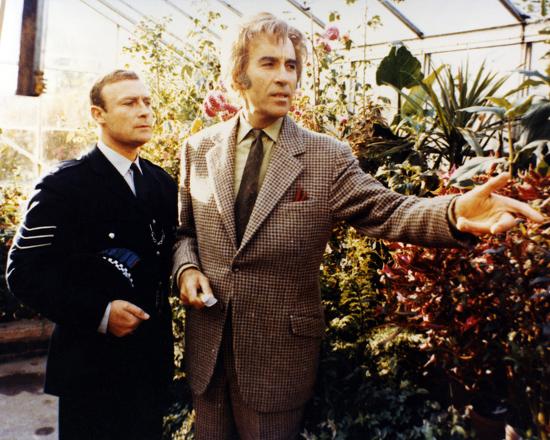
The penny-plain plot — Sgt. Howie (Woodward, later of “Breaker Morant,” and TV’s “The Equalizer”) flies to remote Summerisle, piloting his own float-plane, to chase down a missing person. Someone there wrote him that a girl had gone missing.

The villagers aren’t keen on helping, even declining to provide a dinghy to get him to shore. “The Lord” needs to be consulted, and they’re not talking about The Almighty. Not exactly.

The Sgt. finds himself trotting out “official police business” threats to one and all as he is stonewalled at almost every turn on this agricultural Scottish island. No, nobody there remembers “Rowan Morrison,” the object of the unarmed sergeant’s search. And they have “our ways,” which this stranger won’t understand. The suggestion that he “go home” is broached by more than one local.

But there is a pub and rooms to let. Surely they must get the occasional tourist, you think.

Sgt. Howie gets a glimpse of what goes on there, the history of the place, through photographs and moments where the locals appear to perform pagan rituals and pass them on to their children.

“They never learn anything of Christianity?” He is shocked.

And as he pokes around, finding evidence that the girl no one “can recall” or has ever heard of was enrolled in school, and “died” but has no death certificate, as the gorgeous barmaid Willow (future Bond girl and Peter Sellers’ ex Britt Eklund) comes on to him in the most frank ways, this puritanical policeman (the “extended cut” of the film shows he used to be a preacher) turns to sputtering rage.

Can I do anything for you, Sergeant?

” No, I doubt it, seeing you’re all raving mad!”

Then, at long last, he meets Lord Summerisle. And despite the fact that Christopher Lee — Britain’s greatest horror icon — plays him, Sgt. Howie doesn’t have the good sense to flee.

 “Do sit down, Sergeant. Shocks are so much better absorbed with the knees bent.”

There’s a high-mindedness to the theological debates between the Sgt. and the Lord, a gloom that hangs over the story when we start to fear for this arrogant, brusque outsider who cannot see there’s an island full of simple folk who plainly do not want him there, not for May Day (the next day).

It’s a film that capitalizes on its location — Plockton, Dumfries & Galloway Scotland, and environs — and the now almost-lost sense that there are islands off Britain where time stands still and quaint, strange and disconnected-from-modern-reality things go on. Remember, this came out just a couple of years after “The Prisoner.”

I love the tidiness of “The Wicker Man,” the lack of wasted scenes or moments in Shaffer’s lean, drumtight script. Every character is on screen to make a certain point, and only on long enough to make that point. There’s a shrugging “Just go home” warning in their brush-offs and a shrugging “Well, you asked for it mate” acceptance of his fate when the Sgt. doesn’t heed those warnings.

Woodward’s sputtering self-righteousness, his “One Way” blind faith, is beautifully-contrasted with Lee’s whimsical, long-haired (he even sings), laid-back Lord Summerisle.

“And what of the TRUE God? Whose glory, churches and monasteries have been built on these islands for generations past? Now sir, what of him?”

“He’s dead,” Summerisle quips. “Can’t complain, had his chance and in modern parlance, blew it.”

That sort of flippant swipe at Christianity is particularly, peculiarly British and very much of its era. Monty Python ruled the TV and shots at Protestantism and Catholicism were all the rage, and part of a long tradition in the UK.

And that’s another reason “Wicker Man” would be nigh on impossible to Americanize. We don’t have that tradition here.

I’ve long thought that it’s the flawed adaptations of literary masterpieces, period pieces or biographical films of great lives that should be remade, not “classics.” Yes, a fresh take on “Casino Royale” was justified. “The Beguiled? Maybe. “Catch-22” was worth taking another shot at. No, George Clooney wasn’t the right guy to attempt it.

But looking at “The Wicker Man, now coming up on 50 years since its release, its tidy, compact and menacing perfection is easy to grasp. Attempts at longer cuts of the film only unraveled some of the mystery that is a vital component of its appeal. And unlike most “out there” scenarios, this is one case where “It needs a little more Nicolas Cage” simply does not apply.

Rating: R, violence, nudity, re-rated

Cast: Edward Woodward, Diane Cilento, Britt Ekland and Christopher Lee.

Credits: Directed by Robin Hardy, scripted by Anthony Shaffer, based on the David Pinner novel. A British Lion film, released by Warner Brothers — on This TV, Amazon, other streamers.

Running time: 1:28

Posted in Reviews, previews, profiles and movie news | 1 Comment

Movie Review: Luke Kleintank finds Jonathan Rhys Meyers is more than just “The Good Neighbor”

Jonathan Rhys Meyers in a “Single White Female” thriller set in Latvia? Yeah, I could buy that. The guy cultivates an “Oh, I’m capable of things” vibe, and that’s put to good use in “The Good Neighbor,” a Stephan Rick remake of his German film, “Unter Nachbarn.”

Luke Kleintank of “Man in the High Castle” plays an American reporter following an old editor friend to a news service based in scenic, under-filmed Riga. But the house that editor (Bruce Davison) sets David up in is a bit remote. That means the new guy, with a little command of Latvian and no gift for getting the boss’s old BMW running, will be leaning on the loner next door.

Robert (Meyers) is a mobile nurse who was partly-raised in London. And one of the first things out of his mouth should set David’s Spidey-sense tingling. The nursing business is booming, Robert suggests.

“A lot of people come to Riga to die.”

A little car repair help later and they’re out for drinks in a downtown club, where David meets a London tourist, gets a little tipsy, and accidentally runs over her on their way home. Not to worry, there’s a nurse in the passenger’s seat, right? More than he knows.

“We can’t call anybody. You’ve been drinking. This is murder!

And thus begins the cover-up that David is more a witness to than an eager participant in, something which doesn’t help his rising feelings of guilt as he is A) assigned to cover the hit-and-run by the European Press Network and B) the dead woman’s sister (Eloise Smyth of Hulu’s “Harlots”) shows up to lean on him to get to the bottom of this, badger the police, etc.

Yes, coincidences rule the day in this story, but that contributes to its compactness. It’s a tight tale with a steadily-escalating threat level based on Robert’s growing obsession with his new “friend,” and the extreme efforts he’s more than eager to make to keep him and them “out of a Latvian prison.”

At this stage of his career, Meyers has but to suggest “intensely twisted” to get across the idea that this quiet nurse who paints tiny toy soldiers has something dark going on under the surface. A little moment here, a cross-the-line gesture there and we get it.

“Single Latvian Male.”

Kleintank’s playing the broader story arc here, a guy who listens to the “We have to protect each other, we have to rely on each other” speech and treats the victim’s sister brusquely and dismissively until compassion and/or attraction kick in. That distraction may slow his growing alarm at steps he sees Robert take, and ones he has no idea he’s taking.

Thrillers like these play out in a set of fairly generic ways — predictably. But when the cast is good and the focus is narrowed to two people who might be three, with every outsider a new “threat” of discovery summarily dealt with, it works.

And in using his vulnerable-but-can-be-scary baggage subtly, Meyers makes our buy-in easy and the “What is he capable of?” menace palpable, right from that first tell-all line.

“A lot of people come to Riga to die.”

Rating: R for violence and language

Cast: Jonathan Rhys Meyers, Luke Kleintank, Eloise Smyth and Bruce Davison.

Credits: Directed by Stephan Rick, scripted by Ross Partridge, based on a German film scripted by Silja Clemens and Stephan Rick. A Screen Media release.

Running time: 1:37

Posted in Reviews, previews, profiles and movie news | Comments Off on Movie Review: Luke Kleintank finds Jonathan Rhys Meyers is more than just “The Good Neighbor”

Movie Preview: “Land of Dreams,” Matt Dillon, Isabella and William Moseley in a Satire of the Census

Census workers and closed borders, an America that frets over what these newcomers are dreaming of.

Looks weird. I like weird.

Posted in Reviews, previews, profiles and movie news | Comments Off on Movie Preview: “Land of Dreams,” Matt Dillon, Isabella and William Moseley in a Satire of the Census

Movie Review: “Lightyear” never lightens up

It took “Toy Story 4” to prove to Disney and Pixar that maybe they should’ve let the trilogy end on a glorious high note, rather than milking it for one extra movie.

But here is “Lightyear,” a spin-off adventure that aims to wring a little more lucre out of Pixar’s best idea ever. No, it won’t make anyone forget “Toy Story 3” either.

The conceit is that “this is the movie” that so-obsessed little boy Andy that he had to have that Buzz Lightyear action toy for his birthday. What Pixar set out to do, with some of the most impressively-detailed CGI animation ever and a few epic action beats, was create a straight-up sci-fi adventure that would appeal to a little boy still young enough to play with dolls.

They recast Buzz with Captain America himself, Chris Evans, a handsome charmer in live action films, and a guy who can be funny. Just give him a funny line and he’ll nail it. Again, just give him a funny line.

But without the irony of Buzz thinking he’s real, even though he’s just a toy come-to-life, with lots of other exasperated toys trying to shake him out of this dogmatic belief, without Tim Allen’s deadpan egomania rubbing up against Tom Hanks’ folksy exasperation, “Lightyear” has given up its best laugh.

And the replacement gags — mainly via Sox (Peter Sohn), a robotic, multi-tasked talking cat who is a combination of R2D2 and C3PO — are never remotely as original or as amusing as that.

Taika Waititi and Keke Palmer also provide voices, and Isaiah Whitlock Jr. and Erfren Ramirez. And they’re voicing characters so colorless almost anybody could have replaced them, with only Waititi’s quizzical Kiwi way with a line adding even a hint of humor to the proceedings.

The story — Buzz is a Space Ranger with a tendency for going it alone, wanting to be the hero, and a gift for screwing up.

He “narrates” his story into an imaginary “log,” a running joke amongst his fellow Space Rangers at Star Command. Yes, he takes it all terribly seriously.

Buzz is part of the first-to-wake crew on a huge cryo-sleep spaceship that he nicknames “The Turnip,” because “the ship looks like a root vegetable.” That’s it. That’s the joke.

They get a diversion signal (straight out of “Alien”), causing them to go off course and land on a planet with swarming, tentacled beasts occupying its underground. Buzz botches the escape liftoff, and there they are, a large group of humans stranded on a planet, unable to call for help (apparently), forced to build and DIY their way out of their doom.

They need to synthesize an alternate power source. Buzz will pilot a shuttle/fighter craft into hyperspace and go for help. “Finish the mission” is the Space Rangers’ code, and he’s determined to do just that.

But every test fails, and with every failure, Buzz’s guilt, his “court martial myself” doubts, grow. With every failure, time dilation means that his fellow crew and colleagues, including his biggest champion, Captain Hawthorne (Uzo Aduba) age years, while Buzz stays the same.

He’s trapped on the “Edge of Tomorrow,” repeating himself. And he’s not learning from his mistakes.

But his last return from a failed test flight finds that his nemesis, Emperor Zurg (James Brolin), has shown up with his own ship, menacing and threatening to enslave or wipe out the nascent colony. Hawthorne’s granddaughter (Palmer) and a couple of colorful sidekicks (Dale Soules and Waititi) are ready to pitch in, but Buzz still has his own “I can get us out of here” ideas.

The movie’s theme is summed up in a single sentence — “We don’t need you to rescue us, we need you to join us.”

The predictable action beats are recycled from lots of similar sci-fi movies with the only difference being that here they’re animated. It’s a great looking movie, no doubt about it.

There’s more message than laughs or heart in the screenplay, which has Buzz soul-searching his way out of the trap that his ego has become. It’s also constructed in ways that maximize representation — many races, a gay couple, etc.

But what little wit there is was confined to the Xmas Toy to be Sox, a robotic Swiss Army knife of save-the-day, deus ex machina gimmicks that extract Buzz & Co. from many a fix.

A “real” Andy would’ve probably preferred Sox as a birthday present to Buzz, I dare say. But honestly, I didn’t find much in “Lightyear” that any kid, or adult, would obsess over. Impressive as it looks, it’s emotionally lacking, humorless and kind of dull.

Pixar turned out the light and left out the joy.

Rating: PG for action/peril

Cast: The voices of Chris Evans, Keke Palmer, Peter Sohn, Uzo Aduba, Efren Ramirez, Dale Soules, Mary McDonald-Lewis, Isaiah Whitlock Jr., James Brolin and Taika Waititi.

Credits: Directed by Angus McLane, scripted by Jason Headey and Angus McLane, based on a character created by John Lasseter. A Pixar/Walt Disney release.

Running time: 1:40

Posted in Reviews, previews, profiles and movie news | Comments Off on Movie Review: “Lightyear” never lightens up

Movie Review: Cam Gigandet gets “Blowback” when he picks Randy Couture for his Heist

A bank heist, “a case” snatched from a safe deposit box, a “stick to the plan” edict and a brutal, old-fashioned double-cross is the can’t-miss formula for the umpteenth thriller to be titled “Blowback.”

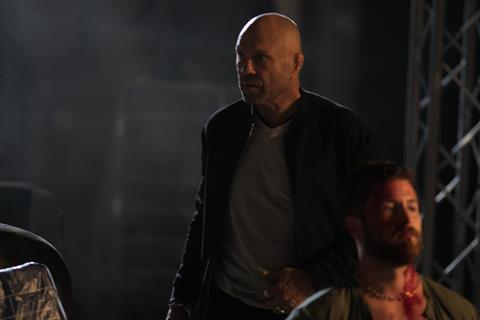
Cam Gigandet, Randy Couture and Louis Mandylor star in this “Blowback,” three stars playing three points-of-view and anchoring three storylines that weave together in this routine, bloody and slowfooted cops and robbers tale from Vegas.

“Ah, Vegas,” you think, “casino heists or robbing a bank where a casino stashes its cash,” “Ocean’s 11” and all that.

Nah. This is straight-up down market, where a single casino is a backdrop and our robbery involves something less cinematic but very much in the news, and probably going away soon, perhaps taking the world economy with it. And that just threatens to make “Blowback” feel instantly-dated, on top of everything else.

Gigandet (“Never Back Down,” “Twilight”) is Nick, a rideshare driver with a daughter dying in the hospital. He can’t get her into an “experimental program” on his insurance and the pittance he makes driving. Good thing he’s sketchy and knows the right guys to pull a heist.

It’ll be an inside job, and with his tech pal Xander (Benjamin Abiola) on board, and a crew of five others, it should be a cinch. It never is.

Couture (“The Expendables” movies) is Jack, a hardcase who’s taken up with one of Nick’s exes (Michelle Plaia), and both of them are in. Jack is pretty obviously the thuggish wildcard in all this.

When we hear the instruction “Nobody gets hurt,” we know better. When we hear “Stick to the plan,” we know SOMEbody won’t. And we know who.

Next thing we figure out is how Nick is bleeding out, running his rideshare car on the rims until a cop notices him and gets him to a hospital in the film’s opening scene. Jack and the others double-crossed him.

Mandylor is Detective Cooper, heading the police team trying to research every part time employee in Vegas who was off that day (I kid you not) as a data-based trackdown begins. Cooper’s always asking “What’re we missing here?” and answering “What’re you thinking?”

We know Nick’s gonna live, at least long enough to make it to that opening scene. And we know he’s coming for payback, because he’s the “blowback” these mugs weren’t counting on.

The heist is nervy enough, although veteran director Tibor Takács, who’s made a LOT of Christmas TV movies of late, and his DP bring nothing new to such scenes. Where “Blowback” goes off the rails for me is in its scripted solution to Nick’s problem.

We expect our bad guys to be resourceful, tough and willing to turn ruthless to get what’s theirs. Nick turns to a boring mobster who supplies him all the help he’ll need.

Say WHAT?

The guy is literally a “Gangster ex machina,” providing transportation, muscle for “enhanced interrogations” and a place to hold such torture sessions as Nick seeks to retrieve something stolen from our charisma-starved character actor playing a heavy.

The fact that we’ve seen Nick get himself “fixed up” by a disgraced junky doctor (William McNamara) living in an RV tells us he’s dirty and wired into this underworld. We want to see him struggling to solve his own problem, and getting more desperate every step of the way.

One semi-tense meeting with our Mr. Big and half the dramatic potential of the movie is tossed out the door. And it’s not like the other half is “Point Blank” or any of its hard-man-getting-payback variations.

The leads aren’t bad, but this script is fatally flawed and you’d hope they’d notice that before the camera rolls.

Rating: R for violence, drug use and language.

Cast: Cam Gigandet, Randy Couture, Michelle Plaia, Benjamin Abiola, Rafael Cabrera and Louis Mandylor,

Credits: Directed by Tibor Takács, scripted by Matthew Eason, Robert Giardina and Robert Edward Thomas. A Saban Films release.

Running time: 1:33

Posted in Reviews, previews, profiles and movie news | Comments Off on Movie Review: Cam Gigandet gets “Blowback” when he picks Randy Couture for his Heist

Netflixable? Kiddie Cartoon Indie Jones — “Chickenhare and the Hamster of Darkness”

“Chickenhare and the Hamster of Darkness” is a straight-up “Raiders of the Lost Ark” send-up about “embracing” your unique self because “Our differences are what make us special.”

It’s a European production based on a comic book by Chris Grines, with lets of action — much of it derived from the Indiana Jones movies — some splendid design and a couple of very clever sight gags.

But dull? If you’re old enough to read reviews, you might want to leave this on for the kids and find something else to do elsewhere in the house. Or the yard.

The quest is for a magical idol, with sea journeys, a trek across “The Desert of Death,” an ancient temple, a “legend,” and a map activated by sunlight at a particular hour of the day,

“Where’s the ‘X?’ Don’t most treasure maps have an ‘X’ that marks the spot?”

There it is.

“Oops! Darn tropes!”

Chickenhare, voiced by Jordan Tatakow, is a foundling, discovered by his adventurer dad and uncle. They’re in line for the throne of the kingdom that they’re from, a place that holds Royal Adventurer’s Society Tryouts, which Chickenhare fails.

He’s already insecure about being half-chicken, half rabbit. He wears hats and fur-covered boots to seem “just like everybody else.”

His father the king’s advice about accepting himself, and the fact that he’s flunked his one shot at the Royal Society, is ignored. Chickenhare fetches a fedora, leather jacket and bullwhip and sets out to find the treasure that eluded his dad and his treacherous brother Lapin (Danny Fehsenfeld) failed to find many years before.

That’s how Lapin escapes from prison to go on his own quest, to acquire the magical idol and seize power for himself.

Chickenhare is accompanied by turtle-servant Abe, voiced by Joey Lotsko, doing Woody Allen kvetching and shtick.

“Why can’t I ever meet anyone who shares my skepticism?”

And the “muscle” of their group is Meg (Laila Berzins), a skunk who was once so embarrassed by being different that she “corked” herself…for years.

The one-liners are limp jokes about assorted earlier or later quests, for “The Holy Spork” or “The Fountain of Middle Age.” The fact that the voice cast is more competent than comical or charismatic works against the one-liners.

But the best sight gag is a winner. The trio run afoul of “pigmies,” Minion like volcanic island piglets whose groupthink solutions to problems involves using their uniform shape to create Lego-like walls, traps and the like, teeming around the three as they try to toss them into their sacred volcano.

Nothing else in “Chickenhare” really registers. It’s a message with a half-hearted harebrained movie painted around it.

Rating: TV-Y, kid-friendly

Cast: The voices of Jordan Tartakow, Laila Berzins, Danny Fehsenfeld and Joey Lotsko

Credits: Directed by Ben Stassen and Benjamin Mousquet, scripted by Dave Collard, based on a graphic novel by Chris Grine. A Netflix release.

Running time: 1:31

Posted in Reviews, previews, profiles and movie news | Comments Off on Netflixable? Kiddie Cartoon Indie Jones — “Chickenhare and the Hamster of Darkness”

Netflixable? Hemsworth and Teller face-off in Joseph Kosinski’s “Spiderhead”

Before “Top Gun: Maverick,” director Joseph Kosinski made “TRON: Legacy,” “Oblivion” and “Only the Brave.” It’s a filmography that is the epitome of “mixed-bag,” in terms of entertainment value, aesthetics and bottom line.

But count “Spiderhead,” his latest collaboration with his muse, Miles Teller (“Only the Brave,” “Maverick”), as a checkmark in his favor, even if it’s something of a slick quick-and-dirtyt for Netflix. It’s a mixed bag in itself, but squeezing Chris Hemsworth into an outside-the-box role in between “Thor” outings and having him face-off with Teller in a simple story with a high-end setting and “human choice” morality pays off.

Based on a short story that first appeared in The New Yorker, “Spiderhead” is “A Clockwork Orange” for the Age of Big Pharma. The premise — drugs can make the world a better place, modify feelings and behavior, improve society.

“The world needs our help, now more than ever,” Dr. Steve Agnesti (Hemsworth) preaches. And those in his “care” aren’t exactly in a position to disagree.

“Spiderhead” is a prison/”clinical trial facility” on a mountainous island paradise. The inmates, “selected” and incarcerated there by choice, have drug injection pump MobiPaks installed on their lower backs. And every so often, they’re brought in for a “test.”

“Drip on?” jocular Dr. Steve asks? “Acknowledge!” the guinea pigs reluctantly reply.

Everything can seem funny after this dosage, sexual attraction is guaranteed and heightened by that one.

The drugs have names like LuvActin (an aphrodisiac) and Verbaluce. That one makes the recipient more articulate and forthcoming.

Jeff (Teller) is one of the patients there. Flashbacks give us an idea of why he’s in prison. But Dr. Agnesti — “Call me Steve!” — can help him escape, make him see a grimy industrial park as a Fijian beach.

Still, Jeff is giving up what, Film 101 class? “Free will.” And he’s the first to realize that this narcotized “cure” or whatever it is meant to accomplish isn’t all it’s cracked up to be. Not when he feels “the most normal” when he’s sharing chores with his cute fellow convict Lizzy (Jurnee Smollett), but the drug tests are causing him to have sex with assorted partners in the one-way-mirror “lab.”

One thing that pops out of this is the stretch this part was for Hemsworth. Much of the dialogue has a creaky “better on the printed page than read aloud” quality.

“No other penal institution in the world boasts such a respectful relationship” between prisoners and those who imprison them.

But Hemsworth, taking extra hits of Red Bull between takes, rushes through them like a guy who finally gets to show-off his acquired American accent at top speed. Not every line sings, but he’s kind of a laugh tearing through them.

“Beautiful people get away with too much,” Agnesti gripes about the good-looking but always-tardy and testy inmate Heather (Wyomi Reed). “I say that having benefited from it myself, from time to time.”

You don’t say?

Teller is earnest and conflicted and carrying a sad burden, the memory of his “fateful night,” the one that put him in prison. What he really wants is a little “Eternal Sunshine of the Spotless Mind.”

“Is there a drug to make you forget s–t?” “Yeah, it’s called ‘old age.'”

As memory and guilt have a role in rehabilitation, we can see the logic in “not” wanting that in the pharmacopoeia here. But the script isn’t a deep dive into what constitutes rehabilitation (barely touched on), and only flirts with challenging the cynicism of allegedly “good” people who take jobs doing something their consciences should warn them are immoral.

“Deep” isn’t really Kosinski’s thing, after all.

The pleasures of this surface gloss are in the shocks, the moments things start going “too far,” and the mental, moral and physical sparring of Teller and Hemsworth, well-matched foes so long as Hunka-Hemsworth doesn’t have his hammer handy.

Rating: R for violent content, language and sexual content.

Cast: Chris Hemsworth, Miles Teller and Jurnee Smollett

Credits: Directed by Joseph Kosinski, scripted by Rhett Reese and Paul Wernick, based on a short story by George Saunders. A (June 17) Netflix release.

Running time: 1:47

Posted in Reviews, previews, profiles and movie news | Comments Off on Netflixable? Hemsworth and Teller face-off in Joseph Kosinski’s “Spiderhead”

Classic Film Review: Is it time to renew our worship of Monty Python’s “Life of Brian?” (1979)

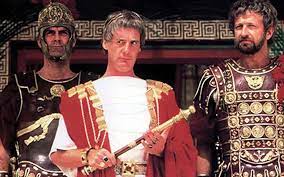
 Well slap me sideways and call me Jolson. I’d plum forgotten Our Lord John Cleese‘s first appearance in “Life of Brian” was in Blackface.

The decision, this past week, for British cinemas to give up showing “The Lady of Heaven,” an Islamic history lesson that bent over backwards to not offend, because of protests at the theaters by British Muslims…who hadn’t seen the bloody film, had a local Archbishop having a bit of a laugh at Islam’s “‘Life of Brian’ Moment.” And it gave me a craving to see Monty Python’s big screen masterpiece again.

The idea that the Catholic man in the big funny hat is getting at is a valid one. That in a free society, examining, critiquing and even mocking of belief systems has to be fair game. Islam doesn’t tolerate criticism. And unlike Scientology, there is no call to “Lawyer Up” in the scriptures of that Middle Eastern/Global religion. So protests and the implicit threat of violence will have to do.

“Life of Brian” was protested so vehemently when it came out that members of Monty Python were called upon to debate Big Thinkers and Great Theologians of the Day in the UK on TV. And that, in turn, led to sketches mocking the idea of comedians having to debate allegedly serious people over a seriously silly film.

I don’t remember much in the way of protest in the U.S. when the film came out, unlike the picketing that greeted Martin Scorsese’s “The Last Temptation of Christ,” some years later anyway.

Rewatching “Brian” now, one really does get the feeling that the oft-repeated phrase “They could NEVER film that today” absolutely applies here.

“Life of Brian” is a Life of Jesus send-up about a Jewish (possibly half-Roman) contemporary of Jesus named Brian Cohen (Graham Chapman) having many hapless run-ins with the Romans and mistaken for the Messiah by his fellow Hebrews. It intentionally or unintentionally sets out to offend almost everyone.

There are gay jokes, Blackface gags, and every Jewish (and Italian) “nose” insult and slur is trotted out for one and all. Gender dysphoria wasn’t discussed openly back then, except by the Pythons.

“I want to be a woman. I want you to call me ‘Loretta’ from now on.”

Eric Idle was the only Python so convincing in drag I was sure he was “the gay one” well into the 1980s, British boarding school “experiences” and all that. Nope. That was Chapman.

Speech impediments mocked by Michael Palin? “Biggus Dickus” and his bride, “Incontinentia Buttocks” wouldn’t have it.

Brian’s father was ROMAN?

“You mean you were RAPED?”

“Well, at first, yes,” Mum (Terry Jones) sheepishly confesses.

But in a movie in which there was a Jerusalem Colosseum in which they slaughtered loin-clothed prisoners with gladiators for “entertainment” — but only at “Children’s Matinees” — everything and anything is on the table for laughs.

What stands out about this Terry Jones/Terry Gilliam film — Jones did the directing, Gilliam co-wrote it and gave it the “authentic but goofy” look that sold the conceit her, and in “Monty Python and the Holy Grail” — all these years later is the texture, the pacing and the glorious pedantry of a bunch of Ox-Bridge wits, having a go at comedy.

Watch it with the closed captioning on or read the screenplay. Arcane words and usages decorate a script already riddled with Britishisms of the day.

“And the bezan shall be huge and black…”

And then there’s the hilarious schoolboy prank of having a pedantic British-bobby-as-school-teacher Roman centurion (Cleese) chew out, correct and TEACH Brian the proper way to write “Romans Go Home!” in Latin, as graffiti.

” What’s this, then? ‘Romanes Eunt Domus’? ‘People called Romanes they go the house’?”

“Imperative” and “Vocative plural of ‘annus'” and “dative” and “accusative” and “locative” are questioned and drilled, and we’re left to wonder how this lot ever learned to write and communicate at all, much less conquer the world.

 “Now, write it out a hundred times.”

Chapman was wonderfully befuddled in every scene. Cleese, Palin, Jones, Idle and even Gilliam lad laughs in any number of guises. Python idol Spike “The Goon Show” Milligan showed up and was put to good use.

The way this picture still skips along, sketch to sketch, its a wonder it ever had the chance to offend. But it did. And the fact that you don’t see it — edited or not — on most classic film or even rerun film channels to this day suggests it still does.

Did it end Christianity, or do as much damage to the Catholic Church as a single one of the thousands of sex abuse scandals that dog it? Was Protestantism brought to heel by its withering wit? No.

But the reaction to “The Lady of Heaven” or for that matter, to assorted Muhammad-mocking cartoons in “Charlie Hebdo” and elsewhere remind us that there’s never been a big screen comedy that poked fun at Islam’s origins, even if there have been movies ridiculing Islamic fanaticism (“Four Lions”) and the alleged humorlessness of the culture attached to the religion (“Looking for Comedy in the Muslim World”).

As daring as some comedy is these days, there’s not a comic nor a troupe to match Monty Python’s 1970s audacity or for that matter bravery in tackling ticklish subjects like religion.

Then again, they already knew “The Spanish Inquisition” and “Church Police” sketches hadn’t gotten anyone killed when they went down this road. Yet.

Rating: R, violence, nudity and lots of profanity

Cast: Graham Chapman, John Cleese, Terry Jones, Michael Palin, Eric Idle, Terry Gilliam, Carol Cleveland, Sue Davies-Jones, Kenneth Colley and Spike Milligan.

Credits: Directed by Terry Jones, scripted by Graham Chapman, John Cleese and Terry Gilliam. A Warner Bros./Orion Pictures Handmade Films release on Amazon, Netflix, other streamers

Running time: 1:34

Posted in Reviews, previews, profiles and movie news | Comments Off on Classic Film Review: Is it time to renew our worship of Monty Python’s “Life of Brian?” (1979)