Nothing like watching a “smart house runs amok” thriller on the morning of your latest data breach (Thanks, Netflix) to put you in the mood.
“Margaux” is the story of a “Siri” with serious issues, and it goes like this.
A coding nerd, a stoner, a model, an influencer and a sexually ravenous college couple book a weekend in a gated, remote smart house, the highest of high tech mansions that caters to, flatters and anticipates your every need once you’ve “downloaded my app,” which is how you gain admittance.
As we’ve seen a wealthy couple tortured and butchered in the opening scene — stay away from “automatic” massage chairs — this is not going to end well.
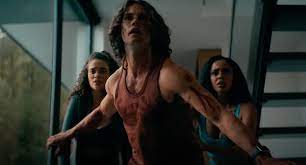
Himbo pretty boy Drew (Jedidiah Goodacre), his last-minute plus-one, the vapid influencer not-really-girlfriend Lexi (Vanessa Morgan), “hot couple” Kayla and Devin (Phoebe Miu and Jordan Buhat) and stoner Clay (Richard Harmon) don’t suspect a thing.
Clay’s as “high as a flock of toucans…FRUIT Loops,” so at least he has an excuse.
The coding queen of this “nerd herd,” Hannah (Madison Pettis) is more leery. She’s not even on social media.
“The more you look at the coding,” she warns, “the more you realize how scary it is.”
And this house, adapting to its new weekend renters, slings a “‘K, queen?” and “balls” and other slang into her speech as she takes on the guise of “the built-in roommate who does ALL the dishes” for these Oregon coeds.
As they tour the facilities, a cover version of “Pure Imagination” from “Willy Wonka” plays along. This place can cook, ferment, digitally 3D print anything they can imagine.
It’s been doing this for a while, now. And “this” includes lulling everybody into a false sense of security, separating this or that person from the group and killing or coming close to killing them as “she” does.”
Hannah’s the one who says “I think we should leave,” but who listens to The Smart One? There’s swimming, “Truth or Dare” and lots of drinking and what not to get into.
They never see it coming.
I like the way one of the three credited screenwriters dipped his toe in “Terminator” styled Machine Conspiracy Theory and “Alien” androids — bleeding milky white. The effects are good.
B-movie mainstay Steven C. Miller (2012’s “Silent Night,” a few recent Bruce Willis action pix) builds suspense here and there and stages a reasonably inventive murder-by-technology moment or two.
But “Margaux” is so formulaic as to forbid anything resembling a surprise. The tech depicted here is closer to “conjuring” than anything that could be mimicked, manufactured or automated today.
And several of the life-threatening situations resolve in ways that can only be described as laughable, all but letting us read the studio’s “notes” to this or that screenwriter.
“We need her around for the third act, so invent a way to do that.” One note that wasn’t passed down the line is getting a character to mention other characters have gone missing.
“Whatever happened to” is seriously late in coming.
Methodical and formulaic or not, “Margaux” manages a few notes of caution in between the screams the splatters. For instance, I won’t be giving Netflix my credit card again any time soon.
Rating:R (Violence and Gore|Drug Use|Some Sexual Material|Language)
Cast: Madison Pettis, Vanessa Morgan, Jedidiah Goodacre, Richard Harmon, Phoebe Miu and Jordan Buhat.
Credits: Directed by Steven C. Miller, scripted by Chris Beyrooty, Chris Sivertson and Nick Waters. A Paramount release.
“Simpson’s” fans might recognize the Sunsphere from the Knoxville World’s Fair of the 1980s, still standing and home of RealknoxvilleMusic.com these days.
Hanging out tonight with Wayne Blledsoe on his show ” Miles to Go” as he plays from his vast collection of labor, work and union songs and we talk about Labor Day, union movies and such.
Great views of Knox Vegas after dark, too.
Yes, when I worked here in the last millennium out of town wags called the Sunsphere”the doorknob to hell,” but I’m more mature now.
You’d think there’d be a historical marker noting this town’s places in cinema history — Sam Raimi, Bruce Campbell and the Coen Brothers filming a movie in the boonies, Food City manager Mike Campbell co-founding a cinema empire out of a closed movie theater.
Maybe Raimi should donate “the car” to get the ball rolling. Have Bruce show up for a ribbon cutting over the ’73 Olds Delta ’88.
“Root Letter” is an indie murder mystery about a missing pen pal, a film based on a Japanese video game.
It’s a slow, sloppily-structured exercise in tedium that is simple yet hard to follow, short but interminable thanks to leaden pacing and often-mumbled dialogue by its cast of mostly-unknowns.
Nah. Not beating around the bush on this one.
An opening scene introduces us to a teen we see getting a beat down thanks to an enraged father catching young Carlos (Danny Ramirez) having sex with his daughter.
That puts Carlos in a Tulsa hospital. And that’s where pen pal notes from Sarah (Keana Marie) are forwarded. It seems his class in Tulsa and her class in Baton Rouge have been assigned randomly-selected pen pals to correspond with as writing exercises.
As they’re both well into high school, this seems oddly late for them to be getting such elementary writing instruction. Usually this sort of assignment rolls out for pre-hormonal fifth graders.
They share the banalities of life — sanitized daily routine, childhood memories. She’s into Billie Eilish and Lorde, he’s all about Slayer and Metallica.
He’s just now figuring out “you can’t save everyone,” he writes. “Dear Carlos, I killed him,” she responds.
When Carlos recovers from his injuries and settles back into work washing dishes, the letters stop. That’s when he decides to travel to Louisiana and figure out what happened.
As as bland as this picture has been — sharing little snippets of his life, cutting to show bigger slices of hers — it’s about to get a lot worse.
Director Sonja O’Hara and screenwriter David Ebeltoft never get a handle on how to handle parallel structure in a screenplay. We lose track of Danny in the fictive “present” for most of the movie, and what few scenes there are utterly blow the mystery of how a teen would figure out another teen’s last name and track her down. Google isn’t the answer.
Danny spreads her letters on his bed as if to hunt for clues, but nah. Let’s just go find her English teacher and get her to figure out a way to let him know without violating her school system’s ethics and without making punching-bag Danny — he gets pummeled a few times — break a sweat doing his own homework.
Sarah’s mother (Lydia Hearst) seems a wreck, and Sarah’s whole life with her is an “Is he gone?” work-around with Mom’s rotating collection of boyfriends and what turn out to be her addictions and probation problems.
Sarah’s friends aren’t much of an escape either. BFF Zoe (Kate Edmonds) has hooked up with Mr. Wrong. And Jackson (Sam A Coleman) is interested in getting into the drug trade, using their stammering, supposedly meek mutual friend Caleb (Breon Pugh) to steal drugs from Caleb’s over-armed, camo-loving drug-dealing uncle (Mark St. Cyr).
Another friend slept with Sarah’s now-ex boyfriend. So Sarah gets drunk at a party, and the film is so sloppy we can’t tell if it’s from imbibing or it she was roofied. Next thing she knows, she’s awakened in a nice house down the street where the kind couple (Terry J. Nelson, Dodie Brown) took her in and let her sleep it off.
Turns out, they lost a daughter about her age. It made the wife a little crazy and left them both shattered. Could they be Sarah’s lifeline?
All this back story isn’t presented as something Carlos is figuring out, reading up on or being told by the good folks of Baton Rouge. Because remember, the script has forgotten about him. Until, that is, he starts poking around wherever Sarah might have been and asking questions about what became of her.
Hand to heart here, very little of this makes any sense. Whatever happened to Sarah would have generated a police report and journalism Carlos could access. Whatever he’s getting off TV station websites doesn’t explain in the least where she is — above or below ground.
Sarah’s an interesting character, and those she finds herself throwing in with are at least colorfully bad. The high school milieu has some limited interest. But Carlos is dully written and sleepily played.
I watch movies for a living, and as thrillers go, I found this laughably inept at just getting the basics of storytelling down. You need to understand who and how people are, follow a narrative throughline of some sort and give us something to hang onto so that we’re in the same boat as the protagonist trying to piece this “mystery” together.
The parallel structure problems, a third act string of crimes without consequences or even remorse and the idiotic steps Carlos takes in tracking somebody he’s never met with only a few PG letters to go on overwhelm this movie and don’t exactly embellish the image of the game it’s based on, either.
Honestly, I feel I know less about what connects these two and why any of this is worth exploring than I did when “Root Letter” started. I know I care a lot less.
Rating: unrated, violence, drug abuse, sex, profanity
Cast: Keana Marie, Danny Ramirez, Lydia Hearst, Mark St. Cyr, Sam A. Coleman, Breon Pugh, Kate Edmonds, Terry J. Nelson, Dodie Brown
Credits: Directed by Sonja O’Hara, scripted by David Ebeltoft, based on the Kadakowa Games video game. An Entertainment Squad release.
Whatever the stylistic charms of Olivier Bourdeaut’s acclaimed novel, the film version of “Waiting for Bojangles (En attendant Bojangles)” offers further proof that “manic pixie dream girls” exist in France, and not just in the person of Audrey “Amelie” Tautou.
It’s about a dizzy, star-kissed romance between two freer-than-free spirits and the child they give birth to and raise in the hippiest “free range” tradition. The novel tells this story through the eyes of the child, and in his voice. That’s not the way the film unfolds.
Director and co-writer Régis Roinsard invites us into a fantasy world of carefree love, lying as performance art and “unbridled imagination” — all made possible because of (one guesses) family money. Nobody works in this fictional bubble, and yet endless parties, extravagant living quarters and mountains of bills can pile up because no one can or should be bothered to pay them.
It’s a world with no visible means of support, a world where a couple can “meet cute” and discover “our song” on his baby blue 1958 MGA car radio motoring their way to a madcap “marriage on impulse” at an empty roadside chapel.
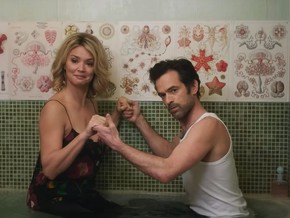
Because that’s how free spirited “Name me as you wish” Camille (or “Antoinette,” “Rita,” etc) and the rakish rogue George (Romain Duris) roll.
The fact that “our song,” which we hear over and over again in the film, is “Mister Bojangles” and Jerry Jeff Walker wouldn’t get around to composing it until ten years after that 1958 opening is immaterial. We’re on the fringes of magical realism and perhaps relying on a child’s misremembered memory. After all, young Gary (Solan Machado Graner) was only conceived that night. He wasn’t really a witness.
We meet Georges as he seems to be crashing this posh patio party overlooking the Mediterranean sunset, thanks to his stubble (a lower-class trait and another 1950s Riviera anachronism) and ever-evolving lies-as-conversation starters. He was Josephine Baker’s lover “during the war.” He is Romanian and “you might have heard” (in French with English subtitles) of his ancestor, “Count Dracula.”
He spies the stunning blonde across the way, dancing as if no one’s watching, and is warned away by his old money family friend (Grégory Gadebois). Camille (Virginie Efira) will “drive you doolally,” is the warning. “She dances on the edge of a precipice.”
It’s already too late. Smitten Georges floats into her dance, leads her into an extravagant tango and fills her ears with colorful lies. She lies a little, too, as she barely takes notice of her new dance partner until the mob descends on him after uncovering his fibs. She sticks up for him, and they’re off , with her standing up in the tiny sports car as her diaphanous Grace Kelly-in-“To Catch A Thief” dress (Chanel?) billows in the breeze.
It was meant to be.
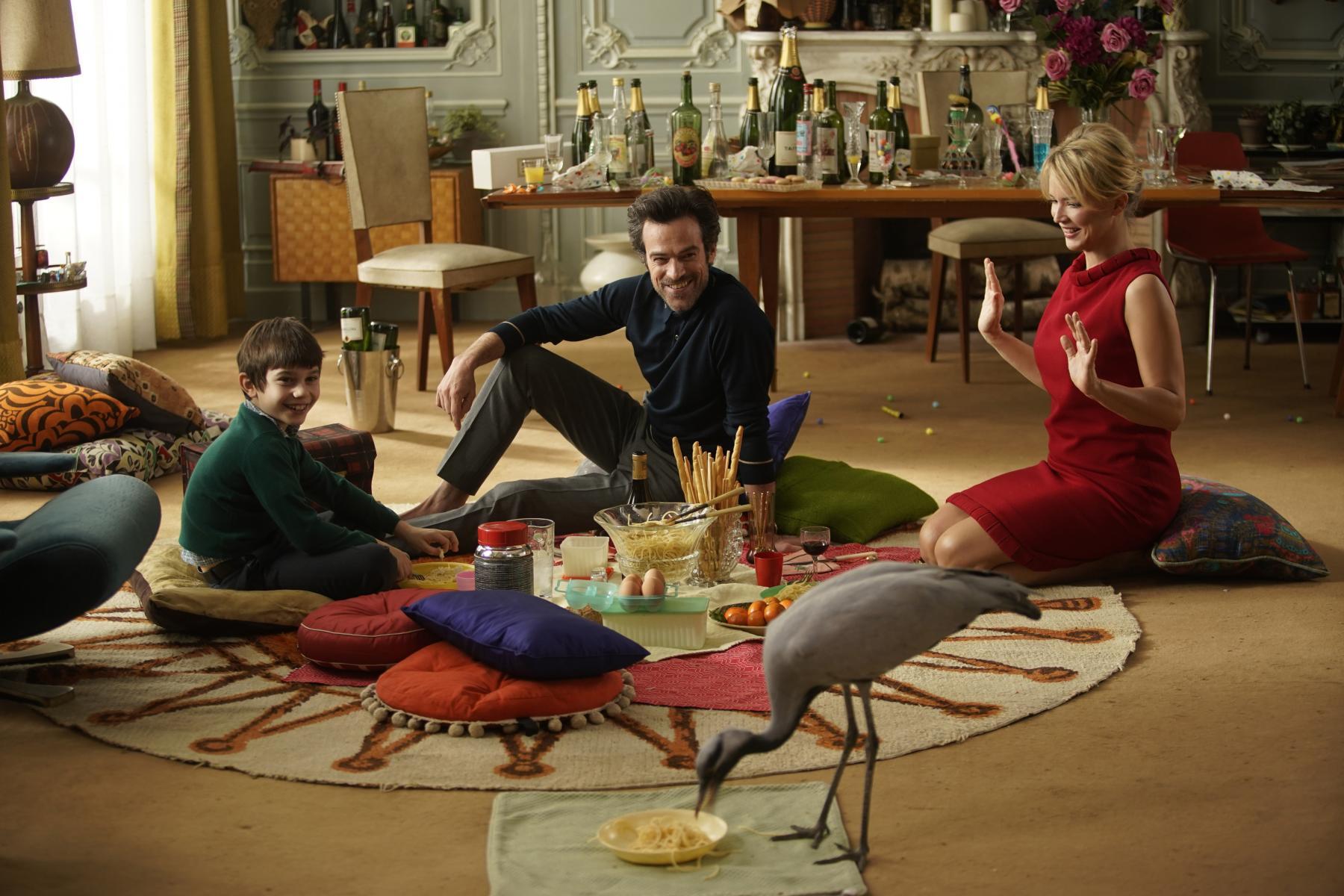
Over the course of the film, we see Georges indulge her every whim and eccentricity as she indulges his — among them, giving birth to his baby. It’s only when their boy reaches the age of 10 or so that the problems surface. Nightly parties, which their son attends, making him miss school, keeping a stork for a pet, doing almost everything on a whim — is that a sane way to raise a child?
Any viewer watching this and taking in the impulses, the bubbly mania and stress-free kick-their-problems-down-the-road lifestyle of these two-now-three, is almost certain to remember the manic pixie dream girls you’ve known, real life versions of Katherine Hepburn in “Bringing Up Baby,” Streisand in “What’s Up Doc?” or Zoey Deschanel in just about anything.
I’ve been blessed with knowing four, by my perhaps-generous definition of these intoxicating free spirits. And as “Bojangles” takes its sobering turn towards “serious,” I couldn’t help but recall that three of the four died young.
Camille purposefully taking a walk down the street in the nude can be indulged by Georges, who dashes out, strips and joins her. But as one dinner party guest suggests when Camille strips off her panties to make an angry point, “She’s lost her mind.”
“Is Mom sick” the boy wants to know? “No more or less than most people” isn’t the most honest answer.
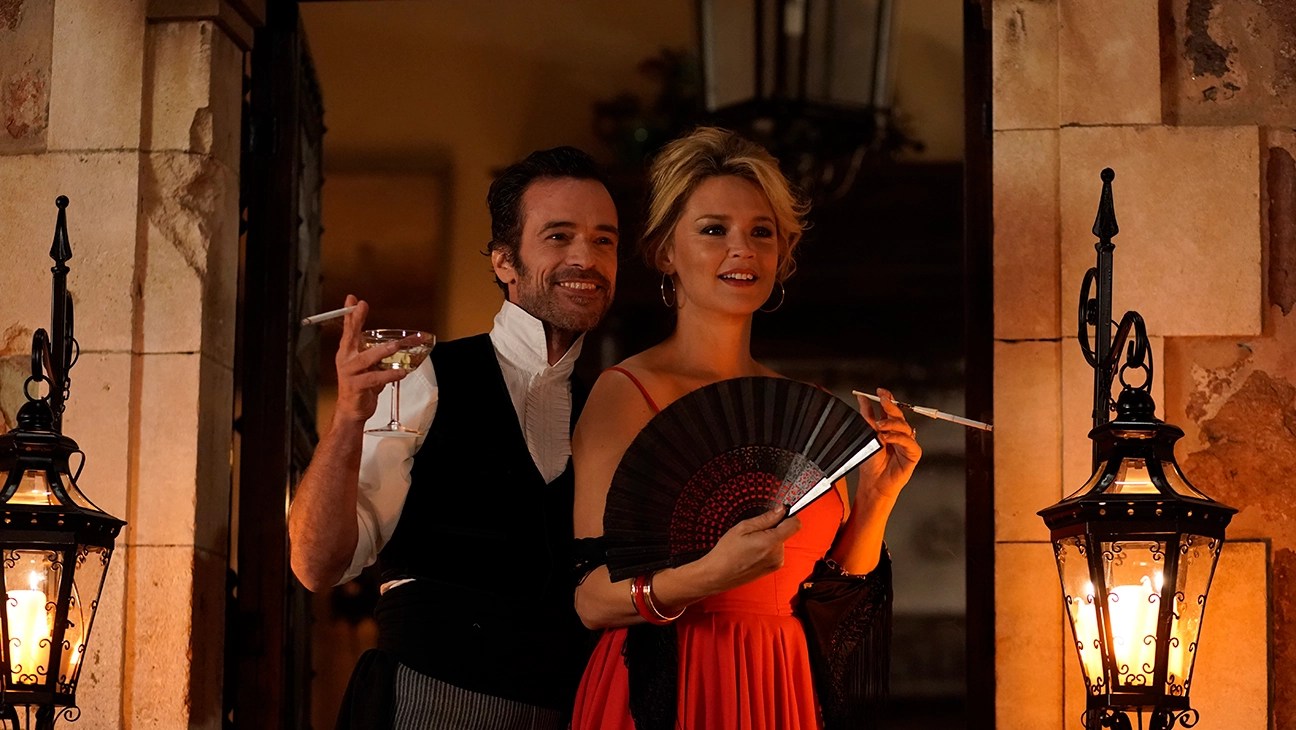
Duris, a star since “The Beat My Heart Skipped” and a screen heartbreaker since “Heartbreaker,” is at his dashing, sweep-you-off-your-feet best here. Georges dances, charms and lies like his life depends on it, like his whole shtick is a lie. He positively swoons over Camille (we get it). Duris sizzles in a Spanish flamenco production number in the third act.
And Efira (“Benedetta,” “Sink or Swim”) so cranks up the energy and the sexual allure for this woman that her dazzling beauty and devil-may-care spirit make her irresistible to pretty much any straight man you can think of, who would throw caution to the wind just to bask in her presence.
“I never fell in love before,” he pleads, after chasing down the MGA she caused him to crash, and then stole the morning after their “wedding.” “Don’t deprive me of such a delight.”
That’s the spirit of “Waiting for Bojangles,” the first half of it, anyway. Even the most irresponsible excesses — allowing Gary to decide he won’t attend school…at 10 — seem reasonable as this couple-and-child skip by on a years-long contact high that they share with us.
The second half is dark and more “reality” based, and manages to be a drag and drag dramatically as well. Perhaps mimicking the novel’s point of view and structure (Dad’s diary entries and Gary’s memories of his folks) would have helped.
But if you know the song that underscores this romance, know the Jerry Jeff and Sammy Davis Jr. and Nina Simone versions of it, you get what the novelist and the filmmakers were going for here. Reality is melancholy. Imagination and memory are our escape from it.
Camille explains it best. “When reality is sad and banal, make up a fantastical story” and live in that.
Credits: Directed by Régis Roinsard, scripted by Romain Compingt and Régis Roinsard, based on a novel by Olivier Bourdeaut. A Blue Fox release.
Running time: 2:04
Posted inReviews, previews, profiles and movie news|Comments Off on Movie Review: A French “Manic Pixie Dream Girl” romance, and its aftermath — “Waiting for Bojangles”













 Movie Nation