The post summer hangover at the box office continues, with numbers further deflated by the hole COVID punched into the movie-going habits of millions.
Horror used to be the most reliable, if never the biggest audience at the cineplex. Endless “Saw,” “Halloween” and “Insidious” sequels could always count on an $18-24 million opening, with occasional breakouts like “A Quiet Place” becoming blockbusters.
COVID has flattened that turnout. Even a terrific film like “Barbarian,” a real creeper, with horror in its DNA and a few minor names in its cast, should have managed $15-20. It did not. A $10 million opening is about half what it might have pulled in.
Will that audience find it next week? Maybe. Maybe not. Horror fankids tend to chomp at the bit and bite off their tickets opening weekend.
“The Black Phone,” just as good, had Ethan Hawke and a King family horror franchise tie-in and opened at pretty much what it would have earned pre-COVID — just under $24.
Indian imports have done unusually well in the American marketplace post-COVID. An audience returning to theaters quicker than other segments of the culture? Disney released “Brahmastra Part I: Shiva” on 810 theaters and it ended up earning about $4.4 million. Nothing great, but considering how poorly everything else is performing.
“Bullet Train” added another $3.2 million. It’s at $92, and should reach the $100 million mark.
Waiting on other figures to come in via Exhibitor Relations, and this will be updated as they do.
“Top Gun: Maverick,” finally slid off steeply enough to drop into the $3 million range ($3.1), $705 million four months into its North American run.
“Medieval” opened wide but not well, an $810 weekend take for this Avenue release starring Ben Foster, Michael Caine and Sophie Lowe.
“Honk for Jesus, Save Your Soul” deserved better. It added another $225k, $2.4 million taken in this far.
The hostage drama “Breaking” was a bust, dropping to $225k its third weekend.
The whiff of fall sends a movie critic into reveries of Toronto, where the annual film festival (TIFF) is underway again. It’s a lovely city that hosts a first rate festival. Is the shoe museum still open?
A movie like Mercedes Bryce Morgan’s “Fixation” triggers other memories, of the oddities one finds in that festival’s eclectic-by-design/serious and yet eccentric-by season-of-the-year programming.
Fall is when the weirder works of Canadians Guy Maddin and Atom Egoyan make their appearance, movies previewed pre-fall at TIFF. Many’s the early morning when I gave myself over to the onanistic excesses of whatever Lars von Trier or his ilk was trotting out this year, staring at my watch as I wondered where this was going and how much longer it would go on.
“Fixation” is a psychological thriller and murder mystery by genre. What it turns out to be is a bizarre burlesque of mental illness, memory and psychotherapy.
Hell, it even has Stephen McHattie, who played a self-serious but comically unethical psychotherapist on “Seinfeld,” as a possibly ingenious, probably demented head-shrinker.
Remember the simplistic dream interpretations of Hitchcock’s “Spellbound?” It’s a bit like that, with a touch of “Truman Show” and hints of Von Trier, et al in its elaborate fever-dream cure.
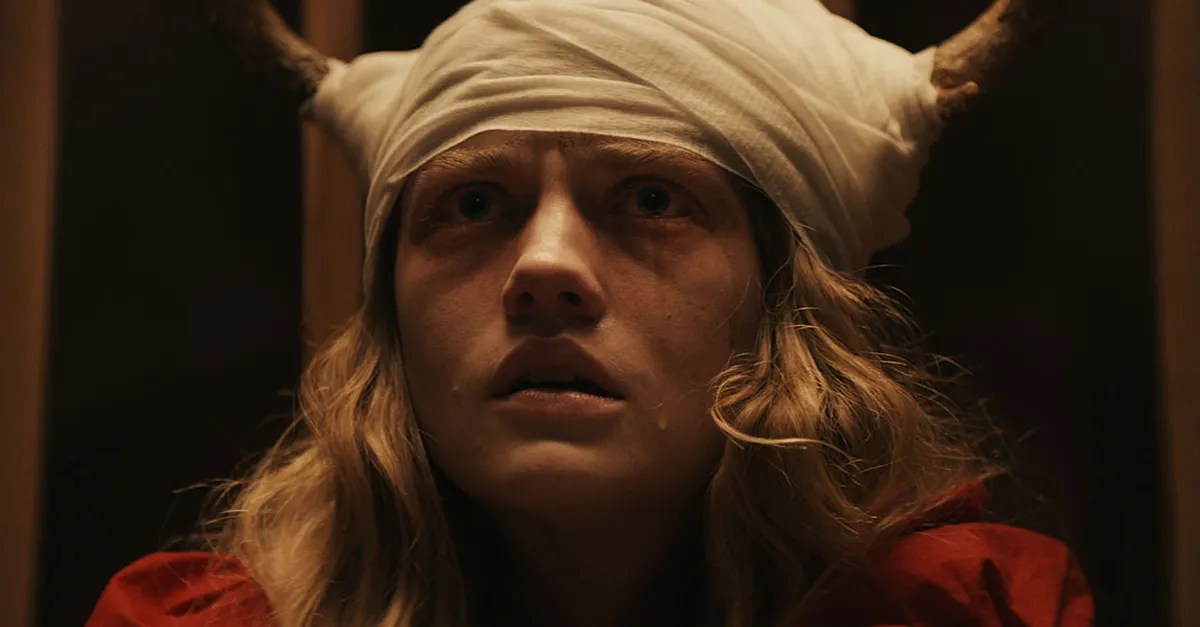
Maddie Hasson of “Malignant” and TV’s “Mr. Mercedes” stars as Dora, a young patient at a peculiarly designed, oddly-staffed mental hospital. She’s there under court order, we gather. She’s under the care of Dr. Clark (McHattie) and his colleague, who likes to go by “Doctor Melanie” (Genesis Rodriguez).
Something about the questions Dr. Melanie asks, the tests Dr. Melanie administers and the peculiar, severe hair and makeup (think Tim Burton’s mates) she exhibits makes one wonder what Dr. Mel is all about.
Something awful happened between Dora and her brother. Just mentioning the name “Griffin” triggers her. We hear he was a taxidermist, and the mind reels at what might have transpired thanks to that detail.
Dora? She seems rational and patient right up to the moment she isn’t. She wants her freedom, can’t figure out how long she’s been there and is starting to have trouble distinguishing her reality from whatever the hell her mind takes her.
But the solution may be simple, Doctor Melanie insists. Just stick to Dr. Clark’s program. “Step One: Submission,” Step Two: Immersion with the Past,” “Step Three: Integration with the Present,” and so on.
“He’s chosen you,” she’s assured. Only she isn’t “assured.” We figure that out when she bites a nurse’s ear off to get out.
Morgan and her co-writers put Dora through a memory play of her life — recreating her past, confronting her present, reckoning with what happened and what she’s accused of.
It’s a vamp of what real therapy looks and feels like.
Hasson plays a reluctant participant in this “play acting” cure, befuddled and outraged, crushed and defiant. She’s an arresting presence, and the sparring scenes with Rodriguez and later McHattie have the feel of something with heft, even if the substance isn’t there to back that up.
With extreme close-ups, creative “stage” lighting that takes us through sets that look like sets (on purpose), Morgan’s made a flashy, technically-interesting but shallow pirouette through paranoia.
It’s got a certain promise to it, with the viewer and Maddie straining to determine which threats are real, which are in her head and which are thrown at her to put them in her head. But once the third act “explaining” begins, we and our heroine realize just how far in advance we saw all this coming even as we sneak another glance at our timepieces, wondering when and if this will ever end.
Rating: unrated, graphic violence, profanity
Cast: Maddie Hasson, Genesis Rodriguez, Atticus Mitchell, Gita Miller and Stephen McHattie
Credits: Directed by Mercedes Bryce Morgan, scripted by William Day, Mercedes Bryce Morgan and Katrina Kudlick. (No Distributor Yet).
“Steal from one,” the old saying goes, “and you’re a plagiarist. Steal from many, you’re a bloody genius.”
Something like that.
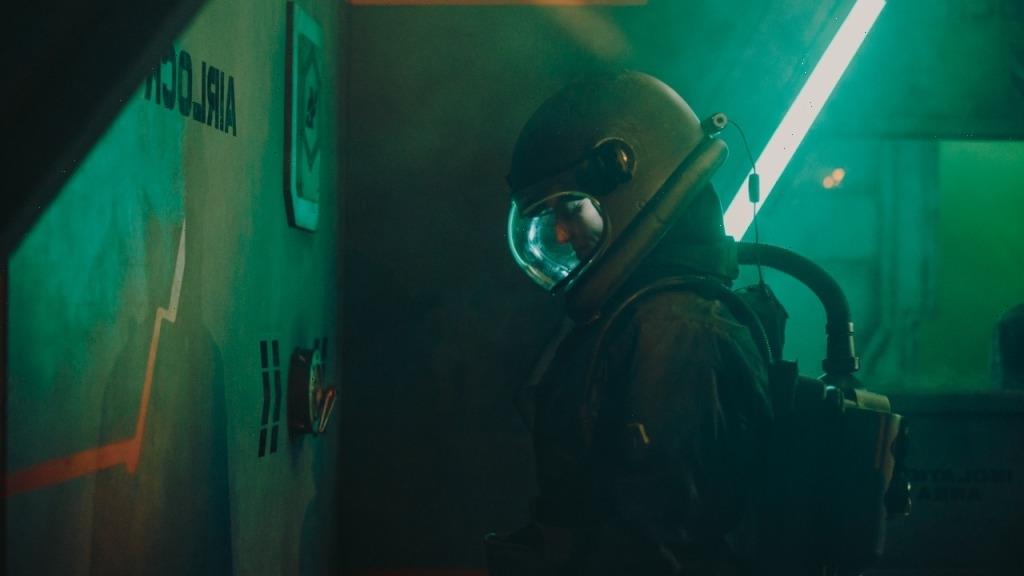
Writer-director Steve Stone almost makes a sci-fi fan viewing party game out of the antecedents for his thriller “Deus,” which is about a spacecraft sent to investigate a freshly-arrived “sphere” in orbit around Mars.
There’s a hint of “Contact” and a movie that Carl Sagan must have seen before writing it, “When Worlds Collide,” in its uber-rich oligarch (veteran character actor Phil Davis) who is writing the checks.
The ship’s design mimics “2001” and “2010” and “Alien,” which also provide generous inspirations for portions of the plot. That can be summed up by a line a character says in response to the single word the “sphere” transmits as its identification — “Deus.”
“How do we know it isn’t what it says it is?”
I caught elements of “The Black Hole,” “Event Horizon,” “Dark Star” and a movie that predates even that one, “Satellite in the Sky,” whose penultimate image haunts me, even though I only saw it once on TV as a child.
But after all that borrowing, and after rounding up “Pitch Black” and “Stargate” alumna Claudia Black, “Eastenders” veteran Richard Blackwood, the always-working Scot David O’Hara (“Braveheart” to “Agents of S’H.I.E.L.D”) and Davis (“Vera Drake,” “Nicholas Nickleby,” “Cassandra’s Dream”), Stone fails to get his players to perform the urgency and shock of this “discovering, ” ofand fails to convey any sense of the momentous event he’s showing us.
The oligarch may tell the crew of the good ship “Achilles” — yes, the engine-bearing pod of the structure is called “The Heel” — that they’ve been sent to solve “the greatest mystery ever encountered by the human race.” But damned if any of these astronauts act like it. Just another day, another punch of the timeclock.
Black plays the scientist on board the girder-linked ship, with Blackwood the skipper, and O’Hara, Charlie MacGechan, Crystal Yu and Branko Tomovic as the crew.
They’ve left an Earth in mid-environmental collapse to go check out this thing that’s parked itself in orbit around Mars.
It is what is says it is? And even if it is, should they, as Ulph (O’Hara) suggests, “blow the f—er up?”
The ultimate question in a sci-fi movie, really.
Predictably, somebody on the crew goes all messianic and crazy upon encountering the god sphere. People die. And dead people park themselves in our heroine’s head when she gets nearer my deus to thee.
The generally blase performances are a mild distraction from the parade of tropes — “hibernation” cryo-sleep pods, hexagonal halls and sliding doorways, a lot of darkness and few if any actual places to sit. Not much “strapping in for landing” here. And one crewmember is…a blogger? What, the podcasting fad is over in the near future?
The ideas the film wrestles with are more down to Earth than religious, and interesting enough. And the approach to the plot and the production design kind of hold your interest.
But the cast seems to have bee directed into narcolepsy. There’s nothing here that they’d care to wake up and get us involved with.
Rating: unrated, violence, profanity
Cast: Claudia Black, Richard Blackwood, David O’Hara, Charlie MacGechan, Crystal Yu, Branko Tomovic, Lisa Eichorn and Phil Davis
Credits: Scripted and directed by Steve Stone. A Darkland Distribution release.
Fierce, furious and feminine, “The Woman King” is an action picture that isn’t so much “released” as “unleashed.
It’s a period piece built around history’s real Amazons — the all-female palace guard of the Kingdom of Dahomey. Oscar winner Viola Davis stars in it, heading a cast of equally formidable women who march us through a fictional but historically-sound story of resistance, fighting the good fight and stirring up “good trouble” in an Africa “corrupted” by the racist European slave trade.
Talk about a movie of its moment.
Women headline this. Women produced it, including Davis and her acclaimed-actress friend Maria Bello (who also gets a “story” credit). Gina Prince-Bythewood takes what she learned making “Old Guard” and applies it to a much better script — by Dana Stevens. And women on screen charge through it, battling abusers, enslavers, Africans and Europeans to set things to right in a small kingdom threatened at all sides by larger powers.
As depicted here, the Agojie were the Green Berets of their era — a committed combat elite. They were an African, asexual (apparently) Sacred Band of Thebes, women trained from youth to fight and work as a unit because Dahomey was losing so many of its men to larger kingdoms’ addiction to the slave trade.
Davis plays Nanisca, general of this corps. With her fearsome lieutenants (wonder women Lashana Lynch and Sheila Atim), she is tasked with carrying out the policies of the new king, Ghezo (John Boyega). And what Ghezo wants is to get out from under the domineering thumb of the Oyo Empire.
Dahomey pays the Oyo tribute, and still Oyo goons and their allies raid villages and take captives to sell to the Portuguese. The film opens on Nanisca and her ululating Dahomey Team Six staging a merciless counter-raid to free hostages and butcher the bad guys who stole them.
The film’s story is largely seen through the eyes of a petite teen (South African newcomer Thuso Mbedu) who will not accept her father’s arranged marriage to a much older man who thinks slapping her in front of her dad will seal the match.
Nawi is physically smaller than the rest of her recruiting class. She is mouthy, talking back to the battle-scarred general, who lectures them “We need SMART warriors. The dumb ones die quickly.”
With a little instruction and a lot of training and discipline, maybe she’ll make the cut.
“Always obey Izuke,” a lieutenant (Lynch, of “No Time to Die” and “Captain Marvel) snaps. Nawi pauses, confused. “I am Izuke!”
Oh.
A towering, ruthless new general (Jimmy Odukoya) is their Oyo foe. He leads from horseback, and is most intent on grabbing hostages for the Portuguese (Hero Fiennes Tiffin and Jordan Bolger) who show up at the slave port controlled by the Oyo.
Nanisca must mold her fighting force, shake off off her injuries and advancing years, battle her own trauma, outsmart her foes and out-maneuver the king’s wives and persuade her monarch that maybe Dahomey should opt out of this slave trade economy altogether.
The script has some old fashioned touches. One of the Portuguese (Bolger) is the son of a kidnapped Dahomeyan mother, and could be somebody’s love interest. The “change our economy” to get out of slave trading messaging seems revisionist and “modern.”
Prince-Bythewood and the screenwriter haven’t yet mastered the perfect drop-the-mike moment, giving the ending an anti-climactic touch or two…or three.
But the production design, the training sequences, the visceral, breathless and just-plain-cool combat, the singing, dancing, parading and mourning by an impressive cast drive the picture and pull us along with it.
Davis lets us see a seriously badass broad’s vulnerable side, mastering the fight choreography and reminding us at every moment that she’s one of the best actresses of her generation. She’s the thespian rising tide that lifts every other performance around her.
Lynch, Odukoya, Atim and Mbedu are her stand-out support. And Boyega seems perfectly cast as a young, impressionable king who’d like to impose his will on all his subjects, but with the good sense to listen to the tougher-than-him woman with the better ideas.
“The Woman King” reminds us that the real history we don’t know makes for a great story, and a grand action yarn. You want to learn where all the good parts and “realistic” elements of that comic book movie “Black Panther” and its sequel came from? Gaze upon “The Woman King,” and be thrilled.
Now here’s a sequel we can all get behind. An “Enchanted” follow up that’s all about life after marrying your McDreamy Prince and moving to the ‘burbs.
Love and Amy! And Maya Rudolph’s on board this time.
“The Bengali” is a lovely home movie about finding one’s roots, a simple tale that connects a New Orleans family to its West Bengal patriarch, who came over from India in the late 19th century.
School teacher Fatima Shaik grew up hearing the stories about her grandfather, Mohamed Musa Shaik, and seeing the hookah he’d brought over from India when he landed in New Orleans in 1893. She’d heard the lore about him being an “Oxford” man, from Calcutta, about him having land back in the old country.
The hookah, family homes and family members were lost in Hurricane Katrina. That adds impetus to her quest.
With Indian American filmmaker Kavery Kaul as her translator and the person documenting this journey, she’d go back to Calcutta — or a village close to it — and see how much of this “lore” was fact, and how much was just grandpa over-selling his past.
Through Fatima, a devout Louisiana Catholic, we learn of a number of immigrants from India who made their way to the port of New Orleans and how interested her family and her adult daughters are in this part of their lineage. As Gandhi discovered, growing up in South Africa, people of Indian and later Afro-Indian descent were “Black” to the dominant, segregationist white culture. Being fair-skinned, Fatima’s family felt an “otherness” that appears to have equated with rootlessness.
So she takes off on a big adventure, a stranger in a strange land, but a place that lingers in her DNA and that might jibe with family memories.
Weaving the Cajun accordions of New Orleans with the tablas and sitars of India into the score, Kaul follows, aids and assists Fatima, who works extra hard not to come off as the stereotypical “ugly American.” That’s not easy, as she is an ever-smiling, inquisitive foreigner who asks a lot of question. She stands out in the crowds of her grandfather’s country, and sets off alarm bells in locals every time she mentions “my grandfather’s land.”
Kaul, being more Indian than her film’s subject, becomes the person the locals confide in as she and Fatima track, via an old letter to an Indian lawyer, the village where Mohamed grew up and the land he might have left behind when he emigrated.
Kaul is the one a mistrusting local man says “I can’t tell if she’s black or white” to, who overhears Muslim villagers gripe “She’ll sing Catholic songs,” whom a village elder lectures “She’s from another religion so she can’t be one of us.”
Fatima smiles, tries to teach local girls the “second line” Mardi Gras dance from New Orleans, and never quite figures out how that the way to defuse the local paranoia might be saying “I’m not here to make a claim on his land.” Because as far as we know, that could be her intent.
“Why are you asking SO MANY QUESTIONS?” more than one local wants to know.
In “greedy, wasteful” America, as she knows the locals see “us,” most of “us” know better than to verbally renounce our property rights, after all.
Her encounters with the Catch-22 rabbit hole of Indian bureaucracy — ancient and English-inculcated record keeping, without any hint of English “efficiency” — are as amusing as they are frustrating.
“Madam, I KEEP the records. I can’t SEARCH the records!”
As you can guess by the fact “The Bengali” was finished and merited a release, there is a warm (ish) payoff to their efforts.
That, and the unknown history it dips into, makes the film rewarding enough to merit a look, even if it never quite transcends its limited “home movies made by a professional filmmaker” reach.
Rating: unrated
Cast: Fatima Shaik, Kavery Kaul
Credits: Scripted and directed by Kavery Kaul. A Dada Films release.










 Movie Nation