Movie Review: Robbers are “Hunted” in this Brit thriller about class, privilege and “the most dangerous game”

As long as there are movies to be made, there’ll be fresh versions of the hoariest thriller plot of all, the one based on a short story with a pun in the title.

Man/human beings are “The Most Dangerous Game.”

“Hunted” was titled “Hounded” (better title) when it was released in the UK. It’s another story about the inbred and entitled rich hunting their fellow humans for sport, another variation of Richard Connell’s classic short story from 1924.

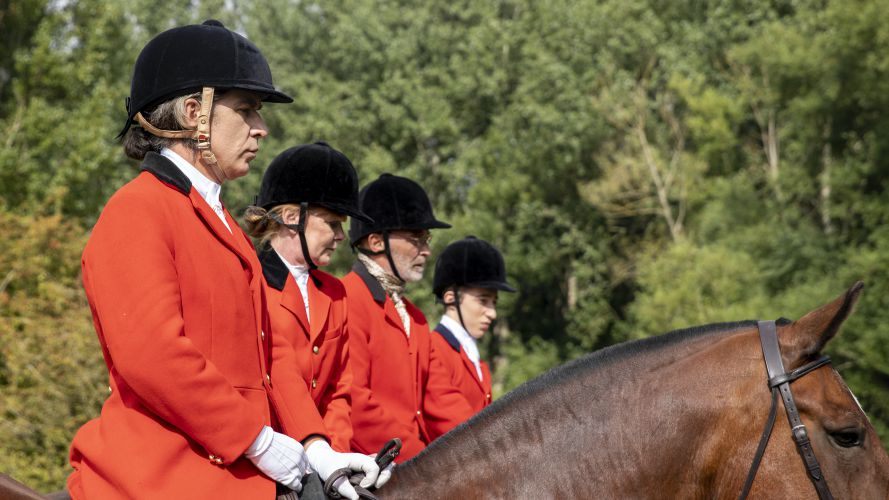
Like every adaptation, it has its unique twists and touches. But this Tommy Boulding tale is depressingly straightforward and generally lacks the urgency of people being chased to death and the menace of upper class twits on horseback dressed for the hunt and dressed to kill.

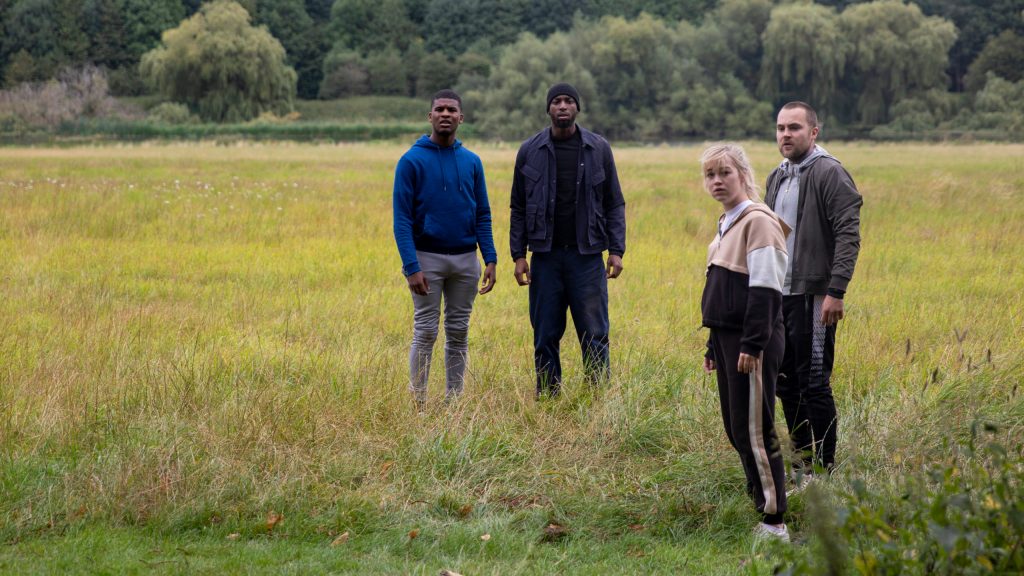
This time, it’s a gang of young London robbers who find themselves trapped, taunted and released by the family that owns the gigantic and ancient rural brick pile, The Redwick Estate.

Leader Leon (Nobuse Jnr), his getaway driver little brother Charlie — “That’s CHAZZ!” (Malachi Pullar-Latchman), lockpicker Vix (Hannah Traylen) and East European muscle Tod (Ross Coles) figure they’ll do — say it with me — “One Last Job” for their antique-shop owning fence.

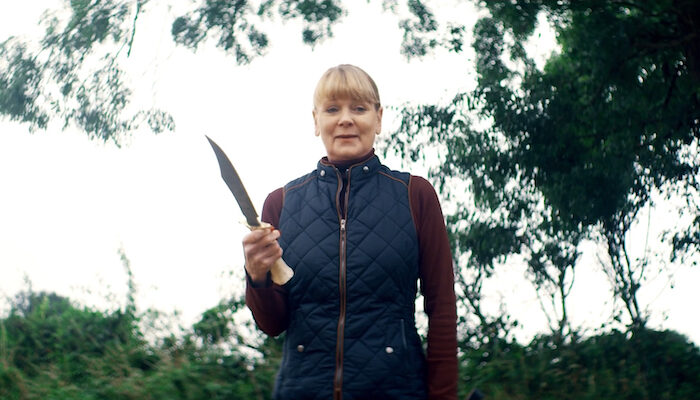
But it goes “pear shaped” as they say in Jolly Olde, and they find themselves hogtied, driven into the middle of nowhere, and lectured by the Redwick matriarch (screen veteran Samantha Bond, who played Moneypenny when Pierce Brosnan was 007).

“This country,” she intones, “used to have a natural order…the rulers, and the ruled.”

These impudent breaking-and-entering commoners have upset that order. The four thieves are left on their own, with a lot of questions they need the answers to.

“Why did they let us go? Why did they wish us luck?”

On hearing the sound of a distant horn, the thunder of hooves and baying of hounds — “I thought they banned fox hunting.”

“They did.” Wait for it. Wait. Wait. “RUN!”

Interestingly, the class consciousness has always been a subtext of the “Game” story, although many films avoided that because the filmmakers/producers were afraid of pointing out how the robber baron rich would just as soon kill us as let The People exercise power.

Decades of “Well, there’s no sense letting them label us communists” thinking prevailed in Hollywood if not everywhere.

Here, it’s introduced and joked about but somewhat lost in the search for inventive ways to kill the hunted and clever twists that let the prey become the predators.

As I mentioned at the outset, there’s a serious lack of menace among the horseback riders. They have four servants working with them, so they may have access to guns, but only carry “ceremonial” knives with them. Damned if I couldn’t overcome an old man, an OAP-aged woman, a daft 50ish father or his skinny inbred punk son. Maybe not all at once, but one on one.

The hounds, tails a-wagging and whatnot, come off as big ol’boo-boos and not killers baying for blood.

Some of this is rectified for brief moments, but the overall feel is of a chase that has low stakes until we see our first victim killed.

Bond gives fair value as the most entitled of the entitled, a woman with lots of miles and plenty of resentment for her inferiors.

“”This country used to be ruled by lions. Now it’s led by LAMBS.”

The rest of the cast? Adequate to a one. That doesn’t quite go for the picture, which has a fine moment here and there, and begins and ends well enough.

It’s all the not-that-scared slow-walking-escape that kicks off and finishes off the middle acts that blow this “game” before it really gets started.

Rating: unrated, violence, profanity

Cast: Samantha Bond, Malachi Pullar-Latchman, Nobuse Jnr, Hannah Traylen, James Lance, Nick Moran, Ross Coles, Louis Walwyn and James Faulkner

Credits: Directed by Tommy Boulding, scripted by Ray Bogdanovich and Dean Lines. A Saban Films release.

Running time: 1:34

Posted in Reviews, previews, profiles and movie news | Comments Off on Movie Review: Robbers are “Hunted” in this Brit thriller about class, privilege and “the most dangerous game”

Movie Preview — Cary Elwes broadcasts underground radio defiance — “Resistance: 1942”

Is the setting France? The character names are French, so probably.

Jason Patric and Judd Hirsch also star in this WWII drama.

Nov. 11 this streams and hits VOD.

Posted in Reviews, previews, profiles and movie news | Comments Off on Movie Preview — Cary Elwes broadcasts underground radio defiance — “Resistance: 1942”

Movie Review: Remembering the Good/Bad Old Days with “My Policeman”

There’s a stately, old-fashioned gentility to “My Policeman,” a period piece romance from the days when homosexuality was “The love that dare not speak its name” in the United Kingdom.

It’s the sort of tragic gay melodrama that stood out in many a fall film festival in Toronto and New York, not quite Douglas Sirk era guarded and 1950s oblique, but something that would have been considered sexually “daring” as recently as Todd Haynes’ homage to Sirk, 2002’s “Far from Heaven.”

As dated as it is, I expected the source novel to be antiquated, and not a relatively recent publication. The story arc has a familiarity and the tropes trotted out are tried and true. Seeing Linus Roache as a sexually-conflicted retiree here reminds us he first gained notice playing a tormented and closeted “Priest” back in 1994, and the presence of Rupert Everett pays tribute to his role in making gay characters mainstream, and the career price he paid for being out and the leading man roles he probably lost, handsome as he was in his youth.

All of which is a way of saying that this overfamiliar and somewhat predictable tale from the 1950s (and today) has value. At a time when gay rights are under renewed assault at home and abroad, it’s worth remembering “the bad old days” and the rippling pain of relationships that could never be, and the hurtful, stifling influence of “the norm.”

A very old man (Everett) is delivered, by wheelchair, to a home by the sea in Brighton. A retired school teacher (Gina McKee) is taking him in, and gets cursory instructions on how to handle him. “No cigarettes,” no matter how much he badgers you, for starters.

Is this some program in which the public is paid to take in the elderly and infirm? Are they related? No to both.

The fact that her retired husband Tom (Roache) has turned to long dog walks along the sea-lashed breakwater rather than meet this failing old man speaks volumes. They have history — all of them.

In flashbacks, we meet Marion (Emma Corrin) just as she’s finishing school and about to start teaching, and Tom (Harry Styles) as he’s just finished his military service and started police work. They meet through a friend of hers, and she is quite taken.

Tom is kind, considerate and curious, a “copper” who would love book recommendations from Marion. But just as they’re starting to become a couple, he introduces her to a museum curator (David Dawson) who’d love to give them a private tour.

Tom met him at work, and the cultured, worldly Patrick becomes a third in their couple — inviting them to recitals, proffering tickets to the opera, leading them in restaurant sing-alongs. He’s the life of the party, a tour guide to life on a higher place. He’s also a third wheel. Her friends think the educated Patrick might be smitten with Marian. She’s sure Tom’s the one for her.

As Patrick is setting off the viewers’ gaydar, the question the picture asks becomes “How did Marian find out, and when?”

“My Policeman” backtracks to Tom and Patrick’s meeting, which is a cliche. And it fills us in on clues Marion is given and misses or grasps, colleagues she confides in, as this “third wheel” enlivens their cultural and social lives, but who invites himself for a visit at the country cottage where Tom and Marion honeymoon.

As I type that, I am wondering anew what publisher took on a typescript that is this far from the social/sexual cutting edge — in 2012. Perhaps there is subtext that the film adaptation lacks. Then again, Bethan Roberts went on to write an Elvis novel (“Graceland”). So maybe not.

Director Michael Grandage did the nicely-realized publishing period piece “Genius,” in which Colin Firth played the Golden Age literary editor Maxwell Perkins, who made Fitzgerald, Wolfe and Hemingway legends. “My Policeman” shares that film’s attention to character and setting, and its quiet tone, with flashes of melodrama and splashes of not-quite-explicit sex.

The cast is also quite good. I wasn’t wholly on board the Harry Styles as cinema star bandwagon with “Don’t Worry, Darling.” In this period piece, he leans into his still boyish looks (grease on the celebrated forelock) and plays up the character’s lack of sophistication but desire to acquire it. He works in the part.

Corrin, who played Princess Dianna on “The Crown,” strips away a half century of sexual sophistication playing a wife of the one of the last “the last to know” generations.

Dawson, who was the skinny, over-matched and yet cunning King Alfred in TV’s “The Last Kingdom,” has an Alan Cumming vibe about him — “dashing,” worldly, sophisticated and not boorish about it.

There are but glimpses of the closeted gay life of the era — the furtive back-alley assignations that begin in the one gay bar in town, brutal police abuse.

The film’s core is the war of wills that emerges, competing agendas, everybody selfishly wanting what’s best for themselves. Marion and Patrick are destined to be hurt. But what about Tom? Who gets to be selfish, who faces consequences?

As familiar as much of this can seem, the players draw us in and make us invest in it. Even if the resolution is entirely too pat and emotionally lacking, the mere casting of the legendary Everett, the quintessential “Gay Best Friend” in “My Best Friend’s Wedding,” McKee (“Notting Hill”) and Roache, most recently a regular on TV’s “Vikings” and “Homeland,” gives the present day scenes the weight they need to work, even if that part of the story is given short shrift.

They ensure that whatever its shortcomings, “My Policeman” is never less than watchable, a frustrating romance from an era when same sex love affairs were, by law, bound to frustrate, curse and wound the lovers. Remembering that simple fact, and that this wasn’t that long ago, has value far beyond what might be just another gay romance with “tragic” undertones.

Rating: R, for sexual content (nudity)

Cast: Harry Styles, Emma Corrin, Gina McKee, David Dawson, Rupert Everett and Linus Roache

Credits: Directed by Michael Grandage, scripted by Ron Nyswaner, based on a novel by Bethan Roberts. An Amazon Studios release.

Running time: 1:53

Posted in Reviews, previews, profiles and movie news | Comments Off on Movie Review: Remembering the Good/Bad Old Days with “My Policeman”

Movie Review: Roberts and Clooney cash their “Ticket to Paradise”

Julia Roberts and George Clooney wring every last drop of good will and good humor out of their long friendship and screen personas as estranged exes who join forces to stop their daughter from marrying too impulsively and too young in “Ticket to Paradise.” They’re charming together, and they almost win us over in a generally sweet if not exactly hilarious romantic comedy from the director of “Mama Mia! Here We Go Again.”

That’s basically the film Ol Parker — who co-wrote this scenic and utterly inconsequential laugher — remade, “Mama Mia!” without ABBA. Or songs. Or big romantic emotions. Or a star-studded supporting cast.

At least Bali makes a decent alternative to Greece as a setting. Only “Ticket” wasn’t filmed in Bali. Queensland, Australia, with a few Balinese sets and bit players and some digital help, stands in for the “Island Paradise” here.

Clooney plays David, a Chicago builder. Roberts is Georgia, his LA art gallery-owning ex. They married right out of college, regretted it and were divorced within five years. But they have this thing in common — a child.

“The last time David was actually help was the night we made Lily!”

Lily (Kaitlyn Dever of “Booksmart” and “Rosaline,” now on Disney+) has just finished law school (“college” is how the script refers to it), and somehow got through it with a hard-drinking, man-crazy roomie (Billie Lourd, Carrie Fisher’s kid, also of “Booksmart”). Wren is this comedy’s comic relief, always ready with a zinger, a bottle or a “pleasure pack” box of Trojans.

The feuding parents have to sit together at graduation, shouting “Love you!”/”Love you MORE!” as Lily gets her diploma. They put her and wild child Wren on a plane to Bali for a few weeks to unwind before starting real life, and that’s that.

In an unfortunate departure from the “Mama Mia!” model, much of the first act is spent with the two graduates as they snorkel, get in trouble and are rescued by a hunky “seaweed farmer” Gede (Maxime Bouttier). We’re subjected to a drab courtship (no sparks here) in a stunning setting that leads to “37 Days Later,” the text that Georgia and David’s go-getter lawyer is about to ditch it all and marry too young and “make the same mistake we did.”

Thrown together on a flight to the wedding, they start cooking up a “Trojan Horse” plan that takes shape after landing. They’ll break up this premature couple-ation, get their girl on the right path and cheat themselves of the charms and quirks of a Balinese wedding.

The scenes that made you perk up in the trailer to “Ticket to Paradise” are the ones that pop in the finished film — Clooney and Roberts bitching/bantering on the plane, getting into a beer pong (Arrack is used instead) contest with the youngsters, which leads to a lot of uninhibited Mom and Dance dancing to ’80s pop.

They click like the old “Oceans” couple that they are, Roberts flinging her hair and barking “You need to calm down,” Clooney unloading “Your telling someone to calm down has never calmed anybody down in the history of the universe!”

But once they’re out to sabotage this “bad decision,” they are in “lockstep.” Only they’re not.

Clooney has some sharp-edged scenes in which he tries to scare off the would-be groom. Roberts is given a boy-toy younger Frenchman (Sean Lynch), an airline pilot, as a dopey, moon-eyed paramour.

It’s just that every situation everybody gets into is a cliche (“stranded” for the night, etc). Throw in the fact that the movie’s on life support when the leads aren’t on screen, and you see the problem.

There are giggles and a few decent laughs here. And it’s as funny seeing Clooney throw himself as bug-eyed mugging (on the dance floor) as it is seeing Roberts shake her groove thing like no one’s watching.

But when the credits roll, there’s nothing here we haven’t already forgotten. Which is why they slap some outtakes under those credits, showing us the way these two click, even between takes. It’s not enough.

Rating: PG-13 for some strong language and brief suggestive material.

Cast: George Clooney, Julia Roberts, Kaitlyn Dever, Billie Lourd, Maxime Bouttier and Sean Lynch

Credits: Directed by Ol Parker, scripted by Ol Parker and Daniel Pipski. A Universal release.

Running time: 1:44

Posted in Reviews, previews, profiles and movie news | Comments Off on Movie Review: Roberts and Clooney cash their “Ticket to Paradise”

Next screening? “Black Adam” — here’s a scene from it

Promoter, wrestler, actor and producer Dwayne Johnson swoops in to give DC and struggling cinemas a hand with a super hero movie this weekend.

Let’s see if it’s worth any hoopla, shall we?

Posted in Reviews, previews, profiles and movie news | Comments Off on Next screening? “Black Adam” — here’s a scene from it

Documentary Review: Reconsidering a Cultural Colossus — “Louis Armstrong’s Black & Blues”

The great New Orleans trumpeter Wynton Marsalis remembers the times his father Ellis suggested he take another look and listen to the jazz of “Pops,” Louis Armstrong. To Wynton and generations of African Americans who only knew Armstrong through is smiling public persona, not being political, never making waves despite the racism he faced from his first breath to his last, Armstrong was best at “Uncle Tomming,” playing the role that pleased white folks who thought he’d accepted his “place.”

But then his dad pushed recordings at his son and suggested trying to match the man’s trumpet and cornet solos. He couldn’t. And Marsalis the younger heard a bit of Armstrong’s vast archive of private conversation recordings, chats he’d have with friends, contemporaries and folks who’d stop by his house in Corona, Queens, New York. Here was the man the public didn’t hear as much of — defiant, salty, angry and frank, not an icon but a human being. Marsalis was turned around.

“I could not appreciate Louis Armstrong,” he admits in the new documentary, “Louis Armstrong’s Black & Blues.” He does now.

With all that’s been said, reported and written about Louis Armstrong over the decades, it’s shocking how eye and ear-opening Sacha Jenkins’ new documentary about him is, what a revelation and re-assertion of the man and his place in the culture it turns out to be.

Jenkins — who has the civil unrest in LA doc “Burn Motherf—-r Burn,” and films on Rick James and Wu Tang clan in his credits — lets us hear from those candid tapes, and they humanize Armstrong and give this revolutionary figure in music his due as a Black man who was the very first to push through a lot of doors in segregated America, and bore the scars for it.

Anecdotes start with “This ofay motherf—-r” comes up to shake his hand and drops the N-word when he does, or that Hollywood “callboy” (production assistant who fetched talent to the set) disrespected him on the set and got an earful that everyone else heard too, blistering and sometimes hilarious exchanges he’d relate to his friends.

Jenkins reminds us that in a few interviews in his later years — with his friend Orson Welles, who was sitting in for David Frost on his chat show, or Dick Cavett or even Mike Douglas — Armstrong let loose on the abuse and insults and racism he faced throughout his career.

“Uncle Tom?” Not hardly.

Armstrong called out then-President Eisenhower for not doing something about the white unrest in protest against integration in 1950s Little Rock, another piece of Armstrong lore that Jenkins jogs our memory’s with.

And that’s just addressing the “Uncle Tomming” rep that “Satchmo” wore by smiling and being America’s greatest musical goodwill ambassador at a time when “I played 99 million hotels I couldn’t stay at.”

As to the music?

He “hit notes” nobody else could, took over and popularized jazz and made it America’s music and made it matter for decades.

“He totally changed the way people sing,” another e expert weighs in. “Jazz, pop, rock, soul,” country, you name it — the way he attacked a phrase, his role in the invention of scat singing.

Touring and singing duets with white trombonist Jack Teagarden, pretty much mentoring his white copycat, Bing Crosby, crowning his many featured Hollywood appearances by singing with and to Streisand for the finale of “Hello, Dolly,” and topping the damned charts with “What a Wonderful World” well into his last decade of life, there is literally no one who comes close to Armstrong’s impact on music and culture and America’s self-image.

Jenkins has the rapper Nas read from Armstrong’s autobiography, “Satchmo,” and makes ransom-note cut-out word collages into subtitles, doubling the impact of Armstrong’s words (Nas sounds nothing like Armstrong. No one does.).

And the filmmaker taps into decades of personal appearances, a filmed TV concert in black and white, a European tour, chats with Steve Allen and Carson and everybody else who wanted the good vibes that an Armstrong appearance brought their talk and variety show, decades after jazz had fallen from its status as America’s favorite.

He was hilarious, joking about racism, poking prejudices and getting big laughs in the same breath.

The Armstrong of the personal tapes renews our appreciation for Armstrong the TV raconteur. The man was candid at home. “Let’s talk about pot,” he says on a tape. And on TV’s “What’s My Line?” a whole string of riffs on “high” and “higher” went right over the host’s head. Or so it would seem.

Jenkins has made a film that does exactly what Ellis Marsalis wanted his brilliant son to recognize, that we haven’t “appreciated” Louis Armstrong, a multifaceted entertainer whose place within the culture and the racial politics of his day have never been given their due.

In this Golden Age of biographical musical documentaries, the filmmaker who is now working on an Ed Sullivan doc has taken a subject we thought we knew all we needed to know about, and all but re-introduced him to a new age. Well done.

Rating: R for language.

Cast: Louis Armstrong, Lil Armstrong, Lucille Armstrong, Wynton Marsalis, Leonard Feather, Jack Teagarden, Orson Welles, Dick Cavett, Steve Allen, Mike Douglass and David Frost.

Credits: Directed by Sacha Jenkins. An Apple TV+ release.

Running time: 1:45

Posted in Reviews, previews, profiles and movie news | Comments Off on Documentary Review: Reconsidering a Cultural Colossus — “Louis Armstrong’s Black & Blues”

Movie Review: The Creation of an “American Murderer”

“American Murderer” is a workmanlike “true crime” thriller about the hunt for con-man turned accused killer Jason Derek Brown.

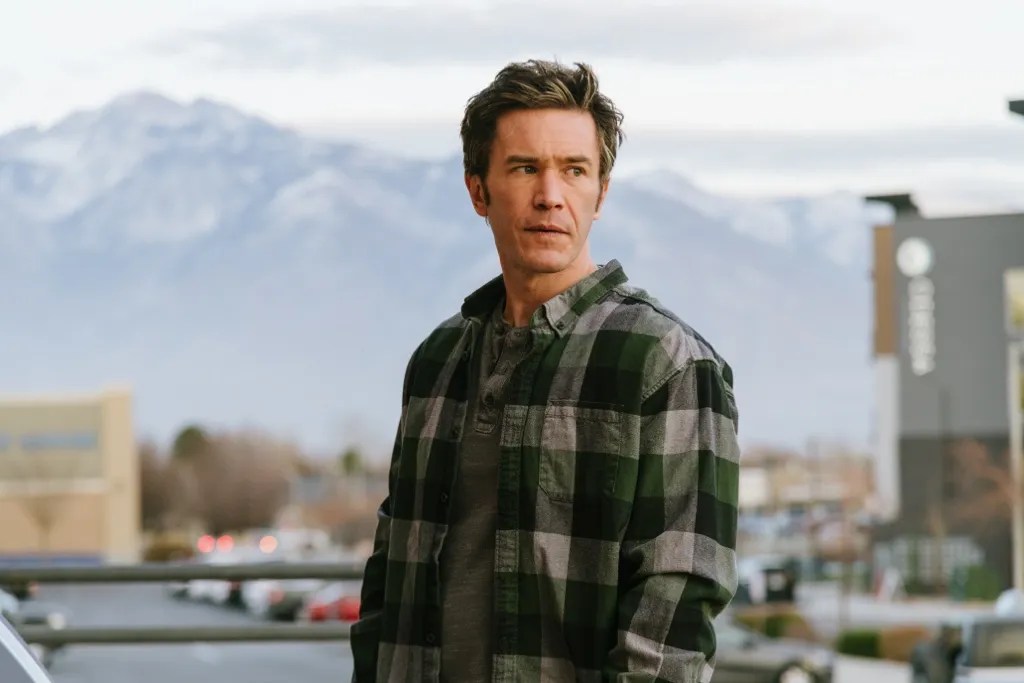
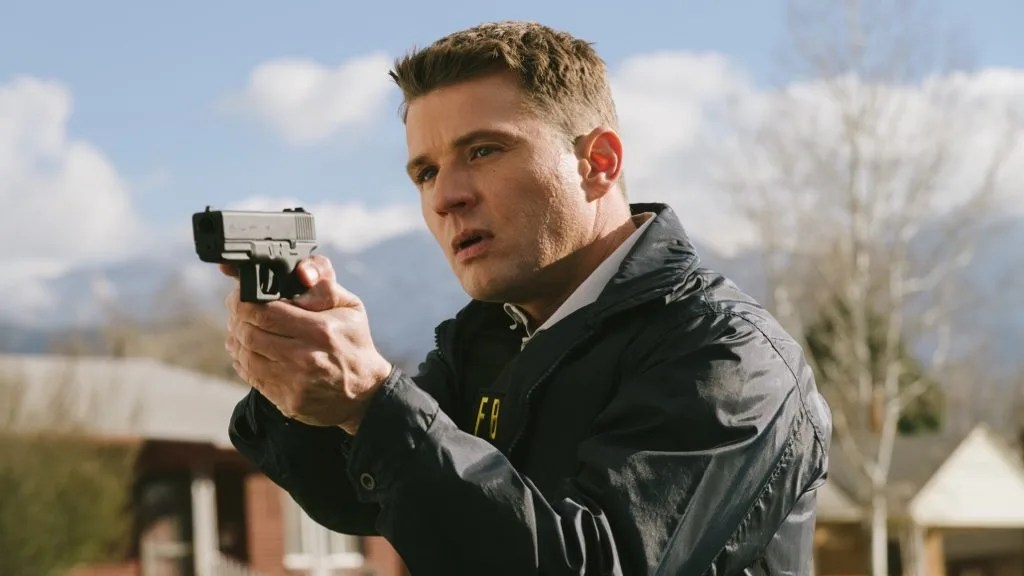
Writer-director Matthew Gentile’s feature debut, following a short film he did on the subject, attracted plenty of talent — with Ryan Phillippe as the FBI agent leading the chase, and Idina Menzel, Jacki Weaver, Paul Schneider, Kevin Corrigan and Moise Arias in support of “Ozark” and “Outer Range” veteran Tom Pelphrey as the lead.

But what was made from that compelling subject and with this impressive cast is a story that lacks excitement, the suspense of a cat-and-mouse tale or anything remotely emotional. It’s a film as dramatically-flat as its desert southwest settings.

We meet Brown as he preps for a “performance” on a November night in 2004. He’s got to get his game face on, get off script and convince a pawn broker to give him lots of cash for a couple of watches he’s hocking. He may roll up in an Escalade, but the hoodie, the sad face and the sad story have to do the heavy lifting.

“My dad gave me” this Rolex, and — tears this time — “my Mom” just passed, and this was her watch, and on and on he goes. Of course he can turn off the waterworks in a flash when the hard bargaining kicks in. The pawn broker doesn’t react to any of this, or the hasty “You got a back door?” at the conclusions of sale. And the broker doesn’t see the cackling Brown does at conning another sucker, and at dodging the guys who follow him into the shop because he owes them and everybody else money.

The FBI is on this case because of what we can figure out from the film’s title, that this con-man, thief and hustler crossed one last line at some point. Phillippe plays the unemotional agent in charge, and the film is a series of flashbacks taken from interviews with people who knew the suspect.

Menzel plays a landlady, single mom and sometime lover, who denies any “intimate relationship.” Schneider is the suspect’s increasingly put-upon and put-out brother, Weaver is the mother who’s decided “You’re some actor, you know that?”

And Shantal VanSanten plays the sister who suggests that their childhood and their sketchy Dad (Corrigan) are the reasons Jason turned out the way he did.

But as we see Brown living it up, over-dressing, buying boats and confidently closing down the strip clubs, two things stand out. Pelphrey is really chewing the scenery in this performance. And there’s an awful lot of interesting detail that would have added color to this generally colorless film, things briefly mentioned and never shown.

Jason grew up Mormon? He was married? Something in him “snapped?” His Dad disappeared? It’s like half the movie is missing.

We’re simply dropped into this cruel hustler’s hustles — hitting family up for money, partying like mad, cozying up to Melanie (Menzel). The storytelling format the filmmaker has chosen seems to want to limit us to only the information the FBI man gleans from those he questions. But that “rule” limiting what he knows and what we know robs the film of anything that could humanize the guy or his victims. And besides, there are places Gentile breaks his own rule.

The narrative begins with a half-interesting transaction and get-away, and choppily jumps backward and forward, leaving so much connective and potentially compelling material out that the film feels incomplete.

Pelphrey’s performance leans towards repellant, and with Phillippe doing a Joe Friday deadpan, we only have the characters surrounding them to grab hold of and identify with.

That points to one last thing Gentile left out, a charismatic and cunning quarry for us to focus on, root against and stick with as this “American Murderer” is pursued through his life of crime.

Credits: R for pervasive language, drug use, some sexual content/nudity and violence.

Cast: Tom Pelphrey, Idina Menzel, Jacki Weaver, Paul Schneider, Shantal VanSanten, Kevin Corrigan, Moises Arias and Ryan Phillippe.

Credits: Scripted and directed by Matthew Gentile. A Saban Films release.

Running time: 1:41

Posted in Reviews, previews, profiles and movie news | Comments Off on Movie Review: The Creation of an “American Murderer”

Movie Preview: “Creed III”

March 23, an ex-con installment in the Never Ending Boxing Story.

Posted in Reviews, previews, profiles and movie news | Comments Off on Movie Preview: “Creed III”

Movie Preview: A donkey’s picaresque journey across Europe — “EO”

This Cannes award winner, a seriocomic odyssey from veteran Polish filmmaker Jerzy Skolimowski, opens in select cities in early December.

Looks lovely.

Posted in Reviews, previews, profiles and movie news | Comments Off on Movie Preview: A donkey’s picaresque journey across Europe — “EO”

Movie Review: The flickering filter of memory — “Aftersun”

The debut feature of Scottish director Charlotte Wells is a meditation on memory, a woman selectively remembering a vacation with her father from twenty years before, sifting for clues about what she might have missed.

“Aftersun” gives us only a couple of glimpses of the grown Sophie (Celia Rowlson-Hall), first in a strobed nightclub-lighting edit in the middle of a piece of home movie footage from that trip, which Dad (Paul Mescal, just seen in “God’s Creatures,” previously in “The Lost Daughter”) recorded on his camcorder. Later, Sophie recreates some of what her father was videoing, as if she’s reached some sort of conclusion about the long Turkish idyll she took with him just after she turned 11, a trip in which he turned 31.

In between, we experience something resembling her incomplete memories of that school break trip, a cute, curious kid (Frankie Corio) who took in some details — how the older kids in the hotel, arcade, pool and beach where they were staying spoke (slang), behaved and flirted — and missed others.

It’s a film of disarming routine focusing on a doting-not-hovering Dad who is plainly making an effort. He’s not with her mother, and not even in the same town anymore. He’s in London, she’s back where he grew up, Edinburgh. He still says “Love you” to Sophie’s mum when she calls to check in on them, which confuses her.

And when Sophie gets the camera, it’s interview time.

“When you were 11, what did you think you’d be doing now?” It’s not a question he answers directly.

She asks him how he broke his wrist (it’s in a cast), as if the adult Sophie has forgotten that detail and needs to remember. She notes his smoking, his solitary moments, his Dad version of tai chi, asks about changes in his work and relationships, and gets distracted by the older kids he lets her hang out with.

Because Dad is distracted, too. Whatever face he’s putting on for this trip, there’s a deflating despair in his unguarded moments. She remembers him being short of cash but not chewing her out for losing her diving goggles. He leaves her on her own more than seems natural today, and in situations that could be potentially dangerous.

Wells set out to tell a story with little in the way of incidents and melodrama, a movie that weaves its spell in observations, snippets of dialogue a child might not have understood then but have resonance for the adult Sophie, experiencing parenting in a same sex relationship at 31.

Overhearing Dad tell a dive boat instructor, who “can’t see myself at 40” doing this job, that he’s “surprised I made it to 30,” was something she might have picked up on, had she not been 11.

The strobing of hotel nightclub lighting becomes a metaphor for memory here, the pixelated edits of old video emblematic of Sophie summoning up snatches of uninformative background noise and the occasional piercing moment of consequence in watching the old videos and casting her memory back to her eleventh year.

Wells tests the viewer by limiting the scope of what we’re seeing, keeping things on a near mesmerizing level by not giving us more big emotions, big revelations or big scenes. It works, although it frankly could have come to the viewer a bit with more of the adult Sophie, letting us see what she’s figuring out. “Aftersun” is unnecessarily obscure and overdoes the whole “understated/unstated” thing.

Mescal gives a subdued performance that draws us in, as we’re forced to focus on him and ponder what insights about this pivotal moment in Sophie’s childhood we might glean from what she remembers of him. Corio is properly unaffecting, showing little hint of the “child wise beyond her years” cliche so common in Hollywood films.

Whatever’s coming, she’s just a kid. How could she have known? Whatever happened, how could she have changed it? That’s the cruel trap of memory, protecting us, then hitting us with revelations long past the point they’d do anybody any good.

Rating: R for some language and brief sexual material.

Cast: Paul Mescal, Frankie Corio and Celia Rowlson-Hall

Credits: Scripted and directed by Charlotte Wells. An A24 release

Running time: 1:40

Posted in Reviews, previews, profiles and movie news | Comments Off on Movie Review: The flickering filter of memory — “Aftersun”