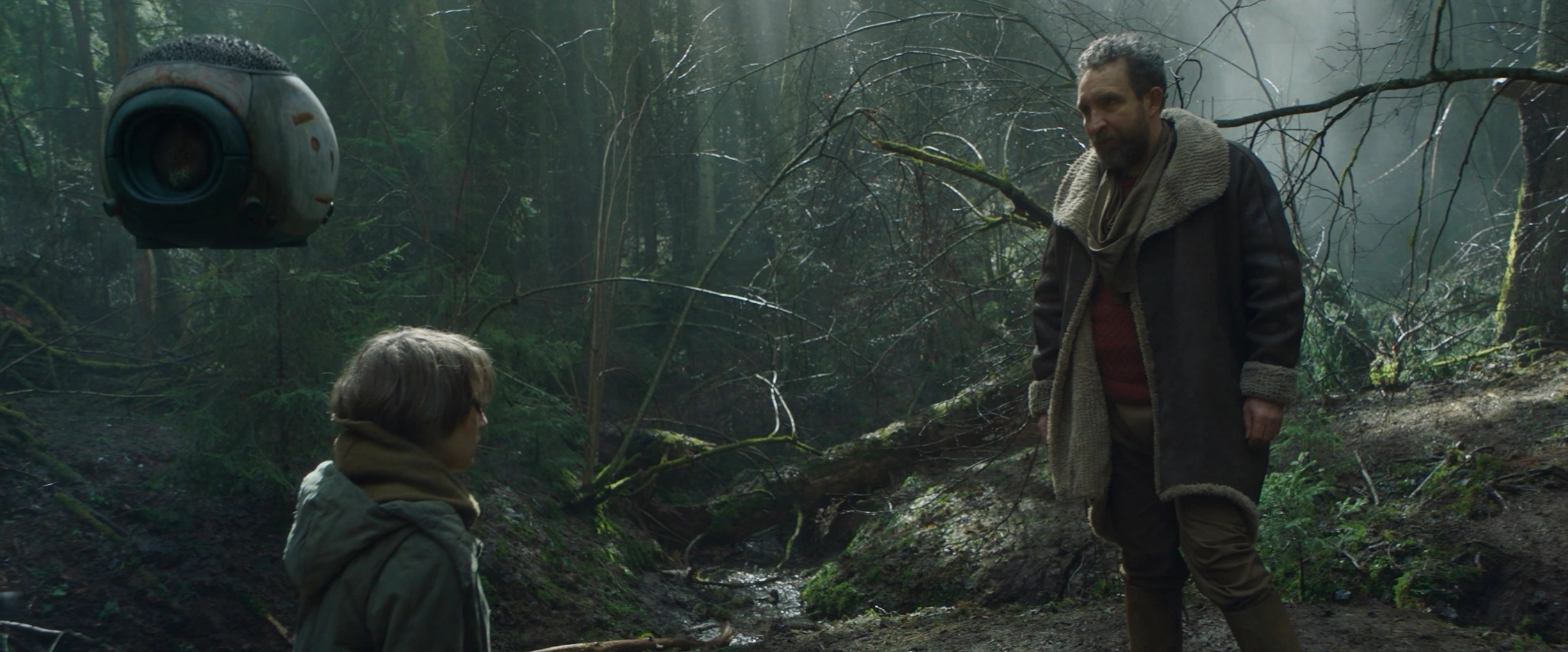


Movie Review: Haunted by what isn’t there, but what you figure you deserve — “Nocebo”

The lady of the house has been through trauma or some sort. It’s wrecking her sleep and gutting her short term memory. All the medication in the world is no help.

Then Diana shows up. Christine doesn’t remember hiring a Filipina cook, maid and and care-giver. But Diana is all smiles, all-in and ready to be of service.

“I can help you, Christine.”

And sure enough, she can. With a few herbs burned as incense, an incantation over hair and nail trimmings, and even a dash of tickling, Diana can feel her humanity coming back, a children’s clothing designer whose zest for work returns with the childhood mantra she repeats before any big meeting.

“Lovely shoes, lovely shoes, make me win and never lose!”

Sure, Diana’s offering a “different kind of medicine.” But it works. No harm in that, right?

“Nocebo” is a tidy and tight-as-a-tick thriller about a woman who wonders what is real and what isn’t in a life that’s coming off the rails, until her live-in help arrives.

It’s a horror movie with a hint of mystery, a chill or two and a dash of pathos. And as the ever-helpful, pushy Diana, Chai Fonacier (“Jesus is Dead”) brings a metallic menace to a role we and the people she comes to work for are meant to treat warily.

What’s her game, and why is she helping this rich woman (Eva Green) and her bratty daughter (Billie Gadsdon), over the objections of the suspicious husband of the house (Mark Strong)?

The Garret Shanley script is just cryptic enough to make us ponder its mystery, but not so clever that we don’t figure out where this is going before the movie’s midpoint.

Sturdy direction, generously chilly sound effects and downbeat and downright sad flashbacks engage us and tell us how Diana gained her “gift,” how it’s been a curse and why she has come to this Irish townhome and this brittle family.

“Nocebo” — a medical term describing the psychological trickery that the mind plays when it expects the worst — never quite sings, never goes as Gothic and over-the-top as one might like and only tugs at the heart when it should tear at it.

The performances, script and tone seem to settle for “menacing” when more terrified reactions are in order. It’s as if everybody here has left things to fate and accepts the horrors to come and refuses to be shocked, just resigned to it.

One and all settle for “watchable” when they could and should have summoned up much more.

Rating: unrated, violence, profanity

Cast: Eva Green, Chai Fonacier, Billie Gadsdon and Mark Strong

Credits: Directed by Lorcan Finnegan, scripted by Garret Shanley. An RLJE/Shudder release.

Running time: 1:37

Posted in Reviews, previews, profiles and movie news | Comments Off on Movie Review: Haunted by what isn’t there, but what you figure you deserve — “Nocebo”

Movie Preview: An influencer and her friends face darkness at and worse at “Willowbrook”

This tale of terror opens Nov. 8.

Posted in Reviews, previews, profiles and movie news | Comments Off on Movie Preview: An influencer and her friends face darkness at and worse at “Willowbrook”

Movie Preview: Troubled veteran finds purpose in caring for a “Wildcat”

Harry Turner stars in this Guy and His Ocelot Friend story, which comes to theaters Dec. 21 and hits Amazon streaming shortly thereafter.

Posted in Reviews, previews, profiles and movie news | Comments Off on Movie Preview: Troubled veteran finds purpose in caring for a “Wildcat”

Movie Review: A Palestinian family separated by “200 Meters” and a wall

Mustafa stands on his mother’s apartment balcony chatting by phone with his wife and children. He can almost see them across the way. We gather that the highlight, for the three kids — 9-and-under — comes at the end of these conversations. That’s when they and their Dad flash the lights of their respective apartments as a nightly message — “I love you.”

They’re separated by a bulldozed field and a wall topped with barbed wire, “200 Meters” and two cultures riven apart and kept that way by the omnipresent strife between Israel and the Palestinian territories.

Writer-director Ameen Nayfeh’s film is a harrowing road picture about a two-household Palestinian family and what the husband and father must do to get to his child’s side when the boy ends up in an Israeli hospital.

Nayfeh makes his feature debut about daily life for a lot of Palestinians, families forced to live apart for better schools and job opportunities, living lives of “permits,” “Israeli ID” and endless checkpoints and road blocks which ordinary people must navigate and endure just to make it through the day.

Nayfeh and his star, Ali Suliman (“The Kingdom,” “Huda’s Salon”), personalize this daily trial by taking us into Mustafa’s simple quest to be by his kid’s side in a hospital in Hadera.

In Mustafa and Salwa, played by Lana Zreik of “Lemon Tree” and “Miral,” we see a loving, bickering and struggling couple who dote on their kids and want what’s best for them. Salwa works two jobs and keeps the kids in a decent school on one side of the wall. Mustafa, a construction worker on the edge of aging out of this backbreaking labor, lives on the Palestinian side, a man who refuses to move, refuses to kowtow to Israel and bristles at anything that would put his life and his children under Israeli control.

“You want Madj (their son) to play with Israeli kids (in Arabic with English subtitles)?” He sees the dangers inherent in a Palestinian boy attending an Israeli school, Israeli soccer camps and the like. One childish fistfight and his world could end.

But weekdays, when they’re apart, Mustafa faces the gauntlet of check points, fingerprint ID, the works, just to work on the crew building another Israeli house.

When his guest-worker ID expires, it all threatens to come undone. There goes the job, the easy access to his family. Even though they can still travel over to see him, this is a fraught situation.

And then the boy is injured in an accident, and Mustafa has to brave the pricy, inconvenient, slow and dangerous “smuggling” route into Israel. He must locate a veteran smuggler, meet his price and hop in a van with other folks who absolutely have to be in Israel, no matter what their “papers” allow.

Nayfeh, whose feature debut comes with some of the same messaging and situations as his short about “The Crossing,” puts an increasingly frustrated Mustafa at the mercy of dallying, cagey and unhurried shadow economy types like Nader (Nabil Al Raee) who has to take his time, fill his van to make a profit and meander up and down back roads towards a point and the right lax-security moment in which he can get his passengers into Israel undetected.

The trip is nerve-wracking and infuriating, with delays planned and unplanned, overly-helpful fellow passengers with lots of questions and offers of bad advice. And then, some German woman (Anna Underberger) shows up with a camera to film her Palestinian friend (Motaz Malhees) as he makes his way to a relative’s wedding in Israel, and things promise to get even more complicated.

Nayfeh maintains suspense via the mystery of exactly how these Palestinian versions of “Coyotes” do their daily work-arounds to get a big chunk of Israel’s illegal workforce on the job.

We fear for Mustafa, his son, his marriage and his sanity as he does something that could get him banned from ever entering Israel again, and cannot instill his sense of the urgency in his situation in anyone around him.

We share his fury at the driver and wary alarm at the German filmmaker/passenger who has shown up and could derail things at any number of junctures and in any number of ways.

Suliman plays the whole movie on simmer, about to boil over with rage, outrage and verge-of-tears frustration. Unterberger gives us a gutsy but naive filmmaker with a sense of mystery and no compunctions about ethical or moral shortcuts.

With every detour, every drive past protesting/threatening Israeli “settlers,” a Netanyahu/Trump billboard, every confrontation and every unplanned stop, we see that “200 Meters” gap growing wider and ponder the fates of those struggling to get to the end of this never-ending journey.

Rating: unrated, some violence, smoking, profanity

Cast: Ali Suliman, Anna Unterberger, Lana Zreik, Motaz Malhees and Nabil Al Raee

Credits: Scripted and directed by Ameen Nayfeh. A Film Movement release.

Running time: 1:36

Posted in Reviews, previews, profiles and movie news | Comments Off on Movie Review: A Palestinian family separated by “200 Meters” and a wall

Movie Review: “The Banshees of Inisherin”

Equal parts funny and forlorn, with a smattering of the violence that always been a sort of Emerald Isle background noise, “The Banshees of Inisherin” is Martin McDonagh’s most Irish film, because it’s a lot like Ireland itself.

Set in isolation, on a treeless island off the Irish coast in the Civil War year of 1923, this parable is about an inexplicable feud that all involved are just going to have to live with, even if its cost is grim self-mutilation and loss. What could be more Irish than that?

The playwright-turned-filmmaker of “Three Billboards Outside Ebbing, Missouri” rounds up his “In Bruges” muses Colin Ferrell and Brendan Gleeson for a story that goes back to troubles before “The Troubles,” which the “Seven Psychopaths” filmmaker has hitherto only addressed on the stage (“The Lieutenant of Inishmore,” etc.).

That brief Civil War during the founding of the Irish Republic is close enough for the folks on Inisherin to hear the rattle of rifle fire, the crackle of firing squads and even glimpse at a distance as smoke arises from explosions. It’s not necessarily the theme of this story, but it’s never far away and near enough to feel, if not involve oneself with.

The distance, the blur of 20th century history that informs the viewer makes Irish history seem like one long feud, one violent period indistinguishable from the next, and entirely arbitrary in the fog of memory.

That’s a word Pádraic Súilleabháin (Farrell) may not be able to summon up — “arbitrary” — when he stops down’ta J & J Devine’s Public House for a pint with his mate, Colm Doherty (Gleeson). He’s already tried to fetch the man from in front of his Victrola in his solitary seaside cottage. He’s already wondered to his sister Siobhan (Kerry Condon of “Three Billboards” and “Better Call Saul”) what’s up.

“Have y’been rowing?” “I don’t tink we’been rowing.”

But the pub confirms, in a public setting, what his bookish sister guessed.

“I just don’t like you no more,” the grizzled old redhead growls.

There are no “Banshees” on Inisherin. But if there were, poor pushover Pádraic would ask, badger and beg them for a reason this has happened. Because he bends the publican’s (Pat Shortt) ear, annoys his sister with his persistence, expects answers from the perpetually clueless Dominic (Barry Keogh, of course) and simply will not let the matter drop with Colm, whose many rebuffs let out specific gripes — starting with “aimless talk,” “nice” used as an insult for the insipid, and zeroing in on “feckin’ stoooopid.”

And if Pádraic doesn’t stop with the questioning — of Colm, the priest and everybody else in the village — the ginger fiddler lets him know that he’s going to start lopping off fingers. Not Pádraic’s, but his own.

That’ll show him.

McDonagh is a filmmaker whose movies are always firmly grounded in a sense of place. This film, which started life as the final third of an Aran Islands (stage) trilogy (the aforementioned “Lieutenant of Inishmore” and “The Cripple of Inishmaan”) was filmed on Inishmore, just off Galway on the west of Ireland.

We’re immersed in a world of ancient loose-stone fences separating scores of tiny grazing fields, of modest, tidy houses with no electricity where pets and livestock — Colm’s faithful and very smart dog, Pádraic’s miniature donkey (a scene stealer) — practically have the run of the place.

Mrs. O’Riordan (Bríd Ní Neachtain) doesn’t just traffic in groceries at her general store. She requires gossip as a gratuity. The priest (David Pearse) may come over from Ireland proper for services, but he’s up to date on Colm’s state of mind thanks to the confessional. And nobody likes the local constable (Gary Lydon), Dominic’s dad.

McDonagh brings Irish music into the mix, with Colm’s circle of players joined by eager students of “diddley aye” music from the Irish traditional music mecca of Lisdoonvarna.

And the performances are uniformly fine, with Farrell great at conveying a sort of stupefied, unconsidered guilelessness and Condon providing the film’s “feckin'” fire.

What our playwright/filmmaker doesn’t manage to any great degree is tying all this — directly or clearly — to a larger theme. I’m sensing the eternal and essentially pointless nature of Irish strife, the feuds that will not die and yet serve their purpose, at least in the national soul. But it’s not crystal clear that’s what McDonagh had in mind.

As he drifts into the grisly consequences of this “don’t want to be friends no more” ghosting, we’re reminded of the repellent violence that has been this “dark comedy” specialist’s trademark, and that the brilliant Martin’s never spelled his “message” out as clearly as brother John Michael McDonagh did in his films “The Guard” and “Calvary.”

That said, the “troubles” subtext is as good as any other to hang onto while following our favorite Irish filmmaker into the myopic abyss of Ireland’s romanticized past, an “Unquiet Man” showing us the good, the bad, the green and the diddley aye that shaped our perceptions of the place forevermore, when violence was always a part of a more accurate picture.

Rating: R for language throughout, some violent content and brief graphic nudity.

Cast: Colin Farrell, Brendan Gleeson, Barry Keogh, Gary Lydon, Pat Shortt and Kerry Condon.

Credits: Scripted and directed by Martin McDonagh. A Searchlight release.

Running time: 1:49

Posted in Reviews, previews, profiles and movie news | Comments Off on Movie Review: “The Banshees of Inisherin”

Documentary Preview — “Mickey: The Story of a Mouse”

Disney+ is where you’ll find this Foundation Myth take on how The Mouse in the House the ho Built was created. Looks good.

Nov. 18.

Posted in Reviews, previews, profiles and movie news | Comments Off on Documentary Preview — “Mickey: The Story of a Mouse”

Movie Review: Inuit Teens to the Rescue? “Slash/Back”

If you see just one Inuit kids fend off tentacled alien invaders thriller this year, make it “Slash/Back,” an above-the-Arctic Circle genre pic in the “Attack the Block” tradition.

It’s a more good-natured-than-good Canadian production about a village beset by beasties, and the ones who figure this out first and take defending Pangnirtung seriously are a bunch of 13 year-old girls.

Scary, right?

“They came here to hunt! But what they don’t know is, we’re the best hunters there is (sic)!”

There are funny lines and oodles of generic fight-the-aliens stand-offs. But the (mostly locally recruited) acting is pretty bad. None of the kids manages to summon up “fear” on cue, and the line-readings are so flat that they drain the blood out of almost every zinger in this Nyla Innuksuk sci-fi action comedy.

Maika (Tasiana Shirley) is the leader of the pack in this corner of the Cumberland Peninsula. She keeps Jesse and Leena (Alexis Wolfe, Chelsea Prusky) hoping that they have a shot with the “hottest boy in school,” because Maika’s not interested. And she keeps mouthy, hustling braggart Uki (Nalajoss Ellsworth) honest when she tries to con Aya (Frankie Vincent-Wolfe), Maika’s pesky tag-along kid sister out of her savings.

Maika is the most jaded about their lives and this insular world. Sure, they have cellphones and they’re as obsessed with how much fun and stuff other kids their age have, thanks to social media. But to Maika and her mates, “Pang” is “Craphole, population ‘Who cares?'” Maika dogs on the “drunk” adults and the limited horizons in the Land of the Midnight Sun, even on Inuit art.

She can’t wait to “move to Winnipeg.” Hey Maika, been there, done that, had the Chinese food, Molson’s and jelly donuts. Heard the Neil Young/Randy Bachman tribute bands. Aim higher, girl!

But in the opening scene, we’ve seen a white geologist grabbed and gutted. Arterial spray on snow, nothing like it. Something is out there. And when the girls take off on a jaunt in Maika’s dad’s boat, they get a load of that “something” first hand. A (digitally) possessed polar bear comes for them. But “It didn’t move right…and its blood was black!”

And those things coming out of its eyes? Tentacles.

Not that they see all of that. Not that they believe the one member of their quartet who did.

It’s only later that (still sunny) night that the rest of them get a clue, and have to take action lest the entire village, population 1481, is slaughtered. Every minute, the body count is rising.

This film has the potential to have a whiff of “Smoke Signals” and “Reservation Dogs” Native Deadpan about it thanks to the setting and the alien (ahem) culture it ventures into.

There’s a smattering of Inuit dialect and words — Ijiraq is one of the words for “shape shifter” in their mythology.

And Maika, the Inuit girl kid down on her culture — “Only dumb Inuit fall for that!” — has a righteous story arc to play out, from jaded cynic to someone who appreciates her people and what they know and how it could give them the edge against the aliens.

Just as in “Attack the Block,” or “Thirty Days of Night” or the August sleeper hit “Prey.”

The dialogue is tween-to-teen sassy in that “As if” sort of way. Lee Lee’s ex-boyfriend, for instance, gave her “the worst two days of my life.”

But every line is as flat as the one that preceded it, every joke is either swallowed in mumbled enunciation (not an accent thing, a “Let’s do another take so my joke lands, girls” problem).

These beasts, which they nickname “skins” because their tentacles are literally getting under human’s skin (a nice effect, better than the alien-possessed bears, etc), may want to “get us right in the Bs (breasts) and Vs (vaginas).”

But the line isn’t funny at all if you don’t hit it right. Why didn’t we get retakes? It’s not like “we’re losing daylight.” Because the sun doesn’t go down (my lived-in-Alaska expertise) in hte summer that far north, does it?

“I’m scared why because this is frickin’ scary” is funny when you don’t say it in a monotone.

The picture comes to a complete, exhausted halt for about 20 minutes before the third act’s Big Finish, which isn’t actually “big.”

Sorry to dog on the movie the way Maika dogs on Inuit “fish pictures,” but “Slash/Back” never overcomes its scene after scene, joke after joke “near miss” status. You might be rooting for it at the end as fervently as you were at the promising beginning. But by then, it’s already disappointed, with far too many punchless punchlines for its own good.

Rating: unrated, violence, profanity

Cast: Tasiana Shirley, Alexis Wolfe, Nalajoss Ellsworth, Chelsea Prusky and Frankie Vincent-Wolfe

Credits: Directed by Nyla Innuksuk, scripted by Ryan Cavan and Nyla Innuksuk. An RLJE film on Shudder!

Running time: 1:27

Posted in Reviews, previews, profiles and movie news | Comments Off on Movie Review: Inuit Teens to the Rescue? “Slash/Back”

Movie Review: Brazil’s Oscar contender, the domestic melodrama “Mars One”

Intimate in scale, narrow in focus, “Mars One” is a melodrama of the “kitchen sink drama” school. A Brazilian submission for the Best International Feature prize at the Oscars, it takes us into the lives of a family of four, brings them into conflict with one another giving each character her or his moment of crisis.

It’s quite simple in structure, simply sublime in execution.

Mother Tercia (Rejane Faria) is traditional, teaching domestic skills to her college coed daughter Eunice (Camilla Damião), letting her younger son Deivinho slide (Cicero Lucas) slide because father Wellington (Carlos Francisco) has dreams of soccer stardom for the kid.

One child in college, the other in braces and glasses, they still manage to get by on her salary as an in-home maid and cook for a same sex dwarf couple and his long service as a building maintenance/handyman at a posh high rise.

Bolsonaro has just been elected, but any partying over that takes a back seat to the fireworks that go off every time their Cruizero soccer club scores and wins. Still, a subtext of the film is the economic inequality of the country and its notoriously lax standards, laws and basic protections for anyone who isn’t rich.

Wellington probably doesn’t need his new assistant to point out “This salary is a joke,” or his wife to remind him how exploited he is at the hands of his rich tenants. He’s got a job. He’s in AA — four years sober. And they’re managing.

Then Tercia finds herself “pranked” in an unimaginably cruel stunt in which a TV crew fakes a bombing in the diner where she’s she’s eating. She is traumatized, suffers PTSD headaches, and being superstitious, starts seeing everything around her going wrong.

Eunice has met somebody. But as her never lover is a woman named Joanne (Ana Hilario), she’s got some explaining to do to her parents. Maybe “moving in together” (in Portuguese with English subtitles) will solve that problem. And you thought “U-Haul Lesbians” was strictly a northern hemisphere thing.

And middle schooler Deivnho, tight as he is with his big sister, won’t be any help here, even though he says exactly what Eunice needs to hear when she tells him about her girlfriend and asks him if he thinks “its wrong.”

“Why would I think that?”

Deivinho isn’t all about soccer and Ronaldinho. He’s into a cosmos that has nothing to do with Pele. He adores Neil DeGrasse-Tyson and longs to join the Mars One planned colonization of the red planet in 2030.

Writer-director Gabriel Martins (the horror film “O Nó do Diabo” was his) is unfussy in setting all this up, and in keeping the story simple and straightforward lets us focus on the performances. There’s an engaging naturalism here, even as “Mars One” drifts into melodrama in the ways each character’s world is upended and their crisis is introduced.

Mom brings Eunice’s “moving out” plans to a head with a blunt demand to meet the “roommate.”

“You aren’t uncared for,” she complains, explaining the obvious to her child. “You have a father, a mother and a brother.” And they’re entitled to meet this person you’re about to cohabitate with.

The “obstacles” to everyone’s happiness and the predicaments they find themselves in are somewhat contrived and even extreme, the very definition of melodrama. But Martins has conjured up a slice-of-life working class story that is sympathetic to its characters and representative of its times, a movie so wrapped-up in domesticity that we don’t need to see the kitchen sink to know it’s there, and that this molecular level of reality is entirely the point.

Rating: unrated, sex, nudity, profanity

Cast: Cícero Lucas, Camilla Damião, Rejane Faria, Ana Hilario and Carlos Francisco

Credits: Scripted and directed by Gabriel Martins. A Magnolia release.

Running time: 1:55

Posted in Reviews, previews, profiles and movie news | Comments Off on Movie Review: Brazil’s Oscar contender, the domestic melodrama “Mars One”

Movie Preview: A Romantic Native American epic from the closing of the West — “The Last Manhunt”

This “true story” looks unusual and arresting and authentic in casting and details. I’m totally there.

Nov. 18.

Posted in Reviews, previews, profiles and movie news | Comments Off on Movie Preview: A Romantic Native American epic from the closing of the West — “The Last Manhunt”

Classic Film Review: Should “Bullitt” (1968) be remade?

Yes, the headline is a rhetorical question. Because if there’s one thing the 50+ years since “Bullitt” has proven, it’s that most every big screen cop thriller has been in many if not most ways a remake of this Steve McQueen/Peter Yates classic.

We’ve had half a century of the “renegade” “outsider,” “goes his own way” cops, hunting for justice in a broken and/or corrupt system. There have been hundreds of films in which the cop hero drove a “car with character,” and any car buff or film fan knows what you mean when you say “Bullitt Mustang.” The “GT” is understood, the image iconic.

But let’s take that headline literally, shall we? Watching the film again for the umpteenth time last night, I gave it a hard, unsentimental pass for the first time in years.

The story — Lt. Frank Bullitt (McQueen) is tasked by his boss (the redoubtable Simon Oakland) to protect a mob witness (Felice Orlandi) expected to testify at hearings being held by an ambitious, self-important peacocking Congressman (Robert Vaughn).

The Chicago “Outfit” (Vic Tayback plays a mobster) “gets to” the witness, almost killing him. Bullitt and a sympathetic doctor (Georg Stanford Brown) conspire to hide him — dead or alive — to lure the bad guys (John Aprea and Bill Hickman, later a cop in “The French Connection”) into trying again.

Bullitt is followed, and this being his town, he turns the tables on the Dodge Charger-driving heavies and a chase ensues. More wrinkles in the plot unravel, but Bullitt — with dogged determination, the love of a beautiful woman (Jacqueline Bissett) and a wardrobe that became the quintessence of cool because Steve McQueen wore it — won’t be denied.

Truth be told, it’s a thriller that peaks with the epic car chase, and fizzles out afterwards. There’s a nice buildup, some terrific tone-and-setting scenes that show us San Francisco as the “cool” was about to give way to the hippies, turtle-necked hipsters in jazz clubs transitioning towards tie-dyed Deadheads in ballrooms or parks. And then that chase, the crashes at its climax, and the movie winds down, the tempo changing from cool jazz to smooth jazz.

As much as many a police procedural owes to this Yates film — he also did “Breaking Away” — and this formulaic Alan Trustman and Harry Kleiner screenplay (based on Robert L. Fish’s novel “Mute Witness”), there’s a LOT of room for improvement. It’s a 90 minute thriller in a 114 minute package.

Some of the performances pop — McQueen, Vaughn and Oakland stand out. Many seem performed in the shadows. Robert Duvall gives away none of the “finest actor of his generation” glory that was to come, here playing a cab driver who leads Bullitt around town, checking out stops their “witness” made before turning himself in.

As a car nut and McQueen buff, I treat this film as a period piece any time I watch it these days. It’s a lovely, gritty San Francisco time capsule from the Golden Age of Muscle Cars. It’s not just the Mustang and the Dodge Charger with the 34 falling off hubcaps (apparently) that draw the eye, or the green VW Beetle they keep passing, the white GTO and white Austin Healey (my pick of the lot) they weave around or pass by repeatedly.

That’s always an economy that filmmakers whose movies become classics live to regret — using the same rented (or crew members) vehicles several times in shots over the course of the film. You don’t notice unless the film hits and people end up watching it over and over again over the years. Check out the driving scenes of Walter Hill’s “48 Hours.” You see the vintage Porsche that figures into the plot in random early traffic “filler” scenes. Stuff like that happens a lot.

Even “Bullit’s” iconic hill-hurtling race through the Streets of San Francisco, gold standard that it is, has been bested by any number of (mostly) European car chases in the ensuing decades — “French Connection” to “The Transporter” movies, “Ronin” to a good moment here and there in this Bond or Tom Cruise film or that “Fast/Furious” effort. “Bullitt” won the Oscar for editing, but largely because it was such a quantum leap ahead of filmed car chases that came before it.

“The French Connection” was the first film whose chase bettered it, and that was five years later and William Friedkin is a madman. So they had that going for them.

But yes, you could remake “Bullitt,” make it tighter although perhaps not more tense, jazz up the chase a bit or a lot. You’d have to set it somewhere more exotic and unusual, I dare say. New Orleans, post Katrina? Half-abandoned Detroit? Somewhere abroad that hasn’t been filmed to death?

But you’d still run up against that roadblock presented by the film’s star. McQueen was a master of acting with his eyes, doing less with more in a way that Eastwood and Cruise emulated but never could quite match, that Denzel has dabbled in more recently with some success. Lean and blond, he cut an angular figure in the film frame. And yes, he did many of his own stunts, something only Cruise can boast of today.

It’s hard to think of a modern star under 40 who embodies “cool” the way McQueen did then.

One of the many definitions of a “film classic” is a movie that cannot or should not ever be remade. Nobody ever has remade “Bullitt.” There was never a “limited series,” never a reboot.

Fifty years later and the closest anyone has ever come to that is simply stealing plot points here, an action beat there, and wishing that their leading man was a tenth as cool as Steve McQueen.

Rating: PG (violence)

Cast: Steven McQueen, Robert Vaughn, Jacqueline Bissett, Simon Oakland, Vic Tayback, Norman Fell, Felice Orlandi, Georg Stanford Brown and Robert Duvall.

Credits: Directed by Peter Yates, scripted by Alan Trustman and Harry Kleiner, based on a novel by Robert L. Fish.

Posted in Reviews, previews, profiles and movie news | 1 Comment