
It takes a funeral to bring these two together.
Apple TV has this one. Looks fun.
It takes a funeral to bring these two together.
Apple TV has this one. Looks fun.
Margaret Qualley lands a starring role, playing a journalist who meets and tumbles into a shady operator played by Joe Alwyn.
It’s from A24, so we pretty much know it’s going to be good.

Writer-director Carlota Pereda’s “Piggy” is a genre-busting, expectations-defying thriller about a morbidly-obese teen whose has her revenge on those who label her “Cerdita” (little pig.).
Only it’s not a straight-up vengeance story, even though bloody enough to fit under the heading “horror.” We see means girls and small town provincialism, a monstrously oppressive mother who can be nurturing and protective and a serial killer who might be our heroine’s avenging angel.
Every time we relax into our smug “I know where this is going,” Pereda finds a way to trip us up.
Laura Galán plays our plump teen from a plump family. She’s a lonely heroine who stress-eats, comfort-eats and eats eats. Sara works in the family butcher shop, and this being Extremadura, Spain, she has learned her way around a hog carcass, thanks to Dad (Julián Valcárcel) and the bossy, chorizo-making mom (Carmen Machi) who is always criticizing Sara for being “lazy.”
But her parents don’t know Sara’s interior life, or the ridicule she faces from her peers. Her childhood chum Claudia (Irene Ferreiro) may still come in the shop. But outside, with no adults around, Claudia follows the lead of her mean girl pals — the venomous Maca (Claudia Salas) and sidekick Roci (Camille Aguilar) — picking on Sara.
They take their Sara tormenting to its biggest extreme at the spring-fed town pool, where Sara can’t even take a swim in peace.
“Check out her bikini,” Maca sneers, in Spanish with English subtitles. “Her body just swallows it.”
Maca goes so far as to try and hold Sara underwater during her taunting, and we think “Uh oh.” Sara is so frantic to escape underwater that she doesn’t notice the body, tied-up and weighed-down at the bottom of the pool.
As we’ve seen the sketchy guy (Richard Holmes) hanging around the pool earlier, we think “Uh oh” again.
But what will Sara do, when she’s stumbling home, humiliated and in her overwhelmed bikini because Maca stole her clothes and backpack, and she sees the bloodied girls stuffed into the back of the creeper’s truck, pleading for Sara’s help?
The performances are mostly quick sketches of character “types,” but quite good for what they are. The indulgent, overweight dad, the small town cop who has brought his eager beaver son onto the force, means girls being mean, parents who lash-out at everyone when their mean daughters go missing.
Pereda flirts with black comedy, here and there, but never wholly gives in to it. We see Sara’s tearful rage at Maca’s latest bit of social media shaming. She ducks into the meat locker to weep, and we spy a child on the floor, blood on his face. Oh, that’s just her kid brother, taking a nap someplace cool. Off-camera shrieks? Those are just kids frolicking at the pool.
The film’s efforts at body-shaming commentary are also something Pereda considers but doesn’t lose herself in. It can’t be a coincidence that the serial killer has a bit of a pot belly himself. As in the French film “Fat Girl,” there’s a hint of Sara being so lonely and lovelorn that she’s drawn to the first guy to show any interest in her at all, even if he’s a monster.
But give it up for Pereda’s sleight of hand here. She keeps tripping us up, pointing us one way and then taking her movie in another direction.
It’s a hard, pitiless abattoir-edgy film with darkly humorous touches. By the time this little “Piggy” is over, you may find yourself doing what Sara and no self-respecting Spaniard could ever do — swear off pork.

Rating: unrated, graphic violence
Cast: Laura Galán, Carmen Machi, Irene Ferreiro, Julián Valcárcel, Fernando Delgado-Hierro, Pilar Castro and Claudia Salas
Credits: Scripted and directed by Carlota Pereda. A Magnet/Magnolia release.
Running time: 1:40
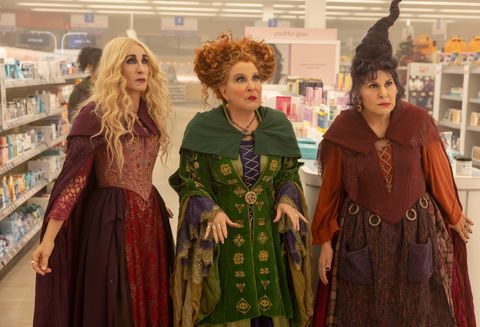
The Sanderson sisters are back, summoned by a couple of modern day Salem teens who cast a “help our intentions manifest” spell.
But the ladies require supplies for whatever they get up to in “Hocus Pocus 2.” Eldest sister Winnifred (Bette Midler) barks at the girls (Whitney Peak, Belissa Escobido) who lit a candle, spoke an incantation and brought them into our world.
Quick, she says. Take us “to thine apothecary!” Winnifred and dizzy sisters Sarah (Sarah Jessica Parker) and Mary (Kathy Najimy) gape in wonder at the modern version of an apothecary’s shop, at doors that open by themselves. It must be a place of great evil and magic.
“OBSERVE sisters, how it glooooows from within with a SICKENING light!”
That’s florescence for you, they’re told. “Wait, didn’t we used to know a Florescence?”
You will never look at Walgreens the same way again.
If there’s nasty on-set gossip from the making of “Hocus Pocus 2,” which reunites three queens of ’80s and ’90s screen comedy for a new kid-friendly romp for Disney, I don’t want to hear it. We see unguarded moments of giggling and affection as well as the odd improvised bit. These three look tickled to be back together.
“Lock up your children!”
And the movie surfs on that wave of good vibes. Midler takes the lead as the unholy trio cover Elton’s “The Bitch is Back” re-written as “The Witch,” vamp through Blondie’s “One Way or Another,” and cackle and threaten and tease, seemingly delighted at revisiting these characters in a sequel to their poorly-reviewed but kid-popular hit from 1993.
Teens Becca (Peak) and Izzy (Escobido) want the original Sandersons around for reasons that aren’t the clearest. They’re feuding with their pretty and popular ex-pal Cassie (Lilia Buckingham), who has a cute jock boyfriend and who also just happens to be mayor’s (Tony Hale) daughter.
Magic shop owner Gilbert (Sam Richardson, always at home in light comedy) has a lot of the 17th century possessions of the Sandersons in his shop, chief among them a living book, “The Manual of Witchcraft & Alchemy.” The sisters are going to need that if they’re going to cope with America in the age of Walgreens.
For one thing, returning to Salem at Halloween means they’re dropping in on the Halloween Festival, where Salem’s most infamous witches are the most popular costume.
“Why are these children dressed like us?”
Don’t even try to explain bobbing for apples to these three.
“Look! You’re drowning a man! How charming! And he’s got an apple in his mouth. Are you roasting him on a spit?”
The witches want to ensure that they get to stick around in this world, and are willing to destroy anyone who isn’t on board with that. Only the young girls have a prayer of stopping them.
One grand touch in this just-funny-enough script is a prologue that shows the Sandersons as young girls, battling the campy and pious town preacher (Hale, again), who wants to straighten out young Winnifred (Taylor Henderson) by marrying her off to a local oaf. She isn’t having it.
“She cannot SPEAK that way to a man!” the locals hiss. And yet, she persisted.
That’s the day these three “weird sisters” went into the forest, met a witchy mentor played by Hannah Waddington, and secured their future as feared conjurers.
Teen actresses always have the best time impersonation the Divine Miss M.
It’s all kind of adorable.
As with the original film, there isn’t a whole lot to this — some good jokes, some jokey tunes, and two very funny women generously taking a back seat to the brassy, sassy redhead who breaks out the cackle and dons the buck-teeth one more time.
I’d say Parker, Najimy and Midler all did a great public service coming back to these characters and deserve the thanks of a grateful nation for giving this their all, giving us a few laughs and a lot of grins and giving legions of little girls Disney role models who aren’t princesses waiting around for some prince to get a clue.

Rating: PG
Cast: Bette Midler, Sara Jessica Parker, Kathy Najimy, Tony Hale, Whitney Peak, Belissa Escobido, Lilia Buckingham, Taylor Henderson, Nina Kitchen, Juju Journey Brener and Sam Richardson.
Credits: Directed by Anne Fletcher, scripted by Jen D’Angelo. A Disney release.
Running time: 1:43
About damned time. Get a room, you two.
As the Cat 4 menace known as Ian bears down on my corner of the world, theaters close, preview screenings are canceled and life goes on hold.
“Smile” will have to wait.
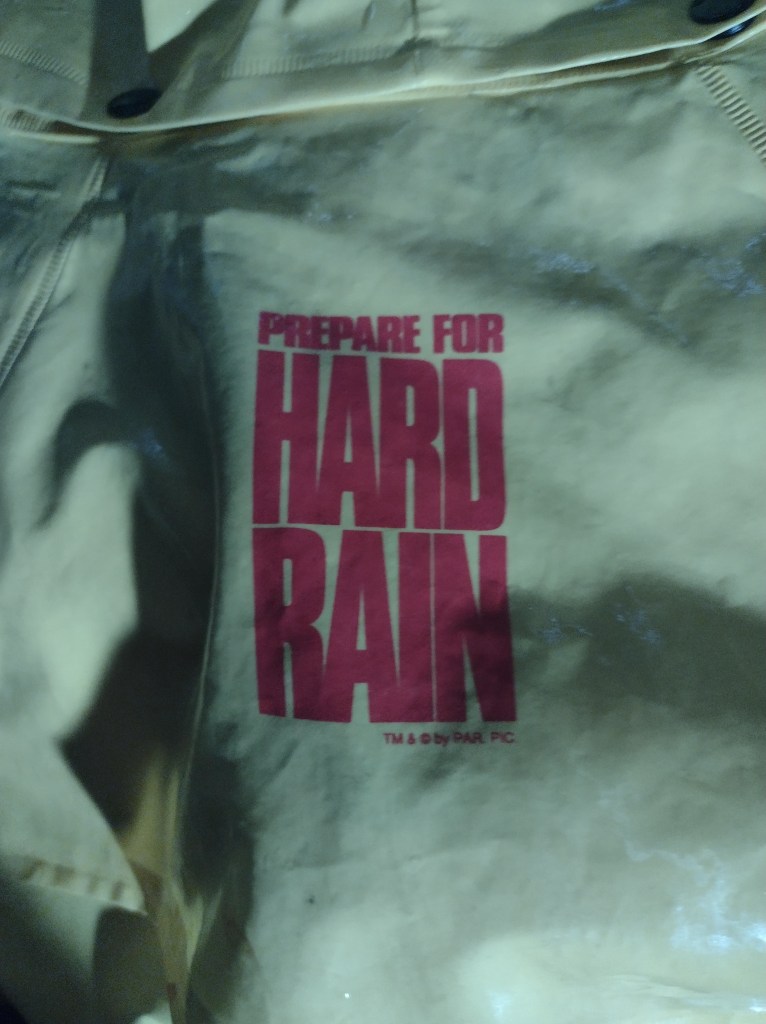
I still have my Warner Brothers provided rain slicker from this movie, which I’ve kept on every boat I’ve had for decades. They don’t make studio promotional material like this any more.
Batten down the hatches, file two reviews and this from my phone (a bitch with WordPress), “Hope for the Best, Expect the Worst.” TTYL.
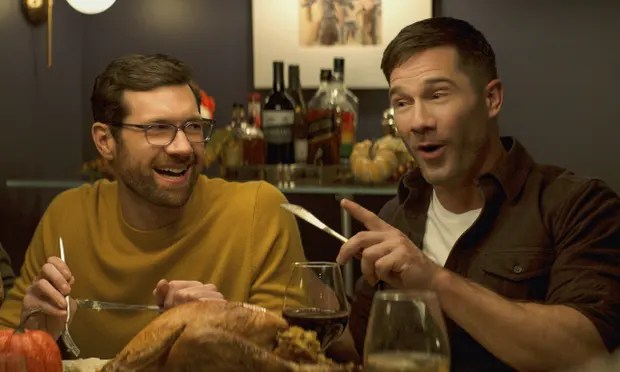
Billy Eichner brings strong “Billy on the Street” energy to his first film, the laugh-out-loud gay romance “Bros,” which he co-wrote with director Nicholas Stoller.
When you’ve got license to poke fun at acronyms and the different priorities across the wide spectrum of gay sex and romantic love, you might have the best shot of anyone who ever attempted to film a “non-hetero-normative” gay romantic comedy.
And when you’re famous for your breathless, almost angry pop-culture puncturing/gay-life celebrating patter, the results can be hilarious, if not exactly warm and cuddly.
Eichner piles decades of issues, angst and agenda into his character Bobby, a high-flying figure in New York and America’s gay scene. He’s an author, activist and popular podcaster who ridicules “Queer Eye,” which he auditioned for, and Hollywood, which wouldn’t let him write a “real” gay romantic comedy, because straight people can’t see “that our relationships are different.”
“Bros,” which follows Bobby through his efforts to get America’s “first LGBTQ+ history museum” off the ground, takes us into Bobby’s struggle to figure out if he wants something more than the shallow Grindr/shirtless meat market/ polyamorous hook-up culture he’s wholly invested in.
Aaron (Luke Macfarlane) is what has him thinking these thoughts. They lock eyes across a crowded club, exchange pleasantries about how “stupid” gay men are and how good they are at branding themselves as witty, and then shirtless, peacocking Aaron disappears just as Bobby is thinking there’s a kiss on its way.
That’s the running gag of this relationship and the movie. Insecure “sunken chest” Bobby isn’t able to quite close the romantic deal with hunky, roid-ripped Aaron, who sees every sexual situation as another item on the smorgasbord. Then again, is he clever enough to keep up with Bobby?
“I like someone who’s frail and won’t stop talking.”
This gets in Bobby’s head and interferes with his efforts to meditate the competing ideas of the spectrum-representing board of the museum. The bitchy bi, transgender, lesbian and “+” people on this LGBTQ+ crew won’t go for his “first gay president” pitch for a tribute to Abraham Lincoln.
Bobby’s cliched friends and support system are rooting for him, but in accordance with rom com convenience, his parents are dead and there’s no messy family to contend with. Well, maybe Aaron’s.
As Aaron continues to hook up with lusty jocks and gay couples –“thrupples” gags aplenty — Bobby struggles to cope with his first real interest in that mythic status of under 40 New York gay men — monogamy.
Riffs on the novelistic qualities of Grindr texts — “Whassup?” — the widespread acceptance of gay life and gay mores by straight culture (gay “Hallheart” Christmas movies), and the difference between gay generations (“We had AIDS, they had ‘Glee!'”) abound and amuse.
The zingers play into Eichner’s manic, mouthy TV persona — on steroided outdoorsy “tops.”
“They’re like grownup gay Boy Scouts and I’m whatever happened to Evan Hansen!”
An attempted love note — “What’re you writing, lyrics for Maroon 5?”
A walk that ends at his apartment door — “Like the bearded lady in ‘The Greatest Showman,’ ‘this is me!”
There’s lots of sex, sometimes played for laughs and often not limited to just two consenting adults
“Gay sex was more fun when straight people were uncomfortable with it!”
The contrast between Eichner’s polished, breathless, amusingly angry riffs and the acting around him calls attention to itself. He’s not an inviting presence and the performance lacks the acting tools that let the viewer in and make us warm to this relationship and root for this couple.
The contrast between what he’s doing and Macfarlane’s performance — Luke M. has a LOT of Hallmark Xmas hits in his credits– is striking and not flattering. Comedy veteran Stoller (“Neighbors,” “Get Him to the Greek”) can’t help Eichner find his sweet spot, if he has one.
The supporting cast might have sparkled brighter had more attention been paid there. Bowen Yang and Jim Rash have their moments.
The film’s energy flags as the picture settles into a long, less bitchy/bubbly second hour. The riffs and one-liners thin out and cameos take center stage. Debra Messing finds a few laughs, Harvey Fierstein has none written for him.
In the end “Bros” seems to hit a wall as it sends up Rom Com conventions while doggedly making the point that they don’t really apply here.
As in, whatever’s going on is funny enough, but is this really a “happy ending?”
Rating: R for strong sexual content, language throughout and some drug use
Cast: Billy Eichner, Luke MacFarlane, Kristin Chenoweth, Dot-Marie Jones, Kenan Thompson, Harvey Fierstein, Debra Messing and Amy Schumer.
Credits: Directed by Nicholas Stoller, scripted by Billy Eichner and Nicholas Stoller.
Running time: 1:55

An organized riot of images and sounds, “Moonage Daydream” is perhaps the only way a documentary biographer could approach the story of David Bowie. Brett Morgen (“Crossfire Hurricane”) has made his true masterpiece, the perfect film to celebrate a multifaceted life of aesthetic excess.
Morgen pieces together Bowie interviews from every medium imaginable, snippets of Bowie concerts, films and music videos, and clips from most everything that might have influenced David Jones as he invented and repeatedly reinvented himself as David Bowie, Ziggy Stardust, Major Tom, the Thin White Duke, husband and dad, to infinity and beyond.
He was a Brixton boy who “never became who I should have been.” A “mod” at 14, the King/Queen of Glam at 25, he put on personae, passions, artistic bents and belief systems like he changed hats and hair colors and styles.
“I was a Buddhist on Tuesday and I was into Nietzsche on Thursday,” and that went for everything about his work and interests.
Keaton? Astaire and Rogers? Bing? “2001: A Space Odyssey?” Fashion? Makeup? Kabuki? Mime? Movement? He worked to combine them into the perfect visual line, pose, gesture and an unfathomably wide range of pop band rock styles.
“We we’re creating the 21st century in 1971,” and to the very end, it seemed the world still wasn’t able to catch up with this ethereal sprite of art, image and philosophy.
“Daydream” is a gorgeous, immersive, overwhelming and intimate and in the end simply touching experience, an artist saying “farewell” to his fans, the cosmos and the culture he bent to his musical, visual, androgynous will.
If you greet “Moonage Daydream” and Bowie on his terms, you can’t help but be moved.
It’s almost too much and never quite enough. So stay through the credits.

Rating: PG-13 for some sexual images/nudity, brief strong language and smoking.
Cast: David Bowie
Credits: Scripted and directed by David Bowie, a Neon release.
Running time: 2:15
Breathless hype greeted this simple, emotional two hander when it premiered at Cannes.
Oct 21, A24 let’s us see what the fuss Is about.
Well, that headline’s something of a bait and switch. “Major motion picture” doesn’t really fit this meek kiddie horror tale, a thriller that still has its training wheels on.
But what more could we expect from a movie that took its inspiration from those “Spirit Halloween” stores that open in empty storefronts all over America every August?
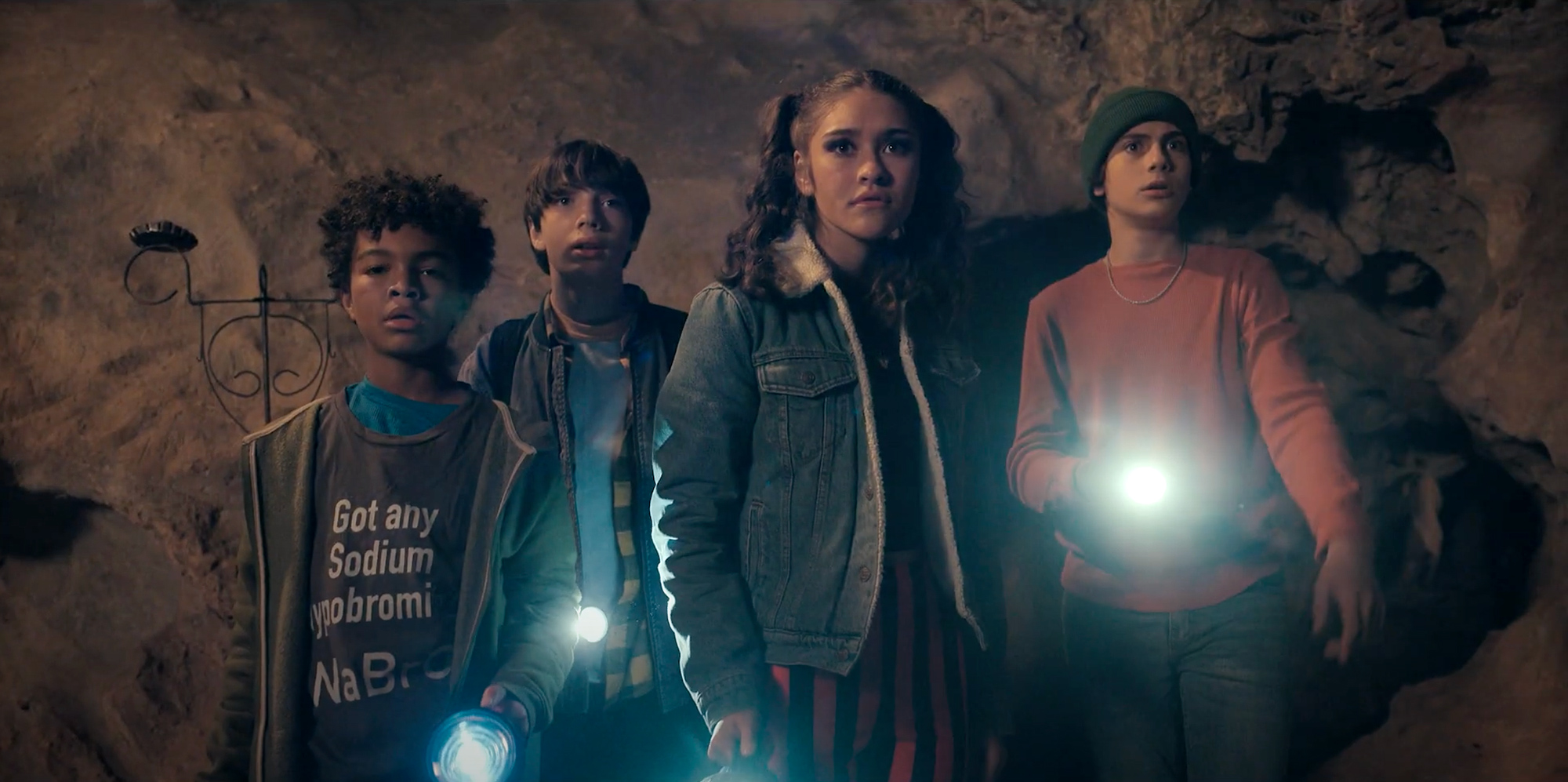
“Spirit Halloween: The Movie” is a “Goonies-lite” quest tale of 13 year-old boys who figure they’re too old to trick or treat, so why not sneak in and stay at the spooky only-store-in-the-strip-shopping center Halloween store on “Fright Night?”
It’s got Christopher Lloyd, whose character dies in a spooky (ish) prologue, and returns as a spirit wanting a new body. Rachel Leigh Cook plays the mother of one of the boys. And Marla Gibbs, sporting a single white blind eye, plays Grandma G, granny to another boy and a beloved local character, when she isn’t scaring the wits out of sensitive Jake (Donovan Colan).
“Dooooooont stay out late, JAAaaaake!”
He does not heed her warning, because what middle school kid would?
Jake is still hanging onto childhood, dressing up for Halloween, missing his late father. He’s a nervous ball of phobias and just-past-tween lashing-out. Mom (Cook) has remarried, and Jake doesn’t like his new “Dad” or princess-obsessed baby sister.
But there’s no trick-or-treating this year, as the slightly-older Carson (Dylan Martin Frankel) has decreed that it’s for “babies.” Their other friend Bo (Jaiden J. Smith) always caves to Carson, so no candy for any of them this year.
The animatronic fright displays at the “spooky” new Spirit Halloween store give them an idea of what to do this All Hallow’s Eve. The fact that the film’s prologue showed a mean old man (Lloyd) dying of a hex for trying to evict a witch who ran an orphanage back in the ’40s means that if this old building is haunted, we can guess which voice from “Back to the Future” will be speaking from beyond the grave.
And since Jake has a crush on Carson’s cool older sister (Marissa Reyes), we know the plot will contrive a way for her to get stuck in that store fighting that spirit in every ghost, ghoul or giant stuffed bear costume our villainous spirit inhabits.
There’s some cute local color in this low-budget affair — the old movie house converted for Little Theatre use, turned into a “Fright Night” spooky exhibit, haunted house and “The Legend of Alec Windsor” (Lloyd’s character) puppet show.
But the script is just a collection of horror tropes. Jake reads from the “Encyclopedia of Shadows” book his dad left him. A fortune teller animatronic display spooks the kids.
The frights are tepid at best. The banter is “sick, and not in a good way.”
And the acting is mostly child actors rushing and slurring their lines with director David Poag not taking the time to get a clean take.

Rating: PG-13, scary elements, didn’t hear any profanity, but…
Cast: Donovan Colan, Marissa Reyes, Jaiden J. Smith, Dylan Martin Frankel, Marla Gibbs, Rachel Leigh Cook and Christopher Lloyd.
Credits: Directed by David Poag, scripted by Billie Bates. A Strike Back release.
Running time: 1:20


