Most everybody had that moment when they just gave up on Lindsay Lohan.
The scandals, the tsunami of gossip, the poor choices off screen and on, few actresses handled the transition from child starlet to adult attention magnet more poorly. Yes, it’s an awful test for even the strongest psyches, and her parental guidance leaned notoriously towards the Britney Spears side of the spectrum. But at some point, you’re well over 21 and what goes wrong is on you and you alone.
I gave the “Mean Girls” queen the benefit of the doubt right up to what should have been a golden opportunity that she turned into a rhymes-with-fitshow. “The Canyons” had one of the great writer-directors, Paul Schrader, a script by “Less Than Zero” author Bret Easton Ellis and a topic — the vapid, vain dysfunction of lives lived on the fringes of LA’s beautiful, rich and entitled.
Lohan diva’d her way into deserved oblivion in 2013 by misbehaving on that set and ruining what could have been something of a restart for her and a filmmaker who would later come back with a vengeance with “First Reformed.”
But as most of what she did she did to herself, it’d be churlish to not think she deserves another shot. So, a Netflix “Hallmark-style” Christmas rom-com? “Falling for Christmas?” Lindsay, now a high-mileage 36, looking winsome, taking pratfalls, wholly-engaged in the work and even doing a little “Jingle Bell Rock” sing-along?
Good for her. And good for Netflix, which is also giving a Hallmarkish rom-com home to the less problematic ex child starlet Victoria Justice, among others.
The movie? Oh, it’s insipid. You half expect to see Dolly Parton — Long May She Rein — show up as a singing Christmas angel. Yeah, it’s like that.
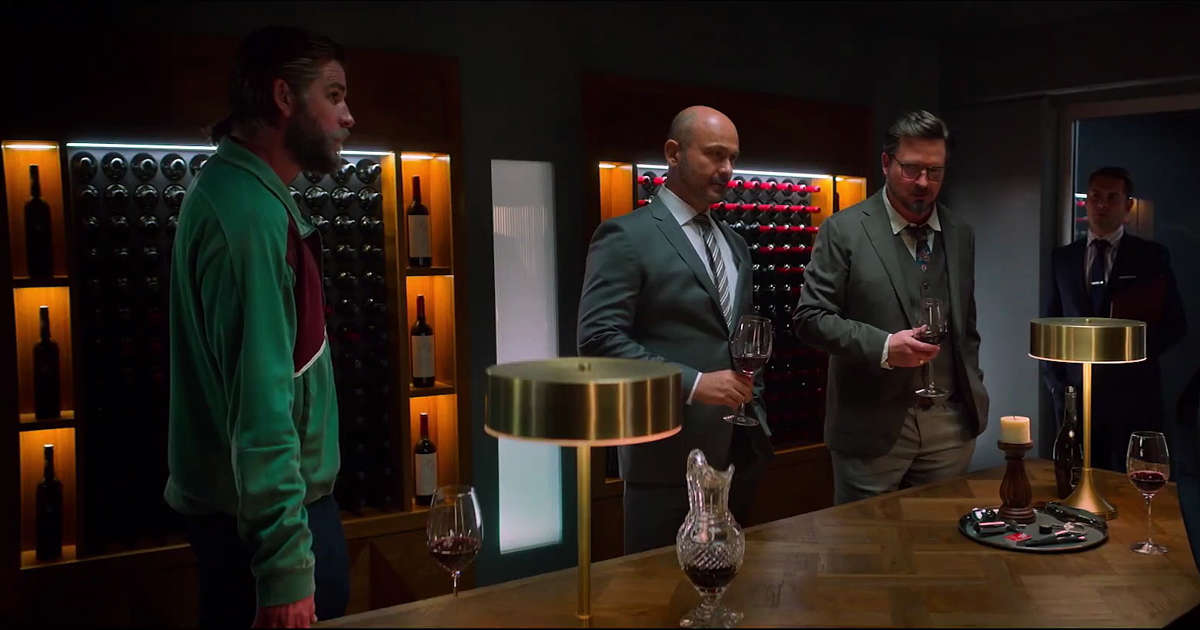
Lohan plays a hotel heiress and influencer who is trying to fend off her father’s (Jack Wagner) efforts to make her grow up and take on work in the family business. Sierra is meeting her super-influencer and boyfriend of a year, the vapid Euro-trash Tad (George Young) at one of Dad’s upscale mountainside ski resorts. Tad is planning on proposing — and posting online about it — on a mountain top.
Things go wrong, and next thing we know, Tad is stranded in an ice shanty on a frozen lake with poacher Ralph (Sean Dillingham), Sierra’s crashed into a snowbank and developed amnesia and nobody knows they’re missing.
The freckled redhead who doesn’t know her name is now “Sarah,” and staying with her rescuer Jake (Chord Overstreet), a widower who runs the failing B & B down the hill, who doesn’t know who she is and who has a winsome mother-in-law (Alejandra Flores) and little girl (Olivia Perez) who falls for this woman who can’t remember her name and lacks even the most basic domestic skills, but who takes interest in her and shares some of the secrets of being a girl with her.
So what we’ve got is “Overboard” without the devious edge of a guy taking advantage of a rich amnesiac, grafted onto “It’s a Wonderful Life” (without an angel, Dolly Parton or otherwise) or “White Christmas,” where our hapless innkeeper has to learn how beloved and valued he is by those who love him.
There’s just nothing to this. A typical scene is a brief, helpful gift-wrapping lesson Jake gives Sarah/Sierra. There’s nothing cute, funny or charming in this 30-45 seconds of screen time. And yet it’s what passes for “home for the holidays” warmth, wit and wisdom.
Spoiler alert — it’s not funny. Second spoiler alert — the only laugh in “Falling” is “Sierra” waking up by turning the TV on to Netflix, which is wall-to-wall holiday movies like…”Falling for Christmas.”
But Lohan does what she can with this thin, treacly material, shows she can be a team player and bring value without (one hopes) drama to a set and a project that may not be an A-picture, but still gets her name out there in a non gossipy way. Good for her.
Call it a win, and maybe a proof of concept of the “I can still show up on time, act, and bring a little sentiment and sparkle to a part” variety. And call it a day.
Rating: TV-PG
Cast: Lindsay Lohan, Chord Overstreet, George Young, Olivia Perez, Alejandra Flores, Sean Dillingham and Jack Wagner
Credits: Directed by Janeen Damian, scripted by Jeff Bonnett, Janeen Damian, Michael Damian, Ron Oliver. A Netflix release.
Every movie opens with a world of possibilities and steadily, one by one, closes off those directions it might take. A good film is one that presents promising options, picks a more intriguing and perhaps less expected one, and maybe trips up our expectations along the way.
Russell Crowe‘s new writing, directing and starring effort “Poker Face” opens with piece of Aussie childhood that climaxes with a teenaged poker bluff that foils a bully. We then meet the adult poker player (Crowe) as he’s losing himself in the paintings at a museum. His sad-faced guise intrigues an attractive artist who furtively snaps pictures and clumsily tells him “I want to paint you.”
In in the third scene, our rich gambler drives his black Rolls Royce out into the country to consult a sage old shaman (the great character actor Jack Thompson) who “reads” him, figures out our hero’s state of mind and his health, reassures him that “You will know when it’s time” and passes on something that might give him “comfort” knowing that he has “some means of control.”
Three sequences set up a man with a past full of childhood friends, a gambling “career” that paid handsomely, a terminal illness and the interest of a painter, who might like more than his face, his “story” for instance.
From that collection of possibilities, “Poker Face” draws to an inside straight — a straight-up heist picture. And what’s the first rule of poker, mate?
Never draw to an inside straight.
Liam Hemsworth, the rapper turned writer-director-actor RZA, Aden Young, Steve Bastoni and Daniel MacPherson play the adult “oldest friends” who race a Roller, a Bentley and a Maybach to rich host Jake’s clifftop modernist mansion for one last poker game.
Molly Grace plays the widowed Jake’s daughter, who doesn’t know, and Brooke Satchwell plays an ex-wife who does.
And Paul Tassone is the fiery, ruthless leader of the gang that busts in on the festivities.
Crowe isn’t a first time director, but this heartless bore of a thriller makes one forget the pleasures of “The Water Diviner.” He leans on voice-over narration to deliver attempted profundities.
“If luck is leaving you, apply what you can to change its motion…Maximize your wins, minimize your losses.”
He tries to animate the poker game itself with extreme close-ups of players, chips and cards, and never makes the stakes seem high or the results remotely interesting. Even the in-game banter is shockingly mundane. But then, this isn’t “Rounders” or any of a slew of better gambling pictures. Crowe is rarely dull as an actor, but his poker-faced turn in “Poker Face” proves the exception to that rule.
The shifts in tone, stakes and genre are abrupt and so clumsily-handled you’re allowed to wonder “What just happened?” And the heist is such a non-starter as to leave one at a loss as to what the Oscar winning actor, one of my favorites, ever saw in this.
Rating: unrated, violence, profanity
Cast: Russell Crowe, Liam Hemsworth, RZA, Aden Young, Brooke Satchwell, Molly Grace, Steve Bastoni, Daniel MacPherson, Benedict Hardie, Paul Tassone, and Jack Thompson
Credits: Directed by Russell Crowe, scripted by Stephen M. Coates and Russell Crowe. A Screen Media release.
The new film from award-winning Venezuelan filmmaker Lorenzo Vigas is a lean, quiet and disturbing parable about global capitalism as it is practiced in much of the Third World.
With “The Box” (“La Caja”), the director of “From Afar” pulls us into the sad, mysterious plight of a boy dispatched to the world of giant sweatshops and ruthlessly exploited workers of northern Mexico. And through this poker-faced child, we get a brutal taste of the grim cost of a system still stuck in a Darwinian Wild West era in much of the world.
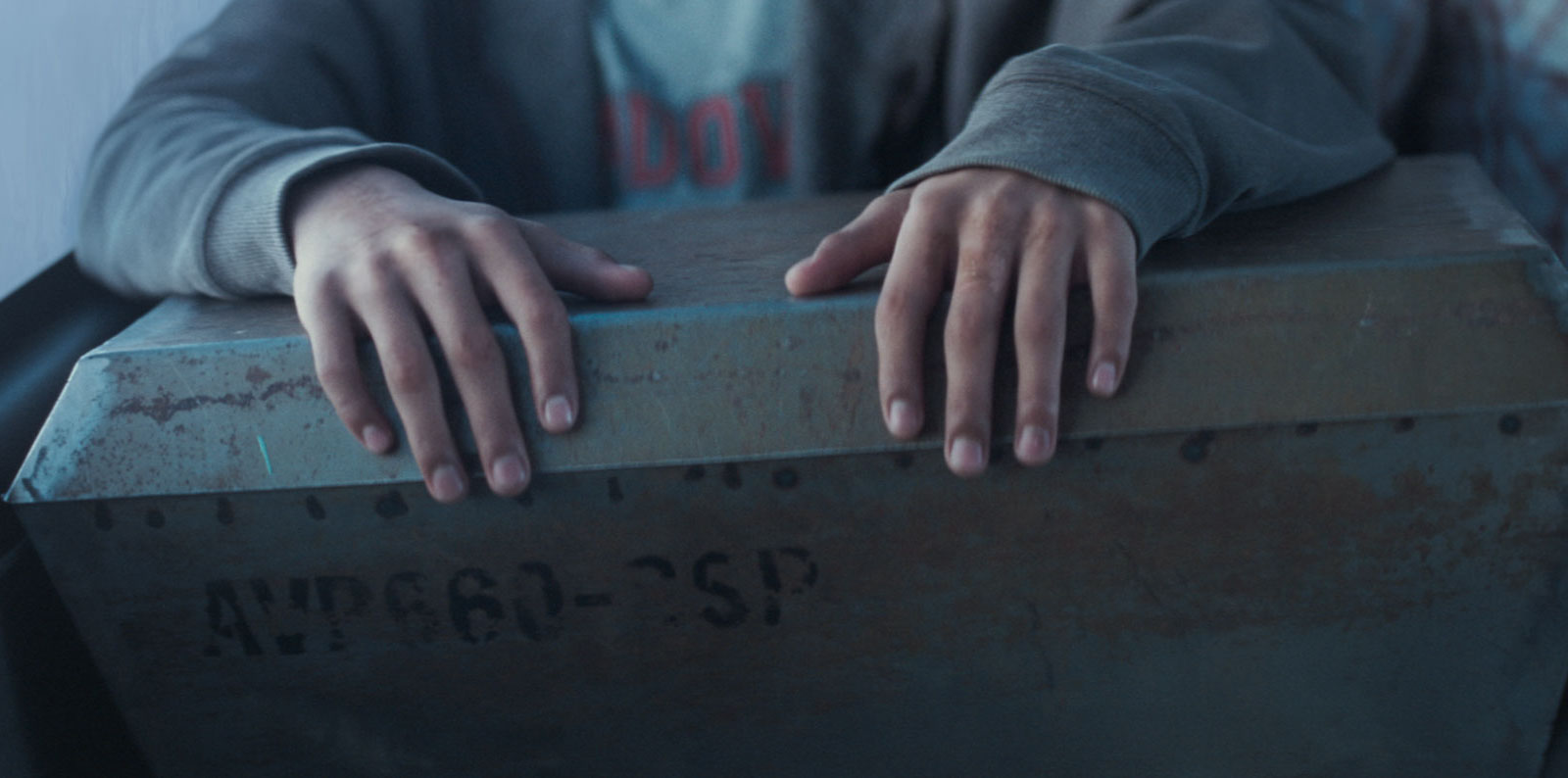
Hatzín (Hatzín Navarrete) has been sent north by his grandmother to retrieve his father’s body. A bus deposits him at a site where trailers have been set up and officialdom is IDing corpses and turning over remains to next of kin in large, coffin-shaped urns.
We can see where the bodies have come from, and it’s too small and tidy a space for a plane or bus crash. What happened? Hatzín asks no questions, and seems strangely unmoved by the process.
“I’m not crying, grandma,” he tells her by phone (in Spanish with English subtitles). He is young, maybe 13, and apparently estranged from the man whose body is in “La Caja.”
Wandering through the nearby town, he spies a man he is sure is his dad, a man who shrugs off his insistence that he recognizes him. Mario (Hernán Mendoza) is bluff and bearded and patient enough to hear the kid out. There’s a flash of compassion as the boy comes back, still insisting, and Mario buys him a drink and offers him bus fare.
Nothing doing, the kid seems to think. “There’s been a mistake” he tells the forensics team at what we slowly figure out is a mass burial site. Hatzín will dump the box on them and make a pest of himself to this stranger, who indulges, then bristles at and finally takes him in.
Hatzín will discover an underworld of labor recruiting, Amazon warehouse-sized sewing factories and peasant labor coming from near and far for work in what one recruiter describes, over and over, as Mexico’s “war” “with the Chinese,” a war with opportunities for quick cash but sometimes deadly consequences, from deceitful exploitation to truck hijackings and worse.
Vigas and fellow screenwriters Paula Markovich and Laura Santullo limit the dialogue, pulling the viewer in, forcing us to plumb the mystery of this unnamed place much as Hatzin does.
We ponder the kid’s annoying persistence and why this burly stranger is so tolerant of it, until he isn’t.
We hear the pitches to workers, and like Hatzin, observe how the promises differ from reality. Some are smart enough to see they’re being exploited, and start speaking up to others.
And we’re immersed in Mario’s reality a former sewing factory worker who saw the real money was in working with middle men and small-sweatshop owner-operators, filling buses with poor people eager to work, unaware of the trap they’re signing up for.
“Be happy with what you have,” they’re counseled. But if they aren’t?
The kid’s journey will take him from “You’re too honest” into things he’d never think he was capable of. It’s like an initiation into the drug world saga, but with lower cash stakes and cheap, ready-to-wear fashions as its product.
Young Navarette doesn’t give away what Hatzin is thinking, which serves the layers that cover where the narrative is going but robs “The Box” of emotional power. The film can feel documentary-clinical as it lays out this world, this “system” and the gregarious Marios who run it.
Mendoza lets us see the older’s man’s kindly, then cunning sides, and wonder which tack he will finally take with this bright boy he’s brought into his trust.
And through them Vigas shows us what’s behind that Walmart T-shirt that lasts two or three washings, that Target dress that loses its color just as quickly, and the true cost of anything that seems cheap, but really isn’t.
Rating: unrated, violence
Cast: Hatzín Navarrete and Hernán Mendoza
Credits: Directed by Lorenzo Vigas, scripted by Paula Markovich, Laura Santullo and Lorenzo Vigas. A MUBI release.
“Aquaman” and “Dune” hunk Jason Momoa figures prominently in the advertising for “The Last Manhunt.” He’s in just three or four scenes in it, but he co-wrote the story, so fair enough.
And he’s the one who got this new version of the story of “Desert Runner” Willie “Boy” Brown on film. This “true story” Western is a tad malnourished, stolid and depressingly downbeat. But it’s a tragic story. Even if you use a lot of Native American actors and Native American plainsong in the score, it would take a special touch to spruce up the few moments of action, lift the pathos of the couple on the run and make the quarrelsome posse entertaining enough to watch.
That touch is mostly missing here. But the story is still fascinating.
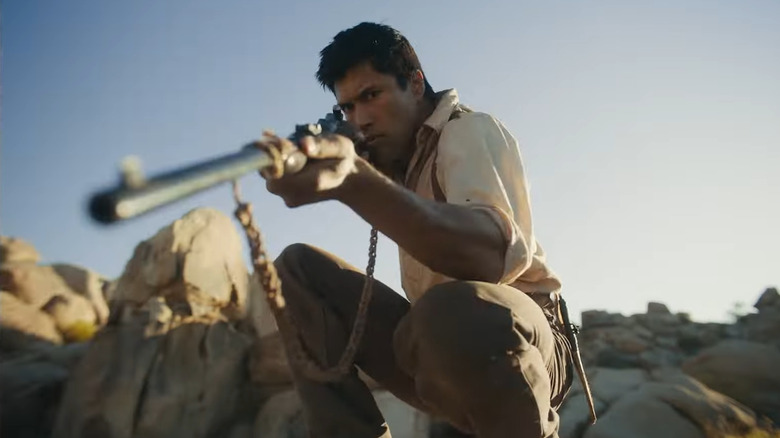
Willie Boy Brown was a Chemehuevi Indian (Southern Paiute) who tried to run off with his distant cousin girlfriend after accidentally killing her disapproving father. He’s been the subject of legend, lore, a book titled “The Last Manhunt” and a 1969 Western — “Tell Them Willie Boy Was Here” — starring Robert Redford as the reluctant sheriff hunting the fugitives, and Italian American actor Robert Blake in the title role.
Set in 1909, “Manhunt” is a “closing of the West” tale, a literal last posse-on-horseback “manhunt” through Joshua Tree, Twentynine Palms and environs, promising striking scenery, tragic young love, endless searching for water as well as the man the posse is hunting, and violence.
Martin Sensmeier of “Wind River” and “Yellowstone” is Willie, Hawaiian actress Mainei Kinimaka (of the Momoa TV series “See”) is Carlotta, the daughter of a medicine man (Zahn McClarnon) who has to track down the 16 year-old to save her from an “inappropriate” match. “You’re BLOOD,” he reminds them both.
That won’t stop Willie Boy. His second meeting with the father over his beloved leads to an argument and a shooting. Tribe members, who tracked them down when they tried to run off the first time, are ready to do it again. But a shooting means the recently-widowed, depressed and crawling into a bottle sheriff (director Christian Camargo) is involved now, with an armed posse of men of varying abilities and tolerance.
A reporter (Mojean Aria) cynically tries to join their crew, willing to manipulate the story which he recognizes needs some sizzle — an editor lowers Carlotta’s age to 14 — and that “You lack a great ending.”
The opening acts have the novelty of filming an under-filmed part of the desert southwest, with palm trees and Joshua Trees and deep canyons adjoining the vast expanse of desert. But the leads are just bland and there’s no sugar-coating that.
The middle acts, posse-centered, are talky and argumentative and don’t have quite enough conflict to engage the viewer.
And the finale can’t get here soon enough.
Momoa, playing a Native named Big Jim, turns up here and there, not enough to add spark to a picture whose score sets the tone, and is eventually overwhelmed by funereal strings — lots of cellos in tears.
I appreciate the effort it took to get a Western made in this day and age. It’s a good story. Redford knew it. So does Momoa. And there are some scattered stand-out moments.
But the relative poverty of the production shows in every too-clean-to-have-been-hiking-through-the-desert costume, every wish-they-could-have-cast-a-pricier, showier actor or actress, every “Let’s hire a script doctor to tighten/quicken/juice-this-up” suggestion ignored.
Rating: R for some violence and language
Cast: Martin Sensmeier, Mainei Kinimaka, Raoul Max Trujillo, Brandon Oakes, Amy Seimetz, Mojean Aria, Christian Camargo and Jason Momoa.
Credits: Directed by Christian Carmago, scripted by Thomas Pa’a Sibbett, Jason Momoa. A Saban Films release.
It’s the”Yellowstone” origin series. Paramount+ cannily cashed I’m on Kevin Costner’s star power among over 50s, and now they’ve talked their Indiana Jones into tackling this prequel, set in…”1923.”
As tales of a family holed up after an apocalypse go, “Shadows” isn’t particularly bad. Carlo Lavagna’s thriller has a decent sense of isolation and a time-tested source of conflict.
But the director of “Ariana” commits two cardinal sins in showing the lives of two teen girls and their all-knowing, self-sufficient mother. One is that is that where he’s taking us is laughably obvious. And the second is this obvious tale is so drawn-out as to give away the fact that he knows it’s stunningly predictable, but he figures that by padding out the story and the running time, he can fool the viewer and create a hint of suspense.
He can’t.
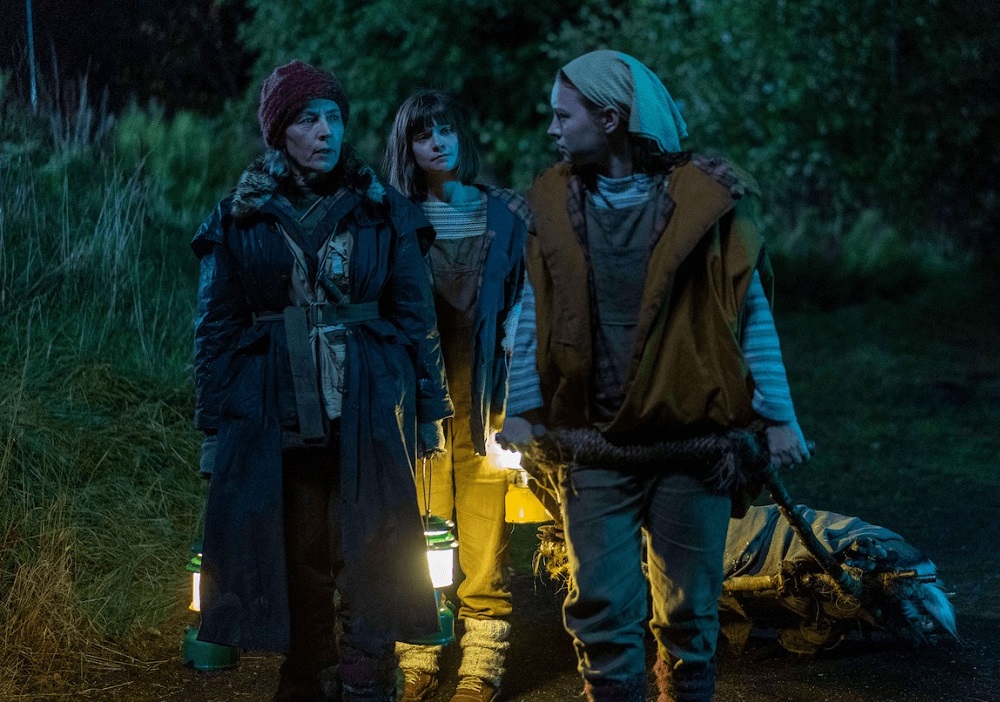
Mia Threapleton (Kate Winslet’s daughter) and Lola Petticrew are Alma and Alex, two teens who live in a room in the Stardust Hotel, not that long abandoned, but certainly going to seed. They keep each other entertained during the day in in a building whose windows are all covered over, sharing a room at one end of the place while Mom (Saskia Reeves) has her quarters at the other end.
“What’s the first rule?”
“Don’t go out during the day!”
Their lives are lived by lantern light, as their mother has told them of the dangers of daylight, of the perils of being out in it. She hunts and checks traps by night and keeps them fed. And they study the plants in the greenhouse, Mom’s school of nature, and other home school-able subjects.
All they know of the outside world they pick up from their mother, who has responded to whatever calamity has befallen civilization by going full naturism.
“Forgive us, Mother, for breaking the sacred bonds,” she prays to Mother Earth. “Thank you, Mother, for giving us everything.”
But young Alma is starting to have questions, and sister Alex is closing in on outright defiance. Mom goes off and leaves them on their own for days, and that fires their curiosity and creates opportunities for mischief. Going into the forbidden “cloak room,” where the detritus of “The Before” years are stored sets Mom off and pushes the girls towards open revolt.
So, Garden of Eden, Fall from Paradise parables anyone?
The acting is as effective as this simple script requires, with the odd animated or attempted emotional moment, most of which don’t land. As slow as it is, it feels as if there are details that’ve been left out, motivations under-motivated.
And it takes so long to get going that any delay in delivering us to the inevitable conclusion is downright interminable.
Rating: unrated, some violence, a sexual image
Cast: Mia Threapleton, Lola Petticrew and Saskia Reeves
Credits: Directed by Carlo Lavanga, scripted by Damiano Bruè, Fabio Mollo, Vanessa Picciarelli, Tiziana Triana A Red Water release.










 Movie Nation