Netflixable? A Monstrous Hit-man takes on Masked Mass Murderers in Japan’s “Demon City”

Movies like “Demon City” are why we pay extra attention to that one credit in an action picture’s production — “action choreographer” or “stunt coordinator.”

More that one actor I’ve interviewed over the years has mentioned he or she took on a picture because of who they had choreographing the fights to make them look “cool.” Jason Statham was the first I heard mention it. He took on “The Transporter” because Jianyong Guo was the hot stunt coordinator of the moment.

And somebody had to invent and stage that barefoot brawl where our hero snaps the toe-clip pedals off a racing bike, spills a barrel of motor oil all over a garage, and kicks ass while bad guys slip and tumble around him.

Takashi Tanimoto was stunt coordinator for the martial arts thriller “47 Ronin.” But what he does with Tôma Ikuta (“The Fallen Angel”) in this martial arts massacre is a wonder to behold, a next-level, “We’ve never seen THAT before” dance of violence and death-dealing.

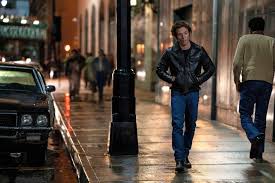
“Demon City” is a Japanese “John Wick,” where our mysterious, seemingly unkillable “baba yaga” is a demonic hitman out for “Oldboy” styled revenge. The classic car is different — he drives a vintage Mach One Mustange — and there’s no dead beagle. But the story arc is the same and the mayhem just as spectacular.

Sanaka (Ikuta) finishes one last bit of mass slaughter in Shinjo City before retirement, hacking and kicking has way through legions of villains, in essence clearing out “the docks” for a new gang to move in.

Sanaka relies on his balance, his martial arts skills and his vast collection of knives, hatchets, machetes and what not, which he sharpens with care.

His middle-man (Tarô Suruga) has arranged this “job,” and for Sanaka’s comfy retirement with his wife and little girl. But that is not to be. Masked marauders have preceded him home and have his wife and daughter Ryo hostage. The Master in this killing cult of mobsters speaks of a “demon” who arises in their “demon city” every so often, and that’s who he figures Sanaka is.

The gangsters who hired him to clear the way for their rule over the city’s underworld cannot have such a “demon” amongst them. They kill his wife and child, and finish Sanaka off.

Ah, but “Demon City” is based on a manga. And you know how “death” works in comic books. Sanaka isn’t dead, merely reduced to a scarred, catatonic “vegetable.”

But twelve years later, when he is released from a prison hospital — speechless, blank-eyed, drooling in a wheelchair — dirty cops show up to finish the job. And Sanaka wills himself to his feet, and fights as he crawls. Because revenge is the great motivator in this narrative. And Sanaka has a lot of masked murderers to track down and hack, kick, choke or shoot to death.

Coordinator Tanimoto has Ikuta, with some digital assitance (sped-up movement, etc.), lurch and jerk about, using upper body strenght and balance to flip guys out of windows even as he struggles to move under his own power.

Even before his beat-down and hospitalization Sanaka is a fighter with moves that suggest every joint in his body is double-jointed. Every blow that lands sets up the next, every minion he faces provides the momentum for crashing into the next one.

Watch the way Sanaka slams one uniformed goon against a rough concrete wall and DRAGs the poor, underpaid punk’s face along that wall, leaving a bloody red streak in his wake. Note what he does to disrupt a drug lab/human trafficking/”recycling” warehouse business. Mere forklifts are no match for his moves.

The first big fight/ambush is in the prologue, an assault on a mobster’s Morocan style-beachside lair, a white house/fortress painted crimson, one slash and splatter at a time.

Sanaka has a mission, a threat to make good on. “I’ll kill ALL of you,” he vows, in Japanese or dubbed into English. Lunging, zombie-jerking about, kicking and flailing, is he still quick enough to fend off bullets with his machete blade?

Will a bow and arrow accomplish what firearms cannot?

You’ll want to watch this with subtitles, because their is no substitute for butch yakuza bellowing in a brawl, bad guy after guy shouting “SANAKA!” as if their physical rage alone isn’t enough.

The story is formulaic — yes, “John Wick” also hewed to a formula grounded in Japanese and Hollywood revenge fantasies. There are dirty cops and a “good” cop helper, twists aplenty because every time you’re sure that was a mortal wound, somebody comes back from the dead, back for more.

But the fights in this bad-boy-amongst-bad-boys butcher shop thriller have to be seen to be believed. “The Raid,” assorted blind swordsman tales, “Oldboy” and John Wickworld all are glimpsed in this slaughter in scarlet saga from Seiji Tanaka.

Some day, some generous minded filmmaker is going to give a Takashi Tanimoto a curtain call credit for a movie like this. Whatever else goes on behind the camera, he’s the one who makes this one and its anti-hero look cool.

Rating: TV-MA, graphic bloody violence, profanity and perversion

Cast: Tôma Ikuta, Tarô Suruga, Matsuya Onoe, Miou Takata,
Masahiro Higashide and Ami Tôma

Credits: Scripted and directed by Seiji Tanaka, based on a manga by Masamichi Kawabe.A Netflix release.

Running time: 1:41

Posted in Reviews, previews, profiles and movie news | Tagged , , , , , , | Comments Off on Netflixable? A Monstrous Hit-man takes on Masked Mass Murderers in Japan’s “Demon City”

Classic Film Review: A Brit Baby Boomer lost in His Own World — “Billy Liar” (1963)

Falling into “Billy Liar” is no easy feat, even for a film buff, over sixty years after it was released.

It’s been included in more than one list of “the 100 Best British Films Ever Made,” albeit in the bottom quarter of that ranking, not far removed from a “Carry On” comedy. But its a story recognizable and “universal,” and stubbornly populated by unpleasant people behaving unpleasantly. There’s no easy “in” or character to connect with, even the ones meant to embody a generation.

Tom Courtenay of “The Loneliness of the Long Distance Runner” stars in it, John Schlesinger directed it and it is based on the Keith Waterhouse novel and play (with Willis Hall) of the very late ’50s. All of that parks it firmly in the “angry young (postwar) man” “kitchen sink realism” dramas of that era. And the surrealism gives it a French New Wave twist, not something the director of “Midnight Cowboy,” “Darling,” “Marathon Man” and “Cold Comfort Farm” was ever accused of again.

But it’s a comedy, with more than touch of Thurber’s “The Secret Life of Walter Mitty” about it. And the first act, despite a boffo, fantasy sequence opening, is hard-pressed to find whimsy or charm in its anti hero or the grim, grey construction zone that was the northwest of England (Bradford, near Leeds, was the filming location) in 1963.

Billy Fisher is 19, a slacker at home and at work, a feckless lover juggling two fiances with one engagement ring between them and a dreamer who escapes his life by dreaming of Ambrosia. Not the drink, but the fantasyland of his own creation, where he is soldier, field marshal, dictator and king in a war torn land which pauses to celebrate his achievements, laud his speeches and give him parades which he both marches in and soaks up from the ruler’s viewing stand.

Billy stops daydreaming to squeeze in the day’s first lie — “Today’s a day of big decisions – going to start writing me novel – two thousand words every day, going to start getting up in the morning…”

In a Britain bubbling back to life after World War II and 1950s austerity, Billy is the slacker’s slacker, an only child as unpleasant as his disapproving Dad (Wilfred Pickles) and racist Granny (Ethel Griffies).

He dodges work at the office, and keeps a stash of the calendars from the funeral home where he works in a locked dresser at home, lest the owners (Leonard Rossiter and Finlay Currie) find out he’s pocketed the money he was supposed to use to mail them. His co-workers are louts, even Arthur, whom he claims to co-write songs with.

The thing about Thoroughly Unpleasant Billy is that he lies like he breathes — to his annoying fiances, the virginal and naive Barbara (Helen Fraser) and angry and brassy barmaid Rita (Gwedolyn Watts). His dad “lost a leg” in the war. He has a sister. He HAD a sister (“She died.”).

And he’s “going to London. Got an offer to write scripts for (the comic) Danny Boon (Leslie Randall).” Boon is in town for a market opening, but there’s no offer, no matter what Billy’s oft-started letter of resignation says.

A walk to work becomes an exercise in sleep-walking with his eyes closed, as Billy lies to avoid facing up to the obvious. He’s never made a real decision, never taken a stab at fleeing the conventional life which seems set up for him. He’s never actually “done” any of the achievements he claims for himself. And when he does, no one in his or her right mind should believe him.

All that lying and all that daydreaming is sure to be for naught, as we know a reckoning is coming for this pathological procrastinator, big talker and two-timer.

His mother (Mona Washburne) doesn’t “get” him, but at least she tolerates him as she dispenses advice he’ll never take.

“If you’re in any more trouble, Billy, it’s not something you can leave behind you, you know. You put it in your suitcase, and you take it with you.”

Things finally come to a head when Billy reconnects with his muse, his role model and his one true “love,” Liz.

Liz is played by Julie Christie in the role that would make her a star and one of the defining faces of the ’60s. She is both perfect in the part — from her fashion-forward mop of hair to her free-spirited “just GO” and figure out how to make a living “there” (London, etc.) later ethos, the embodiment of a restless youth-culture age — and the character who kind of derails the film.

If Billy “dreams” of anything, it should be her. If she says “Let’s GO to London,” he must. The dowdy virgin and dowdier trollop he’s passing an engagement ring to have no prayer in a conversation with Liz in it. She may be working class, a bit of a drifter, but she oozes glamour, worldliness and sex appeal. She even makes it seem plausible that she’d see through Billy Liar and yet “see something” in him.

Liz is the ultimate choice shoved in Billy’s face. He can dream rather than struggle to fulfill his “script writer” dream, without doing much to make it come true. Or he can chase a free spirit to the place that dream requires him to be.

“Billy Liar,” which later became a British TV series, is a fascinating moment-in-time tale that would be comical if Billy was more cocksure of himself or tragic if Billy was less unpleasant. There’s nothing charming about this dreamer and nothing plucky about this striver, even if we recognize the “type” — who gets trotted out with every generation that seems lost in dreams, lazy and irresponsible.

Somebody should take a shot at a Gen Z version of Billy. We’re already “judging” that generation. Why not give them and everybody who judges them a focal point for that angst, a personification of that daydreamy, rebellious impatience?

Because Billy and Courtenay keeps us watching even as we can guess which wheel will come off first and which choices Billy makes or simply cannot make. And Christie embodies that siren just beyond one’s reach, an end goal plainly in sight even if we, like our hero, can’t stop dreaming and “visualizing” what we want long enough to figure out how to get it.

Rating: TV-PG (approved), sexual situations, smoking

Cast: Tom Courtenay, Wilfred Pickles, Mona Washburne, Gwendolyn Watts, Helen Fraser, Finlay Currie and Julie Christie.

Credits: Directed by John Schlesinger, scripted by Keith Waterhouse and Willis Hall, based on the play by Waterhouse and Hall and the novel by Waterhouse. .

Running time: 1:39

Posted in Reviews, previews, profiles and movie news | Tagged , , , , , , , | Comments Off on Classic Film Review: A Brit Baby Boomer lost in His Own World — “Billy Liar” (1963)

Movie Review: Julianne, Sydney and Domhnall know what goes down in “Echo Valley”

The questions pop to mind early and somewhat often in the new thriller “Echo Valley.”

Wait, how did that tiny young woman lift…Her 60something mother chose what to dump a body in a lake…So did the ex-husband take up with a much younger woman before his wife discovered she was gay?

Some mysteries are solved and some left hanging in this engrossing will-they-get-away-with-it mystery from the director of “Beast” and the writer of “Mare of Easttown.” But the one we’re left to ponder entirely to ourselves is “How could anmother capable of the sort of unconditional love we see here raise such a monster?”

Oscar winner Julianne Moore plays the mother, Kate, a widow still grieving the death of her wife, still living on the Chester County, Pennsylvania horse farm she kept in the divorce (Kyle MacLachlan plays the ex), still waiting to hear from her irresponsible, self-absorbed addict-daughter, played by “It” girl Sydney Sweeney of “Euphoria” and “Anyone But You.”

Things are bad enough enough, what with Kate canceling riding lessons in her grief, the farm running in the red and the ex fed up with writing checks. Then the headstrong addict Claire shows up, with her druggy beau (Edmund Donovan), empty promises — “I’m CLEAN, Mom! I’m good.” — and a need for cash.

There’s a dealer (Domhnall Gleeson) with news that Claire “betrayed my trust. Your junky daughter has two choices. Give it back or she can pay me my money.”

As the opening scene of the film is a body coming to the surface of a nearby lake, the questions begin. Who is it? Who sank it? And will she/they/etc. get away with it?

It’s all handled reasonably well, with just enough twists to hold the interest and just enough attention to the logic of it all for Brand Ingelsby’s script to make sense — more or less.

Moore is wholly believable as a woman gutted by loss, trapped by her devotion to a kid who’s just no damned good. Sweeney makes Claire recognizably lost, following her impulses, but cynically sure of one thing — her mother’s willingness to do anything to help her. It’s one of her best performances.

Gleason makes a sharp, sinister villain. And Fiona Shaw sparkles as that ride-or-die lesbian pal a gal needs to lean on in a pinch.

“Echo Valley” isn’t great, but it isn’t bad. And the fact that it’s on Apple TV means you don’t have to keep your questions to yourself. Shout at the screen as much as you like. I know I did.

Rating: R, violence, drug abuse, profanity

Cast: Julianne Moore, Sydney Sweeney, Fiona Shaw and Domhnall Gleason.

Credits: Directed by Michael Pearce, scripted by Brad Ingelsby. An Apple TV+ release.

Running time: 1:44

Posted in Reviews, previews, profiles and movie news | Tagged , , , , | Comments Off on Movie Review: Julianne, Sydney and Domhnall know what goes down in “Echo Valley”

Netflixable? Brazilians look for Grandma in Israel — “Cheers to Life” (“Vida a Vida”)

You can see, hear and feel the strain in the Brazilian comedy “Cheers to Life (Vida a Vida),” the great effort expended to achieve “cute.”

It’s sweet enough, and sweetly sentimental. But for a “finding your (living) roots” story that takes a couple of cousins to Israel to meet a granny they never knew, that’s never quite enough.

So we’ve got to trick granddad Benjamin, whom they’ve never met, lie to him and drug him for a “Weekend at Benjamins” bit. They’ve got to debate whether they’re kissing/copulating cousins, and be as dainty about that as possible. And they’ve got to see the historic sights — the Wailing Wall, Dead Sea, King Solomon’s Mines, etc. — on a Holy Land tour with cute nuns, other tourists and a comically flamboyant Portuguese speaking tour guide.

It’s a competently made film, with flashbacks from the distant past setting up a somewhat cloying story. But the laughs and delights are few and the sentimental finale is contrived and clumsy.

It’s about three heirloom “pendants”(lockets) that “only the bravest women in this family” wear. Decades after she was given one by her mother, who died young, orphaned Jessica (irrepressible Thati Lopes) stumbles across one to match the one her mother gave her.

That’s how she tracks down the “cousin,” Gabriel (Rodrigo Simas), a photographer in the process of being kicked out of his model-girlfriend’s (Aline Dias) apartment. He was selling jewelry, heirlooms included.

They didn’t know they were related, that they have a shared ancestor who fled an arranged marriage and ran off to Israel with her true love. But as both are broke — Jessica is broke enough to “borrow” and pawn jewelry from the antiques store where she works for plane fare — they’ll jet off to meet the mysterious Hava (Regina Braga) and her husband Ben, Brazilian-born tour business owner Ben (Jonas Bloch).

“They’ll think I came here for the money,” Jessica whines. As Jessica and Gabriel have haggled over “inheritance” percentages, “But you came here for the money” (in Portuguese, or dubbed into English) is the only response to that.

They will be fish out of water, trapped with tourists on a “Grandpa Ben” tour, guided by Ramirez Ramirez (Diego Martins), doing everything they can think of to draw the old man owner into the tour so that they can meet him, tell him who they are and meet grandma.

Nude bathing on a no nudity beach in Tel Aviv should do the trick. Ben has to show up to bail them out. But Jessica can’t bring herself to fessing up. Ben is sad. Hava? She’s left boring, trapped in routine Ben.

There’s nothing for it but to “help” Ben find Hava in Jaffa, Jerusalem, Eitat, the Dead Sea or wherever Ben figures she might be.

Lopes gets most of the funny lines — comforting a woman recovering in a hospital with “My dream is to get old and have as many plastic surgeries as you.” She’s a less-than-convincing saleswoman, selling articles in the antiques store by extolling “the nostalgia” of “the ’60s,” before admitting how that decade played out in Brazil.

“Set aside the dictatorship and the many being tortured and murdered” and it was a pretty stylish time, for sure.

There’s tentative chemistry between Lopes and Simas. But that requires us and them to get past the “cousins” thing, and to forget his previous lover was a model.

The movie peaks as Jessica finds herself getting the Bat Mitzvah she never had and learning that The Wailing Wall isn’t for weeping. It’s for “making requests.”

The picture blows the “fish out of water” element of this “journey of discovey,” with “a phony Jew” and a guy who only remembers the Hebrew he needed to get through his Bar Mitzvah finding Portuguese speakers every time they need one. And the travelogue part of the picture is pretty but over-familiar.

The best joke is the one “Palestinian” bit in the picture, the fear of being “sold to a sheikh” on camelback when they get lost near King Solomon’s Mines. But a few others pay off.

It’s still not much of a movie, because really, how many versions of “Hava Nagila” do we need to hear in 100 minutes?

Rating: TV-14, sexual situations, profanity

Cast: Thati Lopes, Rodrigo Simas, Diego Martins, Aline Dias, Regina Braga and Jonas Bloch.

Credits: Directed by Cris D’Amato, scripted by Natalia Klein. A Netflix release.

Running time: 1:40

Posted in Reviews, previews, profiles and movie news | Comments Off on Netflixable? Brazilians look for Grandma in Israel — “Cheers to Life” (“Vida a Vida”)

Movie Review: Mating Rituals of “Materialists” leave Little Room for Romance

There’s a bracing cynicism to “Materialists,” the latest anti-rom-com from the writer-director of “Past Lives,” Celine Song.

“Dating is a risk,” her heroine, the professional matchmaker Lucy declares. And marriage?

“Marriage is a business deal. And it always has been.”

Jane Austen couldn’t have said it better, although she never quite put it this bluntly.

But this very modern, very Manhattan slap of “reality” about the nature of coupling has a few things going against it that make far less satisfying than Song’s previous wistful statement on “love.”

For starters, it’s not romantic. It toys with rom-com conventions, throwing in a “meet cute” and a production designed wedding or two. It’s got the “poor” but oh-so-pretty guy our heroine left for being “broke,” and the chic, handsome and “Tribeca penthouse” rich charmer who “checks all the boxes” as a rival.

But blasts of realistic but clumsily handled melodrama stop us short of connecting with all this. The insurance actuarial table treatment of male/female “types” that might make a good match, and the medical solutions to adding to a man’s “market value” would make Aristotle Onassis and generations of Hollywood power-broker dwarves chuckle.

And then there’s Song’s choice of romantic ideal. Whatever canny reason for having our cynical, pragmatic marriage broker deliver her smiling pronouncements in a flat, kittenish whisper behind the less than wholly expressive face of Dakota Johnson, that so lowers the stakes that it’s hard to care.

Will lonely matchmaker Lucy end up with “It” leading man of the moment Pedro Pascal, or perma-tossled, still-boyish Chris Evans?

Lucy is a failed actress pulling down $80K a year who has turned her head-turning beauty into a recruiting tool for Adore, the matchmaking agency for the rich-and-near-rich she works for. She is celebrated by her all-female-staff colleagues and her boss (Marin Ireland, just seen in “Dope Thief”) for her success rate. She makes “friends” with her female clients.

She should be celebrated for being so well turned-out every day, and being able to dress that well and live in Manhattan on $80,000 a year.

A simple walk down the street gets a little eye contact from just the right sort of client, and a proferred business card when he thinks she’s returning his flirt.

Lucy has just gotten her ninth female client to the altar, and the film’s funniest business has a parade of bridesmaids and others encircling her at that wedding, ready to take the plunge because they’re thin, educated and polished New York career women desperate to couple up and who have a specific set of criteria they figure they “deserve.” And Lucy has the magic touch.

Jokes among the lovelorn — “”You’re not ugly. It’s just that you don’t have money.” — and montages of darkly comical client interviews and not-comical-at-all phone chats with unsatisfied men and women underscore the entitlement one and all feel.

The men are downright hateful in their notion of “high quality women,” translated as much younger, beautiful, but educated and sophisticated and comfortable in a world awash in money. The women are just as shallow — about height, education and salary requirements.

“I’m trying to settle,” Lucy’s toughest client, the pushing-40 New York lawyer Sophie (Zoe Winters) complains. But nobody’s settling for her.

That opening wedding is where Pascal’s version of Matthew McConaughey rakishly overhears his way into Kate Hudson’s (Lucy’s) life. Harry’s brother is the matchmade groom at this wedding, and overhearing the flock of bridesmaids and Lucy’s “find the love of your life” pitch has Harry intrigued — not in her services, but in her.

Her task is to grab this tall, dark, rich and handsome “unicorn” as a prospect for one of her paying clients. Harry’s task is to sweep her off her feet.

But there’s a reminder of her youthful look for love past at the party. Catering waiter John (Evans) is a struggling, 40ish stage actor ex, the guy Lucy struggled with before recognizing she “can’t act” but she did know “a lot about dating,” and had a knack for setting couples up.

As they share an outdoor smoke and he admits that yes, he still has that beater Volvo and yes, he’s still sharing a flat with a couple of other slovenly actor guys at an age when that dream is past its expiration date.

Will Lucy land her “unicorn,” for herself or one of her paying customers? Will she flashback her way back into John’s arms, or simply remember she hated herself for hating him for “being broke?”

Johnson may “check off the boxes” in a role that requires beauty and allure with a whiff of box office “value.” But she isn’t the best at getting across the longing Lucy is trying to package in connecting people with “your nursing home partner and grave buddy,” “the love of your life.” Any number of 40ish romantic starlets would have done a better job at making that swooning sales pitch, or at selling the ache that must set in for having let yourself get this cynical.

Evans, clinging to “boyish” in this turn, and Pascal are so on-the-nose that it’s as if Song put as much imagination into casting as she did to character names. “Lucy,” “John” and um, Hispanic “Harry?” Really?

Ireland sets the brittle “all business” tone for a movie whose rare light moments are merely here to set up the conventions Song is mocking. And when Song takes a shot at making a statement on a grim risk all dating women face in the world of men, it’s so heavy-handed that it stops the picture cold.

“Materialists” is dry and ironic and “honest” while laying bare the hopes that we all cling to that love isn’t really as materialistic as she’s saying. But the rare air of the artificial, archetypal world she sets out to make her big statement in leaves the viewer grasping for not just a breath of fresh air, but hope.

And as perfect as Johnson might be as that elusive “ideal,” casting her is just another reminder that she’s a few shades shy of the alluring warmth her few attempts at rom-coms and romances have demanded of her. This is a sale she was never going to make.

Rating: R, sexual situations, profanity and smoking

Cast: Dakota Johnson, Chris Evans, Marin Ireland, Zoe Winters and Pedro Pascal.

Credits: Scripted and directed by Celia Song. An A24 release.

Running time: 1:54

Posted in Reviews, previews, profiles and movie news | Comments Off on Movie Review: Mating Rituals of “Materialists” leave Little Room for Romance

Movie Review: A B-Western with a Couple of A-Listers, Brosnan and Jackson and “The Unholy Trinity”

Pierce Brosnan and Samuel L. Jackson seem delighted at the prospect of filming a B-Western together in “The Unholy Trinity,” a mediocre genre piece with the occasional entertaining sequence or moment.

Well, I’m pretty sure they share the frame together once or twice in this good-looking, handsomely mounted indie. The way these things work, often you can’t afford to have both stars on the set at the same time. As they’re sometimes joking with each other, and at other times threatening or shooting at one another, they both don’t have to have been there for those one-shots and close-up scenes to edit together.

It’s the sort of Western you get when two Aussies who perhaps enjoy the genre — one who directed the most recent underwhelming version of “Robert the Bruce,” the other a screenwriter with no credits that have crossed the Pacific to any sort of notice. The Montana locations, fights, gallops and shootouts look right. But there’s no “feel” for the story that makes sense.

Not everybody’s Tarantino and gets a pass for a Western that lets Samuel L. cut loose with assorted anachronistic”mutha” this and “my Black ass” that variations, after all.

A condemned man (Tim Daly, unrecognizable) makes his estranged son (Brandon Lessard) promise to “avenge” him for being “framed” by a dirty sheriff just as the priest (David Arquette) leads him to the gallows.

It’s 1888, the year before Montana became a state. And here’s the young man, who bears an unfortunate resemblence to longtime “Drunk History” host Derek Waters, trekking across the territory to a town called Trinity with a small pistol and a brass urn with his father’s ashes.

Montana was ahead of the curve in that choice for burials, at least in this Aussie version of Western America history.

The kid gets the drop on the sheriff in the Trinity church. But the aged Irishman behind the badge (Brosnan) is sage and cagey and the WRONG sheriff. A cleverly-staged standoff eventually straightens that out.

But the kid gets into real trouble when he gets between a “dance hall girl (Katrina Bowden) and her regular, roughneck miner-customer. Three people wind up dead, and with surviving members of the miner’s family and a Scots-born Georgian (Gianni Capaldi) baying for blood and already frustrated that Sheriff Gabriel Dove isn’t charging or pursuing a Blackfoot woman (Q’rianka Kilcher of “A New World”) for another killing, there’s lynch mob trouble on the horizon.

Another newcomer in town who refers to himself as “Saint Christopher” (Jackson) was present at the hanging across the territory at the prison, and has some connection to the dead man and by extension his son. He’s hellbent on setting the locals against one another.

Throw in more “dance hall” girls, an “actor” pretending to be a member of another ancient profession, posses and stand-offs and you’ve got yourself a reasonable facsimile of a Western.

There’s a tiny smidgen of humor, much of it provided by Jackson and a wee bit of it coming from Brosnan’s Sheriff Lucky Charms.

“The Priest?”

“I don’t think he’s a REAL priest!”

“Ah, like a Lutheran?”

Kilcher gives the picture credibility that extends beyond it’s Old West boom-town (new construction) look, and the weathered stagecoach, muddy streets and snow-dusted hills behind the action.

The shootouts are first rate, and the stuntwork does a nice job of hiding the well-past-AARP status of our Big Names.

The script may be surprisingly convoluted, with hidden Confederate gold, assorted alliances and double-crosses and a town that seems to wholly have the sheriff’s back — until they don’t.

But a bit of entertainment creeps in, much of it provided by Jackson and Brosnan, even if it turns out they weren’t one the set together for more than a day or two.

Rating: Rated R for violence, language and some sexual material.

Cast: Pierce Brosnan, Samuel L. Jackson, Brandon Lessard, Veronica Ferres, Tim Daly, Stephanie Hernandez, Katrina Bowden, David Arquette and Q’orianka Kilcher.

Credits: Directed by Richard Gray, scripted by Lee Zachariah. A Roadside Attractions/Saban Films release.

Running time:1:33

Posted in Reviews, previews, profiles and movie news | Comments Off on Movie Review: A B-Western with a Couple of A-Listers, Brosnan and Jackson and “The Unholy Trinity”

Movie Review: To be Pretty, Young and Italian, Figuring It Out at “Diciannove”

Giovanni Tortorici’s “Diciannove” is a dreamy, drifting odyssey into a time in youth when one discovers the meaning of “the world’s your oyster.”

It’s about a young Italian with choices at an age when you know it all and you know nothing and you follow your impusles, figuring everything out on the way — 19.

That’s what the movie’s title means, and that’s the year we float through with our middle class Italian anti-hero, Leonardo (Manfred Marini). He will wander from Palermo to London, Siena to Turin, changing majors and colleges, getting pass-out drunk with friends and family, debating professors and reading 14th century Italian writers.

He will start writing himself, experiment with solitude and sexuality and ponder suicide and perhaps becoming a rent boy to make ends meet.

Yeah. “Nineteen.”

We meet him as his mother is the first to label him a disorganized, doesn’t-sweat-details “moron,” on his way to join his sister (Vittoria Planeta) in her shared apartment in London. A few days of drunken clubbing, getting chewed-out for not helping around the house, eating others’ food and the like and that London university degree in “business” goes out the window like the dream it was.

He applies online to a university in Siena, sets off to study literature, buys books and fails to avoid coming off as a standoffish loner.

“I want to commit suicide,” he writes and recites (in Italian with English subtitles). “I want to kill myself…I want to die…I want to croak…Snuff it…Pass away.”

Writers and their “mantras.”

Of course, it’s all a phase as this poster child for the arrogance of bourgeois youth takes exams without attending lectures, composes a jeremiad against his professor, but chickens out of distributing it, begs mom for money and gets chewed out by his dad as he walks the streets of the old city, buying books and thinking and just generally “figuring it out.”

It’s a mesmerizing movie, in its way, a chronological stream-of-consciousness dissection of a very specific “type” — Western, indulged, pretty enough to attract attention, careless with how he uses it, too removed from his contemporaries to care or commit.

Semi-autobiographical or not, our writer-director has picked his target and hit it in delivering a portrait of youth that tries everything before settling on one thing to make the “fanatical” focus of one’s life. Realizing “We’re not as interesting as we think we are at 19” is just a bonus.

Rating: unrated, nudity, sexual situations, teen alcohol abuse, smoking

Cast: Manfredi Marini, Vittoria Planeta, Luca Lazzareschi and
Zackari Delmas

Cfedits: Scripted and directed by Giovanni Tortorici. An Oscilloscope Labs release.

Running time: 1:48

Posted in Reviews, previews, profiles and movie news | Tagged , , , , , | Comments Off on Movie Review: To be Pretty, Young and Italian, Figuring It Out at “Diciannove”

Documentary Review: A Young Woman “Prime Minister” steers New Zealand Through its Darkest Hours

There’s cold comfort for American and international audiences taking in “Prime Minister,” a new documentary about New Zealand’s first female prime minister, the woman who led the country through a horrific mass shooting hate crime, a volcanic erruption, COVID and the blowback lockdowns and mask and vaccine mandates generated.

Oh. Gullible, belligerently violent morons aren’t solely an America/British et al phenomenon.

The Kiwi country that greeted Jacinda Ardern‘s rise to power with sexist skepticism and found itself impressed with her leadership qualities and her humanity, celebrated the world over for her compassion, forward thinking and problem solving decisiveness — Nobody handled COVID better. Nobody. — found itself roiled by violent, misinformed, media-dominating protests by a noisy minority that couldn’t even spell her bloody name right. Or, as I realized researching this review, her partner and later husband’s (Clarke Gayford) name.

The Sundance award winning “Prime Minister” is an intimate portrait, an oral history of Ardern’s unexpected elevation to leadership of the Labour Party at age 37, her realization that she was pregnant while finishing up Labour’s winning campaign in 2017, having a baby in office and everything she had to contend with on the job — often bringing baby Neve into cabinet meetings and even the U.N. General Assembly.

And the film is a reflection back on her work, the challenges she faced and how she handled crisis after crisis with compassion, intelligence — getting the best scientific advice available and taking it — and decisiveness.

New Zealand’s worst-ever mass shooting, a hate crime against Muslims committed by an Australian radicalized by Trump-worshipping American online hate sites and Rupert Murdoch’s global right wing smear-o-sphere was met with efforts to comfort the Muslim community in New Zealand, a call for unity, and a sweeping ban on assault weapons and military firearms in civilian hands.

The country went along with her “kindness” ethos. The right wing punditocracy and conspiracy buffs freaked completely out.

Ardern remembers that shooting and “the longest week of my life” as she sits down for short interviews for an as-it-happens oral history project the she agreed to participate in. Her partner, Gayford, was a popular New Zealand TV presenter (“Fish of the Day“), something not mentioned here. He videoed her, questioned her and captured footage of their home life with a new baby and outside crises competing for attention.

“Crises make governments and they break governments,” she opines.

“Be really nice to see you sometime,” baby-daddy and caregiver Gayford cracks from behind the camera.

We see Ardern begin her term with a shaky coalition including an anti-immigrant fringe party, and see her decisions and determination to be open, to “tell people what you know, even when it’s not” pleasant or what they want to hear style win her a sweeping new mandate.

There’s her landmark appearance at the UN with her baby, a day when a sea of world leaders openly laughed at Donald Trump’s bragging lies about “accomplishments. And then there was her ever-so-diplomatic handling of talk show host Stephen Colbert’s questions about that expression of international mockery for the blustery Trump.

Ardern’s open progressivism and “internationalism,” eschewing “isolationism, protectionism and racism” was and is defiantly out of step with much of the electorate in the world’s democracies. That explains why she’s not in power now (We see her lecturing at Harvard.), and that the old adage she repeats about “crises make governments” doesn’t work in a media landscape dominated by lies and bad actors — Russians and Rupert — spreading them.

“Prime Minister” is thus an against the grain movie of its moment, out of step politically, and an intimate to the point of myopic doc that zeroes in on the personality it is profiling. But it’s still refreshing to see that violent, foul-mouthed right wing cranks are not simply a Northern Hemisphere problem, and to be reminded that eventually the adults in the room will stop listening to them no matter how many Murdochs, Musks and Zuckerbergs keep giving them a megaphone.

Rating: unrated, some profanity

Cast: Jacinda Ardern, Clarke Gayford, Donald Trump, Christiane Amanpour and Stephen Colbert.

Credits: Directed by Lindsay Utz and Michelle Waltshe. A CNN Films/Magnolia release.

Running time: 1:41

Posted in Reviews, previews, profiles and movie news | Tagged , , , , , , , , | Comments Off on Documentary Review: A Young Woman “Prime Minister” steers New Zealand Through its Darkest Hours

Netflixable? Scientific Couple leaves “Our Times” (Nuestros Tiempos) for a More Diverse and Progressive Future

Time seems to stand still in the Mexican dramedy/romance “Our Times.” Lacking urgency and slow-footed in the extreme, its 90 minutes crawl by as it laboriously makes its points about the sweeping changes in relations between the sexes in culture and work over the past sixty years.

Two Mexico City university professors, Nora (Mexican TV star Lucero) and Hector (singer/actor Benny Ibarra) teach and put in the overtime as they try to test the limits of Einstein’s theories about space and time with this big, pricey gadget they’ve been working on.

It may look more like a Lunar Module than the device in the George Pal’s famous 1960 film of H.G. Wells’ most famous novel. But they’re both time machines.

The year is 1966 and Nora is something of a pioneer, a woman physics professor. She is patronized by all the men around her, with her department chair calling her “sweetheart” and deliveries of parts she ordered from the Soviet Union are thoughtlessly passed on to other men and eventually her husband.

A female student who idolizes her would love to be her first assistant. Fat chance of getting money for that.

But Nora and Hector are close, and with a little tinkering/rethinking they strap in wearing old leather helmets and goggles and give it one more try. Their “fifteen minutes into the future” trip turns out to have shot them 59 years ahead in time.

The plot is about them being “trapped” in this new time, fretting over a wormhole “portal” about to close as they attempt repairs. But the movie is about the different world Nora finds herself in, one with respect, opportunity and a chance to realize her loftiest ambitions.

That student who wanted to be her assistant? Julia (Ofelia Medina of “Frida,” “Before Night Falls” and “Colombiana”) is now the venerable department chair. Julia and the student granddaughter of Nora’s sister, Alonda (Renata Vaca of “Saw X”) are the only people who can know where she and Hector came from, and the place he’s most anxious to return to, “Nuestros Tiempos.”

They’re amazed that the planned Mexico City subway is now a reality, puzzled at such novel concepts as sexual identity and dismayed at the screens everybody stares into.

“A machine that hypnotizes them,” Hector wonders (in Spanish, or dubbed)?

There’s no smoking. “What do they have against smoking?” Fashions and the women who wear them are liberated.

And the university women — professors and students — don’t have time for any Hector “mansplaining” or assertions of the old gender heirarchy.

The script wanders into the seismic changes in attitudes, attire and the culture at large in all the most predictable ways. Hector is more resistant to “letting our eyes get used to this world” when the one he’s desperate to return to is dogmatically committed to holding Nora back.

That’s defensible messaging, and a few scenes of Hector’s out-of-control “mansplaining” play.

The performances pass muster.

But there’s no pace and zero urgency to this. The dated, tame sexual jokes don’t really land and the romantic twist is both touching and so old fashioned it wears cobwebs.

This hasn’t the wit of “Safety Not Guaranteed” or “Back to the Future” (a DeLorean is a rare sight gag), or the danger of “Primer” or the Spanish thriller “Time Crimes”( “Cronoscrimenes”).

And no one involved makes much effort to make the big romance at its heart play in a “Time Traveler’s Wife” or “Somewhere in Time” sense.

The good intentions are obvious, but the movie wrapped around them is a something of a bore.

Rating: TV-14, smoking, sexual situations

Cast: Lucero, Benny Ibarra, Renata Vaca and
Ofelia Medina

Credits: Directed by Chava Cartas, scripted by Juan Carlos Garzón and Angélica Gudiño. A Netflix release.

Running time: 1:30

Posted in Reviews, previews, profiles and movie news | Tagged , , , | Comments Off on Netflixable? Scientific Couple leaves “Our Times” (Nuestros Tiempos) for a More Diverse and Progressive Future

Movie Review: The Demure Charms of Aisling Bea and Billie Lourd unleashed — “And Mrs”

“And Mrs” is a bittersweet and offbeat romantic comedy of love and loss and mourning, and a most unexpected star vehicle for unfiltered Irish comic Aisling Bea, nicely paired up with Carrie Fisher’s kid, Billie Lourd.

Bea, one of the English speaking world’s greatest talk show guests, stars as a woman whose fiancé dies just before their wedding. Lost and bereft, she decides to follow through on “what Nathan wanted” more than anything else, to be married to her.

Gemma will battle friends, family, customs and her own guilty conscience to make this happen. And as she’s living in London, naturally there’s a loophole in arcane British law that allows such “necrogamy” nuptials.

Gemma, a London-Irish graphic designer, was never the “big gesture” and big emotions one in her relationship to Nathan, played by Colin Hanks. He botches his first “I Love You” by prematurely playing The Partridge Family’s “I Think I Love You” on his phone. He can’t get her to commit to an early “I love you,” just “I’m very, very fond of you.”

And he later made his very public proposal awkward enough for the record books.

But when she comes back from a morning run with her mates Ruth and Mo (Susan Wokoma and Omari Douglas) and Nathan doesn’t wake up, her shock is such than when the paramedics start zipping up the body bag, all she can think to say is “D’ye think he’ll be alright?”

Her parents (Sinéad Cusack and Peter Egan) are little comfort. Talking to Nathan, whom she still “sees” now and again, helps only so much. But when Nathan’s dizzy and somewhat less than considerate (never answers her phone or texts) sister Audrey shows up at the airport for the wedding, pink haired, gay and very pregnant from the surrogacy she took on to pay the bills, Gemma has an ally, someone “who gets me.”

Let friends and family tell her this idea of “doing what Nathan wanted” is “tasteless” and absurd, just a way of not coming to grips with grief. Short-skirted, impulsive and foul-mouthed mom-to-be Audrey is down for the dare.

“Grab hold of your labia! Let’s DO this!”

Melissa Bubnic’s script leans on the tropes of romantic comedies from “P.S. I Love You” to “My Best Friend’s Wedding,” with a particular focus on “Four Weddings and a Funeral.”

A clumsy hired officiant (Paul Kaye) begins the funeral with “It doesn’t matter if we’re one or 101, we’re never ready to say goodbye,” and then goes completely off the rails with tactless jokes and self-absorbed confessions that wholly misread the room.

Gemma’s mum and her bestie Ruth are dismayed at her fool’s errand of going through the motions — catering, bookings, fitting her dress and the like.

But brassy Audrey, given a kind of dazed disconnection in between outbursts of American self-righteousness by Lourd, becomes Gemma’s wounded ride-or-die, ginning up public outrage over a judge (Harriet Walter, droll) determined not to allow a loophole to puncture 200 years of precedent and tradition.

Yes, Gemma’s online and media nickname becomes “Corpse Bride.”

Director Daniel Reisinger has a lot of story, flashbacks and “explanations” to get through, so the film is longer than it feels. Nathan and Aubrey’s childhood must be contended with (Elizabeth McGovern is the estranged mom) and Gemma’s flashbacks underscore her own “issues.”

Lourd is game, if a tad underwhelming as the “nut” who gives the picture life, but better at hinting at the heart hurt Audrey is dealing with. Bea’s grim sarcasm nicely serves the character and the picture as she gets over her fury of having to break the news to Nathan’s “only family” that he’s died in the arrivals gate at Heathrow.

Of COURSE she’ll take Audrey in.

“Hardly going to throw a pregnant woman out in the streets. It’s not BETHELEHEM, after all.”

And Reisinger and Bubnic follow nuptial-comedy specialist P.J. Harvey’s (“Muriel’s Wedding,” “My Best Friend’s Wedding”) edict that when family and friends gather for weddings, they can’t resist a sing-along, the “comfort food” of any wedding comedy ever since Shakespeare’s “Hey nonny nonnies.”

The narrative has heart and hurt and laughs and a big finish. Sure, it’s formulaic and not every scene has a proper pay off.

But in a cinelandscape where rom-coms that work are as rare as hope for a better tomorrow, “And Mrs” plays, and gives Bea another year or two’s supply of chat show anecdotes and jokes. Not that she’s needed them.

Rating: unrated, with lots and lots of profanity

Cast: Aisling Bea, Billie Lourd, Colin Hanks, Susan Wokoma, Harriet Walter, Omari Douglas, Peter Egan and Sinéad Cusack.

Credits: Directed by Daniel Reisinger, scripted by
Melissa Bubnic A Vertical release on Amazon Prime, other streamers.

Running time: 1:51

Posted in Reviews, previews, profiles and movie news | Comments Off on Movie Review: The Demure Charms of Aisling Bea and Billie Lourd unleashed — “And Mrs”