Netflixable? Careerists find Baby Fever “Semi-Soeter” (Semi-Sweeter) in this South African farce

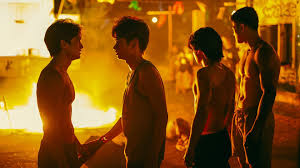
“Semi-Soeter” is a broad, low-hanging fruit “Who has time for a baby?” comedy from South Africa.

It’s a sequel to “Semi-Soet” (Semi Sweet), a 2012 South African hit about an ad agency careerist, Jaci (Anel Alexander) who hires a model to be her fake boyfriend, J.P. (Nico Panagio) to close a deal. The new film brings back our leads, now long-married and committed to remaining baby-free a dozen years later.

But there’s this OTHER deal with a baby product empire. Maybe if they pretend to have a baby? Surely they wouldn’t…

Ah, but that’s the point of bringing back their besties, long-married/lots of kids Karla (Sandra Vaughn, who co-wrote the sequel with Alexander) and Hertjie (Louw Venter). They’ve been breeding like guppies over the past dozen years. Of course they’ve got an infant to lend out. They INSIST.

That’s literally the plot of this bland and predictable farce, with Karla and Hertjie shoving their newborn onto Jaci/J.P. at one of those “weekend retreat at a resort” competitions to “win” the Texas-based yBab Co. account.

Every single thing in that last sentence only happens in film comedies, most often in the least original ones.

J.P. has let out that his “swimmers” have problems, so Jaci can’t get pregnant. But she is, and even though it’s by him, she can’t bring herself to tell him she’s with child. So they’re stuck with her secret and a pooping, borrowed baby who seems to justify J.P.’s aversion to parenthood with every fresh diaperload. Jaci can’t tell him because she thinks he’s baby-phobic. As we see how ineptly Jaci handles the infant herself, we wonder if either of these two — rich as they are — is cut out for parenthood.

J.P.’s old boarding school rival (Neels van Jaarsveld) and his celebrity wife (Diann Lawrenson) are up for the same account. That “baby” seems suspicious to them, so a little sabotage-their-scam is in order.

Pal Hertjie wonders if their old classmate “still has that ‘Punch Me’ face?” Hint. Of course he does.

Baby monitor gags, lost baby jokes, a diaper “tasting” game straight out of baby showers and a whole subplot about a start-up rugby league in Dubai needing advertising/PR help, with a security-conscious sheikh playing into the narrative as another reason “We can’t have a baby” all figure in what’s to come.

If you’ve seen one “what’s the deal with babies” comedy, you’ve heard the “What do they FEED him?” (in Afrikaans, or dubbed into English) joke more than once.

Even dubbed, the dialogue has lots of South African slang for barbecue (braii), lots of talk about the ‘Boks — if you remember the Matt Damon/Morgan Freeman drama “Invictus,” you remember the national rugby team is called The Springboks — and the like.

Our South African-born “Texan” entrepreneur (Hélène Truter) speaks with a South African/Texan drawl. Most peculiar.

The odd Elon Musk reference just underscores the film’s affluent resorts and exclusive housing developments setting, and the fact that Black faces are rarely seen in this (comic, cinematic, not-wholly-post-Apartheid) world.

The tone is light enough, even if we have to wonder why these particular rich Afrikaners haven’t figured out money makes procreating easy.

But what’s most-missed in this corny comedy are jokes. Just a couple of one-liners, a sight gag and a lone bit of physical shtick translate as funny.

The rest is as colorless as its cast.

Rating: TV-PG, pooh-pooh jokes

Cast: Anel Alexander, Nico Paganio, Louw Venter, Sandra Vaughn,
Diaan Lawrenson, Hélène Truter and Neels van Jaarsveld

Credits: Directed by Joshua Rous, scripted by Sandra Vaughn and Anel Alexander. A Netflix release.

Running time: 1:38

Posted in Reviews, previews, profiles and movie news | Comments Off on Netflixable? Careerists find Baby Fever “Semi-Soeter” (Semi-Sweeter) in this South African farce

Classic Film Review: An English Child’s Eye View of WWII — “Hope and Glory

There’s a glorious nostalgia to the great British director John Boorman’s World War II memoir, “Hope and Glory.” The sentiment is what sticks with you, a naive child’s memories of not the fear, violence and loss, but of the freedom, togetherness and adventure of this high-stakes do-or-die fight against fascism.

I remember coming out of the theater positively giddy when this semi-autobiographical epic came out.

But the director of “Deliverance,” “Point Blank” and “Excalibur” only appears to be letting us, himself and his generation off easily. There are hints of the world and culture that gave birth to “Lord of the Flies,” the melodramatic trials of domestic life, the trauma of loss and the shifting mores of a generation shaped by the live-for-the-moment for tonight you may die immediacy of “their finest hour.”

Britain’s 75 year cultural obsession with “The War” is summed up in 113 minutes that only brush on the passing events on the continent. This was how a child too young to be terrified of “carpet bombing” and homemade bomb shelters and shrapnel and fears of a fascist takeover experienced that time.

The director of “The Emerald Forest” ensures that these memories are vivid, backlit and gorgeous — even the fireworks spectacle of a deadly night time air raid. And the filmmaker who gave us “Excalibur” ties his personal story into British myth, the one his generation created, burnished and embraced, if only in whitewashed brush strokes.

“Hope and Glory” — which takes its title from that most Brit-beloved passage of Elgar’s “Pomp & Circumstance” — is about the Rowan family, middle-class row-house Brits who ride out the war at home, and then with relatives.

Dad Clive (David Hayman) is 40something, patriotic and allowing himself the romance of “doing my bit” one more time. He will enlist after the fall of France. Mother Grace (Sarah Miles) isn’t keen about that idea, which Clive plunges into over her objections. He’s leaving her with three kids — including dizzy Dawn (Sammi Davis), reckless, a self-absorbed and boy crazy teen, and a very little girl Sue (Geraldine Muir) — to face the trials of “total war” at home on a soldier’s salary.

We see this fateful decision and the lives it leads to through the eyes of the middle child, little Bill (Sebastian Rice-Edwards), a strong-willed schoolboy who earns constant punishment from his head master, and who is quick to judge his dad’s decision to leave his family and his mother’s inability to prevent it.

There’s just enough movie newsreel introduction and snippets of radio news and speeches (Chamberlain, Churchill) to keep us apprised of this pre-D-Day “end of the beginning” era chronicle. This isn’t a WWII chronology.

“The war” is dramatized in theaters, visible in this distant contrails of dogfights in The Battle of Britain, present in the ever-wailing air raid sirens, hustled into the air raid shelter or below the stairs, the routine of counting the thumb of explosions to gauge one’s odds of the next bomb hitting close to home.

For Bill, it’s the magic of finding shrapnel shards in the family fence, scattered on the street, the bombed-out ruins that a gang of neighborhood pre-tween punks invade to smash anything not already destroyed.

Those kids, led by the mouthy ring-leader Roger (there’s one in every mob) set the tone for how the youngest approach what’s happening around them.

“D’ye know any SWEAR words?” is Roger’s (Nick Taylor) initiation test. “SAY them!”

But gathered in a mob, the children are distanced from the risks, and from empathy at each other’s losses. A child (Sara Langton) loses her home and her mother in a raid. She can’t even weep in her shock, has no way to process what’s happening. The boys all but taunt her, tactless in their curiosity. And the most compassionate words offered come from the littlest, Sue.

“Do you want to play?”

Dawn, running out into the street mid-air raid just to “see” and dance at the colors in the night sky, finding her first love in a GI (Jean-Marc Barr) when the Yanks join the conflict, seems as disconnected from the horrors as the younger kids.

“Nothing will ever be the same again,” she declares, because this is the most liberating thing she’s ever experienced.

Marriages will be tested and fail, prudish sexual mores are gone with the wind and the kids see all this and are shaped by it every day the conflict goes on.

And then the Rowans lose their house.

They’ll move in with irrascible Grandpa George (Ian Bannen), given to drunken toasts “to all the girls I’ve loved before” every Christmas, right in front of his wife (Annie Leon) and the daughters he named Grace, Faith, Hope and Charity. They’ll live in the suburbs, on the river. And it’s there that the tale’s tone turns even lighter.

“You want to know why they’re called Faith, Hope, Grace and Charity?”

“Why?”

“Your GRANDMOTHER! She named them after the virtues I lack. That’s marriage for you!”

Bannen kind of takes over the picture, as a summer idyll of cricket, punting and fishing on the river lets the war become even more distant in the children’s eyes, with a few comical exceptions.

Boorman’s tone here is sweet and safe, with Britain well into its “How I Won the War” sentimentalizing and sending up of the conflict. “Nothing” ever was “the same” after that, and while the filmmaker couldn’t have known how the country would change as that generation died out, that message he certainly got right.

His family film about his family included performances by daughter Katrine Boorman (as Charity, one of Grace’s sisters) and son Charley Boorman, who adds a dash of elan to a silent, lights-up-a-smoke, downed German fighter pilot who winds up in neighbor’s garden.

“Mind those Brussels sprouts, you!”

Katrine would go on to produce “Marie Antoinette.” Charley would turn his love of motorcycles and friendship with Ewan McGregor into a series of terrific long-distance travelogues.

Writer-director John was in his 50s when he made “Hope and Glory,” which was nominated for five Oscars. He’d do the Brendan Gleeson tour de force “The General” and a delightful take on Le Carre’s “The Tailor of Panama” with Geoffrey Rush before announcing his retirement (to me) when the equally autobiographical “Queen and Country” came out ten years ago.

For a filmmaker saddled with a few flops (“Zardoz,””Exorcist II: The Heretic”) he somehow managed to get three or four true “passion projects” on the screen, and rewarded his backers and film fans with the results, undeniable “classics” no matter how they were received (“Excalibur”) on release.

“Hope and Glory” beautifully and nostalgically lays out what formed this child of World War II, the generational experiences and the point of view that shaped his storytelling and informed his cinema for all the decades that followed.

Rating: PG-13, sexual situations, profanity, war’s violence and loss

Cast: Sarah Miles, David Hayman, Sebastian Rice-Edwards, Sammi Davis, Geraldine Muir, Derrick O’Connor, Jean-Marc Barr, Annie Leon and Ian Bannen, narrated by John Boorman.

Credits: Scripted and directed by John Boorman. A Columbia Pictures release streaming on Tubi, Amazon, et al

Running time: 1:53

Posted in Reviews, previews, profiles and movie news | Tagged , , , , , | Comments Off on Classic Film Review: An English Child’s Eye View of WWII — “Hope and Glory

Movie Review: Stormare wants Kinnear to find Duhamel, who’s gone “Off the Grid”

Career bit player Ricky Russert, who was in “I, Tonya” and TV’s “Outer Banks” and even the recent “MacGuyer” reboot , gets a featured role as a villain in “Off the Grid,” a Josh Duhamel star-vehicle about a scientist who MacGuyvers his way out of many a jam with the ruthless goons who want what’s in his head.

Russert isn’t the only villain. In the chain of command, he’s the guy below scientist/project director Greg Kinnear and that scientist answers to murderously impatient oligarch in charge Peter Stormare. But Russert’s Marcus is the trigger man, the “heavy,” the guy with the most black t-shirts, jackets and slimfit jeans.

And to complete the character’s look, Russert made a choice. He went full Jack White — pale, with slippery black hair, everything but the famous hat and more recent rock star dye jobs. I kept expecting him to break into “a seven nation army couldn’t hold me back.”

The movie’s generic in the extreme, a bore that sent a mostly-American cast off to Italy where the production does its best to pass for the American Southeast, some easy drive or other from Memphis (Louisiana). But if the players got a paid Italian vacation out of it, the viewer’s allowed to hope for off-the-wall turns, or jokes. Because seriously, this isn’t serious.

There’s a revolutionary energy device that Belcor is close to getting. Or was until Guy Who Knows Stuff (Duhamel) fled rather than let his work be weaponized. Kinnear plays Ranish, the former mentor all-in with Belcor, the company and the fellow who owns it (Stormare).

Mr. “Off the Grid” lives in an aged Quonset hut, mindful of not exposing himself to electronic tracking, careful to park his motorcycle in the woods outside of town when he goes in for “supplies,” a bearded, backpacked Man with No Name.

But his old mentor knows the “Red Bull/dirt bike prepper” well. That’s how Marcus (Russert) is put on the scent.

“YOU’LL find him?” Ranish chuckles. “Not if he finds you first!”

Did anybody explain that this off-the-grid guy has “special skills,” military training or whatnot? If so, I missed it. Because aside from the punji sticks and other boobytraps (yawn) he’s set for any intruders on his turf, he’s tough enough to bust heads if need be.

Our hero is careful enough not to get close to anybody in this sleepy little not-supposed-to-be-Italian town. The college bound tech teen (Michael Zapesotsky) doesn’t need to know his name, just that he can double-check his computer codes, etc. The friendly barmaid/bar-owner Josie (María Elisa Camargo)? Kept at arm’s length.

And yet, he’s still discovered. And damned quickly, it turns out.

Russert gives minion-murdering Marcus a “stands out in a crowd” personality — dolled up in black, not paying for things at the shop, threatening locals, lying to law enforcement and shooting members of the “B-Team” and “C-Team” that’s sent to help him if and when they displease him.

The character should have had a mustache. To twirl. Because Russert serves up a villainous maniacal cackle or two.

The chases — on bike or on foot — are blasé, the action beats largely dependent on “traps” we see our Guy (IMDb says that’s Duhamel’s character’s name) prep and set. The few creative ones are lost in a collection of off-the-shelf remote-controlled-explosive-devices that you see in every B-movie thriller — a light on the designer bomb, flashing lights on the hand-held control that arms it and sets it off.

The script is a cut-and-paste job — lazy plotting, dull dialogue, no twists at all.

Duhamel has character traits to play — not many, though. There’s plenty of screen time for his go-to move, running his hand through his hair. A lot.

But hell, if a Jack White look-alike is playing your pursuer, what’s HE supposed to do when his dye-job gets in his eyes? A lot?

Rating: R, violence and lots of it, profanity

Cast: Josh Duhamel, Greg Kinnear, María Elisa Camargo, Ricky Russert, Michael Zapesotsky and Peter Stormare.

Credits: Directed by Johnny Martin, scripted by Jim Agnew. A Lionsgate release.

Running time: 1:46

Posted in Reviews, previews, profiles and movie news | Tagged , , , , , | Comments Off on Movie Review: Stormare wants Kinnear to find Duhamel, who’s gone “Off the Grid”

Movie Review: You’ll feel “Sweet Relief” when this inept indie thriller is over

It’s a little known truth of indie film sets that the “indier” the film, the less likely you’ll be able to tell the cast from the crew when visiting the shoot.

I came to this conclusion covering such low budget, tiny budget and micro-budget productions in multiple states over the years. And I was reminded of it just a few minutes into “Sweet Relief,” a stumbling, amateurish thriller filmed with Amherst, Massachusetts subbing for overgrown, backward BFE Rural America.

No, I didn’t have to read the movie’s Internet Movie Database page to realize whoever shot it (Students? Friends?) spent all of six days filming it.

The casts and crews of such films are inevitably young, bright-eyed and bushy-tailed. The actors wear their own clothes, own tattoos and own piercings, and so does the crew, more than a few of whom figure they’re perky and good looking enough to act in movies themselves, and are often right.

But when you see a 20something with lots of ink, a mismatched tank top and cut off jeans and a hat from the horror anthology “VHS” as a character in “Sweet Relief,” you wonder if Adam Michael Kozak was doubling as a grip, setting up lights or reflectors between takes.

There are a couple of decent moments in the third act of this horror thriller, but that’s far too late to do much more than spare it the dreaded “zero stars out of four” rating. The pacing, shot selection, dialogue and plot are clumsy, under-workshopped and nearly unfilmmable. The acting isn’t uniformly bad, but by and large it’s awful enough to wonder if the crew wasn’t shoved in front of the camera because somebody better didn’t show up over those six days.

The score is tonally inappropriate Muzak, so “off” as to make you wonder if they thought any of this was funny.

In an unnamed town where no lawn is mowed, no playground is kept up and no street has a sidewalk, but everybody has Eco Warrior rainwater capturing rain barrels made from recycled plastic (Amherst, LOL) the kids are sharing this social media murder game “Sweet Relief.”

They make a challenge to each other, pointing out someone they’d like to kill or see dead, via cell phone video. The catch is, if they don’t go through with all the promised murders, the Sweet Angel — a dude in a rat or short-eared-bunny mask — will come and do them and all their family in.

Hannah, Lily and Corey (Lucie Rosenfeld, Jocelyn Lopez and Catie Dupont) make such a pact. An “annoying” baby sitter, a boy who jilted one of them and the “c–t mother” of the other seem to be the targets of their pact.

We see that first pointless, pitiless butchery and eventually another killing. But the narrative shifts to Hannah’s frustrated brother (Kozak), his live-in nurse girlfriend (Alisa Leigh), his “crazy” conspiracy theory fan mother (Jane Karakula) and this dopey, Halloween Store-costumed “cop” (B.R. Yeager) and a teen (Gianni Passiglia) he’s trying to impress take over the middle acts.

The cop’s a slob in a corrupt police department, up to no good and always trying to impress his brother officers and Kyle the kid he’s trying to make an informant.

“You shoulda SEEN me in Florida!” should’ve been enough to keep Gerald from getting a job at any other PD in the country. But that’s where law enforcement stands these days.

Social media “murder games” are discussed, murders are carried out, bodies are disposed of, a walk in the woods is interrupted by a swim in the lake (naturally, a woman does this), a witness idiotically confronts a perp and that damned bunny mask wearer is outed. And none of it amounts to anything worth 85 minutes of your time.

With Gerald as an exemplar, it’s no wonder no cop has found a body or sounded the alarm about all this. With soulless kids like this, it’s no wonder a high school science teacher (Paul Lazar) is the biggest conspiracy nut of all. He’s got his reasons.

Writer-director Nick Verdi isn’t quite as green as his surname. Close. He got something titled “Cockazoid” in the can, if not into theaters.

But with a cast like this, who needs a crew? I’ll bet Mr. “VHS” hat has a light meter in his cut-off shorts. If not him, then surely the teen killer girl in shortalls does.

Rating: Unrated, graphic violence, profanity, alcohol abuse, drug content

Cast: Alisa Leigh, B.R. Yeager, Joceyln Lopez, Lucie Rosenfeld, Adam Michael Kozak, Catie Dupont, Gianni Passiglia, Jane Karakula and Paul Lazar.

Credits: Scripted and directed by Nick Verdi. An Art Brut release.

Running time: 1:26

Posted in Reviews, previews, profiles and movie news | Tagged , , , , , , , , | Comments Off on Movie Review: You’ll feel “Sweet Relief” when this inept indie thriller is over

Classic Film Review: Pinter, Losey and Bogarde wind up the Clockwork Creepiness of “The Servant”(1963)

It’s been so long since I reviewed anything scripted by Nobel laureate Harold Pinter that I had to refresh my memory about the traits associated with the phrase “Pinteresque.”

Let’s see, an “atmosphere of menace,” suspense and tension heightened by the quiet of it all, underscored by pauses in the dialogue — long pauses — class conscious shifts in “control” and power and who has it.

That’s “The Servant” in a nutshell, a Pinter screen adaptation (for director Joseph Losey) of a novella written by W. Somerset Maugham’s nephew.

This 1963 black and white jewel is filled with exquisitely composed and lit images by legenadary cinematographer Douglas Slocumbe (“Hue and Cry,” “The Man in the White Suit,” “The Lavender Hill Mob,” “Raiders of the Lost Ark”). It’s beautifully acted thanks to actor’s director/Pinter-collaborator Losey (“The Go-Between”), with career-making performances by newcomers Sarah Miles and James Fox.

And it’s a movie that makes great use of the sinister side of co-star Dirk Bogarde, who truly shone in ambiguous “sketchy” roles in films like “Cast a Dark Shadow,” this film and others.

There’s something in the eyes that makes us wonder about this manservant Barrett (Bogarde) who’s shown up for a job at an empty, messy townhouse that trust fund baby Tony (Fox) has just bought. The tall, thin and privileged blond is a globe-trotting project developer, just in from Africa, experienced in India and talking big things about planned cities in Brazil.

Surely you can clean. But “can you cook?” And can you manage moving in and the “general looking after” that a gentleman requires from a “gentleman’s gentleman?”

Indeed he can. Barrett supervises the repainting and repairs and decorating as Tony moves in. But he’s barely settled before Barrett starts to rub Tony’s intended, Susan (Wendy Craig of TV’s “Butterflies”) the wrong way.

“Every time you open the door that man is there,” she gripes. She’s gotten the informal proposal and it’s just possible that she might see Barrett as an obstacle to her closing the deal. And he’s become good at anticipating the “general looking after” of his employer that she may seem supfluous.

Barrett? He keeps his cards close to his vest, but Bogarde lets us see the wheels turning behind those scheming eyes. When his suggestions that they need a housekeeper end in “my sister” coming in, the game’s afoot.

Miles plays Vera with all the naked guile she could manage at 22 — a young woman not really accustomed to “service,” but working those big, carefully made-up eyes for all that they’re worth. If Tony hasn’t noticed the length of her skirts, Barrett suggests “They worry me.”

If this is a honey trap, it’s well and surely set. But as Tony’s “Brazil” talk sounds and looks more and more like “big talk” and affairs under this stylish roof turn altogether more torrid and complicated, we’re allowed to wonder who is trapping whom?

Whatever the merits of the source material, Pinter and Losey look for ambiguities, intrigues and twists that suggest the story has reached its climax, when no, it hasn’t. Or maybe it has, and this is just one of the cinema’s great anti-climaxes following other anti-climaxes melodramas.

It’s worth recalling that Losey and Pinter pretty much invented the “flash forward” in cinema with their later collaboration, “The Go-Between.” Messing with narrative conventions was something the blacklisted stage and film director and playwright and sometime director or actor (look for Pinter as the dark-suited swell in the film’s famously brittle restaurant scene) brought out in each other.

Fox, the younger and much taller brother of accomplished character actor Edward Fox, holds his own here as an unchallenged young man completely in over his head, “besotted” with Vera but promised to the class-appropriate Susan and drinking entirely too much to keep it together.

Miles takes a giggling archetype and gives her “tart” enough edge to make us wonder just what she’s capable of beyond what we see her doing.

But Bogarde puts on his show-of-shows as Barrett, wearing the mask of crisp fealty as “The Servant,” letting that mask slip and then some in the later acts as the nature of relationships changes and the power dynamic shifts.

“The Servant” is rightly celebrated as a pungent Pinter piece and a performance showcase. But what pushes it over the top as a “classic” has to be its look. This is the dingy beginnings of “Swinging London,” jazz/dance clubs and folk/blues pubs, too much drinking and class distinctions that lingered even as they briefly stopped widening back to “Downton” era schisms. And capturing that, Slocumbe treats us to one stunningly lit and composed shot after another.

Take note of how the initial “scheme” is exposed — just Bogarde, naked in the shadows, smoking a cigarette and trying to figure out if his “gentleman” has returned and heard the romping he and Vera are carrying on upstairs, with Tony and Susan framed from downstairs, cowering in shocked silence.

It’s an image worth freeze-framing and hanging on a wall, and in this classic Pinter-adapted drama, it’s far from the only one.

Rating: unrated, implied sex. alcohol abuse, smoking

Cast: Dirk Bogarde, James Fox, Sarah Miles and Wendy Craig, with Patrick Magee and Richard Vernon.

Credits: Directed by Joseph Losey, scripted by Harold Pinter, based on a novel by Robin Maugham. A Warners/Pathe release on Tubi, other streamers

Running time: 1:56

Posted in Reviews, previews, profiles and movie news | Tagged , , , , , , , , | Comments Off on Classic Film Review: Pinter, Losey and Bogarde wind up the Clockwork Creepiness of “The Servant”(1963)

Netflixable? A Brazilian pop-star biopic — “Latin Blood: The Ballad of Ney Matogrosso”

From the moment little Ney de Souza Pereira spied cabaret and carnival icon Elvira Pagã on the stage, the die was cast and his young life had purpose.

All those beatings he stubbornly endured from his military officer dad because “I’m not raising my son to become an ARTIST,” all that drawing he was doing even at an early age meant something. And when he was finally big enough to ward off his father’s blows and escape his threats, he knew what promise he had to make. He would never be invisible again.

“I’ll make sure Brazil knows about me!”

“Latin Blood: The Ballad of Ney Matogrosso” (titled “Homem com H” in Portuguese) is a straightforward pop star biopic, a film that covers many of the same bases as “What’s Love Got to Do With It,” “Bohemian Rhapsody” and “Get On Up” as it chronicles the life and struggles of a ground-breaking, barrier-shattering Brazilian showman, singing idol and queer icon.

Writer-director Esmir Filho and star Jesuíta Barbosa (“Unremember”) take us through this life, the many baby steps — first crush in his Air Force years, dabbling in costume design and acting before his high contratenor voice got noticed — and into outrageous but balladic glam pop fame and superstardom.

All this happens under the shadow of the long, repressive, censorious military dictatorship that ruled Brazil just as Ney was coming out and seizing the spotlight. A repeated image of the film is of Ney as a boy and then a young man, wandering the rainforest, not so much lost but finding his way and taking in all the wonders around him as he does.

Born in the 1940s, finding his voice in the ’60s and becoming an androgynous glam sensation in the ’70s, non-Brazilian viewers will find a lot of analogies to other careers in this singular star’s life story.

The tropes of the genre — the voice “discovered” while singing in a choir in Brasilia, that first band, a ballad-playing acoustic pop trio that converted known poetry into songs to evade censorship, inept managers and cheating ones, “going solo” and grabbing attention with every performance thanks to his (limited) attire, over-the-top Noh Theatre-Goes Native makeup and writhing stage presence, often in contrast to the lilting tunes he was performing.

Barbosa is riveting in the title role, making our anti-hero tentative but defiant, principled but flawed, passionate and impulsive. We see promiscuity in all its many forms as Matogrosso didn’t just “experiment,” he loved and coupled and throupled according to his shifting tastes and moods.

Bela Leindecker plays a friend, sounding board and lifelong confidante and sometimes lover. Augusto Trainotti is Cato, that first same-sex love, comrade in arms and air force base bunkmate in scenes whose physical chemistry simmers through the caution that their situation demanded. We meet hook-ups, feckless rich toy boys and “the one,” who shows up the moment AIDS hits Brazil.

Through all this, the one evolving constant is Ney’s relationship with his stern, cruel but steadily-softening father (Rômulo Braga, terrific), a man who beat his little boy but who kept checking on him, begging him to “come home” and eventually showing up at Ney Matogrosso’s ever-more-transgressive performances.

The lithe and body-positive Barbosa gives off a strong Rami Malek vibe, and that plays beautifully off Liev Schreiber/Eugene Levy look-alike Braga’s stony sternness.

Matogrosso, who took his father’s middle name as his stage name, was a little bit Jim Morrison, a hint of Freddie Mercury and a lot of Iggy Pop and David Bowie, all rolled up in one performer with the vocal range of a Baroque castrato, dolled-up like the fifth member of KISS.

Yeah, it’s a lot to process and the film meanders and dawdles as it passes through its many cliches. But in any language, in any culture, it’s fun to track a performer’s career from folk through glam to disco to pop and stadium-filling rocker. Here, that performer sounds like no one you’ve ever heard.

If there’s a failing in Netflix’s presentation of the film (in Portuguese, with subtitles, or dubbed) it’s that the songs themselves are NOT translated from Portuguese. As the film is heavily reliant on performance scenes, we miss what made the tunes connect with and reflect the culture Matogrosso has performed in — tunes that could be rebellious, sexual, romantic, patriotic and counter-culture controversial.

There’s a touch of Spanish filmmaker Pedro Almodovar’s story that parallels this uncommon life — a confused boy, closeted, treasured by his mother (Sabina Zúñiga Varela), bristling at the constraints of a fascist-ruled ultraconservative culture.

But unlike Almodovar, Matogrosso defiantly stood up, blew up and came out before the dictatorship ended. If he didn’t have a role in that military-rule downfall, his years of growing stardom were one long raspberry spat in the face of Brazil’s “establishment.” A triumphant “What’s Love Got to Do With It?” finale makes sure to give Ney Matogrosso the last word in that debate.

Rating: TV-MA, some violence, drug abuse, sex, nudity and profanity

Cast: Jesuíta Barbosa, Rômulo Braga, Bela Leindecker, Jeff Lryio, Mauro Soares, Augusto Trainotti and Sabina Zúñiga Varela

Credits: Scripted and directed by Esmir Filho. A Netflix release.

Running time: 2:09

Posted in Reviews, previews, profiles and movie news | Tagged , , , , , , | Comments Off on Netflixable? A Brazilian pop-star biopic — “Latin Blood: The Ballad of Ney Matogrosso”

Movie Review: “The Life of Chuck” Dances for the Reason to Live at the End of the World

Speaking as a critic who’s been “blurbed” a few times over the decades, you’ve got to recognize the double-edged sword such “recognition” in the advertising on a poster for a movie is. That’s you, out there, effusive in your praise, struggling to come up with a coherent, grammatical endorsement of a movie you loved.

And if, as some of the breathless shills for “The Life of Chuck” are insisting, it’s a “life altering experience,” “profoundly magical” and an “It’s a Wonderful Life’ for today,” they’re on safe ground.

But if it isn’t — and it most decidedly is not — at least they have the comfort of knowing that nobody will fling their words back at them from a DVD box or a collectible poster, as in days of yore. Because nobody’s collecting the poster for this, and I dare say few will be buying it on Bluray for their collection.

It’s a cloying, feel-good end-of-the-world story that reaches for emotions in a few stand-out moments, and grasps for many others that just aren’t there. Based on a late-life Stephen King novella, it leans on dance scenes, the words of Walt Whitman and Carl Sagan and Gimme Some Lovin'” by the Spencer Davis Group (“Little” Stevie Winwood on vocals and organ) to give you the “feels.”

Sometimes that works, and often it annoys, a 101 minute annoyance about facing death and the end of times dryly narrated to DEATH by Nick Offerman.

But if Stephen King was feeling nostalgic, wistful and philosphical about “the end,” having survived into old age, a near fatal running-over by a van, decades of coming in and out of favor and the task of passing his horror baton to his son Joe Hill, we owe him this indulgence. Director and screenwriter Mike Flanagan (“Doctor Sleep,” the recent “House of Usher,” “Hill House” and “Bly House” horror series) we owe a lot less.

A cascading torrent of calamities have befallen the Earth — sinkholes and tsunamis, California is sliding off into the sea, vast chunks of it at a time and it’s the End of the Internet as We Know It. There’s nothing for it but to stare into the night sky and watch planets and stars wink-out of existence and resign ourselves to a favorite Carl Sagan quote about the fleeting nature of time, “the great clock of the universe,” and our tiny lives within it.

Sagan’s “We are like mayflies, fleeting ephemeral creatures who live out their lives in the course of a single day,” isn’t quoted in the movie. But it informs every downbeat moment of it.

Chiwetel Ejiofor plays a midwestern teacher trying to keeps his students — and their parents at parent-teacher conferences — focused on their studies with the world ending around them and life serving up day after day of bad news, work-arounds and drive-arounds as society, civilization and life breaks down. Suicides are rampant, something the teacher’s ex-wife/nurse (Karen Gillan) is struggling with.

But this former couple has a bigger concern. “The end…Who do you want to be with for it?”

All around them, on billboards, on radio, the Internet and TV before all that vanishes, are ads congratulating “Chuck Krantz” for “39 Great Years.” It’s become a joke, and in this movie, that joke is a “cosmic” one.

Chuck (Tom Hiddleston) lived his life of comfy “quiet desperation” as an accountant. But in the movie’s signature knock-out moment, this accountant at a conference stops on hearing the busking of street drummer Taylor Gordon, and breaks into dance. As a crowd gathers, a just-jilted-bookstore clerk (Annalise Basso) is coaxed into the city square to dance with him.

“The Life of Chuck” will tell Chuck’s story in reverse order from that moment, how he (Benjamin Pajak, Cody Flanagan and Jacob Tremblay play younger Chucks) lost his parents as a child, was raised by his grandparents (Mark Hamill and “Ferris Bueller” alumna Mia Sara), how he discovered the childhood joy of dancing with his granny, rediscovering that in school and then casting aside that love to be practical and take up accounting like his grandfather.

Chuck’s “congratulations” messaging takes a supernatural turn as the movie progresses and we see him on his deathbed, presumably before The World Ends, comforted by his wife (“New World” Pocahontas Q’orianka Kilcher), perhaps reconciled to the Big Message of this over-narrated wade into what “28 Years Later” reminded us about life and why we should live it while we have the chance — “Memento mori.”

Through it all, a story told in reverse order (more or less), our endlessly opining voice-over narrator redundantly reminds us of the Great Imponderables of The End, as many a character must “wonder why God made the world.”

This feel good “worlds’ end” dramedy isn’t as uplifting as “Seeking a Friend for the End of the World,” isn’t as sad and fatalistic as “On the Beach.” King and Flanagan lack the writerly/cinematic existential heft to truly ponder “the end” from an old man’s perspective the way Orson Welles did throughout his career, from “Citizen Kane” and “Magnificent Ambersons” to “Chimes at Midnight” and “The Other Side of the Wind.”

So their point, such as it is, amounts to little or nothing.

Offerman’s reading of Flanagan and King’s narration never goes deeper than glum and never rises above glib. The performances are competent and some players have “moments,” but by and large they don’t register in much more than an archetypal sense.

“The Life of Chuck” has a resignation and a timeliness to it that render any “escape” it might offer moot. Every viewer brings his or her own baggage into the cinema, but whatever might have touched many seems buried under disorganized treacle.

It’s no wonder that apocalypse movies are all the rage this year. Missiles flying in the Middle East, distracting from an ongoing genocide, a snake oil salesman in charge of American health care and a soulless con man with his finger on the button that could generate End Times, forever boasting of his cunning plan to end Federal disaster relief, it’s all a little too grim to get away from by slipping into a cinema for a generally dull downer of a movie.

“Profoundly magical?” All this facile, faux fatalistic film lacks is a Bobby McFerrin sing-along over the closing credits. Then again, they’d probably have Offerman narrate that, too.

Rating: R, profanity

Cast: Tom Hiddleston, Jacob Tremblay, Annalise Basso, Q’orianka Kilcher, Chiwetel Ejiofor, Karen Gillan, Carl Lumbly, Mia Sara and Mark Hamill, narrated by Nick Offerman.

Credits: Scripted and directed by Mike Flanagan, based on the novella by Stephen King. A Neon release.

Running time: 1:51

Posted in Reviews, previews, profiles and movie news | Tagged , , , , , | Comments Off on Movie Review: “The Life of Chuck” Dances for the Reason to Live at the End of the World

Movie Review: A Tour of Jolly Olde Zombieland “28 Years Later”

It begins with children watching the “Teletubbies” on the tube, reaching for a more innocent time.

But the TV is just a distraction. Parents have parked their kids in front of it while they cope with the awful news they’ve heard of outside of that room, which they lock when the inevitable happens. And when a child opens that door, there’s another inevitability — wanton, pitiless and horrific slaughter of the innocents.

Danny Boyle’s return to his “rage virus” zombie universe comes 18 years after “28 Weeks Later,” years further removed from “28 Days Later.” And “28 Years Later” faces the grim cinematic landscape of zombies over-exposed, an Oscar-winning director forced to try and top “Zombieland” and “Train to Busan” and whole TV series devoted to life in a crumbling civilization where zombies are an ongoing threat.

Aside from far more graphic gore, Boyle doesn’t top himself or the best of the zombie offerings from Korea and elsewhere in intensity and terror. So the Oscar-winning director, working from a script by “Civil War” writer-director Alex Garland, struggles to give relevence and intellectual/allegorical heft to a story about “the other” and a humanity deadened to the reality of an enemy that must be killed on sight ad infinitum.

But all the sizzling in-your-face editing, the black and white montages of 2archival conflict footage, the aural montages of the decades that have passed since “28 Days Later” put Boyle over the top and Cillian Murphy on the map (crackling dial-up internet, etc.) fail at topping the heart-stopping suspense and terror of Boyle’s earlier zombie films, or their Korean offspring.

It’s the suggestions of humanity’s rising inhumanity, the allusions to Joseph Conrad’s “Heart of Darkness” with a Kurtz who has reconciled and resigned himself to the horrors around him that make this picture worth chewing over.

I can’t be the only one who wishes “Slumdog/127 Hours” Boyle had found fresh filmic subject matter and that he had the blank check to film it that a zombie sequel offered. But “Yesterday” punctured that balloon.

All these “Years Later” a survivor from that “Teletubbies” massacre has grown up to be a bearded, longbow-armed warrior (Aaron Taylor-Johnson) with a son of his own. And Jimmy thinks twelve-year-old Spike (Alfie Williams) is ready to leave the island refuge where British civilization clings to life, to go on a foraging expedition and collect his “first kill.”

The signs of a “keep calm and mind the ‘limited resources'” society are all over “Holy Island” (Holy Island of Lindisfarne, Berwick-upon-Tweed, Northumberland, England, UK). They’ve survived the end of Britain, “quarantined” from the rest of Europe, which escaped the worst of the “rage virus.”

As the Elders of Holy Island offer little resistance to the idea of a boy going with his father to kill
“the infected” while scrounging for anything useful on the mainland, and Spike’s mother (Jodie Comer) is having mental episodes and incapable of pushback, off they go.

“He’s got no mind, he’s got no soul,” Jimmy coaches his kid on facing assorted zombie “types.” “The more you kill, the easier it gets.”

The wonders of the vast, nearly empty “mainland” get lost in that lesson. But seeing distant smoke and hearing that a far-off “doctor” is responsible for it puts Spike in mind of “saving” his mother by getting her treatment. Seeing his insensate lout of a father cheating on her after a night of drunken revels in the Holy Island pub when they return seals that pact. He will steal away and take her to mysterious and “mad” Dr. Kelson (Ralph Fiennes).

They will encounter Swedish commandos patrolling Quarantined Britain, and one (Edvin Ryding). And they will find that doctor and his “Memento Mori” bone-statue monument to the dead, all of whom — “infected” and uninfected, were human at one point and mortal in the end.

Little about this is original enough to the zombie genre to note — zombies “evolving” into different strata of threat (Dwayne Johnson/Jason Mamoa-sized “Alphas” being the worst), odd flashes of humanity (childbirth) in them.

And Garland and Boyle, for all their allegories about the dehumanizing nature of conflict — the ingenius use of a 1915 recording of Rudyard Kipling’s poem “Boots” as a soundtrack cue — stumble to keep track of “rules” for their zombielandand, throwing logic to the wind as often as not. They deliver an ending that’s the equivalent of both of them throwing their hands up.

So “28 Years” isn’t as good as “28 Days” or even “28 Weeks” or “Train to Busan.”

But they Boyle and Garland have made a go at making a zombie movie for the moment, a post-Brexit, Israeli genocide, Middle East war, insensate MAGA ICE-goons thriller that makes you think even if all the technique, editing and new levels of violence can’t hide the fact that the filmmakers haven’t quite made up their minds about what they’re trying to say.

Rating: R graphic, gruesome and bloody violence, nudity, profanity, an explicit scene of childbirth

Cast: Jodie Comer, Aaron Taylor-Johnson, Alfie Williams, Edvin Ryding and Ralph Fiennes

Credits: Directed by Danny Boyle, scripted by Alex Garland. A Sony/Columbia release.

Running time: 1:55

Posted in Reviews, previews, profiles and movie news | Tagged , , , , | Comments Off on Movie Review: A Tour of Jolly Olde Zombieland “28 Years Later”

Movie Review: All that stands Between a Black family and Starvation (and being Eaten)? “40 Acres”

Our apocalyptic times are summoning cinema that reflects a survivalist bent, be it faith-based preppers ready for societal collapse (“Homestead”), America’s open political wounds resulting in “Civil War” or the umpteenth iteration of End Times brought on by zombies (“28 Years Later”).

“40 Acres” is a tense, violent and generally satisfying survivalist thriller that ties into history, historical “erasure” and a plausible “how it all breaks down” cause — a fungal plague that triggered wars and the ugly Darwinism thfor the humans who lived through it.

With arable land scarce, livestock wiped out and the supply chain and food chain and social order all but wiped out, Black descendents of slaves who escaped to Canada find themselves battling to protect their farm and prevent the ultimate “erasure.” Because the roaming gangs of white thugs who attack their “perimeter” are meat eaters.

Danielle Deadwyer of “Till” and “The Harder They Fall” is the matriarch of the Freemans, a woman who mustered out of the military and raised her blended family under no-nonsense military order.

She’s taught them to farm with a tractor and hand-planting seeds, drilled them in martial arts and firearms and home-schooled 20ish Manny (Kataem O’Connor), her teen Danis (Jaeda LeBlanc), her stepdaughter teen Raine (Leenah Robinson) and her youngest Cookie (Haile Amare) with an emphasis on practicalities, and a working knowledge of “The Proletarian’s Pocketbook” when they’re old enough.

Her First Nations husband (Michael Greyeyes) still goes by “Sarge,” so he’s a former comrade in arms and is totally down with the military discipline thing.

Their 40 acres is fenced in with CCTV and other security measures (that took some doing), powered by solar panels and dedicated to growing vegetables and grains, maybe a little weed to swap for a neighbor’s moonshine. Their farm house isn’t in great repair, as it’s been 30 years since society started its steep downturn. But they’ve got a bunker and an arsenal in the basement. They’re going to need both.

Because just as “flesh eaters” move into the area and farms start “going dark” on the shortwave radio, Manny spies a lovely woman (Milcania Diaz-Rojas) taking a dip in his favorite river. Mom’s whole “We don’t need nothing or nobody” ethos, and the “don’t trust ANYONE” edict for these dangerous times are both about to go out the window.

Director and co-writer R.T. Thorne might make the “land is the most valuable commodity” pitch in an opening title telling us of the woes of the world. But he figured out early on that nothing raises the stakes in a post-apocalyptic like roaming armed gangs of cannibals. They don’t want “land.” They have no interest in tilling it. They want the folks doing the farming as a main course.

The picture spares few details in the grisly business of shooting, slicing and butchering people, and treats us to some M*A*S*H unit-styled field surgery/first aid as well. It’s pretty bloody. Not “28 Years Later” bloody, but bloody close.

Deadwyler makes a fine, wry and tough-talking Mama Bear in this narrative, credible as an action heroine, but also diminutive enough for us to figure “Somebody or somebodies twice her size are going to get the best of her” at some point.

The unnamed head villain (Patrick Garrow) is made up to be a Brad Dourif look-alike and otherwise woefully underdeveloped. And the picture is predictable to a fault, but with good performances and furious firefights in between a lot of sneaking around in the dark (doing it with flashlights and carlights on that any enemy could track) and third act dash of sentiment amidst the gore, it comes off.

And unlike Danny Boyle’s “28 Years” conclusion to his undead trilogy, it never pretends to be more than a genre picture and thus never goes quite off the rails the way the zombies-in-Scotland finale does.

Rating: R, graphic, gruesome violence, pot use, profanity

Cast: Danielle Deadwyer, Kataem O’Connor, Michael Greyeyes, Milcania Diaz-Rojas, Haile Amare, Jaeda LeBlanc, Patrick Garrow and Leenah Robinson

Credits: Directed by R.T. Thorne, scripted by Glenn Taylor and R.T. Thorne. A Magnolia release.

Running time: 1:53

Posted in Reviews, previews, profiles and movie news | Tagged , , , , , | Comments Off on Movie Review: All that stands Between a Black family and Starvation (and being Eaten)? “40 Acres”

Movie Review: An Indian Woman stands up to a “Pinch,” and Faces the Consequences

Uttera Singh’s “Pinch” is a picture that runs on outrage. It shows us a sex crime and demonstrates how hard it is to get anyone — including women, her own mother and even herself — to take it seriously in a country where “women’s security” has been slow in coming.

A young Indian woman is “felt up” on a crowded overnight bus ride by an older “uncle” she knows. “Did you like that?” he leers, safe and comfortable in his entitlement and his reputation within the patriarchy.

She is shocked and shamed by this, and can’t bring herself to tell her mother. The “uncle” is emboldened enough to stalk her into the mobs at a Hindu festival that bus took them to. But as they’re all jammed up together, she sees her chance. She pinches the wife of a short-tempered wrestler, points her finger at the “uncle,” and Mr. Molester gets beaten to a pulp.

Fair enough. But outrage erupts in her small circle as the cops wonder what she’s not telling them, the man’s wife accuses her, her mother’s business is ruined, they’re threatened with eviction. Guilt eats at her over the rippling effects of her one moment of fighting back against a patriarchal culture where “women’s security” has been dismissed in the past, and cracking down hasn’t solved the problem.

Singh, who co-wrote, directed and stars as the victim, Maitri, frustrates the viewer with the injustice of it all, how this “uncle” Rajesh (Nitesh Pandey) seems immune to consequences for his actions as Maitri is shunned, badgered and even sent his hospital bill as he and his self-righteous wife (Sapna Sand) demand an apology and Maitri’s own mother (Geeta Agrawal Sharma) is inclined to provide one.

Maitri, an aspiring travel vlogger whose “feminist” mind was broadened during college in America, seethes with fury at all this, as will most Western viewers of the film. But “Pinch” is being received as a just deserts comedy in India, especially by women reviewing it. And you certainly see their point.

When Maitri is questioned about her “relative” Rajesh, she’s quick to correct that with a “No…he’s more of a ‘super friendly’ ‘uncle.’

A neighborhood in the small Indian city where Maitri lives is called “New York City,” and all around her are chattering mothers obsessed with bowel movements — “Happy tummy, happy life!” (in Hindi with English subtitles).

Other light touches include Maitri’s friend and much-more-successful online influencer Samir (Badri Chavan), host of “Samir Eats.” Yes, he’s a portly food vlogger, all about quality “content” and eating and eating. But is he an ally, or just another man outraged at what Maitri has done?

Singh, the embodiment of the “stubborn” daughter whose eyes were open and views were broadened by travel, is convincingly conflicted as Maitri. Behind the camera, she sets up expectations, and teasingly dashes them as she masterfully builds our indignation into a lather as Maitri faces further humiliation and more victimization after her “impulsive” act of revenge.

Because we all know who had it coming, even if most of those whining “just APOLOGIZE” do not.


Rating: unrated, violence including sexual assault, profanity

Cast: Uttera Singh, Geeta Agrawal Sharma, Badri Chavan, Nitesh Pandey and
Sapna Sand

Credits: Directed by Uttera Singh, scripted by Adam Linzey and Uttera Singh. A Budhratna Films release.

Running time: 1:23

Posted in Reviews, previews, profiles and movie news | Tagged , , , , , | Comments Off on Movie Review: An Indian Woman stands up to a “Pinch,” and Faces the Consequences