My favorite memory of the landmark Canadian Internet browsing browsing phone was at a mid-90s screening at the Toronto Film Festival.
I’m sitting near the back, and those damned green screens completely decorated the auditorium, distracting one from the latest excesses of Lars Von Trier.
What a hoot. “Crackberry” it was.
Jay Baruchel, Glenn Howerton, and I see Cary Elwes and Canada’s Finest, Michael Ironside in the cast.
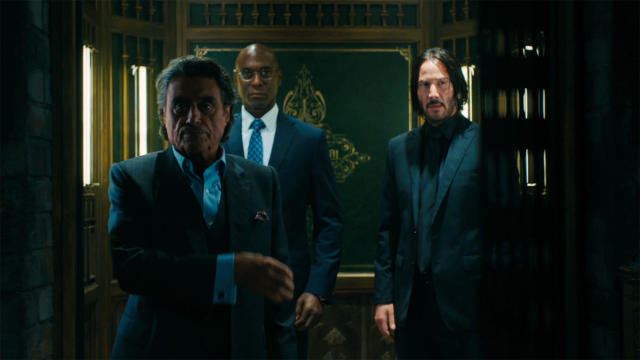
Love for Keanu, Donnie Yen fans joining the fray and a LOT of love for classy, urbane and sinister supporting player Lance Reddick, who died last week while on tour promoting this blockbuster. And the film? It delivers the goods.
It’s running about $10 million ahead of “John Wick 3,” and thanks to a lot of premium-priced screens showing this bad boy, it should be over $100 million by next weekend. Another Keanu franchise that’s just money in the bank.
“Scream VI” moved the franchise to NYC and gave it a new starlet, that “Wednesday” Jenna Ortega queen. It may end the weekend in second place, but it’ll earn about $9 million, putting it on track to cross the $100 million mark by NEXT Saturday, perhaps as early as Friday.
As for “Shazam! Fury of the Gods,” aka “Nobody really asked for this,” it’s fallen off a cliff on its second weekend. Not that the opening was all that and a bag of corn. A lot of back and forth over what went wrong with an after credits tease — in “Black Adam” and in “Fury of the Gods.” Bad blood with The Rock had nothing to do with the “Where do we go with this?” ineptitude of the script.
Bombs away, maybe $8 million and change, a 70-80% plunge from a bad opening wee
“Creed III” should hit $8 million and is tracking towards a $160 million take by the time it loses its screens (two weeks) and winds down its run.
“65” will anchor the top five, a bomb that won’t hit $35 million before it disappears, $2.9 million this weekend.
Here’s the updated “final” estimated take as of Sunday afternoon, courtesy of @boxofficepro.
“Wick” fell just short of $75, “Shazam!” came closer to $10, which pushed “Scream VI” and “Creed III” into third and fourth.
The boy looks like any one of the hundreds of hustling teens on Panama City’s streets. His scam is using traffic cones to sell parking spots with implied “Be a shame if something happened to your nice car” “protection” in the bargain.
But Alicia, a 40ish Mexican architect, isn’t in the mood for a shake down. She ignores, argues with and then pays the kid under his asking price.
As she sits, smoking, on her balcony, she watches the boy who goes by “Chief.” And Chief watches her. When she leaves for work, selling pricey high-rise condos in tropical Panama’s ocean view building boom, he’s washed her Audi, unbidden. More arguing, more angry bickering and more under-paying.
It’s not until he shows up at her door, bloodied by a gunshot wound, that she’s truly forced to deal with Chief. And even after she’s scooped him up and spirited him to a hospital, she keeps her distance, ignoring pleas from nurses and guards for her name and the patient’s identity.
They don’t know she lives on “Plaza Catedral.” But he does. And when he escapes from the hospital, the homeless urchin named makes a beeline for her address. Like it or not, solitary, self-pitying Alicia has a new responsibility in her life.
Panamanian writer-director Abner Benaim’s debut drama — he’s made documentaries and a lone comedy before now — was Panama’s submission for Best International Feature film at the Oscars a couple of years back.
It’s a simple, downbeat tale built on familiar themes, with generally predictable story beats and plot points.
Yes, Alicia — played with a guarded, calloused fragility by Ilse Salas — has a secret pain. All those people asking how she’s doing, the friends dragging her out for drinks? She’s newly divorced. And as we quickly figure out, she used to have a son.
Of course one relates to the other.
Chief has a real name, “Alexis.” But he has no home. Calling a doctor she knows about how long it should take for him to recover only earns Alicia a lecture.
“The younger they are, the more dangerous they are,” he tells her (in Spanish with English subtitles).
But warning or not, even with nightmares about what he might do to her or her property, Alicia finds herself taking care of this uneducated, gang-affiliated street kid, played by real-life street teen Fernando Xavier De Casta.
There’s not a lot of street grit to this story, which is mostly told from Alicia’s entitled point-of-view. The burden Benaim faced making this was in finding something new to do with this situation, a new angle to attack this chronic Third World/Central and South American condition.
He doesn’t. Whatever Chief is mixed up in is bound to infiltrate Alicia’s life. Whatever his presence does for the sleepwalk of grief that is her daily existence is not guaranteed to be a change for the better.
Benaim has made a sharply-observed account of a Panamanian social ill as it impacts two people — one who lives it, the other who “sees” it for the first time. The problem is he doesn’t observe enough that’s new and doesn’t do anything novel with this familiar set-up.
A glimpse of crowded, cosmopolitan Panama and the people left behind in its tax haven/vacation-get-away building boom is all we get. A glimpse is no longer enough.
But that cast, with André Dussollier, in a drama about the Biggest End of Life Decision from François Ozon, who gave us “8 Women” and “Swimming Pool?”
That’s worth marking April 14 on your calendar.
Posted inReviews, previews, profiles and movie news|Comments Off on Movie Preview: Sophie Marceau, Charlotte Rampling & Hanna Schygulla star in François Ozon’s “Everything Went Fine”
What a fascinating, layered character “Return to Seoul” is built around.
Frederique is ever-so French — aloof, patronizing and occasionally downright rude. She is young, bourgeois and pretty, an only child. That adds headstrong, impulsive and sexually assertive to the mix.
But she was born Korean, and she has returned — on what could be a deep-seeded quest, or a youthful whim — to find her birth parents. There’s a rootlessness to her, a “sadness” one Korean who befriends and aids her notes. Frederique is looking for Yeon-hee, the Korean baby she once was, the people who gave her up for adoption and their reasons for doing it.
Screenwriter Laure Badufle, co-writer and director Davy Chou and actress Park Ji-min craft a deeply-considered, utterly-intriguing character in “Freddie.” She is 25 when we meet her. She’s a former pianist, she lets on. Her trip was sudden, we gather.
And she’s done no homework, has no idea how to manage what she’s attempting to achieve in a two week vacation. Being headstrong, she has no idea how notion of the hoops that must be jumped through, of how traumatic this could be for her and others, and she carries not a single care for how she comes off in polite, well-mannered Korea.
“Bull in a china shop” comes to mind.
Chou and Park portray this quest in the most serious tones. But there’s a hint of culture clash comedy to Freddie’s manners and arrogance.
The first Koreans she meets and befriends — hostel clerk Tena (Guka Han) and her friend Dongwan (Son Seung-Beom) — are tickled to have someone they can speak French to. The film gives us a delicious appreciation of Francophone haughtiness as Freddie, from time to time, simply must remind some impertinent local (in English) “I am FRAUNCH!”
Efforts to pass on Korean customs and manners — one doesn’t refill one’s own glass at the table — are met with smiling assertions of her privilege. She barges in on other tables, toasts all around, inviting one and all to join them.
She might bed this guy. She won’t bother to teach him the meaning of “Hit it and quit it.” “He’ll get over it.” And the fact that no one joins her isn’t keeping Freddie from being the only dancer at the music pub (with DJ) they visit. She dances like everyone is watching, and likes it.
Freddie is so brusque and over-the-top that it would only take a simple phrase, never muttered but often thought, to tip this over into dark comedy.
“What a bitch” may not be said aloud. But we and some of the Koreans helpless in preventing Freddie from making a scene have to think it.
Freddie bristles at the “rules” of the adoption agency that knows where her parents are. She thinks nothing of imposing on kindly Tena to serve as translator when she finally gets to meet her weepy, guilt-stricken Dad (Oh Kwang-rok). There’s just as little thought given to brushing off his tipsy clinginess.
Park lets us see Freddie cringe, and the indecisive yearning Yeon-hee feels underneath that burn-it-all-down exterior.
“Return to Seoul” takes a conventional story and adds in all the touchy considerations such tales typically leave out. Maybe the birth parent doesn’t want to see you, be reminded of what must have been a devastating experience for them. Maybe recognizing how little you have in common with them would give anyone second thoughts about all this, mid-adventure.
One interesting twist here it the way the script suggests that the adoption agency — in business since shortly after the Korean War — has seen it all before and has an idea of what this abandoned child is going through, even if she’d never accept that.
How might such a childhood, viewed through the sobering reality of adulthood, impact your self-esteem and willingness to allow yourself to get close to anyone? Freddie isn’t just “sad.” We see her, years later, summon a lover to join her in Korea (where she’s remained) only to tell him (Yoann Zimmer) how easily she could delete him from her life.
Again, nobody says it but you can’t avoid thinking it — Quelle chienne!
Screen newcomer Park makes this character selfish to the point of hateful, but always worthy of our compassion and pity.
“Return to Seoul” shows us that no “simple” adoption from another culture is ever simple, that even if those uprooted try to “come home again” there will be issues. And with or without therapy, those can take years and a lot of life experience to work out.
Rating: R for brief drug use, nudity and language
Cast: Park Ji-min, Oh Kwang-rok, Guka Han, Kim Sun-young, Yoann Zimmer and Louis-Do de Lencquesaing
Credits: Directed by Danny Chou, scripted by Laure Badufle and Davy Chou. A Sony Pictures Classics release.
The wonder of “Joyland,” Pakistan’s contender for this year’s Best International Feature Oscar, is that such a marvel exists.
A more bitter than sweet transgender love triangle romance filmed and set in the Muslim world? How could this be?
Director and co-writer Saim Sadiq’s movie judges without judgement, a tale set in a Pakistan that acknowledges without really accepting that people like its big city drag performers exist.
That’s a fine line to walk in any Islamic state, and even this one banned the film before reaching an accord that allowed it to compete for an Oscar — grudging “acceptance” at last.
It’s a subtle and subtly-acted story told at a slow simmer, adding twists even as it takes an inevitable turn towards tragic. Many a transgender tale is cast in operatically-tragic terms. But here, anything less would feel like a cheat.
Permanently unemployed Haider (Ali Junjeo) spends his days helping sister-in-law Nuuchi (Sarwat Gilani) run the extended family household in Lahore City, having tickle fights with his young nieces, cleaning and cooking and helping look after his tyrannical dad (Salmaan Peerzada).
His wife Mumtaz (Rasti Farooq) is happy enough to be a breadwinner, doing makeup for brides in a local salon, out of the house and challenged by the public every day.
All Haider has to do is turn a deaf ear to the judgement his dictatorial father and older brother (Sameer Sohail) pass on as they treat him like a servant.
Brother Saleem and Nuuchi have been trying to produce a male heir, but daughters have been the result every time. That’s another thing for Abba (Peerzada) to insult him about — no “man’s” job, living off his wife, no offspring.
Haider figures one way to take the heat off is to look for work. A pal sets him up with an interview for a dance gig. Haider can’t dance. The job pays well, but it’s at an “erotic revue,” where he’ll be a backup dancer.
And his boss and choreographer will be Biba, transgender, out and living her pre-surgery “best life” in a place where one wrong move, one misjudged encounter could be her last.
He’s hired, despite having no experience or talent. He begs his friend not to tell his father or family what he’ll be doing. “Theater manager” he’ll tell them.
But the disruption under their roof is as instantaneous and cruel as it is soft-spoken. Nuuchi’s just had her fourth child.
“Who will help her run the house?”
Saleem and his Abba decide. And Haider folds and goes along with them. Just like that. Farooq lets us see how crushed Mumtaz is, an enterprising professional woman with a job and a work life sentenced to the grind of caring for children “who aren’t even MINE (in Punjabi with English subtitles)” and tending house for her aged, tyrannical invalid of a father-in-law.
Cruelest of all, Haider becomes his boss Bibi’s fixer, her Man Friday, running errands, play-acting to get her into photo shoots, sticking up for her on public transit where traditional Muslim women bristle at Bibi, “a man” in women’s clothes, taking a seat next to them, staying out all hours.
Haider stays late at rehearsals, accompanies Bibi on her nightly rounds and neglects Mumtaz. The older brother’s family even imposes on their bed, parking their restless bed-wetter oldest daughter in there with them.
Whatever this movie has to say about transgender rights and transgender romance, Mumtaz is the one who won my pity. When she blurts that “I want to run away” at one point, we pray that she will.
Because Haider, the sibling too sensitive to slaughter a goat to celebrate the birth of his brother’s latest daughter, too meek to stand up to his brother and dad, is falling for bossy, sexy come-on queen Bibi.
Columbia U. alum Sadiq and his co-writer Maggie Briggs use their first feature to invite the world to see a Pakistan never seen on the screen. All male audiences lap up the drag revues. Bibi tempts fate by dancing and flirting with the rough trade in local bars, which may serve alcohol but also draws the line at not admitting women.
A romance is coming, and if we know one thing about love triangles, it’s that virtually nobody will survive that experience unscathed.
Sadiq lets his film carry on past its logical climax. “Joyland” seems to judge, but withholds judgement on Bibi’s callous pursuit of a man in a traditional marriage. Haider’s guilt is left mostly unspoken.
But Farooq sees to it that your heart just breaks for Mumtaz, in an arranged marriage (seen in flashback) and trapped in a house that has become her prison, an entire family cavalierly crushing her spirit and frustrating her every desire with no more thought they they think her status demands.
For all the eye-opening novelty and hoped-for “change” that “Joyland” — named for the carnival/club district of Lahore — provides, in Mumtaz we see the ugly reality of “the now” in a patriarchy that’s still just one bad election from being Iran or Afghanistan all over again.
Rating: unrated, sexual situations, profanity
Cast: Ali Junejo, Rasti Farooq, Alina Khan, Sarwat Gilani and Salmaan Peerzada
Credits: Directed by Saim Sadiq, scripted by Saim Sadiq and Maggie Briggs. An Oscilloscope Labs release.
A star high school pitcher who just signed to an American major league team’s farm system is convicted of killing his rich girlfriend, who wanted to come with him from Taiwan to the U.S. Years later, he busts out of prison, and a former star TV reporter now hunting for eyeballs online decides to help him prove his innocence for the most cynical motives.
That’s the plot of “The Post-Truth World,” a slow but somewhat absorbing whodunit from Taiwan.
Edward Chen of “Your Name Engraved Herein” plays the hothead Zhang Zheng-yi, a kid with the world by the tail when we meet him at a Taiwanese stadium, free-spending and optimistic about the near future until he finds out his girl, Wang Shi-yun (Tzu Hsuan Chan), has assured her rich father that she’ll attend college close to home.
So…you’re not moving to America with me?
What happened after that is a blur of bloody crime scene photos, breathless “ballpark lovers murder” TV news coverage and a frenzy of eyewitnesses describing his temper, his state of mind and his guilt on that night in 2012.
Hsiao-chuan Chang (“The Big Call”) plays Liu Li-min, a TV reporter still remembered for hosting “Dissecting the Society” back in the day. In the film’s fictive present (2019), he’s an online reporter trying to stay above water at True News, where he’s brought his motto — “The news matters, the truth matters more” — but not his audience.
He’s a single dad whose social media savvy teen (Caitlin Fang) tries to help him generate pageviews and subscribers, to little avail. But when he shows up at a prison to interview an aged mobster, he’s the last to figure out he’s a pawn in a prison break involving Zhang.
Liu has the good sense to live-stream his kidnapping and their get away. And after Zhang ditches him, he resolves to follow this story, because that’s where the eyeballs are. He’ll re-investigate that years-ago “ballpark lovers” crime and “prove” his onetime kidnapper’s innocence.
“How did I make it look?” (in Mandarin with English subtitles) he asks his kid after one breathless stand-up. Liu is all-in on this story, which could go viral and save his professional bacon.
But as he digs in, conflicting accounts arise along with seriously suspicious behavior by onetime witnesses. Threats and deaths follow.
Neither he nor we ever consider the possibility that this is Zhang’s vendetta. But other media coverage hangs onto that “convicted killer on the loose” narrative as the case envelopes love, lies, drugs and wealth, with our definitely-violent-now fugitive and his reporter/savior crossing paths repeatedly as new evidence comes to light, old evidence convinces the cops they were right and our reporter crosses ethical and moral lines, further muddying the viewer’s sense of “truth.”
There’s a lot to keep track of here as this “crime” and its context shift and shift again with each new point of view. Liu’s dead wife (Aviis Zhong) was a reporter on another case that figured into events that night, revisited in flashback. The victim’s rich family intrigues further complicate matters.
Director If Chen (“The Long Night”) keeps things straight even as he struggles to keep this story on its feet and moving. Only a chase or two and the odd blast of violence, from the original crime scene in flashback or Zhang or Liu’s present day efforts to “prove” his innocence, only a fight to fend off the police who want to catch the fugitive — his “prove my innocence” quest be damned — liven up the proceedings.
The script does a better job of showing the shifting ethics of “news,” and Liu’s sometimes self-righteous, sometimes self-serving response to that.
“The Post-Truth World” probably puts too much effort into complicating and over-complicating its central mystery and not enough into editing for pace, suspense and simple “hold my interest” contingencies.
It’s not bad. But the truth about “Post-Truth” is that it’s more of a foul ball than a clean single to right.
Rating: TV-MA, graphic violence, drug abuse, profanity
Cast: Hsiao-chuan Chang, Edward Chen, Caitlin Fang, Aviis Zhong and Tzu Hsuan Chan
Credits: Directed by If Chen, scripted by Huang Yen Chiao and Nai-Ching Yeh. A Netflix release.
The acquired taste that is French satirist and genre-spoofer Quentin Dupieux unleashes the unlikeliest superhero “avengers” of them all in “Smoking Causes Coughing,” a film that sends up comic book movies and society’s efforts to regulate or socially normalize “safety.”
Like his earlier films “Rubber,” “Mandibles” and “Incroyable mais vrai (Incredible but True),” it’s basically a one-joke comedy, and is thus quite brief. It was also, for me, basically a single laugh romp that loses the plot along with the punchline.
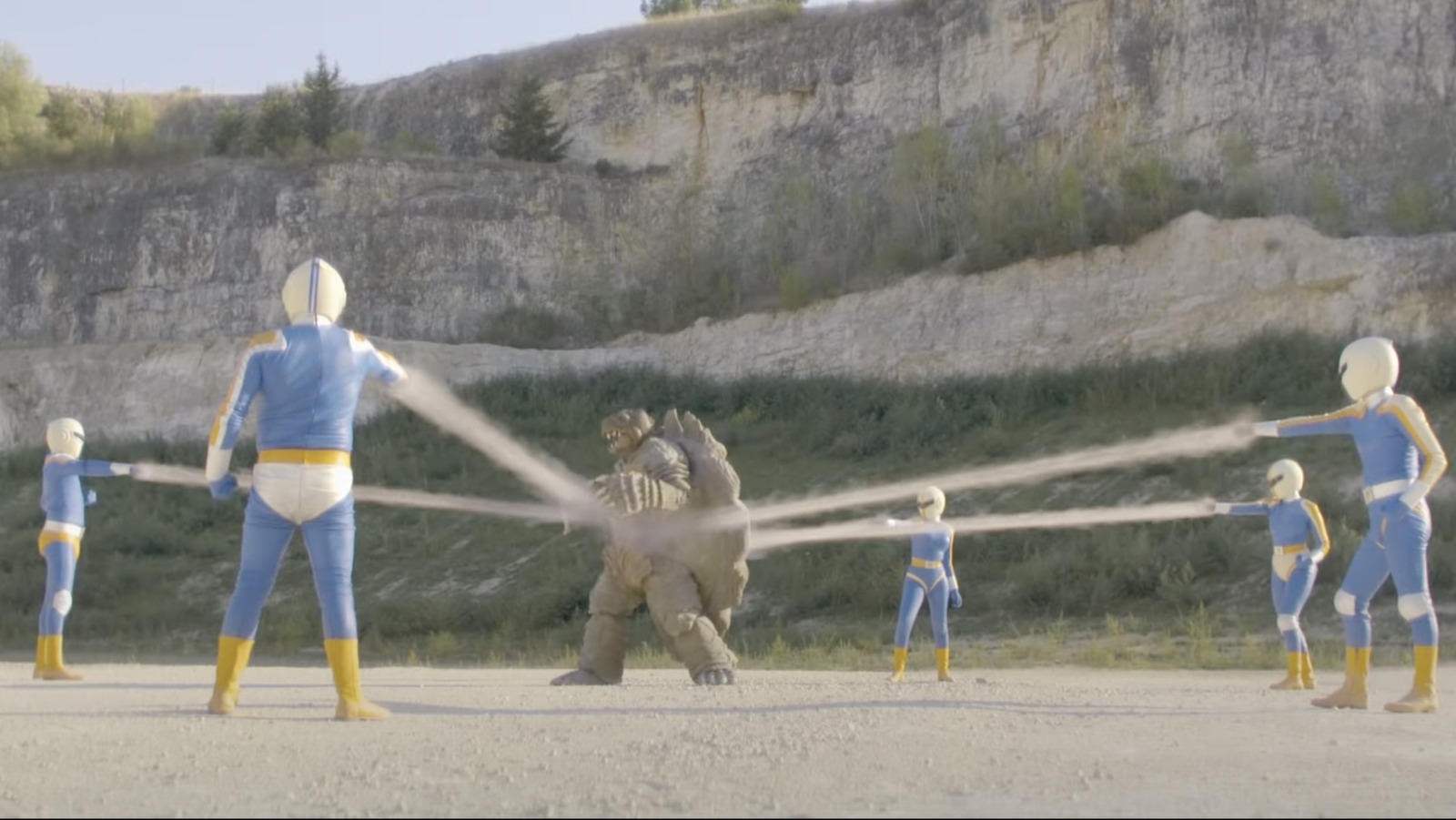
Gilles Lellouche, Anaïs Demoustier, Jean-Pascal Zadi, Oulaya Amamra and Vincent Lacoste play The Tobacco Team, an elite unit in Power Rangers (with tidy whiteys) togs sent to battle monsters and supervillains by Chief Didier, a ratty rat puppet who passes on instructions via CRT TV in their custom self-driving van.
A little boy, the son of a chain smoker, catches them in action in an abandoned quarry as they concentrate their powers — shooting smoke at a foe, which would cause cancer if the villain didn’t explode in a shower of entrails first — on Tortusse, a dino-turtle monster (dude in a rubber suit).
They are named for the poisonous gases contained in cigarettes — Ammoniaque, Nicotine, Benzene, Mercury and (oddly) Methanol, which I think was meant to be Methane.
One has a crush on their womanizing rat-puppet Chief. One has a family. Another is younger and lonely. Because even superheroes have “issues.”
The kid bystander and his Gitane-sucking dad are covered in Tortusse guts after that first big fight, as are the “invincible” Tobacco Team. They, at least, can get hosed off by their cute Norbett 500 robot. They pose for selfies with the kid and they’re off, sent to a secret base to await their next assignment.
And while there, they tell campfire stories. A child sees their fire and comes up to tell her (comically incomplete) tale of hazardous waste terror. Meanwhile, Lizardo (Benoît Poelvoorde), an alien, makes his plans to destroy the “annoying” Earth.
All of the studio-released-photographs and much of the focus of this farce is on the superheroes. But these anecdotes eat up maybe half of the movie’s limited running time.
Two couples are killed off when they discover an antique “Thinking Helmet” which one woman puts on, only to realize what useless boors she’s stuck with on this vacation. An industrial accident tale has a lummox trapped in a giant shredder, apologizing, not wanting to “make a fuss” as his crew stumbles through instructions on how to free him, blundering their way to chewing him up until his still-functioning mouth and a bucket of goo is all that’s left to apologize for causing all this effort.
Little is done with the “secret base” except to show Team leader Benzene (Lellouche of “Tell No One” and the recent “Kompromat”) catching a barracuda, only to have it complain when it’s thrown on a grill, and to make a gag out of futuristic fridges equipped with a “supermarket” behind their door, including a clerk who will fetch whatever you want.
The overarching idea that no society or government or parent or spouses or some superpowered “team” can truly keep anyone safe seems ambitious, and vague. But maybe that’s not what Dupieux was getting at.
I’m not a big Dupieux fan, and this generally incoherent and barely amusing at all film leans into my “comedies for stoners” theory about him. “Rubber” sent up horror in a story with a tale of a tire run amok, wrecking cars and killing everyone it stalks. It is what it is, but in that case, that added up to a movie.
The gimmick and the satiric target here are broader and the punches miss the mark far more often than they land. But if you’re blitzed enough…
Rating: unrated, gore played for laughs, profanity
I don’t know about you, but “jaunty” can cover a lot of sins and do a lot of heavy lifting when it comes to movies based on flimsy, or should we say “less traditional” narratives — games, for instance.
“Dungeons & Dragons” fits that bill, and “Honor Among Thieves,” the latest attempt to make that role-playing game a fantasy film franchise, hits that jaunty sweet spot more often than not.
Jaunty here is the difference between two hours and fourteen minutes of dull nonsense, and a movie that plays.
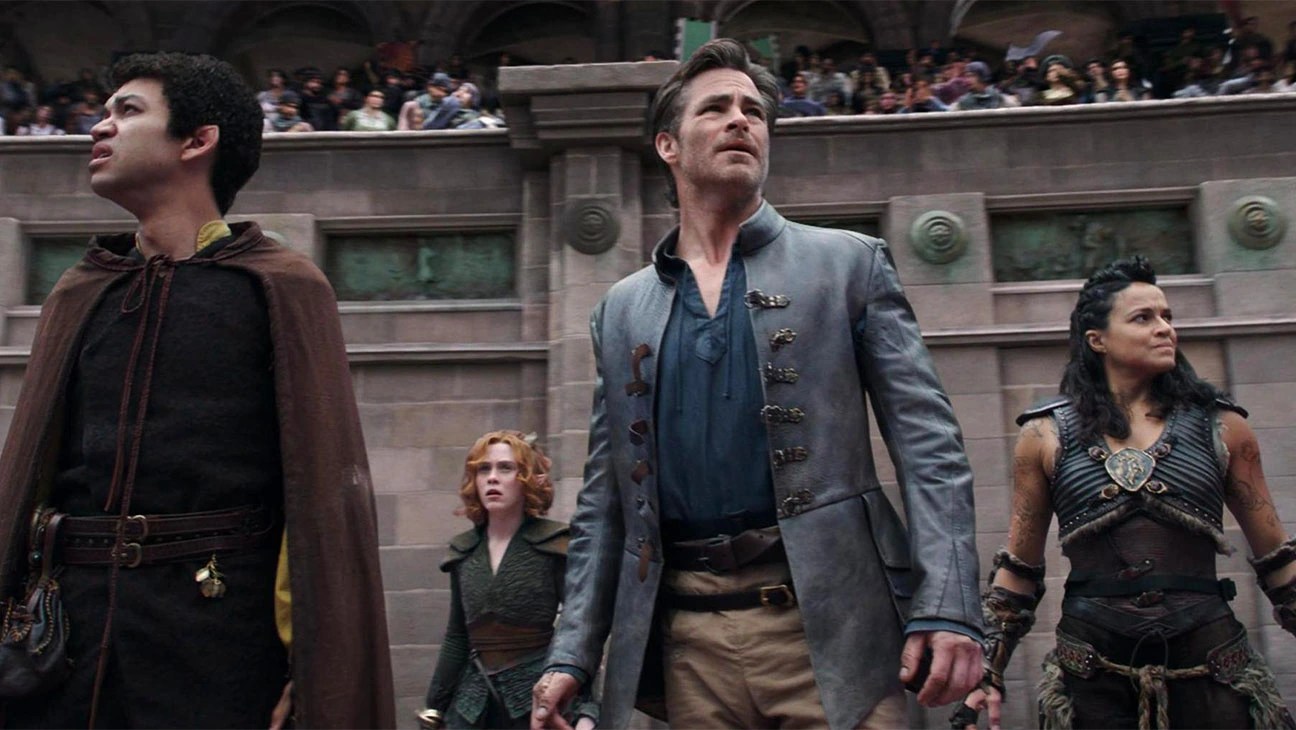
It’s got Chris Pine as Edgin “The Bard,” a singing, lute-playing “leader” of a gang on a quest. Yeah, everybody else wonders what it is about singing Pythonesque Medieval ballads and dance jigs that qualifies him to lead.
“I’m a planner. I make plans.”
With mottos like “We must never STOP failing, because when we do, we’ve failed,” you can see why a two-fisted, sword-slinging badass like Holga, played by career badass Michelle Rodriguez, might lose faith.
“What’s tryin’ to kill us this time?
Holga’s nickname is “The Barbarian.” Go figure. And the answer to her query might be a witch, a morbidly obese dragon, or an “owl bear.”
There’s also a bumbling wizard, Simon (Justice Smith) and a no-nonsense “tiefling Druid” Doric (Sophia Lillis) on this “team” on a quest to retrieve a relic and free Edgin’s daughter (Chloe Coleman) from the clutches of Edgin’s former partner, Forge, given an apologetically-menacing twinkle by Hugh Grant.
His ally in evil is the Red Witch, given a take-no-prisoners harpy edge by Daisy Head.
Edgin’s fresh out of prison, having taken the rap for Forge when a caper went wrong years before. In the intervening years Forge has become Lord Forge, a cunning ruler with possibly malevolent intent, no matter how much he smiles. And and it turns out he’s a much better father to young Kira than Edgin ever was.
So this is personal.
There are magical talismans and big CGI action beats and droll hijinks — casting a spell to question the dead to figure out who might have what they’re seeking. And every so often Led Zeppelin turns up on the soundtrack, because “D&D” really is the classic rock of games.
The co-writers/directors have “Horrible Bosses” and “Game Night” among their credits, and a winner of a “Spider-Man” script that they didn’t direct, so they know something about tone. Daley and Goldstein “get” jaunty.
Honestly, I had forgotten there was a whole other trilogy of “D&D” screen adaptations, with Jeremy Irons, Thora Birch and a few other noteworthies drawing a king’s ransom to star in them. And honestly, I have no doubt this one will be just as forgotten in its own due time.
But the ever-charming and self-effacing Pine, singing? And starring in ANOTHER movie in which he lets a woman fight his battles for him?
Rodriguez, Grant, “Bridgerton’s” Regé-Jean Page as a guide, advisor and ally? And Lillis (“It”)? And again, Chris Pine SINGING?
It’s not high art and not much for big thrills. But there’s no sense fighting how light and fun this is if you give yourself over to it.
Rating: PG-13 for fantasy action/violence and some language
Cast: Chris Pine, Michelle Rodriguez, Regé-Jean Page, Sophia Lillis, Justice Smith, Chloe Coleman, Daisy Head and Hugh Grant.
Credits: Directed by John Francis Daley and Jonathan Goldstein, scripted by John Francis Daley, Jonathan Goldstein and Michael Gileo. A Paramount release.
Comic actor, TV director and “Robot Chicken” co-creator Seth Green’s feature writing and directing debut ventures into Zach Braff “sensitive” territory, and never quite comes off.
“Changeland” is a mashup of Thai travelogue, morose man on a soul-searching quest and male wish fulfillment fantasy that’s built around the idea that the world wants to experience Seth Green on mute. Kind of a mixed bag, in that regard.
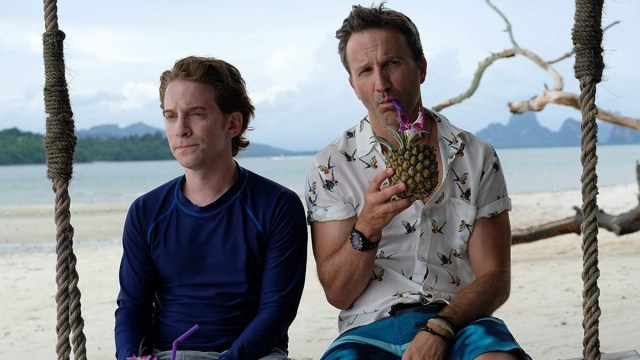
He stars as Brandon, a fellow who meets his “best friend” in the airport in Dubai, a meeting for a connecting flight that will take them to the stunningly-scenic, seriously-touristy Phuket, Thailand.
Brandon is the furthest thing from “excited” about this trip. His well-traveled pal Dan (Brecklin Meyer, veteran light comedy and TV sitcom lead) is going to have to be enthusiastic for the both of them.
Brandon’s figured out his wife is cheating, and decided that didn’t merit the “surprise” anniversary trip he put together for her or “them.” “Dan” it is.
The first jokes are at the resort, where the desk clerk (Kenneth Won) mistakes “them” for a couple. The fact that everybody involved recognizes that as a weary place to look for laughs doesn’t stop the script from repeating this comatose gag with tour guides along the way.
That sets the tone. This isn’t going to be that funny. And for all the gravity weighing on it, will it find something fresh to say about this sort of sad situation?
This trip, Dan decides, is about “one question.”
“You wanna fight for (the marriage) or not? You answer that and everything follows.”
Brandon mopes and Dan copes, the marriage is discussed and the guys’ “You’ve been a (bad) friend” issues surface.
Nothing novel or new about any of that. But at least they’re doing it on islets, in grottoes, mangrove forests and on boat rides in one of the most exotic places on Earth, nicely-showcased here in a way that suggests the whole project was a “paid working vacation” gig for Green and some pals.
Among those pals, is Macaulay Culkin, who plays a dive boat operator and general “You guys should come with me to the club” party goofball who might have been the life of the party, had this ever added up to a “party.”
It’s just Brandon dodging calls from his faithless wife, Dan trying to snap him out of his funk, with cute tour boat guides (Brenda Song and Clare Grant) showing up, right on queue, the “male wish fulfillment fantasy” side of things.
The scenery and sadness are what have value here, and noting the fact that there are still fun parts for Culkin to play. Green and Meyer, both in their mid-40s when this was filmed, feel like peas in a not-as-interesting-as-they-were-in-their-20s pod.
Which might be why no one involved labeled this what it is, a “mid-life crisis” comedy without the laughs or any meaningful life lessons attached.
Rating: R for language and brief drug use.
Cast: Seth Green, Brecklin Meyer, Brenda Song, Clare Grant, Rose Williams, Kenneth Won, Kedar Williams-Stirling and Macaulay Culkin.
Credits: Scripted and directed by Seth Green. A Hulu release.



















 Movie Nation