Movie Review: Remembering the Early NBA, and a Globetrotter who Became a New York Knick — “Sweetwater”

One of the cardinal rules of any sports film is that the actors portraying players need to be convincing in that sport, and the that filmmaker must know how to storyboard, block and edit surfing or soccer, golf, baseball, football or basketball into a convincing facsimile of how the game is played.

“Sweetwater,” a drama about one of the players who helped integrate the National Basketball Association in 1950, puts what look like rec league teams on the various courts — a bunch of Dad-bod white guys — and expects us to accept them as the pioneers and first gen stars of the newly-formed NBA.

The early Harlem Globetrotters, a team the NBA dared to play (and lose to) in those segregated formative years, come off a little better — sort of “Eight Men Out” (two-thirds-speed) basketball clowns on their way to becoming the first global ambassadors for hoops.

But in recreating the literal barn-storming nature of America’s fourth or fifth favorite sport of the day, composer turned writer-director Martin Guigui shows no feel for the game or the medium he’s depicting it in in a cumbersome, clunky film that suggests “last kid picked to play” bonafides, or lack thereof.

Screen newcomer Everett Osborne plays Nat “Sweetwater” Clifton, a star Globetrotter picked to be the guy who integrated the NBA in the late ’40s, a World War II veteran who faced racism within the league heirarchy and from fans as he sought to break “the color barrier” in the infant (two stuggling leagues merged and became the NBA in 1949) pro basketball association.

That’s the way the story presents it, anyway. The first Black player signed was someone else, as was the first Black player to take to the court.

The film is framed within a sports reporter (Jim Caviezel) stumbling into a Chicago cab in 1990, and hearing Sweetwater’s story from the man himself — who spent his post-NBA years as a cabbie, marveling at Michael Jordan and remembering his place within the league’s history.

The flashback yarn that Sweetwater spins takes us back to the bus-riding, segregation-hampered early Harlem Globetrotters, scraping by on owner, coach and bus-driver Abe Sapperstein’s (Kevin Pollack) meager payouts, playing assorted local teams in gyms and barns in states where the ‘Trotters couldn’t get a restaurant meal or a hotel room for the night.

But the Globetrotters turned a corner when they played and beat the new pro-league’s best, the Minneapolis Lakers, in Feb. of 1948. Sapperstein sees it as skills and racial equality validation, and as the game that will “make” his team’s reputation and turn it into a global operation, which indeed it did.

NBA figures like New York Knicks coach Joe Lapchick (Jeremy Piven), his boss, Madison Square Garden chief Ned Irish (Cary Elwes) and perhaps even NBA commissioner Maurice Podoloff (Oscar winner Richard Dreyfuss) could see “the future” in this more entertaining, improvisational, individual skill sets (“Black”) style and an integrated league.

Like the Ben Affleck movie “Air,” this is a true (ish) story about a pivotal moment in NBA history, when the league is in jeopardy and a Black star is seen as its salvation.

But as most of America is segregated in the late ’40s, and even rural New Yorkers (Eric Roberts plays a filling station-owning racist) could be relied on to drop the N-word to assert their supremacy. This was never going to be easy.

One interesting thing this script does is keep the racism off the court. Maybe the refs whistled down Sweetwater — named for his taste for sugary beverages growing up in Arkansas — for something that the movie says hadn’t been named “dunks” yet. But the white and Black players seemed to have no issue with integrating the game.

What little conflict there is in the script comes from Sweetwater’s pay beefs with cheapskate owner Sapperstein, who isn’t so bothered by that that he won’t drop a “Nuremberg” reference to any racist who insults his players, and the arduous arguments about integration held in league meetings, with only the Fort Wayne, Indiana owner/coach really going all-in on the racism thing.

The bigger shortcoming is how the film, like the games it painfully recreates, stumbles along at half-speed.

“Sweetwater” has interesting history to teach us, but it does so in a flat narrative that lacks pace or much in the way of charismatic sparks. “Race,” the recent Jesse Owens movie, and “42,” about Jackie Robinson, were similarly-themed and just as old-fashioned but boasted big budgets and bigger names among the supporting players. And formulaic as they were, their scripts had a bit more heart and spark.

“Sweetwater” had promise in conception, but that promise disappeared in the screenwriting long before the screenwriter directed his own script into a near coma.

Rating: PG-13 for some racial slurs, violence and smoking

Cast: Everett Osborne, Jeremy Piven, Cary Elwes, Eric Robert, Jim Caviezel and Richard Dreyfus

Credits: Scripted and directed by Martin Guigui . A Briarcliffe release.

Running time: 1:54
Posted in Reviews, previews, profiles and movie news | Comments Off on Movie Review: Remembering the Early NBA, and a Globetrotter who Became a New York Knick — “Sweetwater”

Movie Preview: A Charlie Day/Ray Liotta/Kate Beckinsale All-Star comedy destined to go straight to HBO — “Fool’s Paradise”

Look at all the famous faces and voices in this farce about a mental patient “dead ringer” for an actor who has to navigate making a movie and the fame that comes with that “Fool’s Paradise” of a life.

Day directed, with Jason Bateman, Kate, the late Ray, Jason Sudeikis, Ken Jeong and more than a few others in support.

My review of “Fool’s Paradise” is at this link.

Posted in Reviews, previews, profiles and movie news | Comments Off on Movie Preview: A Charlie Day/Ray Liotta/Kate Beckinsale All-Star comedy destined to go straight to HBO — “Fool’s Paradise”

Netflixable? Madrid’s famous Psychic “Team” has a jolly/scary time investigating “Phenomena” in this send-up

Collectively, they were called “The Hepta Group,” and during their peak years — the late ’80s and early ’90s — they were Spain’s three “witch” answer to “Ghostbusters.”

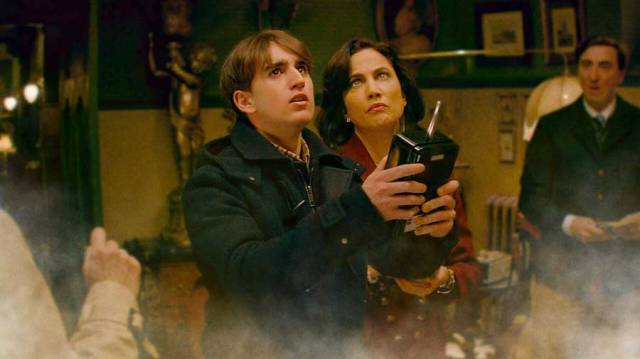
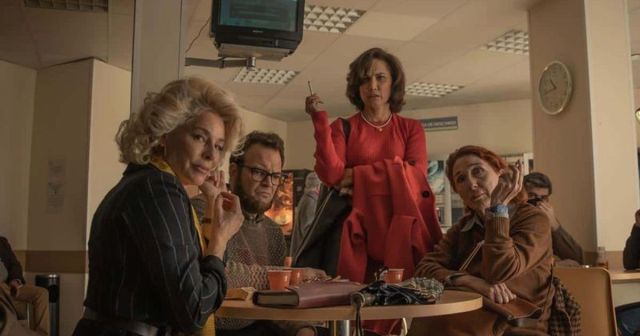
Got a haunted house or antique store, poltergeist trouble or some other supernatural “Phenomena” issues? Call those TV “psychics” — “If you don’t mind, I prefer ‘medium.'” — Gloria, Paz and Sagrario, and maybe their friend Father Pilon. They’ll assess, make contact and help you cope, maybe even “bust” your ghost.

Yes, like “The Pope’s Exorcist,” “Phenomena” is presented as something based on truth. But I never ran across their “Mundo Oculto” (World of the Occult) TV show during trips to Spain back then. I have no idea how true any of this is because I can find no reference to a non-corporate “Hepta” group online.

True or not, that’s a promising set-up for this jaunty Spanish comedy about bantering, bickering psychics — “medium” one prefers, “brujas” (witches) another labels them — called in on a “case” in the early ’90s, one that put their Catholic priest pal and mentor Father Pilon (Emilio Gutiérrez Caba) in the hospital.

Sagrario, played by Belén Rueda (“The Orphanage,””Sara’s Notebook”), is the glamorous blonde, the most famous TV “face” of the trio. She’s “living in the past” leaving her “no time for the present,” their priest pal counsels her (in Spanish with English subtitles). She still mourns her late husband Carlos, and since they made a “Houdini pact” that whoever died first was to use a code to contact the surviving spouse from beyond the grave, she’s always looking for signs. And finding them.

Paz (Gracia Olayo of “Holy Camp!”) is a pragmatic grandmother raising her grandkids, a volunteer ghost buster who, unlike Sagrario, isn’t “cashing in” on their efforts at investigating and “managing” the paranormal.

And Gloria, also a volunteer who resents Sagrario’s pay-for-ghostly-play gig, is the fearless and impatient one, a chain-smoker wearing out a dating service, with prospective beaus fleeing her presence once they realize who she is. Gloria (Toni Acosta of “Poliamor para principiantes,” aka “Polyamory for Dummies”) wants to find love after 50, and is resigned to enrolling in pharmacy school to make a living.

Can these loud, fractious psychics agree to tackle this haunted antiques store and the creepy apartment building above it, where Father Pilon had his “accident?”

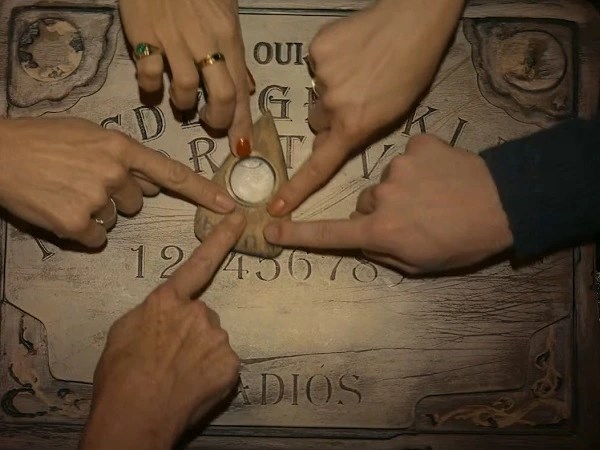
Director Carlos Therón bounces between jokes and sometimes violent jolts in this good-natured comic thriller. The funniest bits have them coping with a fangirl antiques dealer — “My FIRST ouija board!” — and her increasingly fearful and frantic ( to the point where he’s lost his eyebrows and his hair is coming out in clumps) husband.

They bring along a physics student (Óscar Ortuño) and some “gadgets” to detect metaphysical disurbances, an incredulous skeptic destined to become more credulous as their investigation encompasses apartments above the store, and a teen with Down syndrome (Maria Gil) who lives there.

Scripted by Marta Buchaca and Fernando Navarro, “Phenomena” plays more like the promising pilot to a TV series than a movie that wholly delivers the comic or traumatic goods.

There’s great chemistry among the leads — so good that you kind of wish it was a series pilot, or a franchise origin story — and the effects are modestly impressive.

But we need a little something more than the reliable truism that any answer to the question “Is this safe?” is going to be wrong. We need bigger laughs than any assertion — after a steel-tipped spinning top has hurtled across a room and pinned one medium’s sleeve to a table — that “The dead aren’t violent” and “It’s not like he was AIMING” is nothing anyone should take to the bank.

Rating: TV-MA, violence, smoking, profanity

Cast: Toni Acosta, Belén Rueda, Gracia Olayo, Óscar Ortuño and Emilio Gutiérrez Caba

Credits: Directed by Carlos Therón scripted by Marta Buchaca and Fernando Navarro. A Netflix release.

Running time: 1:35

Posted in Reviews, previews, profiles and movie news | Comments Off on Netflixable? Madrid’s famous Psychic “Team” has a jolly/scary time investigating “Phenomena” in this send-up

Documentary Review: Remembering “The Lost Weekend: A Love Story” with John Lennon and “the Other Woman,” May Pang

I did not expect to like May Pang’s latest remembrance of her time with her former employer, then lover, John Lennon.

The question tossed at her in some of her many TV interviews over the years, asking if she feels guilty about “capitalizing” on her brief flirtation with fame, “making money off John Lennon” still resonates.

When Pang, once the “personal assistant” of the Lennons, talks of how she “dressed” Lennon and Yoko Ono for the iconic music video for “Imagine” — “I made them look good!” — she comes off as needy, craving inclusion, determined to hang on to her part of his story and ensure she’s part of the telling the tale of the life of the beloved rock star, ex-Beatle, activist and promiment member of Richard Nixon’s “enemies list.”

Seeing her come up and hug Lennon’s musician son, Julian Lennon, the biggest name and only “Big” name to appear on camera for “The Lost Weekend: A Love Story,” doesn’t dissipate that opportunistic hanger-on cloud that hangs over Pang.

She can say “I don’t want other people to write my story” is her reason for making this film, but the generous collection of TV chat show interviews she’s given sampled here demonstrates she’s always been the one telling it, pretty much the only one — for decades — save for Yoko Ono, who is somewhat more dismissive.

But Pang wasn’t just a part of Lennon’s two year-long “Lost Weekend” in the post-Beatle early ’70s. She was a witness, a photographer, someone who held onto his letters and his doodle art and a big reason for what she claims were his “most productive years,” his most “public” period during their 18 months as a couple.

“Everybody saw John when he was with May,” Apple Records exec Tony King remembers.

He partied with The Hollywood Vampires (Alice Cooper, Mickey Dolenz, Keith Moon, Ringo Starr, Harry Nilsson et al), jammed with everybody from Jagger to Ringo and Paul, and recorded Nilsson, sang with Elton and others, and turned-out a couple of his own records.

The most glorious post-fame “candid” photographs of Lennon came from this period, some by the famous photographer Bob Gruen, more than a few of them taken with Pang and some even taken by Pang.

Ten years younger than her world famous lover, she looks giddy in almost every shot with him, and who wouldn’t be?

Lennon gave his last live performance, of “Whatever Gets You Through the Night,” on stage with Elton John in 1974. May Pang was there, and at home with him watching TV the night he caught a little of hustling TV preacher Reverend Ike’s program, which inspired the song.

“From inspiration to creation to collaboration, I was proud to be a part of the journey.”

Pull all that together, with Pang voice-over narrating and recalling anecdotes that are illustrated here with animation in a sort of Lennon pen-and-ink style, and you’ve got maybe the most intimate portrait of Lennon, who remains a fascinating figure to many over 40 years after his murder.

She takes a lot of the credit for reuniting John with his son from his first marriage, Julian, and being the personal assistant/production assistant to Lennon’s life, she created father-and-son outings from Disneyland to Disney World. Ono? She was trying to keep John and Julian apart, it’s implied.

The affair, “controlled” and stage-managed by Ono according to Pang’s account, was messy and all very adult. And there’s little doubt that yes, Pang is doing something no one else who knew him from this pivotal interlude is doing. She’s exploiting it. You can tell from all the famous folks named here who declined to sit for fresh interviews for this film.

Pang, who narrates the entire story, with a few other figures from their lives during this time also only heard in audio recordings, makes a delayed appearance on camera in the third act to document the break-up of the affair, and doesn’t let us forget — with good reason — how young and naive she was, and how ill-used she felt back then.

But like Ono, who has been just as determined to exploit her connection to Lennon, Pang is a keeper of the Lennon flame and perhaps the best witness to Phil Spector ending his involvement with the sessions recording “Rock ‘N’ Roll” with pistol fire, to that famous reunion with Paul and the less famous one, animated here — Lennon and May Pang in a New York cab spying Paul and Linda McCartney in an adjacent cab, the two Beatles reaching out to shake hands and shout out plans in Manhattan traffic for a meet-up that never happened.

Her memories, and the footage gathered here — include a funny bit where Lennon promoted his latest record by showing up and doing the weather at a journalist/friend’s Philadelphia TV station — “I had a touch of Scranton when I was 16, but got a shot and cured it.” — reconstruct what’s widely regarded as Lennon’s “happy drunk” years. He’d return to Ono, sober up, father and raise another son with her, retire, unretire and then be murdered outside of their New York apartment just as another “comeback” was about to break.

The film, which also details Pang’s Chinese immigrant upbringing and mentions her subsequent life and career in and around the music business, joins other building block documentaries like “The U.S. vs. John Lennon” in performing two services — keeping his memory alive, and wholly charting the many currents of the life of this singular figure in global pop culture history.

And good on Pang for making it, whatever her motives.

Rating: unrated, profanity, genital doodling

Cast: Narrated by May Pang, with Julian Lennon, Alice Cooper, Tony King, Jim Keltner, Chris O’Dell, and with archival footage of John Lennon, Yoko Ono, Elton John, Paul McCartney and May Pang.

Credits: Directed by Eve Brandstein, Richard Kaufman and Stuart Samuels, scripted by May Pang. An Iconic release.

Running time: 1:35

Posted in Reviews, previews, profiles and movie news | 2 Comments

Netflixable? “The Last Kingdom: Seven Kings Must Die”

Orson Welles’ depiction of the confusing, intimate, bloody muddy mire of the Battle of Shrewsbury in “Chimes at Midnight” is the gold standard for Medieval combat recreated on film.

Mel Gibson once told me he consulted “Chimes” in choreographing and shot-blocking his take on the Battle of Stirling in “Braveheart,” which rivals Welles in its murderous, murky, writhing bodies struggling to the death detail.

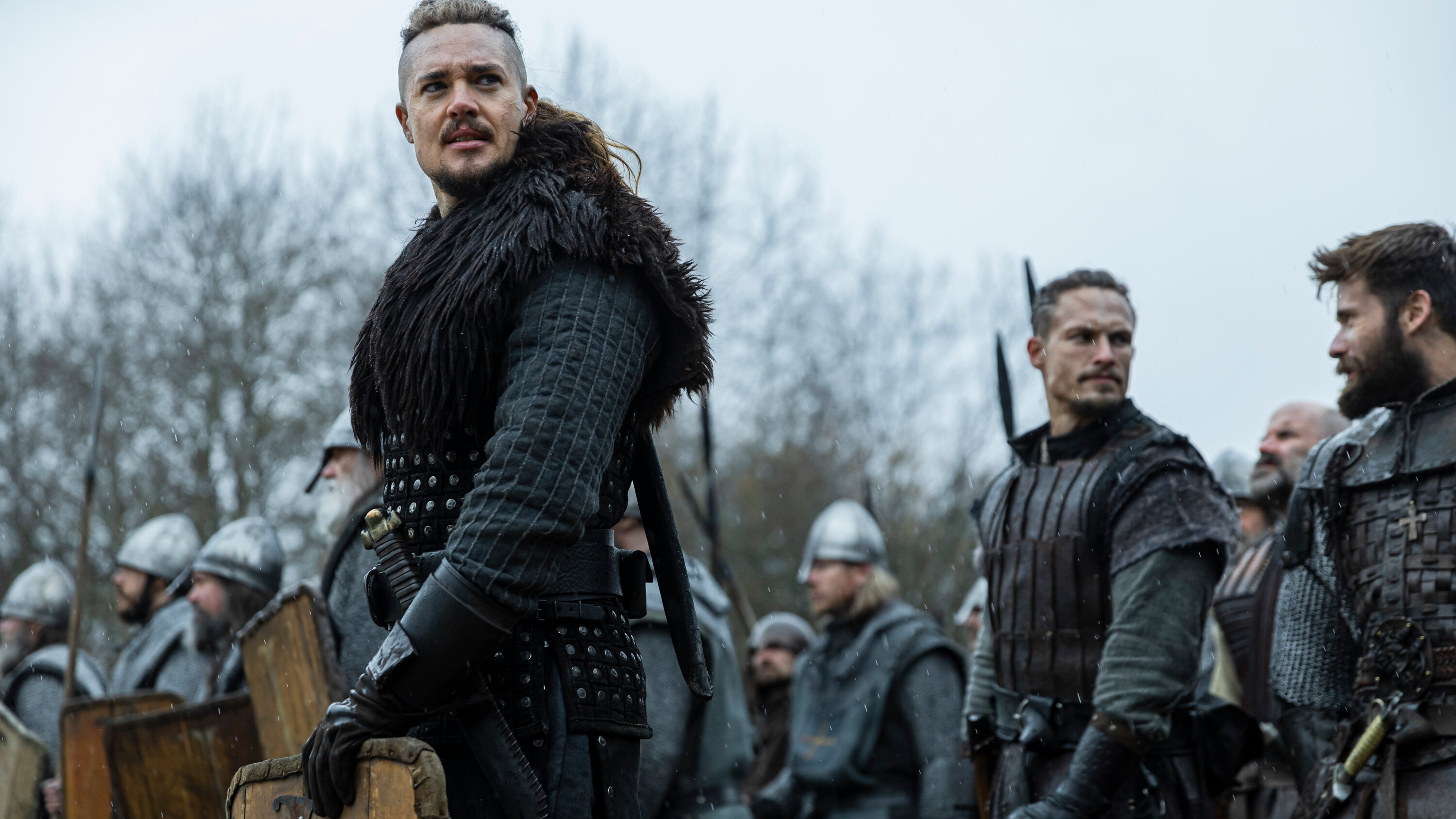
But director Edward Bazalgette gives them both a run for their blood money with his reenactment of of the Battle of Brunanburh, the climax of “The Last Kingdom: Seven Kings Must Die.” The sweep of the sea of soldiers of many “uniforms” and their wooden shields, steel swords and lines of men pushing and stabbing and dying trampled under foot is a wonder to behold, filmed from many angles, “shield wall” to “swine wedge” driving into it.

And amidst the carnage, as is the way of motion picture storytelling, a young King Aethelstan will meet his nemesis, and the Northumbrian pagan Uhtred, whose story we followed through the reigns of King Alfred the Great and King Edward over five seasons of TV’s “The Last Kingdom,” will reach a human lifespan-of-the-day defying climax.

Based on the historical novels Bernard Cornwell conjured out of the historical “Anglo Saxon Chronicle,” this saga has his real-life hero — albeit from a hundredsl years later — present at the Battle of Edington at the end of the first season of the show, and a key figure at Brunanburh, 59 years later.

Tough chap.

Those of us who got into the series accepted that historical Bowdlerization as a small price to pay for a vividly messy, flesh and blood recreation of disunited Britain during the Dark Ages — a Brexit metaphor if there ever was one. But this movie meant to wrap it all up, with intrigues, treachery, massacres, manipulations and same sex romance, can feel like reading the “Chronicle” in the original Old English, even if your memories of the series are reasonably flesh.

The first hour of the film is an alphabet soup of everybody vying for a piece of the throne, their own kingdom or a piece of the action as King Edward I fades and dies. The voluminous “who is whom” and endless exposition just to get us back into this universe and up to status quo ante is “Old Testament/Lord of the Rings” dense, and pretty much pointlessly so.

Treating the show like the Anglo-Saxon soap opera that it could sometimes be, giving us lots of “fan service” in returning characters — from Edward’s widow (Elaine Cassidy) — to Uhtred’s faithful mates, Finan (Mark Rowley) and Sihtric (Arnas Fedaravicius) overwhelms it. One and all are being forced into this bit of fleeing, that kidnapping, fratricide or massacre and power grab by new King Aethelstan (Harry Gilby), his trusted, Christian advisor Ingimundr (Laurie Davidson) and the meddling Dane Anlaf (Pekka Strang) who isn’t just waiting for the Saxons to start killing each other, he’s egging them on.

There’s a prophecy that “Seven kings must die,” and there are spies, back-stabbers and manoevering kinfolk who are hellbent on making that come true.

We dash from setting to settling, wooden 10th century fortresses to stone citadels, islands (Isle of Man), cities (Winchester) and states we recognize (Scotia, “Scotland”) as one and all jockey and stab their way for power.

Uhtred, in his Northumbrian fortress of Bebbanburg, his mates at his beck and call and his trusty, amber-hilt sword Serpent’s Breath by his side, has no time to be dismayed at seeing Alfred and Edward’s unity undone, their “England,” where “a dream unites a people who once sought to kill each other.”

Uhtred must act, heavy-handledly if need be, sticking out his neck for this “dream” many more times.

Dreymon’s brooding energy ensures that Uhtred remains the charismatic heart of this narrative, with Gilby and Strang making strong impressions in support.

But…this…narrative. Bloody hell. The maelstrom of real history sweeping all these characters along, the parade of rulers, nobles and heirs one must keep track of (not really) renders the whole affair rushed and untidy.

It’s a common failing of when series writers try to shift to a compact, beginning-middle-end two hour feature film. The story is too cluttered to register and the cast needed serious streamlining. You can’t fit a season’s worth of characters and their agendas into two hours, as that “Sopranos” fellow famously found out.

The finale is a sequence to remember, and “Seven Kings Must Die” leaves you reasonably satisfied thanks to the climactic battle, even if the script is gutless about who it kills off. And there’s something to be said for finally “wrapping it all up,” as it were.

But as a stand-alone film, this one has about four kings too many to be wholly engaging.

Rating: TV-MA, bloody violence

Cast: Alexander Dreymon, Harry Gilby, Elaine Cassidy. Mark Rowley, Arnas Fedaravicius, Laurie Davidson and Pekka Strang

Credits: Directed by Edward Bazalgette, scripted by Martha Hillier, based on the novels of Bernard Cornwell. A Netflix release.

Running time: 2:00

Posted in Reviews, previews, profiles and movie news | 1 Comment

Movie Review: Russell Crowe makes a fine Italian ham as “The Pope’s Exorcist”

Russell Crowe has made many films better than “The Pope’s Exorcist,” and a few one could label as objectively “worse.” But he’s never made a more cynical movie, a shameless late-career grasp at that which he eschewed back when the offers were more plentiful — a “franchise.”

He and the creative team behind this thriller start with the real-life Father Gabriele Amorth, Exorcist of the Diocese of Rome. They fictionalize that biography into a tale of a late 1980s contest between Satan, in his demonic “200 fallen angels” guises, and the Pope’s top demon-destroyer.

The character is canonical and papal and whimsical, with the catch-phrase “Cuck-oo” which he trots out to tease nuns and passersby on the streets of Italy and Spain and in the halls of the Vatican.

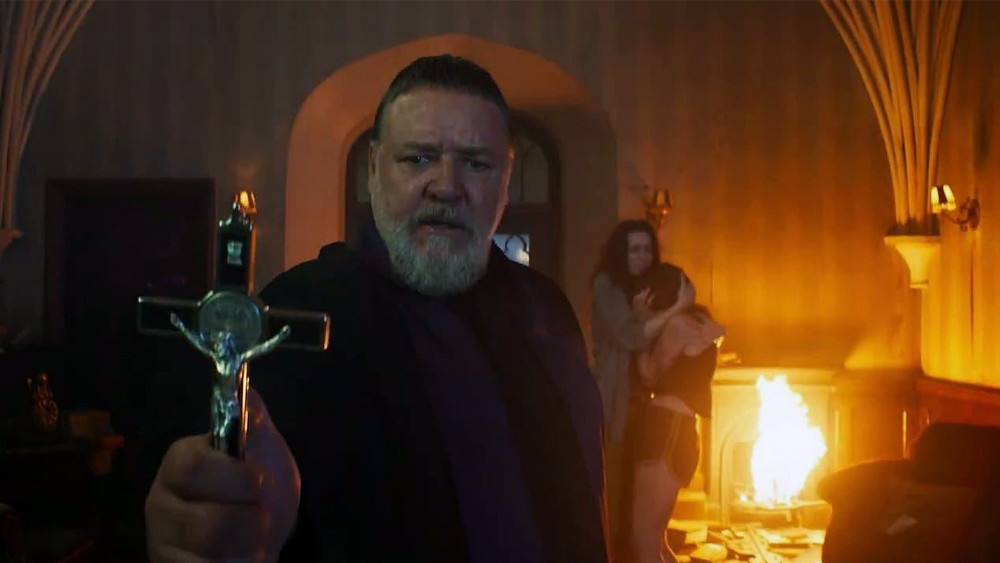
He wears a fedora. He totes a big, boxy exorcist’s tool-kit case, filled with talismans, crucifixes, papal seals and the like. Father Amorth also keeps a whisky flask handy and a few choice profanities on the tip of his tongue.

And he rides into battle with an Exorcist-mobile, an ’80s Vespa in the white and red livery of the Holy See, a vehicle which takes him to Italian house calls, and all the way to the north of Spain.

Father Amorth must have a chiropracter on call, wherever he goes.

All he lacks is a Marvel cape and some DC tights and we’d have ourselves a priestly superhero — CatholicMan!

The thriller’s opening gambit has the Vatican send Father Amorth into the Itialian countryside where a young man is possessed, and the priest comforts the lad’s much younger sister by imploring her to recite “the Our Fathers” over and over again as he sets about his work.

Heaven help her future feelings of guilt if the swaggering priest fails.

Amorth teases the demon, baits and antoganizes “him” as a member of the family brings a prized hog in and we see where this is going before the Dark One does. “Satan,” as the demon identifies himself, is tricked into taking possession of the pig instead of the young man, a pig which is promptly dispatched.

Crowe’s Father Amorth smiles wryly with the audience at this turn of events. We know what he must have figured out long ago. Satan or Lucifer or Old Scratch as he’s called around the globe, is something of a dumbass.

The main test of the narrative is an American family — a mother (Alex Essoe), her rebellious teen (Laurel Marsden) and the little boy (Peter DeSouza-Feighoney) who hasn’t spoken since his father’s gruesome death a year before, but who takes up talking when another of heaven’s “fallen angels” takes possession of him in a mysterious abbey that the family inherited in Spanish Castille.

Daniel Zovatto is the young Spanish priest who has the process explained to him (as the audience’s surrogate) as he witnesses this horrific battle of wills and suffers at the hands of the demon. Father Amorth — with a little help from a Pope (Franco Nero) who does his “own research” — uncovers the truth about this demon and that piece of Spanish real estate.

Crowe seems to impose his own sense of fun on the proceedings, which gives it a light touch even when it should have fear-for-the-victims’ lives gravitas.

The film that starts Father Amorth’s saga has a wink here and a sign of the cross there, Latin and Italian dialogue and accents, a “modern” sensibility.” Tis exorcist understands psychology, and that most of his “possessions” are people in need of counseling, group therapy and medication, not having demons cast out.

But as “The Pope’s Exorcist” settles into key conflict, exorcist vs. a Devil who wants revenge for his losses, the plot loses track of the victims Father Amorth is supposed to be helping and “saving” for stretches.

Crowe may have a bit of fun with this, but state-of-the-art effects don’t necessarily translate into shocks or frights, which are kind of the point.

Maybe “The Pope’s Exorcist” will inspire sequels, setting up Crowe for life. All I took away from it was a curiosity about whether Vespa actually offers a “Vatican edition” paint job. I can find my own Ferrari sticker to decorate it.

Rating: R for violent content, language, sexual references and some nudity

Cast: Russell Crowe, Daniel Zovatto, Alex Essoe, Laurel Marsden, Peter DeSouza-Feighoney and Franco Nero.

Credits: Directed by Julius Avery, scripted by Michael Petroni and Evan Spiliotopoulos. A Sony/Screen Gems release.

Running time: 1:40

Posted in Reviews, previews, profiles and movie news | Comments Off on Movie Review: Russell Crowe makes a fine Italian ham as “The Pope’s Exorcist”

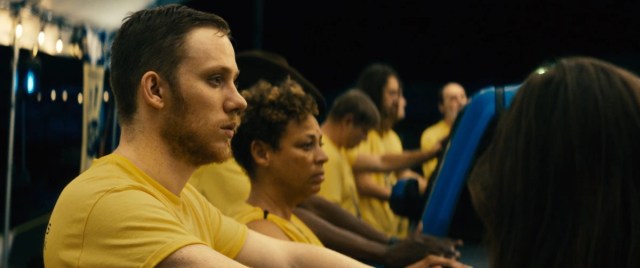
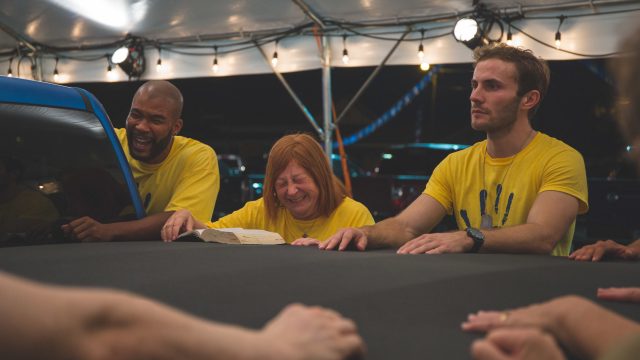
Movie Review: “Hands on a Truck” Contestants Let the Desperation Show — “One of These Days”

“Hands on a Hardbody,” the story of Texans competing to win a new “pick’em up truck” by seeing who could stand up and keep one hand on it the longest was a documentary that was excerpted for a “This American Life” radio essay, and even transformed into a Broadway musical. So it’s understandable that German writer and director Bastian Günther (“Houston,” “Autopilots”) would want to do a little something different in filming his “inspired by true events” take on the the material.

But “One of These Days,” his fictionalized take on just such a contest, loses its way as he goes beyond the psychological and physical toll of such a contest and lapses into melodrama and a sort of “what if” finale. It’s interesting and thought-provoking, even if that thought is “You almost spoilt your movie, meine Freund.”

A few quick strokes establish a sleepy, dying rural town through weed-covered lots, discount stores and struggling, working class Texans and their housing, much of it sampled via Google Street View. Wherever this dead end is, Bubba Boudreaux of Boudreaux Auto & Truck puts on a show, once a year, that gets folks to talking for miles around.

It’s the annual Hands on a Hard Body give-away, an annual contest in which 20 “lucky” contestants get a chance to win a shiny new “Matterhorn” edition pickup (it’s a Ford dealership) just by outlasting each other in a test of stamina and just plain stubbornness.

Promotions manager Joan (Carrie Preston of “True Blood,” “The Good Wife” and “Claws”) runs this show, an ever-smiling fixture in town and on local TV, which covers the hell out of this spectacle. Joan is divorced, we gather. She has a regular “nooner” whom she hooks up with over lunch. And her smile and positivity aren’t shaken even when her paramour (Cullen Moss) callously tells her “I’ve met somebody,” and their assignations must end.

Joan’s sweetness extends to all those folks picked to compete, starting with discount store clerk Kyle (Joe Cole of “Peaky Blinders” and “Gangs of London”). He’s married, with a working wife (Callie Hernandez) and a baby at home.

And they could really use a reliable new “ve-HICLE” as we say in the rural South.

“No sugar,” Joan advises him. “No fatty foods. Lots of water and bananas.”

This isn’t her first rodeo. She not only has “perfected this contest,” with scheduled bathroom and meal breaks, live entertainment and food and drink give-aways designed to draw a crowd, judges working in shifts around the clock and all of it taking place under a tent on the lot. She knows how past winners managed the 50-100 hour ordeal.

Kyle will be facing 19 other people, a real cross section of the community, from aged Bible quoter Ruthie (Lynne Ashe) and bullheaded old coot Walter (Carl Palmer)to telegenic but intense veteran Derek (Evan Henderson) and a Louisianan jerk’s jerk Kevin (Jesse C. Boyd of “Outer Banks” and “Halloween Ends”).

Walter may annoy and Derek threaten. Others may even trot out the race card. But Kevin is goading, taunting and provoking his way to that truck, determined to get inside everybody else’s head, especially the desperate Kyle.

Over the course of this ordeal, fights and compassion, mutual respect and deeply personal contempt will come out as one and all try to endure or bait the others into quitting or simply forgetting what they’re doing and where they are as hallucinations replace recriminations.

That’s a fairly conventional narrative, but it’s interesting enough that it would have made a solid, suspenseful and possibly even “feel good” movie, one about 90 minutes long.

Günther goes for something beyond that Limits of Human Endurance tale for a third act that starts with the melodramatic and turns towards narrative cheats, folding flashbacks in to make one question just how “desperate” someone should be if there wasn’t some salesman waving a shiny new truck in front of everybody’s face, creating relative deprivation and a sense of want.

The actors do a great job establishing characters and Günther nails this milieu as we follow Joan through this “My time to shine” bit of logistics and “managing” her contestants. And then Günther moves on from that, and I thought, loses his way.

Not a bad movie, but a better one plays out and ends before a final 15 minute anti-climax.

Rating: unrated, violence, sex, nudity, profanity

Cast: Carrie Preston, Joe Cole, Jesse C. Boyd, Lynne Ashe, Sam Malone, Amy Le and Callie Hernandez

Credits: Scripted and directed by Bastian Günther. A Gravitas Ventures release.

Running time: 1:59

Posted in Reviews, previews, profiles and movie news | Comments Off on Movie Review: “Hands on a Truck” Contestants Let the Desperation Show — “One of These Days”

Netflixable? A lost treasure caper involving “Florida Man” Or Florida Men.

Say what you like about “Florida Man,” a riff through a lot of familiar action comedy/caper comedy/film noir tropes. It keeps you just invested enough to figure you’re going to have to finish it. Kind of. More or less.

The series isn’t a laugh riot or anybody’s idea of a deep dive into its genre or genres. And it isn’t as “authentic” as say, Elmore Leonard or Carl Hiassen’s “authentic” takes on the screwiness of The Sunshine State. But it does tease out its tale in that “limited series” way, even if the tale itself is as surprising as finding gator jerky next to the oranges and orange blossom honey at every gift shop from Cocoa Beach to Daytona.

Series creator Donald Todd (“This is Us,” “Hart of Dixie,””Sleepy Hollow”) did just enough research to land a few Florida zingers and get a general feel for Central Florida, the Orlando-Sanford-New Smyrna Beach/Coronado Beach setting. I know because I live here.

But the series is shallow and untidy and drawn-out, with some good players popping up in a few episodes and neglected for a few others. Many of the easy laughs don’t land.

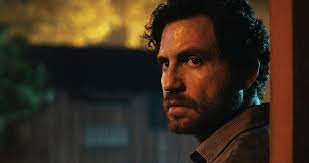
Still, it makes a fine vehicle for Edgar Ramírez, a softer, edge-free “Bloodline” that jabs at Florida weirdness, Florida gun-nuttery and Florida corruption — just a bunch of shady characters trying to get their hands on — wait for it — Spanish treasure.

Ramírez is Mike, the ex Philly cop and gambling addict working off his debts to mobster Moss (Emory Cohen) by collecting on others’ debts, and running errands.

One of those little jobs turns out to be following Moss’s moll, Delly (Abbey Lee of “Lovecraft Country, “Mad Max: Fury Road” and “Old”), a skinny blonde femme fatale who skipped off to Florida.

Turns out Mike had a “thing” with the boss’s gal. Turns out Mike used to live in Florida. Turns out, he’s estranged from his shady-ex-cop Dad (Anthony LaPaglia, terrific). Turns out, Mike’s ex (Lex Scott Davis) is on the Philly PD task force investigating Moss.

And it turns out Delly was on to something big, a staggering fortune of undeclared treasure that is set to entangle Mike, his dad and an NC sheriff’s deputy (Clark Gregg) just visiting Florida with his family, the guy whose gun Mike stole out of baggage claim at the airport.

Double-crosses, back-stabbing, deaths and faked deaths and a treasure hunt play out against a backdrop of ditzy, giggling local TV reporters commenting on the goofy stuff that Florida Man in all his many moronic incarnations gets himself involved in — convenience store stick-ups with a sword, breaking INTO a jail, etc.

It’s jokey and occasionally those jokes land, or at least ring true — tweens firing a .22 at a “Welcome to Florida” sign, rednecks shooting at manatees.

“You can’t shoot manatees.”

“Not with this piece of sh– (gun), you can’t.”

Gregg the deputy’s daughter wants to ride “the zipline” at Gatorland.

“Hell No,” he says. “God only knows what meth-head screwed that together. But when it comes down in a pool of alligators, you can bet we WON’T be on it!”

That’s as close to “edgy” as “Florida Man,” and only in a “We could sue over that” sense.

Mike, who finds himself in a state he vowed never to return to, tells someone “I had to go to Florida.”

“Why?”

“So I could LEAVE Florida.”

There’s not a lot here that’s fresh or new. The whole enterprise feels like a manuscript Hiassen churned over out a long weekend, and stuck in a drawer as “Not quite there yet.”

Floridians and anyone who’s vacationed in the sink hole capital that’s home to Disney World may get the occasional kick out of it. But like the national punchline the “shaped like a gun” or “limp” phallus-shaped state itself, “Florida Man” can’t help but make you to ponder just what all the fuss is about, and think, “That’s not funny, that’s just…off.”

Rating: TV-MA, violence, sex, nudity, profanity

Cast: Edgar Ramírez, Abbey Lee, Paul Schneider, Clark Gregg, Lex Scott Davis, Judy Reyes and Anthony LaPaglia.

Credits: Created by Donald Todd. A Netflix release.

Running time: Eight episodes @:42-53 minutes each

Posted in Reviews, previews, profiles and movie news | Comments Off on Netflixable? A lost treasure caper involving “Florida Man” Or Florida Men.

Movie Preview: “The Last Voyage of the Demeter” takes Dracula to his destiny

A 19th century charter voyage from Romania to…HELL?

Well, trapped on a sailing ship with a vampire seems close enough to that.

Corey Hawkins (“BlackKklansman,””In the Heights,” “Tragedy of Macbeth”), Aisling Franciosi and Liam Cunningham star in this salty take on the Dracula legend.

August 11.

Posted in Reviews, previews, profiles and movie news | Comments Off on Movie Preview: “The Last Voyage of the Demeter” takes Dracula to his destiny

Movie Review: “Once Upon a Time in Ukraine”

Stop me if you’ve heard this one.

A serf, a samurai and a Jew walk into an oligarch’s Ukranian manor house…

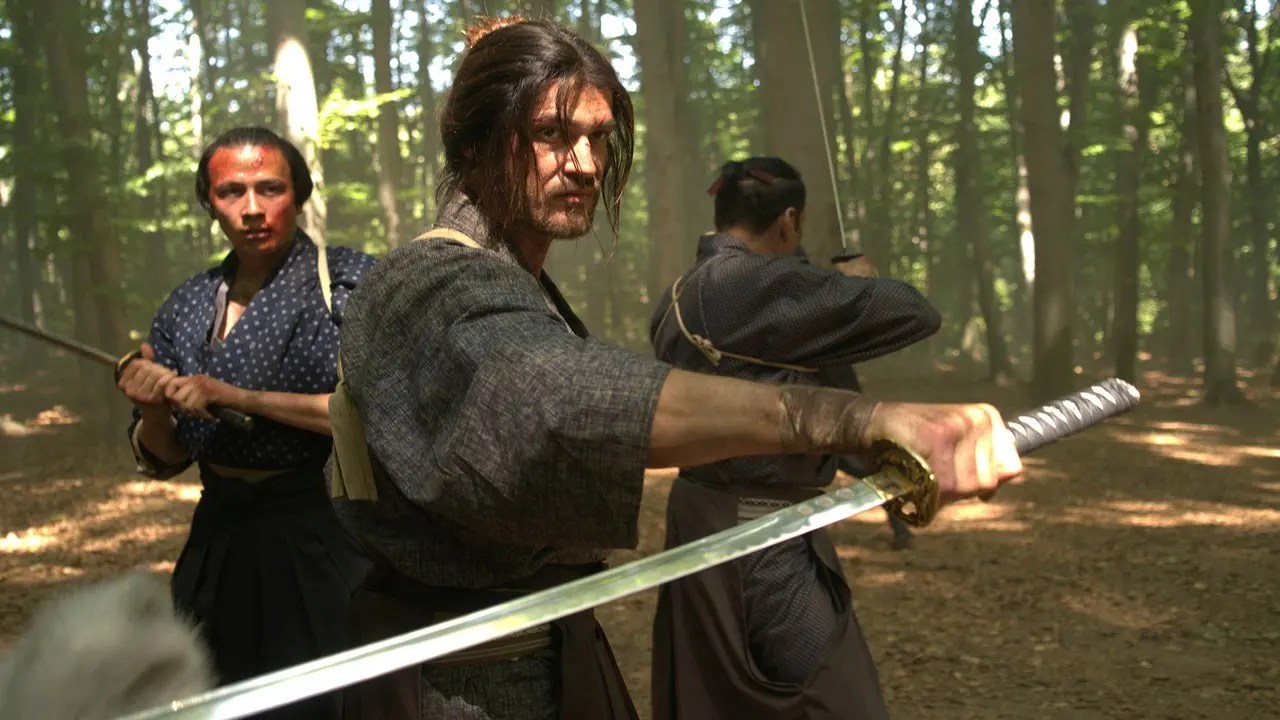
“Once Upon a Time in Ukraine” is a Syrnyky Western, a Slavic stroll down Sergio Leone Lane. It’s just gonzo and goofy enough to make one peruse the credits for the surname “Tarantinovich,” because that’s what writer-director Roman Perfilyev is on about.

It’s an 1844 story about as historical as anything Leone or Tarantino turned out, a tale of a “bondsman” or serf named Taras (Roman Lutskyi) out to free himself and his lady love (Kateryna Slyusar) from bondage and a half-Ukrainian samurai (Sergey Strelnikov) determined to avenge himself on the samurai (Gen Soto) who murdered his mentor and took that father figure’s Katana sword.

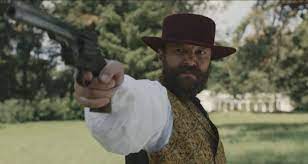
The Jewish gun dealer who throws in with them could be an ally, or an opportunist living down to the “sneaky” stereotypes Taras doesn’t hesitate to trot out.

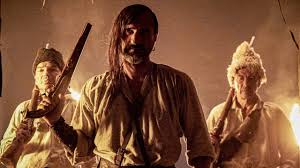
There’s a Cossack bandit, Bogdan Chuba (Yakov Tkachenko) leading a revolt against the landlords, oligarchs (Russians, maybe?) who enslave and sell serfs, sometimes to Japanese sex traffickers. But you know Cossacks. You either join him or face his wrath.

“Those who advocate equality present a threat to the system,” one of the fat cats reminds his fellow feline, in Ukrainian with English subtitles. As they ride around in sedan chairs and exploit the people, you just know they’re going to get theirs.

But our story has a lot of obstacles to the samurai and the serf getting what they want. At least the samurai is “an artist” with a sword. But as Taras thinks of himself as “a different kind of artist, a poet, a writer” how much help can he be?

There’s nothing for it but to acquire guns (the gun dealer, an Adrien Brody look-alike) and train Taras in using a Katana sword, which our samurai, Akayo, can weild to dismember his enemies and in a pinch, even fend off bullets.

“The Good, the Bad and the Ugly” tone is set early enough and underscored by Akayo’s complaint about the script’s tight time frame for “training.”

“You haven’t learned a lot in two days,” he gripes in Japanese-accented Ukrainian.

Ninjas, opium smoking, duels, serving a meal on a naked woman, all manner of historically dubious firearms and anti-Semitic insults (“You circumcised schnitzel!”) pass through the sometimes jaunty 90 minutes of this Eastern/Western. We’re treated to a Ninja hiding in the pit of an outhouse, deciding who to shoot with a Cossack version of “Eenie meeny miny moe” — “A sackfull of crayfish rolled down the hill, one, two three, which one do we kill?” — and an amusing version of a “Raiders of the Lost Ark” gag.

It doesn’t all work, and the pacing isn’t as brisk as the material demands. But the swordfight fights are furious (Wirework!), the shootouts noisy and bloody and the third act provides a couple of genuine bellylaughs.

Tarantino may be retiring, but let’s hope writer-director Roman Perfilyev gets to roll cameras on more gonzo, bastardized history in a free Ukraine. He’s got the touch.

Rating: unrated, graphic violence, nudity

Cast: Roman Lutskyi, Sergey Strelnikov, Kateryna Slyusar, Yakov Tkachenko and Gen Seto.

Credits: Scripted and directed by Roman Perfilyev. A Samuel Goldwyn release.

Running time: 1:30

Posted in Reviews, previews, profiles and movie news | Comments Off on Movie Review: “Once Upon a Time in Ukraine”