
Movie Review: Unsupervised Lunar Kids take a “road trip” to the “Crater”

“Crater” is a slick, cutesie kids’ action melodrama that makes the point that no matter where we transport them, human kids will be kids. And left to their own reckless devices, they’ll go all “Goonies” on you, even on the Moon.

It’s a Disney production, so don’t go in expecting much of an edge. But there is just enough of one to give this tale of life and death and growing up off-Earth to make this interesting.

It’s 2257, and the Moon has been settled for a couple of centuries now. But rather that developing into an off-Earth oasis, it’s still a mining colony, where miners and their families and corporate infrastructure live under a domed largely sub-surface complex.

They’re mining for helium, which is needed to power cryo-sleep starships that transport humans to Omega, an earthlike planet 75 years away.

Caleb, played by Isaiah Russell-Bailey, has just been given the tiny tube with the cremated of his miner-father. His dad’s “death benefits” include a paid-for transport to Omega, which means the young teen will be leaving his friends behind, and in just a couple of days.

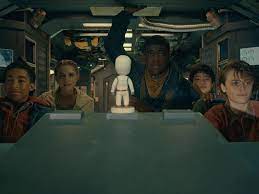
When we meet them, Caleb, mop-topped Dylan (Billy Barratt), Little Mr. Insecurity Borney (Orson Hong) and Marcus (Thomas Boyce) are in the process of swiping a huge, six-wheeled rover to drive them to “The Crater.” Flashbacks tell us that Caleb’s Dad (Scott Mescudi) made him promise “if anything ever happens to me” to go there.

Now, with the help of the cute “spoiled little Earth girl Addison (Mckenna Grace from “The Handmaid’s Tail”), who can gett hem through through the airlock, they’re fulfilling Caleb’s dad’s last wish.

An impending meteor shower “lockdown” has given them the cover to carry out the theft. Heedless of the danger, they head out across the surface for a twelve hour one-way journey.

“Are you sure this is safe?” is worth asking, more than once, especially any time some teen blurts out “You guys ready for some REAL fun?”

The “edge” here comes from the jaded attitudes of the kids, their mistrust of The Company in charge. Every one of them, it seems, has some horror story of the “Sold My Soul to the Company Store” contracts their miner parents wound up trapped in. A “debt” that can’t easily be worked off, deaths, no real prospect of returning to Earth, little interest in the expensive journey into the unknown, without their friends, the only parent we see is Caleb’s, and he’s only here in flashbacks.

There’s enough of this that an adult viewer might be wondering if this corporation is telling people the truth about anything. A meteor shower means a time-consuming “lockdown?” You’re shipping me off to Omega? Sure.

So, a little joyride, a little “baseball” lesson from the Earth girl, a few hinjinx with their precious oxygen supply, some “Who could have seen THAT coming?” perils, and checking out the ruins of space ventures past on their way to a crater with something mysterious in it, an idea swiped from “2001: A Space Odyssey.”

Being a film for kids, there’s no point in parsing the science, the lax dome security and the mysterious living conditions that have children growing up with so little adult interaction it really is as if “The Goonies,” or their VERY mild-mannered descendents, have moved to the Moon.

“Crater” is a good-looking movie, with decent effects. It’s about as logical as any version of “Lost in Space” or “Space Camp.” The bland script gives every kid “issues” — trauma, despair over a limited future, an enlarged heart from living in limited gravity too long — and a couple of actions scenes that could leave them breathless and dead in the cold near vacuum of space.

But the sentimental moments don’t really play, and the comedy — NO horseplay in the ROVER, you GUYS! — leaves a lot to be desired.

Kids may get a little something out of it thanks to its various “Young Adult Fiction” types and tropes. Maybe they’ll enjoy pondering if low gravity could be the thing that “saves” baseball.

Anybody old enough to drive will be bored.

Rating: PG

Cast: Isaiah Russell-Bailey, Mckenna Grace, Billy Barratt, Thomas Boyce, Orson Hong and Scott Mescudi

Credits: Directed by Kyle Patrick Alvarez, scripted by John Griffin. A Disney+ release.

Running time: 1:44

Posted in Reviews, previews, profiles and movie news | Comments Off on Movie Review: Unsupervised Lunar Kids take a “road trip” to the “Crater”

Movie Preview: A Tease, and just a tease, of Emma Stone and Ruffalo and Dafoe in Yorgos Lanthimos’ “Poor Things”

“The Favorite.” “The Lobster.” Now, Sept. 8, oddness incarnate, “Poor Things.”

Posted in Reviews, previews, profiles and movie news | Comments Off on Movie Preview: A Tease, and just a tease, of Emma Stone and Ruffalo and Dafoe in Yorgos Lanthimos’ “Poor Things”

Movie Review: Crazy and Mute? Who’ll notice in the “Fool’s Paradise” of Hollywood?

Charlie Day made his bones as a funnyman as the guy with the fingersnails-on-a-chalkboard voice.

The screeching star of “It’s Always Sunny in Philadelphia,” “Horrible Bosses” and “Fist Fight” takes his shot at mime with “Fool’s Paradise,” a making-movies comedy with Day joining the Keaton, Chaplin and Jaques Tati tradition.

In his writing, directing and starring debut, he leaves the screech behind for silent shtick, a version of Peter Sellers in the Blake Edwards’ Hollywood riff, “The Party” or Richard Mulligan in Blake Edwards’ other Hollywood spoof, “S.O.B.”

It’s a bit of a “Fool’s Errand,” alas, grasp exceeding one’s reach and all that. But Day has to be pleased he got this shot. And if he’s a John Lennon fan, he can take comfort in “Count your age by friends, not years. Count your life by smiles, not tears.” Because look at all the funny people who checked=-n to help ol’Charlie out.

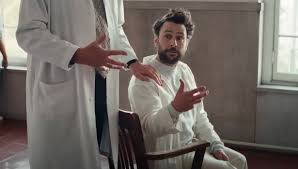
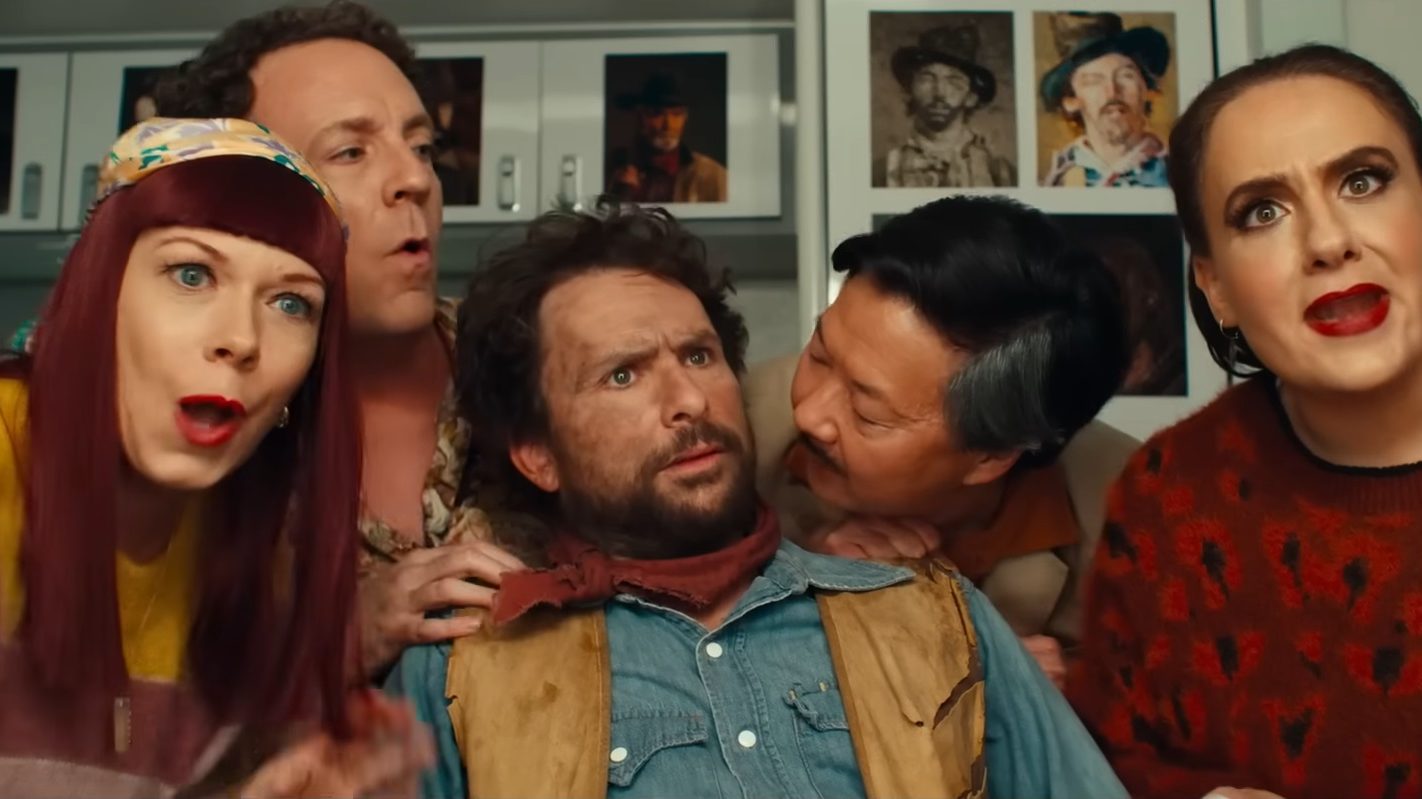
He plays a difficult film star, breaking down so badly in the middle of an expensive “Billy the Kid” movie being filmed on Hollywood soundstages that the ill-tempered producer (Ray Liotta), spying an escaped mental patient peddling oranges on a street corner (Day, again), decides “THIS” is how they’ll “make our day” on the production schedule.

The look-alike stands-in, takes over and despite being mute, confused and overwhelmed by the violence of film production — from the awful hours to the makeup chair ordeal and being manhandled for take after take by the likes of Oscar winner Adrien Brody — becomes a star.

Ken Jeong pulls out all the stops in a way we haven’t seen since his “Hangover/Role Models” days playing an impoverished, incompetent publicist willing to do ANYthing to land a client. Kate Beckinsale, buried under makeup and an accent, then buried under attitude, is the “Kid” co-star (a Calamity Jane type) named “Christiana Diorr” who instantly beds and weds our rising star, who wins the name “Latte Pronto” for reasons that are soooo L.A.

Jason Bateman plays a deadpan on-set effects guy. Jason Sudeikis is the vain, delusional action director Lex Tanner of the “Fast Racer” movies, hired to turn Latte Pronto into comic book hero “Mosquito Boy.”

Edie Falco kills it as the agent who heads up the new star’s “team” of eight — manager, business manager, lawyer, publicist, stylist, personal assistant and intern.

Veteran big screen/little screen bully Dean Norris is the blowhard studio chief who has assistants whisper how he’s supposed to chew this mishaps-prone new talent out, and whisper who he really is when the chief chews out the wrong pipsqueak.

And Jillian Bell is the new wife’s overpriced “shaman.”

The funniest scenes are the manic, noisy early ones, as our undiagnosable head-case is worked-over by Brody’s “half-Method, now” co-star. “Used to go full Method. But people got hurt. Not me.”

Brody ALWAYS gives good gonzo in comedies. Here he channels every story we ever heard about Dennis Hopper as a character actor on the make and recklessly behind the wheel of a vintage Mach I, drinking and driving and shooting out a street light that hosted the first dance between Emma Stone and Ryan Gosling. Welcome to “La La Land,” indeed.

“James Dean died RIGHT OVER THERE” he drunkenly shouts from the lurching Mustang at one point.

Liotta, in one of his last roles, gives Day’s “Latte” his name by accident and a serious cussing-out on purpose. Ray Liotta chewing out Charlie Day, doing the Lord’s Work, right to the End.

The messaging here is that silence in show business is “a choice” that could earn you extra credit just for “Being There,” to mention another Sellers classic. Show folk love the sounds of their own voices so very much that they barely notice “Latte” never speaks.

That’s not deep, novel or particularly astute, as far as Hollywood observations go and not really enough to hang your screen comedy on.

But it’s a relief when the talking/screeching version of Day has an accident and the silent version takes over. He manages the pratfalls and double-takes well enough.

He’s no Keaton, Chaplin, Begnini, Sellers or David Hyde Pierce, to name some of the great physical comics of ancient and recent vintage. There’s no shame in that. Neither was Steve Martin, even though he took more shots and came a lot closer.

What Day tried to do was replicate those all-star farces that generations like his grew up with, but in an R-rated form. He failed.

But look at all these often funny friends who gave their all at trying to help him succeed.

Rating: R for language, some drug use and sexual content.

Cast: Charlie Day, Ken Jeoung, Kate Beckinsale, Edie Falco, Ray Liotta, Jillian Bell, Jason Sudeikis, Jason Bateman, Dean Norris, Adrien Brody and John Malkovich.

Credits: Scripted and directed by Charlie Day. A Roadside Attractions/Lionsgate release.

Running time: 1:37

Posted in Reviews, previews, profiles and movie news | 3 Comments

Movie Review: Surrendering to the Surreal, Memory Play as Magical Realism — “Giving Birth to a Butterfly”

I didn’t much care for “Giving Birth to a Butterfly,” although I can appreciate the attempt to meld elements of the Theatre of the Absurd, memory plays and magical realism into something odd, obscurant and quite out of the ordinary.

A modern story of childish, delusional adults, a pregnant teen and a “big hearted” pet store kid who wants to help her raise her baby, the script folds in local theater, identity theft and dreams that have taken over the lives of some characters, at least one of whom becomes a surrogate for the audience just often enough for us to appreciate the “speaking out in protest” effort, if not its impact on the narrative.

“I don’t mean to be rude,” she says, “but you don’t make much sense.

It matters a little who she is, but it doesn’t matter who she says this to, because while “tragedy is all around us,” it’s the dreamy flakes, veering from upbeat to harshly critical, depending on how you react to their delusions, who take up most of the oxygen here.

Daryl (Paul Sparks) is a father of two trying out restaurant names — “Beautiful and Real Food,” he offers. “Daryl’s Cafe?” “Karma? If was a drive-up place you could call it ‘Carma.'” The whole house is saving up to fulfill this dream.

Wife Diana (Annie Parisse) listens indulgently, daughter Rachel (Rachel Resheff) humors him in between rehearsals of the play she’s lighting.

Son Andrew or “Drew” (Owen Campbell) is expected to go to college until that moment that he walks in with a pregnant peer, Marlene (Guy Birney) on his arm. But the baby’s not his. He’s just stepping up and leaping into adulthood as he does.

A scene or two later, we see Daryl in his chef’s jacket, passing on a burger and fries order to his boss, whom he addresses as “Chef.”

“DARYL! Stop using up all the aprons (to make a fake chef jacket)! You’re not a real chef!”

Rachel dreams of a life in the theater, hearing out the young actors as they try out “stage names.” A light that drops from the ceiling is another clue that maybe we should be taking “Giving Birth to a Butterfly” as a comedy. She’s a little sloppy in living her dream.

Another point-of-view change takes us into Marlene’s home life. Her aged, single mother has gone full “Sunset Boulevard.” She’s ready for another imaginary interview.

“I just need them to see me, Marlene,” she says, swanning about and asking Marlene to “zip me up” into dresses from decades before. She devours supermarket tabloids, looking for references to Brigitte something-or-other, her stage name. “You’ve got to read between the LINES, Marlene. They’re good at hiding what they’re REALLY saying.”

And then Diana hits the wall. She finds herself relying on this strange, pregnant teen she’s just met to travel with her to right a wrong in her life.

Yes, these are the two most rational characters, and yes, their destination and the two people they will meet there will prove just as odd and bizarre as much of what’s preceded this road trip.

The dialogue is mostly a series of confessional musings and memories masquerading as conversations.

The early scenes have a random, “What or who could be next?” curiosity. And they do lead to something like a conclusion.

But the entire enterprise feels like a piece of experimental theater that needs further workshopping before it’s ready for the stage. We all have a higher tolerance for this sort of intentionally opaque drama/dark comedy decorated with the odd lovely turn of phrase on the stage and the actors are right in front of us and thus too vulnerable to catcalls.

I mean, “I don’t mean to be rude. But you don’t make much sense.”

Rating: unrated, profanity

Cast: Annie Parisse, Gus Birney, Paul Sparks, Rachel Resheff, Judith Roberts and Owen Campbell

Credits: Directed by Theodore Schaefer, scripted by Patrick Lawler and Theodore Schaefer. A Cinedigm release.

Running time: 1:18

Posted in Reviews, previews, profiles and movie news | Comments Off on Movie Review: Surrendering to the Surreal, Memory Play as Magical Realism — “Giving Birth to a Butterfly”

Movie Preview: Mocking the “Origin Story” of “Flamin’ Hot” Cheetohs

Eva Longoria’s directing debut is about the “legend” of the real-life janitor who invents a popular snack food grabbed Dennis Haysbert and Tony Shaloub and Matt Walsh in support of Jesse Garcia and Annie Gonzalez for this June 9 Disney+/Hulu release.

Posted in Reviews, previews, profiles and movie news | Comments Off on Movie Preview: Mocking the “Origin Story” of “Flamin’ Hot” Cheetohs

Movie Preview: Josh Lucas has his OWN “Meg” problems — “The Black Demon”

It looks…humorless.

But the effects look rock solid and Paramount is hurling this bad boy against the cinema wall, and it will stream May 30.

“I know a big-ass shark when I see one!”

Posted in Reviews, previews, profiles and movie news | Comments Off on Movie Preview: Josh Lucas has his OWN “Meg” problems — “The Black Demon”

Movie Preview: Jason Statham’s still king’o the beasts, Mate — “Meg 2: The Trench”

“The Apex Predator” is back.

And we ain’t talking “Barracuda,” either. Another Megalodon?

“I just hope it goes better than last time!”

Aug. 4.

Megashark vs. J. Stath. Fair fight.

Posted in Reviews, previews, profiles and movie news | Comments Off on Movie Preview: Jason Statham’s still king’o the beasts, Mate — “Meg 2: The Trench”

Netflixable? Docudrama series “Queen Cleopatra” plays “her Truth,” but lacks Gravitas and Authority

With women’s rights and leadership role in society under assualt in many corners of the world, the time seems right for a fresh look at Egypt’s “Queen Cleopatra,” an “iconic” woman “who bowed to no man,” as producer/narrator Jada Pinkett Smith says in the opening narration of the new Netflix docu-drama series.

The historical record leaves little doubt. Cleopatra she was smart, cunning even, a shrewd operator in a politically-turbulent time.

“Vixen or strategist, collaborator of maverick,” the actress and podcaster/influencer Smith wonders in that narration? Whatever “her truth,” this much is undeniable. She “walked through the sandstorm of history and left footprints so deep that no man could ever erase them.”

This four part biography — tracing her from the day she took the pharoanic throne with her “husband/brother” Ptolemy XIII through her trials, alliances and dalliances with first Julius Caesar and then his protege Mark Antony (whom she married) and to her fall and death — recreates the key moments in her life and career in a modern vernacular with a British headed by Adele James, a Black British actress who backs up a central assertion of this series.

Cleopatra wasn’t just a tough, brilliant woman. She wasn’t just “Egyptian.” She was Black. And rolling this out now not only refutes “traditional” Western depictions of the queen (Liz Taylor et al), it beats the big screen “Cleopatra” starring Israeli actress Gal Gadot of all people to the punch by a year or more, Egyptian lawsuits be damned.

That assertion of her racial heritage, like much of what’s in this account of Cleopatra’s life, seems perfectly defensible. Let’s bring out the historians, air that thesis out and let young Cleo tame the epic Afro she’s wearing when we meet her into something more regal when she dons the crown.

But that’s where “Queen Cleopatra” trips up.

The Oprah-acolyte Smith’s assertion that this is “Her Truth” is telling. So is the first assertion of Cleopatra’s race introduced in the series.

“My grandma told me, ‘I don’t care what they tell you in school. Cleopatra was Black!”

Oh really? Professor Shelley P. Haley is the retired Hamilton U. academic who says that, and who has to know granny isn’t exactly an unimpeachable authority on the matter. It’s not the last “Oh really?” this “history” runs up against.

“Everyone can imagine her in their own way,” another of the six-and-only-six experts appearing on camera here asserts.Oh really?

Still, the series does a decent job of making the case that since we don’t know who Cleopatra’s mother was, only that her father was the Macedonian descendant of one of Alexander the Great’s generals, Ptolemy XII Auletes. So it’s possible and indeed acceptable, based on the little contemporary art and few contemporary accounts describing her, that she was of Nubian/Macedonian (Greek) descent and darker skinned than your average Egyptian of the day.

But the approach here is limited, more History Channel (“History Channel lite”) in its authority than your typical PBS or BBC produced history.

The historians and authors — one is a “PhD candidate” — are almost all women and their use of “emojis” and “ghosted” and other Twitter vernacular in making sweeping statements about “the Egyptian people LOVED her” and “the Roman elite were DISGUSTED by her” can’t help but make them come off as lightweights.

The titles that list their credentials leave off where most of them teach, giving the impression of the producers cherry-picking “performers” without necessarily having the imprimatur of “tops in their field.”

That’s VERY History Channel, BTW.

The settings for the reenactments are decent if inexpensive. The reenactments themselves are a tad stiff, occasionally perfunctory, not quite “The Tudors” sexual, but with the stilted (Brit-accented) Speech of History sprinkled with more approachable, common usages.

“You can’t share my bed and LIE to me!”

While “Queen Cleopatra” can be relied upon to relate her Greatest Hits — the smuggled-in-to-an-audience-with-Caesar-rolled-up-in-a-rug business “probably never happened,” but hell, let’s re-enact anway — it lacks the gravitas to come off as anything that truly rewrites her story.

The scripts set up a thesis — that she was an agent of her own destiny, not just swept along with it, that she was accomplished, learned and cunning and Black — and never quite closes the deal.

If you’re going to make a Big Assertion about her race, even one that’s more generally accepted now than ever before, why not hunt down more historians to talk about that? If Rome was “DISGUSTED” by her, why doesn’t one of these academics ponder the notion that plebian Rome might have been, you know, racist?

Limiting your scope, cheaping out on the research and then cutting corners on the least expensive part of the production — “experts” — just makes us wonder if you had trouble finding lots of accomplished historians to back you up. And no, they don’t have to be old, white men to be “accomplished.” I was waiting for that one voice pushing back against this or that, and it never comes.

Make your assertion, then make your case, covering as many sides of the debate as possible. Because the rest of us aren’t going to take grandma’s or Jada Pinkett Smith’s word for it, even if we never miss an installment of her podcast.

Rating: TV-14, violence, sexual situations

Cast: Adele James, Craig Russell, John Partridge, Andira Crichlow, Callum Banforth, narrated by Jada Pinkett Smith.

Credits: Created/produced by Ben Goold, and Jada Pinkett Smith and Jimmy Abounouom. A Netflix release.

Running time: 4 episodes @50 minutes each.

Posted in Reviews, previews, profiles and movie news | 31 Comments

Movie Review: Shameful Hawaiian History Remembered — “The Wind and the Reckoning”

“The Wind and the Reckoning” is the poetic title of a modestly-budgeted but informative and sometimes moving historical thriller set during the days of The Republic of Hawaii.

That was the government set up by an American-backed coup in the 1890s that ousted the island chain’s traditional rulers in favor of an non-native Hawaiian oligarchy that would run things while lobbying Washington to claim Hawaii as a territory.

The film, a history lesson written by the screenwriter of “Hidalgo,” “The Forbidden Kingdom” and “The Highwaymen,” tells the true story of a Leper War which errupted in 1893, a fight over forced resettlement of those infected with the disease — imported to Hawaii by foreigners in the mid-19th century.

The new “white” government took policies meant to curb leprosy — one of several imported contagions which the natives had no immunity against — to draconian extremes, arresting people thought to be infected via a “bounty” system which had armed men looking for lepers to ship off the the colony set up on the remote, almost unreachable Kalaupapa peninsula.

The story is told by Pi’ilani (Lindsahy Marie Anuhea Watson), the young bride of a native Hawaian cowboy, Ko’olau, played by Jason Scott Lee. They work on “Uncle” Sinclair’s (Patrick Gilbert) ranch until that day that word gets out their young surfer son (Kahiau Perreira) is sick. Ko’olau is breaking out, too, but not Pi’ilani.

They make plans to flee, but the sheriff (Matt Corboy) and a posses of ruffians (one of them is played by the late Lance Kerwin) charge in before they can escape, a stand-off over “legitimate” authority ensues, shots are fired and “haole” blood is spilled.

The family is on the run into the jungles and up the cliffs of Kauai. The new government decides to make an example of the trio and sends a mercenary force led by an Army beteran (Henry Ian Cusick) and a Hawaiian-born tracker and marshal (Johnathan Schaech).

The family throws in with other fleeing locals, who could prove to be a thorn in the side of a new “republic” whose legitimacy is very much in doubt, with a Democratic president and much of the U.S. decrying “imperialism,” and not just the version practiced in Europe.

That’s an awful lot of baggage for this slim script to tote, and with a lot of Hawaiian language sequences (with subtitles) further complicating matters. So screenwriter John Fusco skips over some of it and leaves out much more.

Getting into the whole business of the connection between the “President” Dole running the new “republic” and the big fruit concern that would begin just as the U.S., under a new Republican president, would take possession of the islands, would be messy, so that’s probably wise.

But lacking some of that context robs the picture of the stakes of this uprising, and leaves us with a simple on-the-lam-from-the-law pursuit through some of the most gorgeous scenery on Earth.

And director David L. Cunningham may know Hawaii (“Running for Grace” was his). But the guy who made “The Seeker: The Dark is Rising” has a very hard time keeping this picture on the run. It sort of stumbles from fight to fight.

Lee makes a sturdy lead, Watson a passionate keeper of the family faith and Cusick a fine racist, murderous and alcoholic villain. But the confrontations turn repetitive and the connecting scenes lack the urgency of “running for our lives.”

Other characters (Kelemete Misipeka plays “the judge”) give the film local color, as if the cliffs, jungles and farmland of Hawaii wasn’t enough.

But a few emotional moments, a couple of exciting firefights and a lot of murky debate about the issues, the politics and the morality of what’s happened to the government and what could happen to the people leave “The Wind and the Reckoning” with an incomplete feeling.

Which is why I’ve provided “for further reading” links. The story absolutely demands them.

Rating: unrated, violence

Cast: Jason Scott Lee, Lindsay Marie Anuhea Watson, Ron Yuan, Kahiau Perreira, Matt Corboy, Kelemete Misipeka, Lance Kerwin, Henry Ian Cusick and Johnathan Schaech.

Credits: Directed by David L. Cunningham, scripted by John Fusco. A Lynmar release.

Running time: 1:34

Posted in Reviews, previews, profiles and movie news | Comments Off on Movie Review: Shameful Hawaiian History Remembered — “The Wind and the Reckoning”

Movie Review: A Gay Son Confronts a Stepfather about “Velvet Jesus”

“Velvet Jesus” is an indie melodrama that tumbles into the obvious trap, the one symbolized by its title.

It’s so slow it’s static, like watching the paint dry on a paint-by-numbers “velvet Jesus” kit that a little boy, seen in flashback, wanted for Christmas back in the 1960s.

Directors Anthony Bawn and Spencer Collins and screenwriter Charles McWells dreamed up a period piece of reckoning — a wronged gay man confronting an abusive step father in 1986 Watts. But their dream dramatically flatlines from the opening credits onward.

It’s a two-hander,with most of the action confined to a cluttered, run-down house within sight of the Watts Towers. A Watts Chronicle reporter (Jensen Atwood) shows up to interview an old man (Ernest Harden, Jr.) for a story about “Black veterans.”

But “reporter” Carl takes no notes. He wears glasses and an ill-fitting hat sits atop his ’80s Afro. He may ask Vernon about his early life and service. But Carl isn’t here for that. And when the deception fails, out comes a snub-nosed ’38.

Carl wants to have a conversation with the man who called him “Carol” and worse as a sensitive, effeminate “special” child growing up in the ’60s.

The evening-long “debate” is tepidly written and sluggishly filmed and edited. The dialogue is of the “I was a little tough on you growing up. You NEEDED it” variety, with the stepson’s complaints about Vernon’s drinking “bringing out the EVILness in you” and stepdad dissecting the man he wanted to make out of Carl, his idea of the “N-word” and his “side of the story” every time Carl speaks of a wrong done to him nearly 20 years before.

The acting isn’t great, something partly attributable to the tentative editing, not knowing how to cut for maximum engagement with the characters, and pacing.

Some of the “action” — an escape attempt — is off camera. The violent climax, however, is put on screen, and is so amateurishly executed it too should have been kept off camera.

It’s a story with limited aims and ambitions, although perhaps it has personal and heartfelt meaning to those who created it. No matter what its larger aims, “Velvet” seizes up, right from the start, as we’re treated to four lengthy minutes of Carl getting out of the shower, painstakingly getting dressed for this meeting with his past, actions set to a smoky trumpet jazz score.

The pace never picks up from that slow-walk pedestrian opening, making “Velvet Jesus” a half hour movie stretched to 102 tedious, uninvolving minutes.

Rating: unrated, violence, alcohol abuse, profanity

Cast: Ernest Harden Jr., Jensen Atwood.

Credits: Directed by Anthony Bawn and Spencer Collins, scripted by Charles McWells. A Breaking Glass release.

Running time: 1:42

Posted in Reviews, previews, profiles and movie news | Comments Off on Movie Review: A Gay Son Confronts a Stepfather about “Velvet Jesus”