Movie Review: “The Starling Girl” runs afoul of the Fundamentalist Patriarchy

A teenage girl gives in to her hormones and to tempation and faces the fundamentalist consquences in “The Starling Girl,” an evocative, gripping and revealing drama about a strict upbringing and how it can backfire on the person being groomed.

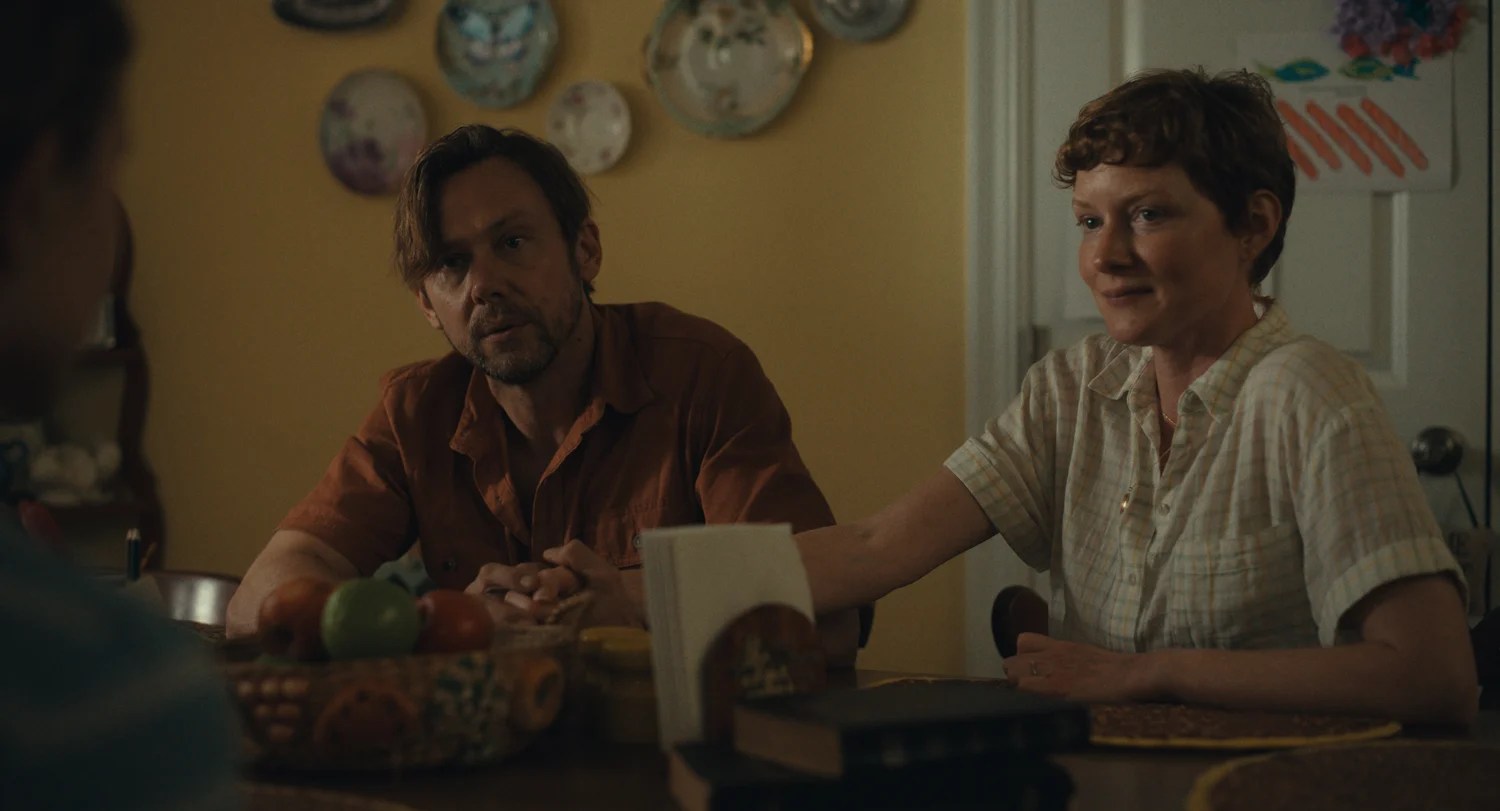
It’s a smart and well-cast and acted debut feature from Laura Parmet, and a fine showscase for Eliza Scanlen of “Little Women” and TV’s “Sharp Objects.” In the title role, she plays 17 year-old “Jem,” whose rural Kentucky life revolves around the neo-Pentacostal “in the spirit” church which she, her three siblings and her parents attend.

She’s in the church youth dance troupe, letting her artistic passion out through PG-rated performances in modest dresses just shy of Amish.

The church is the sort of place where teen courtship is arranged via parents, so when uncharismatic bore preacher’s son (Austin Abrams) takes a shine to her, his preacher dad (Kyle Secor) and Jemima’s dad parents (veteran character players Wrenn Schmidt and Jimmi Simpson, superb) meet and make “Seventeen’s the time to start thinking about these things” noises.

As Jem has to hear out a fellow congregant’s reproach for wearing a bra that can be seen underneath her clothes when she performs, it’s her place to keep quiet and say nothing in protest.

Yes, this is a patriarchy. But the women keep the other women in line, and in Jem’s case, Mom is the one who runs their house, ensuring recovering addict/county music singer Dad on the straight and narrow.

But Jem has hormones that all her middle of the night whispers of “Out Satan, out!” can’t control. The preacher’s other son, Owen (Lewis Pullman of “Top Gun: Maverick” and TV’s “Outer Range”) has just returned from a mission to Puerto Rico. He’s the youth pastor, newly-married. And at some point Jem developed a crush on him that just won’t quit.

She starts stalking him with an earnest sense of purpose he probably notes but doesn’t acknowledge or rebuff. She angles herself into any excuse to chat with him during youth group meetings, at group outings at the fair or helping him gather firewood on a group camping trip.

This is a seemingly innocent infataution, but one with an edge. Whatever the youth pastor is thinking, he’s not saying. Jem lets us know her thoughts in her prayers.

“Lord, I come before you humbled and ashamed.”

Continue reading
Posted in Reviews, previews, profiles and movie news | 1 Comment

Movie Preview: “Teenage Mutant Ninja Turtles: Mutant Mayhem” shows the Seth Rogen touch

Well, children aren’t watching these guys any more, are they?

So why not throw Seth Rogen and his partner in the profane Evan Goldberg at this material. Because there’s just not enough “dark” and edgy fanboy content in the movies these days.

Like the song says, they’re” “growing older but not up.” That could be said of Las Tortugas and their fanbase.

Aug. 2.

Posted in Reviews, previews, profiles and movie news | Comments Off on Movie Preview: “Teenage Mutant Ninja Turtles: Mutant Mayhem” shows the Seth Rogen touch

Movie Review: “Spider-Man: Across the Spider-Verse”

Sony’s effort to wholly blur the line between “comic book” and “comic book movie” comes to something like full fruition with “Spider-Man: Across the Spider-Verse,” a mad cinematic jumble of comic book imagery, comic book mimicry, multiverse plotting and ponderous, pandering fan service.

Where the first film in this animated trilogy was an aesthetically-challenging headache of dot-matrix comic book printing imagery that caused instant eyestrain (in some viewers) by design and flash-imaging seizures in others, the sequel shifts away (somewhat) from the former and doubles-down on the latter, diving into every imaginable incarnation of Spider-Man — the animated TV series, a live action character, a leap into LEGO — with a mad whirl of animation, drawing and painting styles often served up in head-spinning montages that take us through the seemingly infinite smorgasbord of Spideys across all the multiverses.

It can be dazzling, overwhelming and eye-straining as you try to decide what to focus on and why the trio of directors on this project chose to render so many characters in a blurry, unfocused foreground or background. A veritable history of 20th century art and comic booking is painted over sequences, shots and scenes, creating some pretty pictures and some downright ugly imagery, a lot of which doesn’t advance the plot.

Still the “multiversing” of Spider-Man does wonders for inclusion, a real selling point for this trilogy.

“Across the Spider-Verse” fills the screen with famous voices, or in many cases, famous actors with voices most of us couldn’t pick out of a police lineup. Hearing the re-assuring bark of J.K. Simmons as J. Jonah Jameson on radio and TV across various ‘verses’ is somewhat grounding. This new “nemesis” “Spot” is unmistakably Jason Schwartzman, that school principal is Rachel Dratch. But Oscar Issac, Daniel Kaluuya, Issa Rae, Hailee Steinfeld and Oscar winner Mahershala Ali flesh out a distinguished if vocally-indistinct supporting cast.

Stay through the credits and see who actually did what. Don’t stay for the after-credits scene. There is none. The third film, “Beyond the Spider-Verse,” is coming. That’s all we need to know.

But as this or that Peter Parker or Gwen Stacy, Spider-Man, Spider-Woman, Spider-Punk or Hello Spider-Kitty skids across the screen, one can’t help but wonder if the comic books embraced this wrinkle in scientific theory, decades ago, when they ran out of villains and other ideas. And maybe the myriad multiverse movies are doing the same thing just to avoid commiting to a coherent plot with real stakes, real pathos and a narrative that doesn’t rely on periodic bursts of distraction and applause as each iteration of the character, the more obscure the better, makes her or his bow to swooning fans.

“Who’s Doctor Strange? Sounds like maybe he shouldn’t practice medicine!”

Yes, this is marginally more interesting and watchable than the first “Spiderverse.” No, it’s still more of a “feeling” than a film, getting by on razzle and dazzle, not all of which add to the experience in a positive or illuminating way.

Gwen Stacy’s Spider-Woman timeline moves more center-stage as we see her (Steinfeld) coping with the same issues Peter Parker normally does in Spider-tales. Her cop-dad (Shea Whigham) doesn’t know her vigilante hobby, and is sure Spider-Woman is who killed the Peter Parker in her ‘verse.’

A magical hi-tech wristband gadget allows others, and her, to bounce about universes to scores of numerically-differentiated “Earths,” where Spider-Man might be an Indian (Karan Soni) wisecracking through Mumbattan (a Mumbai turned into Manhattan), or street-cockney punk named Hobie (Kaluuya).

Miles Morales (Shameik Moore of “Dope” and TV’s “The Get Down”) is still on “Earth 42,” still just 15, struggling to make it to school meetings with his parents and the principal because of all the crimes and tragedies his conscience won’t let him pass by without intervening.

Miles is still young enough to think he can “save” them all, without having to choose. Much like the writers in your average comic book multiverse or comic book multiverse film adaptation.

Make a choice, kids. That’s life.

When a new nemesis, Spot (Schwartzman) — whom Miles repeatedly dismisses as “random” and worse, as far as super-villains go — emerges, a young scientist/being who loses “face” and yet can travel the multiverses with menacing ease, we arrive at “Across the Spider-Verse’s” buy-in moment.

Miles can’t handle him by himself. Asorted others — Jessica Drew (Rae), vampire Spidey Miguel O’Hara (Isaac), Gwen et al, are summoned as “back-up.”

If you’re thrilled by the mere thought of myriad Spider-interations joining the fight against a pan-dimensional and somewhat comical villain, and you recognize every character who shows up — Peter Parker as a 30something parent (Jake Johnson?), animated TV series Spidey? — this might be just the ticket. For you.

For everybody hoping to see something with narrative coherence, actions with consequences (before the finale), jeopardy and pathos coming from a screen crammed with images and a soundtrack of scrambled one-liners, some of which are funny, this isn’t all that.

Continue reading
Posted in Reviews, previews, profiles and movie news | Comments Off on Movie Review: “Spider-Man: Across the Spider-Verse”

“Spider Man,” when pigs or cats fly? In Tampa

This may start on time. Or not. Apparently, 24 locals somehow went to the wrong theater.

“Tampa” in a nutshell.

Posted in Reviews, previews, profiles and movie news | Comments Off on “Spider Man,” when pigs or cats fly? In Tampa

Movie Preview: A Trippy Kids’ Adventure to “The Secret Kingdom”

June 9, a little “Dark Crystal,” a bit of “Narnia,” a taste of “The Never Ending Story,” and a lot of reptilian CGI critters

Posted in Reviews, previews, profiles and movie news | Comments Off on Movie Preview: A Trippy Kids’ Adventure to “The Secret Kingdom”

Movie Review: Karma comes for “The Machine,” the shirtless funnyman who isn’t

I found an AMC “classic” (an old theater where they don’t fix that which is broken) near me and a matinee showing of comic Bert Kreischer’s “The Machine” that cost me a whopping $5.19.

No, I’m not asking for my $5.19 back, or my wasted time, or even an explanation as to why Sony thought a bloody, dumb and laugh-starved action comedy built around this stand-up’s sole claim to fame would be worth almost two hours of anyone’s life.

Well, it’s not like they could turn back time if I did.

I’m not begrudging Kreischer the cash, and I’m pleased his movie — smuggled into theaters on a holiday weekend (the trailers promised it was coming out May 31) — pulled in a respectable (ish) $6 million on its opening weekend. His fans knew where to find it.

They and many of the rest of us remember the Internet phenomenon that Kreischer ginned-up by recalling a drunken, Russian Mafia-befriending school trip when he was studying Russian at Florida State University.

A clumsy, bad-student mis-translation on his part (Florida…State) led to his billing himself as “The Machine” to his new Russian pals. And he found some shirtless stand-up comedy laughs — in his 40s — recalling the outrageous things he says went down when he was riding from St. Petersburg to Moscow with partying thugs, his fellow FSU students pretty much none-the-wiser–until he helped the Russians rob most everybody on that train.

“The Machine” is a comedy about Russian mobsters seeing this “viral” stand-up story and vowing revenge — actually the return of a pocket watch stolen on that long-ago misadventure.

Fair enough. That has comic possibilities.

But the married-with-two-kids-and-pushing-50 “Machine” is going through a binge-drinking-driven existential crisis. Bert may “make a living ‘creating a scene,’” a pretty good living from the looks of things. Yet he’s stopped doing his act and is in family-counseling because he’s made his teenaged daughter (Jess Gabor) ashamed.

His planned California sweet sixteen party for her is already going wrong in all the bad sitcom ways when Bert’s semi-estranged Florida carpet-kingpin father (Mark Hamill, miscast), the source of his “Daddy issues,” arrives.

And then this Russian mob daughter (Iva Babic) strolls in to threaten his daughter if “The Machine” doesn’t return the watch, which he has no blackout drunk memory of ever having.

Nothing for it but to go with them to try and retrace his tipsy late ’90s steps, with her and assorted oversized Russians, and with his Dad, who was “an Eagle Scout!”

“Vat eez ‘Iggle Scout?”

“It’s like if James Bond was a Mormon.”

In Mother Russia, Bert’s a “folk hero.” There he is, in all his roly-poly shirtless glory, on billboards and the label of a cheap brand of vodka. Gangsters all know the story of “The Machine,” the American who could hold his own in the most alcoholic culture on Earth, join in on slap fights and amuse one and all by imitating catch-phrases from Austin Powers movies.

“Do I make you horny, baby?”

Flashbacks decorate the quest of Bert, his Dad and his Russian minders’ quest for the watch, as we see Bert in his Florida Man attending a “football school” prime, played by Jimmy Tatro.

Those flashbacks recreate many of the scenes from “The Machine” story, which Bert re-narrates, in sections, throughout the movie.

Honestly, I love a good gonzo binge boozing comedy as much as the next guy, but I found almost nothing funny in this.

The recreation robs the story of its reliance on the listener’s imagination, and chopping this long comic anecdote into pieces strips the picture of momentum and makes the Blondie T-shirt wearing Bert’s tale not so far-fetched, unless you’re talking about the idea that anybody was ever amused by it.

Yes, Tatro can act. No, Kreischer can’t. Not really.

The picture’s turn towards the sentimental — after much mayhem and many shootings (this picture has more dead Russians than Kyiv) — is neither surprising nor affecting.

But there’s no begrudging the man the ticket price paid out for this dog. Because the cinema is littered with one-trick comics with one-picture careers, all of them longing for just enough of a bounce to match Larry the Cable Guy or Dane Cook (Remember them?) in terms of longevity.

There are scores of these guys who once got similar shots, and disappeared — guys I can’t remember by name or movie title to save my life. Tucker Max, anyone?

Still, I didn’t enjoy your movie, at all — no big deal. But relish this moment, “Machine.” Maybe you’ll get another. Just watch out for your liver if you do.

Rating: R for strong violence, pervasive language, drug use and some sexual references

Cast: Bert Kreischer, Mark Hamill, Iva Babic, Stephanie Kurtzuba, Jimmy Tatro, Martyn Ford, Aleksandar Sreckovic, Robert Maaser and Jess Gabor.

Credits: Directed by Peter Atencio, scripted by Kevin Biegel and Scotty Landes. Sony/Screen Gems release.

Running time: 1:52

Posted in Reviews, previews, profiles and movie news | 5 Comments

Netflixable? “The Year I Started Masturbating”

It’s titled “The Year I Started Masturbating,” it stars “Sleepy Hollow” hottie Katia Winter and it’s SWEDISH.

What’s not to love in this made-for-Netflix sex comedy? A lot. There’s a lot not to love.

It’s a tepid tease of a farce built around a woman’s sexual self actualization, sort of a modern twist on “It’s My Turn” and the Jill Clayburgh films of the ’70s. A couple of giggles, a genuine laugh, maybe two, some half-hearted “growth” and…credits.

Sexy? For a comedy about a just-ditched woman about to turn 40 who is lectured to start listening to her vagina’s monologues, not so much.

I reviewed that German teen sex comedy “Hard Feelings” the other day. It used the same “listen” to your genitals hook and the same confetti gimmick to simulate the thrill of orgasms. Must be something going around Europe right now.

When you’re a Swedish production and a German comedy drifting into the same territory is A) funnier and B) sexier, you’re not doing “it” right. No. Seriously.

Winter plays Hanna, a distracted creative type who can meet a deadline and dance her way to her dinner date, jamming to “Sweet City Woman” in Swedish.

But her date Marten (Jesper Zuschlag) is getting into a taxi. She’s THAT late. Not to worry, they live together and have a little boy. It’s all good.

But it isn’t. We get a hint that she’s a control freak — partly from him. And as he shakes his head at her refusal to quit her better-paying-job than his and almost melts down when he learns she’s spent “Tesla money” on a designer sofa without consulting him, we can see the writing on the wall.

Yes, the sitter calls to interrupt the break-up we see coming. There’s probably a culture joke in there, as the sitter lectures Hanna about the child’s priorities. “He” wants her at home. NOW. But it, like much of what’s supposed to play as light and funny here just doesn’t.

We get a sense that Marten’s pal has been urging him to end it. We see her dorky boss (Henrick Dorsin) hand her Post-It notes with women’s shelter and AA recovery phone numbers on them, assuming “that bastard” back home abuses her or drove her to drink, and Hanna’s best friend also leaps to conclusions about her “finally” dumping Marten.

She’s the last to catch on — at the hospital, where he’s just over-dramatized a cycling accident and is openly flirting with the nurse.

For the rest of the movie, Hanna’s jam — which she hears on earbuds, mournfully sings to herself in a “singing” therapy session and hears from a street accordionist, is “Must Have Been Love, But it’s Over Now,” by the Swedish duo Roxette.

Hanna reluctantly quit her job to save the relationship just before the abrupt dumping. She’s blown a fortune on a sofa, and has no cash. And she quickly runs out of people she can call on for a place to crash.

Only the fiesty young barmaid Liv (Vera Carlbom) seems to see what ails her.

In the words of Olivia Newton John, she’s not listening to her “body talk, body talk.” What Hanna needs, Liv lectures, is to master is the art of self-pleasure.

I don’t know how you fail to make a beautiful actress neither titillating nor amusing as she mimes stimulating herself at the office, or at home with a gadget, but hats off to director and co-writer Erika Wasserman for managing that.

Couples counseling scenes have long been the fodder for rom-coms, as such “professionals” are notorious for taking sides. That’s what happens here, and it’s not the least bit funny.

Even a sexual stimulation tutorial that gets accidentally blasted over the smart speakers at the office doesn’t merit more than a grin, the way it’s handled here.

A hook-up getting the news, in flagrante delicto, that his mother just died in hospice must play funnier in Sweden.

And the little speeches about the psychological, physical and professional benefits of masturbation aren’t clevely written or comically played.

The script makes Hanna a victim, but one with legitimate focus and disinterested-in-him issues. And Marten comes off the way she describes him, a “whiner” (in Swedish, or dubbed into English) and a bit of a whiney bully.

So we’re not rooting for him, we have a hard time rooting for her and we sure as shooting aren’t rooting for “them.”

How you start off with these movie “hooks” and end up with nothing makes “The Year I Started Masturbating” seem almost that long, and a comedy that comes nowhere near to measuring up to its tease of a title.

Rating: TV-MA, sexual situations, profanity

Cast: Katia Winter, Jesper Zuschlag, Henrik Dorsin, Nour El-Refai, Hannes Fohlin and Vera Carlbom

Credits: Directed by Erika Wasserman, scripted by Christin Magdu, Bahar Pars and Erika Wasserman. A Netflix release.

Running time: 1:41

Posted in Reviews, previews, profiles and movie news | Comments Off on Netflixable? “The Year I Started Masturbating”

Movie Review: Lithuania faces Soviet Occupation, and finds itself wanting — “In the Dusk” aka “At Dusk”

Lithuanian filmmaker Sharunas Bartas achieves a “Defiance” level of grim, wintry detail in his post-war Soviet occupation drama “In the Dusk.”

The director of “The Corridor,” “Freedom” and “Frost” tells a story of his native land’s countryside in 1948, with World War II finally ended, the fascists defeated and the communists moving in to take over.

Summary arrests, credulous denunciations and abitrary land seizures and “loans” to the “Soviet people” (government) were the new occupiers’ preoccupation. Those fighting back, hiding in the forests, clung to the hope that the Russians would withdraw, that the West — after “Churchill’s speech” at “Fulton” — would come to their aid.

If you remember your Eastern European Baltic States history, that help was a tad tardy.

We see the plight of the people through the teenaged Unte (Marius Povilas Elijas Martynenko) who has come home to the farm to find his father (Arvydas Dapsys) and stepmother (Alina Zaliukaite-Ramanauskiene) estranged and living under separate roofs, his father carrying on with the family cook (Vita Siauciunaite) and fretting over seeing everything he’s worked, suffered and married to attain ripped away from him by the machine-gun-wielding socialists who have come to town.

Will the lad find a way to keep his parents together, maybe hold on to some of the dirt-poor, struggling farm? Or will he join or return to (I couldn’t tell) the partisans who have taken to the woods and don’t seem to be carrying the fight to the Bolsheviks, no matter what they would have everyone believe.

As his father goes into hiding and the partisan-alligned Ignas (Valdas Virgailis) starts parroting socialist talking points (in Lithuanian with subtitles) — “They’re saying people will be given land…taken from those who have too much” and given “to those who have nothing.” — Unte has some considering to do.

The final third of “In the Dusk,” also titled “At Dusk” at certain points of its release, is where all the action is — interrogations, betrayals, shootouts and such.

The first 100 minutes of this midwinter’s tale is like watching snow melt. Bartas holds shots too long, lets scenes go on forever, and takes his sweet time getting to anything resembling a point.

Family intrigues, local rivalries, Russians disgusted by the poverty of the place and yet still determined to ruthlessly shake the locals down, the history here is fascinating, and rendered in what feels like slow motion.

Bartas must not have read Hemingway’s advice about murdering “your little darlings,” as huge chunks of the first two acts add little to the narrative and merely flesh out what we can see simply in situations and performances.

This is, no doubt, a vital piece of Lithuania’s history and well worth recalling with Putin’s fumbling efforts to reconstitute the Russo/Soviet Empire. But wasting this much time getting to the point is a lot like the infighting and recriminations amongst the opposition partisans in the film — hurling your efforts and your ammo in the wrong direction.

And recreating important history doesn’t give you the right to bore the viewer to death before getting around to your point.

Rating: unrated, violence

Cast: Marius Povilas Elijas Martynenko, Arvydas Dapsys, Alina Zaliukaite-Ramanauskiene, Salvijus Trepulis, Valdas Virgailis and Rytis Saladzius

Credits: Directed by Sharunas Bartas, scripted by Sharunas Bartas and Ausra Giedraityte. A Film Movement release.

Running time: 2:08

Posted in Reviews, previews, profiles and movie news | Comments Off on Movie Review: Lithuania faces Soviet Occupation, and finds itself wanting — “In the Dusk” aka “At Dusk”

Movie Review: American Quartet takes a zany “Joy Ride” through the People’s Republic

“Joy Ride” is loud, vulgar and crude, exactly what you’d expect from an Asian-American romp across “Girls’ Trip/Bridesmaids” terrain.

But “Crazy Rich Asians” screenwriter turned director Adele Lim gives this raunchy road trip comedy a “Joy Luck Club” detour into sentiment that sets her directing debut apart from all the other “women gone wild” outings of recent vintage.

It’s an unfiltered farce about growing up as “the Asian kid” in America, and about the adoptions end of the Chinese-American diaspora, a comedy of life paths and high expectations, finding your roots and having a lot of noisy, stereotype-smashing mishaps along the way.

Lim delivers a film littered with “Oh no they DIDN’Ts,” one that leans into the culture and swats the image in a lot of profane and unexpected ways.

Audrey was adopted by a white American family as a child. Luckily for her, the tiny bit of white suburbia where she moved already had a Chinese girl, Lolo, who’d moved there with her family.

When an elementary schooler trots out that favorite Asian slur of the underage and ignorant, Lolo’s response is profane and appropriately pugilistic.

A lifelong bond is born.

Years later, Audrey (Ashley Park of “Mr. Malcolm’s List”) is a rising star corporate attorney ready to close the Big China Deal. Lolo (comic and actress Sherry Cola of TV’s “Good Trouble” and “I Love Dick”) rents her garage apartment and makes genitalia-inspired art, bless her heart.

But if Audrey is going to China, she’ll need somebody with a slightly better handle on the language, as Audrey grew up with white parents. Lolo it is!

They’ll fly over, indulge in the Chinese rituals that accompany business deals (binge drinking, karaoke, slap-fight games). Audrey will catch up with her college roommate Kat (Oscar nominee Stephanie Hsu, who’s in everything, and was in “Everything Everywhere All at Once”) who is now a famous Americanized actress in Chinese cinema and TV.

And danged if that cousin-we-all-avoid doesn’t tag along on the trip. “Deadeye” (Sabrina Wu, making a deadpan screen debut) came by her nickname honestly, and it has nothing to do with marksmanship.

Business with the Chinese would-be client, a little sight-seeing, a little catching up with Deadeye’s family. Maybe they’ll even, you know, try and track down Audrey’s birth mother.

Their odyssey will bring a “best friends” rivalry (Lolo vs. Kat) to a boil, Asian “identity” into the spotlight and business to a halt as this motley quartet makes its way across China. The complications include family matters and love interest(s), drug smuggling and basketball, some of which land harder than others.

Lim finds her biggest laughs on the heels of every “Aww, isn’t that...” moment, starting from shy Audrey and brash Lolo meeting as tiny tykes.

Audrey finds a nice, safe “American” blonde (Meredith Hagner of “Search Party”) for them to share a train car with, and then the cops show up looking for a drug smuggler. The blonde panics and implicates one and all by blowing cocaine on everyone.

“You’re drug dealers NOW, bitches!”

The B-word is generously deployed throughout as mishap piles on top of mishap, Kat keeps getting recognized as the star that she is and Lolo uses every opportunity to try out her Mandarin vulgarisms and international gestures deploying her tongue and fingers to shock and awe the People’s Republicans.

Seth Rogen is one of the producers here, and the “best joke on the set” ethos infests this movie — shock-value profanities, throw away lines about racist “Mulan-themed office parties” and the Americans marveling how “We look like everyone else, for once” land laugh after laugh.

Hsu shows a sharp edge here, with Park letting us see a more outrageous side and Wu doing well with that always underestimated “nerdy, quiet one” type. But Cola fizzes and sizzles and swaggers through every scene, a bawdy force of nature, the Asian Danny McBride in this Rogenesque Lim China shop.

But the picture peaks, and nobody involved could think of a graceful way to finish during a turn toward the serious. Whatever one gets out of the third act, we can all hear what the director and screenwriters were muttering off camera in these scenes.

“How do we get out of this?”

Because once you’ve delivered your big “cocaine” joke, and played your “pose as K-pop stars” cards, what else is there?

But “Joy Ride” still fulfills the R-rated promise of “Crazy Rich Asians,” an outrageous comedy that isn’t just about representation. It’s a reminder that rude, raunchy laughs travel, translate and tickle, no matter who you are and where you’re watching.

Rating: R, profanity

Cast: Ashley Park, Stephanie Hsu, Sherry Cola, Sabrina Wu, and Desmond Chiam

Credits: Directed by Adele Lim, scripted by Cherry Chevapravatdumrong, Teresa Hsiao and Adele Lim. A Lionsgate release (July 7).

Running time: 1:35

Posted in Reviews, previews, profiles and movie news | Comments Off on Movie Review: American Quartet takes a zany “Joy Ride” through the People’s Republic

Classic Film Review: So how is “The Big Red One” holding up?

Memorial Day weekend always means WWII movie marathons on all your favorite classic movie channels. But I thought I’d get a jump on that by tracking down a favorite of mine from the ’80s and watching it for the first time in forever.

Samuel Fuller was a genre director who fit neatly into the French auteur theory of directors as “authors” of their movies, with not just a style and repeated themes in their films, but a psychological through-line tying them all together.

He specialized in Westerns (“40 Guns”), noirish crime dramas (“The Naked Kiss,” “Underworld, Inc.”) and filmed, for what it’s worth, the very first “Vietnam War” movie — “China Gate” (1957).

But World War II movies were his bread and butter. He was already a screenwriter when he went into the Army. And when he got out, he dove into making gritty, often cynical grunts-eye-view pictures such as “The Steel Helmet,” “Fixed Bayonets” and “Merrill’s Marauders.”

It wasn’t until “The Big Red One (1980)” that we got a clear picture of what Fuller’s combat experience was like. He served with the Army’s First Infantry Division, came ashore in Algeria with the first waves when no one knew if they French they were facing would fight them or join them, survived the Battle of the Kasserine Pass, fought in Sicily and was on the beach on D-Day.

Fuller fought across Europe, and was present (and even filmed) the liberation of the Falkenau Contentration Camp. Silver Star, Bronze Star, Purple Heart, the man had a helluva war.

All of which lend credence to the film many call his “masterpiece,” “The Big Red One,” named for the division’s shoulder insignia, a saga that skips through all that combat, from shipboard waiting to board the boats all the way through V-E Day.

With a budget that dwarfed most of his genre pictures and coming out in 1980, Fuller finally got his moment in the cinema spotlight with a movie that starred long-in-the-tooth Lee Marvin, “Star Wars” hot Mark Hamill, Robert Carradine of the acting Carradine clan and Bobby Di Cicco, fresh off the epic Spielberg flop “1941.”

It has gripping and believable small-unit combat set-pieces, a cynical “inner circle” of survivors who look on replacements as men they refuse to get to know, seeing as how they’re likely to get killed, and a serious foot-soldier’s eye-view of the war — limited, myopic, concerned first with survival, second with food and-or creature comforts.

The script includes almost magical “fog of war” interludes with a Sicilian boy who will only direct the squad to a German gun emplacement if they help him bury his killed-in-the-combat mother, an assault on a German-held insane asyllum, a baby that simply must be delivered inside of an abandoned German tank and a framing device that sees the WWI vet Sgt. played by Marvin involved in the killing of Germans after the end of hostilities in both “The Great War” and “The Big One,” as veterans referred to WWII.

The dialogue is classic hard-boiled Fuller.

“You’re going to live, even if I have to blow your brains out.”

But 40+ years on, the thing that stands out about the film now is how corny it all is — a combat Pilgrim’s Progress that travels through tropes and cliches that were a lot more familiar to audiences when it came out than maybe they play today.

“The Big Red One” came out after “Patton,” after “A Bridge too Far” and nearly 20 years after “The Longest Day,” its closest WWII combat analog, a movie a lot creakier and cornier than this one thanks to the showy star cameo-cluttered cast.

Fuller’s alter-ego on the screen was Carradine, a few years short of “Revenge of the Nerds.” Private Zab is a cigar-chomping cynic who mouths off at the replacements and voice-over narrates the poor picture to death, first scene to last.

“You know how you smoke out a sniper? You send a guy out in the open and you see if he gets shot. They thought that one up at West Point.”

That’s a detective fiction device that Fuller knew all too well. The character, an already published novelist whose novel sells to Hollywood while he’s serving, is all-knowing and on-the-nose, chomping on a cigar like the WWII comic book version of Nick Fury.

What’s the first rule of cinema? “SHOW us, don’t TELL us.” It’s a visual medium. Zab is forever narrating plot points we’ve already picked up on.

“By now we’d come to look at all replacements as dead men who temporarily had the use of their arms and legs. They came and went so fast and so regularly that sometimes we didn’t even learn their names. Truth is, after a while, we sort of avoided gettin’ to know them.”

But the film gives Marvin — 56 when it came out — one last chance for an actual WWII combat vet (Marines, in the Pacific) to shine in a combat role, and he growls through his patient but unsentimental treatment of the combat-timid Private Griff (Hamill, quite good).

Marvin’s flintiest moments come in this film’s version of the “bangalore torpedoes” on the beach on Omaha Beach on D-Day, basically a more personal reprise of a scene Robert Mitchum starred in back in “The Longest Day.” And his most sentimental scene is in that concentration camp, taking a dying child under his care for a day.

The episodic nature of the movie afforded Fuller the chance to find light moments in the darkness, grim humor in the murder-or-be-murdered world of German submachine guns, castrating mines (graphically illustrated) and close-quarters knife work.

It’s not Fuller’s fault that Spielberg would come along under twenty years later and deliver the last word in WWII infantry combat movies, “Saving Private Ryan.” Or that “Band of Brothers” would almost surprass that. But that’s one reason, no matter what “director’s cut” you see of “The Big Red One,” that it seems so old fashioned.

It’s as formulaic and 1940s fusty as Fuller itself, in structure, storytelling style, unfussy shot-framing and jokes.

That’s not to say that it won’t be one of your better options whenever these “World War II” movie marathons roll around. It’s better than much of what came before it — “The Longest Day,” any John Wayne movie that isn’t “The Sands of Iwo Jima,” “A Bridge Too Far,” but not “Patton.”

And even if it isn’t a masterpiece, it’s certainly Sam Fuller’s biggest and best, a fine big screen curtain call for a reliable genre workhorse from the peak years of Hollywood’s old studio system.

Rating: R for war violence and some language

Cast: Lee Marvin, Mark Hamill, Robert Carradine, Eddie Di Cicco, Stéphane Audran, Kelly Ward, Perry Lang and Siegfried Rauch.

Credits: Scripted and directed by Samuel Fuller. A United Artists release on Tubi, Amazon, etc.

Running time: 1:53

Posted in Reviews, previews, profiles and movie news | Comments Off on Classic Film Review: So how is “The Big Red One” holding up?