
This looks like a grand appreciation of one of the giants of music, a ’60s survivor, guitar hero and Latin icon.
Lovely.
This looks like a grand appreciation of one of the giants of music, a ’60s survivor, guitar hero and Latin icon.
Lovely.
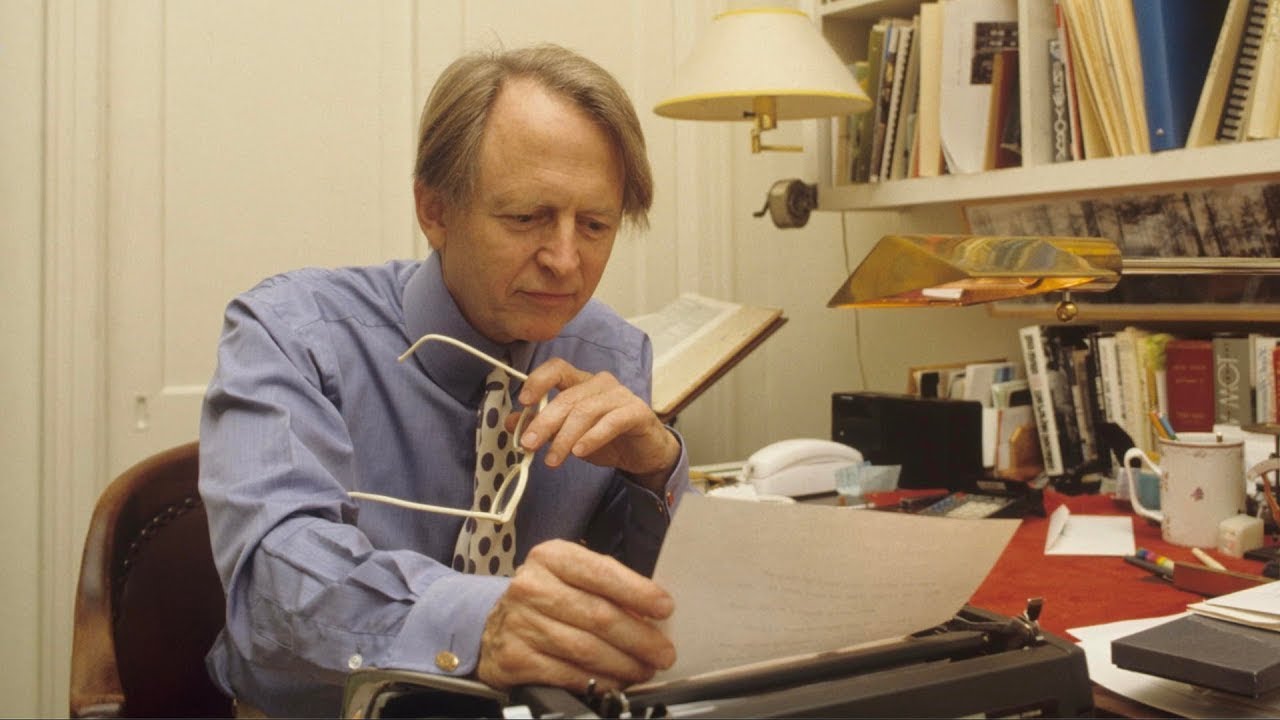
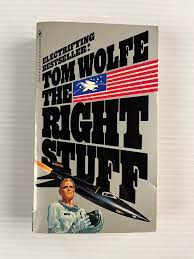
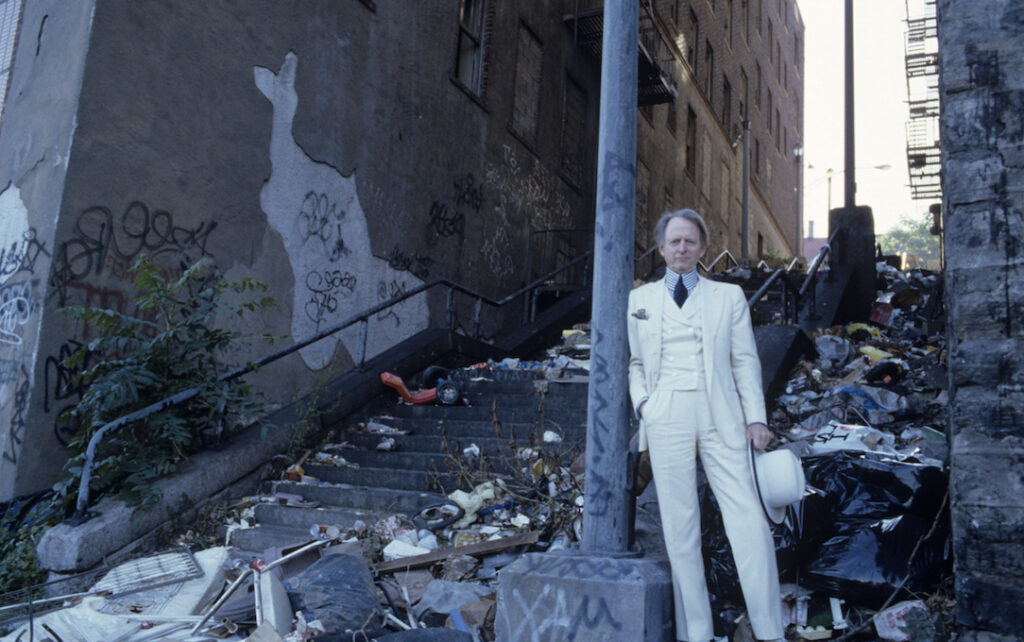
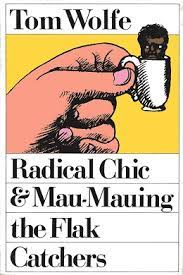
In magazine articles, non-fiction books and novels, Tom Wolfe coined era-defining phrases like “The Me Decade,” “Radical Chic” and “The Right Stuff.”
A “helluva reporter” and a master stylist, the courtly, dapper Richmond-born Wolfe underscored his legacy when he started talking about writing a “Vanity Fair” for the America of the 1980s.
“The Bonfire of the Vanities” became just that, a scalding and amusing snapshot of the “Greed is Good” Reagan decade in America. And his obituary writers — Wolf died in 2018 — had the perfect comparison. He was America’s William Makepeace Thackeray — its keenest 20th century observer and satirist.
“Radical Wolfe” is a new documentary appreciation of the perpetual “outsider,” an Ivy League trained best-seller whose Southernness made him stand out in the world of New York journalism and publishing of the 1970s and onwards.
The film, inspired by a Michael Lewis (“Moneyball,” “The Big Short, “The Blind Side,””Liar’s Poker”) magazine article and relying much on Lewis’s take on the man, the writer and his self-created mythos, is a reminder of Wolfe’s once-giantic footprint in the culture.
Wolfe was a best-seller from an era when a best-selling book — fiction or non-fiction — could dominate the national conversation, something amply demonstrated by “Radical Wolfe’s” many samples of Wolfe interviews — by Cavett and Letterman, Rose and Buckley — and breathless TV coverage of the “lines around the block” at bookstores, eagerly awaiting “A Man in Full,” his Southern affluence-skewering followup to “Vanities.”
A white-suited dandy and gifted raconteur, Wolfe “invented” that look and persona, he freely admitted during his lifetime. “He wanted to be noticed,” and he was, Lewis and others note.
He was “such a polite man,” good-mannered and gentle, but “a terrorist with a pen” who eviscerated big city elites and made lifelong enemies as he “reported” on things he witnessed and took lots of notes on.
Leonard Bernstein’s reputation, it is implied, never quite recovered from the way Wolfe reported on an ego-tripping, dilettantish Bernstein party/fundraiser for the Black Panthers political party in tony New York in 1970.
“Radical chic” became the ultimate putdown of such poseurs, rich entitled swells mingling with hip, edgy and politicized members of the underclasses.
Lewis and others marvel at how Wolfe was able to infiltrate and fit in with an emerging Southern California car-modifying culture or pre-“brand” NASCAR or cozy up to first-generation NASA astronauts, to find a singular figure representing a larger point and an “overlooked America” — often southern, like NASCAR’s Junior Johnson, “The Last American Hero,” or test pilot Chuck Yeager, the embodiment of “The Right Stuff.”
But it was the writing — inventing a self-referential, slangy, onomatopoeia-phrasing that delighted millions and enraged his rivals as “New Journalism” — that made Wolfe a publishing phenomenon and a fan favorite.
“The world was used to enormous egos in artists, actors, entertainers of all sorts, in politicians, sports figures, and even journalists, because they had such familiar and convenient ways to show them off. But that slim young man over there in uniform, with the enormous watch on his wrist and the withdrawn look on his face, that young officer who is so shy that he can’t even open his mouth unless the subject is flying— that young pilot— well, my friends, his ego is even bigger!— so big, it’s breathtaking!”
A relatively brief documentary, “Radical Wolfe” trips through the creation of the various works that “made” Wolfe, “The Right Stuff” being the crowning achievement of his non-fiction years. The film skips back to give us some of the origin story, a privileged young man — son of an agronomist and magazine editor — educated at Washington & Lee and then Yale where he first noticed how Northern elites look down their noses at the South.
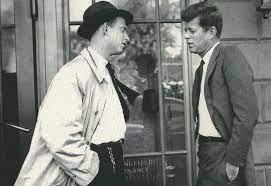
Wolfe cultivated his “outsider” status, friends and Lewis agree. Upon graduating, he didn’t venture into the high-flying world he’d inhabit straight-away. He became a cub reporter at the Springfield, Massachusetts newspaper, learning the ropes and becoming a stand-out by standing up to young John F. Kennedy (pictured above), who tried to turn a frank discussion of how Washington worked to local business leaders into an “off the record” talk. Cub reporter Wolfe wasn’t having it.
Wolfe’s “eureka” moment is revisited, with Esquire editor Byron Dobell remembering how a “blocked” Wolfe sent him a long letter, filled with his notes on that California car customizing story that he said he could not write. Dobell published the “letter,” and that breakout, breezy, flippant and funny piece — “The Kandy-Kolored Tangerine-Flake Streamline Baby” — became “The New Journalism,” a phrase Wolfe coined to describe using everything in the fiction writer’s arsenal in nonfiction stories.
His amusing, fake-feud relationship with fellow “new journalist” Hunter S. Thompson is related (Thompson “hated” being lumped into that genre), and his real-feud with novelists Norman Mailer, John Updike and John Irving, aka “My Three Stooges,” is remembered.
And Wolfe’s pinnacle, the glories of “The Last American Hero” and the Oscar-winning classic “The Right Stuff” becoming great movies, and the decline that seemed to set in after “The Bonfire of the Vanities” became an epic bomb is documented.
Junior Johnson — a book subject then and an interview subject here — and friendly colleagues like Gail Sheehy and Gay Talese fill in the man and his gift for fitting in with different groups he was writing about. And Jon Hamm reads snippets of Wolfe’s works, although that hardly seems necessary, as many public readings as Wolfe gave were captured on video over the decades.
The film is entirely too brief for Wolfe fans. But Lewis is the right writer to build this Wolfe appreciation around, as he can rightly be considered Wolfe’s peer as a reporter — a thorough, immersive master of non-fiction. I’m a big fan. But neither Lewis nor anyone else writing today could hold a candle to Wolfe’s gifts as a stylist in the English language.
Like Wolfe, Lewis has a gift for finding unheralded, representative figures and spinning them into heroes of his narratives — Billy Bean of “Moneyball,” Michael Oher of “The Blind Side.” But his effort to fold his own myth into Wolfe’s story backfires hilariously with his first words on camera, the first words in the film.
Princeton man Lewis remembers “discovering” Tom Wolfe on his corporate lawyer father’s bookshelves, and feeling blessed because he was, at the time, growing up in “New Orleans, not a particularly literary place.”
“New Orleans.” “Not a particularly literary place?” Where Tennessee Williams lived and caught the Streetcar, where Faulkner and Bukowski and F. Scott and Walker Percy and Lillian Hellman sojourned, where Anne Rice and James Lee Burke lived, and John Kennedy Toole discovered “A Confederacy of Dunces?”
As Lewis notes in “Radical Wolfe,” that Twain/Hemingway-based “all writers” feel the need to become larger-than-life characters thing was a part of Wolfe’s makeup and became something of a trap, a persona he couldn’t shake.
But privileged Michael Lewis trying spin a literarily deprived childhood in one of America’s most literary cities is like Steve Martin’s narration in “The Jerk,” the bit about being “born a poor Black child.” One can imagine how “radical” Tom Wolfe would have had endless fun ridiculing that.
“Hardscrabble Ivy League literarily deprived chic?”

Rating: unrated, scene of Hunter S. Thompson drug abuse, some profanity
Cast: Tom Wolfe, William F. Buckley, Jr. (archival interviews), Junior Johnson, Michael Lewis, Gail Sheehy, Gay Talese, Alexandra Wolf, Lynn Nesbit and the voice of Jon Hamm.
Credits: Directed by Richard Dewey, scripted by Michael Lewis, based on his magazine article. A Kino Lorber (Sept. 15) release.
Running time: 1:17
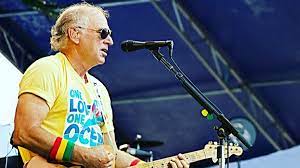

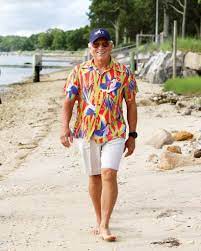
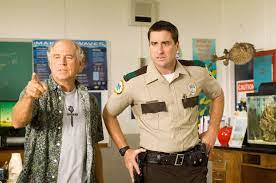
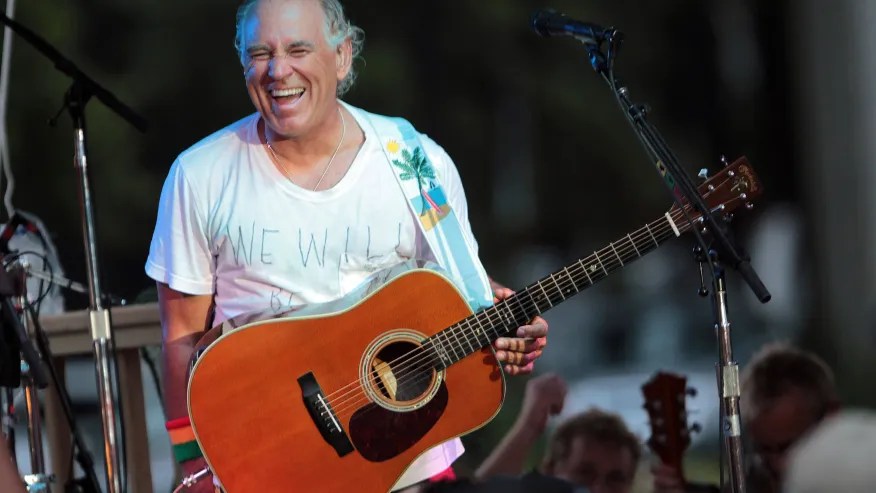
The Alabama troubadour who discovered “Margaritaville” has died.
Jimmy Buffett, a singer-songwriter who popularized “Floridays,” a tipsy laid back beachside Florida lifestyle, who put Key West back on the map and who parlayed a musical fanbase into a “Latitudes” and “Margaritaville” brand empire was 76. The family confirmed his death was from complications from skin cancer.
Emerging from the singer-songwriter generation that followed Paul Simon and included James Taylor, Laura Nyro, Bill Withers, Bonnie Raitt and others in the ’70s, Buffett chronicled a boozy, surf and sunshine Gulf coast scene that his music so popularized it lured millions South, to Florabama — the seaside from Key West spreading west to Mobile, Alabama, where he grew up.
He came up in the music business with his guitar-picking songwriter pals Jim Croce, Steve Goodman and Jerry Jeff Walker, and like them, was a storyteller in song. A train ride Goodman, Walker and Buffett took as struggling young artists on a struggling rail service became iconic songs like “City of New Orleans,” for Goodman, and “Railroad Lady,” co-written by Walker and Buffett.
Buffett’s first hit was a 1974 real-life detail-littered story song about missing someone while on tour, “Come Monday,” whose first big royalty check, Buffett liked to tell fans, “bought me my first sailboat.”
But with “Margitaville,” a tale of resigned heartbreak and alcohol-soaked recovery set in surfside Florida, he became world famous and was set for life. He went from opening for The Eagles and Linda Ronstadt to a headliner, and toured to packed venues until the very end of his life.
He turned generations of fans into “Parrotheads” and eventually a lifetyle brand, with Margaritaville restaurants and gift shops and more recently, Latitudes housing developments for that aging fanbase.
More than anybody else, the “Son of a Son of a Sailor” singer — he was named for his ship captain grandfather — inspired the label, “yacht rock.” “Gulf & Western,” was his quip label for his sound and genre.
I first encountered him on a snowy mid-winter phone call in college in the late ’70s. He was playing at a university nearby, and having found his music as a weekend country music DJ, and just between breakups with The College Hot Mess Girlfriend, I needed a break so I called for a ticket, or just to see if the show was still on, snowfall be damned. I called the wrong number, and got backstage rather than the ticket office. It was soundcheck time.
A distinct Alabama drawl picked up, with the sounds of laughter and tuning-up in the background.
“Sold out? Naaaaaw. COME on over!”
Had to be him. Years later, interviewing Buffett when he produced and took a small role in the film of his Florida journalist/novelist pal Carl Hiaasen’s kids’ novel “Hoot” into a charming, enviromentalist adventure comedy, I tried to confirm that, and he laughed but would only say “Sounds like something I did back then.”
His live record from that era, 1978’s “You Had to Be There,” was celebrated at the time as “uproarious” in its inebriated, good-humored bravado and definitive live-versions of songs, with Buffett introducing each by recalling how he’d written it or come by it.
His first brush with the movie business came when he wrote songs for and appeared in the 1974 Jeff Bridges/Sam Waterston Montana comedy “Rancho Deluxe.” It was based on a novel by Buffett’s brother-in-law, Tom McGuane.
“Hoot” had a similar trip to the screen. Buffett told me in 2006 that he was chatting with his friend Hiaasen, the topic of why “Hoot” — about Florida Keys kids protecting burrowing owls from the state’s rapacious developers — hadn’t been made into a movie yet.
Buffett told Hiaasen, “I believe I know a few folks who can make that happen,” became a producer, provided songs for the soundtrack and played a laid-back teacher in the film.
Fame made him rich, had “60 Minutes” and magazines profiling him and let him dabble in Broadway shows as he repackaged his seminal ’70s hits into boxed sets accompanied by essays on “Why I love my seaplane” and the like.
But he often returned to Key West even after he’d transformed the place into the tourist mecca (“trap”) it is today, performing free solo shows and benefit concerts, which were a big feature of his post-fame career.
He wasn’t to everybody’s taste, but the dream idyll he sang of was intoxicating. I should know. I live on a sailboat. In Florida. And I still like my margaritas and flip flops, even if I’m watching my salt intake.
Buffett was one of a kind, a singular success as a singer-songwriter whose tunes made that lifetstyle so alluring that you can’t visit a marina in North America without seeing sailboats named after his tunes, so omnipresent that you can’t hit a pub in the waterfront South without hearing a picker singing one of his songs as the sun sets, the flounder sizzles on the griddle and the blender churns up “Boat Drinks,” margaritas included, in the background.

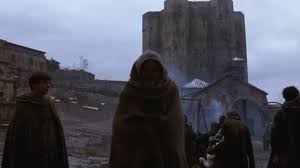
A film bathed in fog and Medieval earth tones, “The Name of the Rose” is an M.C. Escher labyrinth populated with Hieronymous Bosch grotesques.
It’s a throwback epic of the quasi-Biblical school, the “El Cid” of the ’80s — grand, ambitious, a huge canvas enfolding big themes and ideas and performed by larger than life actors. And like “El Cid,” it was dismissed and under-appreciated, somewhat justifiably so.
But back then I was one of those annual-pass riders on the Jean-Jacques Annaud train, utterly bowled over by his “Quest for Fire,” a big fan of “The Bear” and someone who was sure Annaud would become The New David Lean — a maker of challenging epics for the masses. His debut feature, “Black and White in Color,” won the best foreign language film Oscar back in 1976. But it wasn’t until he grabbed the big canvas that he made his mark.
Umberto Eco was a famous semiotician whom I first read in grad school, where one was encouraged to view cinema through the interpretation of signs and symbols included on the screen. But he became one of Italy’s most famous novelists the day he plunged into this Medieval murder mystery epic.
“I felt like poisoning a monk,” he quipped, when describing the compulsion to write “The Name of the Rose.”
Annaud took on this project after his breakout “Quest for Fire.” And despite bringing his “Fire” good luck charm, a VERY young Ron Perlman, despite casting a “has-been” former James Bond (Sean Connery), a former Bond villain (Michael Lonsdale) and newly-minted “Amadeus” Oscar winner F. Murray Abraham as his titanic leads, he had trouble getting this enterprise off the ground.
Even though most of them were willing to commit to the bald-bowl cuts it took to play their roles with accurancy.
The book was too daunting in period piece scale, despite being essentially a genre murder mystery thriller set long before The Age of Reason, before the first “detective” or first detective story.
You’d need a castle (Castle Rocca di Calascio, in central Italy) to pass for a 14th century abbey/fortress. You’d need a real monastery in Germany (Kloster Eberbach) just for the interiors you couldn’t build on a soundstage.
Four screenwriters boiled down the story of serial killing and punishment, faith and heresy, Church dogma and the Inquisition all meeting, debating and wrestling for primacy in a monastery with a great library where books are meant to “preserve knowledge,” not to dissimenate it.
Book burning and “witch” burning and theocratic “law” administered by fanatics make this film of that book as timely today as it ever was.
There’s a gathering of the various Christian orders for a theological debate in the winter of 1327. Our narrator is an old man remembering those days, but back then Adso (Christian Slater, two years before “Heathers”) was but a novice, learning at the feet of a Franciscan thinker and man of reason, William of Baskerville (Connery).
They’re greeted at the abbey by the abbot (Lonsdale). But one look at the lad (check out the Cover Girl makeup on Slater) has another monk pass on a warning.
“Have you not heard? The Devil is hurling beautiful boys out of windows?”
William has an old friend (William Hickey, nominated for an Oscar for “Prizzi’s Honor” that same year) there who is sure the monastery is seeing The Book of Revelations play out in the deaths among the brothers, with the younger and most “beautiful” particularly vulnerable.
Veteran character actor Feodor Chaliapin Jr. plays the blind and thus most fanatical of the monks, another adherent of “The Evil One’s” influence there, and film fans of the era would have recognized the oft-employed Elya Baskin among the many monks in this “scriptorium” monastery, transcribing and illuminating ancient texts for future generations.
If you’ve ever visited Dublin’s Book of Kells, or seen the animated delight “The Secret of Kells,” you have an idea of the work and its importance to civilization.
The abbot knows William of Baskerville’s “reason and deduction” reputation. And William, with or without his prototype spectacles, straight away sees problems with the “supernatural” theory of the first death he encounters.
The monastery’s famous library is kept locked away. Those transcribing and illuminating the books are the ones dying. And the abbot and his fellow senior monks are missing obvious clues. The alternately “foolish boy” or “clever boy” at his side is there for William to explain his version of forensics to, mainly for the benefit of the viewer.
“We are very fortunate having such snowy ground here” he purrs. “It is often the parchment on which the criminal unwittingly writes his autobiography.”
More monks will gather for the Big Debate.
The poor, starving serfs whom the abbey’s walls and gate keep out are treated like illiterate, insensate beasts, which is how the learned Latin speakers regard them, taxed and tithed in their poverty to finance papal luxury.
The Franciscans, at least, will notice. But the Inquisitor Benardo Gui (Abraham) is coming to make sure the Fear of God is put into one and all.

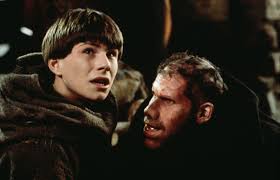



The semiotician Eco no doubt took delight in littering this mystery with suspects as physical “types,” which Annaud visualized via casting — the plump, boy-coveting monk (Michael Habeck), the mad “hunchback” (Perlman), the fanatic (Chaliapin) whose blindness is both literal and metaphorical.
What stuck in my memory in the many years since I’d seen the film was its climax and the solution to the mystery. What hits me re-watching it now is the level of commitment in the performances.
Connery got a tad fat and happy after his Oscar for “The Untouchables,” even if he never let us see him phone it in. But here he’s wholly engaged, giving a little of the twinkle that would be his late career trademark to a character whose very name says “The game’s afoot!”
Slater, not yet burdened with the snide spin on “cool” that became his 20something trademark, is stumbling innocence personified, especially in the sexual realm.
Lonsdale made “chilly” a post-Bond villain career trademark.
And Perlman, years before his TV “Beauty and the Beast” turn remade him, is as manic and down and dirty as we’ve ever seen him — a mad jumble of languages, tics, hideous makeup with the grooming and damaged soul to match. He even sings.
Annaud spared no effort or expense in recreating this world, and the result is stunning in frame after snow-dusted frame. But one thing that really leaps out watching “The Name of the Rose” now is Eco’s ahead-of-the-curve assault on the Catholic Church.
From corrupt, whoremongering and even Satan-worshipping monks craving their “unnatural caresses,” to fat, rich Vatican oligarchs, none of whom give “their flock” any consideration, all are depicted with all the Bosch-ugliness Annaud could summon and Eco could endorse. I was taken aback by how little agency the starving “serfs” have, how the feral beauty (Valentina Vargas) is treated like the dumb and mute “foul being” women are labeled by even the “liberal” William of Baskerville.
It’s “Planet of the Apes” primitive, as savage a takedown of the Church/The Faithful relationship as any I’ve seen.
The film’s unsatisfying climax and anti-climactic ending still merit demerits.
But if ever you want a reminder of what filmmakers used to undertake to create an “epic,” you don’t have to go back to Lean and Kubrick, DeMille and Ford to find examples. Annaud and Herzog and a few others undertook Herculean tasks and made movies in that pre-digital era that awe us to this day, filmmakers who suffered for their art and made sure the cast and the audience suffered right along with them in their pursuit of greatness.

Rating: R, graphic, gruesome violence, explicit sex, nudity
Cast: Sean Connery, Christian Slater, F. Murray Arbraham, Michael Lonsdale, William Hickey, Elya Baskin, Feodor Chaliapin Jr., Valentina Vargas and Ron Perlman.
Credits: Directed by Jean-Jacques Annaud, scripted by Andrew Birkin, Gérard Brach, Howard Franklin and Alain Godard, based on the novel by Umberto Eco. A Constantin Films production, released by 20th Century Fox now on Tubi, Youtube, Amazon, etc.
Running time: 2:12
Two affable exes, trapped in a closed airport in a blizzard.
It’s a talky “grown up” romance aiming for a “Harry Met Sally” vibe.
Good to see Meg again, and Duchovny still “out there.”
Bleecker Street has it, so who knows how they’ll promote this. “Coming soon” is what it is.
Another car company and its “driven” founder tale, this one about the dancing pony of Italian high-end motoring.
Oscar winner Penelope Cruz and Shailene Woodley co-star in this Christmas release.
Did I mention it’s a MICHAEL MANN FILM? That’s the kicker, the selling point. It could be his “House of Gucci” (Adam Driver also starred in that, for Ridley). I don’t see much fun in the offing, no “Ford v. Ferrari” bravado.
But MICHAEL MANN.
Rosamund Pike, Jacob Elordi, Richard E. Grant and Alison Oliver also star in this dreamy drift into a summer of decadence and corruption.
Carey Mulligan is listed on IMDb as being in it, but not in this trailer or its credits.
Another mystery?
Bit player actress turned writer/director Emerald Fennell concocted this Nov 24 release.
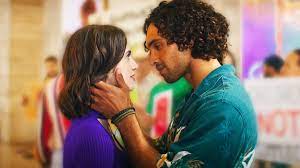
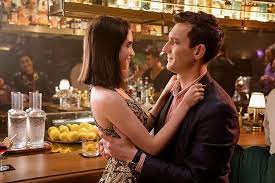
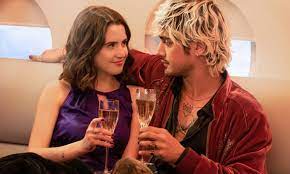
Is “Choose Love” “inane,” “insipid” or merely an “innocuous” attempt to make the cinematic romantic comedy a viewer’s choice “will they or won’t they” experience?
It’s “interactive cinema,” you know. So click on one of the selection of choices that pop up every few minutes. And if you don’t like what transpires after that, or are curious about how the other options might have played out, hit the “Do Over” prompt.
As for how this comes off as a story worth telling and watching, somebody has to make that call so it might as well be me. And in the spirit of the character who says “No backsies!” in the movie, I’ll opt for the last choice — “innocuous.”
It’s an interesting movie to watch in a technical sense, seeing where the edit points for different timelines can be inserted and allowed play out. But the range of choices, like the characters, is “bland” to “blander.”
And being able to pick and choose the narrative direction removes all stakes from the story and renders the entire experience kind of pointless. Then again, maybe that’s just me.
Our perky, 30ish heroine, Cami Conway (Laura Marano of “The Royal Treatment” and “The War with Grandpa”) is an L.A. recording engineer facing big choices in life.
Her career seems stalled, trapped engineering jingles, voice-overs for commercials and the like. And her pleasant, handsome finish-each-other’s-sentences beau of three years, lawyer Paul (Scott Michael Foster), is about to pop the question.
The noncommittal psychic/tarot card reader (Jacque Drew) shuffles the cards, tells her “Destiny is a myth” and that “YOU will have to decide,” and Cami follows those instructions to the letter.
Californians, am I right?
Those choices grow more difficult because she stumbles into the “save the planet” boyfriend “who got away” Jack (Jordi Webber), and then meets Brit pop mop-top Rex (Avan Jogia) at work, and they set off sparks, professionally and personally.
What oh what should Cami do? I mean, she’s looking right at the camera and asking? What should WE have her do?
There have been a lot of attempts at creating interactive cinema — movies in which viewers, or a polled consensus of viewers, get to “decide” which way the story goes — over the years. The best of them captured something of a theme park ride experience, at least as far as which character wins, who loses, who ends up with whom, who lives or who dies narrative goes.
Netflix is the first streamer to do this with a movie every viewer can customize to one’s own preferences
But with video games providing an ever more immersive, cinematic real-time-decision experience, I frankly don’t see the point.
The very nature of cinema is something just as primal as “living” a story and making your own choices within it. “Tell me a story” puts the burden on the storyteller and invites something fundamental into the equation — the element of SURPRISE.
All involved have tackled a string of technical challenges and made them “work.” But to what end?
So when one reaches the open-ended conclusion to the particular inane interactive effort that instructs us to “Choose Love,” the three choices we’re faced with don’t seem like enough.
“Back to Start,” “Back to Dream,” an earlier time-line changing edit-point” and “Back to Protest,” another edit point, should have a fourth option.
“Give my back my 90 minutes.”

Rating: TV-14
Cast: Laura Marano, Avan Jogia, Scott Michael Foster, Jordi Webber, Benjamin Hoetjes, Megan Smart and Jacque Drew
Credits: Directed by Stuart McDonald, scripted by Josann McGibbon. A Netflix release.
Running time: 1:17 plus additional time for all the “choices” you make and unmake.
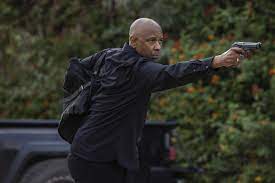
Something about the way Denzel Washington‘s Robert McCall lays his cane across his shoulders and drapes both hands over it tells us that he’s sized up a new threat, that he’s recovered from the Sicilian bullet wound that has him laying low in a postcard-perfect Italian seaside/cliffside town and that the bad guys are about to learn that old English expression, “rue the day.”
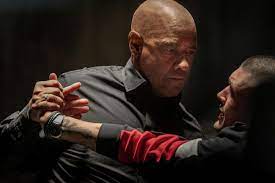
“The Equalizer 3,” pitched as the final film in this one-and-only Denzel franchise, is the most violent film in the series, with Washington making the character — his “government” trained man of violence — the most idiosyncratic, guilt-ridden and prone to tics, we’ve ever seen him.
And it’s the best-crafted film in this Antoine Fuqua trilogy, with Washington’s “Training Day/Equalizer” director making stunning use of Ravello, Italy locations and giving this TV-created character and franchise a finale that’s an homage to John Woo’s hitman thrillers.
That little gesture with the cane gives our hero a hint of the exhausted Christ on the Cross, just for a second, one of many religious images and nods to Woo’s trademark Christian iconography that Washington, Fuqua and screenwriter Richard Wenk give to the character.
“Equalizer 3” opens on a scene of terrible violence. Some 15 armed goons are bleeding out in various corners of a winemaking villa in the Sicilian countryside. Our meticulous “equalizer” is there to recover “something that doesn’t belong to you,” he tells the mob boss who stares down the barrel of a pistol at him.
How did he get to this unreachable mafioso? How did he kill so many thugs? Why is he here, really?
“We’re all where we’re supposed to be,” the unnamed McCall intones, quoting an old Italian saying. And then he adds to the body count.
He gets out of there alive, which is more than we can say for the made men he’s taken down. But McCall is found on a roadside with a grievous bullet wound, and the caribineri (Italian cop) who finds him, doesn’t report him.
The cop (Eugenio Mastrandrea) takes the bleeding, bald Black American to a doctor friend (Remo Girone). When McCall wakes up, he’s facing the troubling question, “Are you a good or a bad man?”. And he’s in scenic Altamonte. As he recovers and is befriended by one and all, he starts to feel “at home” and “at peace” here. He even buys a hat.
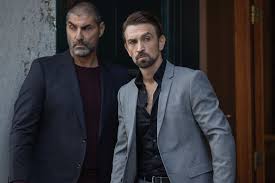
But the Neopolitan mob’s two most reckless brothers (Andrea Scarduzio, Andrea Dodero) are leaning on the local merchants and the property owners. McCall may still be using that cane, but when it goes on his shoulders, this man of violence, feeling his years and his guilt, is about the “equalize” the odds in this little corner of George Clooney’s Italy.
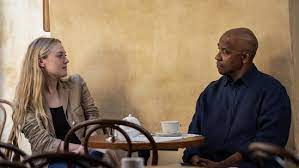
The script loses some of its lean, well-crafted vengeance thriller edge when McCall phones a CIA analyst, played by Washington’s “Man on Fire” co-star, Dakota Fanning, 19 years older than when they co-starred in that one. She’s adequate in this part, playing “young” and trying too hard to look “seasoned” in the field, taking tips from this stranger, wondering just what he’s up to and who he’s killing.
Take a gander at her in Raybans. Those sunglasses are wearing her, not the other way around.
Screenwriter Wenk hits the religious redemption allegory a tad too hard, and the picture doesn’t so much finish as peter out, with an anti-climax or two.
But Fuqua and “Kill Bill,” “Aviator” and “Once Upon a Time…in Hollywood” cinematographer Robert Richardson give us one gorgeously-composed shot after another.
Forget the Alfa-Romeo product placement in this one. “Coastal Italy” is the real sale.
And Washington still makes a very scary dude with a threat, most of them involving measures of time for his foe to “prepare yourself,” still a convincing enough man-of-action that his late-period Steven Segal wardrobe (black and billowy) isn’t hiding a body that’s gone completely to pot.
This “Equalizer” is older, more eccentric because he knows how much blood he has on his hands, mostly because there’s a lot more of it in this, his carnage-covered curtain call.

Rating: R for strong bloody violence and some language.
Cast: Denzel Washington, Eugenio Mastrandrea, Gaia Scodellaro, Andrea Scarduzio, Andrea Dodero, Remo Girone and Dakota Fanning
Credits: Directed by Antoine Fuqua, scripted by Richard Wenk, based on the TV series created by Michael Sloan and Richard Lindheim. A Sony/Columbia release.
Running time: 1:49
Didya love “Black Dynamite?” Didya MISS it? Get on that, wouldya?
I loved it. And this has “Black Dynamite” blaxploitation Western energy, and we know Mr. White’s gift for deadly deadpan.
Michael Jai White wrote, directed and stars in “Outlaw Johnny Black.” September 15, from Samuel Goldwyn.


