Movie Review: Coming of Age Gay in 1980s El Paso — “Aristotle & Dante Discover the Secrets of the Universe”

As we enter the fifth decade of gay coming-of-age screen romances, the biggest challenge for filmmakers seems to be finding something new to say on the subject. To be fair, the straight version of such tales of “first love” has been similarly trapped for a lot longer.

“Aristotle and Dante Discover the Secrets of the Universe” is a sweet period piece about middle class Mexican American teens figuring out their same sex attraction over a couple of El Paso summers in the late ’80s.

Based on a novel by Benjamin Alire Sáenz, it’s safe, unchallenging, PG-13 and just bougie enough to fit in that “Love, Simon” formula. English, Spanish or Spanglish, this love affair isn’t going to be “Amores Perros.” But handled with great sensitivity by all involved, it comes off in all the most predictable ways.

Max Pelayo, also in the new drama “Marisol,” is our hero and narrator, a kid given the lofty name “Aristostle” by his mailman father.

It took me six scenes to figure out that white haired, bearded patriarch was Eugenio Derbez.

“Ari” is a loner lost in his thoughts who has figured out, at 16, that “alone is better.” But he’s no sooner narrated “one more summer without learning to swim” when a stranger offers to help. That’s Dante (Reese Gonzales), a freer spirit, son of college educated parents (Kevin Alejandro and Eva Longoria), a lover of art (his dad’s a professor) and still teen enough to debate the merits of various comic books.

They strike up a friendship, hang out with each other’s families, dabble in astronomy and ignore the nattering of the school gossup (Isabella Gomez) and the sympathetic winks of Ari’s “she’s different” aunt (Marlene Forte).

Dante’s dad takes a research sabbatical and they’re separated a year, and the tone of his letters suggests sexual coming of age and makes Ari uncomfortable in ways such narratives always lead us into.

And then Dante comes home.

Everything above is something of a genre cliche, and the film’s later second and entire third act is no different. But “sweet” does a lot of heavy lifting. The performances are sensitive, and the soft-sale of the story arc doesn’t hammer home its points. Writer-director Aitch Alberto just lets them happen.

The leads are attractive, nicely immersed in their roles. And the presence of Longoria and Derbez in the cast got the film financed and distributed.

It’s a gentle as well as generic take on this subject, with some gay bashing (1987, El Paso, Latino community) to remind us how far the culture has come in terms of tolerance, and make one wonder how far it has to go.

Movies like “Aristotle and Dante” aren’t for the jaded or worldly, as Longoria and Derbez might agree. The whole idea here is to show teens that this “There’s something wrong with me” speech (another genre cliche) isn’t accurate, that they aren’t the first to feel that way and that loving parents — especially today — are better equipped to handle that.

That messaging, the engaging leading men and the picture’s inherent charm put it over, despite its many “on-the-nose” situations and despite the comically symbolic names “Aristotle” and “Dante,” something only a writer dazzling in Young Adult fiction would concoct.

Rating: PG-13, one violent scene, some profanity

Cast: Max Pelayo, Reese Gonzales, Veronica Falcón,
Marlene Forte, Kevin Alejandro, Isabella Gomez, Eugenio Derbez and Eva Longoria.

Credits: Scripted by Aitch Alberto, based on the novel by Benjamin Alire Sáenz. A Blue Fox release.

Running time: 1:37

Posted in Reviews, previews, profiles and movie news | Comments Off on Movie Review: Coming of Age Gay in 1980s El Paso — “Aristotle & Dante Discover the Secrets of the Universe”

Movie Preview: A Monster Placed back in Context — “Godzilla Minus One”

Taking “Godzilla” out of its post-war Japan setting, a country and culture struggling to take on the mantle of victimhood but silently knowing they deserved to be punished, kind of ruined most of the recent iterations of the monster for me.

A warning against technology, nuclear proliferation and heedless “progress” that awakens the dark side of nature only goes so far. What’s been missing is the knowledge that this awful thing is something they brought down on themselves, through brutal aggression, crimes against humanity, racism and barbarism.

Veteran Japanese director Takashi Yamazaki gives us that setting, and perhaps some of that original terror and guilt back in this version of “Oh no, there goes Tokyo.”

“Godzilla Minus One” opens Dec. 1.

Posted in Reviews, previews, profiles and movie news | 1 Comment

Movie Review: Aged Italian Immigrant meets a Young One and Recalls His Own Move to Luxembourg — “Io sto bene (Am Fine)”

“Io sto bene” is a quiet Italian take on the inter-European immigrant experience, a reverie recalled on two timelines as an old man’s encounter with a young woman reminds him of his accidental move to tiny Luxembourg over 50 years before.

Luxembourg-based writer-director Donato Rotunno (“Baby (a)alone”) traffics in nostalgia and concentrates on the little dramas of closely-observed lives in this gentle but generally unaffecting melodrama, Luxembourg’s contender for a Best Foreign Language Oscar nomination a couple of years back.

In the mid-60s, three young friends with no knowledge of foreign languages and few marketable skills ride a train north from their Italian village. A conductor checks their passports and work visas and tells them something they didn’t realize before leaving home.

Vito (Vittorio Nastri) is headed to Belgium. Wait, aren’t we all? No. Giussepe (Maziar Firouzi) will be seeking his fortune in Germany and Antonio (Alessio Lapice) is heading for Luxembourg. Wait, Luxembourg isn’t in Germany? Or Belgium?

Well, they’ll straighten that out when they get there they figure.

But a very old Antonio (Renato Carpentieri), feted as he retires and tries to motor home from the business he helped build in an Alfa Romeo he hasn’t driven in decades, recalls that they never did.

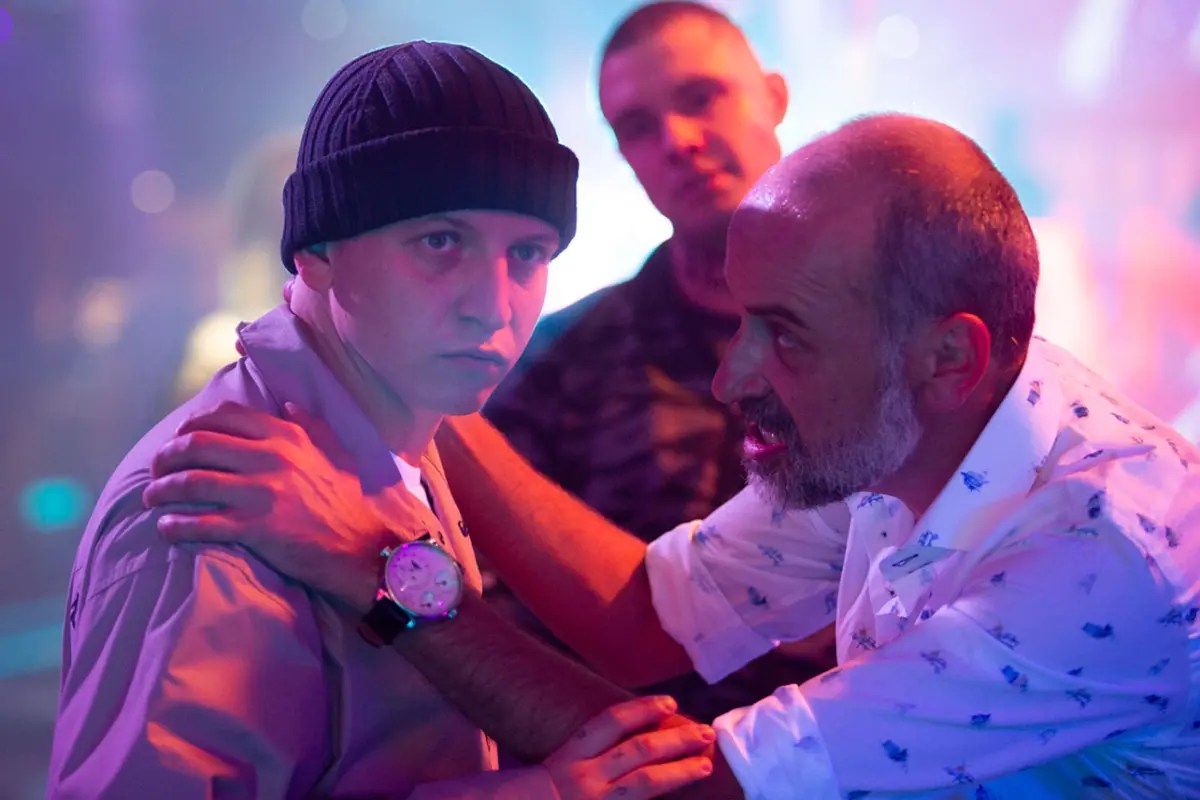
What jars his memory is having a fender bender that a young woman, Leo (Sara Serraiocco), sees and that makes her offer to drive him home. Leo’s an Italian DJ, working the clubs, struggling to make it in a new country just as Antonio did many years before.

The film is about their connection in the present and how that triggers his memories of the ups and downs of his sad saga, moving far from home, losing touch with family and friends, writing back to his parents with letters that always include “Io sto bene,” “I am fine.”

In the present, Antonio is in the process of selling his flat and moving to assisted living, as he is newly-widowed and walks with a cane. The story’s long flashbacks show us his early life in the country, cheated by the locals as he works hard as a laborer, mason and house painter, the “meet cute” moment he meets his future wife, Mady (Marie Jung) and the reason he still walks with a limp.

In the present, he is winding life down. But in this mercurial Italian stranger who brought a college degree in graphic design and a yen for elaborately conceived video to accompany her club mixes north from Italy, he sees something of himself, and a chance to pay it forward.

“In Italy,” Leo tells him (in Italian with English subtitles), “you spend your day waiting.” For a spot in line to apply for a job. When you complain, “they say their are thousands like you.”

She was “suffocating.” So it was with Antonio. But when he met the assertive, demanding Luxembourger Mady, he found purpose, drive, a need to “become a man” and become a success. But there were tests and missteps along the way. Heartbreaks too, it is implied, but those are mostly off-camera.

Leo is being similarly tested, a young woman lacking direction and anyone to help her find her way.

The chief shortcoming of the movie with the generic every-letter-home-everywhere title is that there’s nothing more to it than this.

There’s a hint of sweetness to old Antonio’s concern for Leopoldina, and a rash edge to her reluctance to accept help, even after a club owner sexually assaults her and blackballs her.

But otherwise, their stories don’t interrelate well. As interesting as skipping through the ebb and flow of his earlier life — writing love letters on behalf of Vito to the younger sister of Giuseppe is bound to bring trouble when everybody goes “home” for a visit — might be, there’s not enough here to fashion a compelling generational changing-of-the-guard narrative.

The wistful regrets that accompany such an uprooting, loved ones who break off contact, possibilities lost because of the curse of a country lacking opportunities going back generations, tell us everything letters that begin with “I am fine” leave out. It’s just not consequential, exceptional or interesting enough to add up to a more compelling movie.

Rating: unrated, one scene of violence, sex, profanity, smoking

Cast: Renato Carpentieri, Alessio Lapice, Sara Serraiocco, Marie Jung, Vittorio Nastri and Maziar Firouzi

Credits: Scripted and directed by Donato Rotunno. An IndiePix release.

Running time: 1:36

Posted in Reviews, previews, profiles and movie news | Comments Off on Movie Review: Aged Italian Immigrant meets a Young One and Recalls His Own Move to Luxembourg — “Io sto bene (Am Fine)”

Movie Review: The Baroque Charms of Christie and Branagh’s “A Haunting in Venice”

Take any genre, any movie in any film series and add Tina Fey to it and the proceedings are always going to be more fun.

Fey joins Kenneth Branagh‘s merry parade of Hercule Poirot period pieces for “A Haunting in Venice,” a spooky, stylish thriller loosely based on Dame Agatha Christie’s novel “Hallowe’en Party.”

Branagh’s ever-so-elegantly romped through these Poirot movies, vamping through murders that must be solved, a mustache and Belgian ACK-sant that must be curled. Now it’s time for someone to make fun of him to his face. The University of Virginia’s wittiest alumna is the perfect woman for the job.

“You’re doing that thing where you pretend to know more than anbody else.”

Fey plays a famous mystery novelist who “borrows” from Poirot’s persona and his cases for her books, a friend — “I ‘ave no friends.” — who is something of an irritant, showing up in Venice after The War, a place of peace and an epicurean life for the now-retired detective, interrupted only by frantic suitors who want Poirot to look into this or that mystery.

That’s why Poirot keeps Portfoglio (the wonderful Riccardo Scamarcio of “The Ruthless”) around, an ex-cop who serves as a bodyguard and personal assistant. But Portfoglio doesn’t keep Fey’s Ariadne Oliver at bay.

There’s a seance coming, a woman who wants to hear from her dead daughter in a supposedly haunted palazzo. Ariadne and Poirot have one thing they can agree on. “Mediums,” spiritualists and psychics are predatory frauds. Let’s go, Poirot, and poke holes in this mysterious Mrs. Reynolds and her “commune with the spirits of the dead” act.

“I am the smartest person I know, and I can’t figure it out,” Ariadne tells Hercule. “So I came to the second.”

Newly-crowned Oscar-winner Michelle Yeoh plays Reynolds with a self-serious gravitas that chills.

“It is the hallow tide (Halloween). We’re close. Your spirit is close…We are listening!”

Kelly Reilly is the mother of the dead woman, who may have killed herself over a love affair. Her “nerve storms” troubled doctor (Jamie Dornan) is present, the doctor’s young son (Jude Hill), along with a Russian who runs the household (Camille Cottin), all sitting in with Poirot, Ariadne, Mrs. Reynolds and her two Roma assistants (Emma Laird and Ali Khan).

Are Mrs. Reynolds and the others hearing from Alicia (via a spirit-typewriter)? Or will Poirot punch out Harry Houdini’s favorite punching bag, “mediums?”

“Terrors for children, Mrs. Reynolds,” Poirot grumbles. “I have been, in life, uncharmed by your kind.'”

A murder will intrude on this All Hallow’s Eve, and everybody’s a suspect. But Poirot is seeing things, and as reluctant as he may be, there may come a point when he has to agree with everybody else present, that there is something supernatural, something relacted to a “children’s curse” associated with this place, in play here. Or not.

“No one shall leave until I find if the living have been killed by the dead!”

Branagh is a stylish old school filmmaker sometimes unjustly criticized for the sort of camera flourishes — he films lots of characters in close-up, camera slightly above peering down on them to increase our unease — that whole schools of cinema worship Welles, Hitchcock and Kurosawa for. Critics have carped on his fondness for adding cinematic sizzle to his pictures since “Dead Again,” his first foray into mystery-thrillers.

Here he uses the beautiful and ancient city sparingly, and a watery palazzo gone to seed makes a splendid set for all these murders and frights and things that go bump in he night.

These Christie films have a shared air of lost affluence, of a more literate, high-toned age of conversation that vanished long before our age of tweets and modern vulgarisms.

“The voices speak,” Mrs. Reynolds intones, explaining her typewriter. “I take dictation.”

Mystery movies these days are harder to pull off as the audience has seen enough of these to often be a step or two ahead of the movie. As in the “Knives Out” pictures, Branagh isn’t constrained by playing by the rules and fear of “cheating.”

But it’s not just the mystery that recommends “Haunting” and its Christie/Branagh antecdents. It’s the world we’re immersed in, the grand casts playing colorful “types” we recognize in it, the forlourn air of this film, of a generation haunted by the second of two world wars which has just concluded.

“Scars are not always of the body,” Poirot knows.

I haven’t loved all of these semi-campy/semi-serious Branagh dates with Dame Agatha. But “Haunting” is an unadulerated delight. Only in “Venice” can you hear Tina Fey scream.

Rating: PG-13 for some strong violence, disturbing images and thematic elements

Cast: Kenneth Branagh, Michelle Yeoh, Tina Fey, Jamie Dornan, Kelly Reilly, Riccardo Scamarcio, Camille Cottin, Emma Laird, Ali Khan and Jude Hill.

Credits: Directed by Kenneth Branagh, scripted by Michael Green, based on the novel by Agatha Christie. A 20th Century release.

Running time: 1:43

Posted in Reviews, previews, profiles and movie news | Comments Off on Movie Review: The Baroque Charms of Christie and Branagh’s “A Haunting in Venice”

Movie Preview: A French big-screen “Succession?” “The Origin of Evil”

A woman tries to reconnect with her estranged…and very rich French family in this Sébastien Marnier (“School’s Out”) thriller.

Looks privileged and acrid.

Sept. 22, this rolls out in select cities.

Posted in Reviews, previews, profiles and movie news | Comments Off on Movie Preview: A French big-screen “Succession?” “The Origin of Evil”

Movie Preview: Julia Garner and Jessica Henwick are in the Outback with jobs at “The Royal Hotel”

A fish-out-of-water thriller about two lasses taking work in the most sexist place on Earth.

Hugo Weaving? Scarier as he gets older. Neon has “The Royal Hotel,” so the release date is TBD. Worth keeping an eye out for, though.

Posted in Reviews, previews, profiles and movie news | Comments Off on Movie Preview: Julia Garner and Jessica Henwick are in the Outback with jobs at “The Royal Hotel”

Movie Preview: Emily Blunt and Chris Evans go Big Pharma — “Pain Hustlers”

This looks cute and mean and comes out Oct. 27 on Netflix.

But it’s directed by the guy who dragged Harry Potter over the finish line. It’s over two hours long, and sorry, but David Yates? Not a handler of deft dark comedies.

Posted in Reviews, previews, profiles and movie news | Comments Off on Movie Preview: Emily Blunt and Chris Evans go Big Pharma — “Pain Hustlers”

Netflixable? Dutch Threesome Hunt for that elusive sexual “Happy Ending”

You’d think restaurants would know better than to name a cheese dessert “Fromage a Trois.” A label like that can get couples thinking and talking about the other trans-national use of “trois. And one thing might lead to another, or two others, as it turns out.

But they don’t fret over suggestive dish-naming in The Netherlands. “Fromage” or “Menage,” it’s all good, as long as everybody has a “Happy Ending.”

That sexy TV-MA movie your kids are sneaking onto Netflix to watch this summer is a tepid Dutch treat about sex, communication, relationships, and actresses exploring the difference between play-acting a fake-orgasm and faking a “real” one.

No, it’s not as “meta” or as complicated as I’m making it out to be, and the movie is as gentle and sensitive as a softcore and seriously predictable version of this scenario can be.

But who, other than curious teens, wants to see that?

Luna (Gaite Jansen) is our heroine, the one who voice-over narrates (in Dutch with subtitles, or dubbed) about “my 132nd faked orgasm” as we meet her. She’s smitten with Mink (Martijn Lakemeier), her year-long beau. But he isn’t doing it for her in the bedroom. And at this stage, Luna figures it’s too late to bring up problems with his Touch of Mink.

She, like everybody in this movie about cute Dutch 20somethings, overshares with her friends (Claire Bender and Sinem Kavus), who fret on her behalf and make bad suggestions.

Rather than be honest — he tends to bowl over her, conversationally, but he does show a bit of consideration in bed — Luna uses that dessert menu item to suggest a solution to her unspoken “problem.”

“Threesome” it is.

Awkward flirting — as a couple — dating app consultation and “bike flirting” (making eyes as you pass each other by bicycle), which is all Luna thinks she’s good at, is how they meet Eve (Joy Delima).

And guess what? That complicates matters in exactly the way most movies about threesomes do.

Writer-director Joosje Duk handles the ”attraction” sequences with a little flair and the well-short-of-porn sexcapades with discretion, if not a lot of heat.

But this isn’t a comedy or a romantic comedy. It’s a romance, and wringing laughs out of that First Time You’re in Bed as a Throuple doesn’t suit the tone.

As we see Mink blow through Luna’s reluctance to try and set Eve up with his pal Samir (Sidar Toksöz) it becomes hard to root for them as a couple. And backing away from the deep sexual attraction between Luna and Eve seems cowardly.

What are we left with? Middling sex scenes, desultory arguments, and “real” and “fake” orgasm faces.

There’s an “After School Special” lesson here for the teens who’re logging onto Netflix to watch “Happy Ending,” about boys-to-men learning to be more generous lovers and girls-to-women realizing the need to speak up and service their needs.

But to anyone of voting age, “Happy Ending” is too unsurprising to be happy, too perfunctorily plotted to supply an ending that will satisfy anybody.

Rating: TV-MA, (somewhat) explicit sex, brief nudity, sex talk

Cast: Gaite Jansen, Martijn Lakemeier, Joy Delima, Sidar Toksöz and Sinem Kavus

Credits: Scripted and directed by Joosje Duk. A Netflix release.

Running time: 1:31

Posted in Reviews, previews, profiles and movie news | Comments Off on Netflixable? Dutch Threesome Hunt for that elusive sexual “Happy Ending”

Book Review: Coffee Table Clint — “Clint Eastwood, The Iconic Filmmaker and his Work”

Somebody on your movie-buff birthday or holiday shopping list is a Clint Eastwood fan. This luxe new pictorial with essays on the man and his films comes in its own box, a beautifully presented book that matches its author’s thesis — that what Clint gave us is “not a career, it is a landscape.”

British writer Ian Nathan has turned out picture-centric appreciations of the works of Ridley Scott, Tarantino, The Coen Brothers, Peter Jackson and Tim Burton. “Clint Eastwood: The Iconic Filmmaker and His Work” is a handsome remembrance of the Hollywood icon’s career with some solid observations, a bit of The Man Himself (interviewed for this) and a lot of folding in the research of other biographers, all of it built around gorgeous still shots from Eastwood’s films, on-set directing photos and moments of Clint playing jazz.

It’s not meant to be deep or personal, and as such, it can read a tad glib and fanboyish. But it makes for a glorious gloss of the filmmaker’s career that celebrates the “simplicity” which Eastwood’s films are touted for, which Nathan describes as his “purity.”

Chronologically going through Eastwood’s life and career, Nathan separates “Clint” the film star with his legendary squint and understated acting style from “Eastwood” the artiste, and rightly parks him in the company not of the New Hollywood tyros like Coppola, Lucas, Scorsese and Spielberg, but with Redford and Beatty, great leading men who stepped behind the camera to ensure their vision of cinema is what we saw in their movies.

Eastwood’s quiet simple directing style is traced to his upbringing, and his first experiences on the “Rawhide” set, without much dwelling on actors or critics who find the impatient “One Take Clint” work ethic an increasingly serious drawback, the older and more dogmatic he became.

“The shadow (‘Dirty Harry’) cast over Eastwood’s career,” Nathan writes, “is hugely significant…Throughout his career, Eastood had sought to explore, satirize, oppose, and repeat the cultural event” that character and that first film to feature him created.

The writing here is often choppy, sometimes unnecessarily so, and had me parsing the pages to see if two had stuck together and I’d missed a transition that Nathan doesn’t provide as he skips back and forth. Some of that is the nature of the form, some of it a sort of Britishness in the sentence structure and punctuation (and many many sentence fragments). Every now and then a sentence turns into a paragraph that one simply must puzzle out what this chap is on about.

One must.

The don’t-offend-the-subject ethos in this “unauthorized” biography turns up in groaners like “Tied in with this were Eastwood’s memories of women who struggled to let go of him.” Translation — he’s dated and summarily dumped more than his share of wives, partners and female companions for younger models.

But the insights are solid, the sourcing the book relies on uniformly good and the book, like Eastwood’s movies, plays to his strengths. You don’t have to read it cover-to-cover in one sitting (although it’s that brief). A mere page or even an image brings back memories of a movie, a trademark Eastwood character, wardrobe choice or grimace.

The “Unforgiven” chapter, as a stand alone essay, is superb, if a tad breathless.

Continue reading
Posted in Reviews, previews, profiles and movie news | Comments Off on Book Review: Coffee Table Clint — “Clint Eastwood, The Iconic Filmmaker and his Work”

Documentary Preview: The Queen of Folk Music, “Joan Baez: I AM a Noise”

A giant who still walks, sings, protests and preaches among us gets her due.

Oct. 6.

Posted in Reviews, previews, profiles and movie news | Comments Off on Documentary Preview: The Queen of Folk Music, “Joan Baez: I AM a Noise”