

Movie Preview: Aaron and Bella, Brawls and Drawls — “Rumble Through the Dark”

Aaron Eckhart makes his “boxing picture,” playing a back-alley fighter who has a debt to Big Mama (“Secrets & Lies” star Marianne Jean-Baptiste, looking and sounding fierce).

Bella Thorne is the Southern fried tattoo billboard who seems to believe in him.

Looks brutal and sounds Southern. Nov. 10.

Posted in Reviews, previews, profiles and movie news | Comments Off on Movie Preview: Aaron and Bella, Brawls and Drawls — “Rumble Through the Dark”

Movie Review: Eccentric, Operatic and Romantic — “She Came to Me”

Rebecca Miller’s “She Came to Me” dances and teeters, staggers and skips along the line separating the quirky from the indulgent.

It’s a high-minded, well-cast romantic comedy whose easy laughs come from two Oscar winners and Peter Dinklage, a film whose romance is best delivered by teens and whose quirks include three oddball settings — Civil War reenactments, tugboat work and opera.

Strange? Oh yes. Bold? Sometimes. “Well-cast?” The actors do almost all of the comic heavy lifting in scenes that set up as cute or hilarious but whose only payoff is in a deadpan reaction or the mere fact that this or that player was cast to play this or that part.

The actress turned director of “Personal Velocity” and “Maggie’s Plan” creates a primer for “on the nose” casting. It doesn’t take much of a stretch to imagine “Game of Thrones” breakout Dinklage as a brooding composer facing writer’s block, a tossled, romantic figure dashing and magnetic enough to attract great beauties Anne Hathaway and Marisa Tomei.

Hathaway as an always-put-together OCD “clean freak” psychotherapist? We buy in without thinking. Tomei as a vivacious, “romance” addicted tugboat skipper of a certain age? Of course!

Steven Laddem is an acclaimed opera composer who had a breakdown after his last magnum opus. That was five years ago. It’s a good thing he married his shrink (Hathaway). Because he’s “blocked” and late delivering his new commissioned work. “Doc” Patricia is always counseling him to “break the patterns” of his routine to stir his creative juices.

One dog walk past a Brooklyn waterfront bar later, he meets the very forward, quite working class Katrina Trento (Tomei), who grew up on her tug, inherited her tug from her dad and insists this stranger she’s taken a fancy to over drinks “see” her tug, and her cabin.

A few reluctant kisses and tugs later, they’re in a passionate embrace. He’s so rattled that he tumbles off the dock and into the water on his walk home. Inspiration strikes.

“Doc” is a helpful but chilly spouse, a tad too tidy for sex. She’s happiest when she’s cleaning, and even helps their new cleaning lady (Joanna Kulig) as she chatters through her mild mania. Because when she’s not cleaning, she’s not happy.

Magdalena’s Catholicism…intrigues her.

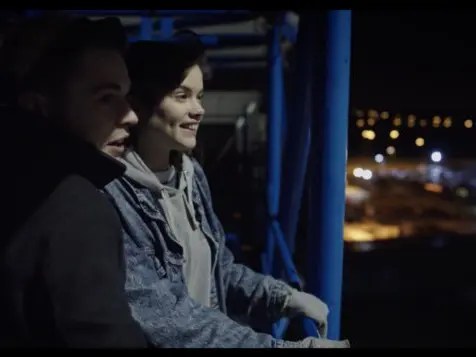
And unbeknownst to Doc and Steven, and Magdalena and her court reporter and self-righteous Civil War reenator partner Trey (Brian d’Arcy James), Doc’s son (Evan Ellison) from a previous relationship is 18, prepping for the best college of his choice, and deeply in love with Magdalena’s smart-cookie daughter (Harlow Jane).

Writer-director Miller is the daughter of playwright Arthur Miller, and there’s flash to the writing, the collision of personalities and situations, including the Big Coincidences that throw all these characters together.

Doc can’t come along with indecisive, panicked Steven on his dog walk because if she does “I’ll make all the decisions,” and where’s the therapeutic, pattern-breaking spontaneity in that?

Katrina isn’t a sex addict. “I’m addicted to romance,” but “I have been known to stalk” this or that guy. So, yeah.

Young Tereza gazes into the eyes of young beau Julian and says the words many an articulate teen has uttered — “I’m going to love you for the rest of my life.” As they’re both very smart and wise beyond their years, you can believe it, even if the more sage among us figure they’ll break up. But even we know that first love will always linger on the memory.

Miller and her players give us a couple of swooning moments like that, which are almost worth the cost of admission by themselves.

Amateur Civil War pedants bickering over the particulars of one tiny, inconsequential engagement, the tug boat operator listing most everything that you can see was at some point “moved by a tug,” the way Steven hears the musical note in Doc’s mini-vac, there’s a rich collection of details in all this.

But the casting is what makes an movie that never quite finds its tone (warm, weird and funny) work. Deadpan Dinklage duels deadpan co-stars for droll laughs in many a scene.

Miller went to the trouble of conceiving snippets of operas Steven is inspired to write by the tugboat skipper he won’t allow himself to call his “muse,” and she hired the composer of the music to Dinklage’s terrific take on “Cyrano,” Bryce Dessner, to whip up the score.

Miller then tops that by casting real opera singers Isabel Leonard, Emmet O’Hanlon, and Greer Grimsley to rehearse and sing Steven’s female tugboat skipper “Sweeney Todd” ripoff and another opera he tries to top that with.

Sure, “She Came to Me” is a tad less than the sum of all its many delightful parts. But Miller is canny enough to cast it perfectly and generous enough to let her players rescue this marvelous mixed-bag of delights whenever it goes astray.

Rating: R, sexual situations, profanity

Cast: Peter Dinklage, Anne Hathaway, Marisa Tomei, Harlow Jane,
Joanna Kulig, Evan Ellison and Brian d’Arcy James

Credits: Scripted and directed by Rebecca Miller. A Vertical release.

Running time: 1:42

Posted in Reviews, previews, profiles and movie news | Comments Off on Movie Review: Eccentric, Operatic and Romantic — “She Came to Me”

Movie Preview: Ken Loach presents a Not Wholly Tolerant British Village and Refugees who meet at “The Old Oak”

Ken Loach, one of Britain’s most politically conscious/working class savvy filmmakers (“The Wind that Shakes the Barley,” “It’s a Free World,””Jimmy’s Hall”), takes his shot at intolerance for displaced persons in his latest.

Looks excellent. As one would expect.

Posted in Reviews, previews, profiles and movie news | Comments Off on Movie Preview: Ken Loach presents a Not Wholly Tolerant British Village and Refugees who meet at “The Old Oak”

Netflixable? Surviving the Holocaust and Getting Sexual Revenge is Tricky for “Filip”

“Filip” is a Polish World War II tale about a Jew, scrambling to survive the ongoing Holocaust, having his revenge by bedding every German woman he can — soldiers’ wives especially — while hiding out in Frankfurt.

Based on an autobiographical novel by Leopold Tyrmand, it plays as a dark wish fulfillment fantasy, a “How I Survived the War” bent into “What I Should Have Done to My Oppressors.” It’s bleak, in a frothy sort of way, and built around a hero who is intensely unlikeable. But we know, even if the Nazis don’t, that he has his reasons.

Eryk Kulm has the title role, a man young and in love, ready to debut a dance routine he’s worked out with his beloved Sara (Maja Szopa) at a popular music hall in Warsaw. They’re giddy as they chatter down the crowded streets, meeting friends, his sisters and parents as they’re about to perform.

But this is Warsaw, 1941. They’re in the ghetto. All that bubbly smalltalk they and their youthful friends exchange about plans and hopes might keep them hopefjul. But we know where they’re going. Filip’s over-sized pants falling down, mid-number, is the least of this act’s problems. Germans burst in, shoot a few folks just because, and Sara dies.

Two yeas later, dapper, cunning and multi-lingual Filip is in Frankfurt, posing as a French “foreign worker” pressed into service as a waiter at a high-end hotel with Pierre from Belgium (Victor Meutelet) and other handsome young men, “the best conquered Europe has to offer,” boasts their concierge.

They have it pretty good — access to fine food and drink, use of the pool, and a need to “service” the frustrated women of a country whose male populace is mostly absent, temporarily if not permanently.

“Surely your fiance is at the front?” Filip, who sees himself as irresistible to the “German brood mares,” asks/taunts one willing partner.

The fiesty, anti-Nazi Blanka (Zoe Straub) may join Filip and Pierre as they secretly listen to Churchill talks on the radio, may see Filip and her as “a good match,” even though Pierre is supposedly her boyfriend. But Filip isn’t making plans.

“I’ll see you after the war,” is his pillow talk (the film is in Polish, German and French, with subtitles).

His assignation with her is no different from any other German woman, younger or older. He makes a point to cover her mouth, lest her passion give him away. Or perhaps he doesn’t want to think of conquests enjoying themselves.

Filip smuggles booze and contraband out of the hotel to an anti-Semite who “doesn’t like Jews, but I like you” (Werner Biermeier), a man who keeps a number of Polish Jew slave laborers alive via his “employment.” Filip stumbles into a Pole (Sandra Drzymalska) who knew him from school, now married and perhaps interested in giving him away, or blackmailing him. And there’s the photo lab worker Lisa (Caroline Hartig), who rebuffs his arrogant, rude advances, but who softens to Filip as he softens around her.

But this character marches through this world without sentiment or humanitarian distraction. He is almost brazen about his “secret” Jewishness. It’s not quite an open secret at the hotel. And he never lets us forget that he’s out for number one, and number one wants to survive this.

Hearing about “ghettos burned to the ground” back home, that “you might be the last (Polish Jew) left,” leaves Filip unmoved. Deaths and threats of betrayal don’t have shake his resolve.

Filip has his “new method of revenge on the German nation” to consider.

Kulm’s performance, taking Filip from enthusiastic plans to help him and Sara hustle to survive to calculated seductions (there are many) to perhaps awakening to his own chance of happiness, or at least feeling the peril that his reckless actions have put him in, is subtle and poker-faced.

That lends the narrative a general disconnect from the dangers of his situation and death facing him and this untouched-by-the-war oasis city (until the third act) and robs the picture of some of its urgency.

Michal Kwiecinski’s film has echoes of “Europa Europa” and “The Unbearable Lightness of Being” in its “hiding in plain sight” survival story and the existential disconnect of sex and love under oppression. The violence of war, when it errupts in summary executions or that first air raid on Frankfurt, is jolting.

It takes some getting used to the idea of never quite fearing for Filip because he doesn’t seem to fear for himself, and he’s loathsome in many ways. But “Filip” still makes for a grimly picaresque burlesque of a survivor’s narrative, a version of “The Pianist” in which our protagonist is arrogant, heedlessly brave and hellbent on having his revenge on “the German State” and the racist, murderous Nazis and their equally vile wives.

Rating: TV-MA, violence, sex, smoking, profanity

Cast: Eryk Kulm, Victor Meutelet, Caroline Hartig, Zoe Straub, Sandra Drzymalska, Werner Biermeier, Robert Wieckiewicz and Maja Szopa

Credits: Directed by Michal Kwiecinski, scripted by Michal Kwiecinski, Michal Matejkiewicz and Anna Gronowska, based on a novel by Leopold Tyrmand. A Netflix release.

Running time: 2:05

Posted in Reviews, previews, profiles and movie news | Comments Off on Netflixable? Surviving the Holocaust and Getting Sexual Revenge is Tricky for “Filip”

Documentary Review: The Soundtrack of the ’70s was performed by the “Immediate Family”

Director Danny Tedesco gave us the acclaimed documentary “The Wrecking Crew!” a film that celebrated the unsung heroes of the songs of the ’60s, LA’s most popular recording studio session musicians. They were the players who always got the call for the records that became the soundtrack of that era.

Guitarist turned country music star Glen Campbell to bassist Carol Kaye, drummer Hal Blaine to director Tedesco’s dad, Tommy, this handful of people contributed to the pop hits, rock records and even comprised the legendary Tijuana Brass, although almost no one knew their names.

Tedesco’s follow-up film “Immediate Family” simply takes that idea into the ’70s and ’80s, the golden age of the singer-songwriter. Carole King didn’t just play the piano and sing. James Taylor and his acoustic guitar weren’t and aren’t the only instruments you hear on his records or on tour. And it wasn’t just The Eagles who made a living backing Linda Ronstadt.

And while the only name on TV composer Mike Post’s “Rockford Files” to “Magnum” to “Hill Street Blues” music might have been his, he wasn’t the guy doing most of the performing.

The core group of guys — male only — in this “world’s greatest cover band” would flesh out, contribute to, co-write and even morph into producers for the music of the Laurel Canyon era, hitting the road with the stars whose sounds they created on record. They’d work into the ’80s and beyond, adapting to the synth sound era, playing for Phil Collins, Neil Young and Keith Richards, Stevie Nicks and Steve Perry.

James Taylor called them “The Session” when they backed him, and Waddy Wachtel, Danny “Kootch” Kortchmar, Russ Kunkel, Leland Sklar and Steve Postell even toured and recorded under that name. But in their fifth decade of working together, they’re better known now as “The Immediate Family.”

The film is built around a collection of interviews that sort of recreate how the “group” came together, beginning with guitarist Kortchmar meeting young James Taylor when their families were both vacationing on Martha’s Vineyard. “Kootch,” who’d eventually write, play on and produce Don Henley’s post-Eagles solo hits, led a band that served as the backing group for Peter & Gordon for some of the British duo’s U.S. dates. When Taylor went to England to try and get from demo artist to pop star, he took the phone number of Peter Asher of Peter & Gordon, Asher having moved to A&R chief with The Beatles’ Apple Records, with him. Taylor was given that contact by his pal Kootch.

This association led to that one, and so on, as bassist Sklar, drummer Kunkel and guitarists Wachtell and Postell found their way to LA just as Jackson Browne, Crosby, Stills, Nash and Young, Joni Mitchell and others were creating “The Laurel Canyon Sound.”

It’s been 15 years since “Wrecking Crew” came out, and while the history presented here and the musicianship — distinct solos, styles, etc. — celebrated in the movie will trigger a lot of memories, “Immediate Family” never feels much more than an addenda to “Wrecking Crew” and all the docs on that scene (“Sound City,” et al) and that sound (“Echo in the Canyon”) that preceded it.

Carole King tells more of the story of how she went from being half of a divorced songwriting duo to a solo songwriter and star, first by playing piano with these session men in the studio and then on stage with James Taylor.

Lou Adler and David Crosby, who were also in “The Wrecking Crew!” doc, have another round of relating the “genius” of this player or that one and their contributions to hits from Jackson Browne to Hall & Oates.

But if you’ve seen any of those other docs, “Family” offers few surprises. It’s repetitive and just plain less interesting. No matter how amusingly Wachtel recalls the creation of “Werewolves of London,” stealing some of the credit for that hit back from credit thief (according to his biographer) Warren Zevon, rounding up the rhythm section named Fleetwood Mac (Mick Fleetwood, John McVie) for scores of takes, there’s not a lot of punch to that story.

The film’s documenting of a notoriously druggy era in studio work is sanitized. If Ronstadt winning at poker on the band bus because “I was the sober one” is the best you’ve got, maybe keep asking questions.

It’s a film best-appreciated as part of a contiuum, where “The Wrecking Crew!” sees its time pass, and a new generation mellows out the sound and the scene and jumps at the chance to going on the road with their idols and employers, something the members of The Wrecking Crew rarely did.

As “the sound” changes and singer-songwriters slip into the background, the guys who adapt to the synthesizer era keep working. The players who can write or co-write songs thrive. And the guys — it’s a frankly less diverse cast of characters (drummer Steve Jordan integrates the movie) here — who paid attention in the studio and learned how to produce become key figures in the ’80s and into the ’90s.

What’s more, as Phil Collins and Billy Bob Thornton (?) point out, none of these people — Wachtel and Kootch in particular — are anonymous. Producers Asher and Adler started crediting them on the records they played on and cult followings for them were born in the early ’70s.

That lowers the stakes. This isn’t about honoring invisible talents “20 Feet from Stardom.” They’ve gotten their accolades and their riches and came out all right. Remember the Linda Ronstadt doc? That had pathos and heart, also lacking here.

Tedeceso teases us with references to Mitchell, Hall & Oates, Billy Joel and others’ music, but none of those figures turn up here and the role the Family had in creating their records isn’t discussed.

It’s OK to repeat yourself, especially if your last film on the subject was almost a generation ago. But Tedesco has turned out a blander, refill-toner-light-on photocopy of a movie that had more colorful characters and a wider range of sounds, songs and life experiences than this “Family.”

Rating:unrated, drugs mentioned, profanity

Cast: Danny Kortchmar, Carole King, Leland Sklar, Stevie Nicks, Russ Kunkel, Steve Jordan, Linda Ronstadt, Waddy Wachtel, Lyle Lovett, Steve Postell, Don Henley, Phil Collins, Lou Adler, Peter Asher, Keith Richards, James Taylor and Neil Young.

Credits: Directed by Danny Tedesco. A Magnolia release.

Running time:

Posted in Reviews, previews, profiles and movie news | Comments Off on Documentary Review: The Soundtrack of the ’70s was performed by the “Immediate Family”

RIP Terence Davies: Director of “House of Mirth,” “Benediction,” and “Distance Voices, Still Lives,” 1945-2023

Terence Davies, a Liverpudlian who made a name for himself with semi-autobiographical films such as “Distant Voices, Still Lives” and serious-minded literary (“The House of Mirth,” “The Neon Bible”) and stage (“The Deep Blue Sea”) adaptations has died.

He was 77.

He was never a prolific filmmaker, as he also wrote fiction and worked in radio because financing his sort of movies — adult dramas, period pieces, literary-minded films — was never easy. He had 15 credits, including “Benediction,” which came out a couple of years back, and a daring Emily Dickinson bio pic (“A Quiet Passion”) a few years before that.

Not everything he filmed worked on screen, and not many earned much money. But there was a high mindedness to all of it. I never got a chance to see his take on Edith Wharton’s “House of Mirth.” Today would be a good day to track it down.

Posted in Reviews, previews, profiles and movie news | Comments Off on RIP Terence Davies: Director of “House of Mirth,” “Benediction,” and “Distance Voices, Still Lives,” 1945-2023

Classic Film Review: Hawkins, Gia Scala and a very young Michael Caine — “The Two-Headed Spy” (1958)

Sometimes you have to use the term “classic” the way it is applied, in property tax and collectible terms, to automobiles. Anything over 25 years old is a “classic.” Yes, that means most models of the Ford Taurus can be considered as such.

The 1958 WWII spy thriller “The Two-Headed Spy” promises a deep undercover tale of a Brit high up in the Nazi government, a starring role and rare romantic lead for Jack Hawkins, a chewy supporting turn by Gia Scala, and very early film appearances by Donald Pleasance and the Oscar winning legend Michael Caine.

Blacklisted Dalton Trumbo fiddled with the script, uncredited. And it was directed by Hungarian-born actor turned writer-director André De Toth, a filmmaker who tackled many genres, and is best known for “House of Wax,” “Springfield Rifle,” the bio-pic “Monkey on My Back” and a much later Michael Caine WWII actioner, “Play Dirty.” His was an uneven career of some acclaim, some misfires and a lot of 1950s and ’60s TV.

“The Two-Headed Spy” is a bit of balderdash about a deep-undercover Brit who becomes “a model National Socialist” amongst the Nazis and a general running supply-and-logistics for Adolf Hitler while passing on secrets to the Allies to foil German plans for conquest. Saying that it is based on “real exploits” of Col. A.P. Scotland, implying that this is a “true” story in any regard is a flat-out lie.

War time “secrets act” and all that made a lot of room for mischief in this clumsy, truncated “history of WWII inside the German General Staff” espionage thriller.

Hawkins plays the uber-loyal Alex Schottland, an officer in charge of logistics who, when the high-voiced tantrum tosser Adolf wants supplies for “75 divisions” to invade Poland, tells his Fuhrer “We will make it happen.” Not telling the Austrian corporal “No,” not daring to speak anything “defeatist” and reminding his fellow officers of “the faith we all have in the Fuhrer” is what gets Schottland, whose British birth puts him under Gestapo suspicion early on, promoted to general.

Schottland’s so passionate about pleasing his leader than he has no time for women, like the Italian songbird Lili (Gia Scala) thrown at him. But his new aide (Erik Schumann) notices he does make time for his clock collection, and regular visits to the clockmaker/repairer Cornaz (Felix Aylmer). Cornaz is Schottland’s contact, his intermediary with British intelligence.

Want to know German invasion plans, the locations of this industry or that supply depot? The Brits have a man who could not be more “Inside the Third Reich.”

The script comically leapfrogs through the early years of the war, and via montage we’re jumped forward into the pivotal year of 1944, when members of the General Staff have lost faith in the Fuhrer, D-Day signals the beginning of the End and paranoia and recriminations spread through the elite officer corps.

Walter Hupp plays the always-looked-the-other-way intelligence chief Admiral Canaris. Alexander Knox is the Gestapo head who figures Schottland is a mole and Michael Caine has a single scene as a intelligence officer (Gestapo in all but uniform) who comes to question Lili, whose loyalties are also worth questioning.

The picture’s third act, with desperate attempts to escape or at least warn the Allies about the coming “Battle of the Bulge” as the net closes in around Schottland, is far better than the first two.

Hawkins, a stage actor whose first wife was the future “Miss Daisy,” Jessica Tandy, rarely played romantic leads. His and Schottland’s discomfort with the vivacious Italian is almost eyebrow-raising. Quite aside from security concerns, a question at a celebration honoring his promotion hangs over the performance and intentionally so.

“Does he dislike all women?”

It turns out, our “perfect Nazi” is not the only insider spy. A lady who makes the bold request, “Start the attack on France soon, so I can see Paris while I am still young!” is beyond suspicion as well.

Quite aside from its outlandish premise presented as something based in fact, “The Two-Headed Spy” is never more than a wildly uneven affair — the occasional cleverly-framed shot, a few nice acting flourishes by Hawkins and Donald Pleasance, as a paranoid fellow officer, and professionalism in front of and behind the camera that the script never merited.

Sometimes we use “classic” just as a way of reminding ourselves that something’s old and old fashioned.

Rating: Approved, violence, smoking

Cast: Jack Hawkins, Gia Scala, Erik Schumann, Donald Pleasance, Alexander Knox, Felix Aylmer, Laurence Naismith, Walter Hudd and Michael Caine.

Credits: Directed by André De Toth, scripted by Michael Wilson and Alfred Lewis Levitt.. A Columbia release on Tubi, Youtube, Amazon et al.

Running time: 1:33

Posted in Reviews, previews, profiles and movie news | Comments Off on Classic Film Review: Hawkins, Gia Scala and a very young Michael Caine — “The Two-Headed Spy” (1958)

BOX OFFICE: “Exorcist” finds $28-30 million in “Believers,” “Paw Patrol” pants into second, “Saw” Buzzes Off

I could tell during the preview screening of “The Exorcist: Believer” that if nothing else, the audience of enthusiasts I was watching it with were cutting it a lot of slack, showing lots more patience with the long dull stretches than I was tolerating.

David Gordon Green’s latest horror franchise vandalism (no one will forget those “Halloweens,” chief) is reaching the faithful. But considering the name recognition of the franchise, maybe more of them are fretting about the “directed by” name below the title. Deadline.com projects a $28-30 million opening, far below Green’s “Halloween” reboot. Good, but not great.

The same strategy behind “Halloween” is there — bring back actors/characters from the original and people will get moist-eyed in nostalgia. But Ellen Burstyn –– 90 years old and long may she reign — and an under-written character didn’t keep it from getting a lot of bad reviews. No, it wasn’t just me who found it wanting. Audience “exit polling” scores are bad, too. It sucks.

The original film spawned a whole lot of sequels, prequels and TV shows, all of it based on a balderdash William Peter Blatty novel based on simple newspaper account from the 1940s of a Maryoand boy acting-out so severely/so strangely that his parents consulted priests, moved him to St. Louis and summoned a team of exorcists who spent many sessions trying to “exorcise” his demons. The victim grew up to have a NASA career and deny he was ever possessed. It’s an interesting rabbit hole to go down, because lots of people — and the pre-show “quiz” at screenings of this latest “Exorcist” — still lean on that “true story” crutch.

Here’s a good rule of thumb. Science teaches us that there’s the natural world, and…no such thing a the supernatural. Demons are the stuff of movies and the wet dreams of the gullible (Hellllloooooo “Nefarious”).

A whole lot of Catholic myth, practice and nonsense was legitimized by that original film and its self-serious supernaturalism. And an entire horror genre was launched fifty years ago.

I covered David Gordon Green, his favorite DP Tom Orr and Danny McBride (don’t remember running across his work) in film school when I worked for the newspaper where the UNC-SA School of Filmmaking was located. He had a beautifully eccentric career before McBride et al got him into gonzo comedies and horror franchises. (McBride is a producer on “Believer”). I wish Green was taking the horror money and making indie movies like “Joe,” “Prince Avalanche” and “All the Real Girls” with his pocket change.

But he’s doing TV (“Righteous Gemstones,” etc.) and spread pretty thin. So…

“Paw Patrol: The Mighty Movie” is owning that family movie audience, pulling in over $11.6 million on its second weekend, based on Friday’s take. It’ll clear $50 million by the end of next weekend.

“Saw X” is falling off steeper, but not off a cliff — $8 million..

“The Creator” is cratering, a 60%+ falloff from week to week — $6 million.

“The Blind” is still making money, a Fathom Events (one time, one night special event screenings, typically) release that is bringing “Duck Dynasty” fans out of the woodwork. It will add another $3.6 million this weekend, and is up to $11 overall.

“A Haunting in Venice” will add $2-3 and clear the $35 million mark. I dare say it’s in the black, worldwide, and will cover production costs just with its North American take.

And “The Nun II” is still making enough cash (over $2) to sit in seventh place.

“Dumb Money” has one more weekend in the top ten, and is fading fast.

“Equalizer 3” won’t quite make it to $100 million, but it’s over $88 as of Midnight Sunday. So by the time it loses most of its screens, it’ll have come close.

The “Hocus Pocus” anniversary re-release barely made pocket change, but reached the top ten.

As always, I’m monitoring Box Office Pro and Deadline and others to update these figures as the weekend progresses.

Posted in Reviews, previews, profiles and movie news | Comments Off on BOX OFFICE: “Exorcist” finds $28-30 million in “Believers,” “Paw Patrol” pants into second, “Saw” Buzzes Off

Netflixable? Vengeance in Pointe Shoe Pixie Form — “Ballerina”

Any list of the best vengeance thrillers of recent vintage has to include Park Chan-Wook’s “Oldboy” and
Hans Petter Moland’s “In Order of Disappearance.” Add your favorite here, because there are lots of examples through film history, movies about a great wrong that one furious character — most often a man — sets out to right, one malefactor at a time.

I’m thinking Korean writer-director Chung-Hyun Lee’s “Ballerina” is worth adding to that conversation, and not just because our avenger is a pint-sized pixie who punches well above her weight. The set-piece fights are epic, the “clean house” shoot-out is John Woo-sized and hell, this tiny dancer packs a flame thrower.

Jeon Jong-seo of “The Call” plays Ok-ju, not the “dancer” of the title, just the dancer’s friend. But as we’ve seen in the convenience store hold-up she interrupts in the opening scene, Ok-ju has her own special skills, her own way of staying en pointe.

She pummels and generally just messes up four hoodlums, deflecting and neutralizing their knives with cans off the shelf, kicking ass and paying her tab on the way out.

Later, her friend Min hee (Park Yu-rim) calls her over, and a box of wrapped ballet slippers are on the bed, a gift with a note — “Please avenge me!” Min-hee was mixed up with something, and someone. And the consequences of it caused her to take her own life.

There’s nothing for it but for Ok-ju to honor that last request and track down whoever did this. As flashbacks show us how the two met, how Min hee got into dancing while Ok-ju found a life in “security” work, we see where we’re going.

No private eye, bodyguard or “agent” or whatever Ok-ju is can rest until their friend’s killer is brought to justice — rough justice.

The suspect is perfunctorily narrowed down to long-haired, handsome and Lamborghini/gated estate-rich Choi (Kim Ji-hoon of “Money Heist: Korea”). Our villain is into BDSM, Ok-ju discovers.

But setting a trap for him is the easy part. Bringing him down is going to take more than one fight, villainous accomplices who must be dealt with and it might require some inside help.

I really like Chung-Hyun Lee’s debut thriller, “The Call,” a supernatural murder mystery. Here, he’s got a story stripped to the basics — kicking ass and breaking glass…that you shove in somebody’s mouth when they won’t talk.

The action scenes are shot and cut with brio — frenetic. The violence is over-the-top, so much so that every scene that lacks it feels slow. Set pieces in the kinky hotel our bad guy likes to take his BDSM victims to (he drugs them with his designer fish ampules) for his videotaped fantasies, in a drug lab and in a rich mobster’s riding stables deliver.

And there’s even time in this generally brisk thriller for a pause for a little humor. Gun shopping in Korea is a hit-or-miss affair, with our dealers here an elderly couple who sell out of a sideshow balloon-popping-with-pistols van. The old man pushes revolvers and a deringer. The old lady doesn’t mess around. Flame thrower.

The knives come out, the blood spills and sprays and the complications are mere afterthoughts in this march towards one last murder. A few plot lapses aside, it’s a lot of fun. And if it isn’t the best vengeance thriller in the age of four John Wick films, it deserves a place at the table and a mention in the conversation.

Rating: TV-MA, bloody violence, drug and BDSM content, profanity

Cast: Jeon Jong-seo, Kim Ji-hoon,
Park Yu-rim

Credits: Scripted and directed by Chung-Hyun Lee. A Netflix release.

Running time: 1:34

Posted in Reviews, previews, profiles and movie news | Comments Off on Netflixable? Vengeance in Pointe Shoe Pixie Form — “Ballerina”

Movie Review: WWII Hungarians in the USSR contend with partisans and atrocities in the grey “Natural Light”

The company is Hungarian, pressed into service with their German allies occupying a corner of the partially-conquered Soviet Union during World War II. But as they troop through the dreary woods, drifting from one fraught encounter with the locals to the next, a pall of doom hangs over their actions as they await the next partisan ambush and that next atrocity against civilians.

They could be any army or EveryArmy caught up in a Vietnam, Iraq, Central America or Central Africa, men in arms trapped in tedium, tit-for-tat reprisals and indefensible actions reconciled with a shrug and a thought but never said aloud excuse and explanation — “The fog of war.”

Director and co-writer Dénes Nagy’s “Natural Light” (“Természetes fény”) is a somber, myopic grunts-eye-view of occupation duty in a forested corner of the USSR in the early 1940s. We see the grim routine of men in their own country’s uniforms, but wearing the helmets of their German overseers, oppressing, exploiting and terrorizing the natives far behind the front lines.

It’s a movie of few words and a few telling incidents, all of it captured in a nearly monochromatic color film of wintry greys, browns and foggy, diffuse “natural light.”

Corporal Semetka (Ferenc Szabó) is our poker-faced guide to this world, a combat veteran just following orders, accepting the latest denial of leave, silent as his patrol relieves two hunters, who went to all the trouble to fashion a raft to bring the elk they shot home to their families, of the all their meat.

Semetka is savvy enough to silently de-escalate an encounter with wood-cutters, even if he guesses their partisan sympathies, human enough to fancy a local widow in a village his company takes over as shelter, man enough to recognize that walking away from that tempation as the most humane thing he can do in a world of rape, summary executions and stealing food from the starving.

And he’s experienced enough to know the proper pace to set on a march into partisan-infested woods, which his brusque commanding officer ignores and promptly gets killed for swapping out Semetka from walking point.

“Natural Light” is more a study in sober, building dread than a straight-up combat film. The action is limited to a nightime firefight, a couple of harrowing moments of interrogation and threats and a rare burst of emotion.

Nagy lets us sense what is coming and steadily steel ourselves for it and resign ourselves to it as it happens.

The lack of action beats makes it somewhat static and dull at times. But the film fits into a rich tradition of combat cinema where the dangerous drudgery of the work, the moral compromises it demands and the ugly shocks of action and reaction are both sudden and wholly-expected long before they happen.

Others step into the frame with Szabó, but he is the face and the conscience of the movie, not quite playing the Hungarians as Victims party line of that country’s right wing historical revisionists, acknowledging guilt and expressing remorse only with his thousand yard stare.

And Nagy immerses us in this time and this world with simple images, archetypal characters and common-to-combat-film situations, another army far from home, out of its depth and uncertain of the necessity and ethics of its mission.

Rating: unrated, violence

Cast: Ferenc Szabó, László Bajkó, Illés Pál and Anna Lancenka

Credits: Directed by Dénes Nagy, scripted by Dénes Nagy and Pál Závada A Film Movement release.

Running time: 1:43

Posted in Reviews, previews, profiles and movie news | Comments Off on Movie Review: WWII Hungarians in the USSR contend with partisans and atrocities in the grey “Natural Light”