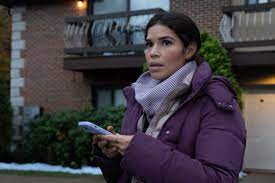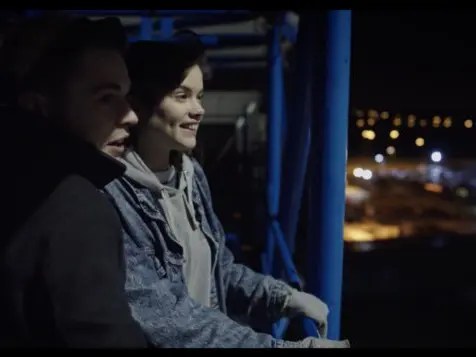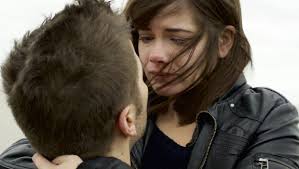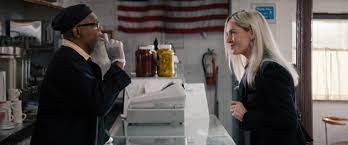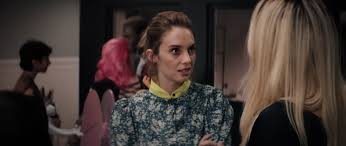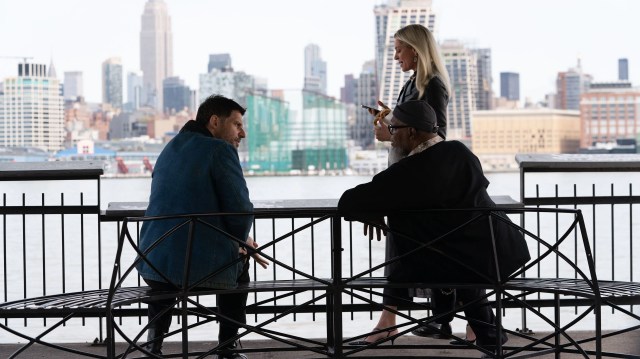

Movie Preview: Emily Blunt and Chris Evans are “Pain Hustlers”

Andy Garcia is the Big Pharma mastermind pushing his sales force to Score Big.

David Yates of the final “Harry Potter Pictures” directs.

Yeah, it kind of looks like we’ve seen it before. But hey…

Oct. 27.

Posted in Reviews, previews, profiles and movie news | Comments Off on Movie Preview: Emily Blunt and Chris Evans are “Pain Hustlers”

Netflixable? A Mexican “Murder, She Podcast” — “A Deadly Invitation (Invitación a un Asesinato)”

Slap the words “unsolved crime podcast” and any hoary old “gather all the suspects” whodunit is “fresh” and new? Is that the idea behind “A Deadly Invitation,” titled “Invitación a un Asesinato”(Invitation to an Assasination/Murder) when it was released in Mexico?

This laughably arch and obvious murder mystery is tedium itself, a tale with little wit, no sense of menace, no urgency and little to no mystery about it.

It’s bad, and thanks to an anticlimax or two, the badness just won’t end.

Agatha (Regina Blandón) is a successful podcaster from the big city, summoned to meet her money-marrying estranged sister Olivia (Maribel Verdú) at her clifftop seaside mansion.

Villa Elisa was named for Olivia’s adopted child, who died five years ago. Since then, she’s lost contact with her sister and divorced her latest rich husband (Pedro Damián), but not before making him buy her a yacht. And she’s invited her almost-estranged sister, her ex Carlos, old friend Sonia (Stephanie Cayo), Sonia’s hunky yoga instructor/lover (Aarón Díaz), a young doctor (José María de Tavira) and an actor friend (Manolo Cardona) to a mysterious gathering.

Olivia hints at old grudges and fresh grievances, at motives and messy history in giving her “Why I brought you all here” (in Spanish, or dubbed) speech. There’s a hint of a threat in her suggestion this gathering will be one of discovery.

“You should figure out who should should apologize to, and who you should say goodbye to,” she advises.

We know, the moment we meet her, that golddigging Olivia won’t last the night. When the cops are called about her “murder, accident or suicide,” there’s bickering over jurisdiction and a local cell service outage that forces the captain to go back to the office.

That leaves impressionable Lt. Julian (Juan Pablo de Santiago) in charge, all by himself. As he’s a fanboy, he enlists podcaster Agatha to solve this mystery, to help interrogate one and all, to literally sniff around when and find secret passages and secret motives and old rivalries and blood grudges that might drive one or more of the “suspects,” who include not just guests but staff.

The script is so half-assed that the cell service issue is abandoned to expedite Agatha’s mystery-solving. Her producer (Mariana Cabrera) is so helpful, sent details to nail down back in the city, she should crack the case herself.

Gadgets and secret associations described in flashback don’t do a damned thing to throw the viewer off our initial thoughts about the death, and who exactly benefits from it and might have further motives to harm others.

This isn’t a “They die, one by one” thriller, which would have raised the laughably low stakes. There’s no suspense. The clues aren’t much of anything even a sharp-eyed viewer would pick up on, because most of them are off-camera complications.

The script, based on a Carmen Posadas novel, doesn’t play fair and doesn’t play smart. The light touches land like rotten tomatillos.

“Knives Out” revived this genre with wit and panache, and Kenneth Branagh reminded us of the many dated pleasures in the works of Dame Agatha, even when the mystery isn’t as mysterious as you might like.

“A Deadly Invitation” is as dumb and dull and creaky as the drawing room mysteries of old, a film that started life with little promise and never fails to live down to that.

Rating: TV-14, violence, adult situations, profanity

Cast: Regina Blandón, Pedro Damián, Aarón Díaz, Stephanie Cayo, Manolo Cardona, José María de Tavira, Helena Rojo, Juan Pablo de Santiago, Mariana Cabrera, Juan Manuel Pernas and Maribel Verdú

Credits: Directed by J.M Cravioto, scripted by Javier Durán Pérez and Anton Goenechea, based on a novel by Carmen Posadas. A Netflix release.

Running time: 1:33

Posted in Reviews, previews, profiles and movie news | Comments Off on Netflixable? A Mexican “Murder, She Podcast” — “A Deadly Invitation (Invitación a un Asesinato)”

Movie Review: Haunted Cage Hunts Bison far from “Butcher’s Crossing”

The first rule a Western fan applies to any modern take on the genre is the eyeball test.

“Butcher’s Crossing,” a lean, gritty parable about shortsighted greed and environmental destruction, looks right. Not original “True Grit” celluloid cinematic, but “Lonesome Dove” authentic, with sweeping vistas, herds of buffalo and a star — Nicolas Cage –– who looks at home in the saddle and scary in his mania for bison hides.

Director and co-writer Gabe Polsky (“The Motel Life”), adapting a John Williams novel, gets good value from his lead, his supporting players and his Montana locations in a film that makes up for its somber pacing and downbeat subject with its fascination for details.

Fred Hechinger of Netflix’s “Fear Street” movies stars as Will, a Unitarian pastor’s son and Harvard boy from “back East” who quit school in search of “stronger purpose and meaning in my life.” The greenhorn has made his way West, to Butcher’s Crossing, Kansas.

It’s 1874, and for a naive lad with designs on “seeing the country” and experiencing the Frontier, he’s found it. Butcher’s Crossing is where the buffalo hunters roam.

Will looks for guidance from a man his preacher-father once took in. But McDonald (Paul Raci, irrascible and fun), who trades in buffalo skins to be turned into the warmest fur coats of their era, is full of warnings and depradations. No, boy, you DON’T want to go hunting.

“It’ll ruin you. It’ll get in you.”

That Miller fellow (Cage) down at the saloon fits the iconic image of a buffalo hunter. Bearded and broad, bald and wrapped in a buffalo robe, he’s as dismissive as McDonald was cautionary.

“Ain’y no ‘tours’ around here.” But if the lad would care to underwrite an outing, the somewhat disreputable Miller knows of a valley where the herd hasn’t been thinned, way off in Colorado.

Finding men to ride with them isn’t all that hard. Old cookie Charlie (veteran character player Xander Berkeley, instantly credible) is Miller’s superstitious, tippling sidekick, ready to drive the wagon. The skinner Fred (Jeremy Bobb of TV’s “Russian Doll” and “Godless”) is another matter. He’s a skeptic.

Miller, it seems, is a big talker whom some have taken for a crank. Chatty, bickering Fred will take a flat fee, thanks. None of this “share the take” risk for him.

They set off through “Indian country” to find the mother lode of buffalo herds. And once there, Will starts to figure out what McDonald’s warnings and Fred’s doubts were about.

The script leans into some tropes of the genre — Will’s pursuit by the saloon’s resident sex worker (Rachel Keller) and dodges others. “Indian country” isn’t particularly perilous.

Cage doesn’t go full NIC CAGE in this role, playing a man more interested in a bragging-rights take to silence his doubters back in Butcher’s Crossing than in settling some darker psychic score. The threat of violence is more subtle, Miller’s monomania is expressed in smaller, meaner ways — refusing to help a stranded widow and her two boys who lost their wagon train.

Polsky focuses on the how-to’s of buffalo hunting as we watch Miller shave his head, load his own rounds and lay out the ways to pick off the herd without scattering it. It’s heartless work, and to Will, starts to seem heedless.

“We’ve got enough,” he insists. “No sense shooting more than we can skin.”

Some old fashioned Cage mania might be appropriate here. Perhaps the John Wayne as Ethan Edwards rationalization from “The Searchers” — killing buffalo to starve out the Natives — might have given this unslakeable thirst for wiping a herd out more meaning.

Bobb adds value as the voice of experience and doubt. Berkeley’s superstitious Charlie gives us just enough (barely) of a “deliver us from evil” message. And Hechinger’s journey from naive to experienced enough to have doubts is adequate, if little more.

But the big setting, big themes and big star’s subtle turn as a blowhard more misguided than manic are enough to put this Western over.

What few real tests the young man from Back East must face, the picture about his coming of age passes the most important. It looks and feels right, with buffal-in-their-element scenes that don’t have the scale of “Dances With Wolves,” but play big enough to make the parable’s point land and land hard.

Rating: R for language, some violence/bloody images and brief sexual content

Cast: Nicolas Cage, Fred Hechinger, Jeremy Bobb, Rachel Keller, Xander Berkeley and Paul Raci

Credits: Directed by Gabe Polsky, scripted by Gabe Polsky and Liam Satre-Meloy, based on a John Williams novel. A Saban Films release.

Running time: 1:48

Posted in Reviews, previews, profiles and movie news | Comments Off on Movie Review: Haunted Cage Hunts Bison far from “Butcher’s Crossing”

Next screening? Swimming to Cuba with Diana “Nyad”

Netflix has this Oscar-bait in theaters this month, on the streamer in early November.

How great is it seeing Jodie Foster on the big screen again? Rhys Ifans also stars in support of Annette Bening in the title role.

Posted in Reviews, previews, profiles and movie news | Comments Off on Next screening? Swimming to Cuba with Diana “Nyad”

Classic Film Review: Holden and Loren in Carol Reed’s Tugboats vs. U-Boats Romance, “The Key” (1958)

Old World War II films that age well tend to have an artist behind the camera and eschew patriotic cheerleading for a weary “war is futile” but “fascism must be stopped” messaging.

Carol Reed’s “The Key” brings the cynicism of William Holden to a stiff-upper-lip/”Every man must do his duty” British WWII drama, and Sophia Loren arrives to give it a hint of sex, of a woman being “passed down” from man to man, and a romance with a whiff of the supernatural about it.

Reed made the most cynical post-war film of them all, “The Third Man,” and here tells a compact story of less glamorous but grim and deadly stakes, a tale of the ocean-going tugs sent to help ships attacked by U-Boats in British waters.

Blending lots of ship-at-sea footage and a few reasonably convincing models for the rescue/combat sequences with a fatalistic love story, and built on outstanding performances by Trevor Howard, Kieron Moore, Noel Purcell and Oscar Homolka in support, it’s a damned entertaining yarn and beautiful to look at to boot.

Holden plays Captain David Ross, an American who enlisted and became a sergeant in the Canadian Army at the outbreak of war. Now it’s 1940 about to turn ’41 and he’s been re-assigned to duty doing what he did years before — skippering a tugboat.

Howard’s Capt. Chris Ford is a grizzled old salt at the tugboat trade, and a hail-fellow ex-shipmate, ready with a dozen wisecracks about his old friend’s new gig.

“You’ve heard of ‘Lend Lease?’ They sent him.”

Capt. Ford takes new Capt. Ross out at the behest of the commanding officer (Bernard Lee, just a couple of years shy of becoming James Bond’s boss) and shows him the ropes of this dangerous duty — burning or sinking munitions ships and the like, U-Boats even more deadly on the surface than underwater, at least to the outgunned tugboats.

And when they finish the day with drinks at the pub and the camaraderie of his flat, complete with beautiful lady love Stella (Loren), Ford has some explaining to do to Ross.

Stella wears a wedding ring. She has a lovingly-signed photo of another skipper on her mantle. And that better-fitting jacket she passes on to new guy Ross has yet another name stitched in the lining.

In the crudest terms, Stella “comes with the flat,” even though Ford goes out of his way to avoid saying it. And he’s hasty to offer a key that flat to Ross. Apparently, one of her now-dead former flatmates started that tradition, a way of looking out for Stella, ensuring her a place to live and well…

“Make me a promise right now,” the not-so-old-salt insists. “The moment you use (the key) it, if you ever have to, (promise) that you’ll get another one made. And you’ll give it to someone, someone on the tugs.”

Keep things in “the family,” as it were.

Stella is a passive figure in all this. Still, she loves Chris and agrees to marry him. But Stella has premonitions. All it takes is a joking spilling of the wine all over his shirt — “Look, I’m wounded!” — for her to know his number’s up.

How will the American handle this responsibility, now that it’s fallen to him? How will he accept his “duty” and hers, and the notion that she’s “bad luck” thanks to her premonitions?

It’s Bill Holden playing the guy, remember. “Bridge over the River Kwai/Stalag 17” Bill Holden. He’ll handle it with that trademark American cynical skepticism, of course.

The combat scenes aren’t heroic, just frustrating as the dated and small-caliber firepower provided to tugs wasn’t enough to defend themselves. A good day is weaving about, reversing and turning, escaping destruction and getting a hearty handshake from whatever freighter captain they’ve rescued and towed to port. A bad day is not coming home yourself.

Holden and Loren are OK in the romantic scenes, little more. It’s the action, the fatalism, Reed’s attention to the details of this sort of work at sea and the men among men relationships that stands out.

Moore gives a fine edge to Ford’s first mate, who resents the American interloper. Lee is unflappable and droll, practically auditioning for Bond’s “M” here. And the veteran character actor Homolka shows what he can do with a meaty role as a pious, professional and helpful Dutch skipper who splits shifts captaining the W-86 tug with Ross. He makes short briefings on seamanship and lectures on sobriety and avoiding loose women entertaining, realistic and compassionate.

Capt. Van Dam owns this tug. He wants it to survive the war.

Reed manages some splendid black and white compositions reminiscent of “The Third Man” — a train departing in steam and twilight — and oversees magnificently-edited action beats.

It’s not quite “Kwai” in “prestige picture” polish. But “The Key” is damned good, and a terrific addition to your “Victory at Sea” World War II drama bucket list.

Rating: TV-PG, combat violence, adult situations, alcohol abuse

Cast: Willian Holden, Sophia Loren, Trevor Howard, Bernard Lee, Kieron Moore, Bryan Forbes, Noel Purcell and Oscar Homolka.

Credits: Directed by Carol Reed, scripted by Carl Foreman, based on a novel by Jan Hartog. A Columbia release on Tubi, Amazon, Youtube etc.

Running time: 2:06

Posted in Reviews, previews, profiles and movie news | Comments Off on Classic Film Review: Holden and Loren in Carol Reed’s Tugboats vs. U-Boats Romance, “The Key” (1958)

Movie Preview: Aaron and Bella, Brawls and Drawls — “Rumble Through the Dark”

Aaron Eckhart makes his “boxing picture,” playing a back-alley fighter who has a debt to Big Mama (“Secrets & Lies” star Marianne Jean-Baptiste, looking and sounding fierce).

Bella Thorne is the Southern fried tattoo billboard who seems to believe in him.

Looks brutal and sounds Southern. Nov. 10.

Posted in Reviews, previews, profiles and movie news | Comments Off on Movie Preview: Aaron and Bella, Brawls and Drawls — “Rumble Through the Dark”

Movie Review: Eccentric, Operatic and Romantic — “She Came to Me”

Rebecca Miller’s “She Came to Me” dances and teeters, staggers and skips along the line separating the quirky from the indulgent.

It’s a high-minded, well-cast romantic comedy whose easy laughs come from two Oscar winners and Peter Dinklage, a film whose romance is best delivered by teens and whose quirks include three oddball settings — Civil War reenactments, tugboat work and opera.

Strange? Oh yes. Bold? Sometimes. “Well-cast?” The actors do almost all of the comic heavy lifting in scenes that set up as cute or hilarious but whose only payoff is in a deadpan reaction or the mere fact that this or that player was cast to play this or that part.

The actress turned director of “Personal Velocity” and “Maggie’s Plan” creates a primer for “on the nose” casting. It doesn’t take much of a stretch to imagine “Game of Thrones” breakout Dinklage as a brooding composer facing writer’s block, a tossled, romantic figure dashing and magnetic enough to attract great beauties Anne Hathaway and Marisa Tomei.

Hathaway as an always-put-together OCD “clean freak” psychotherapist? We buy in without thinking. Tomei as a vivacious, “romance” addicted tugboat skipper of a certain age? Of course!

Steven Laddem is an acclaimed opera composer who had a breakdown after his last magnum opus. That was five years ago. It’s a good thing he married his shrink (Hathaway). Because he’s “blocked” and late delivering his new commissioned work. “Doc” Patricia is always counseling him to “break the patterns” of his routine to stir his creative juices.

One dog walk past a Brooklyn waterfront bar later, he meets the very forward, quite working class Katrina Trento (Tomei), who grew up on her tug, inherited her tug from her dad and insists this stranger she’s taken a fancy to over drinks “see” her tug, and her cabin.

A few reluctant kisses and tugs later, they’re in a passionate embrace. He’s so rattled that he tumbles off the dock and into the water on his walk home. Inspiration strikes.

“Doc” is a helpful but chilly spouse, a tad too tidy for sex. She’s happiest when she’s cleaning, and even helps their new cleaning lady (Joanna Kulig) as she chatters through her mild mania. Because when she’s not cleaning, she’s not happy.

Magdalena’s Catholicism…intrigues her.

And unbeknownst to Doc and Steven, and Magdalena and her court reporter and self-righteous Civil War reenator partner Trey (Brian d’Arcy James), Doc’s son (Evan Ellison) from a previous relationship is 18, prepping for the best college of his choice, and deeply in love with Magdalena’s smart-cookie daughter (Harlow Jane).

Writer-director Miller is the daughter of playwright Arthur Miller, and there’s flash to the writing, the collision of personalities and situations, including the Big Coincidences that throw all these characters together.

Doc can’t come along with indecisive, panicked Steven on his dog walk because if she does “I’ll make all the decisions,” and where’s the therapeutic, pattern-breaking spontaneity in that?

Katrina isn’t a sex addict. “I’m addicted to romance,” but “I have been known to stalk” this or that guy. So, yeah.

Young Tereza gazes into the eyes of young beau Julian and says the words many an articulate teen has uttered — “I’m going to love you for the rest of my life.” As they’re both very smart and wise beyond their years, you can believe it, even if the more sage among us figure they’ll break up. But even we know that first love will always linger on the memory.

Miller and her players give us a couple of swooning moments like that, which are almost worth the cost of admission by themselves.

Amateur Civil War pedants bickering over the particulars of one tiny, inconsequential engagement, the tug boat operator listing most everything that you can see was at some point “moved by a tug,” the way Steven hears the musical note in Doc’s mini-vac, there’s a rich collection of details in all this.

But the casting is what makes an movie that never quite finds its tone (warm, weird and funny) work. Deadpan Dinklage duels deadpan co-stars for droll laughs in many a scene.

Miller went to the trouble of conceiving snippets of operas Steven is inspired to write by the tugboat skipper he won’t allow himself to call his “muse,” and she hired the composer of the music to Dinklage’s terrific take on “Cyrano,” Bryce Dessner, to whip up the score.

Miller then tops that by casting real opera singers Isabel Leonard, Emmet O’Hanlon, and Greer Grimsley to rehearse and sing Steven’s female tugboat skipper “Sweeney Todd” ripoff and another opera he tries to top that with.

Sure, “She Came to Me” is a tad less than the sum of all its many delightful parts. But Miller is canny enough to cast it perfectly and generous enough to let her players rescue this marvelous mixed-bag of delights whenever it goes astray.

Rating: R, sexual situations, profanity

Cast: Peter Dinklage, Anne Hathaway, Marisa Tomei, Harlow Jane,
Joanna Kulig, Evan Ellison and Brian d’Arcy James

Credits: Scripted and directed by Rebecca Miller. A Vertical release.

Running time: 1:42

Posted in Reviews, previews, profiles and movie news | Comments Off on Movie Review: Eccentric, Operatic and Romantic — “She Came to Me”

Movie Preview: Ken Loach presents a Not Wholly Tolerant British Village and Refugees who meet at “The Old Oak”

Ken Loach, one of Britain’s most politically conscious/working class savvy filmmakers (“The Wind that Shakes the Barley,” “It’s a Free World,””Jimmy’s Hall”), takes his shot at intolerance for displaced persons in his latest.

Looks excellent. As one would expect.

Posted in Reviews, previews, profiles and movie news | Comments Off on Movie Preview: Ken Loach presents a Not Wholly Tolerant British Village and Refugees who meet at “The Old Oak”

Netflixable? Surviving the Holocaust and Getting Sexual Revenge is Tricky for “Filip”

“Filip” is a Polish World War II tale about a Jew, scrambling to survive the ongoing Holocaust, having his revenge by bedding every German woman he can — soldiers’ wives especially — while hiding out in Frankfurt.

Based on an autobiographical novel by Leopold Tyrmand, it plays as a dark wish fulfillment fantasy, a “How I Survived the War” bent into “What I Should Have Done to My Oppressors.” It’s bleak, in a frothy sort of way, and built around a hero who is intensely unlikeable. But we know, even if the Nazis don’t, that he has his reasons.

Eryk Kulm has the title role, a man young and in love, ready to debut a dance routine he’s worked out with his beloved Sara (Maja Szopa) at a popular music hall in Warsaw. They’re giddy as they chatter down the crowded streets, meeting friends, his sisters and parents as they’re about to perform.

But this is Warsaw, 1941. They’re in the ghetto. All that bubbly smalltalk they and their youthful friends exchange about plans and hopes might keep them hopefjul. But we know where they’re going. Filip’s over-sized pants falling down, mid-number, is the least of this act’s problems. Germans burst in, shoot a few folks just because, and Sara dies.

Two yeas later, dapper, cunning and multi-lingual Filip is in Frankfurt, posing as a French “foreign worker” pressed into service as a waiter at a high-end hotel with Pierre from Belgium (Victor Meutelet) and other handsome young men, “the best conquered Europe has to offer,” boasts their concierge.

They have it pretty good — access to fine food and drink, use of the pool, and a need to “service” the frustrated women of a country whose male populace is mostly absent, temporarily if not permanently.

“Surely your fiance is at the front?” Filip, who sees himself as irresistible to the “German brood mares,” asks/taunts one willing partner.

The fiesty, anti-Nazi Blanka (Zoe Straub) may join Filip and Pierre as they secretly listen to Churchill talks on the radio, may see Filip and her as “a good match,” even though Pierre is supposedly her boyfriend. But Filip isn’t making plans.

“I’ll see you after the war,” is his pillow talk (the film is in Polish, German and French, with subtitles).

His assignation with her is no different from any other German woman, younger or older. He makes a point to cover her mouth, lest her passion give him away. Or perhaps he doesn’t want to think of conquests enjoying themselves.

Filip smuggles booze and contraband out of the hotel to an anti-Semite who “doesn’t like Jews, but I like you” (Werner Biermeier), a man who keeps a number of Polish Jew slave laborers alive via his “employment.” Filip stumbles into a Pole (Sandra Drzymalska) who knew him from school, now married and perhaps interested in giving him away, or blackmailing him. And there’s the photo lab worker Lisa (Caroline Hartig), who rebuffs his arrogant, rude advances, but who softens to Filip as he softens around her.

But this character marches through this world without sentiment or humanitarian distraction. He is almost brazen about his “secret” Jewishness. It’s not quite an open secret at the hotel. And he never lets us forget that he’s out for number one, and number one wants to survive this.

Hearing about “ghettos burned to the ground” back home, that “you might be the last (Polish Jew) left,” leaves Filip unmoved. Deaths and threats of betrayal don’t have shake his resolve.

Filip has his “new method of revenge on the German nation” to consider.

Kulm’s performance, taking Filip from enthusiastic plans to help him and Sara hustle to survive to calculated seductions (there are many) to perhaps awakening to his own chance of happiness, or at least feeling the peril that his reckless actions have put him in, is subtle and poker-faced.

That lends the narrative a general disconnect from the dangers of his situation and death facing him and this untouched-by-the-war oasis city (until the third act) and robs the picture of some of its urgency.

Michal Kwiecinski’s film has echoes of “Europa Europa” and “The Unbearable Lightness of Being” in its “hiding in plain sight” survival story and the existential disconnect of sex and love under oppression. The violence of war, when it errupts in summary executions or that first air raid on Frankfurt, is jolting.

It takes some getting used to the idea of never quite fearing for Filip because he doesn’t seem to fear for himself, and he’s loathsome in many ways. But “Filip” still makes for a grimly picaresque burlesque of a survivor’s narrative, a version of “The Pianist” in which our protagonist is arrogant, heedlessly brave and hellbent on having his revenge on “the German State” and the racist, murderous Nazis and their equally vile wives.

Rating: TV-MA, violence, sex, smoking, profanity

Cast: Eryk Kulm, Victor Meutelet, Caroline Hartig, Zoe Straub, Sandra Drzymalska, Werner Biermeier, Robert Wieckiewicz and Maja Szopa

Credits: Directed by Michal Kwiecinski, scripted by Michal Kwiecinski, Michal Matejkiewicz and Anna Gronowska, based on a novel by Leopold Tyrmand. A Netflix release.

Running time: 2:05

Posted in Reviews, previews, profiles and movie news | Comments Off on Netflixable? Surviving the Holocaust and Getting Sexual Revenge is Tricky for “Filip”

Documentary Review: The Soundtrack of the ’70s was performed by the “Immediate Family”

Director Danny Tedesco gave us the acclaimed documentary “The Wrecking Crew!” a film that celebrated the unsung heroes of the songs of the ’60s, LA’s most popular recording studio session musicians. They were the players who always got the call for the records that became the soundtrack of that era.

Guitarist turned country music star Glen Campbell to bassist Carol Kaye, drummer Hal Blaine to director Tedesco’s dad, Tommy, this handful of people contributed to the pop hits, rock records and even comprised the legendary Tijuana Brass, although almost no one knew their names.

Tedesco’s follow-up film “Immediate Family” simply takes that idea into the ’70s and ’80s, the golden age of the singer-songwriter. Carole King didn’t just play the piano and sing. James Taylor and his acoustic guitar weren’t and aren’t the only instruments you hear on his records or on tour. And it wasn’t just The Eagles who made a living backing Linda Ronstadt.

And while the only name on TV composer Mike Post’s “Rockford Files” to “Magnum” to “Hill Street Blues” music might have been his, he wasn’t the guy doing most of the performing.

The core group of guys — male only — in this “world’s greatest cover band” would flesh out, contribute to, co-write and even morph into producers for the music of the Laurel Canyon era, hitting the road with the stars whose sounds they created on record. They’d work into the ’80s and beyond, adapting to the synth sound era, playing for Phil Collins, Neil Young and Keith Richards, Stevie Nicks and Steve Perry.

James Taylor called them “The Session” when they backed him, and Waddy Wachtel, Danny “Kootch” Kortchmar, Russ Kunkel, Leland Sklar and Steve Postell even toured and recorded under that name. But in their fifth decade of working together, they’re better known now as “The Immediate Family.”

The film is built around a collection of interviews that sort of recreate how the “group” came together, beginning with guitarist Kortchmar meeting young James Taylor when their families were both vacationing on Martha’s Vineyard. “Kootch,” who’d eventually write, play on and produce Don Henley’s post-Eagles solo hits, led a band that served as the backing group for Peter & Gordon for some of the British duo’s U.S. dates. When Taylor went to England to try and get from demo artist to pop star, he took the phone number of Peter Asher of Peter & Gordon, Asher having moved to A&R chief with The Beatles’ Apple Records, with him. Taylor was given that contact by his pal Kootch.

This association led to that one, and so on, as bassist Sklar, drummer Kunkel and guitarists Wachtell and Postell found their way to LA just as Jackson Browne, Crosby, Stills, Nash and Young, Joni Mitchell and others were creating “The Laurel Canyon Sound.”

It’s been 15 years since “Wrecking Crew” came out, and while the history presented here and the musicianship — distinct solos, styles, etc. — celebrated in the movie will trigger a lot of memories, “Immediate Family” never feels much more than an addenda to “Wrecking Crew” and all the docs on that scene (“Sound City,” et al) and that sound (“Echo in the Canyon”) that preceded it.

Carole King tells more of the story of how she went from being half of a divorced songwriting duo to a solo songwriter and star, first by playing piano with these session men in the studio and then on stage with James Taylor.

Lou Adler and David Crosby, who were also in “The Wrecking Crew!” doc, have another round of relating the “genius” of this player or that one and their contributions to hits from Jackson Browne to Hall & Oates.

But if you’ve seen any of those other docs, “Family” offers few surprises. It’s repetitive and just plain less interesting. No matter how amusingly Wachtel recalls the creation of “Werewolves of London,” stealing some of the credit for that hit back from credit thief (according to his biographer) Warren Zevon, rounding up the rhythm section named Fleetwood Mac (Mick Fleetwood, John McVie) for scores of takes, there’s not a lot of punch to that story.

The film’s documenting of a notoriously druggy era in studio work is sanitized. If Ronstadt winning at poker on the band bus because “I was the sober one” is the best you’ve got, maybe keep asking questions.

It’s a film best-appreciated as part of a contiuum, where “The Wrecking Crew!” sees its time pass, and a new generation mellows out the sound and the scene and jumps at the chance to going on the road with their idols and employers, something the members of The Wrecking Crew rarely did.

As “the sound” changes and singer-songwriters slip into the background, the guys who adapt to the synthesizer era keep working. The players who can write or co-write songs thrive. And the guys — it’s a frankly less diverse cast of characters (drummer Steve Jordan integrates the movie) here — who paid attention in the studio and learned how to produce become key figures in the ’80s and into the ’90s.

What’s more, as Phil Collins and Billy Bob Thornton (?) point out, none of these people — Wachtel and Kootch in particular — are anonymous. Producers Asher and Adler started crediting them on the records they played on and cult followings for them were born in the early ’70s.

That lowers the stakes. This isn’t about honoring invisible talents “20 Feet from Stardom.” They’ve gotten their accolades and their riches and came out all right. Remember the Linda Ronstadt doc? That had pathos and heart, also lacking here.

Tedeceso teases us with references to Mitchell, Hall & Oates, Billy Joel and others’ music, but none of those figures turn up here and the role the Family had in creating their records isn’t discussed.

It’s OK to repeat yourself, especially if your last film on the subject was almost a generation ago. But Tedesco has turned out a blander, refill-toner-light-on photocopy of a movie that had more colorful characters and a wider range of sounds, songs and life experiences than this “Family.”

Rating:unrated, drugs mentioned, profanity

Cast: Danny Kortchmar, Carole King, Leland Sklar, Stevie Nicks, Russ Kunkel, Steve Jordan, Linda Ronstadt, Waddy Wachtel, Lyle Lovett, Steve Postell, Don Henley, Phil Collins, Lou Adler, Peter Asher, Keith Richards, James Taylor and Neil Young.

Credits: Directed by Danny Tedesco. A Magnolia release.

Running time:

Posted in Reviews, previews, profiles and movie news | Comments Off on Documentary Review: The Soundtrack of the ’70s was performed by the “Immediate Family”