Netflixable? “Resident Evil: Death Island” moves the franchise permanently into CGI

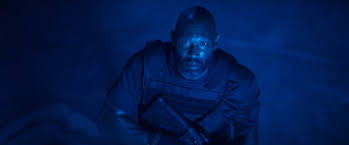
“Resident Evil: Death Island” continues the migration of this long-running video-game adaptation/series to the CGI universe. It’s a continuation of the storyline of the bio-weapon zombie series “Resident Evil: Infinite Darkness,” and judging from the clips of that 2020-2021 CGI production, it’s another step up in creating photo-real characters and action in computer generated (animated) imagery.

The story, the “characters” and the dialogue? They’ve devolved into one big king-sized can of Costco corn. It’s a movie rife with tired zombie movie tropes and cliches uttered by actors “playing” somewhat less-plastic-looking “realistic” characters.

“Sometimes the nightmare sticks with you, and if you’re not careful, it’ll swallow you up!”

“I will make you pay for killing my father!”

“The infected must be shot on sight! Terminate with extreme prejudice!”

The “talking villain” (voiced by Daman Mills) walks with a cane and has a mania for Russian Roulette, and soliloquies.

“Is there even such a thing as ‘evil’ in the food chain?'”

The story follows a couple of timelines — one in the past where we see that first Raccoon City (those Japanese and their idea of what North Americans name their metropolises) outbreak test a couple of commandoes sent to evacuate Umbrella execs — and a “present” where a new “bio weapon” outbreak, delivered by bio-drones and including actual monsters, is traced to Alcatraz Island in San Francisco Bay.

“Death Island” it is.

The combat tac gear always dresses female fighters tops and pants/shorts from the Tomb Raider collection. And the characters are just computer-generated archetypes — the burly soldier, the mop-topped “agent,” the pinup scientists, lady soldiers and villainous henchwoman.

Very video game and seriously dumbed-down as a movie.

As for the animation, most action beats in big screen blockbusters are CGI-dependent, and this movie’s versions of those — complete with Bugs Bunny physics in their unsurvivable (and helmetless) motorcycle crashes — are pretty convincing. The most photo-real moment is a brief snippet of the bad guy loading a revolver for another round of Russian Roulette. The pistol and the hand fumbling bullets into it are as close to the real thing as any CGI human-and-human-activity I’ve ever viewed.

In the rural North Carolina town where my mother retired, there’s one fan of this series who catches my attention each time he drives by. A decade ago, he painted up his black ’90s Ford Taurus in Umbrella Corp. logos and slogans. I see this car most every time I visit — parked at this Subway or McDonald’s where he’s working, in a trailer park I bicycle by where he seems to live.

At this point in the Milla Jovovich-born “Resident Evil” as filmed entertainment enterprise, these movies are for that guy. Probably not that guy alone, but definitely a smaller and more devoted audience.

The rest of us moved on when Milla finally did. CGI leaps forward in “realism” be damned, this beast was beaten to death years ago.

Rating: R, bloody violence and a little profanity

Cast: The voices of Nicole Tompkins, Matthew Mercer, Stephanie Panisello, Kevin Dornan, Erin Cahill, Cristina Valenzuela and Daman Mills

Credits: Directed by Eiichiro Hasumi, scripted by Makoto Fukami. A Sony film released on Netflix.

Running time: 1:30

Posted in Reviews, previews, profiles and movie news | Comments Off on Netflixable? “Resident Evil: Death Island” moves the franchise permanently into CGI

Movie Review: A dark and hilarious “Frankenstein” feminist fantasia — “Poor Things”

“Poor Things” is a deliriously deranged comedy about one woman’s journey from suicidal despair to liberation, thanks to her discovery of the orgasmic pleasures of “furious jumping,” aka “sexual intercourse” done right.

Yorgos Lanthimos, the most successful and mainstream avante garde filmmaker of our age thanks to trippy and witty works such as “The Lobster” and “The Favourite,” creates an homage to the cinema of Terry Gilliam in this dark, bloody and sexually explicit farce. It’s a gloriously over-designed mashup of “Frankenstein” and Terry Southern and Mason Hoffenberg’s “Candy” and every other “dirty book” about a young woman’s ribald romp to sexual awakening and self-actualization.

The real source material is post-modern Scottish writer Alasdair Gray’s 1992 novel. But screenwriter Tony McNamara (TV’s “The Great”) and Lanthimos visualize it as an eye candy sexcapade about the state of women in a regressive, woman-hating era when even bodily autonomy is under assault by the more Neanderthal corners of the Patriarchy.

It’s a bit excessive, but never less than inspired.

Emma Stone, in what has become the most celebrated performance of the year, plays a young woman we first glimpse as she’s plunging off a London bridge. An accomplished surgeon (Willem Dafoe) who learned from a surgeon-father who carved him at will, makes her reanimated corpse his “experiment.”

Dr. Godwin Baxter is “My God” to his young ward, a grown woman with the literal brain of a child.

Ramy Youssef is Max McCandles, a smart or at least compliant student in Dr. Baxter’s lectures summoned to “study” and take down data on Bella’s progression from infancy to maturity in a steampunk London where sky trams and dirigibles traverse the skyline and horseless (steam powered) carriages have a life-size horse’s head as their de factor hood ornament.

“My God” is given to playing God, surgically creating goose-headed dogs and other duck, rooster and goat hybrids that wander his mansion. He has contrived a stomach-mimicking gadget that makes up for his medical lack of digestive enzymes and such, hooking himself up to eat, finishing each meal with a comically colorful psychedelic bubble burped out for all to see.

Stitching together a “new” woman is just a natural progression of his work.

Bella is a lurching toddler with big eyes and breasts, and a small child’s grasp of language, table manners and impulse control. She lashes out, gleefully joins in the cadaver “cutting” that her father-figure practices and abuses dishware and staff and this new assistant assigned to note her every “advance.”

Dr. Baxter notes the shine Max takes to his “experiment” and abruptly suggests they marry. Bella has no say in this engagement.

But when we see the moment she discovers self-pleasure with an extreme closeup of that magical first-ever orgasm, we have our doubts. When that lecherous lawyer Duncan Wedderburn shows up with the paper work to legalize the restrictive “conditions” of this marriage — she must never Dr. Baxter’s care — we expect the worst.

Mark Ruffalo affects a foppish, mustache-twirling accent as the oversexed and heartless Wedderburn, a rake who seduces Bella, lures her on a grand sex tour — Lisbon, Paris, etc. — of the continent and only realizes he’s in over his head after they’re well at sea.

Bella’s offhand remark at a posh, bawling-interrupted dinner, “I must go punch that baby,” might be the silly sod’s first clue.

But the sex is so good and so frequent he’s willing to let her unschooled cruelty slide, being a cruel creep himself. It’s just that Bella’s sexual curiosity means that her “experiments” are just beginning.

Stone is rightly gaining most of the attention for this daring turn, a role that requires mimicking the physical and verbal truisms of childhood and a long, second-and-third-act string of explicit and over-the-top sex scenes.

“Why do people not just do this all the time?” Bella wonders, and forces us to ponder.

But Ruffalo lands a laugh almost every time he opens mouth, making an amusing character an explosively funny smorgasbord of male insecurities, animal desires and cluelessness. This isn’t just the funniest role of his career, it might be his best performance ever.

Lanthimos puts the viewer through the wringer in this tale of surgically Gothic horror, steampunk tech and fashion-forward evening wear under luridly impressionist chiaroscuro skies.

Sequences switch back and forth from black and white to color, not necessarily simply denoting “the past” (the most colorful) or the fictive “present” (monochromatic) in this design scheme.

The excesses of the sex scenes — Bella clocks in at a French brothel for a stretch — include the fact that there are so many of them. Lanthimos dances right up to that “exploitation” line, and crosses it. It’s probably intentional, considering the picture’s sexual politics.

But at some point you start to feel bad for what this role demanded of Stone, how we get the point, see it reinforced and then wonder what just what the chap behind the camera’s deal was in repeating the message and over-exposing his Oscar winning star in this manner. The repetition slows the movie down so much that the third act becomes something of a drag.

Still, in an age when a New Prurience might be a part of the “Control Women” agenda that “Poor Things” is puncturing, Lanthimos, McNamara and Stone have given us a picture that prods, provokes and delights in any discomfort it might create, a bawdy odyssey that, whatever your reservations, insists on being the Must See Movie of the season.

Rating: R for strong and pervasive sexual content, graphic nudity, disturbing material, gore, and language

Cast: Emma Stone, Willem Dafoe, Mark Ruffalo and
Ramy Youssef

Credits: Directed by Yorgos Lanthimos, scripted by Tony McNamara, based on the novel by Alasdair Gray. A Searchlight release.

Running time: 2:21

Posted in Reviews, previews, profiles and movie news | Comments Off on Movie Review: A dark and hilarious “Frankenstein” feminist fantasia — “Poor Things”

Movie Review: Payne and Giamatti enjoy Boomer nostalgia and their own history in “The Holdovers”

Director Alexander Payne and star Paul Giamatti go “home” for the holidays with the warm, acerbic but sentimental “The Holdovers,” a picture that hits a lot of the same notes of their greatest collaboration, “Sideways.”

It’s a sweet but slight film about a privileged boarding school student and his most hated professor, stuck together after their snow-covers-the-ivy Massachusetts campus shuts down over Christmas break in 1970. They bicker, battle and bond in a story about life expectations, depression, class and a culture whose values are shifting from the hidebound ’50s to the “Me Decade” ’70s thanks to the seismic upheavals of the era that’s ending and the one that’s just beginning.

Giamatti is Paul Hunham, a Cicero-quoting/ Peloponnesian War-obsessed ancient history teacher who feels he is fending off the barbarians at the gate by having standards and holding these “entitled” rich boys to the ideals of his notion of who and what a “Barton (School) Man” should be.

The kids don’t like him because of those unbending “standards,” his Latin-and-Greek lingual pretentions and his temper. The lazy eye and “smell” don’t endear him to them either. It’s not just his daily dose of alcohol that gives him an odor.

“Latitude is the last thing these boys need,” is his creed.

Newcomer Dominic Sessa is a Angus Tully, a smart junior who should be a senior because he’s been kicked out of other schools. He’s one of those “Dead Poets Society” style rebels — studious, but sneaking smokes, coveting booze, naive about women and ignorant of just how “lucky” the accident of his highborn birth has made him.

The other kids don’t care for him because of his cutting snark, his better grades and inability to tolerate the intolerant, shallow, destined-to-rule boors who surround him.

“I thought all of the Nazis had left for Argentina!”

Hunham is “punished” for not letting a Senator’s son skate through his class, the punishment being given the “babysitting” duty of keeping rich kids — a jerk, a jock, a Mormon child and a homesick Korean among them — whose families aren’t able, or willing to bring them home for Christmas break.

Angus has “St. Kitts” plans right up to the moment his newly-remarried mother informs him that she’s doing this trip with her new husband and his family, not him.

The gloves come off straight away as teacher and “troubled” student clash and curse their way into this forced-intimacy, made worse when events conspire to allow the other four kids to escape Barton.

Da’Vine Joy Randolph of “The Lost City” and “Only Murders in the Building” is Mary, the unappreciated head-cook in the kitchen, a fellow inmate at the ancient (“founded in 1797”) school this holiday season.

Mary is a character who brings the tragedy and disillusions of the Vietnam/Nixon era backdrop into the story. Posh and priieleged as it is, Barton is integrated. Mary’s son was able to go there. But he’s one of the honored dead in the school’s hall of fame, another alumnus killed in combat — in his case, in Vietnam mere months before.

What’s fun here is the sparks set off by witty characters clashing over their differences even as they start to see — to their dismay — their common ground. What’s grand is the humanity brings to characters in all his movies, from the abortion-debaters of “Citizen Ruth,” the retirees of “About Schmidt” and the “left behind” midwestern coots of “Nebraska.”

Giamatti’s Hunham is mean and maybe kidding himself that he prefers solitude, the “aescetic” life of a bookish man of letters. But his blunt corrections of brats who don’t pay Mary the proper respect — Black, working class and in mourning — show his heart.

Angus is a brat capable of seeing his failings and learning from them. And Mary is a classic character “type” — the Black truth-speaker, keeping it together but not given to keeping her opinions to herself thanks to their shared circumstances, and her very personal ones.

Nobody here is a caricature, as easy as it would have been to make a movie built out of those. And the performances are mostly understated.

That said, the laughs are a bit easy, too familiar, the situations a collection of tropes and the psychological “types” are entirely too on the nose.

“Netflix editing” — aka slack pacing — is the only reason this 95 minutes of incidents and relationships comedy drags on for 135.

And an “OK, Boomer” air hangs over an enterprise that takes pains to remind us of how limited our media/entertainment options (radio and “The Newlywed Game”) were “back then.”

The tiny selection of liquors available, the corduroy fashions, pipe-smoking, post-60s unkempt long hair and “champagne of (bottle) beers” option at any diner or bar, an age when “Cherries Jubilee” was the posh dessert of any table-cloth dining establishment ,give away Payne’s willingness to pander to an audience of peers, even if most of them stopped going to the movies over a decade before “About Schmidt” (2002) lured them back, just for a weekend.

But that’s something a “holiday movie,” by tradition, provides — nostalgia, memories jogged by the fashions, the cars, the characters and the values of a bygone age. Whatever leftovers “The Holdovers” serve up, Payne and his once-and-future-muse Giamatti make this cinematic comfort food perfectly palatable.

Rating: R for language, some drug use and brief sexual material.

Cast: Paul Giamatti, Da’Vine Joy Randolph, Dominic Sessa and Carrie Preston.

Credits: Directed by Alexander Payne, scripted by David Hemingson. A Focus Features release.

Running time: 2:15

Posted in Reviews, previews, profiles and movie news | Comments Off on Movie Review: Payne and Giamatti enjoy Boomer nostalgia and their own history in “The Holdovers”

Movie Preview: “Inside Out 2” next summer for you

More emotions, because you knew Pixar wasn’t going to let go of an idea this good.

Posted in Reviews, previews, profiles and movie news | Comments Off on Movie Preview: “Inside Out 2” next summer for you

Movie Review: Aged writer weighs whether to be “Forever Young”

“Forever Young” is yet another “speculative fiction” tale that takes senior citizens for a dainty dip in the Fountain of Youth.

It’s a somber, downbeat drama in which the familiar themes about how old age is “earned” and how some are anxious to “rewrite” their past and others are more than ready to shuffle off this mortal coil are recycled once more.

Those main themes are lightly accesorized in writer-director Henk Pretorious’ narrative. A lost child, a longing for a child never born, old flames and a writer whose audience is dying off are folded into what, at its most basic, is a story of a marriage and the differing expectations each partner brought to it and hopes, in their dotage, to take from it.

Diana Quick, seen in “The Death of Stalin” and in Ridley Scott’s first feature, “The Duelists” way back when, is Robyn White, a 70something novelist who has noticed, via her public readings of her latest book, that her readers aging and dying out.

She’s a bit of a grump, and right-after-a-reading is no time for old flirt Jim (Julien Glover, a memorable James Bond/Indiana Jones nemesis) to shuffle up and demand to know if she’s “writing my book.”

Irritable Robyn isn’t hearing it, even if Jim claims “I’ve discovered the cure for regret!”

Robyn and longtime husband Oscar (“Lord of the Rings” alumnus Bernard Hill) have an old manor house in the country and a routine that depresses her, weekly “Any bets on who’s next?” visits to older friends in the retirement home down the road.

Then Jim shows up again. And this time he looks the way he did when they were all young. Young Jim (Mark Jackson) was “obsessed with age being a curable disease,” and being a Big Brit Pharma chemist, he’d done his share of dabbling.

Whatever he retired with apparently did the trick, and Robyn breaks out her recorder to begin researching that book. “Novis,” he calls his elixir. And when he offers it to Robyn, she’s in a quandary.

Oscar, whom she considers dull and “average,” but who insists to her “that I don’t regret a single day of my life with you,” isn’t interested. He’s got his woodwork diaramas, his occasional “quiz night” at the pub, and Robyn. For him and his little time left, that’s enough.

Researching Jim, she is introduced to the singing, homeless junky daughter (Anna Wolf) born after a one night stand. Hanging with her granny-pal Jane (Stephanie Beacham), Robyn learns she’s headed to Thailand for a cheap facelift.

Two more candidates for the Novis treatment? And what complications might lie with them? Robyn also has to make up her own mind, and it’d be a mighty short movie if she didn’t get into the bath in her ’70s and wake up as her 30ish self (Amy Tyger).

Films like this have to walk a fine line between sentiment and sentimentality. Pretorious avoids that by keeping the temperature entirely too chilly for warmth. He doesn’t give his cast many moments for sentimental reflection or emotional connection with each other, much less the audience.

The stakes feel low, the finale preordained and none of the little sidebars in the “elixir of youth” story serve up anything to make “Forever Young” — a much overused title — engaging or enlightening.

It’s grand seeing Quick, Hill and Glover here, and if there was any heart to the movie it would come from more scenes including all three. “Forever Young” loses its way as it tries to maintain the ties between narcissistic old-and-then-young Robyn and dull but sweetly doddering Oscar, and the extremes she goes to in order to strenghthen that bond.

Whatever Pretorious was going for in the third act, the words “satisfying conclusion” never figured into it, and a modestly interesting not-quite-sci-fi drama wanders into the wilderness in search of its purpose.

Rating: unrated, adult themes

Cast: Diana Quick, Bernard Hill, Amy Tyger, Mark Jackson, Julien Glover, Anna Wolf and Stephanie Beacham.

Credits: Scripted and directed by Henk Pretorious. A Vision Films release.

Running time: 1:40

Posted in Reviews, previews, profiles and movie news | Comments Off on Movie Review: Aged writer weighs whether to be “Forever Young”

Movie Review: Trapped in Social Media Purgatory, forced to “Share?” to survive

He wakes up in his underwear, trapped in a modernist but spare cell with track lighting, a computer terminal, a sink, a toilet and a lot of questions, one of which matters most of all.

“What’s going on?”

It’s not clear at first, or even after a bit. His Spartan surroundings make this seem like punishment or “a test,” he figures. Purgatory?

“Will somebody go see about my dog?”

That computer screen, through which we view the unnamed-but-numbered man (Melvin Gregg), shows us digital interface graphics (backwards, as we’re peering through “it” at “him”). And while that screen gives him no straight answers, the word “Share?” seems something his captor/tormentor/deity is obssessed with.

“So you want me to share?” What, exactly?

Well, maybe just a bit of himself dancing, fooling around, hurting himself attempting a handstand.

“Sharing” earns rewards, among them screen contact with another inmate (Bradley Whitford), a chatterbox wiseass and apparently a screenwriter. Whoever or whatever has imprisoned them wants its inmates to put on a show, provide “content.”

Other inmates see and “share” what you’re doing, if its interesting enough. And you are rewarded for that — food, furniture, clothes. The second inmate has obviously figured this much out and has been complying for a while.

But that showering woman (Alice Braga) whose screen is shown our first inmate as a “reward” for something? She’s pissed at being Peeping Tom’d.

“Share?” is a social media/”attention economy” parable that feels like a “COVID” lockdown production. The camera is fixed, with a lone point-of-view, and the cast is isolated with no human contact. There was probably just one set, redecorated for each “inmate” the film peeks in on.

But the movie? After a dull and slow start, the Benjamin Sutor script introduces online character “types” (the pretty young woman — Danielle Campbell — who gets attention for leading “just breathe” exercises in skimpy clothes), “rewards” and what might be punishments, all of it seemingly self-sustaining/self-policing.

Time is devoured, attention-grabbing “performance” is rewarded and the sense of the “trap” of it all slips into the background even though some unseen, unheard and unknown entity is serving up rewards and the inmates’ basic needs.

Just like much of the Internet.

The cast — Gregg was in TV’s “Snowfall,” Whitford’s beein in everything and Braga’s career has taken her from “Elysium” to “The Suicide Squad” — gives good value with performances restricted in space and movement.

The story’s conflict, which hangs on “accepting” this “sentence,” or crowd-sourcing possible means of escape, is only mildly interesting as realized by first-time feature director Ira Rosensweig, whose prior credits appear to be music and corporate videos.

Coming out as a major crowd-sourced social media site is facing death by an expensive, oligarch-and-dictator-backed “catch-and-kill” because of its essential role in organizing dissent, the minimalist “Share?” does manage to be thought-provoking, just not thought-provoking enough to recommend, any more than its exercise in single-set-up filmmaking is.

But it does make one ponder the “prison” social media can become unless you’re of the pretty-young-thing-posing-for-“follows” and “subscribers class.

Rating: unrated, violence, a sexual situation, some nudity

Cast: Melvin Gregg, Bradley Whitford, Danielle Campbell and Alice Braga.

Credits: Directed by Ira Rosenweig, scripted by Benjamin Sutor. An XYZ release.

Running time: 1:18

Posted in Reviews, previews, profiles and movie news | Comments Off on Movie Review: Trapped in Social Media Purgatory, forced to “Share?” to survive

Series Preview: The Boys in the Bombers, “Masters of the Air”

Apple TV+ has this companion piece to “Band of Brothers” and “The Pacific.”

Austin Butler and Barry Keough star in this story of the air we over Europe, bombers and fighters and “milk runs” and “suicide missions.”

Whatever practical effects were used, not seeing much that I can ID as “real” B-17s, etc.

WWII in CGI?

January.

Posted in Reviews, previews, profiles and movie news | Comments Off on Series Preview: The Boys in the Bombers, “Masters of the Air”

Next screening? “Poor Things” are perused

Open one’s mind to the possibilities and the possible interpretations of Yorgos Lanthimos’s latest.

Emma and Willem and Ruffalo and Ramy are the stars.

An infamous but much praised sex scene is it’s buzz right now.

Dec. 8 this comes to theaters.

Posted in Reviews, previews, profiles and movie news | Comments Off on Next screening? “Poor Things” are perused

Netflixable? “Rustin” brings an inspiring Gay Civil Rights Hero to Life

He was all but “erased” from the history of the famous 1963 “March on Washington for Jobs and Freedom” of 1963, where the Rev. Martin Luther King, Jr. took center stage as America’s greatest orator and the Conscience of the Nation, a march Bayard Rustin agitated for, planned and organized.

But that erasure didn’t take. A Black Civil Rights icon and gay man at a time when it was dangerous and even deadly to be either, Rustin’s memory was revived during the run up to the 50th anniversary of that August, 1963 protest on the National Mall. Documentaries celebrated him, and President Obama gave him a posthumous Presidential Medal of Freedom.

Now the Obamas’ production company has produced a terrific Netflix biopic, a star vehicle for a mesmerizing and righteously-animated Colman Domingo (“Fear the Walking Dead,” “Passing Strange”) and a piece of “forgotten” history brought vividly to life.

Theater and film director George C. Wolfe (“Ma Rainey’s Black Bottom”) and his cast and screenwriters bring a theatricality to the man, his famous Civil Rights contemporaries and the times, which play here as momentous — people making history, one of whom realized it more than others.

“Inspiration untethered from action loses all value!”

“Who said that?”

“I just did!”

“Rustin” begins with the activist’s efforts to lead a mass protest to the 1960 Democratic National Convention in in Los Angeles, which led to a break with the leadership of “The Movement” and a rift with longtime friend Dr. Martin Luther King, Jr. (Aml Ameen). It tracks Rustin through a couple of years in the wilderness, disdained for his “communist” and “pervert” (homosexuality) associations by white racists and general disapproval by NAACP chair Roy Wilkins (Chris Rock, summoning up as much gravitas as he can manage).

Allies like Ella Baker (Audra McDonald, regal) and union leader A. Philip Randolph (Glynn Turman, terrific) urge him back into the fold of a movement whose momentum, the film reminds us, often stalled in the decade after the momentous Brown v. Board of Education ruling by the Supreme Court.

The televised 1963 police assault on marchers in Birmingham, Alabama brings Rustin back to mend fences, and inspires Rustin to push for a mass march on Washington demanding government action. They’d organize, recruit and stage a march at the end of August while “the horror of Birmingham is still on the entire nation’s mind.”

Flashbacks tell us Rustin’s early awakening to a quest for justice, and the issue of his sexuality is addressed via a lover/assistant (Gus Halper) who helped publicize the march, and a closeted pastor (Johnny Ramey) Rustin cheated with. On the record, Wilkins objected to his “promiscuity” more than his sexual orientation.

Rustin faced resistance, demotion and “outing” at every turn, with threatened smears linking him to MLK and gay bar raids seemingly aimed at catching him in the act.

The story touches on the “accepted” homophobia of the white supremacist Senator Strom Thurmond and the Black New York Congressman and power broker Adam Clayton Powell, Jr. (Jeffrey Wright) and the ramptant sexism in America and even in The Movement.

Female Civil Rights leaders like Dr. Anna Hedgeman (CCH Pounder) were furious at their near total exclusion from the dais on the National Mall. That wasn’t really down to Rustin, who had his hands full with Black New York police officers to train as marchers practicing “passive resistance,” an uncooperative DC police chief and a National Park Service that declined to so much as meet with him for planning purposes.

Domingo catches fire in a performance given to speechifying, understandable given how quotable this man was as he drove “the cause of altering the trajectory of this country towards freedom.” Rustin’s connection to the women of The Movement is underscored when Domingo duets on “This Little Light of Mine” with Coretta Scott King (Carra Patterson) as he visits her and her children.

Turman, Pounder and McDonald are the best at holding their own with Domingo, with Michael Potts lighting up a smaller role, as the fiery and florid Jamaican-American labor organizer Cleveland Robinson.

Recreating the March itself with reenactors added to extant TV news coverage is impressive. Restaging Dr. King’s “I Have a Dream” speech is a mistake, as there’s no substitute for the real thing.

But in a story decorated with white “official” villains whom history has mostly (and rightly) forgotten, Jeffrey Wright is maybe one scene shy of stealing the movie as Powell, all arrogance, peacocking and lording his status over other Civil Rights leaders.

Wright and the script give Powell’s homophobia-as-excuse-for-grabbing-the-spotlight a venomous edge.

“Is this the man we want to see labeled ‘Mr. March on Washington?'”

Wright as Powell in “Rustin” might be the year’s best bad guy in a movie.

“Rustin” is quotable, brisk and inspiring, even if it feels less epic than it should. It has the budget, cast and scale of a good made-for-TV/streaming movie, not really “theatrical” in scope.

But if ever there was a chance its title character might once again be pushed out of the picture and removed from the story of a Red Letter Date in American history, Domingo, Wolfe, the Obamas and Netflix and their powerful movie have ensured that will never happen.

Rating: PG-13 violence, profanity, drug use

Cast: Colman Domingon, Glynn Turman, Chris Rock, Gus Halper, CCH Pounder, Aml Ameen, Audra McDonald, Michael Potts, Carra Patterson and Jeffrey Wright.

Credits: Directed by George C. Wolfe, scripted by Julian Breece and Dustin Lance Black. A Netflix release.

Running time: 1:46

Posted in Reviews, previews, profiles and movie news | Comments Off on Netflixable? “Rustin” brings an inspiring Gay Civil Rights Hero to Life

Documentary Preview: An animated Jeff Goldblum seeks a lost figure in Bossa Nova — “They Shot the Piano Player”

The effortlessly cool actor and jazz pianist Jeff Goldblum becomes literally animated for the Fernando Trueba doc about the late ’50s Bossa Nova craze, the world’s love affair with Brazilian music and a seminal figure in that movement whose life was snuffed out young.

This looks wonderful, and a perfect Goldblum vehicle,

Posted in Reviews, previews, profiles and movie news | Comments Off on Documentary Preview: An animated Jeff Goldblum seeks a lost figure in Bossa Nova — “They Shot the Piano Player”