
Director Alexander Payne and star Paul Giamatti go “home” for the holidays with the warm, acerbic but sentimental “The Holdovers,” a picture that hits a lot of the same notes of their greatest collaboration, “Sideways.”
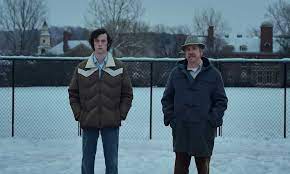
It’s a sweet but slight film about a privileged boarding school student and his most hated professor, stuck together after their snow-covers-the-ivy Massachusetts campus shuts down over Christmas break in 1970. They bicker, battle and bond in a story about life expectations, depression, class and a culture whose values are shifting from the hidebound ’50s to the “Me Decade” ’70s thanks to the seismic upheavals of the era that’s ending and the one that’s just beginning.
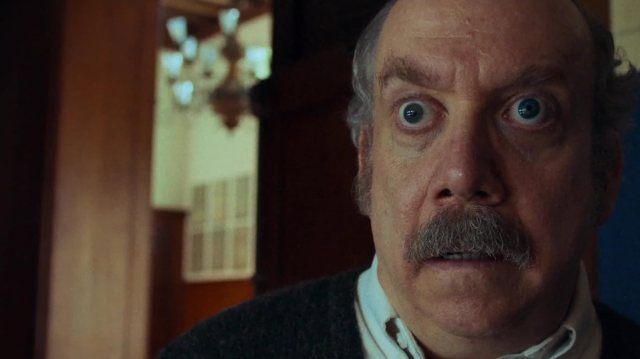
Giamatti is Paul Hunham, a Cicero-quoting/ Peloponnesian War-obsessed ancient history teacher who feels he is fending off the barbarians at the gate by having standards and holding these “entitled” rich boys to the ideals of his notion of who and what a “Barton (School) Man” should be.
The kids don’t like him because of those unbending “standards,” his Latin-and-Greek lingual pretentions and his temper. The lazy eye and “smell” don’t endear him to them either. It’s not just his daily dose of alcohol that gives him an odor.
“Latitude is the last thing these boys need,” is his creed.
Newcomer Dominic Sessa is a Angus Tully, a smart junior who should be a senior because he’s been kicked out of other schools. He’s one of those “Dead Poets Society” style rebels — studious, but sneaking smokes, coveting booze, naive about women and ignorant of just how “lucky” the accident of his highborn birth has made him.
The other kids don’t care for him because of his cutting snark, his better grades and inability to tolerate the intolerant, shallow, destined-to-rule boors who surround him.
“I thought all of the Nazis had left for Argentina!”
Hunham is “punished” for not letting a Senator’s son skate through his class, the punishment being given the “babysitting” duty of keeping rich kids — a jerk, a jock, a Mormon child and a homesick Korean among them — whose families aren’t able, or willing to bring them home for Christmas break.
Angus has “St. Kitts” plans right up to the moment his newly-remarried mother informs him that she’s doing this trip with her new husband and his family, not him.
The gloves come off straight away as teacher and “troubled” student clash and curse their way into this forced-intimacy, made worse when events conspire to allow the other four kids to escape Barton.
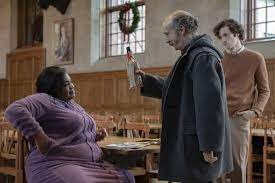
Da’Vine Joy Randolph of “The Lost City” and “Only Murders in the Building” is Mary, the unappreciated head-cook in the kitchen, a fellow inmate at the ancient (“founded in 1797”) school this holiday season.
Mary is a character who brings the tragedy and disillusions of the Vietnam/Nixon era backdrop into the story. Posh and priieleged as it is, Barton is integrated. Mary’s son was able to go there. But he’s one of the honored dead in the school’s hall of fame, another alumnus killed in combat — in his case, in Vietnam mere months before.
What’s fun here is the sparks set off by witty characters clashing over their differences even as they start to see — to their dismay — their common ground. What’s grand is the humanity brings to characters in all his movies, from the abortion-debaters of “Citizen Ruth,” the retirees of “About Schmidt” and the “left behind” midwestern coots of “Nebraska.”
Giamatti’s Hunham is mean and maybe kidding himself that he prefers solitude, the “aescetic” life of a bookish man of letters. But his blunt corrections of brats who don’t pay Mary the proper respect — Black, working class and in mourning — show his heart.
Angus is a brat capable of seeing his failings and learning from them. And Mary is a classic character “type” — the Black truth-speaker, keeping it together but not given to keeping her opinions to herself thanks to their shared circumstances, and her very personal ones.
Nobody here is a caricature, as easy as it would have been to make a movie built out of those. And the performances are mostly understated.
That said, the laughs are a bit easy, too familiar, the situations a collection of tropes and the psychological “types” are entirely too on the nose.
“Netflix editing” — aka slack pacing — is the only reason this 95 minutes of incidents and relationships comedy drags on for 135.
And an “OK, Boomer” air hangs over an enterprise that takes pains to remind us of how limited our media/entertainment options (radio and “The Newlywed Game”) were “back then.”
The tiny selection of liquors available, the corduroy fashions, pipe-smoking, post-60s unkempt long hair and “champagne of (bottle) beers” option at any diner or bar, an age when “Cherries Jubilee” was the posh dessert of any table-cloth dining establishment ,give away Payne’s willingness to pander to an audience of peers, even if most of them stopped going to the movies over a decade before “About Schmidt” (2002) lured them back, just for a weekend.
But that’s something a “holiday movie,” by tradition, provides — nostalgia, memories jogged by the fashions, the cars, the characters and the values of a bygone age. Whatever leftovers “The Holdovers” serve up, Payne and his once-and-future-muse Giamatti make this cinematic comfort food perfectly palatable.

Rating: R for language, some drug use and brief sexual material.
Cast: Paul Giamatti, Da’Vine Joy Randolph, Dominic Sessa and Carrie Preston.
Credits: Directed by Alexander Payne, scripted by David Hemingson. A Focus Features release.
Running time: 2:15



