A body builder — Katy M. O’Brian — draws the attention of lonely K-Stew, who comes to find out just what Ms. Muscles is into and all about — Murder for hire? — with Ed Harris and assorted other bad hombres.
Dave Franco and Jena Malone also star.
A body builder — Katy M. O’Brian — draws the attention of lonely K-Stew, who comes to find out just what Ms. Muscles is into and all about — Murder for hire? — with Ed Harris and assorted other bad hombres.
Dave Franco and Jena Malone also star.


“Merry Good Enough” is an indifferent, listless and generally lifeless holiday comedy built around the admission, “It’s the holidays. We’re all a little suicidal.”
It’s about three unhappy 30ish children coming home to their long-divorced mom in Massachusetts suburbia wondering what the chances are that they could “wake up and be the perfect family.”
“Slim to none” seems like the safe answer.
When your only laugh line is uttered by actress Raye Levine to actor Sawyer Spielberg — “I always wished that I was Jewish.” — you have to know you aren’t quite “getting into the Christmas spirit.”
A leaden prologue introduces us to Lucy (Levine), who gets lectured on how “No one likes a Scrooge” over the holidays on the slowest elevator ride in Greater Boston.
She’s going “home” for Christmas, to the small-town Massachusetts where she grew up. Flaky Mom (Susan Gallagher) seems more forgetful than usual. When they get into an argument over Mom leaving a wedding album out to remind Lucy of her failed marriage, they fight.
Lucy and just-flew-in-from-Singapore brother Tim (Daniel Desmaris) wake up to an empty house. Mom is nowhere to be found, unreachable by phone.
Youngest sister Cynthia (Comfort Clinton) is hardly surprised. She’s a hard-driving Chicago lawyer with a fiance and big plans and little patience for her older sister/Mom drama.
Lucy seems the most concerned, but even she — like everybody else — kind of takes Mom disappearing in stride. We don’t need that much-delayed moment of checking the bathroom to see what medications Mom is on to get the drift.
She’s depressed. This is kind of in-character. Her long-divorced husband, a big shot TV host, shows up and confirms that.
By the way? Jovial, upbeat Joel Murray in this part is the life of this listless party.
“Merry Good Enough” is a motion picture of long, static stretches scored with colorless conversations and Christmas carols. We’re treated to a little eggnog dance party montage, a trip to the skating rink, and a stop at the police station — almost as an afterthought — to report a missing person.
There is history in this house and “baggage” in every trip to the store, the rink and that police station.
Levine makes a passable lead, but pairing her up with the neighbor boy (Spielberg), now all grown up and between love affairs, pays zero dividends.
The clumsy plot advances at a crawl, the resolution is nonsensical and a downmarket bar interlude is lame enough to make one long for the pleasures, the stakes and the performances of “The Family Stone” or any of a dozen other imperfect but as least lively and life-affirming holiday movies.
“Merry Good Enough” isn’t even good enough for The Hallmark Channel.
Rating: unrated, some profanity
Cast: Raye Levine, Susan Gallagher, Daniel Desmaris, Comfort Clinton, Sawyer Spielberg, and Joel Murray.
Credits: Directed by Caroline Keene, scripted by Caroline Keene and Dan Kennedy. A Freestyle release.
Running time: 1:37


Let it be said that the new musical “The Color Purple” in no way replaces the sometimes-wrenching 1985 film adaptation of Alice Walker’s acclaimed novel.
The film version of Marsha Norman’s 2005 stage musical is best appreciated with a word that means one thing on Broadway and another in American Protestantism — “revival.” Packed with tunes in the pre-“Hamilton” stage musical tradition, bubbling over with production numbers that dance right off the screen, it’s a feel-good holiday event that reprises many of the highlights of Steven Spielberg’s earlier film.
First and foremost, it floods the frame with fresh faces, celebrating African American singing and acting talent.
Didn’t catch Fantasia Barrino on Broadway? Her Celie is immortalized here.
Slow to pick up on the brilliance of Colman Domingo and Halle Bailey? Domingo makes a lean, banjo-picking (and singing) menace as “Mister,” and Bailey (“The Little Mermaid”) is the very embodiment of the beautiful sister “lost,” pined-for and found as Nettie.
Forgot Taraji P. Henson can sing? And dance? Danielle Brooks didn’t give us any “Jailhouse Rock” or R&B in “Orange is the New Black.” She does here.
Ghanese New York music video (Beyonce? Naturally.) and film director Blitz Bazawi and screenwriter Marcus Gardley expand on themes and story threads sometimes treated more tentatively in Spielberg’s film. Sexual abuse, same sex attraction, Black enterprise and life in the racist Georgia of the early 1910s through the ’40s are front and center.
It’s quite similar, just more upbeat.
If you don’t remember the story, here’s a refresher. Sisters Celie (Phylicia Pearl Mpasi) and Nettie (Bailey) are tighter-than-tight, bonded under the roof of their shopkeeper/sexually-abusive stepfather (Deon Cole, chilling).
Teen Celie is pregnant when we meet her, but the baby is taken away. Not the first time that has happened. “Daddy” then comes for Nettie, who resists and flees. And when glowering widower Mister makes the stepfather an offer, there’s nothing for it but for Nettie to leave town altogether.
Mister will settle for heartbroken Celie, who will raise his children and keep his house and satisfy his sexual urges and take his beatings. Meeting the cussed “Old Mister,” the ornery bastard’s father (Oscar winner Louis Gossett Jr.) explains a lot.
Celie’s liberation begins when she meets Shug (Hensen), Mister’s one true love, a blues singer who enjoys regional fame and celebrity, and her pick among the men. They “renew” their acquaintance whenever the hard-living, hard-drinking blues shouter swings through.
But “Miss Celie’s” in love, and Shug knows it.
Celie draws further inspiration from the spirited Sophia (Brooks), who wants to marry Mister’s smitten son Harpo (Corey Hawkins). Sophia doesn’t take any guff from Harpo, Mister or racist white folks, and pays a price.
Years and decades pass as we see Celie’s broken spirit renewed and repaired via a sisterhood of women.


This “Color Purple” may not be as pictorially pristine as Spielberg’s film, as he was famed for borrowing shots and inspiration from the great films of John Ford, among others. But the juke joint scenes pop, taking their visual cues from great Black painters and paintings like Ernie Barnes’ “Sugar Shack.”
Bazawule’s brisk “Purple” lacks the emotional gut-punches and taut suspense — How will Celie act-out/lash out? — of master manipulator Spielberg’s film. This is altogether a lighter and sunnier cinematic experience. But Celie’s faith is moved front and center, showing the difference between Black filmmakers with an awareness of the role of the Black church in the South in African American life.
The redemption stories are much more clearly delineated, with Bazawule and the Broadway show seeing “Mister” as both a monster, and another victim of the time and his own cruel upbringing.
And some of the biggest delights come from some very clever casting coups. Henson brings a brassy, world-weary bravado and sexual confidence to Shug, a woman who knows her power and uses it. She beautifully reprises “Miss Celie’s Blues,” a tune co-written by Quincy Jones from the 1985 “Color Purple,” and stomps through “Push Da Button,” a suggestive blues showpiece by the songwriting team of the stage musical, Brenda Russell, Allee Willis and Stephen Bray.
Domingo adds banjo-playing to his sky’s-the-limit repertoire.
The great character actor David Alan Grier steals his scenes as a wry, spirit-filled but judgmental preacher, just tearing through a celebratory opening ensemble hymn “God Works in Mysterious Ways.” He is Shug’s estranged, disapproving dad, but being the twinkly and tuneful Grier, we know a tearful rapprochement duet (“Maybe God is Tryin’ to Tell You Somethin'”) is in the cards.
And watch singer, piano player and former “Late Show” bandleader Jon Batiste as Grady, the piano-player/bandleader whom Shug marries. He sits at the keyboard, vamping the hell out of one of her numbers, turning it into a giddy, mugging-over-her-shoulder romp with his musicianship and comic timing.
“The Color Purple” wasn’t a Broadway-changing blockbuster on the stage, and the songs, pleasant and fun in their context, don’t exactly stick with you after one viewing. Maybe the soundtrack will grow on us.
Some of the casting nods to Black cinema history — two Oscar winners are in the cast — smack of “fan service.”
But this cast and crew ensure that the film is a brisk, upbeat, feel-good bounce through an aching tale of trials and tribulations to triumph story that has become an American classic, and well worth a holiday family outing at the movies.
Rating: PG-13 for mature thematic content, sexual content, violence and language.
Cast: Fantasia Barrino, Taraji P. Henson, Halle Bailey, Phylicia Pearl Mpasi, Colman Domingo, Danielle Brooks, Corey Hawkins, Jon Batiste and David Alan Grier
Credits: Directed by Blitz Bazawule, scripted by Marcus Gardley, based on the stage musical by Marsha Norman which is based on the novel by Alice Walker and movie by Steven Spielberg. A Warner Bros. release.
Running time: 2:20
This has the feel of other Kidman work — the film “Rabbit Hole” for starters. Mournful, bereft, this time in an exotic locale, living far from where she was born.
Amazon Prime has this series, premiering Jan. 26.


Alfred Hitchcock’s fame and reputation for crackling, stylish and expressionistic thrillers was pretty well established by the time he got around to “Secret Agent” in 1936.
“The Lodger” has made his name, and “The 39 Steps” and “The Man Who Knew Too Much” had established his stardom in the eyes of critics and his “brand” with the general public.
But “screwball” comedies were all the rage in Hollywood. And Hitchcock, nothing if not a filmmaker keenly aware of what everybody else was up to, indulged in a bit of that himself with “Secret Agent” and quite a bit more of the witty banter, goofy characters and such with “The Lady Vanishes” a couple of years later.
“Secret Agent” has a goofy premise, a couple of seriously screwy characters and some of the wittiest dialogue ever to grace a Hitchock thriller.
A young officer (John Gielgud), a novelist in civilian life, is summoned home from the trenches of France only to see his death notice in the papers. He’d like to know what this is all about from the fellow (Charles Carson) who summoned him.
Now see here, he blusters, but “I don’t even how what your name is.”
“You can call me ‘R.'”
“‘Argh’ as an exclamation?”
“‘R’ as in ‘Rhododendron.”
An entire James Bond franchise spins out of that very exchange.
Capt. Brodie is no more. He is to be Richard Ashendon, ordered to Switzerland to hear the yodeling and see the folk dancing, identify a German agent about to go bribe the Arabs into fighting for Turkey and keep that spy from traveling to Constantinople and Arabia and foiling Britain’s plans for taking Turkey out of the war and taking over much of the Middle East.
Tell me, do you love your country?”
“Well, I’ve just died for it.”
“Ashendon” must have an assistant, somebody the intelligence service refers to as “the hairless Mexican.” He’s considerably more experienced at cold-blooded killings than Captain Brodie/Ashendon. Hitchcock cast the pop-eyed German expressionist star Peter Lorre as “The General.”
“General Pompellio Montezuma De La Vilia De Conde De La Rue,” as our “assistant” grandly introduces himself many times in the movie, is not a “general” any more than he is “hairless” or “a Mexican.” Lorre oozes amoral menace with such glee that we can’t help but be delighted every time he shows up on camera.
“General Pompellio Montezuma De- oh, we’ve already met.”
On arriving in neutral Switzerland, Ashendon and the General stumble into a Germanic Brit (Percy Marmont) with a dashund and a very German wife. Might he be their quarry? Perhaps.
What’s that? “Mrs. Ashendon” has already checked in?
Unflappable Ashendon asks the concierge how fetching she is without letting on his surprise. And he doesn’t let the fact that dropping in on “their” room, he finds the unexpected Missus (Hitchcock blonde Madeleine Carroll) in the tub with an American-accented rake (Robert Young) flirting and coming on strong just outside the bathroom door.
Gielgud, already a star of the British stage but decades before his Oscar-winning wit was put on display in “Arthur,” makes Ashendon the epitome of droll.
“I hope you haven’t been lonely?”
The rat-a-tat dialogue of the early scenes make one grateful for the advent of streaming movies. One almost has to rewatch to catch every arch zinger from Gielgud, Lorre or Young, as Mr. Marvin.
“Do you understand German, Mr. Marvin?”
“Not a word. But I speak it fluently.”
The tone’s so light and breezy that we have just enough time to forget that this is an espionage thriller, after all. And then there’s a death — a church organist whom we hear has died before our intrepid agents figure out why that organ is hitting and holding such a wailing, dissonant note. The poor man has been strangled and collapsed on the keyboard.
Hitchcock brilliantly (sound) stages a murder at a distance as the novice agent witnesses (we don’t) his hardened killer “assistant” in action on a mountainside.
Mrs. Ashendon is witness to one of the most poignant moments in a Hitchcock film, in the company of the now-dead-man’s wife as their dachsund scratches at a door and then lets out of wailing howl because she knows her owner is dead before anybody else there.
“Secret Agent” has state-of-the-era effects that still manage a chill — a twilight air raid on a Turkish troop train — violence that is mostly off camera, except for the corny finale.
It’s a film that also suffers from dim, dark and washed out prints in streaming circulation, a movie that’s almost lost in the murk that that Hitchcock cooked-up in another black and white homage to his German expressionism fandom.
Look for Lilli Palmer as a “loose” woman The General makes bug-eyes at, flirts with and toys with when it suits him.
It’s always fun to see the sorts of too-handsome-to-be-the-hero roles Robert Young took in the ’30s and early ’40s, decades before “Father Knows Best” or “Marcus Welby: M.D.”
But if we leap to conclusions about his character here, as we inevitably do, it’s only because of a lifetime of getting wise to the tricks of “The Master of Suspense.” Hitchcock coined the phrase “Good villains make good thrillers,” and would have loved for Cary Grant and many other leading men he cast to be “bad guys” that the audience would have to reconcile itself with adoring.
In “Secret Agent,” the dark, dirty and immoral business of murder by government edict is hinted at if never wholly grappled with in a sort of “Thin Man” spy mystery that’s more “Thin Man” witty than mysterious.
It’s movies like this that remind us Hitchock didn’t set out to make “classics,” just entertaining manipulations, suspenseful thrill-rides with a touch of wit and a hint of art about them. It’s movies like “Secret Agent” that made the director, not the stars, the household name, the “brand” film fans would seek out then and for generations to come.
Rating: “approved,” violence
Cast: John Gielgud, Peter Lorre, Madeleine Carroll, Percy Marmont, Lilli Palmer and Robert Young.
Credits: Directed by Albert Hitchcock, scripted by Charles Bennett, based on a play by Campbell Dixon which was based on stories by W. Somerset Maugham. A British Gaumont release on Roku TV, Amazon, etc
Running time: 1:36


The Colombian filmmaker Rodrigo García’s new Netflix movie is a big, inclusive family gathering for a family meal and a little family drama in rural Mexico.
“Familia” isn’t a tale of any cosequence, and a bit of a letdown considering he gave us a Glenn Close/Janet McTeer Oscar contender (“Albert Knobbs”), “Mother and Child” and last year’s “Raymond & Ray.”
“Familia” is as innocuous as its title.
Daniel Giménez Cacho is Leo, the patriarch, who has his many daughters driving in from all over the country for one of their summer outdoor meals at the olive ranch that supports their artisinal “extra virgin olive oil” family business.
“Leo the Lion” his daughters call him.
They will come and eat with Leo and their Down syndrome little brother Benny (Ricardo Selmen) and try to bond with Dad’s new marine biologist girlfriend Clara (Maribel Verdú).
Daughter Rebecca (Ilse Sala) is the oldest, a married anesthesiologist with husband Dan and “the twins” — teens Erika (Andrea Sutton) and Alan (Zury Shasho) in tow. She picks up younger sister Julia (Cassandra Ciangherotti) in the middle of Julia’s latest Tijuana tempest. Her husband’s caught her cheating again and walked out. Her precocious daughter Amanda (Isabella Arroyo) doesn’t know. Yet.
Julia’s an impulsive, narcissistic “writer” sure of her “talent” but lazy and undisciplined. Coming from a “rich” family afforded her all these indulgences.
Mariana (Natalia Solián) is younger still, and very pregnant. She’s rolling in with her latest lover Monica (Natalia Plascencia), who will learn that she “looks like all the others” Mariana has taken up with over the years. Nobody, even unfiltered Benny, is tacky enough to say “short haired and butch” aloud.
And I guess we’ll figure out who the father of that baby is at an opportune moment.
Monica’s concern about acceptance and revealing the nature of their relationship are unfounded. Mariana’s family is hip, tolerant and given to over-sharing, over-questioning — the sisters asking Clara how Dad is as a lover — and over-apologizing.
“Over-sharing is ‘the family glue,'” one wag offers.
Maybe the younger daughters are still rattled by their mother’s untimely death a half dozen years before. Maybe Leo’s extra hard on the one impressionable male, teen Alan, he can perhaps mold in his image or groom to the family business.
“You only get along with women,” is the kid’s astute assessment (in subtitled Spanish, with lots of Spanglish).
Leo, of course, apologizes the way people do in “family movies,” if not most real families.
Maybe teen Erika “kissed a girl” and didn’t “like it” because she wanted to fit in, or our Colombian writer and director was getting all carried away folding Hollywood values and predelictions into his Mexican story of a familia facing a couple of mildly traumatic, dramatically thin “big decisions.”
Erika also apologizes. For not “feeling a tingle” for kissing a girl.
The “surprises” aren’t particularly surprising. The heated arguments blow up, seemingly out of nowhere, even if these indulged, living-their-best-lives kids have had little clue about the strain their father is under. And the cast is big and cluttered, made moreso by including little dollops of the family cook and housekeepers’ love life and troubled past.
“Familia” makes for a pleasantly messy movie that plays and passes the time, but falls well short of offering insight into the human condition in broader terms or the Mexican one in narrower ones. Garcia has made a “We’re all the same” tale that feels a LOT more Hollywood than any “Mexican” melodrama or dramedy I’ve seen of late. The question you ask at the end is “Did we really need that?”
Rating: TV-MA, profanity, sexual conversations
Cast: Daniel Giménez Cacho, Maribel Verdú, Cassandra Ciangherotti, Ilse Salas, Cassandra Ciangherotti, Natalia Solián, Natalia Plascencia, Ricardo Selmen, Andrea Sutton and Zury Shasho
Credits: Directed by Rodrigo García, scripted by Rodrigo García and Bárbara Colio. Netflix release.
Running time: 1:44


If we’ve learned anything from historical books and films such as “Bury My Heart at Wounded Knee” and “Killers of the Flower Moon,” it’s that there is rarely an avenging angel, a righteous man or woman who comes and saves people in the middle of an indigenous genocide and gives the viewer a real life “Hollywood ending.”
In Canada and Australia, Africa, Central and South America and the American West it happened. It was condoned, sanctioned and endorsed, or at the very least tolerated by governments, communities and the clergy. Nobody rode in and saved them.
“The Settlers” is a genocidal story set in a place so forbidding it was nicknamed “Desolation Island,” its main city “Port Hunger” and that harbor “Useless Bay” — Tierra del Fuego. This film isn’t about ancient history. Events depicted here went on into the early 20th century. And “official” history didn’t want to acknowledge it, any more than the wealthy and powerful Catholic Church which, at best, turned a blind eye.
Writer/director Felipe Gálvez Habere treats this as a grim myth, an ugly “Odyssey” about men on a quest for a “safe” path to transport “white gold” — sheep — to the Atlantic on the huge island shared by Argentina and Chile. “Safe,” means territory free of sheep-eating Ona Indians. Making it “safe” means killing them.
This dark film about the ugliest tendencies of human nature under rapacious “colonial” capitalism is Chile’s bid to earn an Oscar nomination for the upcoming 96th Academy Awards. It deserves that recognition.
“Wool stained with blood loses all its value,” a politically-savvy sage notes at one point in this story. Reason enough for the still-young nation and its power-connected Church to be reluctant to stop this while it was happening, or condemn it when it started coming to light.
Inspired by true events and crimes commited by real villains named here, it’s about the desire of a rich landowner, José Menéndez (Alfredo Castro) to find a path to get his vast herds of sheep to a port and then to market.
His “Lieutenant,” foreman and enforcer is Alexander MacLennan (Mark Stanley), a former British soldier who wears his Army red coat years after his service “in the war.” He’s a pitiless brute with “clean this island” orders.
An accident slices off a European laborer’s arm, and MacLennan shoots him, as he’s of no value. If this is how this racist treats “a white man,” we don’t have to guess how he treats the sheep-eating natives. They didn’t name him “Red Pig” for nothing.
He chooses the best shot among his fence crew to accompany him. That’s Segundo (Camilo Arancibia), whom Bill (Benjamin Westfall), the Texas “tracker” Don Jose also assigns to this mission, sizes up as “not white, not Indian,” although “halfbreed” never crosses his lips.
“You never know ‘who‘ they’re gonna shoot.”
They set off — the tippling, bullying Scotsman bickering with the “You’re doin’ everythin’ WRONG, Lieutenant!” Texan, who learned his trade hunting Apache, and the conflicted half-Native given a gun and expected join in the violence when ordered to.
For his debut feature — the film is in English and Spanish with subtitles — Gálvez structures his quest around three encounters — the first with an Argentine army surveying crew. Their surveyor scientist (Mariano Llinás) notes the “delicate features” and intelligence of the indigenous people and ponders the primitive governments, the winner-take-all capitalism of the rich and connected like Don Jose, of this and many other continents in 1901.
“These people, Mister MacLennan, should be taken to the university, to OXFORD, to make them engineers and lawyers!”
But even the “enlightened” surveyor and man of science insists his Native servant join him in his tent, and it is assumed, his bed.
Then there’s an odd party led by an English officer (Sam Spruell), a man one and all get a bad vibe about, but who will not hear of them refusing his hospitality. Something the Argentines said earlier lingers on the viewer’s mind.
“Nothing good happens when military (men) get bored.”
And later still, our hunting party spies a Native tribal group — women and children included. A third encounter will be the ugliest.
Stanley, Arancibia and Spruell are the stand-outs in the cast, with Arancibia letting us see the anguish and fret, at every point, as to how Segundo will respond to this latest threat, affront or crime against humanity.
Structurally, “The Settlers” is a bit cumbersome as it abandons that three-stop quest and we revisit the region and some of those involved in these events a few years later. In this informative history lesson part of the film, the “government” wants to meet survivors and perhaps hear their stories, or at least confirm their loyalty to a country about to celebrate its 100th birthday.
That plays as a theatrical and clumsy epilogue.
But it’s an engrossing story, even at its most gruesome or theatrical. For my money, it’s more satisfying, cinematic and exotic than the thematically and historically similar “Killers of the Flower Moon.”
Rating: unrated, graphic violence, rape, profanity, alcohol abuse
Cast: Mark Stanley, Camilo Arancibia, Benjamin Westfall,
Mariano Llinás, Mishell Guaña, Alfredo Castro, Marcelo Alonso and Sam Spruell
Credits: Directed by Felipe Gálvez Habere, scripted by Antonia Girardi, Felipe Gálvez Haberle and Mariano Llinás. A Mubi release.
Running time: 1:40
Fans instantly get the pun in the title — a riff on “Destroy All Monsters,” for the rest of you.
It’s got Alex Winter, ace documentarian and Eternal “Bill” from “Bill and Ted’s Excellent Adventure,” and Kumail Nanjiani and Jon Daly and Thomas Lennon and that talk-show host/voice-over presence Phil Hendrie in the cast.
Jonah Ray — who was on the latter incarnation of “Mystery Science Theater 3000” and was in “Weird Al” and is now going by Jonah Ray Rodrigues stars.
This looks hilarious, as they certainly had enough gonzo stuff to cut a fun trailer out of it.
Shudder bought “Neighbors,” and it streams Jan. 12. I may have to ull rank and get a screener to review this sooner than that, because…just because, right?

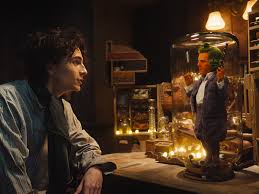
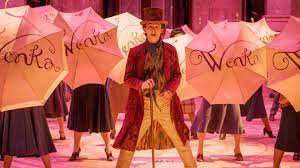
A big holiday musical based on a character by Roald Dahl is proving almost irresistable for filmgoers, as a decent Thursday and big Friday point to “Wonka,” the prequel to “Charlie and the Chocolate Factory,” raking in $39 million+ on its opening weekend.
Friday’s take was around $13, per Deadline.com. No doubt chocolate sales spiked afterwards as well, as this confection does a grand job of selling that sweet, much better than the earlier Willys, which treated it as a poison pill. Sure, we see Keegan-Michael Key balloon up from eating too many sweets (Diabetes to follow?), but it’s all as sweet as can be, and that goes for star Timothee’ Chalamet, who is at his most charming here.
“The Hunger Games: The Ballad of Songbirds & Snakes” is picking up the crumbs, to the tune of $5.8 million.
“Napoleon”($2.2 ) “Beyonce Renaissance” ($1.9)and “Wish” $3.2) are among the titles fading out of the top five. “Wish” has faded to sixth. “Beyonce’s” officially the director and star of a concert film that has hit the $30 million mark, and won’t go much further. It’s only a bomb if you compare it to “Taylor Swift Eras,” which earned six times as much.
Those damned “Trolls” are still around ($4 million), trailing the fading “Godzilla Minus One” ($4.8) and another Japanese offering, Miyazaki’s “The Boy and the Heron” ($5.1).
Fathom Events is showing a holiday special film spun off the faith-based “Chosen” TV series, and “Christmas with the Chosen” is doing $3 million after limited [review screenings gave it a $1.7 million start.
“Poor Things,” earning $1.1 million in limited but pretty wide release, sneaks into the top ten. It’ll drop out next week, so don’t get your hopes up.
Here’s the final Sunday noon estimate from @BoxofficePro


“Freud’s Last Session” is a period piece about an imagined meeting between the Father of Psychoanalysis Sigmund Freud and an “Oxford don,” the emerging “Christian apologist” who would go on to write “The Chronicles of Narnia,” C.S. Lewis.
Based on a play by Matthew St. Germain, it’ s a thoughtful, literary-minded war of wills and words. The The “godless” rational Viennese Jew challenges the traumatized World War I veteran who’d come home to Oxford, reaffirmed his Christianity as he studied and taught English literature, and compared notes on the mythology and lore of many cultures with some like-minded friends and colleagues, most famously J.R.R. Tolkien.
Anthony Hopkins adds another grand laurel to his much-honored career, giving a grumpy, imperious twinkle to Freud, at the end of his life, lauded the world over and not above insulting the 40 year-old Lewis (Matthew Goode, spot-on as always) to his face.
They gently and sometimes testily spar, a sick old man fretting over the pain from his primitively-treated oral cancer and puzzled about how “someone of your supreme intellect” could “embrace an insidious lie” and not let go of “this fairy tale of faith” told by the Christian Bible.
Lewis counters by suggesting Freud has replaced faith with “sex,” in his theories and writings about understanding the human condition, but leans on every Christian apologist’s favorite comeback when backed into a corner.
“Have you ever considered how terrifying it would be if you’re wrong?”
In Matt Brown’s film — he gave us “The Man Who Knew Infinity” — the well-matched leads go at it in this often uneven battle of wits in what is certainly the most quotable film of the year.
Lewis, already well-known, having published “The Pilgrim’s Regress” and taken a pretty good shot at Freud in it a few years before, makes a reluctant and tardy trek to The Great Freud’s rented house two days after Germany invaded Poland. He’s been summoned.
That’s the jumping off point for their to and fro during a day in which the radio is switched on and off to hear war updates — Britain has given Germany an ultimatum, which the Germans are ignoring. We’ve heard their leader calling for the “anihillation of the Jewish race in Europe” in a radio speech under the opening credits. We will hear actual BBC updates, and British Prime Minister Neville Chamberlain’s response before the day is done.
Brown expands the play, opening it up into the garden, a quick hike to a nearby church as air raid shelter, adding to Freud’s thoughts on Christianity as “art appreciation.” He admires the statuary and stained glass of it all. And we’re treated to vivid Vienna flashbacks for Freud and WWI trench trauma for Lewis.
That gives the film more context and visual variety, adding to the richness of the text and the wonderful actors performing it.
But this “opening up” also makes for some mischief, as it adds Anna Freud (Liv Lisa Fries) and the early years of her lifelong relationship with Dorothy Burlingham (Jodi Balfour) and references Anna’s father’s disapproval. Jeremy Northam (Uncredited?) plays a psychoanalyst suitor to Anna that Sigmund most contend with.
The film also gives credence to the possibility that pioneering childhood psychologist Anna was not just her father’s heir apparent in psychology, his caretaker and pupil, but perhaps something worse, an accusation I can find no credible source to back up.
Is the purpose of this to diminish the already somewhat historically-diminished Freud? Seeing as how the simple existence of this speculative play-turned-film serves to place the “Chronicles of Narnia” children’s fantasy novelist and famous WWII era BBC radio Christian apologist on the same level as Sigmund Freud, that seems a reasonable guess.
But for the viewer, even that just embellishes what is a lovely, poignant thought exercise in the most eloquently argued film of the year.
Rating: PG-13 for thematic material, some bloody/violent images, sexual material and smoking.
Cast: Anthony Hopkins, Matthew Goode, Liv Lisa Fries, Jodi Balfour and Jeremy Northam
Credits: Directed by Matt Brown, scripted by Mark St. Germain and Matt Brown, based on St. Germain’s play. A Sony Pictures Classics release.
Running time: 1:48