
James Marsden co-stars in this familiar twist on the hit man-hired killer thriller.
With Oscar winners Marcia Gay Harden and Al Pacino.
March 15.
James Marsden co-stars in this familiar twist on the hit man-hired killer thriller.
With Oscar winners Marcia Gay Harden and Al Pacino.
March 15.
A paranoid survivalist paranoid thriller? Or a riff on life in “A Quiet Place” with a father protecting his twin sons?
The plot description alone could give away the game of this April 12 release.
Denzel Washington will have the title role and that sketchy Jake Gyllenhaal will take on the venomous Iago in what is sure to be THE hot ticket on Broadway in 2025, a new production of “Othello.”
Brian Anthony Moreland is directing. Who oh who shall play his Desdemona?
Denzel sparkled in Branagh’s “Much Ado about Nothing” and stunned as “Macbeth.”
Now he follows in the footsteps of giants such as Paul Robeson, James Earl Jones, Welles, Olivier and Denzel’s contemporary, Lawrence Fishburn and adds his take on “The Moor,” “Othello,” to his Shakespearean resume.
It’s not a lark for him. Remember this Colbert interview, a highbrow highlight of recent late night TV chat show history?
The great Mexican sensualist gets a first rate bio-doc treatment from some of the people who made “RBG.”
This comes to Amazon Prime March 14.


Classic films give us cineliteracy. They change the way we look at every movie afterward, how we talk about films, and they grant us entry into a new way of seeing the world and the movies about it.
Movies like “Bicycle Thieves (Ladri di Biciclette)” were tradiationally passed around like a secret code, seen in film societies and college courses where the greatest of the Italian “neorealist” films altered the way we view cinematic “reality” the moment we saw it.
And revisiting such classics, even in our easy-access, instant-gratification Golden Age of Streaming, is like remembering a first love and the moment you became aware of that emotion.
Vittorio De Sica’s 1948 masterpiece is stunningly simple, beautifully stark and heartbreaking in the bluntest sense. It’s about poverty, a family struggling, Italy in throes of a post World War II reckoning — deep, lingering depression. And it’s about a father and the son who worships him, literally never taking his eyes off his mentor, always looking up at him when they’re together.
Antonio dotes on little Bruno, until that is, the bicycle he needs for his long-sought-after job is stolen on his first day at work. The bicycle means getting ahead, planning for a better future, better housing, food security and financial solvency. And when it’s gone, Antonio’s wholly-relatable obsession with recovering it has him neglecting a little boy imperiled by the inattention, wounded by the side of his father that he now sees.
Lamberto Maggiorani didn’t act in many films. But his intense blend of panic and despair as Antonio carries “Bicycle Thieves,” a lean, streetwise narrative about a man’s dogged search for his 1935 Fide, swiped while he was up a ladder at his new job, hanging posters of Rita Hayworth and others all over Rome.
And little Enzo Stailo, as natural at age eight, when he filmed “Thieves,” as any child actor before or since, is immortalized in a movie that captures a child’s commitment to his first role model as it is tested and tainted by the trauma of what happens to their family.
Alessandro Cicognini’s tender, sentimental score tugs at the heartstrings as we see Antonio selected for a job in a sea of men who have also been waiting since the war’s end for work. “Hope” is set to music.
We don’t understand Antonio’s concern about the “no bicycle, no job” (in Italian with English subtitles) conditions for employment. But we grasp the relief in his eyes and the dogged determination of wife Maria (Lianelli Carell) as she gathers up the family sheets and they parade down to the warehouse-sized pawn shop, which is always a mob scene during hard times like this. Antonio’s bike is in hock and they’re retrieving it.
Little Bruno knows every millimeter of it, as it’s his job to clean and prep the Fide for work. He’s been a breadwinner for the house in his own way, as Dad drops him off at the Esso station, where Bruno cleans up, on his way to his new posters-hanging job.
Antonio needs the bike so that can carry rolled up posters on the luggage rack, a bucket of glue on the handlebars and a ladder over his shoulders. A bit of brief instruction, and he’s off.
He doesn’t notice the creep (Vittorio Antonucci), working with an accomplice, who cases the bike, sizes Antonio up and grabs it. Noble Antonio doesn’t know the other guy “helping” him chase the thief is in on the hustle, just here to slow him down.
Maggiorani lets us see the deflating realization of what this simple wrong will mean to himself, his family and their lives. He’s reluctant to tell Maria, seeking first the connected garbageman and neighborhood theatrical impressario Baiocco (Gino Saltamerenda) for help. Through him, our hero and his devoted son will visit the broad-daylight underbelly of Rome’s bike chop-shop culture — flea markets filled with bike parts which little Bruno can identify, a possibly repainted frame that Antonio can ID for the otherwise useless police.
Half a dozen other screenwriters pitched-in with De Sica to bring Luigi Bartolini’s novel to life. But it is the visual divine comedy/inferno of a broken and broke Rome that makes the picture.
Father and son trek from piazza to river to street markets and even a rescue mission/food kitchen in pursuit of the bicycle and the “ladri” (thieves) who took it. Clues and pursuits are set against the early morning buzz of manual labor and returning postwar commerce. A rainstorm interrupts a parade of novitiate divinity students in their drenched, brimmed Capello romanos.
They are German, which puzzles Bruno and reminds Antonio that the thief was a street punk wearing a German Wehrmacht cap.
Over 75 years after its release, “Bicycle Thieves” still compels you to shout at the screen, urging Antonio to take care of his kid as he frantically forgets him in his heedless, hurtling search. Finding suspects who might lead him to his quarry makes you want to shout “SLAP him until he talks,” even now.
But those are the moments Antonio is most aware that his animated, plucky, talks-with-his-hands bambino is watching.
“Bicycle Thieves” is such cinematic common currency that it is mentioned in almost any movie about a movie lover — Woody Allen’s “Stardust Memories” to Robert Altman’s “The Player.” Maurizio Nichetti’s “The Icicle Thief” comically sends it up, and yet also worships De Sica’s masterpiece.
Because it’s still worth worshipping. The Method is most credited with changing screen acting. But the Italian neorealists and their actors didn’t know Stanislavsky. And this film, in particular, is a shock-to-the-acting system when compared to almost everything that preceded it into cinemas.
Seventy-five years after its conception, filming and release, the first film listed at the top of that inaugural Sight & Sound Magazine poll of critics as The Best Film Ever Made back in 1952 remains essential viewing for any lover of film. It’s a great film — among the greatest, and if you want to have an informed conversation about any movie any where in the world, “Bicycle Thieves” is the cornerstone work of your film cinema education.
And right now it’s on the classic film buff’s best friend, Tubi, for free. What are you waiting for?

Rating: unrated
Cast: Lamberto Maggiorani, Lianelli Carell, Gino Saltamerenda, Vittorio Antonucci and Enzo Staiola
Credits: Directed by Vittorio De Sica, scripted by Oreste Biancoli, Suso Cecchi D’Amico, Adolfo Franci, Gherardo Gherardi, Gerardo Guerrieri, Cesare Zavattini and Vittorio De Sica, based on a novel by Luigi Bartolini. A Produzioni De Sica on Tubi.
Running time: 1:29
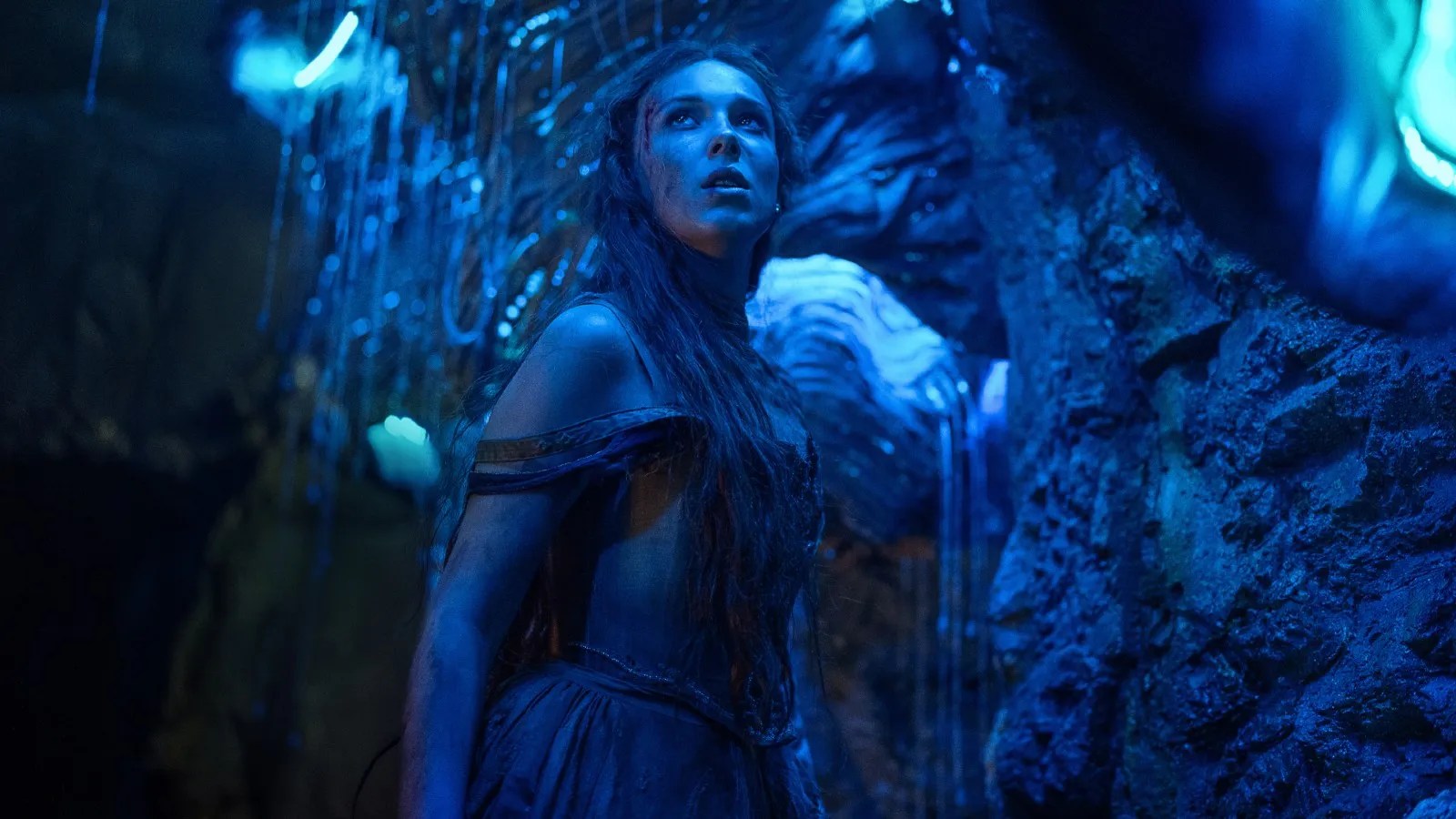


Millie Bobby Brown doth not suffer in silence as the tormented, burned and embattled heroine of “Damsel.”
A violent upending of women’s roles in fairytale fantasies, much of it is spent with her title character struggling to escape a dragon’s lair, screaming in pain and fear, grunting with effort and groaning in agony.
It’s a somewhat muddled action pic, a joyless slog through the first act, some intense and entertaining “work the problem” of getting away from a fire-breathing dragon who growls in the voice of the great Shohreh Agdashloo in the middle acts, and a preachy, speak-my-truth finale that tries to throw punches and pull them at the same time.
No biggy. The “Stranger Things/Enola Holmes” starlet was due for a misstep, and this isn’t an epic failure, just an ordinary, tin-eared and dull one.
She plays Elodie, daughter of a noble of the north (Ray Winstone), a hard-working young lady who tries to help provide for “our people” with her younger sister, Floria (Brooke Carter).
But Dad and stepmom (Angela Bassett) have a solution to their poverty and starvation woes. The rulers of another kingdom pick Elodie to marry their son, the prince (Nick Robinson), with a cash settlement as part of the deal.
It’s just that the minute we meet the blonde Queen Isabelle (Robin Wright), we smell a rat.
Sure, Prince Henry seems to meet at least one of reluctant princess-to-be-Elodie’s “I just hope he’s kind. And well read.” requirements.
But the opening scene of the movie saw a king foolishly lead his knights to slaughter in a dragon’s lair centuries before. There’s something about this kingdom and that dragon that smells of double-dealing and a a long term contract, written in blood.
That’s how Elodie winds up in the bowels of a mountain, struggling to reason out what just happened, what may happen and how to do what none of the women whose carved messages and bones were all they left behind there were able to do — escape.
The fiery effects are good, and pitlessly applied. This isn’t for little kids, as people, birds and other critters die.
The only quotable lines in the Dan Mazeau pedestrian script go to Agdashloo’s (“House of Sand and Fog”) dragon.
“Almost caught you, little bird,” she growls. “This story always ends the same.”
Will it? That might be predictable, but satisfying. What “Wrath of the Titans” writer Mazeau cooks up is a daisy chain of cop-outs. Can’t have an “evil” stepmother. The rough edges are rubbed off almost everyone.
Can’t have this or that character seem dead and stay dead. And let’s see things from the dragon’s point of view, for once.
Some of it plays, some of it doesn’t. Brown isn’t bad, although her character’s coming into her own is so preachy and self-empowering that it’s eye-rolling time.
Didn’t like it. Didn’t hate it. But as the Queen of Netflix, maybe hold out for something better next time while you’ve still got that power.

Rating: PG-13 (Action|Strong Creature Violence|Bloody Images)
Cast: Millie Bobby Brown, Ray Winstone, Angela Bassett, Brooke Carter, Nick Robinson and Robin Wright, with the voice of Shohreh Agdashloo.
Credits: Directed by Juan Carlos Fresnadillo, scripted by Dan Mazeau. A Netflix release.
Running time: 1:47
Crowe and Karen Gillan, Marton Csokas and Tommy Flanagan star in this mystery/thriller based on the novel by E.O. Chirovici.
Crowe plays an ex homocide detective with brain issues, memory problems and a possibly innocent man he wants to save.
“Sleeping Dogs” is the directing debut of the screenwriter of “Exodus: Gods and Kings,” “Allegiant” and “Assassin’s Creed.”
Oh, and the last and least of “Transporter” movies.
Decent cast, solid source material, and the trailer strikes a grim tone. This could be good.
It comes out March 22.
Dale Dickey also survives the end of the world. And Ella Purnell. And Kyle MacLachlan. At least for a bit.
April 11. Prime.
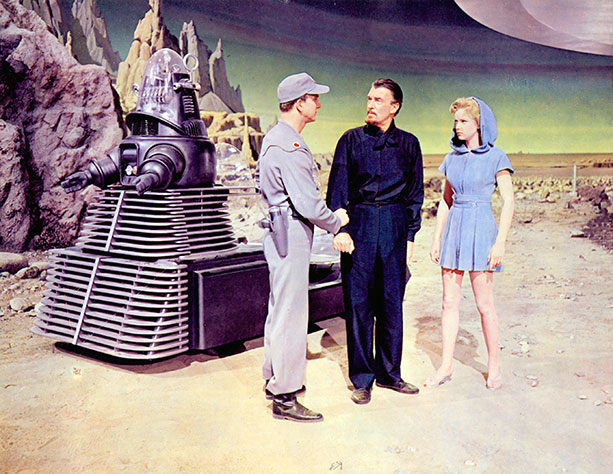
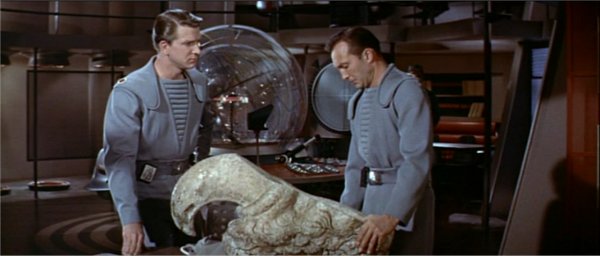
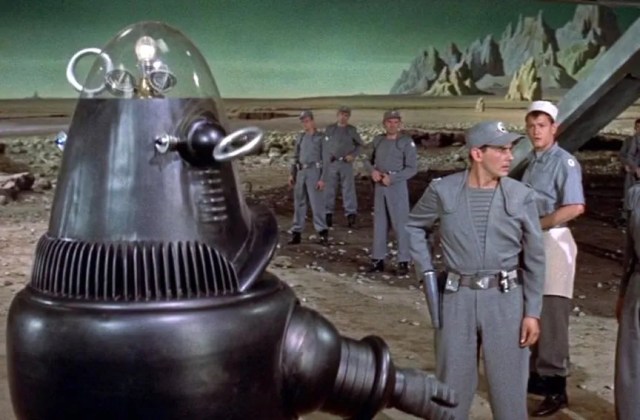
Dated, comically corny but heavy-handed, pretty and production-designed to death but oh-so-sound-stagey, “Forbidden Planet” remains a touchstone film in the science fiction canon almost in spite of itself.
A lot of its cachet relates to the Cold War zeitgeist that produced it, an era more famous for B-movie sci-fi with aliens invading. and real-life fears of World War III with the Russians. A 1950s state-of-the-art special effects adventure labeled “cerebral” in the Golden Age of Flying Saucers and the peak years for Sigmund Freud worship, it merits the label “quaint” today.
“Forbidden Planet” has genuine “wolf whistles,” booze-based low comedy and sophmoric sexism of “The Seven Year Itch/Seven Brides for Seven Brothers” variety. One doesn’t have to recall the great Canadian clown Leslie Nielsen became to be amused by his hunky, womanizing starship captain, “notorious in seven planetary systems!”
The director was best known for “Lassie Come Home” before making this. The bulk of the screenwriter’s stand-out credits were for episodic TV to come — “The Rifleman” — and a B-movie of the late ’50s, “The Invisible Boy.” This isn’t “canonical” cinema in that regard.
But generations of future fangirls and fanboys grew up delighted by cutesy Robby the Robot, which underscores the cartoon nature of it all. Perhaps “Lost in Space” nostalgia contributes to enduring “Forbidden” love.
Loosely based on Shakespeare’s “The Tempest,” it has long been a favorite of dewy-eyed English majors parsing its interpretation of the wizard Prospero, Miranda, Caliban, Stephano and Fernando.
So here it sits, on a (Short?) pedestal, the film whose “id” might have led to “Lost in Space” with the “ego” giving birth to “Star Trek.” Or perhaps it was the other way around.
But is it any good 66 years on? Yes and mostly no, I fear. There are intellectual flourishes that no one should mistake for literary. Some of the performances are amusing on purpose, some unintentionally.
Its futurism is saucer-driven, getting the “moon landing” wrong by a century, showing off communicators with string-wired microphones, “blasters” recycled from “Flash Gordon” and a big, roomy, split-level “bridge” filled with all different ranks of Navy-throwback “spacemen, a lot of tactile props, gauges, dials and switches and a single cathode ray tube “screen” that is as graphcially primitive as anything in Fritz Lang’s “Metropolis,” filmed thirty years before.
If you get past the creepy skirt-chasing of the ship’s senior leadership upon first encountering the mini-skirted Anne Francis there’s still the stunningly-dull parade of matte-paintings cyclorama backdrops, models and stage sets and props that comprise a tour of the planet’s buried “Krell” technology, a tour led by Walter Pidgeon at his most stentorian.
And don’t get me started about the way the cast “aim” their “blasters” in the damnedest directions when shooting bolts at the animated monster then menacing their parked C-57-D United Planets Cruiser (saucer).
The story? That saucer from the Earth of the 2200s is sent to a planet in the Altair system where the “colonize and conquest” starship Bellerophon was sent 20 years before, only to be never heard of again.
The space travel scenes feature the crew decellerating from hyper drive on pads that look a LOT like transporter modules from the “Star Trek” universe. There’s a huge, roomy split level bridge where everybody from the skipper (Nielsen) to the smart and religious ship’s surgeon — “The Lord sure makes some beautfiul worlds!” — (Warren Stevens) to the sailor-capped and aproned cook (Earl Holliman) is welcome and has a voice.
“Another one of them new worlds. No beer, no women, no pool parlors, nothin’. Nothin’ to do but throw rocks at tin cans, and we gotta bring our own tin cans.”
They are warned off this planet and their search for survivors by Morbius (Pidgeon), the previous expedition’s philologist (language expert) and apparently sole survivor.
“Turn back at once,” he demands via radio. “I wash my hands of all responsibility” otherwise.
The ship lands, the crew meets Robby the Robot, with the captain complimenting him on the “high oxygen content” of this seeming desert planet’s atmosphere.
“I seldom use it myself, sir,” Robby intones. “It promotes rust.”
The robot, the hard-drinking joker of a cook and the utter ogling of one and all when, 378 days into their mission, they get a gander at Morbius’s sheltered bombshell daughter, make the early middle acts of “Planet” a comedy.
The captain has a problem with all the other fellows leering at the woman he’s leering at, including his fellow officers (Jack Kelly is the horndog second in command). He disapproves of her (almost see-through) short skirts.
“It would have served you right if I hadn’t… and he… oh go on, get out of here before I have you run out of the area under guard – and then I’ll put more guards on the guards!”
The film takes a turn to the serious when we learn of what happened to the colonists, speculate on how Morbius survived and absorb the danger the saucer’s crew are in.
But there’s no flow to this allegedly building suspense. We’ve got to interrupt that to see the great Morbius’s daughter experience her first make-out session, and second. We’ve got to listen to pages of exposition as Morbius takes the captain on a tour of the planet’s underground lair of nuclear reactors, ventillation shafts and what not.
So many centerpiece moments here take one right out of the movie. Yes, engineer/IT guy and future “Six Million Dollar Man” boss Richard Anderson is listening to data coming in through ear buds, but the futurism lacks the imagination to be accurate or even interesting.
Pidgeon’s man at ease with his great knowledge character turns pedantic and dull. Nielsen’s Captain Adams is the obvious, going-out-of-date prototype for his fellow Canadian Shatner’s more savvy-and-sex-obsessed-than-smart starship captain.
Frances does what she can with a role written by older men in the 1950s, but smart and educated Alta is about as interesting as the most desperate Match.com profile you’ve ever read.
“I’ve so terribly wanted to meet a young man. And now, three of them at once!”
Elevating this as a “landmark film” when Robert Wise’s “The Day the Earth Stood Still” was smarter, more suspenseful, better-acted and more in tune with its times seems laughable. Yes, studgy MGM tried to show us the future and space travel and the eternal shortcomings of human nature. Yes, they took a shot at adapting a timeless Shakespearean plot to a futuristic setting.
That doesn’t mean they succeeded. Even grading it on the “product of its times” curve, “Forbidden Planet” seems best appreciated as MGM Cinemascope/Eastmancolored cheese.
But taken the way those of us who grew up with “Forbidden Planet” experienced it on on late night cable, in college cinema societies and the like, it remains what it’s not-so-secretly-been all along, sophisticated-seeming sci-fi for children, especially children of the 1950s and ’60s.
And even we have to laugh at a lot we maybe weren’t supposed to.
Rating: G
Cast: Walter Pidgeon, Anne Francis, Leslie Nielsen, Warren Stevens, Jack Kelly, Richard Anderson and Earl Holliman.
Credits: Directed by Fred. M. Wilcox, scripted by Cyril Hume, loosely based on Shakespeare’s “The Tempest.” An MGM release on Tubi, Amazon, etc.
Running time: 1:38
Mary Elizabeth Winstead co stars. The rest of the supporting cast isn’t familiar to me.
Impressive looking production, based on a best seller, and not one by Ayn Rand.
March 29 on Paramount+.


