Movie Preview: Chris Pine co-writes, directs and stars (with Annette Bening and Danny DeVito) as “Poolman”

A slap happy farce from the former “Star Trek” star, playing a pool cleaner with private detective and Hollywood screenplay dreams.

DeWanda Wise, Jennifer Jason Leigh, John Ortiz and Ray Wise are also in the cast.

Frenetic trailer, a couple of laughs in it. This got panned, apparently at some film festivals where it played. But maybe they recut it. In any event, Vertical, a court-of-last-resort distributor has it.

May 10.

Posted in Reviews, previews, profiles and movie news | Comments Off on Movie Preview: Chris Pine co-writes, directs and stars (with Annette Bening and Danny DeVito) as “Poolman”

Netflixable? A French Canadian Furball Farce — “Cat and Dog” (“Chien & Chat”)

Years of lobbying against digital dogs and cats in live action movies go out the door when one takes in the French-Canadian farce “Cat and Dog,” with its many slapstick animal-abusing moments.

I mean, thank heavens “No (digitally animated) dogs or cats were injured” in the making of this movie.

And before you say it, I have no idea what market research convinced Netflix to retitle “Chien & Chat” (Dog and Cat) to “Cat and Dog” for U.S. streaming. Maybe the fact that I’m reviewing it on “Caturday?”

It’s an irreverent-to-the-point-of-rude “romp” about two critters, reluctantly teamed-up and on the run from the cops and a jewel thief. The wee Labrador puppy has swallowed The Candy Apple Ruby, and somebody — a couple of SOMEbodies — want it back.

It’s a comedy of crotch shots and poo-poo/pee-pee humor, New York putdowns and Trump insults, Jesus jokes with nuns and blindness as a sight gag.

The dog gets kicked, the cat is tortured and shot at, and that’s just the beginning of their peril.

The most hilarious thing about this generic juvenalia might be its rating — “TV-MA,” for mature audiences. As if. This lowbrow and limp comedy has pretty much nothing to offer to anybody over the age of eight, with a stern “don’t try this at home” proviso as a warning to parents.

Frank Dubosc is our cunning “Cat,” aka “Jack,” the burglar who steals the Candy Apple Ruby from a Montreal museum, but whose getaway is foiled by A) a yappy stray puppy and B) the parkour-crazed policeman and animal-hater Brandt (Philippe Lacheau).

When cop and burglar tangle, the dog ends up swallowing the jewel and the vain, superhumanish policeman gets scalped. Jack barely has time to put a diaper on the dog for when digestion releases the ruby and board a plane for New York.

That’s where he meets Diva the big, fluffy “influencer” kitty and her owner/handler, Monica (director and co-writer Reem Kherici). Jack must pose as a blind man and lean on her help when his dog and her cat are mishandled as luggage and escape.

Monica’s manic deployment of the escape slide on the jetliner tells us just what is at stake. And no, she’d have never gotten out of the airport without wearing handcuffs, but whatever.

The animals — who talk to each other in insulting cat speak and endearing naive puppy talk — and their pursuers must brave winter and snowy roads and mishap after mishap on their way to NYC, which is where the story resolves itself.

I’m all for rude humor for little kids, but even by low-hanging-fruit standards, PooPoo (as the puppy is named by the cat in the English dubbed translation) declaring “I wanna sniff your butt” isn’t much to giggle over.

A terroristic tween tries to take home and torment the plump social media star cat, the uniformed cop tries to shoot them and death is dodged in multiple ways in a kiddie comedy that isn’t quite comical and won’t appeal to most kids, even the ones whose parents figure it’s appropriate.

Rating: TV-MA

Cast: Franck Dubosc, Reem Kherici and Philippe Lacheau

Credits: Directed by Reem Kherici, scripted by Reem Kherici and Tristan Schulmann. A Netflix release.

Running time: 1:28

Posted in Reviews, previews, profiles and movie news | 2 Comments

BOX OFFICE: “Panda” edges  “Dune 2” again, “Arthur” underwhelms, “Magical Negroes” bomb

The week-old release “Kung Fu Panda 4” is falling off faster than the blockbuster of the year “Dune Part 2,” and that’s going to make this weekend’s box office race hard to handicap until Saturday’s receipts are counted.

Deadline.com is putting both films in that $30 million range– big numbers anyway you cut it — as of early Saturday AM. Those are slightly higher than pre-weekend projections from others predicted.

Right now, it looks like the Panda will win another weekend, tracking towards a $31.5 million weekend based on Friday numbers.

As I’ve said many times, Deadline especially has a habit of underestimating Saturday takes on kids’ cartoons. So don’t bet against the bear, as that number should drift upwards.

“Dune Part 2” is the biggest hit of 2024 thus far, and is racing past the $200 million mark in North America and should be in the $205-210 range by midnight Sunday. It will have cleared $29.1 million by Midnight Sunday.

Mark Wahlberg’s effort to reclaim his box office value by taking second billing to a dog hasn’t exactly worked out. “Arthur the King” is an Americanized spin on a true story that happened to a Swedish Adventure Racer (I had no idea they existed either), and is crowd pleasing in just enough sentimental ways to play. But it won’t hit the $10 million mark — weak for a PG-13 dog movie (profanity, puppy peril) on Saturday — $7.5 million is projected for that one, enough to open in third place.

The dud horror movie “Imaginary” will clear $4 million and probably finish its run in two weeks short of $30 million.

The Italian-born “first American saint” bio pic “Cabrini” opened so-so last weekend, and is falling off steeper than any “sleeper hit” should — over 60% — and will fall short of $3 million this weekend.

The terrific and seriously edgy “Love Lies Bleeding” opens wider this weekend but won’t do much better than $2.75 million from Kristen Stewart, female bodybuilder and queer cinema fans.

If “Bob Marley: One Love” is going to hit that $100 million mark before exiting cinemas, it has basically one week to do it. It will add another $2 million and change by Sunday midnight, putting it over $93 with only a narrow chance to getting that last $6 or $7 million by next weekend.

I was going to trek over to catch “The American Society of Magical Negroes” this weekend, as its studio, “the witness protection program of film distribution,” didn’t bother to preview it. But it’s bombing so badly I’d better hurry — $1.25 million in fairly wide release.

“One Life,”  hero of the Holocaust story from the UK, manages $1.7 million.

Posted in Reviews, previews, profiles and movie news | Comments Off on BOX OFFICE: “Panda” edges  “Dune 2” again, “Arthur” underwhelms, “Magical Negroes” bomb

Movie Preview: An all-star cast follows Autistic “Ezra” on his cross-country trip with his Dad — Bobby Cannavale

Oscar winners Whoopi Goldberg and Robert DeNiro, along with Rose Byrne, Vera Farmiga and Rainn Wilson signed on for this summer release, directed by Tony Goldwyn.

William A. Fitzgerald has the title role.

We know a lot more about autism than we did when “Rain Man” came out, or “The Last Right,” for that matter. Our understanding of “the spectrum” is outstripping the movies’ efforts to depict it.

This looks sweet and inspiring.

Posted in Reviews, previews, profiles and movie news | Comments Off on Movie Preview: An all-star cast follows Autistic “Ezra” on his cross-country trip with his Dad — Bobby Cannavale

Movie Review: Father and Son cope with a wife and mother lost to “The Animal Kingdom”

The French thriller “The Animal Kingdom” is set in an alternate reality where humans are starting to transition into animals of various species — snakes and lizards to walruses and birds. The authorities treat this as a contagion that must be isolated and attacked.

But to those whose loved ones are infected, like François and his son Émile, that woman was his wife and his mother. She is “still there,” just in a less recognizable form.

So the latest film from Thomas Cailley (“Love at First Fight”). co-written by Pauline Munier, touches on themes that films from the various X-Men installments to the zombie infection tragedy “Maggie,” on back to “Teen Wolf” wrestled with.

Someone you love has changed. Does that mean the end of your love for them? Yes, that’s an allegory for our “transition” headlined age, handled here with sensitivity if not a lot of emotion.

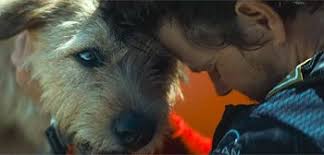
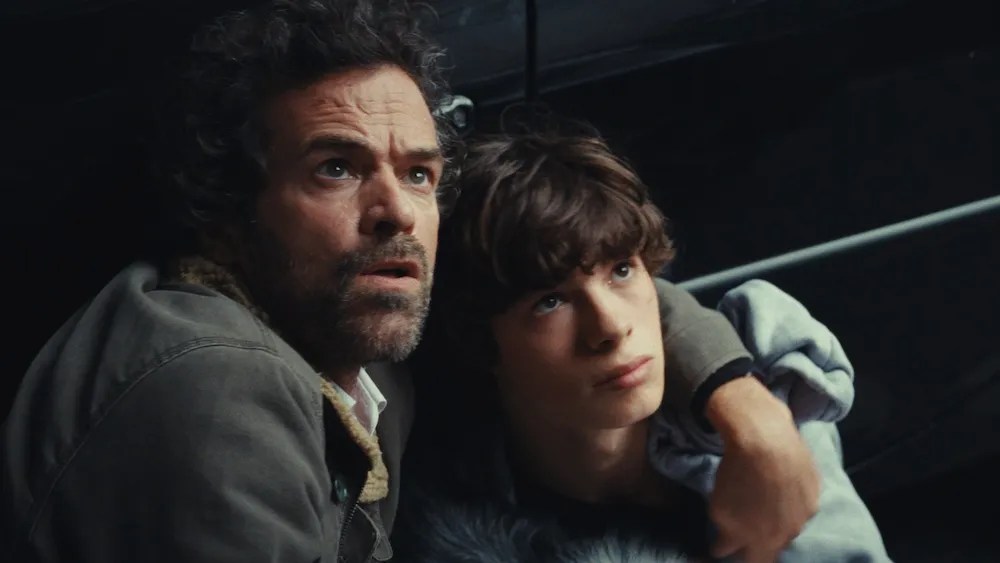
Romain Duris of the recent “The Three Musketeers” remakes and “Waiting for Bojangles” plays François, whom we meet trapped in traffic with his 16 year-old (Paul Kircher) and the family dog.

A violent racket emerges from an ambulance stuck in the same traffic jam, and damned if a human in “critter” form doesn’t bust out. People take cell phone videos. Some even get out of their cars. But nobody’s freaked-out. This has been going on awhile.

“Strange days” a stranger mutters (in French with subtitles) to François, who shrugs “Strange days, yeah” back at him.

What rattles father and son is the news that their plans to move, with wife/mother Lana in care (containtment) to a treatment facility outside the city has gone awry. The vehicle carrying her and others like her crashed and most inside escaped.

Father and son have to break the law to drive into the forest looking for her. But the cop on the case (Adèle Exarchopoulos of “Blue is the Warmest Color” and “Mandibles”) seems sympathetic. Father and son and their dog Albert hunt for Lana when they can, and adjust as they must.

Starting a new school in a new town, Émile should be a lot more bothered than he seems. He’s just lost his mother, and in the most bizarre way imaginable. His coping mechanism is to tell his new classmates she’s “dead.”

Maybe on-the-spectrum curious Nina (Billie Blain) will get it out of him. Maybe he’ll tell after he’s the one who secretly makes contact with a couple of “the creatures/critters” in the forest. Maybe “contact” means he himself will sprout feathers and try to fly.

This world is divided into people who fear and attack the formerly human animals which they don’t understand, people who lost family that way and want to understand, and people like Nina and some of her classmates, who leave food out for them for their own reasons — compassion chief among them.

Cailley never really reaches for the heartstrings in this story, which seems odd. The emotional heart of the picture is the father seeing his philosophy and moral center tested, and the son’s underreaction to what he’s finding out about “them” and himself.

And while the effects are terrific, the action beats are effective but limited in number. One chilling chase features locals wearing drywall stilts to wade through a cornfield on the hunt for “critters.”

“The Animal Kingdom” does what it does fairly well. But what it does isn’t all that original, and lacks the pathos you’d think such a situation might generate in those who live through it.

Rating: unrated, violence, disturbing content, smoking, profanity

Cast: Romain Duris, Paul Kircher, Adèle Exarchopoulos, Tom Mercier and Billie Blain

Credits: Directed by Thomas Cailley, scripted by Thomas Cailley and Pauline Munier. A Magnet release.

Running time: 2:08

Posted in Reviews, previews, profiles and movie news | Comments Off on Movie Review: Father and Son cope with a wife and mother lost to “The Animal Kingdom”

Classic Film Review: Denueve, Rey, Nero and Buñuel dish up a Spanish parable — “Tristana” (1970)

The peak years for Catherine Deneuve, the great French beauty and darling of the Great Directors of her youth, stretched from Demy’s “The Umbrellas of Cherbourg” and “The Young Girls of Rochefort” to Polanski’s “Repulsion” through Buñuel’s “Bell de Jour,” Truffaut’s “Mississippi Mermaid,” with the Oscar nominated “Tristana” (1970), also directed by Luis Buñuel, heralding the end of an era, although she’d work for Demy on a couple of post-peak “auteur” films of the ’70s.

Those ’60s films made her an international screen icon and ensured the longevity and the”legend” label that she grew into in a career that later earned her an Oscar nomination (“Indochine”) and kept her in demand on into the 2000s with films as varied as the musical “8 Women,” the comedy “Potiche” all the way to year’s dramedy “Funny Birds.”

“Tristana” might be the weakest of those ’60s classics, a film that suffers due to the technical and budgetary shortcomings of much European cinema of the day, as well as its general old-fashioned feel.

It’s a Spanish melodrama and the French Deneuve is dubbed into Spanish, as is Italian co-star Franco Nero. Indeed, all the dialogue and sound effects are vaguely disembodied suggesting the entire soundtrack was looped, a not-uncommon European practice of the era.

And that calls attention to the general mustiness of the story being told here. Based on a 19th century novel, this 1920s period piece is about a beautiful young woman who becomes the ward of an older, old-fashioned guardian (Fernando Rey of “The French Connection”).

For all his grumping about “appearances” and “honor” and virtue, noble Don Lope lusts after Tristana, seduces her and continues to try and control her as she develops an independent streak and then falls for eveyr parent and ward’s nightmare — an artist (Nero).

Old attitudes, mores and conservatism run up against “the modern” as we see Don Lope dismiss being asked to judge a duel when he hears the combatants will only fight until “first blood” is drawn.

“There are no longer men of my kind,” he huffs (in Spanish with English subtitles), sneering at the “effeminacy” of the culture he finds himself living in.

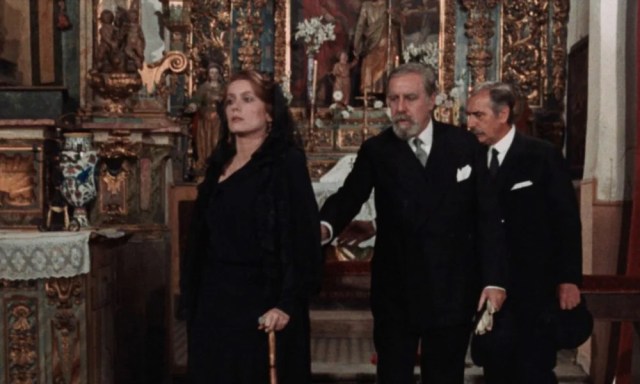
Tristana is in mourning when we meet her. Her mother has passed and as someone who “never enjoyed your father’s wealth,” she is at the mercy of the town (Toledo) and its sexist rogues and chancers.

Don Lope will take her in, and his housekeeper and cook Saturna (Lola Gaos) will help her fit in.

“No one is better than Don Lope,” she assures Tristana. “But where there is a skirt, he has horns and a tail.”

Rey plays Don Lope as a literal mustache twirler when he spies a pretty woman. We are told that he called a married woman’s husband out for a duel, which adds a touch of dash to his persona. But he is a mouthy hypocrite — stingy, cash-poor, domineering and a creature of leisure and habits, contemptuous of capitalism, loans, work, even the Guardia Civil, the police.

When he orders Tristana to “stop mourning,” because of how comfortable her all-black wardrobe makes everyone else, she does. When he comes on to her with a kiss, she giggles. And when he visits her room later, she submits to him.

But as time passes and she grows into her own (Deneuve was 26 when the film was made), Tristana sours on “the old man,” his penny pinching and control issues. She is ready to meet someone to fall in love with, and the not-quite-starving artist Horacio (Nero) is that someone. She dreams of running away to Barcelona with him, contributing piano lessons income to their stake, and freeing herself from Don Lope.

The old contronts the new most graphically in a scene where Don Lope, disapproving of her love match, goes to confront Horacio, insults and threatens with a glove-slap, only to get punched out at this invitation to a 19th century duel. Get with the times, old man, is the message.

Sex is that which cannot be named in this multi-national production, as what Don Lope is most concerned about is Tristana parading in public, “layabouts” coming on to her and her falling for one. Saturna scolds her deaf and horny teen son Saturno (Jesús Fernández) about slacking off at his first job for masturbating. She never says the word, as he’s deaf. A gesture will do.

Deneuve was forced to add ineffectual mime to her repertoire for conversations with the deaf Saturno — who with a pal takes every chance he can get to grope the grieving girl in early scenes — and is saddled with a performance that’s as subtle as a mime, with everything that’s understated struggling to register on screen and especially on the soundtrack.

Long a Spanish exile who filmed in Europe and Mexico, with a career that traced itself back to the famed silent surrealism collaboration with Dali, “Un chien andalou” (An Andalusian Dog”), Buñuel was anxious to make his Spanish homecoming a triumph, in spite of the conservative, Catholic-endorsed restrictions of Franco-era Spain.

But those restrictions may have a lot to do with the early reviews and even Oscar consideration of this Buñuel classic. “Look at all he had to overcome,” after all.

Deneuve had covered similar cinematic ground, as had Buñuel with his sensational “Viridiana”). The filmmaker admitted the novel he was working with here old fashioned to the point of “kitschy” and figured he’d overcome that. He didn’t. Not entirely, anyway.

There’s merit in even the pedestrian depictions of pre-tourism Toledo, the fading glory of the broke Spanish aristocracy — Don Lope mutters about getting a fair price from “the Jew” he sells the family silverware to. And yet Rey, mustache-twirling aside, was one of the more commanding screen figures of his era for a reason. Great presence.

But “Tristana” has a creaking quality. It’s merely a semi-successful attempt to transplant an early Spain (the novel came out in 1892) to a later, Civil War Eve story about a world dying out and the ruthless, unsentimental one about to replace it.

Rating: PG-13, adult situations, innuendo, mild violence

Cast: Catherine Deneuve, Fernando Rey and Franco Nero

Credits: Directed by Luis Buñuel, scripted by Julio Alejandro and Luis Buñuel, based on a novel by Benito Pérez Galdós. A Mercurio/Cohen Media Group release streaming on Tubi, etc.

Running time: 1:39

Posted in Reviews, previews, profiles and movie news | Comments Off on Classic Film Review: Denueve, Rey, Nero and Buñuel dish up a Spanish parable — “Tristana” (1970)

Movie Review: Korean experts on the uneasy dead? Call them “Exhuma”

“Exhuma” is a somewhat lumbering South Korean thriller about ghosts, how they can disturb the tranquility of the families that descended from them and the professionals hired to help remedy such problems and remove such troublesome spirits.

It’s got lighter moments, but it’s no “Ghostbusters.” The film is also about Korea’s uneasy relationship with its past tormentor, Japan, creating afterlife issues that can dog the Korean diaspora in America, thousands of miles removed from the Korean peninsula.

I have no gripe with Jae-hyun Jang’s film’s modest effects, which get the job done. But the paucity of “thrills” and frights, many of them consigned to that “reckoning with Japan” and Japanese ghosts (which are “different”) in a third act that takes forever to show up water down the tale’s impact make one wish for one last vigorous edit.

A young couple that isn’t really a “couple” travels to America to visit a hospital and consult with a concerned family there. Their newborn baby isn’t laughing or responding to stimuli, and they figure it has to do with their ancestors.

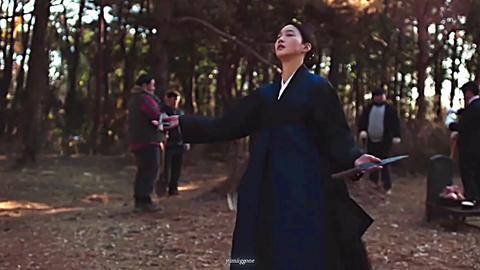
The newly-flown-in Hwa-rim (Kim Go-eun) hears of the history of their family and agrees. “First borns” of every generation of this clan face this. She and her assistant Bong Gil (Lee Do-hyun) try a couple of folk medicine things and recommend more drastic measures that must be taken up back in Korea.

“Shadows” hang over your baby, “pressing down from your ancestors.”

Hwa-rim is a shaman, one who exists “between” the living and the dead, she narrates. She knows her business. With assistant Bong Gil, she will oversee exhumatations. She will dance (more K-Pop and Britney than “traditional” seeming, but maybe that’s just me) and he will chant and play the drums as old graves are reopened and the uneasy dead are dealt with.

To do that, they’ll need a geomancer, a wizened expert in grave sites, soil and whether or not an interred soul has reasons to complain about their accomodations.

Hwa-rim might say a prayer over a grave. Geomancer Kim Sang Deok (Choi Min-sik) will taste the soil, and when his accomplice Mr. Ko (Yoo Hae-jin), a funeral home director, has arranged for the grave to be opened, Kim will climb into it and make an assessment.

“Bloodlines,” Kim intones (in Korean with English subtitles). “You can’t escape them, even in death.”

What follows is a long, convoluted discussion of this one family’s history, who married into it, a mountainside grave that must be located and studied and a bit of joking — when the client’s not around — among these seasoned professionals about their billable hours.

The tale breaks down into chapters, which may help screenwriters organize their dramatic beats but rarely add anything to a finished film.

There are jokes, here and there. An old man tasting the dirt in a grave is amusing. I think Hwa-rim’s dancing might be meant as a joke. But the wisecracks about money and making bank off these “rich” Korean-Americans are openly humorous, as is the occasional generational jab.

“This is why it’s tough working with geezers.”

Choi Min-sik, a veteran of the original “Oldboy,” as well as “I Saw the Devil” and “Lucy,” brings gravitas to Kim that gives us someone to connect with, someone who sees the “everyone could get killed” stakes. Kim Go-eun (“Canola”) nicely suggests a young woman who has probably just aged enough to truly take her job seriously.

But as interesting as many of these folkways and cultural supernaturalist quirks are, and as apt as the whole Korean-Japanese bad blood thing is as a subtext, the meandering narrative robs “Exhuma” of much of its punch.

The third act has higher stakes and violence and rituals that race against a clock. But by then the story’s spell has dissipated, and any hope the tale might twist into something scarier, sadder or funnier is long gone.

Rating: unrated, supernatural violence

Cast: Kim Go-eun, Choi Min-sik, Lee Do-hyun and
Yoo Hae-jin

Credits: Scripted and directed by
Jae-hyun Jang. A Well Go USA release.

Running time: 2:14

Posted in Reviews, previews, profiles and movie news | Comments Off on Movie Review: Korean experts on the uneasy dead? Call them “Exhuma”

Netflixable? Hot Interpol cop hunts Art Heist Hunk — “The Art of Love”

“The Art of Love” is an almost-flippant Turkish take on “The Thomas Crown Affair.” Never quite funny, and nowhere near amusing enough to be a caper comedy, with stakes that are entirely too low to be an effective heist picture, it just sort of lies there, looking sleek and sexy, as if that’s enough.

It isn’t. Any more than the middling thefts and tepid chase scenes through Istanbul and Prague, which could have used a French second unit director’s consulting to bring them to life.

Turkish TV starlet Esra Bilgiç is Alin, someone with a passion for art and a degree in it who found a good use for her expertise — working for Interpol, tracking art thefts. Someone is stealing “the least valuable painting” from Europe’s museums and galleries. She and agent Ozan (Ushan Çakir) are stumped until she figures out these works of Fauvism are all about “love.”

They guess what might be targeted next, guess right, and just as the thief slips through their fingers, Alin realizes it’s this billionaire named Güney (Birkan Sokullu) whom she dated until he “disappeared.”

Small world.

Now he’s back back from hiding, and leading a team in stealing art. Apparently.

The movie’s cat-and-mouse “Thomas Crown Affair” variation is that this time it’s overwhelmingly from the investigator’s point of view as she plots to re-enter his life and tempt him until he slips up.

“Look at what you’re making me do, Güney!”

His “team” is barely in the background, save for a hacker (Nil Keser) vs. Alin catfight.

The odd playful or sexy moment is lost in the low-heat tedium of everything that happens. Even a third act shootout seems dispirited.

Want to remake “The Thomas Crown Affair” on a Netflix/Turkey budget? Script and stage a “Grand Gesture” in a baroque concert hall, with only two dancers and our billionaire and his former enamorata the only ones in the audience. Saves money on performers and extras. Have your swaggering, rich thief talk about “extreme sports,” but skip actually showing them.

The idea is sound as the story’s plot has worked in a couple of other films. But the performances don’t pop. “The Art of Love” never overwhelms us with affluence, never titilates us with sex (not really) and never gives us anything like the suspense that would be needed for this to come off.

A bit more polish in the Craft of Screenwriting and the Art of the Chase Scene, and maybe a little more money in the budget, and this this can’t-miss premise wouldn’t have missed.

Rating: TV-14, gunplay, fisticuffs, mild profanity

Cast: Esra Bilgiç, Birkan Sokullu, Firat Tanis, Nil Keser and Ushan Çakir

Credits: Directed by  Recai Karagöz scripted by Pelin Karamehmetoglu. A Netflix release.

Running time: 1:39

Posted in Reviews, previews, profiles and movie news | Comments Off on Netflixable? Hot Interpol cop hunts Art Heist Hunk — “The Art of Love”

Movie Preview: A record collection enables time-travel — “The Greatest Hits”

A music lover tries to save a doomed lover via the music of their affair. Then again, maybe this new music lover could distract her from that time-traveling music mission.

Searchlight and Hulu have this one. April 12.

Posted in Reviews, previews, profiles and movie news | Comments Off on Movie Preview: A record collection enables time-travel — “The Greatest Hits”

Movie Preview: Ethan Hawke directs Maya Hawke as Flannery O’Connor — “Wildcat”

Hard, brittle and cutting short stories like “A Good Man is Hard to Find” sealed Flanney O’Connor’s reputation as an unblinking observer of humanity, mostly in its Southern form.

“I try to turn the other cheek, but my tongue’s always in it.”

Maya Hawke plays the writer, with Laura Linney as her somewhat disapproving mother.

Oscilloscope Labs got this film festival darling, always a good sign. In theaters May 3.

Posted in Reviews, previews, profiles and movie news | Comments Off on Movie Preview: Ethan Hawke directs Maya Hawke as Flannery O’Connor — “Wildcat”