Classic Film Review: Cops chase killers and drugs in 1950s San Francisco in “The Lineup”

Don Siegel won a couple of Oscars for short films early on, did a lot of 1950s and ’60s TV, directed Elvis and John Wayne and the original “Invasion of the Body Snatchers.” He was behind the camera for enough Clint Eastwood movies that he became Clint’s film school.

Hard boiled? You bet. “Dirty Harry,” “The Shootist,” “Charlie Varrick,” “Riot in Cell Block 11,” the guy turned-out a steady line-up of unsentimental, sometimes downright sadistic action.

“The Lineup” (1958) wasn’t one of his best, but it’s tough, brutal and kind of kinky, with a finish that packs a punch.

The idea behind it was, if the LAPD’s “Dragnet” could begin as a hit radio series, transition to a hit TV series and become a movie, why couldn’t the same thing happen with the San Francisco-based “The Lineup?”

A “taken from real case files” police procedural set in The City by the Bay, “The Lineup” featured fairly colorless cops — like “Dragnet” — chasing more colorful criminals than “Dragnet” ever managed.

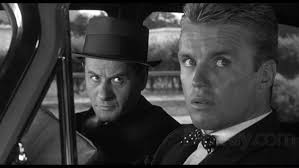
Siegel’s workmanlike 1958 film takes us into a killing spree over drugs being smuggled into the city by tourists returning from Asia, and lets us see the pursuit through the eyes of the police chasing the killer, and inside the car with a door-to-door murderer-for-hire named Dancer, played with his usual relish by Eli Wallach.

Richard Jaeckel is the short blond punk assigned by The Man behind the scenes to drive our no-nonsense drug-retriever from destination to destination. And Robert Keith plays Julian, the demonic dandy correcting Dancer’s English usage and grammar, a misogynistic muse sitting on his shoulder urging him to collect “famous last words” from the poor saps he’s killing.

“For the book.”

Julian tells the driver who’s been sent to take them to the various unsuspecting “carriers” whom Dancer will collect from that the trigger man is “a wonderful, pure pathological study, a psychopath with no inhibitions.”

Julian seems to relish this. Julian is a Hollywood “type” all his own, the homocidal homosexual whose connection to Dancer isn’t so much homoerotic as sadistically co-dependent, a tough-talking but spineless sidekick with a fey obsession for mentoring in the social graces.

The first hint the cops have of drugs flooding into town this way comes when a San Francisco opera swell (Raymond Bailey) has his luggage grabbed in a handoff that gets a cop killed.

Bailey’s innate highborn shiftiness — he went on to player the banker Mr. Drysdale on “The Beverly Hillbillies” — makes him suspect one as Detectives Asher (Marshall Reed from the TV series) and Quine (Emile Meyer) start pulling together clues, visiting the 1950s medical examiner and tossing the cop killer’s apartment, so wrecked it looks a Halloween party got out of hand there.

“No self-respecting witch would bring a broom into this trap!”

Dancer and Julian roll into town and Dancer makes his demands on the wheelman brought in to work for them.

“I like my wheels stored in a prepared drop…I want my plates snatched not more than one hour before I move.”

Sure, those demands fall by the wayside. But a merchant seaman, a society swell and a mother and daughter have no idea who is about to pay them a “friendly visit.”

The direction is quick, cheap and unfussy, with Siegel forced to use low-heat TV actors as cops, early mornings for his exteriors and a lot of rear projection in the still-nerve-rattling chase scenes.

But he and the crew make great use of San Francisco locations, with the climax taking in the famous Sutro Museum and Skating Rink, and the elevated freeway, still under construction as the movie was being filmed, that would famously collapse during the 1989 World Series earthquake.

One thing that grabbed me right away was Siegel’s confidence that the camera could show you things dialogue and the lazy intertitles modern filmmakers use to set the scene. We can SEE it’s San Francisco. We don’t need to be spoon-fed that information.

Whatever the low-risk/pre-sold reasons for putting this TV-tailored tale on the screen, there’s no doubt Siegel went to school on the city and some of the Stirling Silliphant script’s sharper edges while making it. He’d return to the Bay Area several times in the future, most famously for “Dirty Harry” with Eastwood in 1971.

And even if that killer was to be even sicker than ever, this time, the sadist would be the fellow with the badge.

Rating: TV-14, violence, drug content

Cast: Eli Wallach, Robert Keith, Richard Jaeckel, Marshall Reed, Mary LaRoche, Emile Meyer, Raymond Bailey and Vaughan Taylor.

Credits: Directed by Don Siegel, scripted by Stirling Silliphant, based on the TV series created by Lawrence M. Klee. A Columbia release on Tubi, Amazon, etc.

Running time: 1:26

Posted in Reviews, previews, profiles and movie news | Comments Off on Classic Film Review: Cops chase killers and drugs in 1950s San Francisco in “The Lineup”

Netflixable? Big City Chef feels “No Pressure” when she’s tricked to moving back to the farm

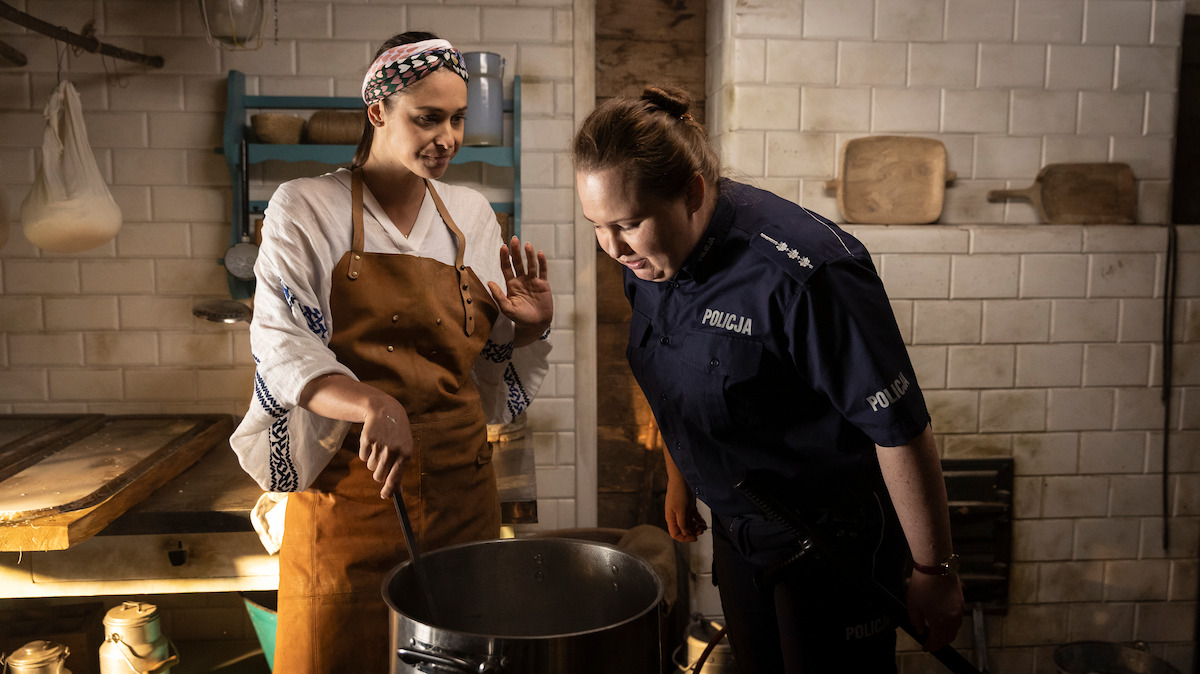
A bit of food, a dash of moonshine and a smattering of local color decorate “No Pressure,” a lackluster, lumbering Polish romantic comedy about finding love and life balance by leaving the big city for grandma’s farm.

Cinematographer turned director Bartosz Prokopowicz (“Chemo”) and screenwriters Karolina Frankowska and Katarzyna Golenia build this laugh-starved farce around a faked funeral, professional sabotage and mistaken identities used to trick Chef Oliwa (Anna Szymanczyk) into giving up her culinary life in Wroclaw for backward, pastoral Bodzki, in rural Podlachia.

Oliwa tells us in voice-over (in Polish, or dubbed into English) about her “hot temper.” But considering all she’s put through as she drops everything, begs for two days off from the boss, and gets her Mini stuck in the mud on the way to her beloved grandmother’s funeral, she maintains her cool.

Especially considering that grandma Halina (Anna Seniuk) pops up in her coffin and snaps “I had to find out if you were sad to see me go!”

That’s the sort of thing that only happens in rom-coms, Polish or otherwise, titled “Nic na Sile” or “No Pressure.”

When granny doubles-down after re-introducing lightly exasperated Oliwa to the farm by disappearing, leaving her career-woman granddaughter holding the bag, we’d expect more of a meltdown than Oliwa ever delivers.

After all, this is a busy time back at the restaurant, which is just about to expand. It was a hassle getting to “the literal middle of nowhere,” and part of that hassle was with this redhead (Mateusz Janicki) who blocked the one-lane bridge Oliwa was trying to cross, and who helps out on the farm. Supposedly this is Wojtek and not the herb grower Kuba who, with his father, are trying to get their hands on the farm and put Halina out of business.

Oliwa finds herself sucked back into this life and all this drama despite being furious at her conniving granny and granny’s paramour (Artur Barcis) and not being all that keen on the life lesson they’re trying to teach her.

“Sometimes, you’ve got to do something bad to do something good.”

Say what?

The colorful, cute neighbors aren’t all that colorful or cute. The mistaken identity thing is dragged out when aspiring pop-singer Wojtek — the real one (Filip Gulacz) returns and is enlisted in the scheme.

The Polish singing — pop, funeral dirge and folk — is a nice touch. But the misadventures with geese and goats and whatnot are weary tropes of the “back to the land/farm” comedy genre.

Like most every other element of the picture, it’s all been played before and played-out. So even if the stars had great, caustic chemistry — which they don’t — “No Pressure” was never going to surprise or delight .

And a comedy with no urgency, edge or stakes isn’t much of a comedy, with or without “pressure.”

Rating: TV-14

Cast: Anna Szymanczyk, Anna Seniuk, Mateusz Janicki, Artur Barcis and Filip Gurlacz.

Credits: Directed by Bartosz Prokopowicz, scripted by Karolina Frankowska and Katarzyna Golenia. A Netflix release.

Running time: 1:52

Posted in Reviews, previews, profiles and movie news | Comments Off on Netflixable? Big City Chef feels “No Pressure” when she’s tricked to moving back to the farm

Movie Preview: Nick Frost lives through the (comic) horror of “Krazy House”

Alicia Silverstone co-stars in this nightmarish twist on a ’90s sitcom that turns murderous, thanks to the arrival of bloody minded Russians

It’s from those Dutch treats who gave us the ultrasound violent “New Kids” movies.

Posted in Reviews, previews, profiles and movie news | Comments Off on Movie Preview: Nick Frost lives through the (comic) horror of “Krazy House”

Movie Review: Palestinian teens weigh the consequences of life under “Alam” (The Flag)

Long before a Palestinian activist/agitator has confronted a busload of tourists to an Israeli “Plant a Tree in Israel” forest with “Just think of the refugees they keep out of your news,” viewers of the new film “Alam” have figured that out.

If nothing else, Palestinian filmmaker Firas Khoury’s dramedy about coming of age Palestinian under the Israeli “Alam” (flag) underscores the vast disparity in whose story gets told and whose point of view is almost invisible there, in that fractious sliver of land on the Eastern Mediterranean.

Whatever efforts to balance coverage and explain the endless conflict within Israel and the Occupied Territories by journalists, virtually the only movies anybody sees or has ever seen about that corner of the world and about Israeli history are celebrations of its founding, from “Exodus” and “The Juggler” through “Cast a Giant Shadow” and the recent “Golda.”

That’s even the history that teenaged Tamer (Mahmood Bakri) and his mates are taught in high school in their corner of Israel, named Al Safa here, after a “depopulated” village erased from history. With Israeli Independence Day coming up, their history teacher is taking a deep dive into the specific events that led up to what Palestinians mark as Nakba, a day of mourning recalling a “catastrophe.”

But it is a history written or at least approved by the winners. A tattered Israeli flag flies over the Palestinian school. The students are labeled “Arab Israelis,” not Palestinians. Israeli soldiers occasionally drop by. And the kids have heard from their parents and grandparents of the land they lost, the villages “erased” via “ethnic cleansing,” and the sugar-coated version of all that served up to the world, always wrapped in Israeli spin, often tagged with “Plant a Tree in Israel” funding or foreign aid appeals.

“Alam,” set in an a Palestinian town within the boundaries of Israel proper, had to be filmed in Tunisia.

Khoury — “Maradona’s Legs” was his best known film — packages this condmened-by-history drama in a coming-of-age dramedy about being smitten by an activist girl, and a comically hapless group of argumentative friends getting caught up in a symbolic attempt to do something about which “Alam” is flying over their school.

Tamer and his buddies Rida (Ahmad Zaghmouri) and the hustler-goof nicknamed Shekel (Mohammad Karaki) debate who if off-limits to date and which relatives must be consulted before dating on their surreptitious smoke breaks between classes, which get them into trouble.

Tamer, trying to ensure his parents allow him to continue to live by himself in his late grandfather’s empty but un-air-conditioned house, is already on thin ice.

And then he spies a new beauty in their midst, a girl “kicked out” of her last school. Maysaá (Shereen Khass) is a mystery to them, but the argumentative Safwat (Muhammad Abed Elrahman) seems to know her. Tamer pumps him for information as they sit outside the principal’s office, each getting another demerit of warning for some bit of malfeasance.

Safwat is always tardy and always determined to debate the teacher who won’t let him join class already in progress.

“The bus is late,” he protests (the film is in Arabic and Hebrew). “It’s an ARAB bus, not a German one!”

That little crack about Palestinian People’s Time gets a laugh in class, and earns another trip to the principal’s office. Safwat is always arguing, often worked-up about something. But Tamer has to befriend Safwat to learn more about about the mysterious Maysaa’.

That’s how he gets caught up in Safwat’s plot to secretly replace the Israeli flag with the Palestinian one flying over their school. Because confident, mature and radicalized Maysaá is already on board.

Continue reading
Posted in Reviews, previews, profiles and movie news | Comments Off on Movie Review: Palestinian teens weigh the consequences of life under “Alam” (The Flag)

Documentary Preview: Disney does “The Beach Boys”

This May 24 “event” on Disney+ looks to hit a lot of the right notes.

Lots of authorities from music, peers, session musicians, etc., singing their praises and pointing out what made “The Beach Boys” special.

It might be too “official” to have much edge to it, but we’ll hear what a jerk the Wilson brothers’ dad was again, if nothing else.

Posted in Reviews, previews, profiles and movie news | Comments Off on Documentary Preview: Disney does “The Beach Boys”

Movie Preview — “Joker: Folie a Deux”

Joaquin Phoenix and La Gaga, mon dieu!

And Steve Coogan?

Oct 4.

Posted in Reviews, previews, profiles and movie news | Comments Off on Movie Preview — “Joker: Folie a Deux”

Classic Film Review: The “Candy” debacle, still awful after all these years (1968)

“Candy” was notorious on its release, and widely acknowledged by everyone who was in it, and the various actors’ biographers as well as generations of film scholars, as “the worst film” virtually anyone involved ever made.

The acting ranges from players who “get it” and pitch their performances to be at least lightly amusing  — despite the comedically incompetent director’s worst efforts — to “clueless.” The writing, done on the fly, is a red mark on the career of screenwriter and sometime actor Buck Henry (“Heaven Can Wait”). The sexuality in it is painfully dated and, well, rapey.

But context matters in pseudo-psychedelic satires like this. And it wasn’t just fear of being perceived as unhip or “square” that had critics like Roger Ebert embrace it on its release. Well it was mostly that, one suspects, but moving on.

Based on an infamously-bawdy 1959 best seller by Terry Southern that American schoolboys shared, hand to hand, well into the ’70s, it was a coming-of-age odyssey that sent-up American mores, sexual hangups and increasingly sexualized “girls” in a world of supposedly uptight but actually lecherous and predatory men.

Whoever thought of casting a Swede in the title role and shooting it in Italy with a not-really-proven French actor-turned-director probably ending up drinking himself to death. Because the movie doesn’t play. At all.

There is pre-digital camera trickery aplenty on display, from filming a sexual come-on (assault) below the glass floor of a Mercedes limo to a surgeon’s gloves being slipped on too gracefully for reality (they were filmed being taken off, and the footage reversed).

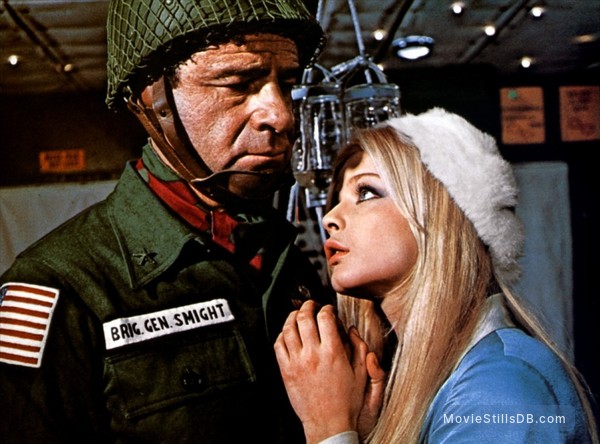
The players who knew comedy well enough to atone for director Christian Marquand’s clumsiness in the genre don’t embarass themselves. Leering loon John Astin of TV’s “Adams Family,” playing Candy’s school teacher father, who wants to protect his “naive” child from premarital sex, and also playing her father’s randy “with-it” New York uncle, is almost funny. Walter Matthau vamps up his always-on-duty Brig. Gen. Smight and James Coburn keeps his cool as a surgeon who might save Candy’s injured father if a little sexual quid pro quo can be arranged.

 “You’re trying to out-diagnose a world renowned surgeon who has attended eight institutions of higher education and who has more degrees than a thermometer!”

Whatever is in the novel (I’m a long way from my Southern-reading teens), that “”do this for me” and I’ll do THAT to you “transaction” is a bit of plot gimmickry that’s beaten to death here.

Continue reading
Posted in Reviews, previews, profiles and movie news | Comments Off on Classic Film Review: The “Candy” debacle, still awful after all these years (1968)

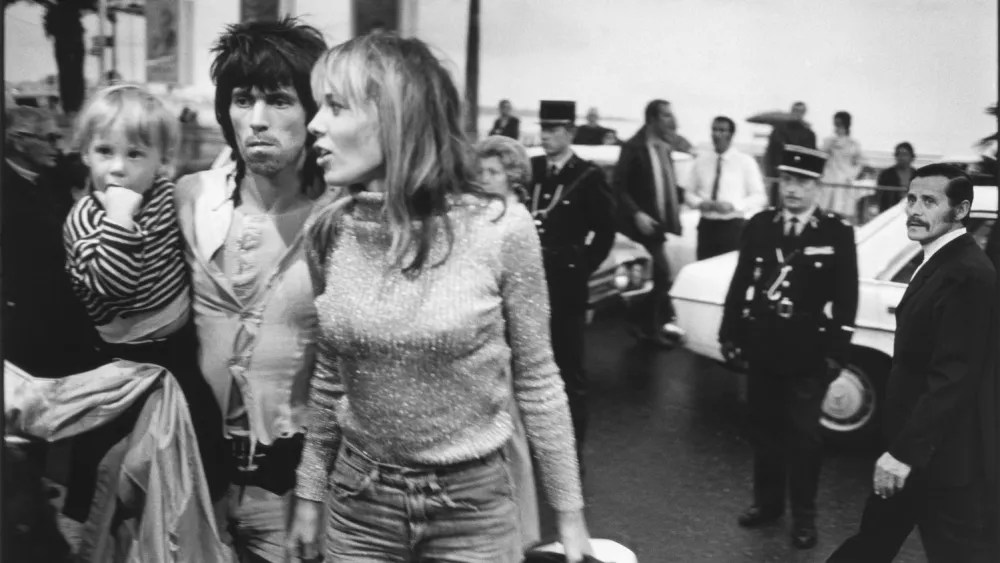
Documentary Review: The ’60s “Rock Chick” incarnate — “Catching Fire: The Story of Anita Pallenberg”

Anita Pallenberg was, model Kate Moss declares, “The original Bohemian rock chick.” And Kate, who dated and married rockers and wannabe-rockers like Johnny Depp, should know.

She was the great rock muse of the ’60s, ex-husband Keith Richards says of the German-Italian Pallenberg. She dated three members of The Rolling Stones, with guitarist-songwriter Keith admitting that their role was chiefly “keeping up with her” as she generated friction and inspired “Gimme Shelter” and “You Can’t Always Get What You Want,” among other songs.

Aptly enough, she even sang backup on “Sympathy for the Devil,” when she wasn’t “making the scene,” popping up in quasi-underground indie films, and co-starring in two of the iconic movies of the era — “Barbarella” and “Performance.”

Filmmakers Alexis Bloom and Svetlana Zill take a shot at capturing the essence of Pallenberg and why she matters in “Catching Fire: The Story of Anita Pallenberg.” They profile a great beauty of her sexist, limited-horizons-for-women era and that first model to take up with famous rockers, immerse herself in their world and become an essential part of it.

If we remember her, it is because of her connection to The Rolling Stones during their most tempestuous, creative and drug-soaked era. But she was more than just a “rock chick,” a striver who used her connection to famous people to become famous herself. Or maybe she wasn’t and she was just kidding herself, despite her 40 or so film credits and the self-consciously poetic turns of phrase in her unpubished memoir, “Black Magic,” generously sampled in “Catching Fire.”

It was to be “a traveler’s tale through a landscape of dreams and shadows,” she wrote.

“My motto was forward, forward forward, never look back” Pallenberg says, her words read and performed in the film by Scarlett Johannson. That line captures the life force and “sparkle” of this singular figure of that storied time. But it also hints at the self-absorption that fed her addictive personality, a life lived without repetenence but also without much in the way of self-reflection.

“Many people confuse me with the roles I played in films,” she disengenously wrote in “Black Magic.” Or not, seeing as how few people saw “Performance” and nobody would mistake her broad, theatrical turn as a “Tyrant” in “Barbarella” for a real woman.

Continue reading
Posted in Reviews, previews, profiles and movie news | Comments Off on Documentary Review: The ’60s “Rock Chick” incarnate — “Catching Fire: The Story of Anita Pallenberg”

Movie Preview: Ti West and Mia Goth take us to 1985 LA in  “MaXXXine”

A porn actress is hellbent on finding stardom via horror, but a “Night Stalker” haunting LA may get in her way.

Did I mention she’s played by Mia Goth? I pity the stalker.

Kevin Bacon, Michelle Monaghan, Giancarlo Esposito,  Bobby Cannavale and Elizabeth Debicki star in Ti West’s latest Mia Gothfest.

July 24?

Posted in Reviews, previews, profiles and movie news | Comments Off on Movie Preview: Ti West and Mia Goth take us to 1985 LA in  “MaXXXine”

Netflixable? Ron Perlman vs. Brad Pitt? “A Stoning in Fulham County”

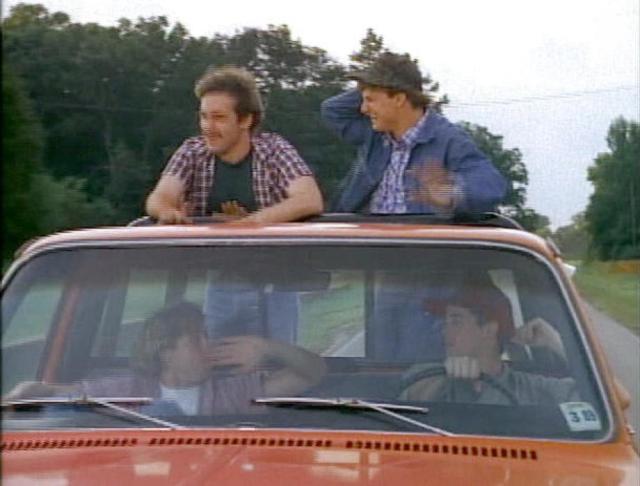
You can look at the young actors playing four redneck teens accused of throwing rocks at an Amish buggy and killing a baby and tell which one of them might have become a star in “A Stoning in Fulham County.” And not just because Brad Pitt’s the most classically handsome of the lot.

Pitt brings a lovely sensitivity to his few scenes in this 1988 TV movie, first aired on NBC. He generates pity, which considering how loathsome what he and his pals did, is saying something. “Stoning” was his first credited role on screen.

The term “TV movie” was, for much of its history, a pejorative label in Hollywood. Shot speedily and on the cheap, usually in between broadcast seasons of network programs and often featuring network series stars or supporting cast members, they generally feature perfunctory direction, adequate acting and just a little more polish than your average indie film.

I used to cover them in the same part of the country that “Fulham County” is set in — central North Carolina — and saw actors like M. Emmet Walsh, William Daniels, David Ogden Steirs, a very young Keri Russell, Jesse Borrego and others bring a little flash and a lot of professionalism to these two-takes-and-done projects.

These days, not many are produced as TV has migrated to the streaming series model, although you can find lots of them on The Hallmark Channel, especially around the holidays, and on Netflix, which has offered players like Lindsay Lohan a new lease on life in these B-movies for the boob tube.

But Steven Spielberg launched his career with “Duel,” Elizabeth Montgomery discovered life after “Bewitched” with her fierce turn in “The Legend of Lizzie Borden,” Cicely Tyson immortalized herself in “The Autobiography of Miss Jane Pittman” and Andy Griffith left his “Aw, shucks” sheriff behind with TV films like “Savages” and “Murder in Coweta County.”

“Fulham County” is better than your average TV movie, if not one of the exemplars of the genre. It was scripted by writers with “Quincy, M.E.,””Murder She Wrote” and “Columbo” credits and directed by a make-your-“day” and make-the-trains-run-on time filmmaker who worked on “Remington Steele,” and did “Mendez: A Killing in Beverly Hills” and the excellent  “Tecumseh: The Last Warrior,” which I watched him film near Winston Salem.

It’s a courtroom drama based on a real case of local harassment of the Amish that led to a death in 1979 Indiana. The film came out three years after the classic murderers-among-the-Amish romantic thriller “Witness,” and squares off “thirtysomething” star Ken Olin against “Beauty and the Beast” (the series) star Ron Perlman, and features Jill Eichenberry (“L.A. Law”) as prosecutor Olin’s wife, big city folk who have moved to rural N.C. (Statesville was the primary filming location).

Well-known character players Peter Michael Goetz, Nicholas Pryor and Noble Willingham (as the judge) flesh out the cast. And one of the greatest character actors of his era, Theodore Bikel, is cast as the Amish elder Abe, classing-up the entire enterprise with his fluid mastery of German (he was a villain in “The African Queen”), his soulful singing (he was a folk music star) and gravitas, joining Perlman’s grieving father Jacob in explaining “our ways” to the city slicker, and to the TV viewing audience.

When the punks harass and hurl rocks in their “claping” prank on Jacob and his family (Maureen Mueller plays his with Sarah), they’re engaging in a local rite of passage, to scare and even injure the folks who are “different” from them, whose values and traditions that eschew many of the conveniences and temptations of modern life.

The new “finishing out the year” prosecutor has hopes of just doing his time and opening his private practice there until this horrific injustice lands in his lap.

As the locals start with “They’re just boys” and move into full-on harassment of the prosecutor, as Jacob declines to testify or allow any of his family to because “Vengeance is mine, sayeth the Lord,” prosecutor Jim has to ask, “What the hell have we gotten into?”

The film resembles many a “Matlock” episode (my elderly mother was an addict, before moving on to the hard stuff — “Blue Bloods”), and has barely a whiff of “To Kill a Mockingbird” or “Inherit the Wind” in it, despite the drawls, the desperate appeal for witnesses, a biased local judge and the organized, ingrained ignorance they’re fighting against.

“Turn the other cheek,” the go-along-to-get-along Sheriff (Greg Henry) says of The Amish Way. “Not a bad way to live.”

“Unless you’re the only ones who do,” Jim snarls back.

Olin was an early adapter of the empathetic vocal fry school of near-whispered TV acting of the era, and is less convincing in the fiery appeals for justice that are necessary for this button-pushing melodrama to close the deal.

Mueller doesn’t give us much, as a mother struggling with grief and to not lose her faith at this severest test.

But Perlman and Bikel are outstanding, and they do things the generic, sappy “TV movie” score and pedestrian shot selection and editing don’t. They make us invest in this story, move us and infuriate us, and in no way prep us for the formula-breaking finale that shows up and almost cheats us of what we’ve always comes to expect out of such courtroom tales.

That’s TV movies for you. Future “superstar in the making” or not, we’ve got 94 minutes to tell a story, with commercial breaks. And by God, that train’s got to arrive and leave on time, no matter what.

Rating: TV-14, violence

Cast: Ken Olin, Ron Perlman, Jill Eichenberry, Noble Willingham, Maureen Mueller, Greg Henry, Peter Michael Goetz, Nicholas Pryor, Brad Pitt and Theodore Bikel.

Credits: Directed by Larry Elikann, scripted by Jackson Gillis and Jud Kinberg. A Landsburg Co. production first aired on NBC. Now on Netflix.

Running time:

Posted in Reviews, previews, profiles and movie news | Comments Off on Netflixable? Ron Perlman vs. Brad Pitt? “A Stoning in Fulham County”