Documentary Review: “When We Went MAD'” for a Humor Magazine

It was more obvious 40 years ago, but we in America live in a MAD culture, a land of mockery, parody and running gags aimed at the institutions, pop trends, entertainment and “Americana” that we once thought of as “sacred cows.”

Generations grew up with MAD magazine, “Humor in a Jugular Vein” as it was billed in the early days. And many of those of us who grew up with it came to make a mocking mark on the culture in their own vein, from the ’60s, when that first generation of kids who grew up on it started pursuing careers in comedy, sketch and humor writing or cartooning, to today, when cultural mockery has spread from “Saturday Night Live” to “The Daily Show” to Tik Tok, Youtube and beyond.

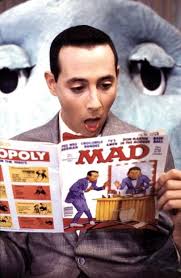
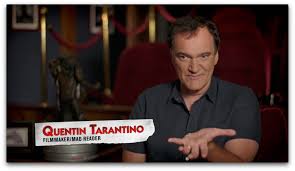
“When We Went MAD!” is an affectionate documentary history of this magazine, taking us back to the prehistory — publisher and founder William M. Gaines was the son of pioneering comics publisher (“Wonder Woman,” “Green Lantern,” “Hawkman”) Max Gaines — on through the magazine’s 2019 demise, with a Quentin Tarantino “Time Warp Final Issue” conceived to provide set decor for “Once Upon a Time…in Hollywood.”

MAD was conceived as a venture in juvenile humor from a company (EC Comics) that had devolved from its “Education Comics” mission — with illustrated stories from The Bible as one of their titles — into tween/teen horror comics like “Tales from the Crypt” and “Vault of Horror.” The horror titles and violent “Two-Fisted Tales” had gotten EC into trouble with Congress during the “juvenile delinquincy” panic of the 1950s, an earlier version of the culture’s later panics — fear of TV, rock music, video games and social media’s impact on children.

The idea in house was to write for older juveniles so that the mag would appeal to younger ones.

“Things that go over your head make you want to life your head up,” writer Desmond Devlin reasons.

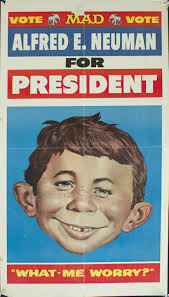
“When We Went MAD!” hits the red letter dates in that early history that gave the magazine its style, its mission and its cover-boy, Alfred E. Newman. Politics and social mores, movies and TV and pop culture phenomena were targets that worked their way into the comic book that transitioned into a “slick” (monthly magazine with better paper, sharper images) to hang onto an early editor.

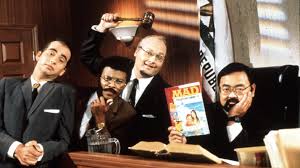
“MAD went after EVERYone,” one and all marvel as Gaines & Co. assembled staff and contributors who came to be known as “The Usual Gang of Idiots” as they were credited on the masthead.

Early readers became aspiring writers, and the irreverent style was established with that blend of old art and gag writing pros and youth culture alumni who turned the magazine into a major force in America in mid- ’60s through the ’70s.

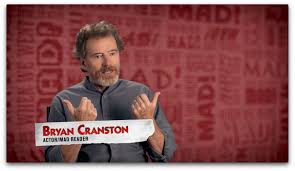
The testimonials here— Bryan Cranston, Howie Mandell in interviews and Jerry Seinfeld, Howard Stern and others in archival clips from TV appearances, are filled with performers and personalities needing “no other honor” in their lives after their show or shtick earned them a MAD Magazine cover.

Bernstein’s documentary revels in Baby Boomer nostalgia and the magazine that mocked much of what Boomers still get nostalgic over. And we get a hint of just how “out there” the mercurial personalities and wise-crackers who wrote it, drew and joked MAD up could be.

The man behind it all — Gaines — was a hands-off publisher who didn’t see any issue until it hit his desk at publication, with a staff that lovingly hated him awaiting his first belly laughs. Gaines is remembered as a bon vivant, generous cheapskate and “one of the biggest nuts who ever lived.”

But the genius of the magazine was its instinctive wrong-footing of the reader. Nothing was sacred. Capitalism and socialism were mocked in equal measure, politicians were punctured and smoking and faux “patriots” and “gun nuts” were relentlessly ridiculed.

“The curse of being a satirist,” former editor Nick Meglin opines, is “you laugh in the WRONG places.”

Continue reading

Posted in Reviews, previews, profiles and movie news | Tagged , , , , , , , , , | Comments Off on Documentary Review: “When We Went MAD'” for a Humor Magazine

Movie Preview: Gael Garcia Bernal, “Magellan”

This Lav Diaz film is the Philippines’ entry on the Best International Feature Oscar race.

Epic, but hardly old fashioned, on the way it treats the “cost” of “discovery” and conquest

Posted in Reviews, previews, profiles and movie news | Comments Off on Movie Preview: Gael Garcia Bernal, “Magellan”

BOX OFFICE: “Wicked” blows up the Box Office “For Good,” but will records fall?

Considering that it’s on over 4100 screens, is the sequel/second half of a blockbuster that fans couldn’t get enough and it showing pretty much every thirty minutes at every cineplex in America, “Wicked: For Good” had better blow up at the box office. Every theater chain bet on that.

The film sold a staggering $30 million in tickets just Thursday afternoon and night, and added to Friday’s $38 million+, that totals into a $68-70 million or so “opening day. The Numbers verifies that it hit $150 million before midnight Sunday.

Pre-opening ticket sales were through the roof, so none of this is a shock. h “A Minecraft Movie” ($163 million opening weekend, raking in $423 million in North America alone) and become the year’s biggest hit? It’s within the realm of possibility for both this weekend, or by year’s end, and certainly will be the bigger hit by late January, when “Wicked” either finishes its run or gets an Oscar bounce.

It did my surpass”A Minecraft Movie” ($163 million opening weekend, raking in $423 million in North America alone) and become the year’s biggest hit? It’s within the realm of possibility for “Wicked 2” to pass Jack Black & Co  by year’s end, and certainly will be the bigger hit by late January, when “Wicked” either finishes its run or gets an Oscar bounce.

I don’t see that “bounce” happening, but it may yet have box office “legs.”

I saw it at a matinee in a small Southern city where it was booked every 30 minutes after 230 and the only showing that was reasonably well-attended (I was in the cinema all day) was the one I caught at 7 Thursday night. But a trickle of fans was getting out to catch it opening day and night, even there.

Financially, it was canny to split the popular stage musical into two halves with the first film opening to $112 million last fall on its way to a $474 million take. Figure the two halves will clear a $billion when all is said and done.

But aesthetically and in terms of how the halves play, it was a mistake. I’m not the only critic to pan it. Whatever hopeful, accepting messaging the play had that the movie defiantly doubles down on under the current repressive American regime is all the viewer has to cling to as the story loses whatever heart and spark it had going for it at the outset. Fans will go and say they’re pleased, but I didn’t hear a laugh from the half-full house I saw it in.

Early projections had this film opening in the $175-200 million range, so Saturday’s take will be telling. Maybe that pre-release enthusiasm has cooled a bit. Or maybe not.

“Now You See Me Now You Don’t” is looking at a $9.1 million or so second weekend, a 55-60% falloff from its opening weekend. This lifeless reboot earned $27 million its opening week, but the word on that one is that it’s big in China and it’s still #2 at the U.S. box office.

“Predator Badlands” sticks around earning another $6.25 for third place.

The Running Man” is falling off apace, and should clear $6 million and come in fourth on its sophomore outing. This heartless remake turned out to be a pretty big bomb, and Glen Powell isn’t as “box office” as everybody had thought. He isn’t the reason filmgoers flocked to “Twister.”

The first weekend of “Rental Family” in wide release cracks the top five at $3.2.

It’s the best movie in most cinemas at the moment.

“Sisu: Road to Revenge” did $575K Thursday for  $2.6 million and the second five (sixth place) is all to expect from that.  Reviews for this one have been more generous than mine. It’s basically an inferior followup with low stakes, slow pace and even more outlandish slaughter, I thought. Dead Russians play, though. Wildly overrated by splatter film fanatics.full top temn, visit The Numbers.

.

Posted in Reviews, previews, profiles and movie news | Tagged , , , , , , , , , | Comments Off on BOX OFFICE: “Wicked” blows up the Box Office “For Good,” but will records fall?

Movie Preview: An action pic about Mercenaries in Africa that’s titled “Lost Horizon?”

Mercenaries trying to carry out a rescue of some sort in the middle of an African civil war.

Sounds a lot like a Christopher Walken outing from the ’80s, “Dogs of War.”

The title “Lost Horizon” has been emblazened on Shangri La in the Himilayas fantasies for a century. Here, it’s slapped on a generic B-movie that feels like an ’80s throwback.

But maybe not.

This “Lost Horizon” hits theaters Nov. 28.

Posted in Reviews, previews, profiles and movie news | Comments Off on Movie Preview: An action pic about Mercenaries in Africa that’s titled “Lost Horizon?”

Netflixable? A Life Lived with Loss and a Search for meaning — “Train Dreams”

“Train Dreams” is a forlorn folk ballad with pretensions of being a tone poem.

This downboat but picturesque saga of one man’s life during the lumbering-mad early years of the 20th century is both intimate and remote. We see a life closely-observed and lived in Big Sky Country by a solitary and simple man looking for meaning and never quite giving away that he’s found it.

It’s based on a novella by Denis Johnson, a long short story which implies lots of cinematic room to expand on characters, situations and dialogue while hanging onto the the life-death-and-not-exactly-“rebirth: themes. Johnson’s “Jesus’s Son” and “Stars at Noon” were also turned into films, albeit movies almost no one saw.

Here Clint Bentley of “Sing Sing” and “Jockey” fame is the director and co-screenwriter. He tends towards “elegaic,” and with this film, it feels as if he’s reaching for something broad, deep and evocative, a sort of Terrence Malick (“Badlands,” “Days of Heaven” and “The Tree of Life”) meditation on life and nature.

There’s no dishonor in falling short of that. Bentley’s film is watchable — beautiful in its reveries, sad in it’s laments — but somewhat less than great. And the more I chew on it, the less satisfying it seems.

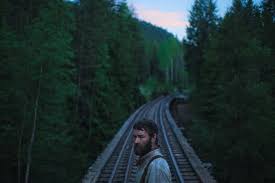
Bentley shot it in the little-used 3:2 aspect ratio, a narrow “boxy” frame meant to remind us of old photographs (but doesn’t) in the images of virgin forests facing the axe, sunsets on the high plains and railroad tracks receding into the woody horizon. Those cinematic picture frames, which are among the film’s great assets, are less than spectacular, majestic and soul-stirring in that chopped frame.

Malick wouldn’t have made that mistake. Nor would Costner, Redford or Campion.

And our lonesome hero’s story is voice-over narrated, seemingly taking every line of description, back-story and narration from the novella and having the actor Will Patton read it for the screen, when in many cases, the image alone — with Joel Edgerton‘s senstive turn as the lead — tells the story and ponders the mysteries the movie never solves, even with that remedial narrative boost.

Malick and many a more confident filmmaker would have eschewed this as the needless, self-conscious writerly crutch that it is. The movie’s mystery is part of its allure, and all that yakking about who is thinking what don’t solve the mystery. So why disturb the peace?

Edgerton plays Robert Grainier, who grew up an orphan to live his entire adult life mostly in Idaho, with railroad crew and lumbering treks as far east as Montana and far west as Spokane.

Grainier is an Idaho introvert who probably never would have met and married the love of his life (Felicity Jones) had she not made the first move.

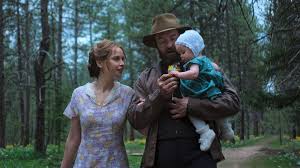
In the years during and after the First World War, they build a cabin on an acre beside a river and have a happy if lean life, raising a little girl out on the edge of the forest.

They have chickens and perhaps a garden. And wife Gladys is handy with a firearm. She’s the hunter of the family. To make ends meet, they need Robert’s income from cutting lumber or clearing land through mountains and gorges for railroad lines.

A litany of tragedies bedeviled Robert’s early life, and when he sees a Chinese railroad laborer publicly murdered by the rail gang for reasons unknown, he has a horror that will stick with him always. Did he do enough beyond complaining “What’s he done?” The narration mentions mass deportations of previous years, as if this will be a big theme of the movie.

It isn’t.

Visions of Fu Shing (Alfred Hsing) stick with Robert, displacing the nightmares about a murdered man (Clifton Collins Jr.) Robert saw bleed out as a child. The random dangers of lumbering work in that pre-OSHA era hang over every day in the woods on the job. Accidents with big saws among big trees are a given.

Among the blowhards, braggarts and silent types Grainier encounters, a colorful old-timer Arn (William H. Macy) stands out. His declining strength limits his usefulness in the actual tree cutting. But he eulogizes the ever retreating forest line and laments the majestic trees, “over 500 years old,” that they’re chopping down as fast as they can get to them.

Arn’s seen things and might give Robert new perspective.

“It’s just beautiful.”

“What is, Arn?”

“All of it. Every bit of it.”

But the script doesn’t let itself sentimentalize nature in some John Muir early environmentalist reverie. It doesn’t address the guilt at the murderous racism Robert witnesses, or the random nature of violence depicted here and the dangerous, destructive work that might be a metaphor of warning.

It just takes us through a hard life, with periods of domestic harmony and the long mourning that accompanies personal tragedy.

We can’t get too attached to anybody or anything, and yet we do. And we suffer when we lose them.

Graingier may believe he’s dogged by tragedy because of some transgression, that he carries every bad thing that he’s been a part of with him to the grave. A lady forest ranger (Kerry Condon) comes as close as anyone to explaining why life goes on after something happens to you.

We’re all “just waiting to see what we’ve been kept here for.”

That’s kind of deep and sort of poetic, which is why it stands out enough to quote. But as somewhat famous faces (Nathaniel Arcand, Paul Schneider, John Diehl, Collins and Condon) pass by and register but serve little to no purpose in the plot, we’re entitled to think we’re entitled to more.

There’s pathos in the deaths that pass us by, but they lack the punch in the gut we feel we deserve and that might somehow change or educate the shocked but silent about it Grainier.

I enjoyed this world, random and sometimes melodramatic tragedies included, and the people who populate it. Macy in particular stands out in the cast, but everybody does justice to their roles, even the ones barely sketched in and here for but a scene or two.

“Train Dreams” feels as if it’s supposed to be bigger than it is — soulful or soul-stirring even. It never gets there. And at some point we have a right to expect more than musing voice-over narration.

“A River Runs Through It” was just as scenic and just as heavily narrated and still had a point. For all its attempted ethereal touches, “Train Dreams” never settles on a track that delivers one.

Rating: PG-13, violence, sex

Cast: Joel Edgerton, Felicity Jones, Nathaniel Arcand, Alfred Hsing, John Diehl, Paul Schneider, Clifton Collins, Jr., Kerry Condon and William H. Macy.

Credits: Directed by Clint Bentley, scripted by Clint Bentley and Greg Kwedar, based on a novella by Denis Johnson. A Netflix release.

Running time: 1:43

Posted in Reviews, previews, profiles and movie news | Tagged , , , , | Comments Off on Netflixable? A Life Lived with Loss and a Search for meaning — “Train Dreams”

Movie Review: An Actor finds the Meaning of His Calling working as “Rental Family”

Just when you think Japanese culture could not seem more strange and exotic, along comes another movie reminder that the “problems” have a different gravitas over there, and the solutions to them can be downright ingenius.

Little shrines decorate the land of “eight million gods.” You hear the care with which Kobe beef is raised and about the little wraps they put on apples to ensure they reach full size on the tree and marvel over the ways an entire civilization has been built around the pursuit of serenity, “balance” and tiny dollops of perfection, perfection which can include Hello Kitty, manga and a perpetual pursuit of “cute.”

I thought I’d sampled the culture at its most serene and oddly empathetic with the Oscar winning “Departures,” a delicate character study that takes a deep dive into the traditions, mores and taboos of the Japanese way of death as seen through their funerary practices.

But it turns out you can rent mourners if you’re worried yours or a loved one’s final rites will be sparsely attended. And that’s not the only thing that falls under the purview of “rental families.” You can rent a friend or celebrants for your wedding.

“Rental Family” is an almost miraculously sensitive movie about the limits of such “services” in a culture where decorum, saving face, protecting feelings, apologies and shame are appreciated for their real value. And it’s about acting and the core of that “calling,” making connections with strangers while playing a part that entertains, flatters or fulfills them on some level.

It stars Brendan Fraser as a bottom-rung thespian, seven years in Japan, still living job-to-job playing brand mascots, extras, and the “token American” in this commercial or that TV episode or movie. When his unseen agent books him for a gig that requires “a black suit,” he changes clothes — no questions asked.

But when he shows up, even though he’s been warned it’s not a conventional “acting” job, he’s rattled by his sudden immersion in not just a funeral, where paid mourners aren’t unheard of. It’s a fake funeral, some oddball’s weird idea about getting a taste of what friends and family really think of him before he’s dead and gone.

Phillip was a late arrival and a garish Gaijin stand-out in the crowd, but a gig’s a gig, right?

And that’s just a playful introduction to this whole serious world of playing a rented friend for a lonely gamer, an American reporter interviewing an aged actor who thinks the world’s forgotten him or an absentee parent who retains him to convince a child her dad’s returned and will sit for the parents’ interview at an exclusive school that frowns upon admitting the children of single moms.

“We sell emotions” is the pitch the actor/owner of the agency, Tada (Takehiro Hira of “Gran Turismo,” the last “Captain America” movie and TV’s “Shogun”) gives him. “We play roles in client’s lives.”

A businessman embezzles from his fellow employees’ pensions and needs a faked mea culpa, filled with self-recriminations, tears and lots of bows? Tada makes it happen. A cheating husband needs a fake paramour to apologize to his wife? That’s right up Aiko’s (Mari Yamamoto of TV’s “Monarch: Legacy of Monsters”) alley.

Kota (Bun Kimura) is the youngest member of the “Rental Family” team, learning to lie on the fly and fake it until he makes it.

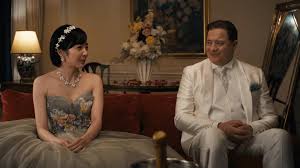
Their new “token American?” Phillip has to pass muster as the fake groom at a much younger woman’s wedding so that she can skip off to Canada to marry her girlfriend.

Fraser, in his first high-profile role since winning the Best Actor Oscar for “The Whale,” takes on the task of playing an actor out of his depth, a sensitive soul who tries to go above and beyond in being considerate of the clients whose vulnerabilities he picks up on.

“I’m messing with people’s lives,” he frets.

Phillip is lonely and vulnerable himself. He’s been on the other side of this equation. He has a regular “date” with the bubbly, hooker-with-a-heart-of-gold Lola (Tamae Andô). Like her, he’s tempted to push the built-in boundaries of such arrangements. Unlike her, he lets it get out of hand.

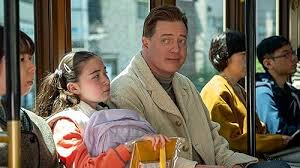
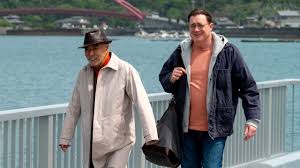
That bright, brittle little bi-racial girl (Shannon Mahina Gorman) whose mother (Shino Shinozaki) has hired him to help get her into a choice school just melts his heart. And that spirited, fading old actor (Akira Emoto, whose credits go back to the ’70s and include a key role in Takeshi Kitano’s take on “Zatoichi: The Blind Swordsman”) would like to escape — if only briefly — from the limited life his daughter (who hired Phillip) has him living in thanks to the onset of dementia.

Fraser lets us see the actor’s pursuit of “truth” crossing over into a fear of “doing harm,” a fear that sometimes sets in after the harm’s been done.

In director and co-writer Hikari’s jewel of a film, Hida plays the voice of Japanese rationalization of this business where they trade on the culture’s ingrained fears of confrontation, public displays of emotion and familial shame.

Yamamato’s Aiko takes the middle ground, impatient with the annoyingly sensitive new token Gaijin, but facing her own epiphany about what they’re doing and what it says about the culture she grew up in.

But Hikari — she did the equally immersive and similarly culturally revealing “37 Seconds” — doesn’t judge and doesn’t take sides in a “which culture ‘gets it'” sense. There are merits and drawbacks to both the Eastern and Western ways of living.

This is probably an exaggerated extension of what “rental families” do. But her artifice is right out in the open — casting a matinee idol as agency owner (Hida), with a succession of gorgeous starlets playing everything from single mom to concerned daughter, fretful, bitchy employee, winsome bride or sex worker.

And in Fraser, Hikari found a “token Gaijin” just hitting his prime in his ’50s, an actor with a “nice guy” image (he’s Canadian) who, like the actor he plays, still dyes his hair but is only just now wrestling with what it is he does, why he does it and the responsibilities that come with that calling.

Rating: PG-13, profanity, sex worker scenes, “thematic elements”

Cast: Brendan Fraser, Takehiro Hida, Mari Yamamoto, Shino Shinozaki, Shannon Mahina Gorman, Tamae Andô, Bun Kimura and
Akira Emoto

Credits: Directed by Hikari, scripted by Hikari and Stephen Blauhut. A Searchlight release.

Running time: 1:43

Posted in Reviews, previews, profiles and movie news | Tagged , , , , , , , , , | 1 Comment

Movie Review — “Wicked: For Good” does Dorothy Wrong

I said at the start that turning “Wicked” the musical into a two-part big screen epic was a mistake. Just how big a mistake is obvious as this bloated beast staggers to the end of the Yellow Brick Road in “Wicked: For Good,” aka “Wicked Part Two.”

Five hours of director Jon M. Chu slow-walking us through Nathan Crowley’s lavish production design colored and given its art deco curves by a whole team of art directors while we’re feasting our eyes on Paul Tazewell’s Oztastic costumes just buries the story.

Any fear anybody might have had that the charming if not the most memorable stage musical “Wicked” would be lost in all this excess is confirmed. And don’t get me started on what all this back engineering and other-point-of-view revisionism does to the classic MGM film, the L. Frank Baum prairie populist novel and poor Dorothy.

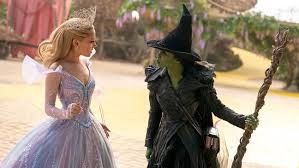
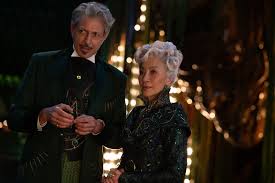
Oz and the Wizard figure they’ve vanquished the young witch in green, Elphaba (Cynthia Erivo) by “branding” her The Wicked Witch of the West. Her sister (Marissa Bode) may still be an Oz insider, “governor” and happily tied to the Munchkin Boq (Ethan Slater). And her bestie, the dizzy and adorably shallow Glinda (Ariana Grande) may pine for her return so that she can sit her down with the Wizard (Jeff Goldblum) and mend fences.

But Elphaba knows the Wizard is a charlatan, a humbugging fraud who is scapegoating minorities (talking animals), restricting freedoms (Munchkin travel) and spying on and imposing his will on everybody else through his soldiers and flying monkeys. She sees the cruelty and vows to fight it, often in song.

Madame Morrible (Michelle Yeoh) has her clutches on Glinda, appealing to the cute fake witch’s vanity to “keep morale up.” And Glinda and her team (Bowen Yang and Bronwyn James) are all in, and all about image.

“We really should look into trademarking the word ‘good!'”

Glinda’s easily distracted, and her stage-managed courtship to the Prince (Jonathan Bailey) named for an infamous Pontiac sports car has an Oz-Themed Wedding in the works.

But with the land brainwashed so that “No one in Oz will be happy until you’re dead,” Elphaba has no choice but to fight.

SOMEbody’s got to conjure up a tornado. SOMEbody’s going to steal someone else’s beau. And SOMEbody’s going to have a house fall on her, turning a pair of shoes into an excuse to skip and march all the way from Kansas, taking the newly-opened Yellow Brick Road to the Emerald City.

Splitting the musical in half puts the weight of “message” and “seriousness” mostly on the second film. The songs are more downbeat, with ballads and laments dominating the score.

All the padding and overstuffed screen time still leaves the shifts in tone and later act introduction of characters abrupt and sloppily handled.

Stretching, stuffing and filling make this film play flatter, as if all the fun is gone. The jokes are few and far between, and they die of loneliness in the wait.

There were allegories about the farm economy, “the gold standard” and the city vs. farm country schism of the 19th century in the original novel. The revisionist musical made inclusion, acceptance and kindness its message. And now the films take another tack, resisting authoritarian cruelty, corruption and a blathering liar/leader who would divide us with his lies and lead us to ruin.

“The truth is just what a lot of people agree on,” the Wizard purrs. And the people, starting with Glinda, buy that “truth.”

The Wizard’s “so wonderful it’s a part of his name now!”

The sparkling comic pixie Grande and the serious and seriously talented Erivo don’t get to take us by surprise a second time, any more than the bigger and bigger spectacle of it all is any more impressive than the first time we saw it, one two hour and forty-five minute movie before this one.

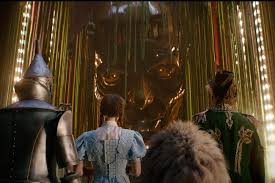
The Tin Man isn’t just heartless, he’s bitter and vengeful. The Lion (Colman Domingo) is determined to blame the wrong person for his gutlessness. Dorothy?

“That mulish farm girl” is how Madame Morrible describes her.

Waiting around for all the characters you remember from the 1939 movie to make their entrance after that twister and tumbling house, vividly recreated by a state of the arts effects team, becomes cold comfort for the viewer.

We’re not just following the Yellow Brick Road. “Wicked: For Good” makes us feel like we’re laying the bricks like a Munchkin road crew, with no end in sight.

Rating: PG

Cast: Cynthia Erivo, Ariana Grande, Jonathan Bailey, Marissa Bode, Ethan Slater, Bowen Yang, Michelle Yeoh and Jeff Goldblum, with the voice of Colman Domingo.

Credits: Directed by Jon M. Chu, scripted by Winnie Holzman and Dana Fox, based on the musical by Stephen Schwartz and Winnie Holzman which was based on a novel by Gregory Maguire that was based on characters created by L. Frank Baum. A Universal release.

Running time: 2:18

Posted in Reviews, previews, profiles and movie news | Tagged , , , , | Comments Off on Movie Review — “Wicked: For Good” does Dorothy Wrong

Movie Review: “Sisu: Road to Revenge” takes a Wrong Turn or Three

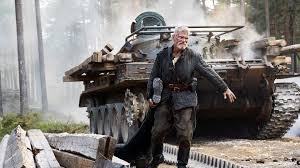
I am an audience of one at a late afternoon “preview” matinee of “Sisu 2,” aka “Sisu: Road to Revenge,” the sequel to the savage sleeper hit by Finnish carnage Jalmari Helander.

Do the locals know something I don’t? Or are the good folks in “The Last Capital of the Confederacy” showing their red ball cap displeasure at a movie about mowing down Russians by staying home?

I’m guessing it’s the fact that Screen Gems’ marketing didn’t spend enough to move the needle even a centimeter that dampened enthusiasm, as nobody knows about it.

That’s no big deal, because this sequel is inferior in pretty much every way to the original “Sisu,” which came out of nowhere back in 2023 and which takes its title from a Finnish word that more of less means unfettered rage. It’s not on a par with Helander’s “Rare Exports” Santa-horror splatter film either. He’s due for a misstep. Here it is.

“Road to Revenge” brings back our non-speaking, unstoppable and unkillable Finnish commando Korpi (Jorma Tommila), this time out to haul the pieces to his house across the Russian border after the end of World War II.

When your anti-hero is “unstoppable” and “unkillable,” that lowers the stakes. A lot.

Throw in feeble pacing and thus no urgency to its story of driving, shooting, stabbing and missle-launching his way through legions of belligerant Russians, fresh from their triumph in “The Great Patriotic War,” and you’ve got a thriller whose only creative bits are random moments of Russian-mutilating and murdering.

Remember, the vodka/borscht-folk and their dictator sided with the Nazis at the beginning of WWII, only to F-around and find out you can never trust a Nazi. And the Russians further earned their history’s bad-guys status by invading Finland at the start of the war, and paying dearly for their miscalculation, at least for a time.

The Soviet Russians annexed Finnish territory at war’s end, and that’s where Korpi lived. So he’s got his passport and his battered, oversized military truck and he’s aiming to move the logs of his old homestead, where his family was slaughtered, to a new location across the new border.

Ivan doesn’t want him to get away with it.

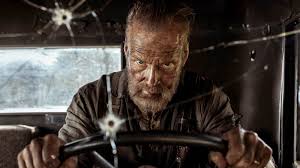
The stages of his quest are broken into superfluous “chapters” like “Old Enemies,” “Motor Mayhem:” and “Incoming.” The dialogue, almost all of it by a Russian tormentor (Stephen Lang) who commanded the troops who failed to finish off the Finn in the first film, is every bit as pointless.

“Unleash Hell,” like they haven’t already. “Keep your eyes open,” the most worthless command cliche of them all. And “Look at me,” served up as if he isn’t looking at you.

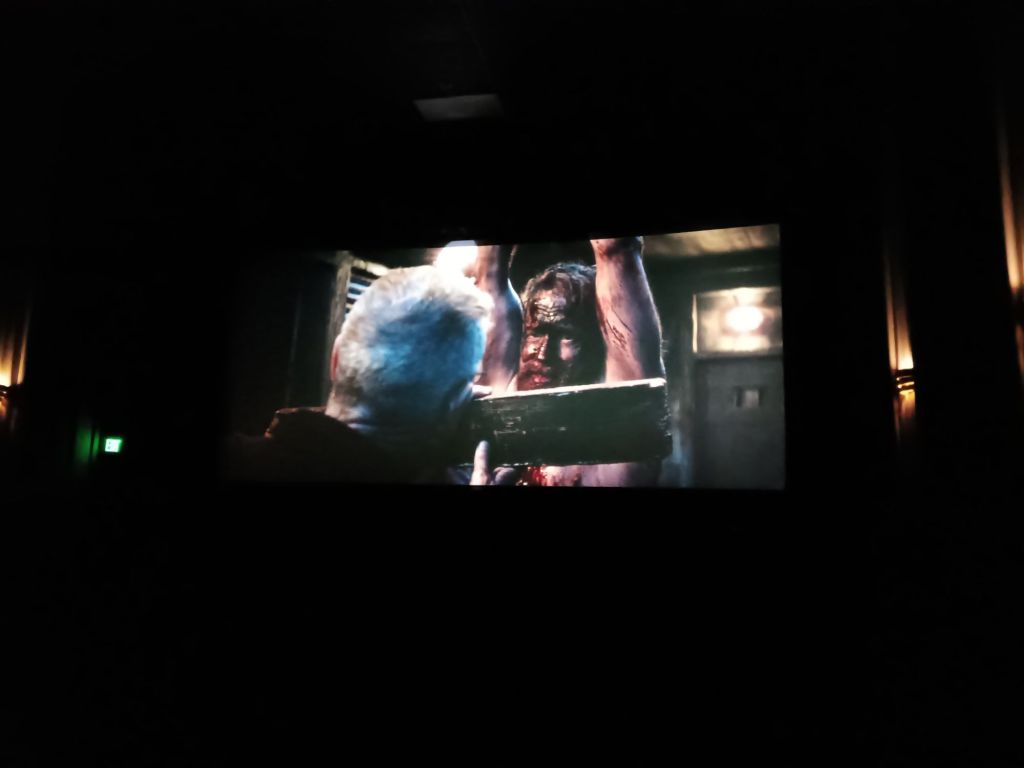
Duels against armored commandos on motorcycles (!?), airborne fighter bombers and the like ensue. Our hero takes another licking and keeps on ticking. The Russians? Let the body count commence, Comrades!

I laughed at a few of the more audacious butcherings, but that was early on. The narrative settles into a slog in the middle acts and no pull-out-the-stops train ride finale could drag it out of the mud.

Rating: R, graphic violence, pretty much start to finish, profanity

Cast: Jorma Tommila, Richard Brake and Stephen Lang.

Credits: Scripted and directed by Jalmari Helander. A Screen Gems release.

Running time: 1:29

Posted in Reviews, previews, profiles and movie news | Tagged , , , , | Comments Off on Movie Review: “Sisu: Road to Revenge” takes a Wrong Turn or Three

Movie Marathon Thursday, “Wicked for Good,” “Rental Family” and “Sisu 2: Finno-Russian Boogaloo”

Erivo, Arianna and Goldblum again, Brendan F speaking Japanese and Stephen Lang as a Russian trying to kill an unkillable Finn. Again.

A few more songs, some curious corners of Japanese culture and dead Russians by the dozen.

A pretty good Thursday, one would hope.

At least the second half of a musical blown up to five hours is only  2:17 long, half an hour shorter than the bore that became a blockbuster.

Posted in Reviews, previews, profiles and movie news | Comments Off on Movie Marathon Thursday, “Wicked for Good,” “Rental Family” and “Sisu 2: Finno-Russian Boogaloo”

Movie Review: A New Yorker widowed by a Police Shooting seeks Justice in “Aftershock: The Nicole P. Bell Story”

An infamous police shooting leads to trials and a search for justice that doesn’t end in a courtroom in “Aftershock” The Nicole P. Bell Story.” It’s a sturdy, often moving fil built aroud Rayven Symone Ferrell’s affecting performance in the title role.

Years before Trayvon Martin, over a decade before George Floyd, Michael Brown and others, before “Black Lives Matter” became a national movement thanks to rampant, consequence-free police violence against Black men, a young man was killed in a hail of police gunfire in Queens, New York.

Sean Bell was 23, out celebrating with friends the night before his wedding when unidentified undercover officers emptied their weapons into him and the car he was driving friends home from a night club. Some of New York’s finest even reloaded their pistols and emptied them again.

There were child seats in the car, and fellow celebrants. But there were no guns and no warrants, just a cascading series of errors exposing ignored police “protocols” and alcohol impaired deicision making by officers whose shoot-first-rationalize-later defense was “I feared for my life.”

“Aftershock” takes us through the all-too-familiar “demonize the victim” news cycle as it was experienced by the woman Bell was set to marry, the mother of his two little girls. The film humanizes the victim and points its damning finger at a system more interested in protecting unionized police behaving badly than in keeping the peace and delivering justice.

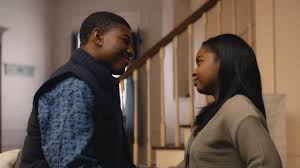
We meet Nicole Paultre as a sixteen year-old whose crush on tall high school baseball star, Sean (Bentley Green) is requited, it turns out. She gushes, they chat, and when he asks her out, her sister notices her antic primping.

“Why’re you getting all cute?”

“My future husband,” Nicole declares!

Six years later, they’ve got a little girl and another newly born. It’s November of 2006, and Sean — catnip to the ladies, it is implied — is being cagey about something. Is he coming home late because he’s cheating? Nope. He’s been secretly planning their wedding.

But when Nicole’s small bridal shower breaks up, she gets alarming news. Something’s happened. Sean’s in the hospital.

“Afterschock” vividly recreates the indignities and outrages of this wee hours dash to the hospital. Nurses are evasive. The surgeon who’s “been working on Sean” is told not to talk to her. The cop who insists he can fill her in takes her name, hears the phrase “wife” and spits out “You mean ‘wife’ or wifey?'”

The police are “managing” this tragedy and circling the wagons. The only thing the medical establishment wants to establish is whether or not Sean’s an organ “donor.” That’s before anybody will admit Sean’s dead, much less the circumstances of his death. Nicole seeing his body is out of the question.

It’s only when Rev. Al Sharpton (Richard Lawson) expresses his condolences that Nicole sees a way to fight a “system” that is steamrolling her and the surviving victims thanks to police leaks, police spin and a court system setting the table for a “fix.”

Lawson, a veteran character actor whose credits go back to the original “Poltergeist” and Walter Hill’s underworld musical “Streets of Fire,” gives us an eye-opening rethinking of “Reverend Al,” already a public figure and TV fixture when these events happened.

This is a Reverend Al who promises to help “make sure nothing is covered up” and that the “people responsible are held accountable.” He will help arrange a lawyer (William DePaolo), give advice and arrange an appearance on “Larry King Live” to help her get the true innocent young man “shot down on his wedding night” in “a hail of bullets” story out there.

The only hint of the self-caricatured, attention-hungry opportunist Rev. Al that Sharpton has allowed to be his image is when he notes the importance of this case — “the biggest thing since Amadou Diallo.

Ferrell, of “The Hate You Give” and “Through Her Eyes,” ably gets across Nicole transforming into the woman she needs to be, finding her voice to speak out before the eventual trial of the officers involved, and beyond. It’s a somber, sober-minded performance, showing us a young mom growing into someone not to be underestimated.

Director and co-writer Alesia Glidewell’s film started life as a planned web TV series, according to the Internet Movie Database, which has been Glidewell’s medium of choice. So the production values are good, but not major-studio-feature polished. The same is true of the casting, which has a few standouts (Richard T. Jones as the attorney defending the cops) among the parade of lesser-known talents given roles.

The narrative changes points of view a couple of times — we see the police getting their stories straight, protesting their innocence, with a commanding officer or two seemingly recognizing the right-and-wrong of the situation. Will they treat their fellow officers accordingly?

You don’t have to remember how this case played out and its place within the “Black Lives Matter” prehistory to be both outraged and moved by the story told here, and unsettled by the fear that “not much has changed” since.

This is indie cinema with a point and a point of view, and Glidewell, Ferrell and the cast deserve to have this engrossing and worthhile drama be a career highlight that should lead to others.

Rating: R, violence, some profanity

Cast: Rayven Symone Ferrell, Bentley Green, Richard Lawson, Richard T Jones, William DePaolo, Byron Kenneth Brown Jr. and Kevin Jackson

Credits: Directed by Alesia Glidewell, scripted by Alesia Glidewell and Cas Sigers-Beedle. A Faith Media release.

Running time: 1:48

Posted in Reviews, previews, profiles and movie news | Tagged , , , , , , , , , , | Comments Off on Movie Review: A New Yorker widowed by a Police Shooting seeks Justice in “Aftershock: The Nicole P. Bell Story”