


There are many good excuses for a film buff to not “get around to” the Powell & Pressburger production, “The Life and Death of Colonel Blimp.”
It’s almost three hours long, is famous for its sentimentality and cinematic patience in getting round to those sentiments.
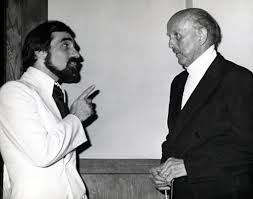
But the new David Hinton documentary “Made in England,” basically a filmed Martin Scorsese Master Class on why the films of Michael Powell and Emeric Pressburger stood out in their day and still matter now, talked me into at long last getting around to the one WWII Powell and Pressburger film I’d missed, all of them made as the war was raging.
“Blimp” is a mostly soundstage-bound Technicolor spectacle, offering Britons a few hours of escape just after The Blitz, just as the war in Europe was turning into an Allied offensive that would eventually crush if not exterminate fascism.
Inspired by a satiric newspaper comic strip character, a walrus-mustached old fart whose reactionary politics and out of date military acumen were the subject of fun, “Blimp” was a movie Powell and Pressburger made over the objections of much of official Britain at the time, especially Prime Minister Winston Churchill.
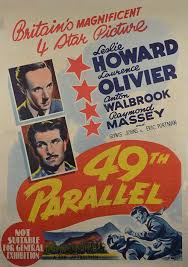
But the object of “The 49th Parallel,” “One of Our Aircraft is Missing,” “A Canterbury Tale,” “
“A Matter of Life and Death” and “Blimp” was to remind Britain and the world of what “we” were fighting for. Nothing unpatriotic about that.
The debates between “Colonel Blimp” and his pre-war friend, dueling foe and German officer Theo Kretschmar-Schuldorff are about the dangers of militarism tied to political fanaticism — cult leader politicians goading the public with race-baiting nationalism, the masses rationalizing “any (murderous) means necessary” to achieve their efforts to dominate and rule. So yes, this 80+ year old saga has something to say to modern audiences.
The story, which has little to do with the comic, is framed in an embarrassing Colonel Blimp debacle.
An eager beaver Army officer (James McKechnie) uses his romantic connection to a female Army driver (Deborah Kerr) to start a war games assault on London six hours early.
It’s to be an Army attack with the WWII “home army,” recruited and armed militiamen — many of them older veterans — relied upon as a last line of defense in the event of an invasion. The war games are intended to simulate “the real thing,” but have a set start time.
“The war starts at midnight!”
Violating that rule allows this officer to storm into a London Turkish baths and seize the elderly officers in charge of the Home Guard, including “Blimp” plump Brigadier Clive “Sugar” Wynne-Candy.
A naked “Blimp” (Roger Livesey) bellows through his mustache at the “impudent” junior officer and drags him into the bathwater for a senior citizen thrashing.
“D’ye KNOW how many WARS I’ve been in?”
That sets up the flashback where we meet the young “Sugar” or “Suggie” Candy, a junior officer fresh out of South Africa’s Boer Wars, 40 years earlier. He’s won the Victoria’s Cross. And acting on his own newspaper-interview notoriety and a friend’s tip from a letter “niece’s governess’s sister,” a governess in Germany, he sets off for a place where “they HATE us” thanks to anti-British German propaganda ginned up by a spy who worked both-sides of that colonial conflict.
One in the Kaiser’s Germany, Candy meets the governess (Kerr, again), and sets out to trip up and taunt Kaunitz the spy (David Ward) in a very public restaurant. And the next thing he and the VERY disapproving local embassy know, he’s been challenged to a duel. He insulted the entire German Army, and German officers of “honor” won’t stand for it. They wear their sabre-cut dueling scars with pride in their increasingly militaristic imperial state.
A draw of lots pits Candy vs. Teutonic Theo Kretschmar-Schuldorff (Anton Walbrook) through an elaborately explained, protocol-governed duel by “the rules.” And as the two convalesce from their wounds, they become lifelong friends.
That friendship is tested by World War I, and Kretschmar-Schuldorff’s blind patriotism, even in defeat, and by the coming of World War II, by which time one old man has become wise to the threats of military dictatorships even if another still regards war as something of a sport, where “right makes might” when the other side is constantly cheating, killing civilians, introducing poisonous gas and sinking unarmed merchant ships.
Continue reading


















 Movie Nation