Classic Film Review: You can’t “Fiddle dee dee” away The Great Depression — “Dinner at Eight” (1933)

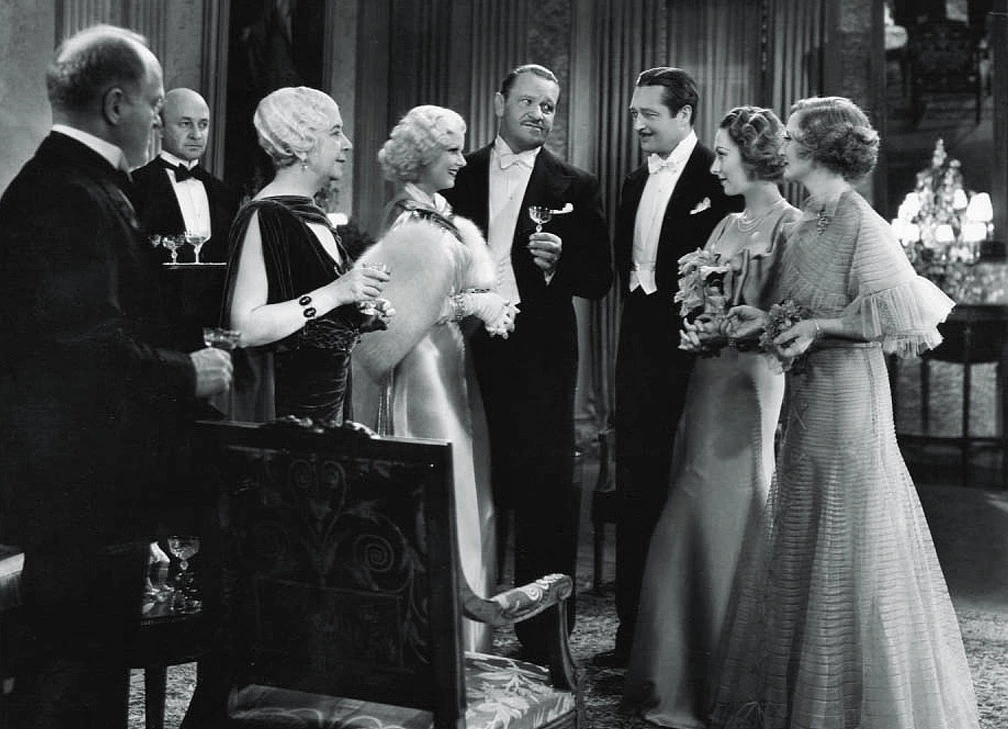
“Dinner at Eight” (1933) is a fascinating snapshot of a moment in time.

An early “talkie,” a mid-Great Depression adaptation of a then still fresh and edgy Broadway dramedy, we can look at this ancient George Cukor film and appreciate the topicality, the wit and the many cinematic shortcomings evident in it, stylistic traditions that would fall by the wayside as Hollywood sprinted towards its Golden Age.

It’s stodgy and stagey, a movie burdened by the limitations of sound gear and the dull, lock-the-camera-down technique that inspired. But the dialogue is pre-“Screwball” quick and funny . Well, at times.

It’s “Pre Production Code,” a movie made just as Hollywood was about to morally police its pictures lest governments and censorious church organizations take that job for themselves.

That makes this a showcase for sex symbol Jean Harlow at her peak, a scantily clad “bombshell” who could be hilarious as a dizzy blonde, or a blonde not as dizzy as you might think.

It was the pentultimate film of stage and Oscar-winning screen comedienne Marie Dressler.

No less than two Barrymores, John Barrymore and Lionel Barrymore, would grace the screen.

And through them, and the machinations of a George S. Kaufman/Edna Ferber comical melodrama, we see the seas about to change in the theater and in acting, and in the genre that come to define Depression Era Hollwood — the Screwball Comedy.

It’s 1933, and business is bad, but the well-traveled are still the well-traveled, keeping up appearances.

Oliver Jordan (Lionel Barrymore), owner to the hundred-year-old Jordan (shipping) Line is having to keep ships in port for lack of exports. But dithering, chirping wife Millicent (Billie Burke) all atwitter at the social coup she’s managed, wrangling a couple of wealthy members of the visiting British aristocracy for a dinner party.

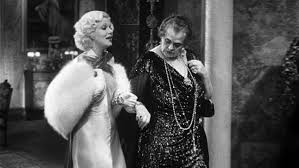
She buzzes about the staff and plants invitations with an old family friend, the ancient, well-traveled and well-connected actress Carlotta Vance (Dressler), their society doctor (Edmund Lowe) and his wife (Karen Morley), with the Jordans’ daughter Paul (Madge Evans) and her just-back-from-a-Grand-Tour fiance (Philip Holmes).

As her husband needs business from the rough, new-money Montana tycoon Max Packard (Wallace Beery), he’s invited, along with the gauche lower class young beauty (Harlow) he’s married to.

“You’re joking! Ask that common little woman to my house and that noisy, vulgar man? He smells Oklahoma!”

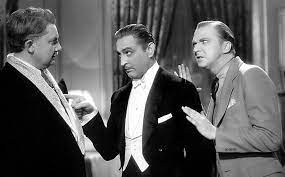
A late addition? Another actor, struggling, aging matinee idol Larry Renault (John “The Profile” Barrymore).

The twists in all this are that Oliver is deathly ill and is reluctant to tell his family. His doctor (Lowe) is carring on an affair with the platinum blonde Kitty Packard (Harlow). Her cutthroat husband is planning on buying The Jordan Line out from under Oliver behind his back.

Oliver’s daughter Paula is having an affair with the actor Renault, who is a hopeless drunk whose big stage show may not come together for him after all.

And “everybody’s broke,” bitching about the social requirements that translate to the great expense of keeping houses in New York, Florida, the Riviera, London and the like.

Dressler gives us a taste of the grande comedienne of the stage she was and how that translated to screen presence, best appreciated in silent comedies with Chaplin and Marion Davies. But she had a late career talkie revival in popularity that won her an Oscar and put her back in demand. She gives us moments of subtlety and broad gestures straight out of 19th century melodrama — a lot of facial mugging that had her over-made-up eyebrows bouncing along to a performance that had little to do with the dialogue coming out of her mouth.

“I belong to the Delmonico period. A table at the window, looking out on Fifth Avenue. Boxes with flowers in. Pink lampshades. String orchestra. And, I don’t know, yes, yes, willow blooms. Inverness capes. Dry champagne. And snow on the ground.”

Burke, aka Mrs. Florenz Zeigfeld, reminds us why her turn as Glenda the Good Witch in “The Wizard of Oz” made her high-pitched, upper class chirp one of the era-defining voices on the screen. Every time she opens her mouth it’s worth a giggle.

Lionel Barrymore was a few years from taking the turn toward the grumpy old men character roles (“It’s a Wonderful Life,” “Key Largo”) that we remember him for.

His brother Barrymore, a great Edwardian actor and great drunk great at playing a drunk, registers. Beery is all bluster, self-importance and the threat of violence as Packard.

But Harlow just pops, and not just because of Cukor’s gooey, gauzy soft-focus closeups. She’s got a louche look, a sexually self-confident air and a sass that she turns on the minute her lout of a husband gives her cause, such as suggesting Roosevelt might put him in the cabinet in Washington.

“Nertz! You’re not going to drag me down to that graveyard. I seen their pictures in the papers, those girlies. A lot of sour-faced frumps with last year’s clothes on. Pinning medals on girl scouts and pouring tea for the DARs and rolling Easter eggs on the White House lawn.”

The film’s theatricality, built out of a series of intimate, serio-comic scenes, and some of its dialogue date it firmly in the “before talking picture cameras moved” and “before dialogue got snappy” era. It’s static, and its turns towards the melodramatic are daring only in that the coming Production Code would frown upon alcoholism, infidelity, suicide, bare-backed bra-lessness and dialogue leaning towards “son of a…”

But it’s a classic of its type and its era, a fine moment-in-time look at the theater in the fourth year of the Depression, the first year under Roosevelt and the cinema just as it was about to get a lot quicker, punchier and wittier.

“You know, my skin’s terribly delicate and I don’t dare expose it.”

Rating: TV-PG, today, pre-code in 1933

Cast: Lionel Barrymore, Billie Burke, Jean Harlowe, Wallace Beery, Marie Dressler, Edmund Lowe, Jean Herscholt, Lee Tracy and John Barrymore

Credits: Directed by George Cukor, scripted by Frances Marion and Herman J. Mankiewicz, based on the play by George. S. Kaufman and Edna Ferber. An MGM release.

Running time: 1:51
Posted in Reviews, previews, profiles and movie news | Comments Off on Classic Film Review: You can’t “Fiddle dee dee” away The Great Depression — “Dinner at Eight” (1933)

A Classic Film is restored, along with its Trailer, for a re-release — “The Story of G.I. Joe”

World War II movies made during the war were rarely as bluff and blunt as this Robert Mitchum, Burgess Meredith star vehicle.

William Wellman’s film celebrated the infantryman’s champion, celebrated journalist Ernie Pyle. Meredith plays the Scripps New Service grunts-eye-view reporter, covering the liberation of Italy. Mitchum, in his first role of real stature, plays the lieutenant Pyle deals with on what would turn out to be his last assignment.

“G.I. Joe” has been restored for a late June re-issue by Ignite, and they even found the damaged and almost lost nitrate trailer for the film and restored that, too.

Interesting suggestion of what a “wolf” might be seen as today, in terms of a lecherous soldier in a foreign land.

Posted in Reviews, previews, profiles and movie news | Comments Off on A Classic Film is restored, along with its Trailer, for a re-release — “The Story of G.I. Joe”

Movie Preview: Old West Horror on a Budget — “Thine Ears Shall Bleed”

Nicely evocative of the period, a little promise in the set up.

Good looking trailer, Great Title.

Posted in Reviews, previews, profiles and movie news | Comments Off on Movie Preview: Old West Horror on a Budget — “Thine Ears Shall Bleed”

Movie Review: Who Needs Louise? “Thelma” has this caper comedy well in hand

Write a good script. Keep costs low by focusing on characters, situations and witty dialogue, not effects, lots of settings and stunts. Look for a world to show us that the movies don’t often visit.

With a little luck, good actors will come to you and your indie film is as good as made.

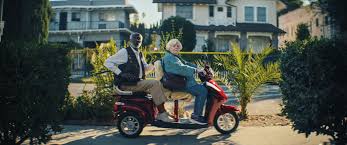
“Thelma” is an indie comedy that proves a lot of the truisms of “How to make your debut feature film.” The most adorable “action” pic of the summer is a senior citizen’s caper comedy that’s novel enough and clever enough that the fact that it also has something to say is merely the cherry on top of the cinematic sundae.

The further it putters along, maintaining forward-motion at senior citizen speed, the cuter and more surprising it becomes, and the more we understand why Oscar nominee June Squibb and five other “names” signed on, why the money to make it came together and why its headed to a theater near you.

We’re all going to get old. We’re all going to be victimized, probably online. And we all want our revenge.

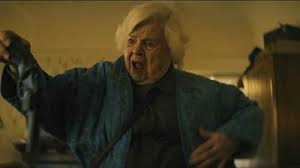
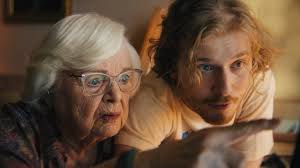
Squibb has the title role, an LA 90something who has been widowed a couple of years and is still keeping her apartment. She’s active and mobile enough, even if she can’t drive. But her world has shrunk. Her peers have mostly passed on.

She has that habit of the extremely elderly, blurting “I think I KNOW her!” about most every person of advanced years she sees. That always starts a conversation, almost always with someone it turns out she doesn’t know.

“If I fall, I’m lost,” she knows, passing on that mantra of everyone’s dotage. “It’s why I don’t fall.”

She seems savvy enough with her iPhone, but needs doting grandson Danny (Fred Hechinger of “News of the World”) to help her get her laptop going and email operating. That’s probably how she’s exposed to the scam.

“Danny” calls, in a rush. Says he’s been in an accident, he’s in jail and a lawyer’s about to call. The “lawyer” calls, demands $10,000, gives her an address and the bum’s rush and hangs up.

And with Danny, his mom (Parker Posey) and Dad (Clark Gregg) not answering their phones — only seniors answer calls from strangers these days — next thing we know, she’s raided her cash-stashes around the house, stuffed it into an envelope, addressed it and waddled down to the post office.

Oh well. At least she’s OK, they tell her. “Nothing you can do at this point,” they say to her face.

“These things happen to people her age,” they say behind her back, but within earshot.

With the police yawning about her crime, her family just relieved she’s safe and no peers she can call for help, Thelma takes inspiration from the action star of a movie her grandson just watched with her. Like Tom Cruise, she’ll do her “own stunts.”

First-time feature writer-director Josh Margolin sets up problems, builds comical (and serious) suspense in, and foreshadows solutions. No car? That widower whose calls she doesn’t return mentions his new “scooter.” Ben is in a nursing home, lonely, and realistic.

“We’re old. Diminished. A liability to the ones we love.”

It’s not like Thelma’s enlisting his help. Getting Ben’s scooter is merely another obstacle on her quest.
But Ben is played by the late Richard Roundtree, in a fitting and fun final performance. That’s an accomplice well worth enlisting.

“Thelma” has our heroine visit an old friend who’s become a shut-in, and stumble into more than one “I think I KNOW her!” The indignities of great age, outliving your peers, coping with an ever-changing world via a shorter and shorter attention span and helplessness in climate where preying on the elderly is tolerated are commented on with resignation and wit.

“How can Zuck-uh-Berg let this happen?”

The narrative grinds almost to a halt in the middle acts, and there are head-scratching lapses in logic that hang over many a twist.

But Posey’s presence turns the family-squabbles about “Mom/Gran dma’s MISSING!” into ’80s indie kvetch-offs and the running gags pile on and everything — EVERYthing — we see coming we see coming for an amusingly excruitiatng long time.

Roundtree introduces pathos and gravitas to the proceedings. And a little muscle. Hechinger sparkles as a hapless, directionless and indulged 24-year-old racked by guilt, but the guy who gives granny the most credit for being able to get what she wants.

And Squibb holds it all together as a nurturing (smothering) mom turned doting granny, but transformed into a stubborn old cuss, simply by being preyed upon the way many of her peers are.

Her revenge is their revenge and their revenge is played out, at walker-scooter speed, to our delight in this winning, against-the-grain codger caper comedy.

Rating: PG-13, gunplay, profanity

Cast: June Squibb, Richard Roundtree, Fred Hechinger, Parker Posey, Clark Gregg and Malcolm McDowell.

Credits: Scripted and directed by Josh Margolin. A Magnolia Pictures release.

Running time: 1:38

Posted in Reviews, previews, profiles and movie news | Comments Off on Movie Review: Who Needs Louise? “Thelma” has this caper comedy well in hand

Movie Preview: Guy Pearce is thrust into the middle of Maori  Wars in pre colonial New Zealand — “The Convert”

The first important and well known Maori filmmaker, Lee Tamahori (“Once Were Warriors”)  gives us this period piece about an outsider, a preacher, out of his depth in an alien land which Europe is set on conquering and colonizing.

Pearce, a quixotic figure in the acting world, listening to his own drummer, seems the perfect choice to play a conflicted Man of Peace, a mere mortal among Maori warrior tribes.

July 12, we find if both actor and director recapture some of their former glory.

Posted in Reviews, previews, profiles and movie news | Comments Off on Movie Preview: Guy Pearce is thrust into the middle of Maori  Wars in pre colonial New Zealand — “The Convert”

Movie Review: An Animated dip into Puberty, “Inside Out 2”

Pixar’s “Inside Out” was an Oscar-winning “return to form” for the pioneering CGI animation house back in 2015, a film that found heart in attempting to visualize the emotions that guide us through childhood and make us the adults we become.

And while there are changes in the cast and changes in directors for the sequel, “Inside Out 2,” there’s no change in direction of emphasis.

It’s even more about sentiment and emotions, finding, embracing and exposing our shared humanity as we experience “Joy,” “Sadness,” Anger” and now “Anxiety,” “Envy” and oh “Ennui.” And it’s about finding ways to send those emotions up that will resonate with most any adult watching it, and perhaps amuse and inform kids young enough to let their classmates know they’re still into “cartoons.”

Laughs are few and far between here, but a movie about the emotional RED ALERT that heralds puberty is bound to produce a few.

And a film about the age when your core values start to solidify who you are, the tests that come when friendships are pulled-apart and the emotional roller-coaster that could be in animated form ensure it’ll produce a tear or two. Or three.

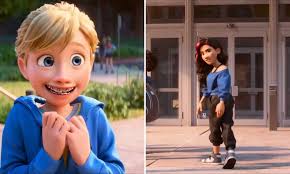
Our little gal Riley, expressively-animated in all the shades of teen angst, with Kensington Tallman’s perfectly pitched to that, has just turned 13. The “simple” emotions — Sadness (Phyllis Smith of “The Office”), Fear (Tony Hale of “Veep”), Anger (stand-up comic Lewis Black), and lead-“childhood” emotion Joy (Amy Poehler) might not be enough to get her through high school.

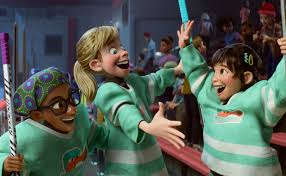
They don’t figure this out until running up against what Riley feels as she’s peaking as a tween hockey player, thrilled and confident winning The Big Game with her Middle School besties, but suddenly getting the attention of older teens she’d love to impress on the high school squad, and their coach (Yvette Nicole Brown).

Mom (Diane Lane) and Dad (Kyle MacLachlan) might be proud. But Riley’s mood changes, crying jags, sarcastic eye rolls and snappishness tell those “old” emotions that there are new players in town.

Enter Anxiety (Maya Hawke), Embarassment (Paul Walter Hauser) and too-cool-for-all-this Ennui (Adèle Exarchopoulos). With high school star Valentina (Lilimar) and Riley’s possible high school Firehawks teammates to hang with at summer hockey camp, Anxiety figures she has the answers.

Out with the old friends, middle school ways, tastes and tried and true emotions. Before the ebbulient, impuslive Joy can blurt “Jiminy mother-loving toaster strudel!” Anxiety has taken control, exiled Joy and her team and put Riley on a path that might alter which memories she leans on that make up her core beliefs, changing who she is and how she thinks of herself.

Joy & Co. figure this coup cannot stand.

The visual genius of “Inside Out” and the similar “Soul” was in the animated ways the screenwriters and the animators visualize memories as tiny orbs, either kept where they can form a musical string that makes up Riley’s character, or pushed to “the back of the mind,” with the least helpful memories buried and best forgetten.

The old emotions must travel the Stream of Conciousness, cross the Sar-Chasm, transit Imagination Land, dodge The Rumor Mill, take part in the Parade of Future Careers and the like on their quest.

As suspense builds, with Riley facing tests of character with competing emotions pulling her in fraught “entire future depends on it” directions, we see the “Inside” struggle in her head and heart, and the ways Riley, “Out” there, acts on this psychic tug-of-war.

The best gags here might be a send-up of Riley’s former favorite singing educational kiddie TV character (goofily voiced by Ron Funches), a riff on “Blue’s Clues” and “Dora the Explorer,” and the flawed and embarassed about it but still haplessly “selfless” video game character (Young Yea) Riley used to crush on.

The lack of humor is felt.

I felt a bit let down by the indistinct voice-casting. Losing Bill Hader and Mindy Kaling takes a bit of edge off the soundtrack, and Hawke, given the plum part of Anxiety, is competent but colorless voicing the role. Ayo Edebiri doesn’t give us enough “Envy” to stand out, nor does Exarchopoulos take Ennui over the top, where she’d register as funny.

That’s the one give-away that writer turned diretor Kelsey Mann is making her feature debut. The voice performances don’t pop. Even Poehler seems a tad winded playing Miss Upbeat All the Time, Joy. That’s the director’s job, to get line-readings that sing.

Some of that can be traced to a script which treats the hunt for sentiment and emotional resonance on an equal level with cute ways of visualizing mental processes, and forgets the laughs.

But most of these “entertainment value” quibbles can be attributed to the original film that spawned it. That means a perfectly fine film suffers just enough when set side-by-side with the modern classic “Inside Out” to be worth mentioning.

Coming in second to one of Pixar’s very best is nothing to, you know, get all emotional about.

Rating: PG

Cast: The voices of Amy Poehler, Lewis Black, Maya Hawke, Liza Lapira, Kensington Tallman, Tony Hale, Ayo Edebiri, Lilimar, Phyllis Smith, Yvette Nicole Brown, Kyle MacLachlan and Diane Lane.

Credits: Directed by Kelsey Mann, scripted by Meg LeFauve and Dave Holstein. A Disney/Pixar release.

Running time: 1:36

Posted in Reviews, previews, profiles and movie news | Comments Off on Movie Review: An Animated dip into Puberty, “Inside Out 2”

Movie Preview: Damon and Casey Affleck are “The Instigators” in Apple’s new caper comedy

Ving Rhames as a cop, Ron Perlman as the mayor of beantown, with Alfred Molina, Michael Stuhlbarg, Jack Harlow and Paul Walter Hauser.  

Two desperate guys too old to be leading “a criminal conspiracy” like this, one of them in therapy (Hong Chau goes deadpan), try to rob a mayoral fundraiser.

Did I mention Ron Perlman’s the mayor?

Aug. 9 on Apple TV+.

Posted in Reviews, previews, profiles and movie news | Comments Off on Movie Preview: Damon and Casey Affleck are “The Instigators” in Apple’s new caper comedy

Movie Preview: Erana James is one of the New Zealand misfit girls exiled to an island “reformatory” — “We Were Dangerous”

This 1950s period piece looks chilling, heartbreaking and uplifting.

I can’t easily find any reference to the history this film may be remembering. Maori reform school? Something broader that took in “problem” girls from any race and class? And “cured” them?

Release dates in North America TBD.

Posted in Reviews, previews, profiles and movie news | Comments Off on Movie Preview: Erana James is one of the New Zealand misfit girls exiled to an island “reformatory” — “We Were Dangerous”

Movie Preview: Netflix goes anime for its Imaginary Friend Fantasy — “The Imaginary”

Everybody has the same idea, cinematically, all at once.

“IF” and “Harold and the Purple Crayon,” and “Imaginary” and now a Netflix anime story about an imaginary…Roger?

Do tell? Looks lovely. Kid friendly. And possibly insipid.

July 7.

Posted in Reviews, previews, profiles and movie news | Comments Off on Movie Preview: Netflix goes anime for its Imaginary Friend Fantasy — “The Imaginary”

Movie Review: Discovering gender, sculpture and “20,000 Species of Bees” in Basque Country

The debut feature of Spanish filmmaker Estibaliz Urresola Solaguren is an evocative immersion in a place, avocations of that place, in family and trying to figure out how one fits in all that.

“20,000 Species of Bees” grabs you on several levels, starting with the arresting Basque Country locations. We pick up the rituals of beekeepers, but also explore how one of the fruits of the hive — beeswax — is vital in casting bronze sculptures.

It’s a traditional world, with a very Catholic martiarch, widow of a locally famous sculptor, and the return of her daughter with her three kids. Ave and her brood show up on the eve of St. John the Baptist’s Day, celebrated with a festival and bonfire, allowing them to take a vacation from a struggling marriage and lifestyle just across the border in France.

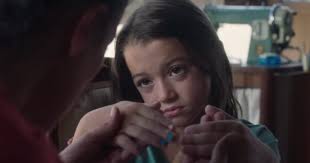
Whatever else is going on in their lives — husband Gorka is skipping this visit — it is their youngest, Aitor, who seems clingiest and neediest. Aitor prefers to be called “Coco.” Aitor likes having his nails painted, playing dressup and waring his hair long.

Aitor acts-out and is indulged, frets and is comforted, and asks questions — of his slightly older brother Eneko, sister Nerea, and when he’s with them, older family members. And for Aitor, or Coco, answers are always forthcoming.

“Will I be like Dad when I grow up?” (in Spanish with English subtitles). “What’s faith?” “Did you always know you were a boy?”

Aitor is eight years old.

Let’s steer clear of the label “coming of age story” for this sympathetic drama about adults bending over backwards to accomodate what we tend to label what children go through at that age — “phases.”

“He’s eight,” more than one adult shrugs.

Even in this corner of Basque country, there’s tolerance — with limits.

“20,000 Species of Bees” is about a family forcing itself to listen to a kid and a child struggling to find the words and blundering about in confusion and the schisms this causes within the family.

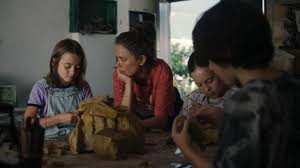
Mother Ane (Patricia López Arnaiz) isn’t hearing the relatives gripe about what’s OK “back home” in France. As supportive as she is, she is distracted, with three kids, an absent husband, a possible teaching job in Bayonne. She relishes the chance to dive into her late father’s workshop to see if she still has the skills and the talent to land that job.

And then what?

“Are you separated,” her mother (Ane Gabarain) wants to know?

Grandmother Lourdes sees the kid’s “girlish” hair and affectations and ponders ways to get Catholicism involved. But Aunt Lita (Itziar Lazkano), granny’s sister, is more worried that Coco’s parents haven’t taken the time to “see” the kid and hear the child out. If Aitor/Coco is asking questions of siblings, insisting on using the women’s toilet and dressing room at the pool with Mom and other little girls, Ane needs to shed some distractions.

Bits of the beekeeper’s work, rituals and traditions meet sculpture casting basics in this sublime drama. But “20,000 Species of Bees” lives on its performancs, and the open-faced/open-hearted turn by little Sofia Otero closes the sale.

It’s a childish, unaffected portrait of impulse, shame and anger. A child gets labeled, and wants to correct that label. But to what? At eight, who would know?

Aitor’s reluctant to wholly embrace the gender-neutral name Coco, with his parents shrugging off every bit of acting-out, accepting their indulgence as a way of getting everyone to school/the train/etc. on time.

That’s how lip service is paid to the push-back in a lot of cultures about the seeming explosion in trans identifying children. But “20,000 Species” has somebody from many points of view for the viewer to identify with.

There is no “media” or pop culture “pressure” behind Aitor’s confusion. Aitor takes it on “faith,”
in his heart, that something’s not connecting him to the sex he was born with.

Arnaiz stands out as the mother, and there’s great contrast between grandma and great aunt — one obsessed with finding a stolen statue of St. John, a prank that precedes their festival some years, and baptisms, the other hearing the kid and seeing the seeing Coco and wondering how blunt she has to be with Ane to get her to do the same.

Even on the remote edge of the Pyrnees, what much of the world recognizes as “gender fluidity” on a sexuality spectrum, their people grew up as knowing that there’s more than one species of bee.

Rating: unrated, adult themes

Cast: Sofía Otero, Patricia López Arnaiz,
Ane Gabarain, Itziar Lazkano, Unax Hayden and
Andere Garabieta

Credits: Scripted and directed by Estibaliz Urresola Solaguren. A Film Movement release.

Running time: 2:08

Posted in Reviews, previews, profiles and movie news | Comments Off on Movie Review: Discovering gender, sculpture and “20,000 Species of Bees” in Basque Country