
There’s a “just go with it” madness that is demanded of anyone who dives into the glorious — some will say wretched — excesses of “In the Hand of Dante.”
A romantic thriller contrived out of history, great “lost” literature and the great creators who write it, it’s a “Da Vinci Code” mystery with “In the Name of the Rose” thrills tucked into an epic length mob movie.
Naturally, there are Italian mobsters. Unnaturally, Jason Momoa plays one and the great Martin Scorsese is cast as a 14th century Jewish intellectual who speaks of the meaning of love and life and who helps finance the art of Durante di Alighiero degli Alighieri;,known to history as Dante Alighieri, the greatest writer in Italian history and a beacon who lit the way for the literary age that became The Renaissance.
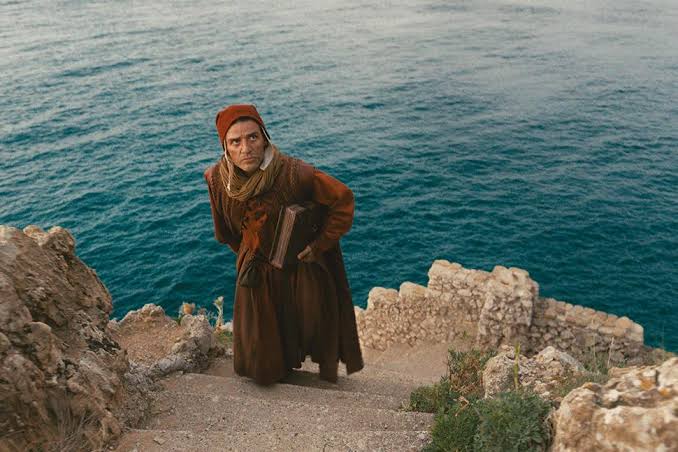
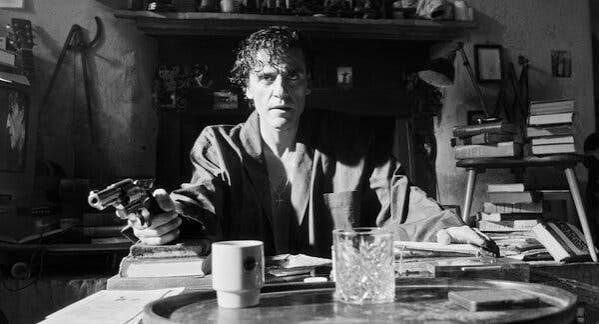

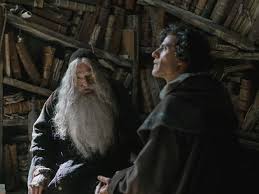
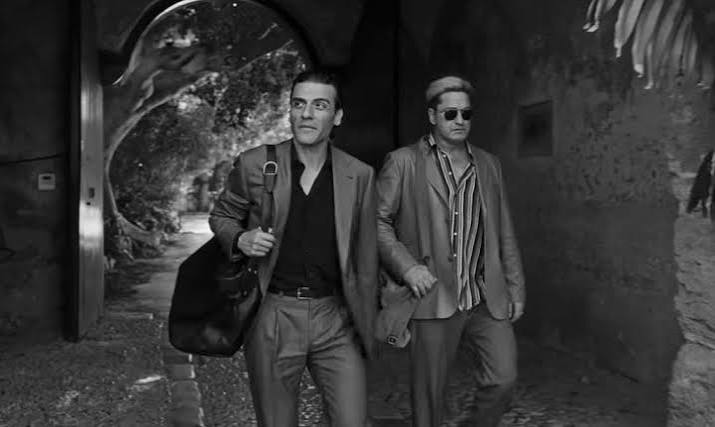
It’s based on a novel by journalist and biographer Nick Tosches, who fictionalized an egomaniacal version of himself as protagonist, a rough-and-tumble writer involved in mob efforts to murderously procure the copy text of Dante’s epic poem, “The Divine Comedy,” written in Dante’s own hand, and as Dante himself, struggling to create and survive Florentine politics and papal disapproval in 1300s Italy.
Any way you look at “In the Hand of Dante,” it’s a LOT.
Al Pacino has a lone scene as a made-man uncle who counsels Nick in his early teens after the boy confesses to killing a kid his age. Gerard Butler plays a inhuman hit man sent to “clean up” any loose ends in the procurement of this priceless manuscript, and a megalomanic 14th century pope (Boniface VIII?). Gal Gadot is both Dante’s wife, Gemma, the woman the poet never wrote about as “The Divine Comedy” was inspired by his longing for a long dead childhood crush, and Nick’s Italian secretary/assistant and new love. Franco Nero and John Malkovich play mobsters, Dennis Hopper’s daughter plays a daughter Nick never knew he had.
And Oscar Isaac is Nick, a man of reason but with a past that gives him the edge a writer needs to traffic in this deadly company, and he is Dante, a Medieval writer caught up in the turmoil of his times, neglectful of his faithful wife if not his genius.
The film is messy, sprawling, with many settings and timelines, and is paying the price for the overreach with poor reviews.
But what can I tell you? It spoke to me.
I’ve interviewed the painter turned filmmaker Julian Schnabel a few times over the years. And I could not imagine a more hilariously arrogant egomaniac outside of a comic book. He is supervillain larger than life and convinced of his greatness, and that I can’t begin to tell you how delightful it is to engage or attempt to engage a creative person like that in conversation. Just getting on his wavelenght is invigorating.
So Netflix giving the director of “Basquiat,” “Before Night Falls,” “The Diving Bell and the Butterfly” and the even more indulgent “Miral” and “At Eternity’s Gate” the money and latitude to make this isn’t their dumbest move.
Isaac’s Nick is a blunt, verbose writer with delusions of his own hardboiled grandeur, ready to chew out any editor with “My books can’t be edited any more than a leopard can be given a manicure!” He’s quick to suggest his greatness and wealth will only be achieved “posthumously,” after he’s dead and gone.
The real Tosches died at 69, and has come to be lionized by the hip set, including Schnabel and Johnny Depp. The fictional Tosches plays hardball with editors and publishers. That hardscrabble Italian-American upbringing — and his love of Dante — is why mobster Joe Black (Malkovich) summons him.
Black relates a long, colorfully-detailed anecdote about this long lost manuscript discovered by a mob-installed functionary at the Vatican. Nick is sent to Italy to meet the aged priest and the mobster (Nero) who now possess the first hand-written copy of “The Divine Comedy,” among other pages.
Mob enforcer Lou (Butler), who insults Black’s prized Rembrandt self-portrait in the same words that Nick does, will come along and kill anybody who keeps the manuscript from them and basically anybody who learns about it.
Nick is trapped in a quest to “authenticate” what he and Lou procure, with assorted Italian archivists and librarians paying the price for his “consulting” with them.
He’s got a new assistant, Giuletta (Gadot), on board to help him get flights, move money and the like. In their past lives, he is Dante and she is Gemma, the great love who made Dante’s life make sense.
The two main timelines are 2001 and the early 14th century, with Nick learning the science of carbon-14 dating and the properties of ancient velum paper stocks as the clock ticks down towards 9-11, and Dante threatened and evicted for his “republican” politics by a power-drunk pope (Butler).
“I place the mark of Cain upon thee!”
Momoa plays a towering, white-suited (and hatted) mobster connected with the gangsters Lou has killed. Benjamin Clémentine is a mysterious Italian underworld figure who goes by “Mephistopheles.” And Scorsese is a Jewish sage who ponders matters temporal, racial and metaphysical with our poet.
“The Arab is the new Jew.”
And most everybody quotes poetry off the cuff, reaching for “a wisp of a memory that can’t be caught.”
“Tempus fugit,” “time flies” according to more than one character, then and in the fictive “now.” But does it?
Schnabel indulges in color cinematography in depicting the distant past, black and white footage to capture the ’70s and 2000s. A lot of lush, baroque villas, public and academic Italian and European spaces are thus drained of the distracting shades of generations of painters. Extreme closeups and swirling pans abound as we bounce through time and chase Nick on his quest and on the lam through Italy, Paris and Tunisia.
The violence is jolting, even when it’s expected. The novel-turned-screenplay’s indulgences stand out — an unnecessary bit of 1920s Sicilian mob history, Dante’s sea journey/test to grasp the infinite and Schnabel finding an excuse to throw Scorsese’s favorite band, The Rolling Stones, onto the soundtrack.
Netflix has indulged filmmakers like Scorsese, Cuaron and Fincher. Why not Schnabel?
Through all this messiness, Isaac is our grounding anchor, mastering the self-absorption of the artists, then and “now,” showing off his mastery of Italian, convincing as a guy just acquainted enough with this world to realize the stakes and attempt to scheme his way out of this fix.
Gadot doesn’t give us much to grab hold of, but it’s fun seeing Butler, Scorese (his later scenes are better than his early ones) and even Malkovich used in this way in these roles.
Even harder to follow scenes wash over you if you’re able to get yourself into that historic/poetic frame of mind. And it’s easy to see what all these talented people grasped in this story to make them want to help Schnabel tell it.
“You look at anything long enough, you see what’s wrong with it,” Nick muses about his love-then-“like” of Dante’s masterpiece. That won’t be the case with “In the Hand of Dante.” Its “issues” are often obvious.
But the result is unlike any movie you’ll see and listen to this summer, a grand overeach with indulgences that will make you grimace even as they give you access to the fertile creative mind of poets, painters, actors and a filmmaker who gets it even if he sometimes struggles to help us get it with him.

Rating: R, graphicviolence, sexual situations, profanity
Cast: Oscar Isaac, Gal Gadot, Gerard Butler, Jason Momoa, Sabrina Impacciatore, Martin Scorsese, Franco Nero, Benjamin Clémentine, John Malkovich and Al Pacino.
Credits: Directed by Julian Schnabel, scripted by Louise Kugelberg and Julian Schnabel, based on a novel by Nick Tosches. A Netflix release.
Running time: 2:30


 Movie Nation