Movie Review: Rough Sex turns Deadly when there’s a “Strange Darling” involved

It’s a reflex reaction.

You see an actress “putting it all out there” for a role — skin, simulated sex, violence and drug abuse. You remember how Hollywood burns through starlets, uses and misuses young actresses until many are “used up,” most often long before having a shot at becoming a Leading Lady.

And you think of the film’s premiere or that first time that young woman’s parents see the film and fret over what they must think of her choices, this often unsavory, reflexively sexist “business” that their precious child has gotten into.

Then you see a movie like “Strange Darling,” with Willa Fitzgerald talking the kinky talk and sprinting, bloodied, out of a motel room into the broad light of day in nothing more than her unmentionables, and you have to say, as a parent or in words of reassurance to the parents — “That’s a gamble that was totally worth it.”

Most of Fitzgerald’s “breaks” up to now have been on episodic TV — “Scream: The Series,” “Reacher,””The Fall of the House of Usher.” I remember the name from if not her supporting performance from “The Goldfinch” and “Desperation Road,” a recent Mel Gibson thriller which, as everyone knows, isn’t going to warrant a gold star on any resume.

If she’s going to make it happen, a big showy part in an edgy, nervy thriller like “Strange Darling” is a safer bet than it looks.

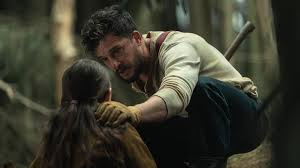
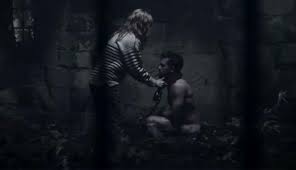
It’s an “unsafe sex” play thriller about a hook-up gone wrong, a motel encounter involving choking, handcuffs, “safe words” and worse. And writer-director JT Mollner, telling this “true” story in “six chapters,” shown out of order, is all about twists, the dark and darker turns, the shocking violence and the upended expectations.

Kyle Gallner of “Smile” is the unnamed hook-up, a stereotype with the mustache, pick-em-up truck with beer in the back and a gun under the seat.

“The Lady” seems to figure he fits the profile, and not just a voting “weirdo” one.

“Are you a serial killer?”

Pretty, sexy in a magenta wig, boots and prone to a lot of eye contact, she’s well-read on “the kind of risks a woman like me takes to have a little fun.”

Recreational sex with a stranger is on both their minds. But she’s out to lay down her concerns and set up some ground rules.

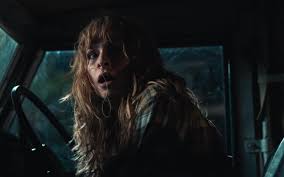
As the film opens with her, in red scrubs and red boots, blonde hair mussed and weepy and running for her life, we can guess that somebody didn’t respect the “safe word.”

The “chapters” jump about as we meet a couple of “old hippies” (Barbara Hershey and Ed Begley Jr.) whose help she seeks, and learn how she came to be chased down a deserted Oregon road by a stereotype in a pick-up with her trapped in a “’78 Ford Pinto.”

“Seriously?”

Mollner is unsparing in the torture and violence and unblinking in the gender politics he puts in play. And Fitzgerald and Gallner just flat out bring it — the suspicions, the sketchy boundaries crossed, the role reversals, the blood that tells us things have gotten out of hand.

I didn’t love everything about this. Scenes have characters lose the logic of the moment and do the one stupid thing that would put them in the most jeopardy — repeatedly.

And a long opening title crawl tries to convince us this is a “true story” for some reason is READ in voice-over for the benefit of the reading-impaired (apparently) by Jason Patric.

But writer-director Mollner (“Outlaws & Angels”) doesn’t take many other missteps, and actor-turned-cinematographer Giovanni Ribisi (he has a cameo here) keeps his lens close even as he’s and his crew are sprinting ahead of the gasping Fitzgerald in hand-held chases.

It matters that the story’s told out of order. It’s great that they landed Hershey and Begley for small but chewy supporting roles. And Fitzgerald’s gamble on her most daring, naked (not quite literally) performance pays off in what could be her break-out role, even if she had a bit of explaining to do to mom and dad when the credits rolled.

Rating: R, graphic violence, drug abuse, sexual situations, profanity

Cast: Willa Fitzgerald, Kyle Gallner, Barbara Hershey and Ed Begley Jr.

Credits: Scripted and directed by JT Mollner. A Miramax release.

Running time: 1:36

Posted in Reviews, previews, profiles and movie news | Comments Off on Movie Review: Rough Sex turns Deadly when there’s a “Strange Darling” involved

Movie Review: Abbie Cornish is “Detained,” but by Cops?

“Detained” is a bloody-minded thriller of “The Usual Suspects” variety. There’s a crime scene with a lot of bodies, and somebody is going to need to explain how they got there, preferably in a series of long flashbacks.

That’s the aim, anyway. But think of this Felipe Mucci (“Two Deaths of Henry Baker”) film, with limited sets and a fixed number of characters, as a play — a play that needed further workshopping.

Abbie Cornish stars in a woman who wakes up in police custody. She blacked out, the cops (Moon Bloodgood, Laz Alonzo) tell her. Somebody’s blood is on her car bumper. She can claim the bar pick-up she met (John Patrick Amedori) “roofied” her, but bad cop/worse cop aren’t buying it, even if they’re up to hearing it.

“Why don’t you walk me through it?”

She’s a woman of means, so she wants a lawyer. But who IS this green kid (Justin H, Min) who shows, unbidden, up in a suit with a briefcase?

What’s the deal with this “precinct,” the fresh paint she touched in the bathroom, the dangerous, unsupervised drunk tank with the deranged “Sully” (Silas Weir Mitchell)?

And that opening “crime scene” aftermath?

Actually, that unnecessary opening simply establishes how clumsy the structure of this script is. The film’s true beginning that is “flashback,” with Rebecca Kamen trying to figure out how she got here, what’s going on and what cards she has to play in this mouse and two-cats interrogation.

Cornish plays our “heroine” as puzzled but cagey, wary and curious. “How did I get here?” is just the first question.

When her besty (Breeda Wool) shows up, she takes a hasty bite of what looks like a Nestle’s CRUNCH Bar. Sarah then covers the letters on the wrapping as a warning to Rebecca.

“RUN.”

That’s clever.

And there’s enough going on here to hold one’s interest…up to a point. The ensemble is believable enough in their respective roles and the violence ranges from depressing to jolting to furious.

It’s the “what’s going on here” that becomes too convoluted to invest in, killing the pacing and robbing the suspense of any sense of urgency. The escalations and rising violence and body count utterly botch any sense of mystery about each “usual suspect,” and that shred of promise Cornish & Co. give the picture in her opening moments is lost.

Rating: unrated, graphic violence

Cast: Abbie Cornish, Laz Alonzo, Moon Bloodgood, Justin H. Min, Breeda Wool, Silas Weir Mitchell, John Patrick Amedori and Josefine Lindegaard

Credits: Directed by Felipe Mucci, scripted by Felipe Mucci and Jeremy Palmer. A Quiver release.

Running time: 1:37

Posted in Reviews, previews, profiles and movie news | Comments Off on Movie Review: Abbie Cornish is “Detained,” but by Cops?

Movie Review: Byrne is Beckett, Grappling with Guilt, Remembering to “Dance First”

The full title of “Dance First” includes the phrase “A Life of Samuel Beckett.” They left out the word “abridged.”

Because while one simply could not do better than have the great Irish actor Gabriel Byrne playing Beckett as a reluctant Nobel laureate, wracked by guilt and having a film-long debate with an alter ego about what to do with “the prize money” from that unwanted honor, it was never going to be easy to fit all that Beckett was, with generous samples of his work, into a 100 minute movie.

The Irish playwright, novelist, poet and short story writer was one the most celebrated and influencial authors of the 20th century. Beckett spent most of his working life in Paris, and composed many of his most famous works first in French, which is how the world first encountered Vladimir and Estragon, Pozzo and the unlucky Lucky, standing around talking, “Waiting for Godot.”

In the film that British director James Marsh (“The Theory of Everything”) and Scottish TV writer Neil Forsyth conjure up, Beckett is basically reduced to that guilt as he considers the women in his life, and men, that he figures he let down over the years.

While that reductivism seems a valid, servicable approach and provides the frame to the black and white flashbacks of Beckett’s brooding past, it proves a bit of a slog as the script serves up few highs and lows, almost no “work in progress” scenes or “Eureka!” moments. It’s as sentimental as a “Maestro,” but lacks the spark, the thrills of more entertaining biopics.

I’d blame some of that on Beckett himself. When the BBC editor Barbara (Maxine Peake of “The Theory of Everything”) who falls for him gushes over “Waiting for Godot,” she calls it a masterpiece and then states the obvious.

“But nothing happens.”

“Nothing happens twice,” the wily absurdist Beckett corrects her.

Aside from the time a Paris pimp stabbed him in the chest, a brief interlude in which the not-yet-famous Irish expat joins the French Resistance during World War II and a few testy exchanges over the autobiographical nature of his work with the women in his life protesting their treatment in the fiction, that goes for the film as well. Not a lot happens. And what does happen is treated too matter-of-factly to be of great dramatic interest.

Beckett hears his name called out in Oslo at the December, 1969 Nobel Prize ceremony, and turns to his (secret) wife and longtime collaborator and “companion” Suzanne (Sandrine Bonnaire) and mutters “What a catastrophe” (in French). He stomps up on stage, snatches the award and then climbs the lighting rig in the wings, leaving the theater. He emerges in what looks like a decomissioned salt mine, the perfect empty space/wasteland for Samuel Beckett to debate himself (Byrne x 2) over what this means.

He and his alter ego decide that the only way to make amends for this “undeserved” glory is to consider what to do with the cash, and rehash all the people the imperious, brilliant Beckett wronged over the course of his life — starting with his demanding, hated mother (Lisa Dwyer Hoff, brittle, bitter and toxic) — and how he might somehow “honor” or “repay” them with the money.

With her and his more-doting dad (Barry O’Connor) raising him in the privilege of private school and kite-flying reveries, May Beckett simply cannot understand or countenance the portrait she sees of herself in his earliest fiction.

“You could only imagine it as you because the whole world is you,” young Beckett (Fionn O’Shea) hisses back, drawing blood.

After graduating from Trinity College in Dublin, Beckett moved to Paris and sought out James Joyce as a mentor. “Game of Thrones” and “Peaky Blinders” alumnus Aiden Gillen plays Joyce as a 1930s burnout, still famous for “Ulyssees,” but no longer “that James Joyce.”

The script gives Gillen an edge to play in his world wearinness, setting the tone for their connection when he dismisses the fanboy’s first approach.

“I’m deep in THOUGHT.”

Beckett eventually befriends Joyce, and we meet the second source of his lifelong guilt. Joyce and his wife (the great Bronagh Gallagher) allow him to stay for dinner, to hang around and rudely pick the great writer’s brain while ignoring the women of the house only so long as Beckett takes their mercurial, impulsive “mad” daughter Lucia (Gráinne Good, terrific) out dancing.

Beckett cannot let that go any further, and Joyce cannot commit his daughter because once they’ve done that, she can’t come back and “Where else can she go?”

Joyce still had “Finnegan’s Wake” in his future, but he pushes Beckett to either write the truth, challenge himself and the literary status quo, or settle for a lifetime of pondering “consideration”great works, rather than actually writing them. “Stay there, it’s safe there.” And when it comes to translating Joyce’s works, he and his wife have their revenge on Beckett when he undertakes that.

Paris is where Beckett met the smart and beautiful Suzanne (Léonie Lojkine), who could see greatness in the young man, if he has the right “companion.” They live in Occupied Paris, flee when their Resistance cell is blown, and survive.

“Dance First” spends little to no time in the creative fervor that drove Beckett’s writing after the war, suggesting guilt over a murdered comrade was the impulse to write “Godot,” “Krapp’s Last Tape” and “Endgame,” revolutionizing the theater, fitting a trio of novels and made-for-BBC radio dramas in between these landmark plays.

We glimpse only one show — “Play” (1962) — which features its three characters acting with their heads sticking out of gigantic urns.

The relationship dramas of his life, with the long-suffering Suzanne the only one canny enough to insist he keep composing his works in French so that they could be paid twice “for the translation,” and BBC Barbara (Bray) is both the classic “other woman” soap opera and key to his rising reputation because Bray was sleeping with him while also reviewing his works for various British media.

There is a lot more to Beckett than this melodramatic side of his life, and Marsh and Forsyth’s chief blunder is in showing us so little by way of introduction to why he’s still the exemplar of theatrical minimalism, a key figure in the Theatre of the Absurd, why her merits having bridge shaped like an Irish harp named for him in Dublin, and a whole class of Irish patrol boats (named for the first vessel in its class) as well.

Those with little acquaintance with his novels, poems, plays or film won’t have that “Why Beckett matters?” question answered. And those who do are sure to find this meditation frustrating in its lack of explanation and celebration.

Byrne is “right” and quite good at showing us the artist reluctant to accept the late-life accolades. O’Shea gets across the conflicted, emotionally stunted egoist consumed by his art and Gillen auditions for a Great Joyce biopic to come.

But Byrne will only get one crack at Beckett, and it isn’t great. With Joyce, as well as Beckett, we’re unlikely to ever get more than one film telling that life story. “Dance First” isn’t exactly bad. It’s just too narrow in focus, too incomplete, a biopic that leaves us “waiting” for an elusive, mythic “author” to truly make his entrance.

Rating: unrated, adult themes

Cast: Gabriel Byrne, Sandrine Bonnaire, Aiden Gillen, Bronagh Gallagher, Gráinne Good, Lisa Dwyer Hoff, Maxine Peak and Finn O’Shea.

Credits: Directed by James Marsh, scripted by Neil Forsyth, based on the . A Magnolia release.

Running time: 1:40

Posted in Reviews, previews, profiles and movie news | Comments Off on Movie Review: Byrne is Beckett, Grappling with Guilt, Remembering to “Dance First”

Movie Preview: Aisling Bea is widowed — “And Mrs.”

It’s not what you think. OK, maybe it is.

Awkward funeral? Check. Weird sister in law? Oh yeah.

Billie Lourd also stars in this, with Colin Hanks as the bloke who makes our heroine a “Corpse Bride.”

August 19? We’ll keep an eye out.

Posted in Reviews, previews, profiles and movie news | Comments Off on Movie Preview: Aisling Bea is widowed — “And Mrs.”

Classic Film Review: Beatty and Christie in an Altmanesque Old West — “McCabe and Mrs. Miller” (1971)

Scenes rarely play like “scenes” in the films of Robert Altman. They don’t so much begin, reach their point, and end. The dialogue is cluttered, non-stop, layered in around the leads. “Important” lines from the characters the story is about melt into the conversations going on all around them, some punchy and funny, some inane.

It’s like lives — a world — the viewer drops in on, eavesdropping or even invited into by the human comedy — sometimes tragic — unfolding in front of you.

Altman brought “Altmanesque” to the Western with “McCabe and Mrs. Miller,” a scruffy, gorgeous star driven drama about a gambler and entrepreneur (Warren Beatty) who meets a prostitute (Julie Christie) who introduces herself life this.

“I’m a whore, and I know a LOT about whorehouses.”

“McCabe and Mrs. Miller” was a big studio star vehicle with a stunning Pacific Northwest setting (Squamish, British Columbia was the filming location). Altman had spent a little of his “M*A*S*H” capital in Hollywood on the wildly eccentric “Brewster McCloud.” He tried to play Hollywood’s game with films like “McCabe,” the later Elliott Gould/Raymond Chandler mystery noir “The Long Goodbye” and the gambling buddy dramedy “California Split.”

The set is almost as detailed, wooden and “lived-in” as “Popeye’s” Sweethaven, which came later. The wintry location shooting, with themes and images borrowed by such later films as “The Claim” and” The Hateful Eight,” would provide a backdrop for a tale a of man trying to live “up” to his reputation and a British prostitute trying to get her piece of the American Dream before she aged out of that chance.

But being an Altman film, the obvious isn’t “obvious” and the chiaroscuro of the crowded images and “world” we’re immersed in is what’s paramount in this Warner Brothers box office bomb.

Beatty’s McCabe rides into newborn village Presbyterian Church — named for the structure they’re building, a symbol of “civilization” — as a man with a bearskin coat, a bowler hat and a reputation.

The proprieter of the bare-bones-minumum saloon (Rene Auberjonois) thinks he knows the man’s name, and his reputation, that he killed a fellow a while back. McCabe does nothing to deny this, insists he only be called by his last name, and rolls out a tattered red duck table cloth to invite the locals to play poker.

An Altmaneseque touch — we don’t see McCabe win, clean out the locals and finance everything to follow via his skills at five card stud. He loses. A lot.

But next thing we know, he’s secured land, planned a saloon and brothel and traveled back down the trail to Bear Claw to procure prostitutes, the saddest and most ill-used hookers in the West.

It isn’t until Mrs. Miller rolls up on him, asks him to feed her and lays out her “hygiene” and long-term plan (to make enough money to buy a San Francisco boarding house for her declining years) that everything starts to pay off for McCabe.

Mrs. Miller makes him build a bathouse, makes patrons of their brothel — which he also builds — visit and pay to bathe before they’re allowed to be near the new “San Francisco” sex workers she brings in, and McCabe almost doesn’t care that his saloon and gambling parlor takes a back seat.

McCabe kind of, sort of, goes sweet on Mrs. Miller, who indulges that ardour — for a price. Mrs. Miller has a secret. So does McCabe, we figure.

When McCabe is challenged to sell out his property to a bloody-minded mining concern (Michael Murphy represents them), we start to wonder if he’s as tough as his bluff, foul-mouthed bravado makes out.

“If a frog had wings, he wouldn’t bump his ass so much, follow me?”

Continue reading
Posted in Reviews, previews, profiles and movie news | Comments Off on Classic Film Review: Beatty and Christie in an Altmanesque Old West — “McCabe and Mrs. Miller” (1971)

Movie Preview: A waitress in a remote diner — trapped? “Last Straw”

Maybe Jessica Belkin is a victim to be. Or maybe those coming for her crossed the wrong waitress.

Sept. 20.

Posted in Reviews, previews, profiles and movie news | Comments Off on Movie Preview: A waitress in a remote diner — trapped? “Last Straw”

Netfixable? In a Mexican Hostage Situation, some points are “Non-Negotiable”

Say this for the Mexican action comedy “Non-Negotiable.” They pack a lot of characters, plot and “twists” into 86 minutes.

An almost jaunty, populist action comedy about a presidential kidnapping, scandal, petty corruption with a whiff of police incompetence built around a hostage negotiator in a troubled marriage trying to free his therapist wife — also held hostage with El Presidente — director John Taratuto’s got his hands full just trying to make the four-writers-screenplay make sense.

Taratuto, who gave the world “I Married a Dumbass” a few years back, misses as often as he hits in that regard, even if he and his cast get the tone, the messaging and the subtext right.

Mauricio Ochmann, from the vast supporting cast of the long-running Mexican TV series “El Señor de los Cielos,” stars as Alan Bender, an adrenalin junky who loves coming in and saving the day as a police hostage negotiator.

He loves it so much he’s neglecting his psychiatrist wife (Tato Alexander) and undercutting her practice with his showboating.

Alan’s way of getting out of his promise to give up “field work” so that he can be more help to her and their daughter is to make a guy with a stutter (Itza Sodi) the protege he’s training to replace him. The joke there is Menendez will never work out in a job where your ability to talk fast and lie faster to plead criminals into giving up their hostages is paramount.

Alan even takes a call in the middle of couple’s counseling. But hell’s bells, it’s a “Code Pig” (in Spanish, subtitled, or dubbed into English).

That means the country’s cowboy-hat populist president Araiza (Enoc Leaño) has been grabbed. Turns out the populist has a congresslady on the side, and that’s how the tinkerer with a grudge, Vicente (Leonardo Ortizgris) trapped him and her and tied them up in bomb vests.

Alan is late to the scene, which all involved try to keep hush-hush. The competent SWAT commander in charage (Claudette Maille) figures she has the situation well in hand — squad deployed, cameras everywhere tapped into.

“Why can’t I see the drone video?” “Lt. Vasquez borrowed it to record his son’s birthday.”

Another twist to the hostage scenerio is that Victoria, Alan’s wife, and the personal trainer (Gonzalo Vega Jr.) she may be having an affair with are also being held, as the kidnapper has an agenda, a plan and a grudge — perhaps against Alan.

The script’s subtext is that “corruption” and fake “populist” rich dude politicians are the reason none of Mexico’s insoluable problems ever get solved. How far will the kidnapper go to get his revenge, and what political ramifications will that have?

Because the government cannot let this blackmail come off, cannot let this “get out” and has all these assetts in place to ensure that. Well, except for the drone.

As for the results, some sequences play, some are novel and some are tried and trite cliches. The picture’s opening pre-kidnapping scenes are hard to follow, and the story reaches a climax, an ending, and then struggles to go on. More obvious and contrived populist points must be scored. Apparently.

Still, it’s not a bad effort one and all and quite a bit more high-minded than “I Married a Dumbass.”

Rating: TV-14, violence, sexual discussions

Cast: Mauricio Ochmann, Tato Alexander, Leonardo Ortizgris, Enoc Leaño, Itza Sodi, and Claudette Maille.

Credits: Directed by Juan Taratuto, scripted by Julietta Steinberg, Joe Rendón, Daniel Cuparo and Marcelo Birmaj. A Netflix release.

Running time: 1:26

Posted in Reviews, previews, profiles and movie news | Comments Off on Netfixable? In a Mexican Hostage Situation, some points are “Non-Negotiable”

Documentary Preview: “The Life and Deaths of Christopher Lee”

This premieres at London’s Frightfest in August, and doesn’t appear to have distribution…yet.

But considering the filmmakers eager to appear on camera to sing his praises, that could happen.

He was apparently a deadly spy, a definitive Dracula, Bond villain and “Lord of the Rings” heavy, a multilingual actor for some 60 years, and occasional singer. Will this film get to it all, or just scratch the surface?

Posted in Reviews, previews, profiles and movie news | Comments Off on Documentary Preview: “The Life and Deaths of Christopher Lee”

Movie Preview: Falco and Rappaport, “I’ll Be Right There”

Edie Falco plays the hovering/mothering type in this comedy with Bradley Whitford, Michael Rapaport, Jeanie Berlin, Charlie Tahan, Kayli Carter, Michael Beach and ex-Congressman/ex-“Love Boater” Fred Grandy.

This just came off the film fest circuit, so look for it to sneak into release any minute now.

Posted in Reviews, previews, profiles and movie news | Comments Off on Movie Preview: Falco and Rappaport, “I’ll Be Right There”

Movie Review: An Irish pilot makes his mark in the RAF — “The Shamrock Spitfire”

Years of experience teach you to set your sites low for some movies. An ambitious, combat-heavy WWII RAF bio-pic with no big names in the cast, no major distributor behind it, a modest-budget film that premieres and reaches much of the world on Tubi?

That’s “The Shamrock Spitfire,” the story of an Irish ace in the “British Oppressor’s” Royal Air Force during World War II. Tubi got it, and it’s a sturdy, sentimental period piece with decent performances, excellent production values and great special effects.

I don’t know how the Higgins brothers, Dominic and Ian, got their dazzling aerial combat sequences, which can be Heironymous Bosch freeze-frames of planes, clouds, tracer bullets, pilots, explosions and fire. Sampling, compositing and layering combat footage, repurposing clips from “The Battle of Britain,” whose collection of airborne Spitfires, German bombers and ME-109s have turned up in decades of RAF stories since?

But those scenes serve as foundation to a solid, if somewhat dramatically flat and generally unsurprising genre picture on the order of “Mission of Honor” (about Polish pilots in the RAF) and “Dark Blue World” (about Czech pilots in the RAF).

Brendan Finucane was a Dublin native, son of an Easter Uprising revolutionary and an English mother. After Irish independence, his father’s work took them to London, where Brendan (Shane O’Regan), long fascinated by flight, answered the call to join the Royal Air Force just before World War II.

His father (Eoin Lynch) may not approve, fretting over what the folks “back home” would say about an Irish patriot’s son serving in the “Royal” anything. But young Mister “head in the clouds” confers with his priest, whose advice about “the cost of not following your heart” sways him.

Young Brendan is determined to succeed, even though he has trouble with the “landing” part of flying — lots of trouble. But his instructors see the “fight” in him.

And as he notes later in the film, once he’s won his wings, “‘Fighter’ always comes before ‘pilot,’ doesn’t it?”

The film follows Finucane’s tough-minded career, from training to glory as the pilot of the “Shamrock Spitfire,” which wore that green symbol on its fuselage once he became famous.

The Higgins are British filmmakers (Birmingham born) whose earlier feature films had faith-based themes (“The 13th Day,” “All That Remains”). They cover a parade of tropes and cliches in this script, from the “lass back home, waiting” (Bethany Billy), the taunting and bullying the pilot they nickname “Paddy” which his English comrades serve up — sometimes leading to fisticuffs, the twinkling Catholic priest and the “Battle of Britain” “finest hour” newspaper headline montages.

Only two Brits would try to soften the “Paddy” business by referring to this infamous, ancient ethnic slur as an “affectionate” nickname in an opening title. But Finucane could have taken it that way, one supposes — after a few fistfights over it.

What’s novel here is the attention to detail in the training sequences, the combat and the in-the-cockpit actions of a flyer frantically looking all around him for enemy planes, working the controls, trying to stay alive to fight another day, even when he’s been hit.

In that regard, “The Shamrock Spitfire” holds its own, and then some, with big-budget films such as Christopher Nolan’s “Dunkirk.”

The many obvious moments of foreshadowing, the first sight of the squadron dog, first words about “my lucky (cigarette) lighter,” the lager-fueled esprit de corps with his British comrades and later the Australian-piloted squadron “just call me ‘Paddy'” commands, are common currency in such films, so common that Monty Python mocked these cliches fifty years ago.

Still and all, “Shamrock Spitfire” more or less gets the job done, with or without surprises. O’Regan shows promise and the cast is competent, even without the sparks.

And when this one gets in the air, it’s a cinematic textbook on how to create suspenseful dogfights, how to fake, shoot and edit convincing aerial combat on a tighter-than-tight budget.

Rating: TV-MA, violence, mild profanity

Cast: Shane O’Regan, Bethany Billy, Chris Kaye, Eoin Lynch and Emily Outred

Credits: Scripted and directed by Dominic and Ian Higgins. A Tubi release.

Running time: 1:48

Posted in Reviews, previews, profiles and movie news | Comments Off on Movie Review: An Irish pilot makes his mark in the RAF — “The Shamrock Spitfire”