Movie Review: “Nobody Walks”

“Nobody Walks” is an intriguing but thin romantic drama about one young artist who strolls into Los Angeles and, like a stray electron, tears atoms loose and threatens relationships all around her.
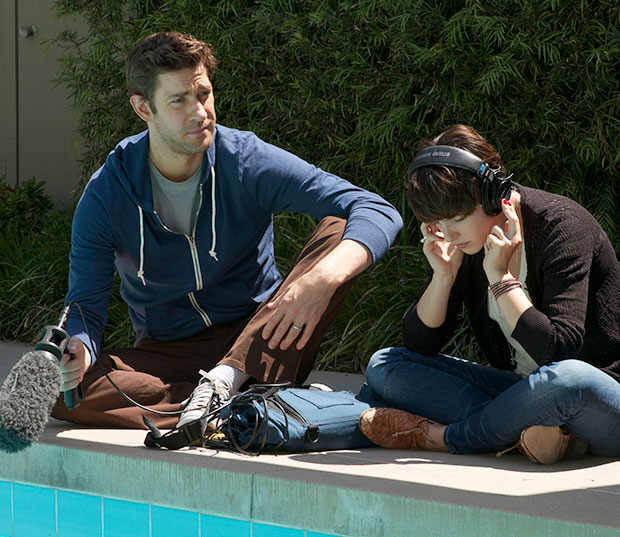
The winsome Olivia Thirlby stars as Martine, a hip New York artist who needs a sound mix for her avante garde bug documentary. She’s new to the field, so sound editor Peter (John Krasinski) is there to walk her through the process. And like every man Martine meets, he’s smitten. She may play coy with the men who enter her orbit — she belatedly rejects a stranger she met on the flight over just as they’re about to have sex in the LAX parking garage. But she’s not shy about using one and al, blithley sailing along on where her sexual impulses take her.

Peter is married to psychotherapist Julie, played with a professionalism that barely masks her sexual curiosity by RoseMarie DeWitt (“Rachel Getting Married”). Julie is smart enough to see Peter’s “little crush” but is she smart enough to resist the blunt, cocky advances of her screenwriter patient (Justin Kirk of TV’s “Weeds” and “Animal Hospital”).
“You’re too witty to be a professional listener,” he purrs.
Julie has a sexually awakening 16 year-old, Yma (Emma Dumont) with a crush on David, Peter’s 20something studio assistant. That makes her resist the shy advances of classmate Avi and a frankly predatory older tutor who teaches her Italian — starting with Italian sexual come-ons.
It’s from the director “Hannah Takes the Stairs” and the writer of “Tiny Furniture,” but it lacks the charm and wit of those films. “Nobody Walks” is more mysterious, revealing its relationships and inter-connections slowly, something an eighty-minute film can ill afford to do. Especially one with this many characters and relationships to develop and follow.
Thirlby has never been cast in a role meant to be sexually beguiling, and she doesn’t make Martine any deeper than the poseur fully aware of where her looks can take her. But Krasinski and DeWitt make us feel the pain and confusion of a marriage being tested, people who know they should be smarter than this.
“Just don’t embarrass me,” Julie tells Peter, two steps ahead of him.
And Kirk, cast on the nose as a smarmy, rich writer on the make, ratchets up the temptation for Julie, a woman who knows she’s about to be cheated on.

Continue reading →

Posted in Reviews, previews, profiles and movie news | Comments Off on Movie Review: “Nobody Walks”

Movie Review: “Madea’s Witness Protection”


With Tyler Perry movies, I’ve found it best to just search for a way to go with it and see where he tries to take you. His homilies, homespun wisdom and relationship/life advice have a touch of Oprah about them — a bit preachy. But he’s gotten in the habit of casting better actors in supporting parts. He’s grown beyond the chitlin’ circuit all-black-cast tenor of his stage plays. And supposedly, he’s learned a thing or two about making movies over the past decade.
But “Madea’s Witness Protection” is, even grading on the curve, a weak effort. His distractions — TV series to oversee, an outside-Madea acting career that he’s trying to get going (playing detective Alex Cross), a film studio to run — make this something less than “phoned in.”
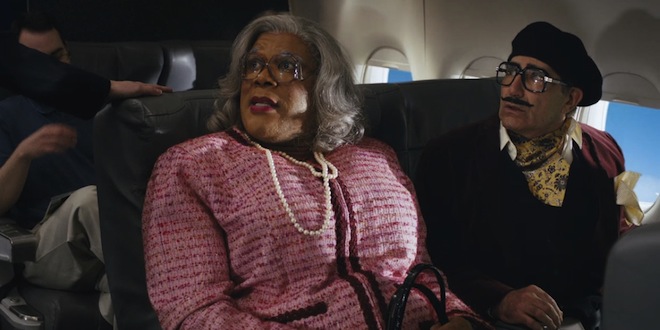
The witless “Witness” has the worst performance of comic Eugene Levy’s storied career, doesn’t even hide where it steals its ideas (“Ghost”), and feels exhausted from the start. Scene after scene has Perry, in his prettiest Madea makeup, straining to find something funny to say — riffing, impatiently trying to improv something, anything, needing to get on with it because he has more important things to worry about.
Prosecutor-nephew Brian (Perry, in less makeup)needs a place to hide a mob-connected accountant whose firm (run by Tom Arnold) just got caught running a Ponzi scheme. Brian talks Madea into taking in the accountant (Levy), his trophy wife (a plastic-faced Denise Richards), mom (Doris Roberts) and two kids. Lots of jokes about the white folk hiding in Madea’s African American neighborhood. More jokes about the dotty old mother not quite being hip to 21st century race relations.
Somehow, mom and old Joe (Perry’s funniest character in this film) have a connection. Somehow, the guilt-ridden accountant has to help the charities that were ripped off by the Ponzi scheme, especially the Atlanta church whose aged pastor (John Amos)entrusted his son (Romeo) with the money,
Somehow, Madea has to get on a plane, go to New York and re-enact Whoopie Goldberg’s Oscar-winning turn in “Ghost,” convincing a bank to transfer money that isn’t hers to foil villains she doesn’t know.
Madea’s first-ever plane trip is a centerpiece, and it’s as unfunny as the movie gets. Perry drags this dull, dated bit about airport security (“What, I’ve got to take my SHOES off?”) on and on, failing utterly to find a laugh in it.
Levy tries to get into the spirit of things, sputtering up to some sort of lather in moments of outrage. Only Roberts, flirting shamelessly with creaky old Joe, manages a giggle. And Perry’s Joe, who starts to wonder about his connection with this New York family, scores a chuckle or two.
“I’ve been looking at your wife. She’s doin’ that Yoda.” Joe is the sage in this film, the one who advises the kid “You’ve got to get in where you fit in.”
Perry needs to keep doing these films to finance his other ambitions. But he can’t rely on simply showing up in a dress to get a laugh any more. He needs to nurture other writers, other talents. He needs people he can trust to make him cut the unfunny fat out of his pictures, to tell him to do another take when he blurts out, “Don’t you know they got those dawg sniffing dawgs here?” Or to tell him that that mistake isn’t any funnier than the line he (drug sniffing dogs) botched.
Otherwise, his sermons will fall on deaf ears, and the good intentions that had him cast Roberts and Richards (who needs the work), John Amos and others, go for naught.

MPAA Rating:PG-13 for some crude sexual remarks and brief drug references
Cast: Tyler Perry, Eugene Levy, Doris Roberts, Tom Arnold, Denise Richards.
Credits: Written and directed by Tyler Perry. A Lionsgate release.
Running time: 1:54

Posted in Reviews, previews, profiles and movie news | Comments Off on Movie Review: “Madea’s Witness Protection”

Movie Review: “Children of Paradise”

What makes a film a classic? What causes a movie, in an age when nobody watches old movies, to grow in esteem, to become timeless, to burn itself into world culture as a legendary work of art?
Sometimes, it’s an image or handful of images. Maybe it’s a line of dialogue, here and there — “We’ll always have Paris.”
It’s the performance — thrilling, hilarious or touching — sometimes all at once. It’s the story — tragic, moving, poignant.
“Children of Paradise/Les Enfants du Paradis” is one of those movies. You see it in your youth, maybe in a college film society, even on cable TV, and it lingers in the memory — it haunts. It’s the zenith of French pre-war/pre-New Wave art, not as important as “Rules of the Game” or “Grand Illusion,” not as romantic as “L’Atalante,” perhaps. But magical, more a “Wizard of Oz” than a “Citizen Kane.” Here, in a film made during the Nazi occupation, French filmmakers summoned up everything that was lost, everything they knew about cinema before the Storm Troopers goose-stepped through Paris. Context alone makes it moving, but Marcel Carne and his cast see to it that there’s so much more to this masterpiece than that.
The title comes from the French phrase for the cheap seats in a theater or cinema — high up, near the angels often painted on the ceiling — and the setting is 1820s Paris, a riot of poverty, crime, class war and theater. In two acts — the film was made in two parts to get by Nazi/Vichy restrictions on its three hour length — we are treated to pantomime and pick-pocketing, stage farce and off-stage tragedy, and not a love triangle, but a love pentangle.
Four men long for — lust after — the inscrutable, Sphinx-like Garance, played by Arletty, an actress still stunningly sexy in her 40s, as she was when she made this.
Lacenaire (Marcel Herrand) is a swindler, a crime boss capable of violence. Garance is aloof, but he keeps her under his protection.
Frederick (Pierre Brasseur) is a would-be actor who stumbles into her in the crowded “Street of Crime” where rogues, beggars and actors congregate. He sees them as lovers, and she coyly plays along. The genius of Arletty’s performance is her quiet, still confidence in the face of such proposals.
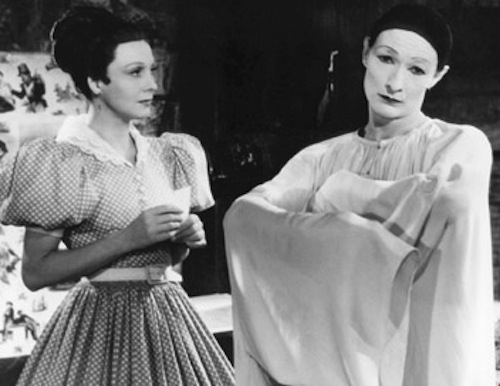
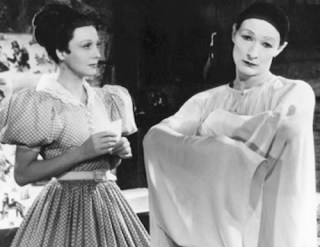
Baptiste (Jean-Louis Barrault) is a put-upon mime whose genius only earns a showcase when Garance is accused of a crime Lacenaire commits. Baptiste, in full makeup, mimes the crime as a witness and the cops let Garance go based on his hilarious testimony. This is the film’s first great scene.
And Louis Salou plays a jealous, duel-happy count who falls under the Garance spell.
We are set up for tragedy as the characters meet, fall in love, move on with their lives and up in the world. Frederick will become a great and popular actor. Baptiste will become a folk hero, the King of French mimes, marry and have a family.
But always, there is Garance — kept, treasured, or missed and pined for.
Director Marcel Carne spent a fortune on sets and extras and makes this world of cafes, theaters, street lowlifes and highly-strung actors come to life.
The funny lines still land laughs — shouted from the peanut gallery where the “Children” watch the shows — “Shut up! We can’t hear the pantomime!”
But it is the performances that linger — Brasseur’s hilarious, cocksure dandy of an actor, trapped, for a while, working in pantomime — “I’m dying of silence, like others die of hunger and thirst.”
Americans long ago made mimes a punch-line, but Barrault’s lovely pantomimes and tableaus return the pathos and wit to the profession.
Herrand is thoroughly vile and frightening.
And around them all is the inscrutable Arletty. Only an actress with some years, some worldliness, could play a character this bored with love, yet simmering with sex, even for the dull and violet count.
“Not only are you rich, but you want to be loved as if you are poor.”
Like most long films, this one is stately and slow for long stretches as Carne sets up the misunderstandings and treachery and builds the character’s back stories. Like many a vintage classic, it can seem quaint and dated, at times. But only in the odd moment. It feels fresh and timeless. And the rewards are peppered throughout it, from start to finish.
The no-expense-spared restoration of the film makes it more lovely than you remember, with those scratchy prints college film professors were forced to use, or the inferior cable, vhs or early DVD transfers.
“Children of Paradise” might have been overwhelmed by its legend, by its biography — started during World War II, made by the actors who weren’t able to flee occupied France, the teeming street scenes peopled with members of the French Resistance, working as extras and hiding from the Nazis.
But it wasn’t and isn’t. It’s as funny, moving and thrilling as any movie made 78 years ago has any right to be. You will be thrilled and yes, you will fall in love with a movie about a mime, no matter how many punch-lines about the powder-faced princes of silent acting you’ve been exposed to.
And thanks to this new restoration, “We’ll always have THIS Paris.”
MPAA Rating: unrated, worthy of a PG
Cast: Arletty, Pierre Berasseur, Jean-Louis Barrault, Louis Salou, Marcel Herrand
Credits:Directed by Marcel Carne, written by Jacques Prevert. A Pathe/Janus release.
Running time: 3:10


Posted in Reviews, previews, profiles and movie news | Comments Off on Movie Review: “Children of Paradise”

Movie Review: “The In Betweeners Movie”

To the uninitiated, the British TV comedy “The In Betweeners” is but a “horny teenager” movie writ large, peppered with the foulest British slang, a short series stuffed with jaw-dropping vulgarity and craven crassness.
Every boys-on-the-make cliche under the sun shows up in it. The kids are awkward, gawky, “types,” braggarts drooling with lust, in search of that first potential sexual conquest and that next taste of alcohol.
And the girls are every boys’ wish fulfillment fantasy — pliable, curious and if there’s sex to be had, we’re sure it’s pity sex on their part.
It’s all that, and more — corny and over-familiar in its sentimentality, edgy in its frankness (bodily fluids, excrement, etc).
“The Inbetweeners Movie” provides comical closure to the series, so “Oh no they didn’t!” daring in the UK, so watered down and de-fanged in its pale American remake, now on MTV.
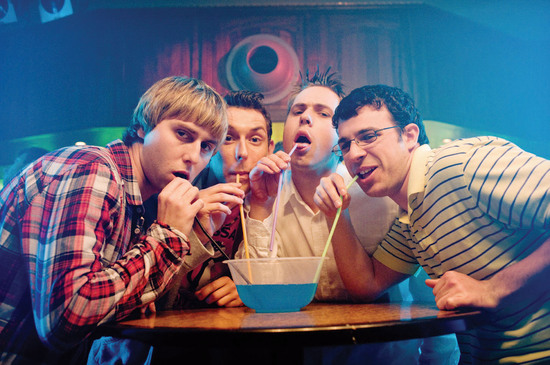
Our four lusty lads graduate high school where they were forever “in between” the various social groups and in between adolescence and adulthood. And what do randy middle class boys from suburban London with limited prospects (no everybody is headed on to “uni”) go post-graduation?
To the party palaces of Malia, in Crete — home to beaches, bars and every British babe in their age range.
The bucktoothed, bespectacled wit Will (Simon Bird) has a mind to prove to his trophy-wived dad (Anthony Head) that he’s not all “pretentious pedantic chat.” Simon (Joe Thomas) has packed his hair gel with a notion of tracking down and winning back the fetching Carli (Emily Head, daughter of Anthony), who dumped him at graduation. Tall and gangly Neil (Blake Harrison) has left behind his girlfriend, borrowed her tan-in-a-can (just for his face, mind you) and is ready for a little cougar action — the older the better, apparently.
And big-mouthed “spasticated” Jay (James Buckley, perfectly obnoxious) is ready to add to his ready supply of whoppers about all the babes he’s bagged, all the “vag” and “gash” he’s scored.
“SHE’D get it,” he bellows at every passing skirt.
Their hotel’s a Cretan dive. Their chances of meeting and hooking up — just four more cretins on the prowl in Crete — are remote.
“All girls are out of my league,” the Jerry Lewis look-alike Will complains. “Look at me. Imagine my league.”
But naturally they meet four likely candidates (Laura Haddock, Tamla Kari, Lydia Rose Bewley, Jessica Knappett)
— one for each lad — and then spend the rest of the movie mucking up their chances.
The hilarity in this quartet is in their utter cluelessness. They have just enough information — about Crete, abut bidets, about girls, about how gullible customers are lured into loser-discos — to get into trouble.
“Are we players?” one wonders.”
“I’m not really sure what that means.”
They’re sexist, self-absorbed and incompetent at most everything a girl their age would find alluring.
But as predictably sophomoric as “The Inbetweeners” can be, it’s the ways you stay ahead of it that amplify the laughs. No romantic or sentimental moment is too tender to undercut, no grand gesture so grand it won’t be ruined by saying or doing precisely the wrong thing. 
Simon goes on and on about Carli to the fetching and more available Lucy (Talma Kari), despite the fact that his friends punch him in the testicles every time he mentions Carli’s name. Lucy makes warm, moist-eyed and tender efforts to help Simon, and he stupidly misses every signal in his single-minded pursuit of the unattainable Carli.
Will uses his tactless, chattering charm to come on to Alison (Laura Haddock), who suggests pity sex “in a year” if he’s still a virgin.
“Can I get that in writing?”
Director Ben Palmer and the screenwriters stay true to the characters, but also serve up montages of them dancing (ineptly), pub crawling (ditto) fighting (yup, ineptly) and being bullied one last time before adulthood.
One could do without the graphic feces and masturbation jokes and the seriously unbecoming bits of full frontal nudity. But it’s all good, clean dirty fun, soft “American Pie” porn without the pastries.

MPAA Rating:R for strong crude and sexual content, some graphic nudity, language, alcohol and brief drug use
Cast: Simon Bird, Joe Thomas, James Buckley, Blake Harrison, Emily Head, Laura Haddock, Tamla Kari, Lydia Rose Bewley, Jessica Knappett
Credits: Directed by Ben Palmer, written by Iain Morris, Damon Beesley. A Film 4 release.
Running time: 1:34

Posted in Reviews, previews, profiles and movie news | Comments Off on Movie Review: “The In Betweeners Movie”

Movie Review: “Celeste & Jesse Forever”

Celeste of “Celeste & Jesse Forever” is a professional trend-watcher, someone who can size up people, ideas and “brands” based on demographic data and simple observation.
One trend she might pick up on is the one “Forever” represents. In a nation where divorce is commonplace, screenwriters are trying to reinvent the break-up. That was a driving force in Jennifer Westfeldt’s “Friends with Kids,” and with this summer’s “Ruby Sparks.”
And it’s the alpha and omega of “Celeste & Jesse,” a cute and wistful romance co-written by and starring Rashida Jones (“The Big Year”). She is Celeste, the over-organized, controlling professional woman who has been married, for six years, to artist/illustrator/surfer Jesse (SNL’s Andy Samberg). They’re best friends, even though he’s an unambitious slacker, a guy who “doesn’t have a checking account, or dress shoes.” That’s why they’re getting a divorce.
Sort of.
They still sing along to “their song.” They have “their gesture,” a little heart shape they make with their hands. They love talking mit zilly German accents, yah? And there’s this game they play with a tiny object that looks phallic.
So what gives?
Their friends — Air Graynor, Eric Christian Olsen, co-writer Will McCormack) may be puzzled, but not “C” and “J.”
“It’s the perfect breakup!”
Ahh, but J is not quite over C. So he starts dating with a mind toward making her jealous. How’s that work out?
Jones and McCormack (who plays a pot-dealer pal), with Lee Toland Krieger (“The Vicious Kind”) directing their script, don’t so much dodge as finesse the obvious pitfalls in this set up.
Yes, this is going to be a see-saw. He’s missing her, then she’s missing him. There’s code-language — “Come over and help me put together this IKEA furniture!” There’s “sex with the ex.”
You crazy kids.
“Celeste & Jesse,” like the characters we’re watching, skates by on being simply R-rated “adorable.” The no-longer-a-couple drops cute little F-bombs, smokes a little weed, drinks a lot of wine, and hits trendy LA’s trendiest spots — “Vegan Vittles” to juice bars, yoga class to Walt Disney Concert Hall.
Dating game mishaps include stumbling into each other in their favorite restaurant, awkward conversations with people too young for you and little slices of LA kinky.
And all around them are characters just a smidge more interesting than the chilly Celeste and the adorably dull spouse who is mostly in the background. Not that Jones has written herself a star vehicle and vanity project. But close.
Elijah Wood is entirely too on the money as Celeste’s “gay, sarcastic friend.” Chris Messina is the guy who hits on Celeste at yoga. Emma Roberts vamps it up as a childishly wise Miley Cyrus-ish pop star client of Celeste. Graynor’s testy “best friend” is getting married and dreading the toast Celeste is sure to give at the wedding.
The script has marvelous grace-notes, a couple described as having “an ease” about them, a woman (Rebecca Dayan) who is “simple, but in an elegant way,” and Celeste is sized up (by Roberts’ pop star) as having “contempt prior to investigation.” She judges books by their cover.
Jones, for all her close-ups, plays Celeste as likably chilly, not a frosty, judgmental workaholic living in her own “dark little prison.” Celeste’s character arc isn’t a journey but a very short jaunt.
And Samberg, who sometimes finds funny when that’s what is called for, is more at home mugging than emoting. The pair of them never give us enough to root for them as a couple.
All of which adds up to break-up comedy that is somewhat less than the sum of its parts, but best summed up by the “sarcastic gay” guy, sending Celeste out to date and “be admired.”
“Go. Be admired. Who knows, you may actually show a human emotion.”

MPAA Rating:R for language, sexual content and drug use
Cast: Rashida Jones, Andy Samberg
Credits:Directed by Lee Toland Krieger, written by Rashida Jones and Will McCormick. A Sony Pictures Classics release.
Running time: 1:31

Posted in Reviews, previews, profiles and movie news | Comments Off on Movie Review: “Celeste & Jesse Forever”

Movie Review: “Machine Gun Preacher”

Gritty, gory and violent, “Machine Gun Preacher” is a better action picture than it is an uplifting story about a violent man who found religion and a cause and became better for it.

Because that, this Marc Forster film suggests, just isn’t what happened. This confused and unsatisfying “true story” has a solid, tormented lead performance by Gerard Butler and promises the arc of a tale of redemption. But in missionary-with-a-machine-gun Sam Childers, the movie has a hero it cannot make its mind up about. And that confusion muddles the movie.

We meet Childers (Butler) the day he gets out of the joint. A violent, drug-dealing biker, he has enthusiastic sex with his wife (Michelle Monaghan) in her tiny Ford Pinto, settles back into their trailer and picks up right where he left off before prison. He drinks. He fights. He takes drugs. And he robs others who have the drugs.

Michael Shannon is wonderfully cast as his biker-junkie running mate.

Sam’s wife used to strip, and he’s none too pleased when she tells him why she quit.

“It ain’t right in the eyes of God.”

But Sam eventually crosses his own line and snaps. That’s when he, too, finds religion, gets his life straight and eventually starts his own church in rural Pennsylvania. And that’s when he becomes aware of the situation in Sudan and Northern Uganda, where warring groups torture, rape and kill adults and kidnap kids to be in their armies.

Sam, now a Man of God, tries to do things the turn the other cheek way. But for a man with his access to guns and knowledge of them, there’s only so many kids he’s going to watch carried off, only so many times he’ll stand by and watch his new orphanage  burned down. As he tells a rebel soldier who asks him if he’s in the military, “I just like my guns.”

Continue reading →

Posted in Reviews, previews, profiles and movie news | Comments Off on Movie Review: “Machine Gun Preacher”

Movie Review: “The Sessions”


“The Sessions” is a sentimental, feel-good romance about pity sex.
That’s not how it’s pitched, of course. The story of a paralyzed polio victim/journalist/poet (John Hawkes) who engages a sexual surrogate — a therapist who teaches him how to have sex by having sex with him — it’s uplifting, a tale of a great soul trapped in a ruined body, about a desperate wish to feel “complete” and the way this incomplete man completes the women fortunate enough to know him.
But holes in the script leave us with the feeling that what we’re seeing is a woman feel sorry for the less fortunate, when she isn’t being clinical.
Mark O’Brien spends his nights in an iron lung and his days coping with shift-changing care-givers. He’s a poet, a great profession for somebody who lives “inside your head.” He managed to graduate from college. He can write, tapping out keys, one at a time, using a stick he holds in his mouth. But he knows “I’m always in somebody’s way.”
And he’s all too aware of his own mortality.
“I’m getting close to my ‘use-by’ date.” His body is also telling him he needs love. He wants to experience it before he dies. And simply confessing his affection to an attractive care-giver is not enough.
William H. Macy plays the hip, understanding long-haired priest (San Francisco, the ’80s, go figure) whom Mark confesses his desires to. Mark’s researching a magazine article about sex and the handicapped. He has some good information. He just wants the priest to “give me an advance quote” on what that will do to his chances for salvation.
Helen Hunt plays Cheryl, a sexual surrogate — women paid to clinically teach and administer hands-on sexual instruction to the disabled.
It all starts with “body awareness exercises” and ventures onward into “Does that hurt?” “Not yet.”
Writer-director Ben Lewin’s film is a fascinating peek into the sexual difficulties faced by those stuck in wheelchairs or on gurneys, and their possibililities for sexual fulfillment. A couple of handicapable supporting actors fill out the cast.

Continue reading →

Posted in Reviews, previews, profiles and movie news | Comments Off on Movie Review: “The Sessions”

Movie Review: “Coriolanus”

“Oh yes, he is wounded,” the war hero’s mother exults at the news her son is returning home. “I thank the gods for it!”
Volumnia (Vanessa Redgrave, fierce and feral) proceeds to list her offspring’s many cuts and injuries gained in battle. She keeps track of Martius’s wounds, because she is sure they will bring him glory and power.
But in “Coriolanus,” power and popularity are fleeting things. And nobody knows this more than that anti-heroic hero, Martius. Even after the Senate has offered him the consulship, he resists the need to curry favor with the masses, whom he holds in contempt. Honored and flush with new victory, he knows that mob has hated him in the past and will again, soon enough.
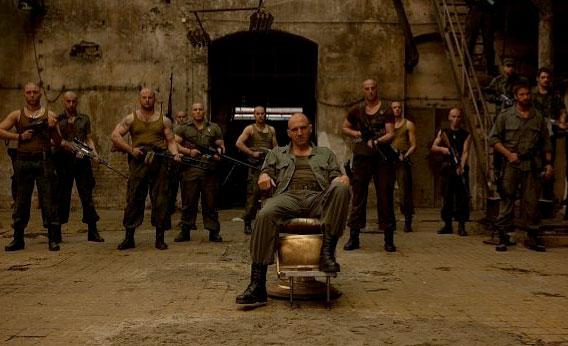
One of Shakespeare’s bloodiest plays is given a vigorous and stingingly  contemporary updating as Ralph Fiennes explores the tragedy of pride and the fickle tastes of “the mob” with “Coriolanus.” Taking the title role, that of a military hero modest enough to not readily accept accolades, snobbish and proud enough to refuse to pander to public tastes, Fiennes surrounds himself with a stunning cast. And as director, he gives this war drama a BBC/CNN war zone coverage, hand-held camera immediacy — men with M-16s shooting men with AK-47s — but men who know, as Shakespeare did, that the ugliest, most horrific combat is personal, hand to hand, knife to knife.
Martius has a super-patriotic mom, a devoted wife (Jessica Chastain), a son who longs to follow in his footsteps and allies (Brian Cox) in the Senate. But even single-handedly chasing off Tullus (Gerard Butler, not bad) and the enemy Volscians isn’t enough to make the impoverished classes of “a place called Rome” forget that he called them “dissentious rogues,” “curs” and worse when he was chasing them away from the city’s grain supplies.
Martius is unbending, unwilling to hear tributes to him in the Senate, unwilling to show a common touch or soft side. It will be his undoing, even after he’s been renamed Coriolanus, after his latest victory.
Fiennes has gone at this play the way Sir Ian McKellen adapted “Richard III,” and Orson Welles once updated “Julius Caesar.” He has updated the military setting and found a world filled with contemporary parallels to what Shakespeare was addressing.
What is his mob but the Arab Spring or Occupy Wall Street? What is the patrician Senate but “the one percent?” And who is Coriolanus but a noble man of heroic measure but myopic view of humanity?
Shakespeare fans will glory in some of the Bard’s flintiest dialogue.
“If e’er again I meet him beard to beard, he’s mine or I am his,” Tullus spits, talking about his sworn enemy, Martius.
Asked to dinner after her son’s downfall, Volumnia isn’t hearing it.
“ANGER is my meat!”
Redgrave hasn’t had a role this good since “Howard’s End,” and one this charged with fury since–who knows? It’s towering performance.
Fiennes, too, is in his element, rage so overwhelming he spits with every line.
The filmmaker in him highlights every timeless theme that Shakespeare trotted out, that age-old truism that the world loves a man in uniform, until he takes it off, the ways politicians rouse the rabble for their own nefarious ends. He and screenwriter John Logan trim the play and ends it, not with a whimper, but a deflating bang.
The great actors, from Welles and Olivier to Branagh and McKellen, want the popular audience to see what they see in Shakespeare — that he still matters, that he still moves, thrills and teaches. With “Coriolanus,” Fiennes brilliantly takes his place in their ranks.

MPAA Rating: R for some bloody violence
Cast: Ralph Fiennes, Vanessa Redgrave, Gerard Butler, Brian Cox
Credits: Directed by Ralph Fiennes, written by William Shakespeare, adapted by John Logan. A Weinstein Co. release.
Running time: 2:02

Posted in Reviews, previews, profiles and movie news | Comments Off on Movie Review: “Coriolanus”

Movie Review: “Jiro Dreams of Sushi,” and so will you

In a corner of Tokyo’s Ginza subway station sits a simple little restaurant of white walls and blond wood and just ten seats –Sukiyabashi Jiro. And in it, presides the oldest chef ever to earn a three star Michelin rating for his eatery, a stern, dour man who, in a quiet variation of Soup Nazi/”Cheeseburger-Cheeseburger” seriousness, reads unsuspecting visitors the law.
“No appetizers.” It is sushi only. Prices? They START at 30,000 yen. No walk-ins, reservations are required two-months in advance. And no, I DON’T have any brochures.
But land that reservation, sit down at one of those ten seats, and Jiro Ono will conduct a symphony of sushi — perfectly marinated, sliced and hand-patted fish wrapped around delicate, immaculately seasoned rice.
“Jiro Dreams of Sushi” is a movie as elegant, spare and tantalizing as its subject. In 80 minutes, filmmaker David Gelb captures a mild-mannered task-master who practices a zen approach to seemingly uncomplicated work — making sushi.
“You must dedicate yourself to mastering your craft,” Jiro says. “Every dining experience there “has to be better than the last time.”
And he has passed this on to his somewhat willing sons, men who gave up their own dreams of college or sports to serve their father and learn from the master.
Jiro, 85 when Gelb and his crew caught up with him, is a shokunin, a master craftsman who is passing on his legacy both to his sons and assorted apprentices who must serve him ten years before he’ll call them shokunin.
Gelb gives us some of Jiro’s background — he grew up poor, and served in the Japanese military during World War II — and takes us behind the scenes of one of the great restaurants in the world. Oldest son Yoshikazu sighs as he slaps mats of seaweed wrap against a hibachi grill. He wanted to be a racecar driver. But his life, chosen by his father, has him pedaling a bike to the seafood market at dawn, working with his tuna expert, his octopus guy, his halibut, abalone and eel vendors, each expert in his own right.
One of the underplayed jokes here is how Jiro seems to have bent this world to his will, his uncompromising standards. Yoshikazu is 50, and all that faces him is inheriting the restaurant from his father, taking on dad’s life’s work. Jiro’s younger son runs his own high-end sushi place, a mirror image of dad’s ten-seat diner.
Vendors — rice guys, fish guys — talk of being ready to retire, not in the best health. But they don’t because they won’t let Jiro down.
Gelb lets Jiro educate us on sushi — the difference between fatty tuna, “medium” tua and ruby-colored lean tuna.  He lets Jiro bemoan the proliferation of sushi as a food the world over and the awful over-fishing that leads to.
And Gelb photographs each dish as it comes off Jiro’s hands — minimalist works of art that melt in your eyes.
Everything is understated here, and that includes the conflict that normally drives any film, even a documentary. Jiro could retire. His eldest son is every bit as good as he is.
But does Yoshikazu live and breathe sushi? Does he dream of new sushi ideas? Only Jiro, the zen master of bite-sized morsels that seem to pop right off the screen and into your mouth.

MPAA Rating: PG for mild thematic elements and some smoking.
Cast: Jiro Ono, Yoshikazu Ono
Credits:  Directed by David Gelb. A Magnolia release.
Running time: 1:22

Posted in Reviews, previews, profiles and movie news | Comments Off on Movie Review: “Jiro Dreams of Sushi,” and so will you

Movie Review: Joaquin returns in “The Master”

Every movement has its founder, its days of working out its sacred text and its first fanatical acolyte. And it doesn’t matter if the founder is Mary Baker Eddy, Joseph Smith, Ayn Rand or Mohammad, the details are going to look messy.
That’s the fertile ground Paul Thomas Anderson tills in “The Master,” a fascinating film presented as a fictionalized version of the early days of Scientology.
Anderson (“There Will Be Blood”) vividly recreates the psychological climate of post-World War II nuclear-armed America and injects a charismatic charlatan into it. And set opposite the mesmerizing, arrogant yet oddly sympathetic Philip Seymour Hoffman in the title role is the bent, malnourished figure of Joaquin Phoenix, screen acting’s most tortured soul, given a comeback of startling dimensions.
Phoenix is Freddy Quill, a Navy vet of vulgar impulses and violent mood swings. He’s sexually voracious and unabashedly crude. Freddy doesn’t just drink. He used to drink the alcohol fuel from the torpedoes on his destroyer, so no libation that he hasn’t concocted out of paint thinner and pills does the trick for him.
He literally staggers into the orbit of The Master, a writer and self-described intellectual who has acquired a small, well-heeled following which he teaches to “process” others as he has processed them. Anderson presents a sober and fair-minded take on this procedure, which entails a hypnotic questioning and breaking down of the subject, supposedly revealing “trillions” of years of past lives that shape who we are.
“Do your past failures bother you?” the Master wants to know. “Is your life a struggle? Have you ever had sex with anyone in your family?”
The Master cares, calls Freddy a “silly animal” for his base urges and treats him as his ultimate “guinea pig.” Freddy, the most deeply disturbed person ever drawn into The Master’s orbit, will be the test case for the treatments proscribed in “The Cause” and the follow-up books the Master has in mind. He is going to upend a sick world and heal it, starting with Freddy.
Strip away any thought of “processing” as “auditing” and “The Cause” as “Dianetics” and you’re left with the portrait of a man whose life is a wreck and who finds some thread of hope in the attentions of this Kool-smoking guru.
Phoenix finds all sorts of new corners of disturbed to play in a performance that is not pretty on any level. The actor has never been more haggard, and the loss of weight makes him more menacing, a stooped Lee Harvey Oswald figure, a fanatic who barely contains his life-long rage and a man without a deep thought in his head.
Hoffman, all clipped sentences and self-control, makes this Master intellectually adroit, fearsome when he is challenged, sincere and mentoring when he sees the challenge Freddy represents.
“We are on a journey that risks the dark,” he intones in his lectures. He modestly offers his latest book as “a gift to homo sapiens.”
Amy Adams gives a Lady Macbeth edge to the Master’s latest wife, an unnaturally calm harridan who circles the wagons for The Cause whenever she sees it not being taken seriously.
“The only way to defend ourselves is to attack.”
“The Master” is captivating on a simple performance level. The story, an overlong, rambling personal journey that takes Freddy from the beaches of the South Pacific into his past and stumbling — perhaps healthier/perhaps lost –into his future, does little to break the spell the players cast.
Anderson cunningly lets the viewer add the “sinister” here. We can ponder a group that sees value in collecting and guarding the secrets of its members, that seeks out celebrities, the passion for litigation as a means of battling those who question it.
Hoffman, as The Master, may be full of it. But Anderson doesn’t have his film question The Master’s character or motives. He gives hints, suggests the costs as well as the benefits of this sort of imitation psychiatry.
The questioning, the worries over how such a cultish group might use its members, its influence and its clout for nefarious purposes? That’s up to us.

Continue reading →

Posted in Reviews, previews, profiles and movie news | Comments Off on Movie Review: Joaquin returns in “The Master”