Movie Review: “Only Lovers Left Alive” gives us vampires in a Jarmusch setting

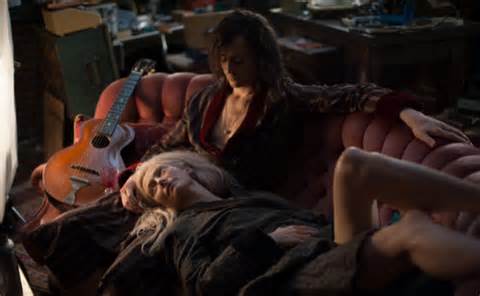
ImageAging indie hipster Jim Jarmusch finally gets around to making his vampire movie with “Only Lovers Left Alive,” a droll, dry and atmospheric character study in the Jarmusch style.
The director who brought us “Night on Earth,” “Mystery Train” and “Broken Flowers” tells the story of a couple of undead lovers, together through the centuries, now separated by an ocean and half a continent.
Adam (Tom Hiddleston) is a musician. And having had several lifetimes to practice, he’s mastered guitars, violins and lutes. He once passed a string quartet to Schubert.
“Only the adagio” movement, he sniffs. “Just to get it ‘out there.'”
Now, he’s holed up in an abandoned Detroit mansion where the Addams Family would have felt right at home. He collects old records and rare guitars and plays his morose, metal dirges onto vintage recording gear, all with the aid of Ian (Anton Yelchin).
Ian doesn’t know Adam’s secret, just his musical notoriety. Adam is hiding from his fans. All Ian knows is that the guy is a messy housekeeper, that he seems depressed and that he pays for everything with cash, lots of it.
Eve (Tilda Swinton) stays in a Tangier apartment cluttered with books of every language — poetry, plays, novels. She devours them, and occasionally goes out to collect a goody bag of blood from her aged friend, Christopher Marlowe (John Hurt, perfect). Yes, THAT Christopher Marlowe, “Kit” to Shakespeare’s “Will,” alleged author of some of the Immortal Bard’s immortal works. Kit knows Adam, too.
“How I wish I’d met him before I wrote ‘Hamlet’!”
Adam gets his goodies by masquerading as Dr. Faust, slipping into the hospital where Dr. Watson (Jeffrey Wright) is his blood-supply connection. Watson, a regular Dr. Feelgood for the blood-craving, calls Adam “Dr. Strangelove” and “Dr. Caligari,” for laughs.
Eve senses Adam’s state of mind, Skypes him (vampires prefer iPhones, wouldn’t you know it) and travels first class (Air Lumiere) “only at night” to be with him.
The Jarmusch touches here are the self-aware little jokes, Eve hanging out in the Moroccan Cafe Mille et Une Nuit (Cafe A Thousand and One Nights), flying on a Daisy Buchanan (“The Great Gatsby”) passport. His characters pass judgment on the human race, “zombies,” they call us, and on the human history they’ve observed over the hundreds of years.
“Did you play chess with Byron?”
Jarmusch loves ruined towns, and Detroit offers a smorgasbord of an urban desert — empty neighborhoods, collapsing factories, all part of Adam’s nightly tours in his ancient Jaguar XJS. A biting joke — Detroit “will bloom” when America’s “Southern cities burn” — a global warming prophecy.
The effects are very limited, but so is the story’s dramatic tension. Only the arrival of Eve’s bratty younger sister, Eva (Mia Wasikowska) stirs thing up. Wasikowska is the most animated player in it, with Swinton and Hiddleston (“Thor”) playing everything on a low simmer.
The lack of urgency may bore those unused to Jarmusch’s style and pacing. But his languor is his calling card. The deliberate pacing makes the offhand jokes and dry observations seem funnier than they are, at least in this case. This borders on being “cute.” And dull.
You’d think, post “Twilight,” that the guy was just selling out, as if that could ever happen.

 Image
MPAA Rating: R for language and brief nudity
Cast: Tilda Swinton, Tom Hiddleston, Mia Wasikowska, Jeffrey Wright, Anton Yelchin, John Hurt
Credits: Written and directed by Jim Jarmusch. A Sony Pictures Classics release.
Running time: 2:03
Posted in Reviews, previews, profiles and movie news | Comments Off on Movie Review: “Only Lovers Left Alive” gives us vampires in a Jarmusch setting

Box Office: “Spider-Man” falls off, still could hit $90, “Rio 2” clears $100

“The Amazing Spider-Man 2” didn’t suffer much of a fall-off from Friday to Saturday. But no fall off, on most people’s first full day off to go see it, might have been expected. It’s still on track to hit $90-91 million, but Sunday’s numbers will be the final arbiter.

“The Other Woman” is on track, after Friday and Saturday, to take in just under $15 million on its second weekend.

“The Grand Budapest Hotel” cleared the $50 million mark, the very definition of a long-running low-budget hit. It’s done 2.5 times the business of “Transcendence,” the very definition of a big budget “blockbuster” bomb.

“God’s Not Dead” is finally out of gas and losing screens. The no-cost indie hit will still end up just under $60 million, a major win or the filmmakers.

“Heaven is for Real” is still making money, clearing the $65 million mark this weekend.

Posted in Reviews, previews, profiles and movie news | Comments Off on Box Office: “Spider-Man” falls off, still could hit $90, “Rio 2” clears $100

Box Office: Bad reviews can’t keep “Spider-Man” from a $90 million+ weekend

spiderThe experts, professional box office watchers, predicted a 30% improvement in the take for this “Spider-Man” sequel. The last film opened at $62, and this would should clear $90 — Box Office Mojo, Deadline and Box Office Guru opined.

And they appear to be right on the money. Based on Friday’s numbers, that’s where this film will be Sunday night $91 million richer. Reviews aren’t helping, but they sure aren’t hurting.

“Belle,” opening in limited release, has a healthy (not epic, though) per screen average.

“The Other Woman” is holding over 50% of its opening weekend BO, close to $15 million,

The season’s big faith-based hits — “Heaven is for Real” and “God’s Not Dead” are hanging around the top ten. They may pass “Son of God” by the weekend’s end — both are at close to $60 million. “Noah” is closing in on $100 million.

Posted in Reviews, previews, profiles and movie news | Comments Off on Box Office: Bad reviews can’t keep “Spider-Man” from a $90 million+ weekend

Next screening: “Legends of Oz: Dorothy’s Return”

It’s an animated offering with a lot of names in the cast and an untested studio behind it. L. Frank Baum’s books are in the public domain, and animation is still the most consistently lucrative corner of the business (expensive, too) to break into.Lea Michelle, Bernadette Peters, Dan Aykroyd, Martin Short,Hugh Dancy, Oliver Platt — it’s a musical, a comedy, “Legends of Oz” opens Friday.

Posted in Reviews, previews, profiles and movie news | Comments Off on Next screening: “Legends of Oz: Dorothy’s Return”

Next interview: Got questions for James McAvoy?

ImageHis screen work in recent years has taken on a lot of different colors — conflicted guys, crooked guys, and in “Filth,” James McAvoy takes things even further afield as a devious, reprobate — a bad, bad cop.


“Trance,” “Welcome to the Punch,” he’s got another “X-Men” film due out after “Filth,” a turn in “Frankenstein” on its way. We’ve spoken a few times over the years, beginning with his break-out film, “The Last King of Scotland.” I think the last time we talked, he’d provided the title character’s voice in “Arthur Christmas.”

Got questions for James McAvoy? Post them as comments, and thanks for the help.

Posted in Reviews, previews, profiles and movie news | Comments Off on Next interview: Got questions for James McAvoy?

Box Office: Will “Amazing” reach $100 million?

The reviews haven’t been generous. There’s the sense, among the cognoscenti, that this Sony “Spider-Man” beast is just too cynical, too generic, too lacking, to stand shoulder to shoulder with the Marvel marvels that “Captain America,” “Iron Man,” “The Avengers” and “Thor” have become.

But people will still flock to see it, right? Box Office Mojo is thinking it’ll do an eye-popping $91 million over this weekend. Reviews be damned.

Box Office Guru says $92.

My guess is that the reviews will suppress this one a bit, that word of mouth won’t help, and that it won’t hit $90.

If women are truly embracing the amusing-enough “The Other Woman,” this weekend will be the giveaway. If it does what the prognosticators are expecting it to do, it’ll only manage $13 million. I think it’ll hold more audience than that — $15-18. But we’ll see.


Posted in Reviews, previews, profiles and movie news | Comments Off on Box Office: Will “Amazing” reach $100 million?

Weekend Reviews: “Spider-Man” fails to amaze, “Belle” dazzles

ImageThere are often course corrections by critics over the course of a director’s career, or over the path of a film franchise.

Maybe critics, like Siskel & Ebert at the start of the “Ace Ventura” era, will all of a sudden discover GRAND fun and GREAT art in a second film after audiences embraced a first film they so memorably and cluelessly trashed.

Maybe critics who wept tears of bitter joy over the silly “depth” of “The Tree of Life” go ahead and eviscerate everything Terrence Malick does afterward, rightly realizing — late — that he’s lost it.

Or maybe they ride the tide of “Amazing Spider-Man,” knowing how angry the killer bees of fanboydom will be if they don’t, even if they know it’s a heartless, cynical “product.” Still, nobody likes to be called an “easy lay” or a hack, even when it fits.

Thus, does “Amazing Spider-Man 2” fall into rotten territory on the Rotten Tomatoes tomatometer.

I dined out for months on the web traffic I got for being a lone voice in the wilderness saying “Amazing” wasn’t. Now, my middling endorsement of the second film — Garfield’s found a fun way to play the character, at least — may end up being in the minority as a huge section of the reviewing classes are panning it. I sat on the fence with this one, cut Garfield, if not the hack making the film, some slack. “Ordinary” it is. Let the killer bees be damned.

“Belle” is a splendid romantic lesson in history, art, slavery and class. Jane Austen meets “12 Years a Slave.” A star-making performance by Gugu Mbatha-Raw, a director (Amma Asante) now to be reckoned with. Go see it. A cluster of New York critics panned it, but they’re a circle jerk of hate, on most occasions.

Actual conversation I had with a publicist for the movie “Walk of Shame,” who refused to preview the film for critics. Including me.

“Listen, tell your boss that NOBODY is going to be talking about this movie THIS weekend of all weekends. NOBODY. You need people to review it.”

Wouldn’t listen. POS will be lucky to pull in 77 customers, nationwide. Utterly ignored, too.

Posted in Reviews, previews, profiles and movie news | Comments Off on Weekend Reviews: “Spider-Man” fails to amaze, “Belle” dazzles

“Belle” director and star go where Jane Austen never dared

ImageFolding fans flutter, bosoms heave above Empire-waisted dresses and class distinctions get in the way of true love.

But in the 18th century romance “Belle,” the young British aristocrat trying to find her place, in society, and in love, is black, the daughter of a black woman and a white sea captain of noble birth. Still, try to find a review of the new costume romance “Belle” that doesn’t mention “Jane Austen.”

The comparison to the works of the author of “Emma” and “Pride & Prejudice” may be too obvious to avoid. However, “Belle” is about something Austen rarely came close to addressing, Britain’s contemporaneous debate on the financially important-morally indefensible slave trade.

“It wasn’t something polite people talked about,” Amma Asante, the film’s director says, explaining Austen’s omission of the subject, itself the topic of Austen studies and scholarly debate. .

“There’s even a breakfast scene in our movie that demonstrates that, where Lady Mansfield interrupts and says ‘This is a vulgar topic,'” Asante says.

“Austen’s world was more concentrated on the domestic,” adds Gugu Mbatha-Raw, the British actress of mixed race who plays the title role in “Belle.” “That’s what makes “Belle” so new. We still have Austen’s world, that domestic, marriage market life. It may have the familiar Jane Austen feel of it, but there’s something more at stake here than marrying well.”

Dido Elizabeth Belle grew up in the home of a very famous uncle. William Murray (played by Tom Wilkinson in the film) was Lord Mansfield and Lord Chief Justice. After raising Belle in his home, Lord Mansfield decided the pivotal case in the history of Britain’s early abolition movement — the “Zong Massacre” — in which an insurance company refused to reimburse a slave ship owner for the human cargo he tossed over the side in an effort to commit fraud.

“The Zong Case really does something that no Austen novel or film ever does,” Mbatha-Raw says. “It gives a political context, with the abolition movement as a big part of that.”

The title of Austen’s “Mansfield Park” may not just be a coincidence. As the literary critic Edward Said has pointed out, Austen’s only direct mention of the slave trade comes in the novel titled “Mansfield Park,” where character Fanny Price “reminds her cousin that after asking Sir Thomas about the slave trade, “there was such a dead silence”” that spoke volumes. The lively debate over Austen’s hidden or barely hidden attitudes on the subject has played out in such scholarly works as Gabrielle D. V. White’s “Jane Austen in the Context of Abolition.”

But “Belle” wasn’t filmed as an anecdote to Austen’s concentration on the domestic rather than the worldly. After all, Austen never mentioned the late-18th, early 19th century Napoleonic Wars, any more than the slightly earlier “Belle” focuses on Britain’s losing efforts in the American Revolution, which was going on as the Zong Case was decided and Dido Belle was coming of age and being presented to British society. Asante saw the film as a chance to “blend politics, art and history” into an Austenesque romance.

The film depicts Belle’s life, growing up with a cousin the same age, a white woman also being raised by her aunt and uncle. And it’s inspiration was a contemporaneous portrait of the two young women made by Johann Zoffany.

“The producer sent me a picture postcard of it, and it drew me in,” Asante says. “I knew how unusual that representation was. People of color were accessories in European portraits of that age. Pets, almost. They were always lower in the frame, looking up in awe to the white protagonist in the painting.

“Dido was higher in the frame, dressed in expensive clothes, grinning and pointing at herself. You ask questions when you see a painting like that.”

The portrait was the main thing the screenwriter, director and star had to go on in creating “Belle,” “a lovely starting point, for all of us,” Mbatha-Raw says. “It’s so unusual, seeing a black woman, of that time, in a painting with her white counterpart, Elizabeth, her status plainly equal in the composition of it. Her gaze is mischievous. There’s a brightness to her eyes, looking directly at the viewer.”

There’s documentation of how Dido Belle was not exactly treated as an equal in the household, an American businessman’s diary noting how she wasn’t allowed to dine with guests, but “he was ‘shocked’ to see ‘a black’ emerging, after dinner, to socialize with the family,” Mbatha-Raw says, with a laugh. But the Mansfields all left Dido money in their wills, “showing the degree of love and affection they had for her, “Asante says.

Asante, who uses lots of close-ups “as sort of my signature, taking you into the mind of the character,” knew she’d found her Belle when she met Mbatha-Raw, best known in this country for a supporting role she played in Tom Hanks’ “Larry Crowne.”

“She has the innate sense of grace that made her seem absolutely at home in this world,” Asante says.

“The corsets help,” jokes Mbatha-Raw. “Your posture, your movement, it makes you fit in.”

“Belle” is earning winning reviews, with Variety’s Justin Chang echoing many in calling the “Austen” and “Slave Trade” topic pairing “a surprisingly elegant and emotionally satisfying fit.”

The director and her star, both British and both black, say they were, in the end, most moved by their love of period romances and the lack of roles for women of color in them. As Asante puts it, “I made this for all the little girls like me, who love a costume drama, who get swept in the romance of it all, but never see themselves reflected on the screen as anything other than a servant.”

Image

Posted in Reviews, previews, profiles and movie news | Comments Off on “Belle” director and star go where Jane Austen never dared

Movie Review: “Decoding Annie Parker”

ImageIt’s easy to forget the dark ages — when women died in their thousands and the staid, male-dominated medical profession didn’t react with alarm and purpose in trying to figure out why, when geneticists wouldn’t roll up their sleeves to tackle something difficult and time-consuming that impacted mostly women, when computers took days, weeks and years to process data your laptop could crunch in a flash.
“Decoding Annie Parker” is about those dark years — the 1970s and early ’80s — when it took women, teams of them, to sort through medical histories, beg for funding and computer time and reach a conclusion that seems blindingly obvious, now.
Breast cancer is mostly genetic, stupid.
“Decoding” isn’t just a science biography and isn’t just “Breast Cancer: The Movie.” It tells the tragic story of a Canadian high school graduate who buried her mother and her sister, who knew her grandmother died from breast cancer, and couldn’t get doctors to admit that yeah, maybe she inherited the disease that takes her own breast years after she “knew this would happen.” The film tells Annie Parker’s story with heart and wit, and finds a few funny insights into the stubborn, brusque woman, Dr. Mary-Claire King, whose lonely quest to find proof would bear fruit.
Samantha Morton plays Annie, whose morbid sense of humor arrived at an early age.
“My life was a comedy. I just had to learn to laugh.”
She and her sister (Marley Shelton) grew up under a disease that dominated their youth thanks to their mother’s early death. They regard cancer as a monster, hidden in a room they never go into in the house they grew up in.
“Someday, he’ll get us, too.”
And when sister Joan dies of the same thing, Annie’s fears are confirmed. Her joyful, sex-filled “bad decision” life — she married a Toronto pool cleaner and musician (Aaron Paul, hilarious) — has a cloud hanging over it. She can find humor in funerals, but she is obsessed about what she knows is coming, not that the obsession makes that day she finds a lump any less wrenching.
King is a cold and charmless researcher who can’t convince donors to fund her search for genetic markers in breast cancer in 1970s Canada. Helen Hunt is perfectly cast, bringing the too-brilliant/too-impatient scientist to brittle life.
Kindly, patronizing male doctors tell Annie “Your family did have a bit of bad luck.” But she and Dr. King, whom she has never met, know better.
Eventually, a younger doctor and a sharply observant nurse (Rashida Jones, sassy-funny) join Annie in her quest to find clues, even as Dr. King finally gets together a team, the computer time and the money to crack this code. It takes years and years, with Annie going through the horrors of cancer and the nightmare of chemotherapy and surgery, never knowing when “the monster” will return.
Co-writer and director Steven Bernstein finds ways for Annie to lighten the glum mood this movie should have had, mainly through her wacky, sex-filled marriage. Aaron Paul, of “Breaking Bad” and “Need for Speed,” is an amusing essay in eye-linered, glam-rock slacker.
“Decoding Annie Parker” is an uplifting story, a generic medical drama that doesn’t transcend its TV movie “disease of the week” origins. But it does remember this history with wit, charm and heart. It’s “be willing to reject orthodoxy” ethos seems like a lesson that the medical profession needs to learn and relearn when dealing with patients. Unlike doctors, the sick take no comfort from the tried and failed orthodox way of treating what is killing them. They need people as desperate to find a cure as they are.
Image
MPAA Rating: R for language and some sexual content
Cast: Samantha Morton, Helen Hunt, Aaron, Paul, Rashida Jones, Alice Eve, Maggie Grace
Credits: Directed by Steven Bernstein, written by Adam and Steven Bernstein and Michael Moss. An eOne release.
Running

Posted in Reviews, previews, profiles and movie news | 1 Comment

Image

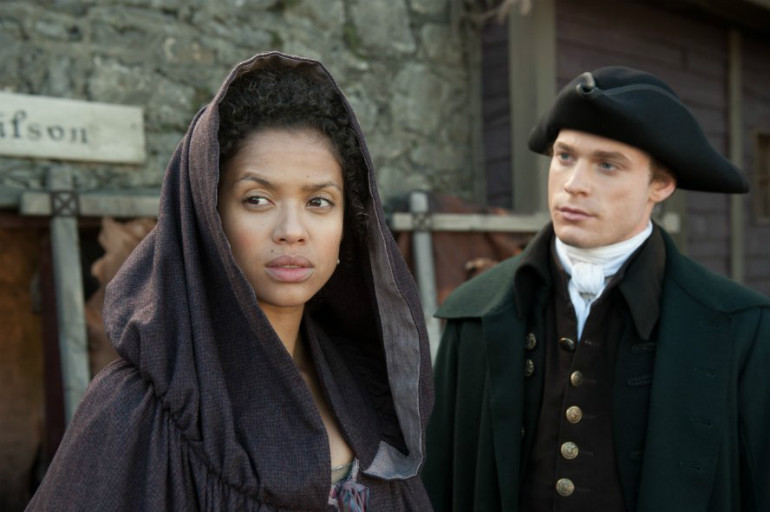
Image“Belle” is a movie that instantly joins the ranks of the screen’s great period piece romances.
Imagine a Jane Austen adaptation, with all its Empire waistlines and romantic longing, but a film in which the obstacles to love are far greater than mere social standing, a story that transcends its comedy of manners frame and is actually about something — slavery.
“Belle” is loosely based on the life of Dido Elizabeth Belle, the daughter of an aristocratic Royal Navy captain (Matthew Goode) and a Negro woman. That sort of thing happened in 18th century England, but polite people didn’t speak of it. And a child born of such a union faced a hard life of the same drudgery that faced England’s slaves and freed blacks — servants, as a class.
“I am here to take you to a good life,” her father says after her mother, whom he did not marry, dies. And so he does.
Belle, or “Dido,” as her new family calls her, comes to live at Kenwood House in Hampstead. She will be raised by her father’s uncle, Lord and Lady Mansfield (Tom Wilkinson and Emily Watson), and the Lord’s spinster sister (Penelope Wilton of “Downton Abbey”).
Her upbringing will be alternately kind and generous for its day, and circumscribed. “Papa” may say he is doing this “in accordance with your birthright,” but the Lord is keenly aware of his times. She will be companion to the other niece they’re raising, Elizabeth (Sarah Gadon) and enjoy all the education and privilege life has to offer.
But when company comes, Dido (Gugu Mbatha-Raw) will dine by herself. No sense shocking the proprieties of their guests.
“Too high in rank to dine with the servants,” Dido grows up to complain, “but too low to dine with the family?”
Hers is a future “without possibility of a suitable marriage.” Being smart, talented and unutterably beautiful, they may be writing Dido off a little too easily — even if this was the 18th century.
Tom Felton does a nasty Draco Malfoy-ish turn as a young swell who woos Elizabeth and disapproves of the attentions his brother (James Norton) is giving Dido. Sure, have your fun, he suggests, but one wants “a pure English Rose to decorate one’s home.” Still, Dido’s wealth has the boys’ snob of a mother (Miranda Richardson) seeing her with a more approving eye.
But Lord Mansfield has bigger things on his mind than mates for his nieces. He is Lord Chief Justice of the King’s Bench, and in 1783, all of Britain awaited his ruling on a case involving England’s “most important” business — the slave trade. And whatever tolerance he has developed raising the “cherished” Dido, the wrong ruling on an insurance claim for a cargo of dead slaves could be a bigger blow to the Empire than the recent loss of the American colonies.
Amma Assante’s film is very much a chamber piece, intimate and romantic, full of actors in beautiful period costumes requesting the pleasure of “taking a turn” about the grounds with one other. But it is breathtakingly ambitious for such a piece, taking us back to that age and letting us see slavery, in all its inhuman ugliness, through Mbatha-Raw’s huge, expressive eyes. She is a revelation, suggesting Dido’s curiosity and confusion at her odd station in life, and spirit that just wasn’t allowed in someone of her sex or race back then. Assante wisely keeps the camera close on Mbatha-Raw as Dido discovers what typically becomes of people of her skin color, and revels in Dido’s haughty dismissal of the passionate young abolitionist and would-be lawyer (Sam Reid) who sets off sparks every time they clash over class divisions, slavery and the Lord’s “duty.”
Misan Sagay’s script crackles with Austen-esque banter.
“Girls, will you REFRAIN from shrieking…like the blessed FRENCH!”
“Did you not listen to the rumors when you were spreading them, Mother?”
Beautifully cast, touchingly played and handsomely mounted, “Belle” is as close to perfect as any costumed romance has a right to be. This is a story Austen herself would have been proud to claim as one of her own, if polite young ladies ever talked of such things in polite company. And in its heartbreaking young star, the movies have a glorious new feminine ideal, as bedroom-eyed heart breaker or wide-eyed innocent, and an English Rose for the new millennium.

(Roger Moore interviews director and star about “Austen” and slavery and the portrait that launched the movie.)

MPAA Rating: PG for thematic elements, some language and brief smoking images
Cast:Gugu Mbatha-Raw, Tom Wilkinson, Emily Watson, Tom Felton, Miranda Richardson, Sarah Gadon, Sam Reid
Credits: Directed by Amma Assante, written by Misan Sagay. An Fox Searchlight release.
Running time: 1:44

Posted on by Roger Moore | Comments Off on Movie Review: “Belle,” an instant classic