Movie Review: Buster Keaton in a “Minions” comedy by Terry Gilliam? “Hundreds of Beavers”

We tend to think of slapstick comedy gag writing as a lost art. It didn’t die along with Buster Keaton and Charlie Chaplin, but its most acclaimed practioners these days are in animation, heirs to the Chuck Jones/Looney Tunes tradition.

But here’s a side-splitting, cartoonish but live-action comedy about a frontier drunkard, fur trapping and never quite obtaining the basics of survival in wintry 19th century Wisconsin.

In “Hundreds of Beavers,” food, shelter, clothing and companionship are kept just beyond the reach of the hapless hero in an increasingly hilarious and downright deranged farce that features a sea of woodland creatures played by people in fuzzy mascot costumes.

It’s from the creators of the whimsical and even more nonsensical “Lake Michigan Monster,” writer-director Mike Cheslik and co-writer/star Ryland Brickson Cole Tews. Whatever absurdist bar they set for themselves there, with “Beavers” they clear it with a knockabout romp that plays like a Wile E. Coyote cartoon, borrows from The Old Masters of silent slapstick and finds its laughs the old fashioned way — with somebody getting bonked of bested, falling down a hole or pounded on the noggin by a woodpecker.

For their latest trick, Cheslik and Tews go even more primitive in their search for “primal” comedy with a pretty much dialogue-free black and white slapstick farce about the hard life on the frontier.

A musical prologue introduces us to apple-growing/hard-cider (applejack) distilling Jean Kayak (Tews), his success and downfall — a drunken accident destroys his business. The tale of Jean Kayak and applejack is half-animated, half-danced and sung by a Pythonesque chorus.

And when Jean shifts his focus to just staying alive in the bitter cold — building a fire, struggling to fish or hunt himself something to eat, the movie changes titles to Jean Kayak and “Hundreds of Beavers.”

That’s the pelt most-valued in the 1810s or so, the one the surly trader (Doug Mancheski) will barter for. Well, that and raccoons, maybe rabbits, too.

Not that Jean is any good at outsmarting, catching and killing them. He needs rescuing by the bearded, sleigh-riding Master Trapper (Wes Tank), and the occasional life-saving barter with The Indian (Luis Rico).

But the trapper, his pelts and his dogs (more actors in mascot suits) are taken by wolves, one and two by two. The Indian is only so much help.

As the trader has a flirty, fetching skinner/furrier daughter (Olivia Graves) Jean is motivated to persevere, trapping his way towards competence, trading his way towards the “hundreds of beavers” the trader will take as the price of his daughter’s hand.

The filmmaking is simple, crude and quite funny, with in-camera effects and the cheapest digital ones available that put our hero and the wildlife in snowbound conflict on an ice-covered lake where the beavers are organized and building the most elaborate dam and lodge this side of the Waldorf.

We see Jean scheme and study and learn and luck into pelt after pelt, so many that a silent beaver version of Holmes and Dr. Watson start investigating his “crimes.”

A climactic chase through the beaverworks is as cartoonish as it gets, with a horde of beavers tumbling after Jean in an image borrowed from Keaton’s classic “Seven Chances.”

The furrier’s daughter’s behind-daddy’s-back flirtation ups the ante until a stripper pole is introduced.

Sight gag after sight gag follows pratfall after pratfall. The narrative runs on a tad too long, meandering into more and more convoluted messes. But I was in slack-jawed awe at the gag-writing/problem solving on display here. Getting our hero into and out of the wolves’ cave, into the beaver lodge, or into a bartering position to succeed at this wild hare and beaver trapping enterprise is a marvel of visual wit.

Tews was wacky and droll in “Lake Michigan Monster.” Here, he reverts to mime and the occasional daft scream, an intrepid Everyman we root for — and against. Because beavers and bunnies are cute, right?

It is the funniest film you’ll see this year, made on a shoestring and costumed on the cheap, because buying beaver, rabbit and raccoon suits in bulk is the best way to visualize “Hundreds of Beavers” and the trappers who cross them.

Rating: unrated, comic violence, pole dancing

Cast: Ryland Brickson Cole Tews, Olivia Graves, Doug Mancheski, Luis Rico and Wes Tank

Credits: Directed by Mike Cheslik, scripted by Ryland Brickson Cole Tews and Mike Cheslik. An SRH
release available on Apple TV, Amazon, etc.

Running time: 1:48
Posted in Reviews, previews, profiles and movie news | Tagged , , , , , , | Comments Off on Movie Review: Buster Keaton in a “Minions” comedy by Terry Gilliam? “Hundreds of Beavers”

Movie Review: Martial Arts Magic, Mystery and Mayhem delivered by “The Tai Chi Master”

I’m not a big fan of fantasy action films, but I make an inception when the phrase “martial arts” is tossed in.

One can never have too much flying wirework, too many mystical punches that could flatten mountains or heroes who utter the ancient profundities of the genre with all the gravitas of Confucius.

“The highest excellence is like water, which nourishes all while not competing with all.”

Even if that came from a fortune cookie, that’s what you want from the latest actioner titled “The Tai Chi Master.”

Genre veteran Yue Wu stars as Zhang Junbao, a swaggering, wine-loving hero who can hold his liquor, otherwise he’d be another “Drunken Master.”

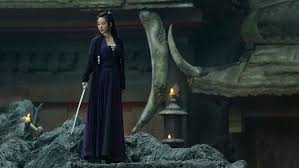
He’s the wild card martial arts wizard tossed into a salad of Song Dynasty shenanigans involving competing cults and sects, supernaturalism, giant silkworms that devour men and women and spit silk webs to trap their prey, a long-imprisoned wizard who might be freed by The Iron Box Key and lots of flying feet and fists.

“The Tai Chi Master” is parked right on the edge of silly, flirting with somber when heroes and heroines die, and truth be told, the plot makes little to no sense. But sequences play and some of the fights are borderline epic. And even if this “Tai Chi Master” is more reliant on CGI sets and effects than the Jet Li/Michelle Yeoh “Tai Chi Master” of 1993, it’s rarely less than watchable even through the dull middle acts.

We meet Junbao in a city under siege, where the Di Clan (Yi Long plays their sadistic leader) is about to storm in thanks to his secret weapon — catapults that hurl commandos in ancient Chinese wingsuits, who sail over the walls to open the gates.

Our hero intevenes with the help of his bratty little girl/martial artist sidekick (Zhang Mingcan)/ Before all is said and slapped, they’ll have a whole lot of wizards and witches to get through to accomplish whatever vague mission he has to finish.

He must fight Man Feng (Ganggang Wang) to lead their clan, fight to escape the clutches of a supernaturally-imprisoned wizard (Simpson Tang), ally himself with the mysterious flutist/warrior Yue Er (Yan Liu) and fight her venomously beautiful opposite number (Ruoxi Li) and others while enduring lectures on the idea that there are “evil” forms of martial arts, and on balancing his own yin and yang in and out of combat.

The first act is the flashiest and the most promising, as our hero shows himself to be the “reluctant hero.” Fighting to save Yeching City is “not my problem” (in Mandarin with English subtitles), “none of my business,” and most importantly, “not my DESTINY.”

OK. We get it.

The effects are quite good, although if you’ve seen one giant worm with a triangular mouth of teeth you’ve seen them all.

The fights can be fun, but all this insistence on weaving Chinese myth and mysticism and indentifying factions bogs the picture down in between throw-downs.

Call it what it is, a B-movie of its type. Crack open a bottle of Junbao’s libation of choice (“Peach wine!”) and ignore the plot and you’ll be fine.

Rating: unrated, fantasy violence, some of it grisly

Cast: Yue Wu, Yan Liu, Ruoxi Li,
Mingcan Zhang, Yi Long and
Kai Zhang

Credits: Directed by Siyi Cheng and Zhenzhao Lin, scripted by Mengmeng Huang and
Huan Niu. A Hi-YAH!/Well Go USA release.

Running time: 1:31

Posted in Reviews, previews, profiles and movie news | Tagged , , , | Comments Off on Movie Review: Martial Arts Magic, Mystery and Mayhem delivered by “The Tai Chi Master”

Netflixable? Teen tries to intervene in a slashing spree — “Time Cut”

There are a couple of extra twists in the time travel conundrun presented in “Time Cut,” a tale of teens terrorized by a mad slasher in small town Minnesota. 2003.

Serious moral choices are faced, in addition to the “can’t change the past without changing the future” paradoxes of such movies.

That’s a good thing, because the slasher movie all this time traveling is attached to is an unintentionally funny bust.

It features a rubber-masked nut-with-a-knife. Yawn. The killer comes at one victim with a grim reaper’s scythe at one point. I mean, come on.

Kids new to the genre experiencing this “Halloween” to “Scream” variation will also get a taste of the most head-slappingly-obvious product placement in recent film history.

If you can’t decide between Oliver Garden or just snacking on a Butterfinger afterwards, you’ll know Netflix’s machinations worked.

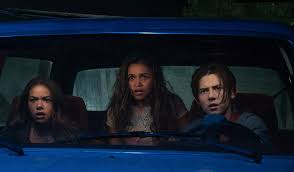
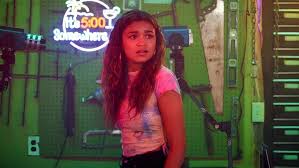
But it’s a slasher star vehicle for “Outer Banks” ingenue Madison Bailey, and she acquits hewrself with honor in a narrative that could not be more generic were it not for her and the whole time traveling thing.

“Time Cut” opens with the final murder in a spree killing. Somebody murdered a handful of teens in Sweetly, Minnesota (it was filmed in and around Winnepeg, Manitoba) back in mid-April of 2003. The killer wore a blonde villain’s mask. Summer (Antonia Gentry) was the last victim.

In 2024, Summer’s sister Lucy (Bailey) lives with the consequences of that before-she-was-born murder. Her parents pay tribute every April 18, and keep Summer’s room as it was, a shrine. Lucy’s town is a shell of what it was back then.

But perhaps that’s why Lucy’s all about the science of getting out. She’s won a NASA summer internship which her fretfully protective parents (Rachel Crawford, Michael Shanks) will never go for.

A flash of light in a barn on the farm where that last murder took place lures Lucy in, where she discovers a TIME MACHINE, you guys! She stumbles into its laser beams, and next thing she knows, she’s stuck in 2003 — a bit too fashion-forward to fit in, with an iPhone that can’t find a connection and beloved science teacher (Jordan Pettle) who has no idea who she is, and is 20 years younger.

And then there’s that perky, popular classmate who turns heads. That would be Summer, still alive as the slashing has yet to begin.

Lucy stumbled across Summer’s letter stash and has some suspicions about who the killer might have been. She can poke around, listen in and make some guesses.

First, though, she’s got to prove how girlhood has changed in 20 years by getting tough and intervening in a school bullying ritual. She’s got to meet the smartest kid in school, science nerd Quinn (Griffin Gluck), the one person who might buy in to her crazy story.

She’s got to subject herself to new bestie Summer’s makeover montage and condition herself to enjoy the girl pop of Vanessa Carlton, Hillary Duff and Avril Lavigne.

Go to the cops? That wouldn’t help this little-effort-involved plot. Lucy and Summer’s dad’s place of employment is so convenient to the narrative that it might provoke a laugh.

Otherwise, there isn’t much humor ro this, “Marty McFly” references included. Every dangerous situation is set-up so obviously as to scream “CONTRIVED.” Legions of “Scream” movies have ridiculed these conventions and the genre’s most obvious turns.

But the moral quandary of who to save or try to save, who to let die or who to kill is almost interesting.

Not that any of the young cast brings much to the shock, grief and terror everybody in Sweetly High should be experiencing when the murderous mayhem starts. Only Bailey comes close to adding that to her character’s emotional repertoire. And “close” here just doens’t cut it.

Rating: TV-14, violence

Cast: Madison Bailey, Antonia Gentry, Griffin Gluck, Samuel Braun and Megan Best.

Credits: Directed by Hannah Macpherson, scripted by Michael Kennedy and Hannah Macpherson. A Netflix release.

Running time: 1:31

Posted in Reviews, previews, profiles and movie news | Comments Off on Netflixable? Teen tries to intervene in a slashing spree — “Time Cut”

Movie Preview: Tilda Swinton, Michael Shannon, George MacKay, “The End”

This one has me intrigued. A small cast of survivors,  including Moses Ingram, sing through the Apocalypse.

Dec. 6.

Posted in Reviews, previews, profiles and movie news | Comments Off on Movie Preview: Tilda Swinton, Michael Shannon, George MacKay, “The End”

Movie Preview: Ken Jeong moves the Fam to rural Wyoming — “A Great Divide”

San Fran sophisticates experience culture shock and xenophobia out in the Red State West.

Dr. Ken does his thing. Could be cute and biting.

Posted in Reviews, previews, profiles and movie news | Comments Off on Movie Preview: Ken Jeong moves the Fam to rural Wyoming — “A Great Divide”

Movie Review: Liev Schreiber broods beautifully in Hemingway’s “Across the River and Into the Trees”

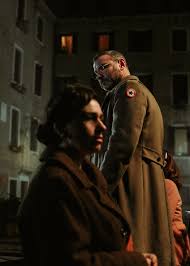
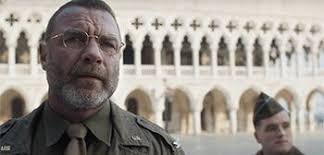
“Across the River and Into the Treespresents Liev Schreiber as the latest Ernest Hemingway literary alter ego to make it to the screen, and perhaps the best ever at capturing the world weariness of the late life, post-World War II “Papa” of American literature and legend.

A stately, pristine period piece, it’s a classic “fall film” in its themes, tone and appeal. Beautifully acted and handsomely mounted, it leans into its sadness and its seriousness.

It’s unapologetically a movie for grownups, folks who have read some books, traveled a bit, tasted the wine and lived the opera that life presented to them.

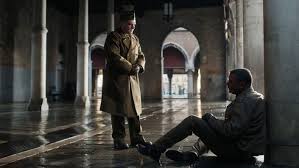
Set a few years after World War II and before the death of “Uncle Joe” Stalin, at the birth of the Cold War, it’s about an old soldier undertaking one last mission — a “duck hunt” in the marshes off Venice, Italy.

But we get the news that Col. Cantwell (Schreiber) has probably suspected for many months, that he’s dying and those nitroglycerin pills he takes for his chest pains won’t be enough. His Army doctor (Danny Huston, perfect as always) barks about the hospital Cantell needs to be in “NOW. Today!”

But not before this drive down to Venice. After that, “I’ll let you prolong my life as much as you’d like.”

Captain O’Neill (Huston) assigns him a driver for his Cadillac convertible, against Cantwell’s wishes. The young sergeant (Josh Hutcherson) isn’t proper “GI” in his decorum around a superior officer. Blame the hero worship. Everybody seems to know Col. Richard Cantwell, who “fought in two World Wars, the “grunt’s” grunt, a real combat soldier. Cantwell can’t wait to ditch the kid.

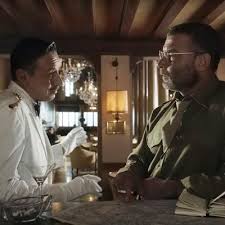
That fame goes for Venice, as well. Cantwell has a favorite hotel, the Gritti Palace. And everybody, from the Gran Maestro (majordomo, played by Enzo Cilenti) to the barman knows the Col., his favorite drink (martini) and his unusual requirements.

He wants a boat, for duck hunting. H needs duck decoys. And he requires a couple of fowling pieces, shotguns for shooting ducks. Those can be acquired from a widowed contessa (Laura Morante) whose ancient, titled family is a bit short of cash. That negotiation will require more than one visit and a bit of “begging” to help her save face.

Perhaps the fact that Cantwell’s met her beautiful, young and newly-engaged daughter Renata (Matilda de Angelis), will help. She delivered him to the hotel on the family motorboat. Her love of America and indifference to her arranged engagement to a son of wealth means she’ll take an interest in this older man, and he’ll indulge in a paternal flirtation.

But there are still plenty of fascists around and “toy soldier” Italians who don’t like Americans in uniform asking questions. Because Cantwell’s got something other than ducks he’s hunting.

Director Paula Ortiz (“Teresa,” “The Bride”) and veteran British screenwriter Peter Flannery (“The One and Only”) take their time with this tale, immersing us in this life and in this world of luxury and first class travel unblemished by the recent war.

Hemingway fans will relish this taste of how journalists remember Hemingway as a “war correspondent” — looking for action, insisting on the finer things at the end of every day, “combat zone” be damned.

There’s no hint of shortages, no suggestion of Venetian privation greeting the American with his big black Cadillac and love of fine firearms and the perfect martini.

Schreiber gives us a Papa avatar who has seen the wars and fought in them, a man of experience, culture — he stops and makes his sergeant-driver appreciate half-ruined frescoes in an ancient, bombed-out cathedral — and confidence. He’s got little patience for this kid his doctor has assigned as his minder, except as someone to lord over, dismiss or mentor. Cantwell drawls his disappointment at the lad’s lack of push-back at his dismissal.

“For a minute there, I though you had some lead in your pencil.”

Schreiber is magnificent in the part, understated, his beard peppered with white and his eyes giving away the world weariness of a man who has seen much, processed it and is just cynical enough to wonder what it all was for.

War? “It’s a business.”

And mortality?

“I have death sewn into the lining of my clothes.”

Like “Old Man and the Sea” and “Islands in the Stream,” the narrative embraces the Hemingway legend much as the author mixed in his real life in his fiction, identifying with older men as he aged into the relic he most feared becoming.

“Across the River and Into the Trees” is sedate to the point of “slow,” old fashioned to a degree that will feel dated, and yet every minute of it — every gorgeous image, every twist and turn, even the predictable ones — is to be savored.

Rating: unrated, bloody combat, smoking, profanity

Cast: Lieve Schreiber, Matilda de Angelis, Josh Hutcherson, Laura Morante, Enzo Cilenti and Danny Huston

Credits: Directed by Paula Ortiz, scripted by Peter Flannery, based on the novel by Ernest Hemingway. A Level 33 release.

Running time: 1:47

Posted in Reviews, previews, profiles and movie news | Tagged , , , , , | 2 Comments

Classic Film Review: Welles’ “Othello,” a Masterpiece in Black and White and Blackface

The lore and backstory behind Orson Welles‘ years-in-the-making production of “The Tragedy of Othello, the Moor of Venice” has come to overwhelm the movie itself.

He was so strapped for funds, filming this in Europe as his American directing career was all but finished, that it shooting and editing “Othello” took three years.

Actors came and went with the ebb and flow of production cash.

Money ran out and he lost access to a ready supply of costumes more than once. So he shot the murder of Cassio in an old Turkish bath, where costumes could be optional, or at least simple.

He couldn’t afford to film in Venice itself, cheap as that might have been in the post-war years. So he shot the movie in the stunning, off-the-tourist track, largely unchanged Medieval port of Mogador, Morroco.

The production could never have afforded to rebuild Medieval warships for the port of Venice. So Welles stuck poles as masts behind the battlements, hanging billowing sheets as stylized sails, and filmed that from just the right distance.

When people talk of the “genius” of Welles as a filmmaker, they may start with the wizardry of “Citizen Kane” and the sizzling camera technique of “Touch of Evil.” But it’s this improvising, wrangling a moody “Macbeth” out of a B-movie studio known for Westerns (lots of horses), filming Kafka’s “The Trial” in an abandoned Paris train station, piecing together locations, performances and chunks of Shakespeare plays for his masterful Falstaff turn, “Chimes at Midnight” and whipping up a stirring and stunningly, ruthlessly brisk (he cut and cut the Shakespeare script) “Othello” that shows real genius and makes his version a touchstone for how to tackle this play.

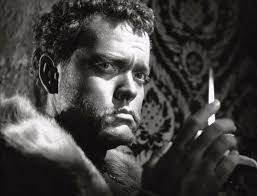
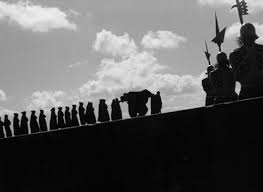
It is one of his most striking black and white films, with every exterior shot stark and beautiful, often shot from a low angle, emphasizing architecture and piercing Mediterranean skies that look production designed to suit. Crowds are filmed in closeup, hiding their size but emphasizing movement, turmoil and roiled emotions. And characters are captured in intimate closeups, by turns underscoring doubt, “the green-eyed monster” of jealousy, confusion and venality at its most sinister.

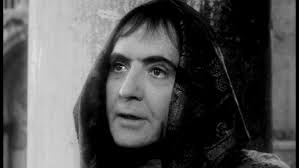
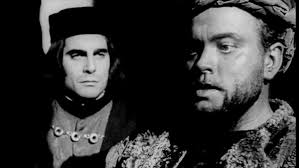
Welles immortalized two of his earliest influences, the Irish actors and founders of the Gate Theatre in Dublin, givingmMicheál MacLiammóir his lone great film role as the villainous Iago, and making MacLiammóir’s longtime life-and-theater partner, Hilton Edwards the role of Brabantio, Desdemona’s father.

Wellesians know them as the two gay thespians who either were taken in by teenage Orson’s bravado, showing up at their door claiming to be a “famous American actor,” or charmed by his lying bluster.

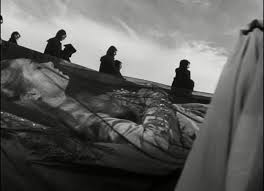
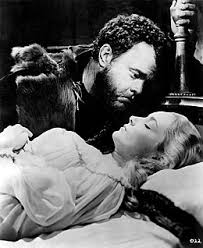
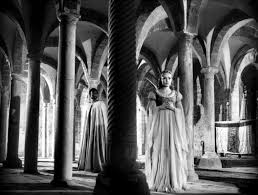
Welles opens the film with a dazzling prologue of images, setting the scene, showing the Moorish general Othello in his coffin and his young bride, Desdemona (Suzanne Cloutier) borne to her burial by black-robed monks.

We know how the story ends. We see Iago caged, facing justice. The movie thus turns this tragic tale into a long flashback. How did it all end like this?

Racism is suggested, as the respected and noble Othello has secretly fallen for Desdemona, and she for him. Her father doesn’t approve but the city needs Othello’s military prowess.

Look to her, Moor, if thou hast eyes to see. She has deceived her father, and may thee. I do perceive a divided city.”

 Iago is jealous, resentful, and bristles at how his privilege has earned him little more than the status of “ensign” to the acclaimed Othello.

“I hate the Moor!”

With his aide Roderigo (Robert Coote, his voice re-dubbed by Welles himself), Iago conspires to use jealousy to take out Othello and another rival Cassio (Michael Laurence). He will start a whispering campaign that Cassio is sleeping with Desdemona.

Othello, with some doubt yet with rising fury, is soon convinced.

The story passes by in a Shakespearean sprint. We barely have time to register the unique settings and costume flourishes amidst the dastardly machinations of Iago, the hapless drunken entrapment of Cassio, the protestations of Desdemona and the rising fury of Othello.

Welles preserves the poetic language and blunt-instrument plot of Shakespeare and rushes us past anything less important. A tag team of cinematographers serves Welles’ vision for an “Othello” in motion in a location preserved in amber. Stunning image after stunning image shows Welles’ sure hand with camera placement and blocking.

Every “Othello” has something to say and has its own merits, even the reset-in-an-American-high- school adaptation “O.” This version, if not definitive thanks to its many cuts, simply bowls you over with its brutal beauty.

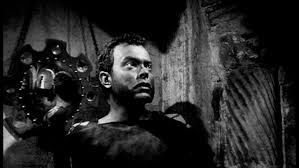
But no Welles fan can confront the film without wrestling with the Shakespearean “tradition” of casting a white leading man, who then performs the role in makeup of varying quality even if here it is too subtle and polished to merit the label “blackface.” That is, to say the least, problematic.

This practice endured well into the world’s “civil rights” years, with Laurence Olivier’s “Othello” (1965) allowing Lord Larry to indulge in face painting that is almost minstrel show cringey. Welles’ makeup here doesn’t call attention to itself as much as you’d expect, and pairing the look with his brooding presence and sonorous voice make it the least offensive “blackface” version of the film, for what that’s worth.

But Welles knew Black actors, and whatever financing issues this no-budget classic faced, it’s within reason to ask why he didn’t try to enlist if not a Paul Robeson, then a Black acting “discovery.”

Welles made his name as an American theater director with his famed “Voodoo Macbeth,” a groundbreaking 1937 New York stage production with an all African-American cast that created a sensation and struck a blow for civil rights. He was an outspoken civil rights activist on the radio in the World War II years. He threw away his career indulging in South American “diplomacy” attempting to finish his docu-drama “It’s All True,” with Mexican and Afro-Brazilian actors and settings during World War II.

And yet the man never cast an African American actor in any role of note in any film before or after that.

Perhaps no Welles film invites “Well, which VERSION did you see?” quibbling like “Othello,” with the movie having a 1952 Cannes version, which was shown (dubbed into Italian) in Italy, the released version in the U.S. and U.K. from 1955, and the beautifully watchable “restored” version which Welles’ daughter Beatrice supervised in 1992.

That’s the one I first saw at an art cinema in Madrid in ’92, and the one now on Tubi and other streaming services. It’s worth it for the polished sound — most of Welles’ over-dubbing of other actors is removed for the cleaned-up original performances — and pristine images, and is not appreciably shorter than any other one, with Welles narrating the opening here rather than reciting the opening credits as he did in the Cannes “original.”

It’s not worth quibbling over any “lost” version of the film for those reasons. Watching Welles’ unrestored later films projected in class during my grad-school days underscored how sound was always a mess in Welles’ hardscrabble years, and getting that right in restoring “Othello” was paramount.

Any restoration that allows one to experience an “Othello” this beautiful and brisk in crisp clear images and words is to be embraced for what it is — the ultimate “bucket list” Welles Shakespeare adaptation.

Rating: TV-PG, violence

Cast: Orson Welles, Suzanne Cloutier, Micheál MacLiammóir, Robert Coote, Hilton Edwards, Michael Laurence and Fay Compton

Credits: Scripted and directed by Orson Welles, with contributions by Jean Sacha, based on the play by William Shakespeare. A Mercury Productions/Castle Hill release on Tubi.

Running time: 1:33

Posted in Reviews, previews, profiles and movie news | Tagged , , , , , , , | Comments Off on Classic Film Review: Welles’ “Othello,” a Masterpiece in Black and White and Blackface

Movie Preview: Ben Kingsley makes a scary overture to “William Tell”

Switzerland’s mythic hero, subject of a Frederich Schiller play nobody produces and Rossini opera nobody presents and yet whose overture is one of the most famous warhorses (classics everybody knows) in classical music, gets another Swiss “Robin Hood” style film treatment (he’s been the subject of TV series as well), with Kingsley the villain and Claes Bang in the title role.

Golshifteh Farahani, Emily Beechum, Rafe Spall, Ellie Bamber and Jonathan Pryce also star.

Looks like the release date of this Swiss epic is early 2025.

Posted in Reviews, previews, profiles and movie news | Comments Off on Movie Preview: Ben Kingsley makes a scary overture to “William Tell”

BOX OFFICE: “Venom” loses HALF of its fangs, “Here” is barely There, “Absolution” can’t pay for its sins

A steep drop-off for the final film of Tom Hardy’s “Venom” trilogy was always in order. These movies have sucked, and by the second weekend, the supply of filmgoers who might go plunges and “repeat business,” even for comic book fangirls and fanboys, was never a “Venom” thing.

Projections suggested a 60%+ plunge, maybe $19 million on its second weekend for “Venom: The Last Dance.” That’s what Deadline.com saws based on Thursday night and Friday’s take.

But Tom Harby & Co. pulled a surprise out of their hats, because whatever letdown opening weekend was (Low $50s, when it projected in mid-$60s), they managed a robust $26 million+, according to @thenumbers Sunday report.

“The Wild Robot” continues its steady march into the $120-140 million range, a good movie that should have opened bigger, but which is finding its family audience, one weekend at a time. Another $7.5 in the bank for that one.

“Smile 2” will clear the $50 million mark if it achieves the $6.8 million (@thenumbers) its projected to pull in this first weekend in November. It won’t match the all-in take that “Smile” managed, but $62-65 million should be in the bank when it leaves theaters for good.

November is traditionally the start of holiday blockbuster season, but “Red One,” “Gladiator” and “Wicked” are coming later, perhaps fearing “Venom” devouring all the screens. That’s a bad move, as this fall has been starved for big box office content. “Beetlejuice” is the one, true books-balancing smash that theater chains have needed.

The big opening this weekend isn’t by any stretch “big.” “Here” is a Miramax film that Sony is rolling out, a Bob Zemeckis gimmick movie where the hook is pairing up his “Forrest Gump” romantic leads, Tom Hanks and Robin Wright, and shaving 40-45 years off them as we follow their relationship — and several others — through time.

Paul Bettany and Kelly O’Reilly get a bit of digitizing, too, in this adaptation of a comic turned graphic novel about a piece of New Jersey, seen as T-Rexes stampede through it, Native Americans settle it, Ben Franklin’s estranged son builds a mansion on it and later, a house is built across the street and assorted couples make lives, make their fortunes, and bury members of their families there.

It’s sentimental, structurally misshapen, and unsatisfying. “Here” is also a bomb, falling short of the middling $7 million it was supposed to pull in. $5 million, Deadline says. I saw it in a nearly empty theater Thursday. That Boomer demographic it needs to succeed may turn up Sat and Sunday, but not bloody likely.

Reviews have been brutal. It’s maudlin and cloying and claustrophic (London soundstages and greenscreens) and it’s bad enough to remind the viewer that nearly every Zemeckis movie — even the good ones — have relied on some gadget, trick or stunt in the production. Sometimes they work. Sometimes performances transcend the trickery. And sometimes even that is illusory.

Seen “Forrest Gump” recently? Listen for what Zemeckis does with the “Original Hits, Original Stars” soundtrack. On-the-nose pop that bludgens the “point” of every scene until it bleeds. Once you start hearing or noticing lazy touches like that, you can’t unhear or unsee them.

Michelle Dockery stuck back in the 1910s again must have been a deflating offer of a role to play, but she did it. Zemeckis gave his daughter a plum part in it, too. Nepotism never helps.

Ralph Fiennes’ Papal politicking thriller “Conclave” is doing well, with a whiff of Awards Season cachet attached to its story of archbishops backbiting and intriguing to select a new pope. It’s on track to earn another $4 million and change and should clear $20 million by the end of next weekend. You need to see it. It’s one of the best pictures of the year.

I watched about 45 minutes of Sean Baker’s “Anora” before ducking into “Absolution.” All that sex and nudity was bound to keep selling tickets. It’ll pull in another $1.75 million this weekend, so I’ll have to sit down and watch all 2:20 of it, though I’m damned if I can see how they stretch that story out over that much running time.

Liam Neeson’s latest action pic could be his last go-round as that “Taken” era avenger. “Absolution,” released by Samuel Goldwyn, tries to be deeper, higher-minded, and fails. Pairing Liam and Ron Perlman was a good idea, but it’s gassed and Neeson’s beatdowns these days have the air of “Let the stuntman do it” because our 70something leading man isn’t as credible, or as capable, as any of us would be at that age. Maybe $1.1 million for that one.

It’s not cracking the top five (I saw it in an empty Thursday night theater).

The animated misfire “Hitpig!” is based on a Berkeley “Bloom County” Breathed book and script, featuring the voices of Jason Sudeikis and RuPaul and Rainn Wilson and Lily Singh won’t reach $1 million.

As always, I’ll update these figures as the weekend progresses and more data makes the picture clearer.

Posted in Reviews, previews, profiles and movie news | Tagged , , , , , , , , | Comments Off on BOX OFFICE: “Venom” loses HALF of its fangs, “Here” is barely There, “Absolution” can’t pay for its sins

N.C. Symphony concert night, because Cinephiles love Holst

There were only eight known planets in the solar system when Gustav Holst composed his orchestral suite, consisting of seven tone poems (leaving out Earth, and before Neil DeGrasse Tyson killed “Pluto”) in the middle of World War I.

This is one of the great “chestnuts” or “war horses” of classical music. Those are the “greatest hits” of this world, ones trotted out by orchestras far and wide when they’re in need of a crowd-pleaser.

Lucas lore has it that George L. used Gustav Holst’s “The Planets” as his temp score and “inspiration” in editing “Star Wars,” and that John Williams paid homage to the thundering themes of this towering work, as well as the music Erich Wolfgang Korngold composed for the Ronald Reagan melodrama “King’s Row” when Williams put together his score.

You can REALLY hear “Star Wars” aborning in the martial thumping of “Mars.” A great orchestra pins you in your seat when they perform it. But there are hints of Williams’ inspiration in several of the separate tone poems.

This damned good symphony orchestra will refresh one’s memories of these connections, I suspect.

Posted in Reviews, previews, profiles and movie news | Comments Off on N.C. Symphony concert night, because Cinephiles love Holst