Movie Review: Liev Schreiber broods beautifully in Hemingway’s “Across the River and Into the Trees”

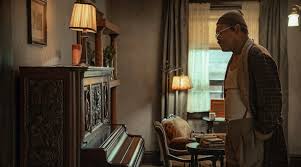
“Across the River and Into the Treespresents Liev Schreiber as the latest Ernest Hemingway literary alter ego to make it to the screen, and perhaps the best ever at capturing the world weariness of the late life, post-World War II “Papa” of American literature and legend.

A stately, pristine period piece, it’s a classic “fall film” in its themes, tone and appeal. Beautifully acted and handsomely mounted, it leans into its sadness and its seriousness.

It’s unapologetically a movie for grownups, folks who have read some books, traveled a bit, tasted the wine and lived the opera that life presented to them.

Set a few years after World War II and before the death of “Uncle Joe” Stalin, at the birth of the Cold War, it’s about an old soldier undertaking one last mission — a “duck hunt” in the marshes off Venice, Italy.

But we get the news that Col. Cantwell (Schreiber) has probably suspected for many months, that he’s dying and those nitroglycerin pills he takes for his chest pains won’t be enough. His Army doctor (Danny Huston, perfect as always) barks about the hospital Cantell needs to be in “NOW. Today!”

But not before this drive down to Venice. After that, “I’ll let you prolong my life as much as you’d like.”

Captain O’Neill (Huston) assigns him a driver for his Cadillac convertible, against Cantwell’s wishes. The young sergeant (Josh Hutcherson) isn’t proper “GI” in his decorum around a superior officer. Blame the hero worship. Everybody seems to know Col. Richard Cantwell, who “fought in two World Wars, the “grunt’s” grunt, a real combat soldier. Cantwell can’t wait to ditch the kid.

That fame goes for Venice, as well. Cantwell has a favorite hotel, the Gritti Palace. And everybody, from the Gran Maestro (majordomo, played by Enzo Cilenti) to the barman knows the Col., his favorite drink (martini) and his unusual requirements.

He wants a boat, for duck hunting. H needs duck decoys. And he requires a couple of fowling pieces, shotguns for shooting ducks. Those can be acquired from a widowed contessa (Laura Morante) whose ancient, titled family is a bit short of cash. That negotiation will require more than one visit and a bit of “begging” to help her save face.

Perhaps the fact that Cantwell’s met her beautiful, young and newly-engaged daughter Renata (Matilda de Angelis), will help. She delivered him to the hotel on the family motorboat. Her love of America and indifference to her arranged engagement to a son of wealth means she’ll take an interest in this older man, and he’ll indulge in a paternal flirtation.

But there are still plenty of fascists around and “toy soldier” Italians who don’t like Americans in uniform asking questions. Because Cantwell’s got something other than ducks he’s hunting.

Director Paula Ortiz (“Teresa,” “The Bride”) and veteran British screenwriter Peter Flannery (“The One and Only”) take their time with this tale, immersing us in this life and in this world of luxury and first class travel unblemished by the recent war.

Hemingway fans will relish this taste of how journalists remember Hemingway as a “war correspondent” — looking for action, insisting on the finer things at the end of every day, “combat zone” be damned.

There’s no hint of shortages, no suggestion of Venetian privation greeting the American with his big black Cadillac and love of fine firearms and the perfect martini.

Schreiber gives us a Papa avatar who has seen the wars and fought in them, a man of experience, culture — he stops and makes his sergeant-driver appreciate half-ruined frescoes in an ancient, bombed-out cathedral — and confidence. He’s got little patience for this kid his doctor has assigned as his minder, except as someone to lord over, dismiss or mentor. Cantwell drawls his disappointment at the lad’s lack of push-back at his dismissal.

“For a minute there, I though you had some lead in your pencil.”

Schreiber is magnificent in the part, understated, his beard peppered with white and his eyes giving away the world weariness of a man who has seen much, processed it and is just cynical enough to wonder what it all was for.

War? “It’s a business.”

And mortality?

“I have death sewn into the lining of my clothes.”

Like “Old Man and the Sea” and “Islands in the Stream,” the narrative embraces the Hemingway legend much as the author mixed in his real life in his fiction, identifying with older men as he aged into the relic he most feared becoming.

“Across the River and Into the Trees” is sedate to the point of “slow,” old fashioned to a degree that will feel dated, and yet every minute of it — every gorgeous image, every twist and turn, even the predictable ones — is to be savored.

Rating: unrated, bloody combat, smoking, profanity

Cast: Lieve Schreiber, Matilda de Angelis, Josh Hutcherson, Laura Morante, Enzo Cilenti and Danny Huston

Credits: Directed by Paula Ortiz, scripted by Peter Flannery, based on the novel by Ernest Hemingway. A Level 33 release.

Running time: 1:47

Posted in Reviews, previews, profiles and movie news | Tagged , , , , , | 2 Comments

Classic Film Review: Welles’ “Othello,” a Masterpiece in Black and White and Blackface

The lore and backstory behind Orson Welles‘ years-in-the-making production of “The Tragedy of Othello, the Moor of Venice” has come to overwhelm the movie itself.

He was so strapped for funds, filming this in Europe as his American directing career was all but finished, that it shooting and editing “Othello” took three years.

Actors came and went with the ebb and flow of production cash.

Money ran out and he lost access to a ready supply of costumes more than once. So he shot the murder of Cassio in an old Turkish bath, where costumes could be optional, or at least simple.

He couldn’t afford to film in Venice itself, cheap as that might have been in the post-war years. So he shot the movie in the stunning, off-the-tourist track, largely unchanged Medieval port of Mogador, Morroco.

The production could never have afforded to rebuild Medieval warships for the port of Venice. So Welles stuck poles as masts behind the battlements, hanging billowing sheets as stylized sails, and filmed that from just the right distance.

When people talk of the “genius” of Welles as a filmmaker, they may start with the wizardry of “Citizen Kane” and the sizzling camera technique of “Touch of Evil.” But it’s this improvising, wrangling a moody “Macbeth” out of a B-movie studio known for Westerns (lots of horses), filming Kafka’s “The Trial” in an abandoned Paris train station, piecing together locations, performances and chunks of Shakespeare plays for his masterful Falstaff turn, “Chimes at Midnight” and whipping up a stirring and stunningly, ruthlessly brisk (he cut and cut the Shakespeare script) “Othello” that shows real genius and makes his version a touchstone for how to tackle this play.

It is one of his most striking black and white films, with every exterior shot stark and beautiful, often shot from a low angle, emphasizing architecture and piercing Mediterranean skies that look production designed to suit. Crowds are filmed in closeup, hiding their size but emphasizing movement, turmoil and roiled emotions. And characters are captured in intimate closeups, by turns underscoring doubt, “the green-eyed monster” of jealousy, confusion and venality at its most sinister.

Welles immortalized two of his earliest influences, the Irish actors and founders of the Gate Theatre in Dublin, givingmMicheál MacLiammóir his lone great film role as the villainous Iago, and making MacLiammóir’s longtime life-and-theater partner, Hilton Edwards the role of Brabantio, Desdemona’s father.

Wellesians know them as the two gay thespians who either were taken in by teenage Orson’s bravado, showing up at their door claiming to be a “famous American actor,” or charmed by his lying bluster.

Welles opens the film with a dazzling prologue of images, setting the scene, showing the Moorish general Othello in his coffin and his young bride, Desdemona (Suzanne Cloutier) borne to her burial by black-robed monks.

We know how the story ends. We see Iago caged, facing justice. The movie thus turns this tragic tale into a long flashback. How did it all end like this?

Racism is suggested, as the respected and noble Othello has secretly fallen for Desdemona, and she for him. Her father doesn’t approve but the city needs Othello’s military prowess.

Look to her, Moor, if thou hast eyes to see. She has deceived her father, and may thee. I do perceive a divided city.”

 Iago is jealous, resentful, and bristles at how his privilege has earned him little more than the status of “ensign” to the acclaimed Othello.

“I hate the Moor!”

With his aide Roderigo (Robert Coote, his voice re-dubbed by Welles himself), Iago conspires to use jealousy to take out Othello and another rival Cassio (Michael Laurence). He will start a whispering campaign that Cassio is sleeping with Desdemona.

Othello, with some doubt yet with rising fury, is soon convinced.

The story passes by in a Shakespearean sprint. We barely have time to register the unique settings and costume flourishes amidst the dastardly machinations of Iago, the hapless drunken entrapment of Cassio, the protestations of Desdemona and the rising fury of Othello.

Welles preserves the poetic language and blunt-instrument plot of Shakespeare and rushes us past anything less important. A tag team of cinematographers serves Welles’ vision for an “Othello” in motion in a location preserved in amber. Stunning image after stunning image shows Welles’ sure hand with camera placement and blocking.

Every “Othello” has something to say and has its own merits, even the reset-in-an-American-high- school adaptation “O.” This version, if not definitive thanks to its many cuts, simply bowls you over with its brutal beauty.

But no Welles fan can confront the film without wrestling with the Shakespearean “tradition” of casting a white leading man, who then performs the role in makeup of varying quality even if here it is too subtle and polished to merit the label “blackface.” That is, to say the least, problematic.

This practice endured well into the world’s “civil rights” years, with Laurence Olivier’s “Othello” (1965) allowing Lord Larry to indulge in face painting that is almost minstrel show cringey. Welles’ makeup here doesn’t call attention to itself as much as you’d expect, and pairing the look with his brooding presence and sonorous voice make it the least offensive “blackface” version of the film, for what that’s worth.

But Welles knew Black actors, and whatever financing issues this no-budget classic faced, it’s within reason to ask why he didn’t try to enlist if not a Paul Robeson, then a Black acting “discovery.”

Welles made his name as an American theater director with his famed “Voodoo Macbeth,” a groundbreaking 1937 New York stage production with an all African-American cast that created a sensation and struck a blow for civil rights. He was an outspoken civil rights activist on the radio in the World War II years. He threw away his career indulging in South American “diplomacy” attempting to finish his docu-drama “It’s All True,” with Mexican and Afro-Brazilian actors and settings during World War II.

And yet the man never cast an African American actor in any role of note in any film before or after that.

Perhaps no Welles film invites “Well, which VERSION did you see?” quibbling like “Othello,” with the movie having a 1952 Cannes version, which was shown (dubbed into Italian) in Italy, the released version in the U.S. and U.K. from 1955, and the beautifully watchable “restored” version which Welles’ daughter Beatrice supervised in 1992.

That’s the one I first saw at an art cinema in Madrid in ’92, and the one now on Tubi and other streaming services. It’s worth it for the polished sound — most of Welles’ over-dubbing of other actors is removed for the cleaned-up original performances — and pristine images, and is not appreciably shorter than any other one, with Welles narrating the opening here rather than reciting the opening credits as he did in the Cannes “original.”

It’s not worth quibbling over any “lost” version of the film for those reasons. Watching Welles’ unrestored later films projected in class during my grad-school days underscored how sound was always a mess in Welles’ hardscrabble years, and getting that right in restoring “Othello” was paramount.

Any restoration that allows one to experience an “Othello” this beautiful and brisk in crisp clear images and words is to be embraced for what it is — the ultimate “bucket list” Welles Shakespeare adaptation.

Rating: TV-PG, violence

Cast: Orson Welles, Suzanne Cloutier, Micheál MacLiammóir, Robert Coote, Hilton Edwards, Michael Laurence and Fay Compton

Credits: Scripted and directed by Orson Welles, with contributions by Jean Sacha, based on the play by William Shakespeare. A Mercury Productions/Castle Hill release on Tubi.

Running time: 1:33

Posted in Reviews, previews, profiles and movie news | Tagged , , , , , , , | Comments Off on Classic Film Review: Welles’ “Othello,” a Masterpiece in Black and White and Blackface

Movie Preview: Ben Kingsley makes a scary overture to “William Tell”

Switzerland’s mythic hero, subject of a Frederich Schiller play nobody produces and Rossini opera nobody presents and yet whose overture is one of the most famous warhorses (classics everybody knows) in classical music, gets another Swiss “Robin Hood” style film treatment (he’s been the subject of TV series as well), with Kingsley the villain and Claes Bang in the title role.

Golshifteh Farahani, Emily Beechum, Rafe Spall, Ellie Bamber and Jonathan Pryce also star.

Looks like the release date of this Swiss epic is early 2025.

Posted in Reviews, previews, profiles and movie news | Comments Off on Movie Preview: Ben Kingsley makes a scary overture to “William Tell”

BOX OFFICE: “Venom” loses HALF of its fangs, “Here” is barely There, “Absolution” can’t pay for its sins

A steep drop-off for the final film of Tom Hardy’s “Venom” trilogy was always in order. These movies have sucked, and by the second weekend, the supply of filmgoers who might go plunges and “repeat business,” even for comic book fangirls and fanboys, was never a “Venom” thing.

Projections suggested a 60%+ plunge, maybe $19 million on its second weekend for “Venom: The Last Dance.” That’s what Deadline.com saws based on Thursday night and Friday’s take.

But Tom Harby & Co. pulled a surprise out of their hats, because whatever letdown opening weekend was (Low $50s, when it projected in mid-$60s), they managed a robust $26 million+, according to @thenumbers Sunday report.

“The Wild Robot” continues its steady march into the $120-140 million range, a good movie that should have opened bigger, but which is finding its family audience, one weekend at a time. Another $7.5 in the bank for that one.

“Smile 2” will clear the $50 million mark if it achieves the $6.8 million (@thenumbers) its projected to pull in this first weekend in November. It won’t match the all-in take that “Smile” managed, but $62-65 million should be in the bank when it leaves theaters for good.

November is traditionally the start of holiday blockbuster season, but “Red One,” “Gladiator” and “Wicked” are coming later, perhaps fearing “Venom” devouring all the screens. That’s a bad move, as this fall has been starved for big box office content. “Beetlejuice” is the one, true books-balancing smash that theater chains have needed.

The big opening this weekend isn’t by any stretch “big.” “Here” is a Miramax film that Sony is rolling out, a Bob Zemeckis gimmick movie where the hook is pairing up his “Forrest Gump” romantic leads, Tom Hanks and Robin Wright, and shaving 40-45 years off them as we follow their relationship — and several others — through time.

Paul Bettany and Kelly O’Reilly get a bit of digitizing, too, in this adaptation of a comic turned graphic novel about a piece of New Jersey, seen as T-Rexes stampede through it, Native Americans settle it, Ben Franklin’s estranged son builds a mansion on it and later, a house is built across the street and assorted couples make lives, make their fortunes, and bury members of their families there.

It’s sentimental, structurally misshapen, and unsatisfying. “Here” is also a bomb, falling short of the middling $7 million it was supposed to pull in. $5 million, Deadline says. I saw it in a nearly empty theater Thursday. That Boomer demographic it needs to succeed may turn up Sat and Sunday, but not bloody likely.

Reviews have been brutal. It’s maudlin and cloying and claustrophic (London soundstages and greenscreens) and it’s bad enough to remind the viewer that nearly every Zemeckis movie — even the good ones — have relied on some gadget, trick or stunt in the production. Sometimes they work. Sometimes performances transcend the trickery. And sometimes even that is illusory.

Seen “Forrest Gump” recently? Listen for what Zemeckis does with the “Original Hits, Original Stars” soundtrack. On-the-nose pop that bludgens the “point” of every scene until it bleeds. Once you start hearing or noticing lazy touches like that, you can’t unhear or unsee them.

Michelle Dockery stuck back in the 1910s again must have been a deflating offer of a role to play, but she did it. Zemeckis gave his daughter a plum part in it, too. Nepotism never helps.

Ralph Fiennes’ Papal politicking thriller “Conclave” is doing well, with a whiff of Awards Season cachet attached to its story of archbishops backbiting and intriguing to select a new pope. It’s on track to earn another $4 million and change and should clear $20 million by the end of next weekend. You need to see it. It’s one of the best pictures of the year.

I watched about 45 minutes of Sean Baker’s “Anora” before ducking into “Absolution.” All that sex and nudity was bound to keep selling tickets. It’ll pull in another $1.75 million this weekend, so I’ll have to sit down and watch all 2:20 of it, though I’m damned if I can see how they stretch that story out over that much running time.

Liam Neeson’s latest action pic could be his last go-round as that “Taken” era avenger. “Absolution,” released by Samuel Goldwyn, tries to be deeper, higher-minded, and fails. Pairing Liam and Ron Perlman was a good idea, but it’s gassed and Neeson’s beatdowns these days have the air of “Let the stuntman do it” because our 70something leading man isn’t as credible, or as capable, as any of us would be at that age. Maybe $1.1 million for that one.

It’s not cracking the top five (I saw it in an empty Thursday night theater).

The animated misfire “Hitpig!” is based on a Berkeley “Bloom County” Breathed book and script, featuring the voices of Jason Sudeikis and RuPaul and Rainn Wilson and Lily Singh won’t reach $1 million.

As always, I’ll update these figures as the weekend progresses and more data makes the picture clearer.

Posted in Reviews, previews, profiles and movie news | Tagged , , , , , , , , | Comments Off on BOX OFFICE: “Venom” loses HALF of its fangs, “Here” is barely There, “Absolution” can’t pay for its sins

N.C. Symphony concert night, because Cinephiles love Holst

There were only eight known planets in the solar system when Gustav Holst composed his orchestral suite, consisting of seven tone poems (leaving out Earth, and before Neil DeGrasse Tyson killed “Pluto”) in the middle of World War I.

This is one of the great “chestnuts” or “war horses” of classical music. Those are the “greatest hits” of this world, ones trotted out by orchestras far and wide when they’re in need of a crowd-pleaser.

Lucas lore has it that George L. used Gustav Holst’s “The Planets” as his temp score and “inspiration” in editing “Star Wars,” and that John Williams paid homage to the thundering themes of this towering work, as well as the music Erich Wolfgang Korngold composed for the Ronald Reagan melodrama “King’s Row” when Williams put together his score.

You can REALLY hear “Star Wars” aborning in the martial thumping of “Mars.” A great orchestra pins you in your seat when they perform it. But there are hints of Williams’ inspiration in several of the separate tone poems.

This damned good symphony orchestra will refresh one’s memories of these connections, I suspect.

Posted in Reviews, previews, profiles and movie news | Comments Off on N.C. Symphony concert night, because Cinephiles love Holst

Avengers…ASSEMBLE! A reunion?

Sure. Well, it’s the actors who STARRED as “The Avengers.” They have a message for America, too.

Posted in Reviews, previews, profiles and movie news | Comments Off on Avengers…ASSEMBLE! A reunion?

Netflixable? Troubled Swedish Family has to “Let Go” to break-up

Swedish actress, screenwriter and director Josephine Bornebusch conjures up a downbeat star vehicle for herself with “Let Go,” about a dysfunctional family’s trip to support their sixteen year-old in a pole-dancing competition.

Sweden, right?

There’s a catatonic grandfather to visit, a granny who figures gluten allergies are more proof that “these children are just plain spoilt,” a teen in open, foul-mouthed rebellion, a five-year-old who wears a masked costume everywhere because he’s indulged to the point where he’s out of control and a couples counselor husband who wants a divorce.

But before you get your hopes up, this mopey, morose melodrama chases away any notion that this will be a “Little Miss Sunshine” road comedy. There are no real laughs. And the few emotional moments contrived for the second and third act pack little punch. So all you’re really inclined to take away from it all is a short bout of the sads.

Stella (Bornebusch) is the machine that keeps the Holm family running. She gets everybody out the door, organizes the house, does the school pick-ups, supervises little boy Manne’s (Olle Tikkakoski) diet and indulges daughter Anna’s (Sigrid Johnson) pole dancing passion.

Husband Gustav (Pål Sverre Hagen) may give his best advice to his troubled-couples at work. But he’s completely checked-out of his own marriage. It’s not a shock to find out he’s cheating, but one can’t help but be appalled at how little he’s involved in his family.

For this effort, martyred Stella is cursed-out for the tenth time today when she challenges her daughter for forging her signature on a permission slip to complete in the big pole dancer contest in far-off Skåne. Her little boy adores over, but walks all over her, hogging every second’s attention.

It’s no wonder she wears the scowl of the relentlessly downtrodden. She doesn’t feel “seen.”

The last thing she wants to her from her above-it-all spouse is “I want to separate” (in Swedish, or dubbed into English). If she thought he wasn’t doing Jack around the house or with the family before, the future just darkened even further.

Nope. You’re not getting a divorce. Yes, we’re going to Skåne, and you’re coming along. That’s the “end of the discussion,” so Gustav can spare her the soothing, manipulative couples-counseler-speak and his talk of things she needs to “Let Go” of. They’re going.

And once there — Surprise! — they’re staying with his old-fashioned, estranged mother (Tone Danielsen) who is taking care of his post-stroke father.

Gustav is about to get a bellyful of “family.” But will Stella survive her own ultimatum?

Bornebusch the writer-director sets-up Gustav as the ultimate self-absorbed, distracted “villain” of the marriage, always on his phone with his mistress, but then takes some pains to explain his point of view.

The later act twists tend to over-reinforce the story arcs everyone is going through — Anna’s self-absorption tested by a flirtation with a straight-talking local boy (Leon Mentori), character “secrets” and the consequences of “losing” the out-of-control Manne one time too many.

Bornebusch goes heavy on the mother martyrdom, reaching for tears in the later scenes. One on or two of those scenes come close to delivering that “Where’s my hanky?” moment. And some of her “explaining” character motivations has the effect of softening the few emotional blows the story is meant to deliver.

It’s sober minded enough. Yet it’s all rather less satisfying than it might have been, and not all of that is due to our Swedish filmmaker and star’s reluctance to “Let Go” of judgement, Swedish parenting and “nobody’s really to blame” fence-sitting with her script.

But some of it is.

Rating: TV-MA, pole dancing, sex, lots of profanity

Cast: Josephine Bornebusch, Pål Sverre Hagen, Sigrid Johnson, Olle Tikkakoski,
Leon Mentori and Tone Danielsen

Credits: Scripted and directed by Josephine Bornebusch. A Netflix release.

Running time: 1:50

Posted in Reviews, previews, profiles and movie news | Tagged , , , , , | Comments Off on Netflixable? Troubled Swedish Family has to “Let Go” to break-up

Movie Preview: Reinventing the Haunted House Genre? “Presence”

The trailer is creepy enough, although the hyped quotes pushing this January release seem to be a collective over-reach.

But maybe it’s all that. Certainly looks a step or two above your average weekly and ever-so-generic horror offering.

Posted in Reviews, previews, profiles and movie news | Comments Off on Movie Preview: Reinventing the Haunted House Genre? “Presence”

Movie Review: A “Gump” sized Gimmick in Search of a Movie — “Here”

“Here” is such an empty cinematic experience that it summons up everything you ever hated about a Robert Zemeckis movie and the Zemeckis “style.”

An Oscar winner with enduring classics scattered across his resume — “Cast Away,” “Back to the Future,” “Romancing the Stone,” “Flight” — Zemeckis has long been a filmmaker overly fond of the technical challenges and the tech “gimmick” he could lean on for a given film.

From back-engineering the characters and worlds of “Back to the Future” to the walking-dead-Meryl Streep of “Death Becomes Her,” to manipulating “Forrest Gump” into scenes with historic figures and just plain digitizing actors for “The Polar Express,” “A Christmas Carol” and “Beowulf,” he’s often lost track of the forest while figuring out how to fake the trees.

With “Here,” the technical challenge is taking a piece of land through time and showing people living, building and dying on it over the millennia.

There’s a whiff of Orson Welles’ adaptation of “The Magificent Ambersons” in this soap opera saga, the timeless appeal of nostalgia. But that gets lost in a narrative which deigns to go back so far as to show us New Jersey Jurassic pre-history, climaxing with a Native American couple (Joel Oulette, Dannie McCallum).

We glimpse the Colonial Era construction of a magnificent (Ambersons style) house owned by Benjamin Franklin’s estranged loyalist “bastard” son (Daniel Betts), see a newer house eventually built across the street from it, drop in on a dawn-of-the-“aeroplane” era couple (Michelle Dockery and Gwilym Lee) who move into it, and watch a succeeding pre-WWII pair (Ophelia Lovibond, David Fynn) who just know their fortunes will be made if they can just get SOMEbody to buy and manufacture the inventor-husband’s “Relixichair, RelaxiBoy, “Lazyboy” recliner.

There’s a modern day Black couple (Nikki Amuka-Bird, Nicholas Pinnock) who move in and who live there long enough to have to have “the talk” about what to do when a cop stops their son for “driving while Black.”

But the “story” is about one family, traced from the day a veteran (Paul Bettany) returns home from WWII to buy this house across from the William Franklin House with his wife (Kelly Reilly) and they raise kids, one of whom will grow up to be Tom Hanks who’ll marry Robin Wright, reuniting the iconic Baby Boomer couple from “Forrest Gump.”

We’ll see “Richard” and “Margaret” as lovestruck teens, thanks to the technological “de-aging” now available via CGI. To give Zemeckis his due, the effect is remarkable and the actors are good enough to make us quickly forget the special effect in their wrinkle-free scenes.

But is their story of youth and dreams and dreams abandoned and marital trials and parents aging and dying of even the slightest interest, even to Baby Boomers who have lived out those versions of “The American Dream?”

It makes absolute sense that Zemeckis shot this quintessentially America saga entirely on British soundstages — save for the sequences that are wholly digitized. “Sterile” describes the visual experience. And it’s easy to understand why there are no still shots from any other era or its characters depicted in the movie extant on the Internet, because Zemeckis & Co. paid that little attention to those “Here” and “back then” or “now” storylines and characters.

The Zemeckis trademarks of reaching for low-hanging fruit and leaping at the obvious — in casting, settings, messaging and music — pops up as we hear the pop tunes of each era wafting off the Victrola, the transistor radio or TV (The Beatles on “Ed Sullivan!” How original!).

How much imagination do you figure it took to put Michelle Dockery in the same era and wardrobe she wore for “Downton Abbey?”

As we watch digital zoom-ins on characters and scenic details from the various epochs digitally dissolve back and forth into different eras, we can’t help but notice the script is pretty much shapeless and the dialogue “graphic novel” banal. There’s not a quote-worthy line from it. If you’ve seen and heard the trailers, you’ve tasted the best on offer.

“You know, if you like, you could spend the rest of the night here.” “I could spend the rest of my LIFE here!”

Zemeckis turns his daughter into a nepo baby by casting Zsa Zsa Zemeckis as Margaret and Richard’s teen jamming to The Runaways (“Cherry Bomb”) and getting into “The Jane Fonda Workout.”

Still, there are moments that evoke Welles’ (gimmicky for its day) “Ambersons” nostalgia. But in chopping this story into the vignettes required to tell it, nothing really resonates, touches or for that matter, entertains.

It’s “Gump” rendered in the shallowest strokes, an “evocative” saga with all the depth of Billy Joel’s Boomer anthem, “We Didn’t Start the Fire.”

Zemeckis is always a filmmaker to show his peers “the future” by demonstrating a proof-of-concept of their medium’s latest effects and trickery. We all believe Deloreans can fly and that jetliners can be landed upside down and actors can play younger versions of themselves and need to ensure that their “likeness” is owned by themselves and their heirs, lest some Future Zemeckis digitally manipulate Hanks and Wright and Bettany into, say, porn.

But in a storytelling medium, story comes first. When Zemeckis swings and misses, it’s always because he’s lost focus on that forest in favor of the latest trick for digitizing the trees.

Rating: PG-13, sexual situations, smoking, alcohol abuse, profanity

Cast: Tom Hanks, Robin Wright, Michelle Dockery, Paul Bettany, Kelly Reilly, Nikki Amuka-Bird, Nicholas Pinnock, Joel Oulette, Dannie McCallum, Daniel Betts and Angus Wright

Credits: Directed by Robert Zemeckis, scripted by Eric Roth and Robert Zemeckis, based on a Robert McGuire graphic novel. A Sony Tristar release.

Running time: 1:44

Posted in Reviews, previews, profiles and movie news | Tagged , , , , , | Comments Off on Movie Review: A “Gump” sized Gimmick in Search of a Movie — “Here”

Movie Review: Liam in Winter — “Absolution”

Any grace notes 70something Liam Neeson brings to his aging and about to become infirm man of action in “Absolution” are pretty much overwhelmed by cliches, loose ends and overreaches in a sloppily pieced-together screenplay.

Character motivation and the hasty and incomplete “tidying up” of a messy life makes this Hans Petter Moland thriller go right off the rails and into the ravine in the slapdash third act. The director of the superb Norwegian vengeance tale “In Order of Disappearance” and its inferior Neeson remake (“Cold Pursuit”) lets his star down, as a promising start tumbles into an inept finish.

Neeson plays an unnamed collector and hunk of muscle for an underworld boss (Ron Perlman) who runs his seedy loan sharking and criminal transport enterprise out of a Boston mattress dealership.

Boss man pairs up the flip-phone-using, ’70 Chevelle SS driver with unfashionably long sideburns geezer with the boss’s Boston College grad son (Daniel Diemer) who wants to learn the family business rather than go to law school. The fake tough guy is supposed to learn from the real one, the fellow a Latin mobster (Javier Molina) nicknames” Jurassic Park”on sight. What our muscle finds himself doing is keeping the kid from messing up — fatally.

But the big man who still takes cash for sparring with up-and-coming boxers at his local gym is losing his memory. He keeps a tiny notebook to jot down simple things — the boss’s name — so that he can recall him.

His “of COURSE I remember” your name/that address/that my son died will be familiar to anyone who has dealt with someone slipping into dementia. We know the diagnosis before the corrupt Oxy peddling doc hints at it, and before the specialist confirms it.

“CTE, chronic traumatic encephalopathy.” Too many concussions — from his old man as a kid, from the ring and from the beatings he’s taken in his work and perhaps in prison — have doomed our unnamed big lug.

Just when he’s met a persistent sex worker (Yolanda Ross) newly smitten with him. Just as he’s ready to re-connect with his estranged daughter (Frankie Shaw). Ok, the diagnosis provides the impetus to the latter, but if he doesn’t tell her why he’s reaching out, will she accept his apologies?

The dialogue is mostly boiled-over “hardboiled,” such as when his grandson (Terrence Pulliam) gets “Sometimes, you have just got to walk away” advice from him.

“Mom said you were in prison. What for?”

Not walking away.”

Neeson’s at an age where the physical demands of the brawls his characters are meant to deliver  give us glimpses of stunt men pitching in. Not a lot of 72 year-olds could knock somebody out with a single blow, although I’d still hate to be on the business end of those Irish fists.

One can wish for as graceful an exit as possible from this post “Taken” revival section of his career. But even if he’s managed his to maintain his persona better than most of his action contemporaries, Neeson really does need to take a step back and question the credibility of playing brawlers as he enters the “fall and break a hip” years that face us all.

We’ll forgive a beloved action star many a sin, but there’s no “Absolution” for swinging your fists and dodging and absorbing blows past the point of credulity. It’s not just football players and boxers who get CTE, after all.

Rating: R, graphic violence, nudity, sexual content, smoking, drug and alcohol abuse

Cast: Liam Neeson, Yolanda Ross, Frankie Shaw, Javier Molina and Ron Perlman.

Credits: Directed by Hans Petter Moland, scripted by Tony Gayton. A Samuel Goldwyn release.

Running time: 1:52

Posted in Reviews, previews, profiles and movie news | Tagged , , , , | Comments Off on Movie Review: Liam in Winter — “Absolution”