Movie Review: The Troubles, vividly seen from a soldier’s eye view, in “71”

71It wasn’t that long ago.
The streets were littered with barricades, and at night, you could see the bonfires scattered all along the religious fault lines of the city.
Graffiti covered the walls — an “I.R.A.” slogan here, a “No Pope Here,” there.
And the hatred just seethed, turning husbands and fathers into bomb builders and gunmen, sons into cold-blooded murderers.
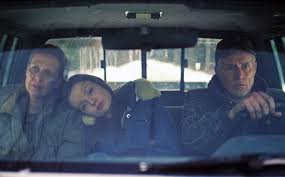
Yann Demange’s “71” takes us back to the swirling maelstrom of the peak of the civil war in Northern Ireland. Set just three years after “The Troubles” began and a year before “Bloody Sunday,” it’s an intricate, intimate thriller about a single soldier’s nightmare day and night on the front lines.
Jack O’Connell of “Unbroken” stars as Gary Hook, a working class recruit into a British Army still divided along class lines. Hook is shipped to Northern Ireland, where he’s exposed to an idealistic, posh upper class lieutenant (Sam Reid of “Belle” and “Anonymous”) and the depths of animosity between Catholic “republicans” and Protestant “loyalists” in Belfast.
Lt. Armitage has some sort of “win their hearts and minds” delusion about the Army’s “peacekeeping” role there. It’s why he orders riot gear left behind as they accompany heavy-handed cops on a raid on the apartment of I.R.A. sympathizers.
A riot ensues, and when circumstances separate Hook and another recruit from their unit, one is summarily executed and Hook flees for his life, through the bowels of the Catholic stronghold, a day and a night of terror, bloody entanglements, wounds and confusion.
Demange, working from a clever, gritty Gregory Burke script, hurls obstacles aplenty at this frightened boy. This last incarnation of “The Troubles” had plenty of infighting, so bloody-minded young turks (Killian Scott plays their leader) are hunting Hook just to execute him, while older, cooler I.R.A. heads (David Wilmot) try to find the lost soldier just to calm the situation.
The foppish but humane Lieutenant wants to ameliorate his blunder and recover his missing man, but the brooding, brutish head of undercover operations (Sean Harris) has other motives.
The journey here is a one in which Hook, if he lives or dies, has his eyes opened at the nature of the fight and his place in it.
“You’re just a piece of meat to them,” a kindly civilian (Richard Dormer) warns him. Catholic women try and protect soldiers, a small loyalist boy (Corey McKinley) spews such hatred that we and Hook wonder if he can be trusted and how long it will be before he becomes a killer.
O’Connell keeps fear close to the surface of his performance, even as flashbacks suggest a tough background that may play a hand in whether Hook lives or dies.
The violence is immediate and personal. Demange, keeping his camera hand-held through the chases through alleys, backyards and apartment blocks, makes this film as visceral an experience as Paul Greengrass’s breakthrough movie, “Bloody Sunday.”
Demange’s movie isn’t nearly as moving as that one. It’s more removed, observing and casting blame for that awful conflict far and wide even as it remains fixed on this one young man’s fate, making us care about that fate. But “71” is rare enough and good enough to make us long for more thrillers with context and consequences, something sorely missing from your average Hollywood action picture.

3stars2MPAA Rating: R for strong violence, disturbing images, and language throughout

Cast: Jack O’Connell, Sam Reid, Sean Harris, Charlie Murphy

Credits: Directed by Yann Demange, script by Gregory Burke. A Roadside Attractions release.

Running time: 1:39

Posted in Reviews, previews, profiles and movie news | 1 Comment

Next Interview: Questions for director John Boorman?

boorman

If you’re a film buff — and seriously, if you’re reading, stumbling across movie blogs, etc., why not? — you may have a ready question or two you’d love to ask the great John Boorman.

He did “Point Blank” and “Hell in the Pacific.” He made “Deliverance” and “Zardoz” And “Excalibur.”

There was “Beyond Rangoon” and “The General,” “The Tailor of Panama” and, one of my all time favorites — the semi-autobiographical “Hope and Glory.”

“Queen and Country” is his sequel to that film, and I’ll be asking him a few things about coming back to those characters 27 years later for a story about a young man’s years in the Korean War era British military.

But what about you? Got a question? Comment below, and thanks for the suggestions.

Posted in Reviews, previews, profiles and movie news | Comments Off on Next Interview: Questions for director John Boorman?

Movie Review: :”Song of the Sea” is an Oscar contender that coulda been a winner

3half-starEvery scene is magical, every image a work of art in “Song of the Sea,” the latest Oscar-nominated feature from the folks who gave us “The Secret of Kells.” “Sea” is an Irish folk tale, a modern day account of selkies, fairies and elves in Ireland, full of adult concerns and sadness, childhood wonder and delight. It’s one of the best children’s cartoons of the past few years.
A pregnant mother sings her little boy, Ben (voiced by David Rawle) to sleep, telling him stories of the magic creatures that once roamed Ireland and reassuring him that when his sister is born, “You’re going to be the best big brother in the world.”
That’s important, because mom, tragically, leaves the picture. It’s just lighthouse keeper dad (Brendan Gleeson, of course), tiny, speechless Saoirse. Dad still mourns Mom, and Ben resents the sister who cost him his mother. Ben is a fearful boy. Living in a lighthouse on a storm-tossed island, he wears 3D glasses, the cape of a would-be super hero, and the life jacket of a child scared of the water.
He calls his sheep dog his best friend, and tries to ignore the toddler in his care. But Saoirse is drawn to the sea, lured by the friendly faces of the seals that beckon her into the deep. Ben needs to do a better job of watching over her.
Granny (Fionnula Flanagan) lectures her son about the proper place for his children, and takes them ashore, to the city. “I know best,” she says. But she leaves Ben’s beloved dog behind, and when he resolves to follow his own hand-drawn map back home, Saoirse tags along.
Ben remembers the tales his mother told, and is shocked to run into fairies, most of whom have had their “feelings” torn from them, turning them into stones. The fairy stones are everywhere. And the few fairies still alive need a selkie to sing her song to set them all free.
Menacing owls track the kids. They are in the employ of Macca (Flanagan, again), an owlish witch who only wants to protect us all — magical creatures and Ben, the “human child” — from pain.
“Kells” director Tomm Moore concocted this story (with Will Collins writing the script) from the legend of Mac Lir, an Irish giant who suffered a terrible loss. “Such was his anguish that he cried a whole ocean,” Ben remembers Mom telling him. Mac Lir’s grief turned him to stone, an island. What will wake him up?
In an age when 3D computer-animated films dominate this corner of the medium, Moore makes films defiantly hand-crafted. Every setting has an exaggerated, 2D expressionistic edge — fanciful cliffs and mountains, houses and seals, sea captains and fairy storytellers.
“Song of the Sea” covers some of the same ground as the John Sayles live-action fantasy “The Secret of Roan Inish,” and is every bit as engaging, a child’s fantasy in which a destiny must be fulfilled, a boy must grow up and everyone — adult and child — learns that losing your grief, your “feelings,” is the most tragic destiny of all.

seaMPAA Rating: PG for some mild peril, language and pipe smoking images

Cast: The voices of Brendan Gleeson, Fionnula Flanagan, David Rawle, Jon Kenney

Credits: Directed by Tomm Moore, screenplay by Will Collins. A GKids release.

Running time: 1:33

Posted in Reviews, previews, profiles and movie news | Comments Off on Movie Review: :”Song of the Sea” is an Oscar contender that coulda been a winner

Movie Review: “Bluebird”

2half-star6bluebird

Lesley is a conscientious school bus driver. A kid doesn’t have a stocking cap for his snowy walk home from his bus stop, she gives him hers.
She parks her vehicle at the end of a shift, mentions to the school district mechanic something about one of the wipers sticking, and does a quick walk-through. And darned if a bluebird doesn’t fly in after her.
It’s winter in Maine, and that’s unusual enough to demand her attention. Lesley (Amy Morton of TV’s “Chicago Fire”) never sees the kid curled up and dozed off near the back of the bus. By the time she stumbles on him the next morning, he’s frozen–nearly dead.
“Bluebird” is the title and blue is the mood of this intimate indie film about the ripple effects of tragedy, and how it never rains, it pours.
Because even though the trees still tumble, the paper mill, seen in all its semi-automated glory in the opening scene, is reducing production. There’ll be less work for lumbermen in Millnocket, Maine. Rick (John Slattery of TV’s “Mad Men”), Lesley’s husband, may be out of a job.
Then there’s Marla (Louisa Krause), the mother of the child who froze. This terrible accident — a word we don’t seem to accept in this litigious age — has some of her fingerprints on it, too. She’s a bitter, tuned-out pothead of a waitress, pregnant in her teens, she has let her mom (the great Margo Martindale) raise her kid. Except for that one day, when Marla was supposed to meet him at the bus.
Emily Meade is Paula, the cute high school clarinetist coping with the first boy to pay attention to her, wondering if sex is what it will take to change the subject that the whole town is thinking about, if not talking about — that her mom “killed” that little boy.
“Bluebird” has a serene quiet about it, with writer-director Lance Edmands matching his tempo to a rural way of life’s pace. Much is left unsaid even as life goes on — teens having snowball fights, Marla in denial over her child’s fate and her role in it, local police figuring out what constitutes “criminal negligence” and old wounds, old love affairs, bubbling to the surface.
Nobody here has a Maine accent, not even a hint, which would have cemented the movie’s sense of place. But the cast is otherwise quite good. Morton and Martindale and Adam Driver (as a cook-pothead beau of Marla) stand out. Slattery, so dapper and droll in “Mad Men,” is convincing, physically, in this blue collar guise. Until, that is, Rick has a long, dialogue-filled scene with a former fling. A city sophistication and educated polish slips in that doesn’t suit the tractor-saw driver’s persona.
“Bluebird” never rises to the heights of grief, guilt and regret of the film it most closely resembles, Atom Egoyan’s “The Sweet Hereafter,” achieved. But Morton gives us a wonderful take on silent suffering. Lesley’s efforts to cope in out-of-date small-town ways with a tragedy that’s been regulated into something more sterile, impersonal and formal are so moving that they make “Bluebird” a worthwhile trip into the wilderness of grief, guilt and regret.

MPAA Rating: unrated, with adult situations, pot use, profanity

Cast: Amy Morton, John Slattery, Margo Martindale, Louisa Krause, Emily Meade, Adam Driver

Credits: Written and directed by Lance Edmands. A release.

Running time: 1:30

Posted in previews, profiles and movie news, Reviews | Comments Off on Movie Review: “Bluebird”

Movie Review: “Out of the Dark”

dark

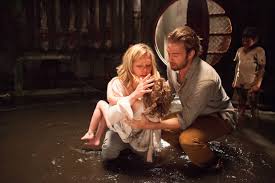
There’s something chilling about thrillers that put a child in jeopardy. And from the minute we meet Hannah (Pixie Davies) in “Out of the Dark,” she’s being menaced.
Her parents (Julia Stiles and Scott Speedman) have just moved with her from London to rural Colombia, where granddad (Stephen Rea) owns and operates the town’s big paper mill. Mom is to manage it while kids’ book illustrator Dad stays at home with Hannah, who looks about five.
“We’re going to be happy here,” Mom opines.
“Of course we will,” Dad chimes in.
But this is a creepy place for kids, starting with this local celebration — “Fiesta de los ninos santos” — Festival of the Saints’ Children. Local urchins are rare, and some seem to run about with their faces swathed in costumes — apparently in tribute to villagers massacred by Conquistadors hundreds of years ago.
Superstitious locals hint that this long ago tragedy is behind the mysterious shadows and faceless gangs of children that go bump in the night around here. The rational Americans scoff, but they’re a little antsy every time Hannah is out of their sight. And she’s always wandering off in the market, into the woods around their huge house, climbing into the old, disused dumbwaiter.
“Out of the Dark” is an old school ghost story, with a supernatural cause-and-effect story and modest and modestly effective effects — watery footsteps, creaking stairs, shadows glimpsed through a window. Director Lluís Quílez and cinematographer Isaac Vila conjure up nothing special in terms of mood-setting lighting or surprise frights.
Stiles has a few moments to get across the terror of losing one’s child, but isn’t that convincing. Speedman is more interested in letting his character come off as under-estimated, a man of hidden resources and courage. There GHOSTS after your kids, guys. Confusion and terror are what we’re looking for.
It’s more a reflection of our jaded, horror-hardened tastes that the film doesn’t manage much more than the occasional hair raising moment. Modern horror audiences still prefer nubile coeds under assault in various stages of undress to ghost stories about supernatural retribution. And frankly, this isn’t “The Orphanage.”
But the kid is cute and we fear for her safety, even as the film reveals its secrets in its pat and seemingly pre-ordained payoff.

2stars1

MPAA Rating: R for some violence, terror and disturbing images

Cast: Julia Stiles, Stephen Rea, Scott Speedman, Pixie Davies
Credits: Directed by Lluís Quílez, screenplay by Javier Gullón, David Pastor, Alex Pastor. A Vertical Entertainment release.

Running time: 1:32

Posted in Reviews, previews, profiles and movie news | Comments Off on Movie Review: “Out of the Dark”

Movie Review: “Deli Man”

deliYou may see better, more Oscar-worthy documentaries this year. But you will never see one more mouth watering than “Deli Man,” Erik Greenberg Anjou’s look at the dying dietary tradition of America’s Jewish delicatessens. It’s a playful and tasty crash course in deli history, deli dining and deli language, a world of smoked meats, cured meats and fresh fish. Vegetarians are excused. But for the rest of us, take notes and you might understand how to properly “Jew it up” when you visit one, as Toronto deli owner Zane Caplansky likes to put it. You’ll learn that greater New York had over 1500 Kosher delis, and just as many Jewish non-Kosher ones at the peak of delic chic — the 1940s. “One on every street corner,” entertainers like Jerry Stiller and Fyvush Finkel marvel. Now, there aren’t but 150 or so all over North America. You’ll learn that pastrami was an invention of Romanian Jewish immigrants and that “schmaltz” (poultry fat) is “the WD-40 or the Kosher kitchen — the KY of the Jewish marriage, too.” Yeah, you’re going to pick up a shtickle of Yiddish, especially words that relate to “haimishe maykholim” — comfort food — deli dishes, not all of them Old World Jewish, strictly speaking. We visit Katz’s on Manhattan’s Lower East Side and Manny’s in Chicago, Canter’s in Los Angeles and Nate N Al’s in Beverly Hills, Yitz’s in Toronto and Kenny & Ziggy’s in Houston. That’s where Anjou’s film finds its mensch, David “Ziggy Gruber, grandson of a deli man, a London-trained chef who looked at the old men aging out of the business and asked himself, “Who is going to perpetuate this food?” He would, by opening an insanely popular New York delicatessen…in Texas. Ziggy, a portly 40something “married to the business” is the film’s poet. “When I cook, I feel my ancestors around me,” he says. “You can TASTE the diaspora!” The owners, young and old, who still run these restaurants can see them as a grind, a physically, financially (check out the price of meat these days) and emotionally draining job that you live and breathe, seven days a week. The idealistic ones see them as Jewish outreach, creating extended families among their clientele, and as “community builders” in their neighborhoods. And the successful ones are like the late Abe Lebewohl, famed for running New York’s 2nd Ave. Deli, “saving the world, one sandwich at a time.” The experts quoted here range from Stiller and Larry King to deli historians and Canadian writer Michael Wex, who delivers that zinger about “schmaltz.” Watch this movie on an empty stomach and you may not make it to the credits. You’ll be craving a corned beef on rye, and maybe some chicken soup — heavy on the schmaltz. 3stars2 MPAA Rating: PG-13 for some language Cast: Ziggy Gruber, Jerry Stiller, Larry King, Jane Ziegelman, Michael Wex Credits: Directed by Erik Greenberg Anjou. A Cohen Media Group release. Running time: 1:30

Posted in previews, profiles and movie news, Reviews | Comments Off on Movie Review: “Deli Man”

Movie Review: “Ana Maria in Novela Land”

novela

“Ana Maria in Novela Land” is a comedy spoof introduces us to the wonder that is Edy Ganem by hurling her into the world of Latin
soap operas — Telenovelas. She plays both an obsessed young fan and blogger about one such soap, and the vampy diva pursued by
two men on the small screen in “Pasion sin Limites” (“Passion without Limits”), a show she is so obsessed by that it’s cost her more
than one job.
Ana Maria dreams of turning this broadly acted, comically melodramatic show into a zombie series. Her dreams and fantasies get in
the way of her work and her life. Her sister (Mercedes Mason) is about to marry, her mother (the late Elizabeth Pena, in her final film
role) doesn’t know what to do with her.
And then, something magical and electrical happens and Ana Maria is trapped in the soap, over-dressed, overly-made-up, over-
emoting.
Now, instead the dashing, rich Eduardo (Juan Pablo Gamboa) and his over-sexed son Armando (Michael Steger) competing to see who can bed and impregnate the vivacious Ariana (Ganem, again), it’s Ana Maria they want.
Georgina Garcia Riedel’s Spanish-and-English comedy mocks telenovela conventions, such as the florid guitar solo that accompanies
every seduction.
“Do you hear that?”
Only Ana Maria does. Her co-stars don’t, and are equally puzzled at her switch to English and Spanglish.
“Gringos!”
Their semi-chaste courtliness is no match for her hip hop twerking and grinding in a party scene.
“Is it the brain tumor again?” Eduardo wonders.
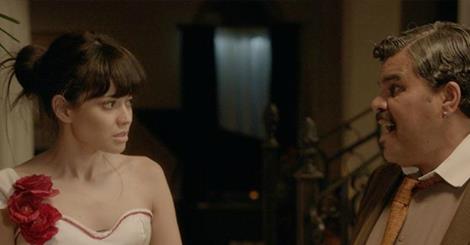
Luis Guzman is comically diabolical as the soap opera’s resident villain.
“You will know TRUE pain if you cross me!”
And Ana Maria has to cope with a TV world so unrealistic that it’s never shown a toilet. Try taking a home pregnancy test without one.
Meanwhile, the fictonal, shrill, slap-happy Ariana is trying to cope the “Real World” that she’s been dropped into, her new mother
(Pena) and the sister she never knew she had. She must have amnesia.
“This isn’t a gimmick where I come from,” she explains. “EVERYone has suffered from it!”
Check out the poses Ariana strikes, the dainty way the soap starlet runs and the real world consequences of dramatically slapping every person who crosses you.
“Ana Maria in Novela Land” is over-the-top, but not far enough over the top to fully pay off. But Ganem makes the title character, and
her soapy doppelganger, enough of a hoot to make it worth staying through the credits.

2stars1

MPAA Rating: Unrated, with adult situations, sexuality, soap opera violence
Cast: Edy Ganem, Luis Guzmán, Mercedes Mason, Elizabeth Peña, Michael Steger

Credits: Directed by Georgina Garcia Riedel, script by Jose Nestor Marquez, Georgina Garcia Riedel. A Synthetic release.

Running time: 1:33

Posted in Reviews, previews, profiles and movie news | Comments Off on Movie Review: “Ana Maria in Novela Land”

Movie Review: “The Widowmaker”

wido3stars2
Heart attacks might seem a mundane subject for a documentary. They kill suddenly. And they’re so depressingly common as to make one wonder how you get a movie out of them.
But Patrick Forbes’ “The Widowmaker” has the makings of a thriller, with heartbreaking loss captured in wrenching 911 calls from loved ones to calm, collected operators, a little comic relief provided by heart attack survivor and professional talker Larry King — and heroes and villains, possibly motivated by greed.
Gillian Anderson narrates this story of statistics — 600,000 dead Americans per year, one fourth of them dying without showing any signs they were headed for heart failure, often due to coronary blockage.
“You don’t know you have it until you’re dead.”
We hear from surviving spouses and children, see their obituaries (“Died, age 42.”) in white graphics on black screens as somber music plays in the background.
And we hear that the “vast majority of them, men and women, could have been saved.”
Forbes hunts down the principals to tell two histories –that of the heart stent, invented by Dr. Julio Palmaz, the folding tubular structure that forces open closed arteries — and the CT heart scan, the “mammogram of the heart” that identifies the calcium deposits in the heart that predict future heart problems.
These two histories, which began in 1970s San Francisco where both procedures were born, set up the film’s central conflict. Stent surgery, expensive (as much as $50,000) mass-production medicine that has made a lot of surgeons and investors rich and put many a hospital in the black, is contrasted with a non-invasive scanning that, with lifestyle and dietary changes, might head off a heart attack before it happens.
Miami “South Beach” diet Dr. Arthur Agastston is among those in “the calcium club,” championing scanning. And notable cardiologist/opinion-makers such as Dr. Steven Nissen and Dr. Martin B. Leon are stent sticklers, leaders in the big push back against the cheaper scanning protocol that might cut into the stent business.
That’s how the film paints America’s stent-mania. One surgeon boasts of how many procedures he can do in a luxuriously short work week. And we visit Dr. Palmaz in the winery he was able to open from his stent invention.
But lives have been saved by the stent, among them retired CNN host Larry King, who tells great anecdotes about a guest on his show (former Surgeon General C. Everett Koop) telling him to see a doctor, simply based on his pallor.
And the scanning folks have made many a PR blunder as they fight against powers that seem to change the rules just to keep them down.
If you haven’t been following this debate, you might not know how it came out. But Forbes makes this story compelling, moving and provocative enough to prompt outrage, never more so that when Anderson periodically updates the death toll from heart attacks in the years since both these miraculous procedures were first developed.

MPAA Rating: unrated

Cast: Narrated by Gillian Anderson, with Larry King, Dr. Julia Palmaz, Dr. Steven Nissen, Der. Martin B. Leon, Douglas Boyd, Dr. Arthur Agatston
Credits: Directed by Patrick Forbes. A FilmBuff release.

Running time: 1:35

Posted in Reviews, previews, profiles and movie news | Comments Off on Movie Review: “The Widowmaker”

Jack O’Connell and director Yann Demange talk about getting the history, and the gritty thrills, right in “71”

71Director Yann Demange doesn’t want people to pigeon-hole his pulse-pounding Northern Ireland chase picture “71” as, well, “a chase picture,” or simply another tale set amid “The Troubles,” the decades-long civil war in Northern Ireland.
“When people call it ‘The Troubles,’ it feels a bit patronizing,” says Demange, a London native.  “‘Troubles’ is like a bit of spin, that we cannot really come to grips with what happened or was happening there. It was a CIVIL WAR, man. And people are still trying to find out what happened, find out what happened to their loved ones.”
And the son of a French mother and Algerian father, who calls the classic French army vs. insurgents thriller “The Battle of Algiers” his chief inspiration in making “71,” didn’t want to make “just a genre” picture — a young British soldier, separated from his unit, hunted by IRA gunmen, by more peaceable IRA members, unionist paramilitaries, the British army and British intelligence.
“You have a certain responsibility, treating a subject from recent history as divisive as this,” he says. “You can’t just exploit it and make it into a simple-minded chase movie that ignores the context that all this is happening in.”
The main sensibilities that Demange, working with a Gregory Burke screenplay, wanted to avoid offending were those of his star. Derbyshire native Jack O’Connell is Irish Catholic. He says he had to rethink his dogmatic attitudes about the conflict to play Private Gary Hook.
” I had to make myself know LESS about the situation, the context,” says O’Connell.”In Gary Hook’s generation, he wouldn’t have known a lot. He was a recruit being stationed on what he was told was a peace-keeping mission. If anything, working on this film helped me take a more impartial view. I won’t be as quick to point fingers, because the film doesn’t allow anybody to point fingers. It was a warlike situation, with heinous wrongdoings on either side. And there were innocents on both sides, which is true of any war and it’s what makes this film universal.”
Demange met with veterans of all sides of the conflict and has taken great care to show the film where it was set. He says that when you tell someone you meet in Belfast that you’ve”made a movie about ‘The Troubles,’ “they just roll their eyes. There’s a long legacy of films, from ‘The Wind that Shakes the Barley,’ to ‘Bloody Sunday,’ both about Northern Ireland and ‘The Troubles’ specifically, that I thought about. But those earlier films freed me of the responsibility of giving a history lesson.”
He could use that historical legacy as backdrop for a horrific day and night in the life of a green British recruit, on the run and threatened from all sides. The resulting thriller, named after the year the violence truly escalated (“71”) is earning the best reviews of the new film year, “a lapel-grabbing, immersive viewing experience likely to shake up audiences” Trevor Johnston said in the film journal “Sight & Sound.”
Demange may be concerned with the delicate politics and opening of old wounds that his film might lead to. O’Connell, 24, starved and tested star of the POW drama “Unbroken,” was all about the “freakish heat wave” in part of shooting (he was in full combat gear for the daylight scenes) and “freeezing cold” night sequences, shot later.
In one night sequence, he overran his mark and “careered, right into the camera. Knocked myself out. Cold. I felt fairly hard done by,” says a chuckling O’Connell, who as a teen trained as a military cadet and gave some thought to a military career.  But does he, like Demange, worry about opening “old wounds” with a film about the conflict?
“I hope people see that the blame goes all around,” O’Connell says.  “I hope we’ve moved on. Yann may say he’s worried about that. But I think he’s got an Algerian passport, so he’s not THAT worried. If ‘Troubles’ start up again, he”ll be LONG gone!”

Posted in Reviews, previews, profiles and movie news | Comments Off on Jack O’Connell and director Yann Demange talk about getting the history, and the gritty thrills, right in “71”

Oscars: Who I HOPE wins

oscars

Never liked predicting the Oscars, and I have never obsessed over them the way some corners of filmfandom do.

But I do watch them, every year.  I don’t watch them for the fashions, the dance numbers, the broken English best foreign language acceptance speeches. All I want out of an Oscar night are those little magical moments when great work is recognized and the winner says something gracious and delights us in other ways.

The gold standard? Adrien Brody’s win for “The Pianist.” Laying a big shock-smooch on Halle Berry (well-played), then delivering a speech that moved and put that little victory in a global context.

Kevin Costner had a nice line on his “Dances with Wolves” night — that the voters might forget that night, “But me, my family and nobody we know EVER will.”

Anna Paquin’s breathless shock, Martin Landau’s sentimental victory and botched speech (cut off by the orchestra, thanks Bill Conti!).

So here’s what I want out of tonight.

I want J.K. Simmons to wax on the character actor’s life, and NOT read a thank you list (the way he did at the Golden Globes).

I want Patricia Arquette to weep. I want Michael Keaton to get choked up, but I won’t weep myself if Eddie Redmayne wins. Bradley Cooper? I hope he wins for a better film.

Julianne Moore should be given a regal amount of time to reflect on a stunning career.

I want a standing ovation for Indie Cinema’s undisputed King, Richard Linklater.

He should get best director, “Birdman” should win best picture.

Give Wes Anderson a writing Oscar, laud “Grand Budapest” for design, costumes, etc.

The reason I never get too worked up about the Academy Awards is the fact that the winners don’t matter, that those are not the films that endure — typically. And too many actors and others stand up there and timidly run through a laundry list of people they want to thank. Bad form. Thank your spouse, thank everybody else later that night, personally and sincerely.

Drinking games? Backless dresses, “thank my agent” lines. You know the drill.

Let this Oscars be less disappointing than the norm.  Please please.

Posted in Reviews, previews, profiles and movie news | 1 Comment