Weekend movies: “Ben Hur” beaten down, “War Dogs” neutered, “Kubo” conquers all

benhur-faithtrailer-1-1024x426

Had to happen. I mean, last weekend had “Florence Foster Jenkins,” “Anthropoid,” “Pete’s Dragon” and “Sausage Party” opening wide, “Hell or High Water” opening wider.

And all were at least pretty good (“Pete’s Dragon”) and most were outstanding.

So this weekend, naturally, Hollywood taketh away.

Sure, the animated “Kubo and the Two Strings” from Laika and Focus Features, is a winner. “Lo and Behold,” the latest meditative documentary from the great Werner Herzog, scores. Rave reviews from one and all for those.

But the widest releases don’t earn raves.

“War Dogs” was a promising dark and supposedly funny Miami yeshiva alumni sell arms to the military buddy dramedy. Doesn’t really come off, and reviews are mixed. Teetering right on the brink of fresh or rotten on the Tomatometer all week.

Then there’s “Ben-Hur,” about which there is no doubt. Good action beats, alterations to the well-known “Story of the Christ” — some of which work, some not so much — and a general choppiness and heartless approach to the emotional high points that we KNOW are there, break it. Consistently poor reviews for this one.

Another “Final Fantasy” video game adaptation sucks the life right out of you. “Kingsglaive” isn’t the silliest word in it. 

Will “Ben-Hur” find a big faith-based audience? We’ll know by Sunday.

Posted in Reviews, previews, profiles and movie news | Comments Off on Weekend movies: “Ben Hur” beaten down, “War Dogs” neutered, “Kubo” conquers all

Movie Review: “Ben-Hur” loses heart

ben1

It’s been a pretty good year for faith-based films, with “Risen” and “Miracles from Heaven” showing that Hollywood can get stories about Jesus and those who worship him right.

The latest remake of “Ben-Hur” pretty much lets down the side, though.

Russian director Timur Bekmambetov and his screenwriters make a thorough hash of the book. Not so much General Lew Wallace’s 19th century “A Tale of the Christ,” the one that tells the story of the Jewish prince who likes chariot racing, hates the Navy and meets Jesus in Jerusalem, though they chop that up, too.

I’m talking about the Bible, the Gospels, the New Testament.

In this “Ben-Hur, Dismas (Moises Arias), “the penitent thief” the Bible describes as accepting Jesus while they’re both nailed to crosses, becomes a Jewish zealot attempting to chase the Romans out, one assassination at a time. The Ben-Hurs shelter him.

Jesus (Rodrigo Santoro) is practically a neighbor of Judah Ben-Hur (Jack Huston). The timeline is so bollixed that there’s no need for a triumphal entry into the city on Palm Sunday. Jesus is there so often that Pontius Pilate points him out as a potential threat years before crucifying him.

If Mel Gibson went out of his way to remind the world of the Jewish religious hierarchy’s role in condemning Jesus and ensuring his death, the new “Ben-Hur” solely blames the Romans and leaves the Hebrews out of it. It’s got other fish to fry and hand out, with loaves, to feed the masses. It has pointed references to the House of Ben-Hur’s privileged place in Jerusalem’s “one percent.” They should wholly support Roman occupation against revolutionary zealots, Judah’s adopted “brother” Messala (Toby Kebbell) argues.

Because “When they’re done with us, they’ll turn on you.”

All that said, Bekmembetov, aptly-enough the director of the even more revisionist “Abraham Lincoln: Vampire Hunter,” stages a mean sea battle and a damn fine chariot race. It’s all the stations of the cross and the novel that he skips along the way that rob the film of its heart and soul.

Judah’s family took in the Roman boy Messala, grandson of a disgraced general, and the two lads grew up as brothers. Not that Messala didn’t lust after his adoptive sister (Sofia Black-D’Elia). He goes off to war, to prove himself and earn his fortune fighting barbarians in Germany and Persia.

When he returns, he’s an officer of Pilate (Pilou Asbæk) who wants Judah’s help putting down a rebellion. And if you remember the Charlton Heston/Stephen Boyd 1959 film, there’s an incident that forces Messala to send Judah into slavery and wipe out his family. Judah spends years chained to an oar in a Roman war galley.

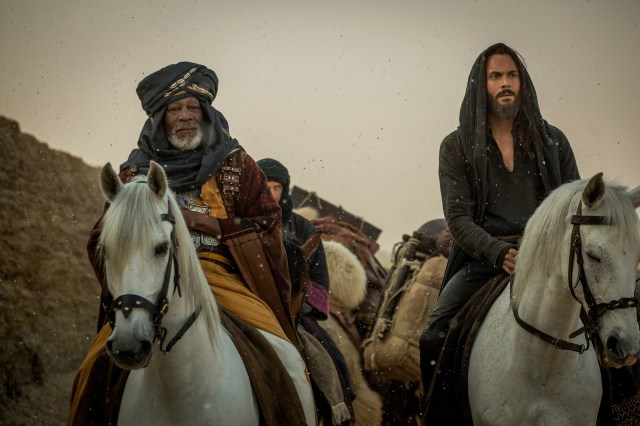
Events conspire to free him, he winds up in the camp of an African horse trader (Morgan Freeman), and that takes him back to Jerusalem and the big showdown we all know is coming. 
ben3

The story arc here, twisted around as it is, is closer to the mark if you’re looking for a vengeful man’s finding Jesus and redemption and freedom from hate.

But the movie skips past many moments that are supposed to be poignant to get to the famous race, and then saddles itself with a new ending that doesn’t atone for that.

Nazanin Boniadi (of TV’s “How I Met Your Mother” and “Homeland”) makes little impression as Esther, the lovely servant Judah marries and then almost loses to the new religion she has found.

Santoro, a towering Xerxes in “300,” makes for one of the handsomest Jesuses in screen history.

The Pilate here lacks cunning and gravitas, Kebbell (“Fantastic Four”) fails to make us feel Messala’s journey from love to bitterness and thenhatred. Morgan Freeman lends some weight, but not a lot of sparkle, to the proceedings.

But Huston (“Pride and Prejudice and Zombies“) holds the screen and manages the film’s lone moment of pathos well.

And I cannot say enough about the dazzling, digitally-enhanced chariot race, where Bekmanbetov poured most of his energy. We are in the chariots, chasing the chariots, under the hooves and swooping down on the Roman Circus as the race pounds away.

The galley fight — shown from Judah’s below-decks point of view, is equally impressive. He sees officers deciding his fate only through the gaps in the deck planking and the sea-spray filled fight only through the oar-ports he and his fellow condemned row through. It’s a chilling, visceral and surreal sequence where in the 1959 film it was more majestic and stately.

And that, in the end, is the undoing of this latest version of one of the most-filmed tales in screen history. This “Ben-Hur” tries to squeeze what was once a three and a half hour movie into two hours. There’s no room for the majesty and power of Rome, and no budget to show the wealth of the Ben-Hurs and monumental building spree of the Romans, no pauses to absorb the words or actions of Jesus. When he interrupts a crowd stoning a woman, we’re supposed to feel something. There’s no time for that, here.

Everyone, from director to cast, seems so rushed that there’s no time for romance, less time for leaps of faith and every moment of conversion is abrupt, dictated by the script and not by the heart.

As Charlton Heston would have told you, if you rush it, it’s not an epic. Because “Ben-Hur” is supposed to be more than just a chariot race.

2stars1

MPAA Rating:PG-13 for sequences of violence and disturbing images

Cast: Jack Huston, Toby Kebbell, Nazanin BoniadiMorgan Freeman, Rodrigo Santoro

Credits: Directed by Timur Bekmambetov, script by Keith R. Clarke, John Ridley, based on the Lew Wallace novel and . A Paramount release.

Running time: 2:04

Posted in Reviews, previews, profiles and movie news | Comments Off on Movie Review: “Ben-Hur” loses heart

Movie Review: Will glib gun dealers get theirs in “War Dogs”?

ward

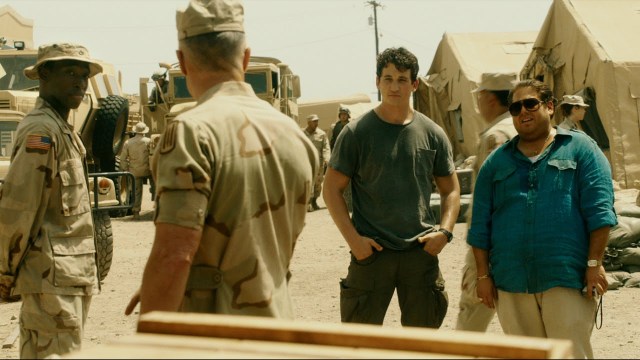
In “War Dogs,” a couple of homeys from Hebrew School take on the job of selling arms and ammunition to the U.S. military — for a big profit, of course.

Because not everybody who got rich off the invasion of Iraq and the ongoing mess in Afghanistan had to be a Friend of Dick (Cheney).

“Hangover” director Todd Phillips brings as much gravitas to this farce — two South Beach drop-outs sneaking arms across borders, circumventing U.S. law in Albania and lining their pockets doing it — as he can. But you never get the sense that he, his stars Miles Teller and Jonah Hill, or the real-life anti-heroes they’re portraying ever grappled with the amorality of it all, the consequences of filling Afghanistan with dated, defective ammo or of flooding the bloodstained Middle East with the arms that will destabilize the place for generations to come.

Teller (“Whiplash”) is David Packouz, our narrator, facing a life of limited prospects thanks to no education and not much going for him other than his Florida massage therapist license.

Enter his old pal, Efraim Diveroli (Jonah Hill), a roly poly fast-talker who has returned to Miami after lining his pockets, slicking back his hair and learning how to price, buy and sell guns online in L.A.

Efraim is moving into middle man arms dealing, finding the “crumbs” in the daily posted Pentagon contracts that other contractors haven’t bid on.

“When you’re dealing with the Pentagon, crumbs are worth millions.”

David is drawn into business with him, and away we go — buying Italian Beretta pistols for the Iraqi police. Italy won’t allow arms exports to Iraq? No prob. They’ll just run the guns in from Jordan.

“Jordan Goldfarb?”

“JORDAN Jordan!”

David keeps this work life from his exotic foreign-born girlfriend (Ana de Armas). He’s learning from Efraim, an up-and-coming hustler who lies like he breathes.

“When does telling the truth ever help anybody?”

That flippancy comes and goes in this glib would-be romp. Tone is tough when you’re snickering at “gun nuts” while you live the good life off underhanded ways of selling them. The movie takes swipes at Bush era bungling and corruption while reveling in it, because, um, these guys had fun doing it?

Bradley Cooper plays a stubbly, shady legend of the blood money business, and Kevin Pollack is a devout Jewish Miami dry cleaning mogul who is their silent partner, doing all he can for Israel — he thinks.

Occasional  tense moments aside, these guys are depicted as having never, for more than a second, encountered the violence they’re enabling. That’s by design. This is how they rationalized what they were doing. David rationalized. Efraim didn’t bother.

And besides, Phillips is least at home co-writing and directing moral quandaries, tense standoffs and the like. He floods the soundtrack with vintage pop tunes, celebrates every time the U.S. Army bails the boys out (physically or financially) and has a hard time whenever the movie needs to turn serious.And he fills the screen with intertitles of the wit and wisdom of Efraim Diveroli.

“God bless Dick Cheney’s America!”

Hill feigns a high-pitched cackle of a laugh. This is a “Wolf of Wall Street” where he gets to be the wolf. Sort of. It’s a performance at the extremes, designed to irritate. He aims for funny-scary, Joe Pesci lite. He isn’t, though one would think he’d eaten Joe Pesci from the massive weight gain he’s undergone. Still, the comic in Hill riffs laughs into the proceedings — cutting in line at Jordanian customs.

“Don’t worry. I have to go first, I’m an American.”

Efraim haggles for a Jordanian black marketer’s Lacoste sunglasses.

“Tell him I want those shades,” he instructs his 11 year old interpreter. “Tell him in jibberish.”

Teller is meant to be the conscience of the piece, and he doesn’t really manage that — even after David becomes a father. It’s a bland turn, lacking “Eureka” moments of selling out or pangs of guilt.

The story arc is oh-so-familiar, the drugs, the hookers, the over-reach, the blowback. That being the case, Phillips does his movie (based on a Rolling Stone article) no favors by dragging out the trips between the waypoints and going on and on past the climax.

The amoral, anything-for-a-buck yarmulke wearing Jews depicted here border on stereotypes, but if cast and crew weren’t offended, who am I to judge?

Look for the real David Packouz  in a cameo singing “Don’t Fear the Reaper” to the residents of a Miami rest home. And that’s kind of the problem with the movie. It’s engrossing and sometimes entertaining, but too glib to resonate.

Nobody here fears the reaper, even though they’re providing him with scythes.

2stars1

MPAA Rating: R for language throughout, drug use and some sexual references

Cast: Miles Teller, Jonah Hill, Ana de Armas, Bradley Cooper, Kevin Pollack
Credits: Directed by , script by Todd Phillips, script by Steven Chin and Todd Phillips. A Warner Brothers release.

Running time: 1:54


Posted in Reviews, previews, profiles and movie news | Comments Off on Movie Review: Will glib gun dealers get theirs in “War Dogs”?

Tarnished Triumph? Nate Parker’s ugly past punctures “Birth of a Nation” balloon

nate

Actor turned actor/director Nate Parker and his film,  “Birth of a Nation”, were sensations at this year’s Sundance Film Festival. A whopping $17.5 million was paid for the rights to this account of the slave rebellion Virginian Nat Turner led in Virginia in 1831.

This little known chapter in American history has been, by all accounts, thrillingly brought to life, and “Birth of a Nation,” a cheeky attempt to reclaim that phrase from the racist D.W. Griffith silent classic that has worn it for over a century, is due out in October.

birth

Maybe.

Because with Parker’s fame has come with scrutiny. A lot of people went to college with him at Penn State, where he was a wrestler. And they started bringing up the rape he and his pal, Jean Celestin, who got a STORY credit on the film, wriggled out of (civil settlement from the university, retrial abandoned when the victim bailed out of it).

And that is the narrative that is engulfing the film. Even cheerleaders for the movie and for Parker have had to address it, bending over backwards to talk about the era he was in school — it was the ’90s people, to hear Jezebel tell it, it was the Jim Crow 1940s — and the like. In an online media landscape where rape victims always get the benefit of the doubt and the trials of black men are regarded with a jaded eye (it took another black comic to bring down Bill Cosby), Parker coverage sits on the horns of a dilemma.

The victim attempted suicide multiple times, and according to her brother, succeeded in killing herself in 2012. That bombshell has rattled one and all, maybe even Parker.

But here’s the world he’s working in.

Woody Allen still makes movies, despite increasingly heated accounts of his relationship with his children and allegations of abuse.

Roman Polanski still works in Europe, where he sought refuge after drugging and raping a 13 year old girl. He’s over 80, still free and still working. Lionized by some.

Hollywood has continued to employ convicted sex offender Victor Salva (“Jeepers Creepers,” “Powder”). He videotaped himself molesting a 12 year old boy.

So it’s not like it’s a business that attracts saints, or holds talent to much of a moral standard. Mel Gibson? That’s anti-Semitism, another thing altogether.

But what will happen to “Birth”? Parker was slated to show it in Toronto, and do more awkward press interviews. 

He has tried to make amends, re-branding himself as an ardent supporter of women and womanhood. But the damage, two months before release, is piling up. The film is already tainted. Will this die down? Will the film be pushed back, or rolled out more quietly?


Posted in Reviews, previews, profiles and movie news | Comments Off on Tarnished Triumph? Nate Parker’s ugly past punctures “Birth of a Nation” balloon

Movie Review: “Gleason” has heroes that aren’t the title character

gleason2

Steve Gleason is a smart, articulate and self-aware retired NFL star whose life on the field was defined by one play — a blocked 2006 punt that came to symbolize his team’s and his city’s comeback from the devastation of Hurricane Katrina.

It was his post-playing days life that raised his profile from New Orleans Saint punt-blocker to national spokesman for people, like himself, who suffer from Amyotrophic lateral sclerosis, ALS, the motor neuron illness that was named “Lou Gehrig’s Disease” after it killed the famed New York Yankee in the 1940s.

But as “Gleason,” a documentary built out of Gleason’s efforts to make a video diary for his infant that grew into a vivid study of the progression of this deadly disease and how a smart, thoughtful person reacts to it makes clear, the guy is no saint, no matter who he played for.

There’s something to be said for making a documentary about someone dying from a deadly disease, and not putting a halo on them or their noble suffering.

Refreshingly, for such portraits, Gleason and his wife Michel curse and struggle with his increasing dependence on her and other caregivers. They easily make scatological jokes when Steve loses control of his bowels and requires enemas. They weep as their struggle grows more overwhelming, as Steve tries to get across who he was to the son, Rivers, born in the early stages of the disease, growing up with a father who needs video to be able to pass along life lessons to a kid who will only know him as a dependent in a wheelchair.

We watch plucky Michel physically wear down from the demands of looking after Steve, and we see Steve deteriorate from the illness and the wear of starting a charity that lobbies Congress, raises cash for electronics that allow ALS sufferers to communicate when the illness has robbed them of speech and brings attention to the disease and to Steve, presented as a public face of ALS.

The folks he and his wife assemble and call on — Team Gleason — give you an appreciation of the burden this illness places on one and all. And it makes you shudder at what those who aren’t famous, aren’t well-off, must endure.

Look at the photo above. Is the average person facing the trauma, fatalism and expense of ALS going to Machu Pichu for photo ops? No.

gleason1The Seattle native gets to hang with Mike McReady of his favorite band, Pearl Jam, and interview Dave Grohl. But when Congress lets Medicaid cut funding for gear that gives ALS sufferers a more complete life, Gleason’s charity steps in to fill the gap and his name goes on a bill that gets that funding restored.

Steve tosses around “hero” a lot, pondering what that means, and the film that Clay Tweel (“Finder’s Keepers”) assembled from all this footage, carries that question further.

The Saints unveiled a statue of Gleason blocking that punt a year after his diagnosis, six years after the block itself. Would they have done that without his illness, without the attention he determined to draw to it?

Gleason didn’t start the stunningly successful and far better known “ALS Ice Bucket Challenge,” he merely joined in and helped organize the New Orleans event that went for a “record” number of those dumping buckets over their heads for charity.

As Steve pursues a course that echoes his charity’s motto, “No White Flags,” we hear him talk about how others in his condition choose not to do this or that, to let their increasingly circumscribed, pain-filled and burdensome lives end. The implication? The real heroes are the ones who deal with the consequences of his struggle, his caregivers.

The film’s unblinking and unfiltered look at the indignities and horrors of ALS and its impact on a loving marriage is without parallel. Steve, communicating through a computer, criticizes his wife, tries to engage in discussions about his needs and all Michel can do is apologize and shrug it off.

“This is our life, this is what it is,” she says, stoically.

They are doing what thousands of others do, families without deep pockets, big support systems and cameras catching their every utterance, struggling to hang on — for a new treatment, for a possible cure, or for an end to their awful burdens.

“Gleason,” perhaps unintentionally, shows us that hope can be a heroic thing, but that real heroes are those who keep others’ hopes alive.

3stars2

MPAA Rating: R for language

Cast: Steve Gleason, Michel Varisco
Credits: Directed by Clay Tweel. An Open Road/Amazon release.

Running time: 1:50


Posted in Reviews, previews, profiles and movie news | Comments Off on Movie Review: “Gleason” has heroes that aren’t the title character

Movie Review: “Indignation”

indignant2

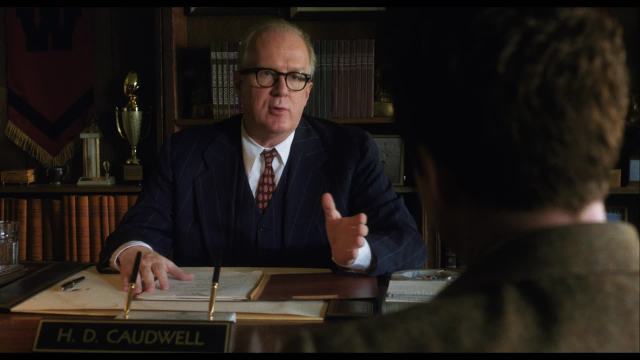
“Indignation,” the latest Philip Roth novel to make it to the big screen, hangs on a trio of absolutely delicious if somewhat delusional confrontations — big scenes between its young hero, a secular Jew debating his Protestant academic dean about faith, privacy, sex and assimilation.

That hero, another version of Roth for those who read most novels by the “Goodbye, Columbus/Portnoy’s Complaint” author as at least a little autobiographical, is a self-possessed college freshman from Newark, standoffish, deep into the atheism of Bertrand Russell and able to hold his own with a senior academic despite being the 19 year-old son of a Newark butcher.

And the scenes — pitting Logan “Percy Jackson” Lerman against the actor/playwright Tracy Letts (“Killer Joe”), are laugh-out-loud marvels orfirony and dark comedy. Young Marcus Messner has asked to change dorm rooms. And Dean Caudwell uses their interview as an interrogation, to probe young Messner’s refusal to “learn how to get along with people,” to question his “tolerance” and to figure out what or whom Marcus turns to for spiritual comfort.

“I am sustained by what is real,” the kid declares, before launching into a defense of Bertrand Russell, an assault on the small 1950s Ohio college’s requirement that students attend chapel and umbrage taken at the dean’s assumption that the kid’s father is a “kosher butcher.”

The rest of “Indignation” isn’t much to latch onto. But these scenes give it heft, or at least entertainment value.

The big theme here is “even the littlest mistake” can have consequences. The Korean War is on, and Marcus goes to the funeral of a friend killed in action and meets others who are fodder for the draft. But he is off to college and its promise of a deferment.

That’s where he becomes smitten by Olivia Hutton, or “the unceasing movement of Olivia Hutton’s leg,” he narrates. She’s a bobbysoxer prone to sitting with one leg carelessly draped over a chair while reading in the library where Marcus has his student job. She’s blonde, and without saying it out loud, Marcus appreciates her shiksa appeal .

Because he wouldn’t. Marcus makes a big deal out of getting away from his smothering, stereotypical Jewish parents but not about the “coincidence” of being roomed with two other Jewish kids in the dorms, out of the dean’s assumption that his father is a kosher butcher but bristling at the notion that he is somehow “hiding” from his Jewish identity.

You know, that whole self-loving/self-loathing Philip Roth thing.

Olivia, the experienced and alluring gentile siren, is played by JCanadian starlet Sarah Gadon.

Their one and only real date ends with an unexpected and under-motivated (as far as Marcus is concerned) act of oral sex. And that so befuddles him that he puts enormous academic energy into figuring out why this happened, what is going on with her (“I think it’s because her parents are divorced.”) and how he should act around her.

And Olivia, showing a damaged vulnerability that suggests she’s a little off, takes that badly.

“One little mistake” has consequences, and they ripple into arguments with his roommates, debates with his dean and onward and outward.

The story, framed within a Korean combat scene, plays like a Proustian parody of 1950s potboilers as filtered through the Semitism-centric prose of Roth. Producer-turned-writer/director James Schamus hits his Roth-marks, but fails to make the material sing, or particularly relevant. It all feels dated and entirely too pat to be much of a challenge. indig1

But Lerman (“Fury”) is game and handles the wise-beyond-his-years/guilt-ridden Marcus with skill. Gadon has less to work with, but is gamely gamin when need be, and her Olivia is smart enough to keep Marcus on his heels.

And those scenes with Letts are worth the price of admission, even if the movie overall drags, dry and not nearly as droll as Roth must have intended.

2stars1

MPAA Rating:R for sexual content and some language

Cast: Logan Lerman, Sarah Gadon, Tracy Letts
Credits: Written and directed by James Schamus, based on the novel by Philip Roth. A Summit release.

Running time: 1:50

Posted in Reviews, previews, profiles and movie news | Comments Off on Movie Review: “Indignation”

Movie Review: “Kubo and the Two Strings”

tudo1Laika is not an animation studio to coddle and over-protect children. The studio that scared kids and challenged younger viewers with “PAraNorman” and “Coraline” gets back to what it does best with “Kubo and the Two Strings,” an imaginative, scary and wonderfully rendered stop-motion fright about a little Japanese boy battling witches and a ghost with only his banjo to protect him.


It plays like a classic folk tale, with a hero on a quest, supernatural threats and super friends to help him pursue three magical talismans. But it’s an original script. The only film I can think to compare it to is a Chinese folk tale film — “Life on a String” — about an aged musician whose playing was so lovely he could stop armies, mid-battle, with his tunes.

In Asia, they take their banjo-picking seriously. In Japan, it’s called a Sanshin or Shamisen, in China, a qinqin or sanxian.

“If you have to blink,” our young hero narrates, “do it now.”

Kubo is a mesmerizing storyteller, a boy who accompanies himself on the magical Shamisen his mother gave him. She saved him from death at sea, and from a worse fate before they fled in a small boat. Kubo lost an eye, as an infant, to a hated villain.

Their escape cost his mother much. Her injuries are taking her memories, so Kubo walks from the cave where they live each day to tell his stories, actually the same story, and his banjo causes the origami he has created to illustrate it to spring to life.

The hero of his tale must find the Sword Unbreakable, the Breastplate Unpenetrable and the Helmet Invulnerable to battle giant origami sharks and crabs and a fire-breathing origami chicken.

“Got to have some comedy,” an old villager (Brenda Vacarro) counsels.

Whatever he does, though, must take place before nightfall. “Never, ever stay out after dark,” Mother preaches.

Of course he does, and of course that’s when the witches and the ghost find him and renew their pursuit of his remaining eye.

His quest to “the very edge of the Far Lands” is the same as that of the samurai of his story — get the sword and the armor, so you can fight back.

The toys of his childhood — a wooden monkey doll (Charlize Theron) and an origami samurai, help. So does a samurai beetle, voiced with daft bravado by Matthew McConaughey, a hero sure of his “indespensibilities.”

“Got to have some comedy,” after all.

The stop-motion animated art has found digital, technological shortcuts since the glory days of the California Raisins, whose studio gave birth to Laika. But the texture, the tactile beauty of the puppet-like characters, model sets and hand-crafted props live on and make the stop motion art distinct from the digital animation that displaced traditional hand-drawn cell animation.

Kubo’s yarn-like hair hangs over his eye patch, the monkey’s fur blows in the breeze (there’s a lake to cross) and the witches, voiced by Rooney Mara, have a menace above and beyond what mere digital drawing would have given them. They wear capes and porcelain masks and vast, black hats, like Guy Fawkes in “V for Vendetta.”

They are truly chilling, and Kubo and his friends must battle these sword-wielding ninjas repeatedly before facing a villain with the voice of a certain boy wizard’s nemesis. Listen, too, for the voice of an Asian American TV icon in a supporting role.

The story’s energy flags, here and there, but the life-lessons are rich, the brawls are epic and you and your children will never look down on banjos again. “Kubo” and his two strings (actually, he has three) rock.

And Laika has a second masterpiece to park alongside “Coraline,” the best animated film of the summer, and perhaps of the year. kubo

3half-star


MPAA Rating:PG for thematic elements, scary images, action and peril

Cast: The voices of Charlize Theron, Art Parkinson, Matthew McConaughey, Ralph Fiennes, George Takei, Rooney Mara, Brenda Vacarro
Credits: Directed by Travis Knight, script by Marc Haimes, Chris Butler . A Focus release.

Running time: 1:41

Posted in Reviews, previews, profiles and movie news | Comments Off on Movie Review: “Kubo and the Two Strings”

Movie Review –“Kingsglaive: Final Fantasy XV”

king1


kings2

It seems like only yesterday — OK, it doesn’t, because really it was 2001 — that the video game creators of “Final Fantasy” sought to put their vision of their universe and their “story” in a big screen movie.

My memories of “Final Fantasy: The Spirits Within” are hazy, but not the hate mail. Oh, those video gamers and their fumbling grasp of the distinction between a movie, placed in wide release, and a game that they’re already invested and immersed in.

Animated characters — not remotely photo realistic — fought and chased each other hither and yon in a tale that made little or no sense, with or without the rules of the (badly) computer-animated gamescape it’s all set in.

Fifteen years later, another Japanese-made, “Kingsglaive: Final Fantasy XV” makes it to theaters, a quantum leap forward in animation and design, if not a great leap in motion capture technology or in story.

The images are more flexible, more tactile and more mobile, though the faces still lack much expression, and none that anyone could call nuanced or subtle. The settings are striking and photo real, on a par with the fantasy and sci-fi cinema’s state of the art.

But take away the advertorial nature of “Kingsglaive,” ignore its utility as a cheat sheet, prep for the players of various corners of the game world it depicts, and deal with it as a story with characters and incidents anybody not into the game would watch, and it’s the same old “Final Fantasy.” It remains a misshapen mash-up freighted with sci-fi fantasy exposition and a back story so convoluted that a mere two hour movie cannot make heads or tails from it.

This one dwells mostly in the realm of fantasy, a universe of medieval castles and armor and steampunk sci-fi weaponry and creatures, a world where  the Kingdom of Lucis  faces new treachery at the end of an uneasy peace with the Niflheim Empire.

There’s a magic crystal — of course there is — and the only warriors King Regis (voiced by Sean Bean) trusts to defend it are his Kingsglaive “empowered by the magic of their sovereign.”

There are tusked wildebeest warhorses, and when somebody shouts “Release the DEMON!”  they’re talking about war crabs — crabs that spit out a hailrstorm of fireballs.

The stakes are high, and there’s been a lot of intermixing of Lucians and Niflheimers in the “hundred years of peace.” But anti-immigrant backlash rears its head.

“We don’t need any of you immigrants jumping around, playing war hero!”

And since there are immigrants, there’s a “wall.” Who says video game film adaptations can’t be topical?

The dialogue, delivered by actors like Aaron Paul and Lena Headey, who didn’t do the motion capture “acting,” is generic “Get back here alive! That’s an order!” and “You speak of matters beyond the wall.”

There are good soldiers, “immigrants” who must prove themselves, an evil prince, all given tongue-tangling names like Lunafreya Nox Fleuret, should you choose to try and remember them.

Only one name matters for movie fans, the city under threat. It has the silliest city name this side of “Resident Evil” and its “Raccoon City.” They call it “Insomnia,” here. Though this “Final Fantasy” is a sure cure for that.

1half-star

MPAA Rating:PG-13 for fantasy violence and action throughout

Cast: The voices of Aaron Paul, Sean Bean, Lena Headey, many others
Credits: Directed byTakeshi Nozue , script byTakashi Hasegawa . A  Sony release.

Running time: 1:50

Posted in Reviews, previews, profiles and movie news | 11 Comments

Warner Brothers “Suicide” CEO takes his lumps from a former underling

Warner_bros_logo-4The art of the “Karma’s a bitch, bro” letter has seemed a lost one, and this “FU” kiss-off from Gracie Law  to Warner Brothers CEO Kevin Tsujihara is notable only for its rarity.

She was laid off during the bloodletting of 2014, when the studio’s release slate was lame, though perhaps not the debacle it has sometimes seemed this year.

Law is no longer employed there, the stakes for her are low and Tsujihara is primed for a piling on. “Suicide Squad” is dying, and Law claims that “Wonder Woman” is a debacle in the making. That’s why this open letter is trending, the DC disasters of the recent past and the near future.

There are a lot of fiasco films in her list — “Jupiter Ascending,” “Jersey Boys,” “Pan,” “Point Break.”

“People lost their jobs and you decided Pan was a good idea.” My favorite line from the note.

The studio has traditionally tied its fate to reliable filmmakers, but the Wachowskis and Eastwood are well past their due date. And poor Zach Snyder is never going to be the New Spielberg. Ever. Giving him that much of the DC Comics franchise is a mistake, pure and simple.

But Warners’ reputation for working with talent, attracting talent and keeping the brilliant on the studio’s roster is still there. So there’s nothing happening that a blockbuster “Sully” or revived “Justice League” or “Wonder Woman” couldn’t gloss over.

The point of Law’s letter is that a lot of good people got sacked because the braintrust in charge is relying on a formula that only works when you have great talents to lean on. David Ayer (“Suicide Squad”) is not Kubrick. Who is? Eastwood isn’t even Eastwood any more, no matter what “American Sniper” earned.

kevin.jpgWill the feeding frenzy take out Tsujihara? I could see that. But these recent flops or near misses don’t change the fact that Warners is the class of the league. Disney/Marvel/Lucasfilm may be eating their lunch, at the moment. But culture will tell, and eventually the best and brightest will be lured to WB, because most of them already go to Warners first with their big ideas. If that is no longer the case, Tsujihara should go, and he ought to be the first to realize it.


Posted in Reviews, previews, profiles and movie news | Comments Off on Warner Brothers “Suicide” CEO takes his lumps from a former underling

Box Office: “Suicide” sinks, “Sausage” sizzles

boxoffice

A very bad second weekend for “Suicide Squad” — a 70% plunge — will not know Warner’s latest DC adaptation off the top spot at the box office. It will still near $42 million in ticket sales by midnight Sunday, based on Friday’s take. The film set the August opening weekend record and is already over $221 million, or will be by Sunday.

Will it be enough? Nothing to chase it off the screen for the rest of the summer, so maybe.

But Seth Rogen’s dirty, sassy little “Sausage Party” cartoon is sending the sophomoric sophomores back to college with a grin. It is headed toward a $32 million opener. Those aren’t Pixar numbers, but that’s a hit, a great big hit, and suggests it will out perform his last live action comedy — “Neighbors 2.” Frat boys should be making group outings to that one for weeks.

“Florence Foster Jenkins” opened on half as many screens and will manage a $6 million weekend, according to Deadline.com. That’s good, and it should be selling tickets well into September. That audience will take a little longer to find it.

“Hell or High Water” and “Anthropoid” are doing decent per screen numbers in very limited release (“Hell” opens wider next weekend).

“Bourne” and “Bad Moms” are holding steady and will make money at least until Labor Day. Will “Moms” make  it to $100 million? It’s at $71. It could come close.


Posted in Reviews, previews, profiles and movie news | 1 Comment