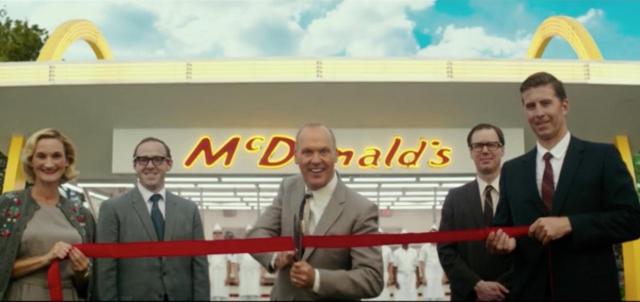
Movie Review: Keaton sizzles on the griddle as “The Founder”

found1

The legends of America’s great robber barons are equal parts inspiring and appalling. And damned if “The Founder” doesn’t get that balance just right.

Director John Lee Hancock (“The Blindside”) tells the story of McDonald’s tycoon Ray Kroc with old fashioned warmth and pluck, and new-fangled dark edges and cynicism.

And in the title role, Michael Keaton makes Kroc his most lovable screen villain since Beetlejuice.

Robert D. Siegel (“The Wrestler”) picks up the Kroc story in 1954, when this 50something serial failure stopped peddling milk shake mixers the minute he caught a gander at the little San Bernadino burger joint that has just become his best customer.

Kroc’s a plucky, hard-drinking, hard-working self-helping loser, or close to it. He’s been working in the restaurant supply trades for years, struggling, forever disappointing his lonely, society-conscious wife (Laura Dern). As doors slam are slammed in his face in fast food joints all over his native Illinois, places with names like Piggie Park Drive-in, Kroc has a Walt Disney-sized epiphany.

The service, by overworked women in roller skates, is lousy. The menus are a hodge-podge, the food takes too long and there are too many mistakes.

Then, he visits the McDonald brothers. One of the glories of this script is its dogged determination to give the “real” founders of McDonald’s their due. John Carroll Lynch and Nick Offerman, perfectly cast as Mac and Dick, have failed a few times themselves. But they’ve come up with a limited menu, no dining room/no utensils mass production system that is the epitome of “the better mousetrap.”
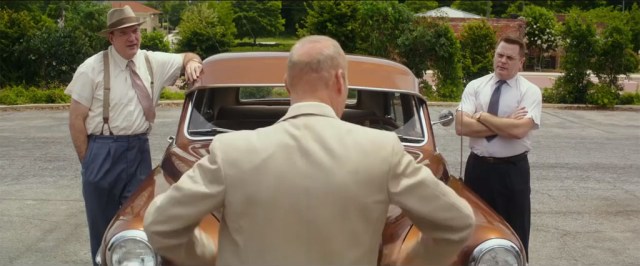
found2And Ray Kroc beats a path to their door. In a witty montage that includes black and white still photos of the brothers’ earlier efforts — driving trucks for movie studios, owning a movie theater, selling BBQ — we see efficiency-obsessed Dick (Offerman, of course) working out the ballet of burger building, laying out and testing a model kitchen, in chalk, on a tennis court. They try first one assembly (“make”) line after another, with their staff walking through the motions, erasing the chalk and starting over until Dick creates “a symphony of efficiency.”

Orders filled almost instantly, French fries perfectly crisped, every burger with two slices of pickle, perfect dabs of ketchup and mustard, satisfied and instantly-gratified customers. They invented it all, right down to the Golden Arches.

Ray wants in. And if you know anything about the rest of the story, what Ray wants, Ray gets.

Keaton, affecting Kroc’s nasal Chicago twang, summons up memories of his early, patter-packed career. Think “Night Shift.” Kroc may be a real piece’a work, but he’s got vision. And Keaton sells that vision — God, family and Golden Arches, Americana on a bun. An almost-instant credit thief, a gambler and a huxter, Keaton’s Kroc becomes a Mickey D’s evangelist.

Yeah, we’re treated to Kroc’s most desperate moment with a, “Look, I’m gonna level with you. I really NEED this” speech. Siegel’s script has the odd trite recycled line and is conventionally structured, but perfectly-pitched and beautifully played. There’s victory snatched from the jaws of defeat, conflict as the pace of change rattles the small-timers Kroc is in business with and more conflict at home as Kroc realizes that his wife’s country club “idle rich” are not the sort of hard-working folks he wants running his franchises.

And there’s the turn toward the dark side — greed, shortcuts on food quality, battles with the McDonald brothers, the married Kroc’s pursuit of the wife (Linda Cardellini) of a business partner (Patrick Wilson). Keaton reminds us that even at his most adorable, he’s still got an unpleasant edge he can whip out.

A feel-good movie like “The Founder,” pitched somewhere between “Big Eyes” and “The Master” in tone, is proof that even though Keaton has yet to win the Oscar he so craved for “Birdman,” his real victory is landing roles in “Spotlight” and “The Founder.” Like Ray Kroc, he’s a talent whose greatest strength may be on that salesman’s self-help LP Kroc listens to in dinky motel rooms, struggling for a break.

“Persistence.”

3stars2

MPAA Rating: PG-13 for brief strong language

Cast: Michael Keaton, Laura Dern, Nick Offerman, John Carroll Lynch, Linda Cardellini, Patrick Wilson
Credits:Directed by John Lee Hancock, script by Robert D. Siegel. A Weinstein Co. release.Patrick Wilson

Running time: 1:55
Posted in Reviews, previews, profiles and movie news | 1 Comment

Movie Review: Scorsese’s mad movie prayer is answered with “Silence

silence1a

It’s tempting  to write off any religious-themed picture from master filmmaker and ex-seminary student Martin Scorsese as an indulgence, a grasping attempt at cinematic atonement for a  path not taken and a lifetime of making movie violence.

“Silence” does nothing to shake the feeling that the director of “The Last Temptation of Christ” and “Kundun” is wrestling with big ideas and never getting beneath the surface. A frustrating two hour and forty minute period piece about Jesuit priests having their faith tested and their lives threatened in 17th century Japan, it has maddeningly unsatisfying theological debates, scrupulous though myopic period detail and an utter lack of narrative drive.

It’s a quest tale with no payoff,  a battle of wills with no victor with an ending that is more a cop-out than a climax. And the thoughts the viewer takes away from it cannot be what he or the novelist he’s adapting intended.

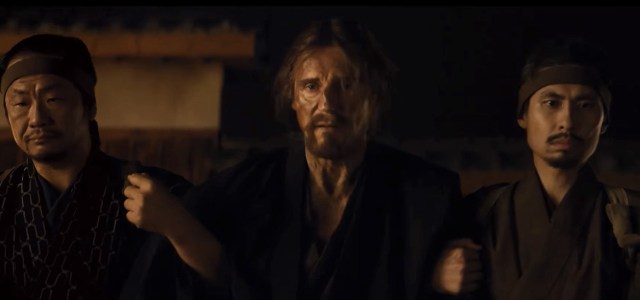
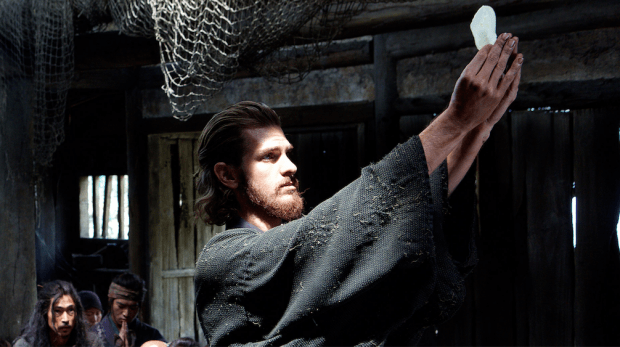
Andrew Garfield and Adam Driver are idealistic, impassioned Portuguese Jesuits who convince the head of their order (that high priest of gravitas, Ciaran Hinds) to send them to Japan, which has engaged in a murderous, decades-long persecution of priests and those they’ve converted to Christianity.

Inspired by a fierce priest (Liam Neeson) who preceded them, they want to find this missing man and clear his name. Reports indicate that Father Ferreira (Neeson) “apostatized,” renounced his faith to save his skin, and went native. Fathers Rodrigues and Garrpe refuse to believe this.

They’re smuggled into Japan by a troubled soul, Kichijiro (Yosuke Kabozuka). And on landing in an impoverished, wretched village, they learn there is a price on their heads and on the heads of the hidden Christians they encounter at every turn. As Father Rodrigues (Garfield) narrates, they stoically press on, impressed by the devotion of the locals, romantically linking their isolation, suffering and mission to that of early Christians hiding in the catacombs of Rome.

Persecution? They welcome it.

“The blood of martyrs is the seed of the Church.”

But as time drags on and they witness the faithful being sacrificed by ruthless authorities — murdered by fire, beheading or drowning — they come to question their work and the proper stance a Christian should take when presented with the choice of renouncing their faith, or dying.

And when Rodrigues faces the comically menacing old man called “The Inquisitor” (Issei Ogata) and his sneering interpreter (Tadanobu Asano), his nagging concern is that his prayers are being met with silence. But his worst fear is not getting his Great Theological Debate and of not winning it. The Inquisitor is content to torture Rodrigues’ flock and mock his “arrogance.”

“The price for your glory is THEIR suffering.”

The depiction of intrepid Jesuits facing death, unspeakable cruelty and myriad hardships reminded me of Roland Joffe’s heavy-handed “The Mission” (1986) and “Black Robe,” Bruce Beresford’s far more brisk and compelling 1991 film of Jesuits making contact with Native American tribes in 17th century Canada. “Silence” has the funereal pacing of TV’s “Shogun,” without the palace intrigues, sex and combat.

The only sparring here is verbal, the greatest mysteries are the inscrutability of Japanese intolerance and their version of Buddhism. If Christians are banned, why is Rodrigues allowed to minister to a flock in prison? If they’re Buddhists, how do they rationalize their many exotic tortures and forms of execution?

The story lacks the conventional ways this confrontation plays out. Rodrigues never makes the obvious argument — “If yours is the True Faith of Japan, then what do you have to fear from Christianity?”

Careful readers of Scorsese’s filmography will note that his most scripturally clumsy pictures are those he co-writes with his former-film-critic-turned-Yes-Man aide Jay Cocks (“Gangs of New York,””The Age of Innocence”). This undisciplined, meandering movie lacks structure, urgency and suspense.

Driver is no more convincing as a Jesuit than he was as a Jedi. But Garfield is positively beatific, and ably supported by a little-known and most capable Japanese cast. Asano stands out as a tormented drunk, saving his skin but unwilling to abandon his new faith, begging for Confession and forgiveness at each transgression.

Neeson is utterly wasted in a role that features prominently in the advertising and in the prologue and shrinks in the film’s anti-climactic climax.

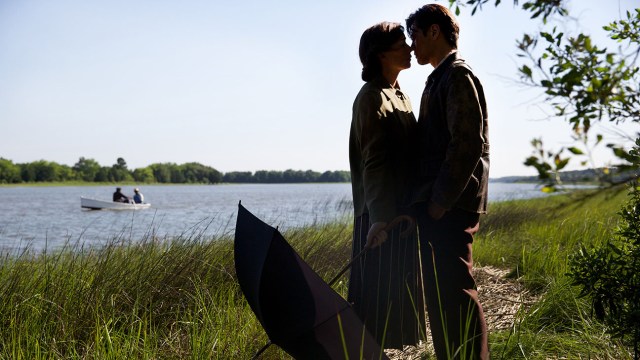
silence2This is the third film based on Shusaku Endo’s most famous (1966) novel. I’m a sucker for period pieces, and you don’t write off the Great Scorsese’s work, even when he’s out of his element and aiming for the cerebral and celestial. But “Silence” smacks of an obligation, a passion project which he wouldn’t edit for clarity, in which the passion withered away long before the cameras rolled.
2stars1

MPAA Rating:R for some disturbing violent content

Cast: Andrew Garfield, Liam Neeson, Tadanobu Asano, Issei Ogata, Yôsuke Kubozuka, Adam Driver, Ciaran Hinds

Credits:Directed by Martin Scorsese, script by Jay Cocks and Martin Scorsese, based on the Shûsaku Endô novel. A Paramount release.

Running time: 2:42

Posted in Reviews, previews, profiles and movie news | Comments Off on Movie Review: Scorsese’s mad movie prayer is answered with “Silence

Movie Review: Affleck returns to the Dennis Lehane well once-too-often with “Live by Night”

live3

Ben Affleck’s gangster epic “Live by Night” doesn’t fail through lack of ambition. It’s an over-reach, a sprawling tale of love, betrayal, violence and “the demon rum.”

It’s built on a book by Mr. Can’t-Miss Movie Material, Dennis Lehane, who wrote the stories that became “Gone Baby Gone,” “Mystic River,” “Shutter Island” and “The Drop.”

But as this competently-made Big Studio locomotive goes off the rails, I was reminded that however vivid some of the characters are, however poetic the narration, Lehane’s period pieces are markedly inferior to his modern day crime thrillers.

My first encounter with his fiction was “The Given Day,” a misshapen, overarching mess of an historical novel set in 1919 Boston. I read it in prep for an interview with Lehane when the book came out, and recall wondering what all the fuss over him was about. I kept thinking back to that book during the dead and dying stretches of “Live by Night,” which gets lost at about the one hour mark and drags us through another 68 minutes of KKK violence, religious power plays and lectures on white privilege and power.

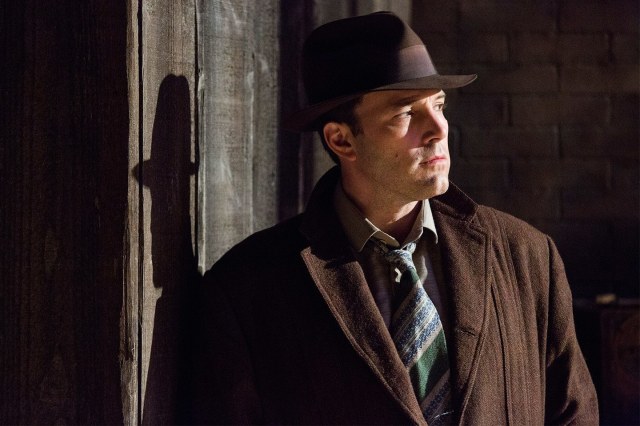
But it begins with great promise and plenty of nerve. Affleck, who scripted, directed, stars and narrates the tale, is Joe Coughlin, whose World War I experience he sums up thusly.

“I left a soldier. I came back an outlaw.”

He’s a Boston gangster too good to let himself be called that. He’s forsworn violence, even as he leads his pals in sticking up mob card games and knocking over banks.

His dad (Brendan Gleeson) doesn’t approve. In a great introductory scene, we learn that his father also doesn’t approve of the mob moll (Sienna Miller) Joe sneaks around with. Because he’s a police commissioner.

Emma, given a dazzling, reckless, Irish fervor by Sienna Miller, belongs to Mr. Big, Albert White, played with a murderous menace by British character actor Robert Glenister. Joe has crossed White, and might cross him further if the blackmailing head of the Italian mob Maso Pescatore (Remo Girone) has his way.

But events conspire to get Joe out of town, in Maso’s employ, to Tampa — “Ybor City, the Harlem of Tampa,” where he’ll mingle with the cigar makers and make deals with Cuban runners of “the demon rum.”

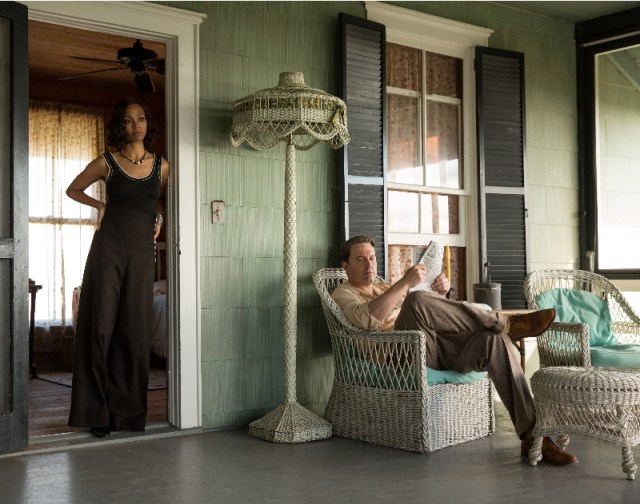
Joe has his only his sidekick (Chris Messina of “Ira & Abbey”) to rely on as he contends with White’s Tampa mob, a look-the-other-way but “incorruptible” police chief (Oscar winner Chris Cooper), the chief’s KKK hoodlum brother-in-law (Mathew Maher), the chief’s would-be actress turned evangelist daughter (Elle Fanning) and the red-hot sister of Joe’s Cuban rum connection, Graciela, played at low simmer by Zoe Saldana.

live2

As you glimpse that cast list and the picture traipses through Prohibition’s brutal “End Times,” where “gambling is the future” and Joe dabbles in civil rights do-gooderism thanks to Graciela and goes to war with not just the Irish mob, but the KKK, you realize “This is a mini-series, not a movie.” And despite well-handled car chases and shootouts, and a splash of droll Klan-mocking wit, it’s a mini-series that would strain to keep us interested in a story that loses its main thread early in the middle acts.

Affleck shed pounds and years for the film, but what he needed to lose was about a third of the script. The cigar factories and Florida speakeasies and juke joints are nice. But what’s fascinating are the mobsters and their threats to give Joe “the dead man’s drive” and the like.

“You’ve been hoping someone will come along and punish you for your sins,” Glenister’s sinister White hisses. “Well, HERE I am!”

Affleck is a more-than-competent director, and aside from giving himself way too many hat-wearing close-ups, he does nothing here to embarrass himself. But his performance is a mere reflecting mirror for more dazzling turns by Cooper, Glenister, Maher and especially Miller, who utterly immerses herself in a flashy, furious performance of violent bravado and vulnerability.

Fanning is, for the first time in her young career, in over her head as an Aimee Semple McPherson figure. Her sermons couldn’t fill a collection saucer.

As a Floridian, it’s fascinating to watch the movie’s alternate history of gangsters in the Sunshine State. But truth be told, “Live by Night” gets lost almost from the moment it leaves Lehane and Affleck’s home turf, Boston.

2stars1

MPAA Rating: R for strong violence, language throughout, and some sexuality/nudity

Cast: Ben Affleck, Sienna Miller, Zoe Saldana, Elle Fanning, Brendan Gleeson, Remo Girone, Robert Glenister

Credits:Written and directed by Ben Affleck, based on the Dennis Lehane novel. A  Warner Brothers release.

Running time: 2:08

Posted in Reviews, previews, profiles and movie news | Comments Off on Movie Review: Affleck returns to the Dennis Lehane well once-too-often with “Live by Night”

Movie Review — “Underworld: Blood Wars”

under2.jpg

In a global economy roiled by uncertainty, there’s something to be said for going easy on anybody doing a dirty job just to get by.

But there’s a better argument for making Kate Beckinsale, her agent and her financial planner sit through the prologue of “Underworld: Blood Wars.” Five films spread over 13 of the talented and gorgeous star’s prime acting years, plus a video game, all summed up in a mad mashup of story threads that condensed and packed together, make zero sense.

What a waste.

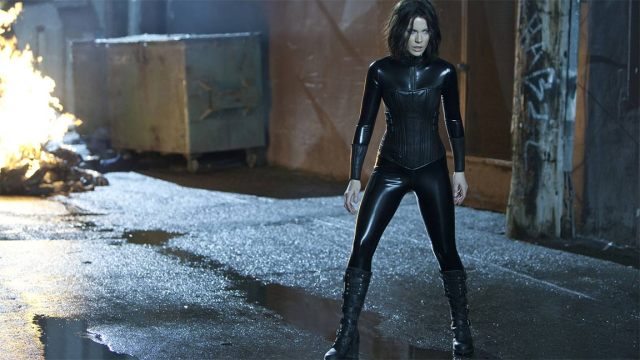
She can still wear the wires that let her hurtle across rooms in fights or scamper up ice walls. She still looks spectacular in Spandex, still can kick ass in those kick-ass high-heeled boots.

But she’s better than this vampires vs. werewolves debacle, and always has been.

The idea has long been that Selene, her character, was on the run from both vampires and werewolves — each an ancient culture with traditions, history, enmities and…real estate. She’s given birth to a hybrid child whose blood could make either side all-powerful.

So when the vamps, manipulated by Semira (Lara Pulver), realize they need her help in fending off the lycan (wolf) assault, Selene is understandably leery.

“Welcome!”

“AM I?”

Not to worry. Her old foe turned ally (Charles Dance) and his son (Theo James) are there to ensure her safety.

“Things change.”

“Vampires do NOT.”

Back on the run it is, then, chased into the frozen north and elsewhere by both sides. The head lycan, Marius (Tobias Menzies) uses pack organizational skills to hunt her down. Can David (James) keep her alive long enough to find and perhaps save her daughter?

Feel free to yawn, because I certainly did. The action beats are barely passable — glitchy, pixelated jerks in the digitally-augmented jumps, punches, etc. The production design — dark on dark, all the better to hide the bored actors.

under1

The costumes are the usual Red Tag Sale items from Bondagewear Ltd.

And Beckinsale, rarely called on to do anything as challenging as “Love & Friendship” or “Cold Comfort Farm” these days, just keeps her mop of jet-black-dyed hair flopped into her face, her nose to the grindstone and her eye on the bottom line. At least she’s well-paid to be in something this forgettable.

1star6
MPAA Rating: R for strong bloody violence, and some sexuality

Cast: Kate Beckinsale, Theo James, Lara Pulver, Tobias MenziesCharles Dance

Credits:Directed by Anna Foerster, script by Cory Goodman. A — release.

Running time: R for strong bloody violence, and some sexuality

Posted in Reviews, previews, profiles and movie news | Comments Off on Movie Review — “Underworld: Blood Wars”

Movie Review: Greece collapses and lovers find that they’re “Worlds Apart”

worlds

Three generations of Greeks struggle with intercultural romance amidst the turmoil of modern Athens in “Worlds Apart,” a romantic melodrama by Greek writer, director and actor Christoforos (Christopher) Papakaliatis.

This wistful, melancholy yet hopeful romance has a warmth that singes, a poetry to its stock situations and a biting allegory about the country where Western civilization began facing a world of troubles, not all of its own making.

Daphne (Niki Vakali) is the sort of coed who would cross the street to avoid contact with the sea of immigrant beggars and street peddlers that have flooded her country, right in the middle of its economic collapse. But when she’s grabbed and about to be gang-raped, a young Syrian (Tawfeek Barhom) comes to her rescue.

She sees him a few days later, and he sees her. She won’t make eye contact, but he is persistent. He has saved her phone. Love, “eros” is soon in the air. But an old man, a failed merchant (Minas Hatzisavvas) has been moved to join the black-shirted thugs who gather for assaults on immigrant camps, including the abandoned jetliner where Farris (Barhom) hides out.

Giorgos, played by writer-director Papakaliatis, is a stressed-out middle manager, separated from his wife, whose inefficient Greek company is to be thinned out by a Swedish efficiency expert (Andrea Osvart). Of course, neither knows the other when they meet, argue in a bar and being young and beautiful, tumble into bed together.

worlds2

And Maria (Maria Kavoyianni) is an over-60 housewife who still goes to the market even though she can’t afford anything there any more. She is just bi-lingual enough to aid a semi-retired German history professor (J.K. Simmons, twinkling and slinging an accent) who supposedly knows no Greek, but is in love with the culture and soon just as in love with her.

“I don’t understand a word, but I love your expressions!”

Papakaliatis uses these three inter-connected stories to explore the doomed romance of “Eros” and “Soul” from Greek myth, and the doomed romance of Greece with the European Union. There is tragedy, comedy and melodrama in its three acts.

The first story, titled “Boomerang” and named after an item Farris sells as a street vendor, is about how treating immigrants harshly will come back to haunt Greece.

And the middle tale, named after an anti-anxiety drug, is about the cruel and inhuman effects of “efficiency” on lives and cultures, both the inefficient and those who insist on efficiency in all things.

Maria harangues Sebastian (Simmons) about Germany’s high-handedness with her country, about the money “you owe us, starting two wars, destroying nations.” She does this in Greek so he won’t understand her fury, but confesses her growing infatuation in the same language, hiding her true feelings behind her mother tongue. Kavoyianni lets us see what Sebastian sees — longing, disappointment and woman helplessly falling in love.

It’s all rather obvious, but Papakaliatis manages a few surprises. Saving the sweetest story for last works beautifully, and there’s cleverness in the way he ties the tales together.

Papakaliatis, whose earlier film “What If?” also explored Greece in crisis, offers us a rare look inside Greece and from a Greek point of view, a nation straining to rediscover its footing in the world, wrestling with its inadequacies, raging about its place in history even as its electorate is largely ignorant of that history as it follows one incompetent populist or political demagogue  after another over a cliff.

It’s naive to hope that “eros” might pull them out of the ashes of their civilization, but “Worlds Away” and its filmmaker are to be praised for having that hope in a time where that is increasingly in short supply.

3stars2

MPAA Rating: unrated, with violence, sex, adult themes, smoking, alcohol

Cast: Maria Kavoyianni, J.K. Simmons, Andrea Osvart, Christopher Papakaliatis, Niki Vakali, Tawfeek Barhom

Credits: Written and directed by Christopher Papakaliatis  . A Cinema Libre release.

Running time: 1:51

Posted in Reviews, previews, profiles and movie news | Comments Off on Movie Review: Greece collapses and lovers find that they’re “Worlds Apart”

Hugh Laurie wins “Best Golden Globes” speech — again

I don’t make it a habit to watch the Golden Globes. Yeah, “La La Land” may be destined to win the best picture Oscar. But as they unloaded all their love on various Brits last night (“The Crown”? Ahem.) for TV shows, well, I remembered why they don’t matter and that I’m weaning myself of NBC programming altogether, as a matter of principle.

Still, any time Hugh Laurie does something worth honoring, they honor it. Remember when he went through one of his “House” acceptance speeches by pulling names out of assorted pockets, one pocket per win? He’d thank the makeup/wardrobe/screenwriter, etc. whose name was on what came out of that pocket?

He did something equally witty with his “Night Manager” villain win last night.


Posted in Reviews, previews, profiles and movie news | Comments Off on Hugh Laurie wins “Best Golden Globes” speech — again

Box Office: “Rogue One,””Sing” and “Hidden Figures” finish in dead-heat

boxThe weekend’s blizzard over much of the northeast made calling the movie box office race tough until late Saturday night.
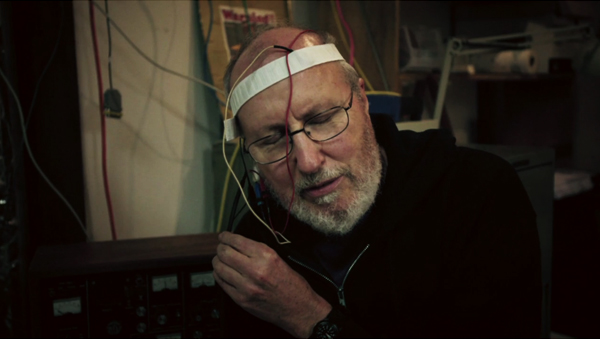

For a while, it looked as if “Hidden Figures,” the historic drama about African American mathematicians and the early space program, might pull off the upset. It looks to clear $21 million by midnight tonight.

But “Rogue One” ended up winning the weekend, packing in another $22-23 million, with “Sing” managing another $21-22.

January always means more “Underworld” and “Resident Evil” movies. “Underworld: Blood Wars,” opened at $13 million. The last in the franchise? Maybe. The “last” “Resident Evil” is due out at the end of the month.

“Passengers” has a slim chance of clearing $100 million at the U.S. box office, now, “Why Him?” will clear $50 million by Tuesday.

“A Monster Calls” has great reviews and opened wide — not 3-4,000 theaters wide, but wide enough. And it didn’t crack the top ten. A fairy tale with somber undertones and a dying mother is not much of a draw and it didn’t crack the top ten.

Oscar contenders “Fences” and “La La Land” remain in the top ten, “Manchester by the Sea” fell out. Will “Hidden Figures” get an Oscar nominations bounce to go with its big opening?

Posted in Reviews, previews, profiles and movie news | Comments Off on Box Office: “Rogue One,””Sing” and “Hidden Figures” finish in dead-heat

Movie Review: Forbidden love in 1941 SC is the hook of “Sophie and the Rising Sun”

sophie

Veteran indie writer-director Maggie Greenwald’s best-known films — “The Ballad of Little Jo” and “Songcatcher” — are period pieces, fish-out-of-water romances. And all of her films have the refreshing novelty of being told from a female point of view.

“Sophie and the Rising Sun” is further proof that “an artist is someone who pounds in the same nail, over and over again.” It’s a timid, tired but a tender-hearted wartime romance that should have more edge than its subject promises.

Margo Martindale has a secure place among the ladies with hobbies in sleepy 1941 Salty Creek, S.C. She’s a well-off widow with a garden column in the newspaper, devoted acolytes in the Garden Club and one really good friend.

Julianne Nicholson (“Black Mass”), who co-starred with Martindale in “August: Osage County,” is Sophie, a free spirit who harvests her own blue crabs, dabbles in watercolors and quietly mourns a sweetheart who died 23 years before “in the Great War.”

And then this Asian fellow tumbles off the bus, bloodied and beaten, and Miz Anne (Martindale) is convinced to do the Christian thing and take him in.

The stranger (Takashi Yamaguchi) is barely conscious. And everybody, from the cop (Joel Murray) who finds him to the ladies around town, figure they know who this guy is. So does Anne.

“I’ve got a Chinaman in my cottage.”

But knowing the time setting, taking a long hard look at the man and knowing he’s been beaten, we guess he’s Japanese long before the Palmetto State provincials do. His first uttered word, “Ota,” confirms it.

Anne and Sophie and later Anne’s maid (Lorraine Toussaint) try to keep that information quiet, especially after that “date which will live in infamy” passes.

Ota, being Japanese-American, has garden skills, which endear him to Anne. He likes to paint, which plants the seed of romance in Sophie’s lonely heart.

Can they protect Ota from the town’s rage after Pearl Harbor? Diane Ladd is Ruth, the hateful busybody who insists Sophie keep her distance from the newcomer. But Ruth has her own burdens, caring for a burned-beyond-repair son wounded in the Great War.

The setting is intriguing, and there’s nice period detail — including actual radio broadcasts about Pearl Harbor and its aftermath. The few jokes, about everything one can make with crab, are feeble in the extreme.

“Sophie” has the slack pacing of a Sleepy Time Down South story, and only livens up in a couple of blasts of melodramatic violence. The characters are more than caricatures, but not by much.

And the actors are, to a one, better than the archetypes this stultifyingly unsurprising script (based on an Augusta Trobaugh novel) has them play. There is a little suspense about where things are headed, and just one mild twist in the proceedings.

About the best one can say about “Sophie and the Rising Sun” is that Greenwald & Co. made a film that shows more care than the source material deserves.

2stars1

MPAA Rating: R for some sexuality and nudity

Cast: Julianne Nicholson, Takashi YamaguchiMargo Martindale, Diane Ladd, Lorraine Toussaint, Joel Murray

Credits:Directed by , script by Maggie Greenwald, based on an Augusta Trobaugh novel. A Monterey Media release.

Running time: 1:45

Posted in Reviews, previews, profiles and movie news | Comments Off on Movie Review: Forbidden love in 1941 SC is the hook of “Sophie and the Rising Sun”

Movie Review: The LSD underground is unearthed for “The Sunshine Makers”

suns1

suns2.jpg

The mischievous twinkle never quite dims in the eyes of the two guys nicknamed, for the purpose of a documentary about them,  “The Sunshine Makers.”

And since the film’s about Tim Scully and Nicholas Sand, the “Orange Sunshine” manufacturers who called themselves “LSD evangelists,” that’s absolutely as it should be.

Whatever the dire warnings attached to anti-drug propaganda of their era, no matter the changing currents of law, social and scientific acceptance of their area of — um — interest, they are still here — Septuagenarian witnesses, participants and enthusiasts for the “Peace, Love and LSD” 1960s.

“Sunshine Makers” is a tall tale, but true story that documents the history of Lysergic acid diethylamide and of the two men who embraced it and manufactured the most famous variation of it to “turn on the world” and thereby end violence and promote transcendence in the process.

Yeah, they were naive idealists. Well, one more than the other, anyway.

Scully (pictured in both photos above) was the scientific one, the methodical dabbler “with a touch of Asperger’s” who got into the drug in the mid-60s, learned how to make it from the underground masters of the art and ran labs until the law caught up with him.

He and his friends speculated that they’d need 200 kilos of acid to create 750 million doses — the number of people, worldwide, they were sure would want to at least try to “experience wonders” and take a trip. Tim wanted to “transform the world” and give this stuff away. So he got to work.

Sand, a portly ex-New Yorker whom we meet as he’s doing nude yoga, is more of a hustler, figured there was a buck to be made. He, too, dove into turning on the world, and turning a profit.

In the film, Scully methodically explains how he set up the various labs and the chemistry involved with flow charts and a winking “Don’t try this at home!”

And Sand mixes idealism with criminal pragmatism, talking about prison and dodging the law as various states altered their legal view of LSD and the pre-DEA Bureau of Narcotics and Dangerous Drugs was hot on their tail.

“The art of making LSD involves not getting busted.”

Cosmo-Feilding-Mellen’s film folds in “the Hippy Mafia,” a free love/LSD advocacy group called The Brotherhood of Eternal Love, and biker gangs and The Grateful Dead, rich kid financiers and female accomplices/lovers who were never prosecuted for smuggling drugs or aiding getaways.

It’s all utterly amoral, if you look at the world of science, social acceptance and the law as unchanging.

But they aren’t, and that makes “The Sunshine Makers” a light and lively look at a drug culture and trade that didn’t avoid all of the darkness that followed, but seems somehow less a part of it in retrospect as LSD is once again back in science’s good graces, the object of therapeutic study once again after a 50 year absence.

3stars2

MPAA Rating: unrated, with drug content, nudity

Cast: Nicholas Sand, Tim Scully, Alice Einhorn, Gordon White

Credits:Directed by Cosmo Feilding-Mellen , script by Connie Littlefield. A FilmRise release.

Running time: 1:31

Posted in Reviews, previews, profiles and movie news | Comments Off on Movie Review: The LSD underground is unearthed for “The Sunshine Makers”

Movie Review: A documentary lets James Baldwin remind us “I Am Not Your Negro”

negro1

Few have articulated America’s ongoing struggles with race better than the African-American writer and social critic James Baldwin.

“We carry our history with us,” he said. He wanted to make certain we understood that.

A gay man, he fled the racism of a country that would not accept him, much less nurture his talents and allow him to flower. But he came back from self-imposed exile in France for long stretches during the turbulent years of the Civil Rights Movement to make the intellectual case for equal rights in debates, in essays and magazine articles and in long, thoughtful TV interviews back when TV did long, thoughtful intellectual interviews.

“I Am Not Your Negro” is a filmed attempt to complete his last, long-contemplated but never finished project. “Remember This House” was to be his researched and annotated memoir of three Civil Rights leaders martyred by the cause.

Raoul Peck’s film uses Baldwin’s many TV appearances — most famously on “The Dick Cavett Show” — and his letters to his agent, Jay Acton, letters voiced by Samuel L. Jackson, which outlined the parameters of the project and Baldwin’s memories of Martin Luther King, Jr., Malcolm X and Megdar Evers.

In those letters, Baldwin described the photo that so moved him that he had to return to America to weigh in on the great issue of our times. It was a news image of Dorothy Counts, the gutsy and assailed young black woman who integrated Charlotte, N.C.’s public schools. Her courage reminded Baldwin that he “missed the life that nourished me,” awful as it sometimes was, that he needed to reconnect with African America and African Americans, who possessed “that style like no other people in the world.”

Peck uses grim images from the era — white rioters attacking black protesters at lunch counters or in voting rights marches — as well as footage of police beatings, then and now, murdered kids, from the 1950s through Trayvon Martin on up to today — to underscore Baldwin’s incisive arguments about the disconnect between what Black America experienced and what White America wanted to see.

“White Americans’ evaluations of these matters are laughable,” he intones over the whitewashed TV and film images of “The fabulous ’50s.” He bites off lines about the violence of “the vast, unthinking, heedless and cruel white majority” as images of recent unrest in Ferguson, Missouri plays out on screen.

negro.jpg

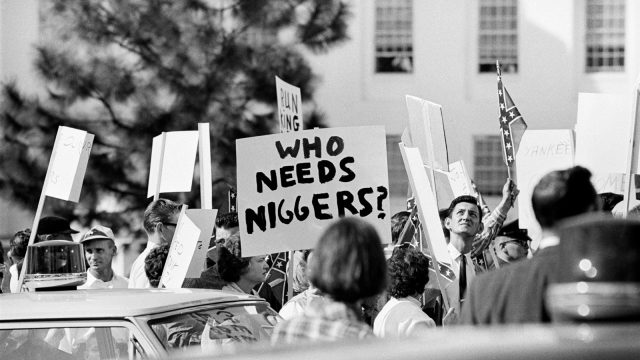
Images from way back when remind us that swastikas and Confederate flags have long been a part of the iconography of American racists.

In film chapters with titles such as “Paying My Dues” and “Purity,” Baldwin recalls his own journey, from exile to involvement.

Baldwin, in his letters, sets up the conflict between non-violent Martin Luther King, Jr. and “any means necessary” militant Malcolm X, men he saw “being driven closer and closer together” over the years he knew them until, by the time each was murdered, their positions on the “movement” were mirror images.

Peck’s brilliant and timely film ranges from “the famed Bobby Kennedy meeting” Baldwin and playwright Lorraine Hansbury (“A Raisin in the Sun”) had with the former attorney general, to images of white people “apologizing” for America’s history of racism, white people who include Ronald Reagan and Donald Trump.

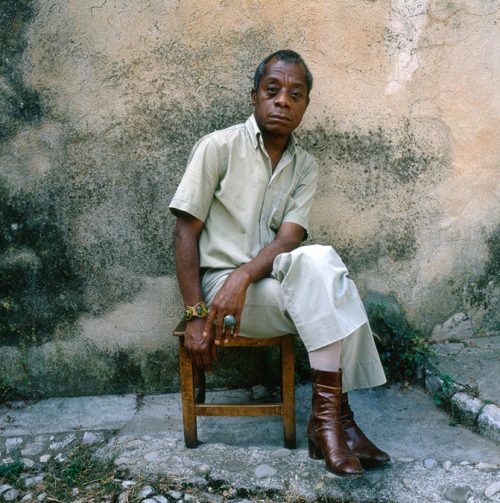
But best of all is the man who stands front and center, thinking, smoking and expounding, off-the-cuff, about a subject he spent his career and life mulling over, fuming over and struggling to understand in depth. At a time when intellectualism is once again under assault in America, it’s worth remembering that we once produced giants like James Baldwin, and had the good sense to honor and embrace them. Eventually.

3half-star
MPAA Rating:PG-13 for disturbing violent images, thematic material, language and brief nudity

Cast: James Baldwin, Malcolm X, Martin Luther King, Jr. and the voice of Samuel L. Jackson

Credits:Directed by Raoul Peck, written by James Baldwin. A Magnolia release.

Running time: 1:32

Posted in Reviews, previews, profiles and movie news | Comments Off on Movie Review: A documentary lets James Baldwin remind us “I Am Not Your Negro”