Movie Review: “Warcraft”

war

Another video game makes a branded transition to the big screen, and Hollywood blows it, yet again. That’s “Warcraft.” And seeing as how this tripe just wasted two hours and three minutes of my life, with the threat of sequels to come (Yeah, right), I’m tempted to leave it there.

But no. I didn’t get up and leave. Which I thought about. Might as well have a go at it.

A CG-reliant sword and sorcery fantasy that owes an awful lot (a LOT) to Tolkien and even more to the generations of fans that made World of Warcraft a gaming phenomenon, it has two things the vast majority of such fare lacks — characters, and moments of pathos.

It’s that old bugaboo “STORY” that lets it down.

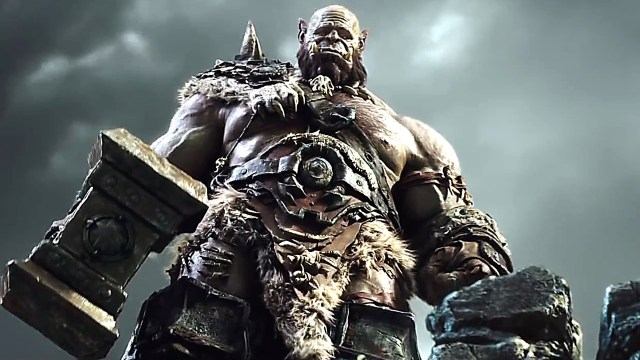
Orcs, those gigantic, blood-and-battle loving beasts of myth, have ruined their world. But thanks to their wizard-leader, they have this portal that can bring their war parties to a human world.

They take prisoners, because their magic is fed with human life force (literally). And they’re preparing the whole Horde for an invasion.

But the Orc chieftain Durotan (voiced and motion-captured by Tobey Kebbell) of the Frost Wolf clan has a new baby on the way, and wonders if things could be different.

Can’t we call just get along, he asks? Or words to that effect, muttered through his bejeweled tusks.

The humans respond to the threat. Dominic Cooper wears a lot of pretty armor and a lot of hair — facial and otherwise — as their king, Llane. His  brother-in-law, named Lothar (without SNL irony) and played by Travis Fimmel, is their champion, humanity’s Achilles or Lancelot.

He will require the aid of The Guardian, a member of a sacred wizard class, played by Ben Foster. And he’s certainly going to need the help of the skilled flunked-out wizard, Khadgar (Ben Schentzer). If they can get past their trust issues.

“What are you doing in my city, spell-chucker?”

Paula Patton plays a fetching “half-breed,” half-human and raised by Orcs, she speaks both languages and has tusks, in addition to everything leather shorts and a halter top offer.

Orcs and humans battle and scheme, digital brawls set in digital wastelands in between visits to digital cities and digital fortresses. The backdrops and roughly half the characters are animated.

David Bowie’s son, Duncan Jones (“Moon”) was an odd choice to direct this time-and-space-wasting oddity. His great accomplishment was keeping a reasonably interesting cast from looking embarrassed every time they have to spout tendentious jibbering or don armor or tusks to stage fights with guys in motion capture suits in front of green screens.

Assuming they went to that much trouble.

Every actor involved with this — Foster, Cooper, Patton and Fimmel (“Maggie’s Plan,” TV’s “Vikings”) — is better than this movie lets on.

If you’ve loved the game, you might appreciate the visuals cooked up for this fantasy universe. As it’s not interactive, and there’s no chance of playing one’s way into a better story, it doesn’t mimic the game experience or improve on it. The plot, subtexts and acting are a hash.

Put another way, I was bored out of my skull, from the “Lord of the Rings” opening to the Old Testament/Moses Afloat finale.

1star6


MPAA Rating:PG – 13 for extended sequences of intense fantasy violenc

Cast: Travis Fimmel, Ben Foster, Paula Patton, Dominic Cooper, Ben Schnetzer,
Credits: Directed by Duncan Jones, script by Duncan Jones and Charles Leavitt. A Universal release.

Running time: 2:03

Posted in Reviews, previews, profiles and movie news | 19 Comments

Thumbs Up — “Hitchhiker’s Guide” lives on

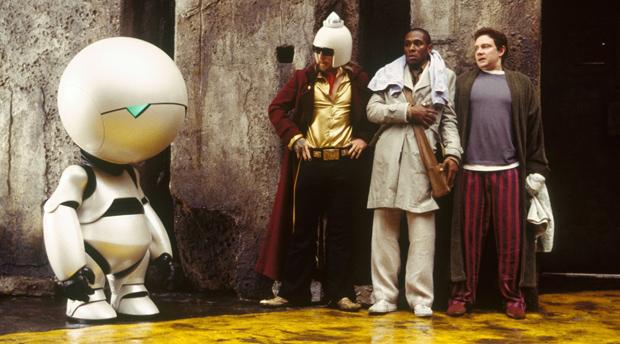
Editor’s note: The news that BBC radio was re-visiting “The Hitchhiker’s Guide to the Galaxy” for a fresh series (“And Another Thing…”) prompted me to pack my CDs of the earlier incarnations for a recent road trip. And I thought I’d re-post a 2005 piece I did on Douglas Adams, the Guide and the then-upcoming movie which a little known Martin Freeman would star in.

hit1

Far out in the clearly charted backwaters of the unfashionable southern docks of the Titusville City Marina sits an ancient Catalina sailboat with the words “Don’t Panic” inscribed in large, friendly letters across its stern.

The message, having little to do with sailing, evades most folks. But the few — OK, not so few, more than you might imagine — get it.

“Boats passing us on the Intracoastal always do a double take and grin,” says Orlandoan Carol Henrion, who owns the boat with husband Larry Tegethoff. “We frequently have notes clipped to the shrouds that say stuff like, `Hey, Ford! Meet us at The Restaurant at the End of the Universe. Signed, Zaphod,’ ” Carol says.

And “of course, we never leave the slip without a towel.”

Henrion sounds as if she is speaking code, as indeed are we. But with more than 20 million copies of “the five-book trilogy” of “The Hitchhiker’s Guide to the Galaxy” in print, and millions of fans around the world fondly recalling the radio and TV series and video game of Douglas Adams’ story — plus an eagerly awaited motion picture due Friday — it’s not exactly a secret.

Hitchhiker’s Guide tells the story of Arthur Dent, an Earthman rescued just as the planet is about to be demolished to make way for a bypass. His friend, Ford Prefect, is actually an alien, and a researcher for a travel book, The Hitchhiker’s Guide to the Galaxy, sort of a Frommer’s for the interstellar. Ford grabs Arthur, and they zip off on adventures that bring them in contact with evil, bureaucratic Vogons; the legendary planet Magrathea, which used to build “custom” home planets; and with Zaphod Beeblebrox, the deranged, delusional and egomaniacal two-headed galactic president.

A 1978 BBC radio show that inspired a phenomenon, Hitchhiker’s Guide is for fans who may or may not be into science fiction, says British writer M.J. Simpson, perhaps the world’s foremost authority on HHGG or H2G2, as it is known. He ran a Web site, and is author of several works on Hitchhiker’s and a biography of its creator, due out in paperback in May.

“It explores what it means to be a human being and humanity’s place in the universe, but it does so with comic exaggeration,” says Simpson, noting Adams’ jabs at TV chat-show pundits, psychology and universal paranoia, man’s insignificance in the cosmos and government bureaucracy.

“Combine this with some absolutely sublime use of the English language, very obviously influenced by the master, P.G. Wodehouse, and you have something that will last forever,” Simpson says.

`CRACKING GOOD LINES’

The wordplay often takes a reader or listener a minute to catch.

After just reintegrating from a trip in a “matter-transference beam,” Ford asks novice hitchhiker Arthur how he feels.

“Like a military academy. Bits of me keep passing out.”

Jumping into hyperspace is “rather unpleasantly like being drunk,” Ford warns Arthur.

“What’s so unpleasant about being drunk?”

“You ask a glass of water.”

Think about it.

hit2

“It was the coolest thing to have around, growing up after Star Wars,” says Garth Jennings, who directed the film version of Hitchhiker’s. Jennings first encountered Hitchhiker’s Guide on TV, “and I remember it was just this insane version of the same sort of universe ‘Star Wars’ took place in. Lovely ideas, and cracking good lines.”

Every fan has his favorite.

“How about `the Ravenous Bugblatter Beast of Traal, a creature so mind-bogglingly stupid, it believes that if you can’t see it, it can’t see you’?” offers Neil Olcott, a fan from Poinciana. “You really have to think about that one,” he says, adding that although he has forgotten much in his life, “I still know where my towel is.”

As the Guide tells us, no self-respecting hitchhiker would leave home without the always-useful towel: “You can lie on it on the brilliant marble-sanded beaches of Santraginus V, wrap it around you for warmth on the cold moons of Jaglan Beta. . . wet it for use in hand-to-hand combat. . . and of course dry yourself off with it if it still seems to be clean enough.”

The good lines are there from the very introduction:

“Far out in the uncharted backwaters of the unfashionable end of the Western Spiral arm of the Galaxy lies a small, unregarded yellow sun. Orbiting this at a distance of roughly 98 million miles is an utterly insignificant little blue-green planet whose ape-descended life forms are so amazingly primitive that they still think digital watches are a pretty neat idea.”

The tone is set. The die is cast. Earth and earthlings, science and religion are mere punch lines in the running gag that is the universe. And the book, drolly narrated by Stephen Fry in the new film, provides commentary, galactic history, science and trips into the fantastic.

“Adams was great with ideas, but he’s even greater with words,” says Martin Freeman, the “Everyman Briton” (as Jennings puts it) who plays that Everyman, Arthur Dent, in the film. “He doesn’t throw the silly ideas out. He makes the [uber-translator animal one sticks in one’s ear] Babel fish — a preposterous idea — feasible.”

The book within a book is a best seller across the galaxy. Why? Because it’s cheap. And, “it has the words `Don’t Panic’ inscribed in large, friendly letters on its cover.”

The marriage of comic wordplay and thoughtful science fiction has been catnip to movie studios, though they’ve been a bit put out trying to wrestle it into film form. A movie has been in the planning stages since the early 1980s, when Ivan Reitman was going to direct from a Douglas Adams script, with Bill Murray or Dan Aykroyd in starring roles. Monty Python’s Terry Jones had a shot. More recently, Austin Powers director Jay Roach had his hands on it; Hugh Laurie, Jim Carrey and Nigel Hawthorne were to star.

But before it came to pass, the 49-year-old Adams died in 2001. The finished film is based partly on his script and directed by Jennings, best known as half of the music-video-directing duo Hammer & Tong.

FANS ON ALERT

The film will be what fans are referring to as the “ninth” medium for H2G2. It began on radio in 1978, became a record album, then a series of novels, then a TV series, a computer game, various stage shows, a comic book and most appropriately, a towel.

Most of those fans are in their 40s and 50s now. They talk about passing the books on to their children and grandchildren. But although they’re not as numerous as hobbit-huggers, or as fanatical as wearers of Mr. Spock’s ears, H2G2 fans are voicing concern over their baby finally making it to the screen.

Like many fans, Byron Rambo of Sanford passed on his love of the books to his teenage kids and just hopes “the movie can re-create the feeling of the book.”

“I will keep an open mind, because Lord of the Rings was true to the books,” says Cheryl Osborne of Geneva, who also says she never takes a long road trip without a towel. “Who said these books weren’t educational?”

Others are downright leery.

“This is one of those books that should be a 10-hour movie,” says Larry Sawdo of Mount Dora.

Michael A. Scibetta of Orlando worries, too, about what he calls Hollywood’s efforts to squeeze “10 pounds of sausage into a 5-pound casing.”

“I’m braced to see the film,” says Candice Critchfield, a Maitland towel-owner who speaks in H2G2 tongues. “I swear to Zarquon — if the filmmakers have screwed up, I’ll find them and feed them to the Bugblatter Beast of Traal, see if I don’t.”

But Karen “Karie” Wilson of Apopka, who fell for the TV series she calls “Monty Python Meets Doctor Who,” plans to see it, fan-buzz and reviews be hanged.

“I do wonder what the Vogons will look like,” she says. “They were pretty ugly in the TV series.”

Susan Gilliland of Haines City wonders if ex-rapper Mos Def (“The Italian Job”) is up to playing hitchhiker Ford Prefect, whom she sees “as a Han Solo type. . . casually cool, worldly, unobtrusively sexy and quite intelligent.”

Director Jennings is aware of fan “interest.” Early fan-buzz reviews have either embraced or excoriated the film, depending on the fan’s intensity. Simpson, the expert, announced, in a huff, that he was shutting down his planetmagrathea.com Web site after criticizing the movie and taking abuse for that criticism.

“I can quite understand their concern,” Jennings says. “We all feel passionate about this stuff. We kept to the spirit of Douglas Adams’ work, even if we didn’t have every single line from him in it.”

Freeman says he is “not sure at all how this will go over with the fans. But we’ve made a movie we can be proud of, I think. These are people we want to please.”

Acknowledging that the movie isn’t as verbal as the books or radio series, Jennings isn’t taking any chances. Peter Jackson had all of New Zealand to lay low in, had Lord of the Rings failed to meet expectations.

“I don’t think we copped-out on this,” Jennings says. “But if we had, I’d have to be looking for a place I could hide.

“And not tell you, or any of them, where.”

another.png

Posted in Reviews, previews, profiles and movie news | Comments Off on Thumbs Up — “Hitchhiker’s Guide” lives on

Weekend Movies: Bad reviews for “Now You See Me,””Warcraft,” thumbs up for “Conjuring”

warSummer sequel season is long since in full swing. This weekend’s crop is quite representative — one solid sequel that might please the faithful, one limp one to a movie nobody thought merited a sequel in the first place.

Jesse Eisenberg could have gotten a franchise out of “Zombieland.” Because no one was interested in “The Further Adventures of Mark Zuckerberg.” But the lame “magic” caper dramedy “Now You See Me” is the one that laid the egg. Middling reviews, but it made bank. So back come Jesse, Woody Harrelson, Dave Franco, Morgan Freeman, Mark Ruffalo and Michael Caine — no Isla Fisher this time. Lily Caplan has “the girl role.” Daniel Radcliffe is on board, for villainous measure. Poor reviews, as to be expected, from “Now You See Me 2.” Not even clever enough to make the title “Now You See Me Too.”

Hollywood’s unblemished record in adapting video games earns no “exception that proves the rule” with “Warcraft.” Getting a story out of a game is always tough. And they didn’t do that here. 

Travis Fimmel is much better in “Maggie’s Plan,” Dominic Cooper needed the work, as did Paula Patton and Ben Foster. A blip on their resumes, and a paycheck.

“The Conjuring 2” is that almost-unheard of horror sequel that’s earning reviews almost as rapturous — OK, I oversold that — as the original. Those widely discredited spook hunters Lorraine and  Ed Warren, the “Amityville Frauds,” are back (Vera Farmiga, Patrick Wilson), this time in London. Because nobody in America takes them seriously any more?

Director James Wan is the closest thing horror has to a modern Hitchcock — reliable, stylish frights, time and again.

“Maggie’s Plan” is Rebecca Miller’s version of a Woody Allen rom-com — smart, witty, top-drawer cast. Going into wider release today. See it. 

“Conjuring 2” may have the edge at the box office, being a sequel to a  horror hit. Horror, however, has a definite ceiling. I don’t think Box Office Mojo is on the money, here. $36 million? We’ll see.

Box Office Guru is more in line with my thinking on this. “Warcraft” has the brand name edge — $24 million should win the weekend. “Now You See Me” should clear $20. “Conjuring?” Around $20-24 seems about right. 

Either way, those “Ninja Turtles” are done at the top of the box office mountain. Top four is their fondest hope.

Posted in Reviews, previews, profiles and movie news | Comments Off on Weekend Movies: Bad reviews for “Now You See Me,””Warcraft,” thumbs up for “Conjuring”

Movie Review: “One More Time”

Wider release this weekend. Walken is always worth hunting down.

Roger Moore's avatarMovie Nation

onemore

The unlikely pairing of Amber Heard and Christopher Walken pays comic dividends in “One More Time,” an agreeably predictable famous father/bitter daughter dramedy.

Walken plays Paul Lombard, an aged crooner, “The King of Romance,” contemplating a comeback as only Christopher Walken can. He’ll open for a more hip band and find a new audience.

“The FLAME-ing Lips,” he says, in Walkenspeak.

Heard is his struggling jingle-singing daughter, over 30 “wasting her talent” and determined not to let the old man or his agent (Oliver Platt) help her get a leg up.

Jude Lippman (Heard) was born “Star Shadow,” so-named by her six-times married dad, whose “makeout music” LPs are a go-to move for any unknowing guy about to bed her.

“It was my luck to be named during his ‘hippy’ period,” she grouses. And, knowing that makes no mathematical sense, “Who has a ‘hippy’ period in the ’80s?”

Paul lives…

View original post 380 more words

Posted in Reviews, previews, profiles and movie news | Comments Off on Movie Review: “One More Time”

Movie Review: “Maggie’s Plan”

mag1“Maggie’s Plan” is the best romantic comedy Woody Allen never made.

A tale of pretentious academics in love, infidelity, and “Let’s get you two back together” manipulations, with plucked guitar jazz in the score and oodles of Manhattan locations, director Rebecca Miller had to be expecting that inevitable Allen comparison.

Which is why she improved on the exhausted Allen formula. The performances are funny, but err on the side of natural — not the arch, stagey inventions of Allen’s last 30 years. They talk like real people. The romance, when it hits, hurts. And when love ends or takes a detour, there’s bite to the bitterness.

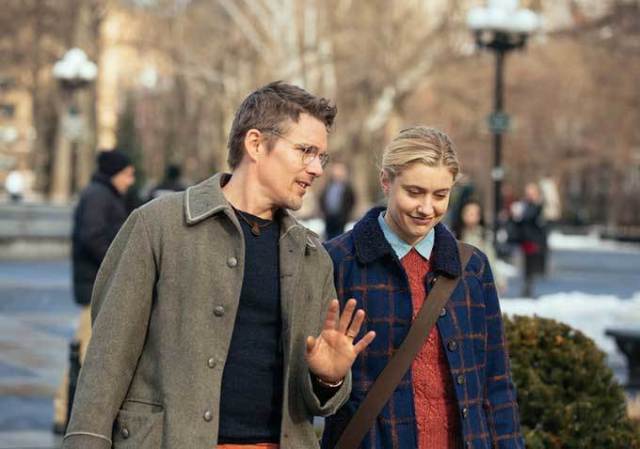
Greta Gerwig has the title role and toned down her “Mumblecore” affectations for her most touching performance. Maggie’s “plan,” outlined to her onetime college beau (Bill Hader,  is to have a child. No husband because, “Let’s face it,” she hasn’t ever taken a relationship past the six month mark.

That “Let’s face it” line may be the lone cliche in the Karen Rinaldi/Rebecca Miller script. We’re only subjected to a single scene of “I’m just facing the truth about myself” retreads, which Tony (Hader) isn’t buying, and the “Plan” is set in motion.

There’s a “pickle entrepreneur” (Travis Fimmel of TV’s “Vikings”) she has in mind for the donor. There’s a gawky chivalry — he’s a little smitten — to Guy that Maggie rejects out of hand. An academic at The New School, she’s too organized and into a life of the mind to consider this awkward hipster.

Which is how she falls for her colleague, the”ficto-cultural anthropologist” John. He’s given a faintly-downtrodden air by Ethan Hawke, playing another “blocked novelist.”

They meet, she takes an interest in his interest, and reads his novel-in-progress. And from that autobiographical book and John’s complaints, she picks up on his unhappy marriage. His self-absorbed Scandinavian academic wife, Georgette (Julianne Moore) undervalues him, lets him raise their two kids.

There goes the guilt when Maggie lets herself fall for John’s damaged desperation. She’s already become his muse. Soon, she’s his wife, raising their adorable daughter and stabilizing John’s disordered life.

“Maggie’s Plan” becomes “Maggie’s Back-Up Plan” thanks to what happens after that.

The story hangs on a series of Shakespearean manipulations and under-estimations. Maggie, for starters, is never given any credit. Gerwig’s “adorable ditz” baggage may have been kicked to the curb for this performance, but we instantly do what Tony, John and Georgette, and John and Georgette’s kids (who speak Danish when they insult Maggie to her face) do. We take her lightly, figure she’s naive at best.

“”You are such a hall monitor!” John complains of the organized young woman he nicknames “”Little Miss Quaker two-shoes,” riffing on her childhood religion.

“Am I so capable that I never deserve any attention?” Maggie wonders.

The Oscar winning Moore slings just enough of an accent for her lines to be funny. Her top-knot hairstyle says everything about the character we need to know — frosty, severe.

“I detest ze role of ze spurned wife. I von’t play it!”

mag2Miller knows the rules of a romantic comedy, so the “surprises” here are more twists that shocks. But Moore, Hawke, Gerwig amd Hader and for that matter Maya Rudolph (as Tony’s wife) all play this as if they’ve never read a play, never heard that there’s an inevitable happy ending for all these complications.

They never let on that they know that in life, as in this movie, it that ending won’t be the one we’ve planned.


3stars2


MPAA Rating:R for language and some sexuality (nudity)

Cast: Greta Gerwig, Ethan Hawke, Julianne Moore, Bill Hader, Maya Rudolph
Credits: Directed by Penelope Miller, script by Rebecca Miller, Karen Rinaldi . A Sony Pictures Classics release.

Running time: 1:39

Posted in Reviews, previews, profiles and movie news | Comments Off on Movie Review: “Maggie’s Plan”

Movie Review: “Puerto Ricans in Paris”

PR.jpg

Luis Guzman, for decades one of the funniest character actors in the movies (“Waiting…” “Yes Man”) hilariously steps into the spotlight in a comedy whose title is as deep as it ever gets — “Puerto Ricans in Paris.”

It’s a cop buddy picture that suffers from a serious imbalance in the partnership. But Guzman lands laugh after laugh as a Boricua out of water in the City of Light.

There are giggles and grins in the opening, when Guzman, as an NYC fraud detective, poses as a Born Again Texas tourist (Miriam Shor scores as his “wife”/boss) who wants to buy Louis Vuitton handbags from a Times Square counterfeiter.

The scene’s a cliche — rube tourists, an Indian hustler (Ravi Patel, a hoot), “New York Rolexes, “New York Vuittons,” etc. — but it zings.

Then Luis’s partner, played by Edgar Garcia (TV’s “How to Make it In America”) lumbers in. From here on out, the movie teeters between funny and dull, between working and not-quite, between Guzman and Garcia.

A French fashion team (Alice Taglioni, Frédéric Anscombre) commission these real New York cops to solve the case of a stolen designer bag, which has been ransomed by counterfeiters who threaten to flood the market with fakes before Colette (Taglioni) can release her latest creation.

There’s a big reward involved. The catch? The two Puerto Rican NYC cops have to go to Paris.

Luis, from the moment he sets foot in France, lights it up. Literally. He hits up a generic Frenchman, “Heeeyyy, man” for a smoke.

“It’s Paris, baby. The cigarettes are HEALTHEIR. Google that s–t!”

Luis is on the case and on the make — hitting on every skinny mademoiselle he meets, swaggering into meetings with suspects posing as a Saudi prince or Colombian drug lord. The jokes are entirely too on-the-nose, but no matter. Guzman finds the laughs in even the most weary scenes in the Ian Edelman/Neel Shah script.

Garcia? Not so much. The character is supposed to be the straight man, the one Colette flirts with (because…he looks like Vin Diesel?). But even as a straight man, Garcia’s a stiff. His line-readings are the very definition of that phrase — “line reading.”

He’s such dead weight that you can’t help but ponder how much funnier this might have been by pairing say, Guzman with Rosie Perez or Rosario Dawson, who play the two NYC cops’ love interests with gusto. Heck, putting the tantrum-tossing Perez with the smoldering slow-burner Dawson in Paris would make a pretty funny movie, too.

You figure out the “mystery” long before the “Puerto Ricans in Paris” do. But Guzman makes even the most trite moment — hailing a taxi in oh-so-tolerant Paris — amusing.

“What? You don’t pick up Puerto Ricans here, either?”

2half-star6

MPAA Rating:R for language including some sexual references

Cast: Luis Guzman, Edgar Garcia, Rosie Perez, Alice Taglioni, Rosario Dawson
Credits: Directed by Ian Edelman, script by Ian Edelman, Neel Shah. A Focus World release.

Running time: 1:22


Posted in Reviews, previews, profiles and movie news | Comments Off on Movie Review: “Puerto Ricans in Paris”

Movie Review: “Quitters”


quitters

Clark, the smart, judgmental teen at the heart of “Quitters,” has a reason for being that way.

His mother (Mira Sorvino) is a medicated mess, weepy, unstable and needy. She insists on driving him to a friend’s house after she’s canceled a family getaway at the last minute. She’s in her bathrobe. She’s fawning over him, utterly distracted despite his “Watch the road, Mom,” pleas.

When she plows into a stop sign, it’s her turn to plead. “Let’s keep this between us.”

Whipping out his cellphone tells us he’s not having it. “I’d like to report an accident.”

Clark quits on her, once and for all, it seems.

“Quitters” plays as a downward spiral that plainly has been underway for a while.  Mom is off to rehab, where they’ll try to get her medications right. Because she needs them. Clark, given the loathsome certitude of the self-righteous by Ben Konigsberg (“Anesthesia”), hears his dad (Greg Germann) beg him to “keep this quiet.”

But Clark is above that kind of reasoning. The girl (Kara Hayward) that he most wants to impress gets an earful. And when she dismisses his romantic overtures — with extreme prejudice — she gets Clark’s unfiltered take, too. He starts a whispering campaign about her “depression,” and informs her, by condescending email, that he’s A) “concerned” and B) can no longer “be your friend.”

He’s the sort of teen who debates his hip, young English teacher (Kieran Culkin, quite good) about his grade on an essay, and bullies the guy to get his way.

The kid finds Dad’s “chipper” (small marijuana pipe) in the glove compartment, and wrecks it. He sees a receipt for a massage parlor, and in front of his father, calls the place to catch the old man in an indiscreet lie.

First-time feature writer-director Noah Pritzker has created a near-classic anti-hero in Clark, a kid who wins our sympathy, then our fury and finally, something resembling our pity in this 93 minute film.

We wince at Clark’s infuriating mix of tactlessness and cluelessness. “Awkward” doesn’t begin to cover it. And we grimace at his every misstep, because we see them coming long before he does.

He ogles a hot mom (Saffron Burrows), only to ingratiate himself with her daughter, a classmate (Morgan Turner) he barely knows. He joins them for dinner and angles his way into their lives and into classmate Natalia’s bed, even though she seems to see through him.

He punishes his father, and watching Mom’s narcissistic approach to rehab, we wonder if Dad actually deserves any of this. He sees his son as “a mean spirited little s—.”

We will, too.

Konigsberg is deftly infuriating as Clark, Hayward and Turner make their vulnerable characters more insecure girls next door than beguiling teen sirens, Burrows suggests a deep soul with a dark side and Germann just looks….guilty. Of something.

Set in San Francisco’s tony Presidio, idle affluence permeates Pritzker’s picture. The title “Quitters” signifies relationships that one and all are quick to abandon — the parents cheat or have cheated, the kids abandon this or that significant person in their lives on an impulse. The parents have quit on their kids, too. Sorvino’s May is merely the last to do that.

There’s an abruptness to the conclusion that makes “Quitters” feel incomplete. But Pritzker has conjured up a world and peopled it with believable co-dependents, no mean feat in a 93 minute film.

The adult “Quitters”, caught up in their own melodramas, never ponder how their kids turned out this way, which is funny. Narcissists, by nature, are never that far from a mirror.

2half-star6

MPAA Rating: Unrated, with pot use, teen sex, exploitative sexual situations, profanity

Cast: Ben Konigsberg, Kara Hayward, Morgan Turner, Mira Sorvino, Kieran Culkin, Greg Germann, Saffron Burrows

Credits: Written and directed by Noah Pritzker. A Monument/eOne release.

Running time: 1:33

Posted in Reviews, previews, profiles and movie news | Comments Off on Movie Review: “Quitters”

Movie Review — “Raiders! The Story of the Greatest Fan Film Ever Made”

fan1.jpg

If you’re a film fanatic you’ve seen or heard of them — “fan films,” homages, remakes of or tributes to movies that fans are so crazy for that they want to put themselves into the experience of that world and try to recreate it on the screen.

They tackle “Star Wars” with fast food toys as the stars, recreate the bridge of this or that starship in their house, and act-out and videotape their efforts at playing their favorite characters and recreating their favorite filmic universe.

“Son of Rambow” was a decently-budgeted indie film about British kids making such a movie — (“Rambo”), “First Blood.”

As a film critic, I’ve seen a few of these enthusiastically cheesy efforts over the years. I recall one that a bunch of Orlando area theme park employees — set builders — made in a guy’s house, styrofoaming every room into a different corner of a space ship. At least the sets were impressive. They made a documentary about their filming this back in the ’80s. But an hour’s dogged research and memory crunching have failed to turn up that title, or the title of any other fan films I’ve checked out over the years. They’re forgotten because, well, they’re forgettable.

“Raiders! The Adaptation” got itself billed as “The Greatest Fan Ever Made” in the capital city of geekdom — Austin, Texas. It was a  1980s attempt by a bunch of Mississippi kids to do a shot-by-shot remake of “Raiders of the Lost Ark.” Think for a minute what that would require. No wonder it took them seven years to complete it. Or almost complete it.

Steven Spielberg’s film, based on a story dreamed up by Philip Kaufman and George Lucas, hit little boys where they live. I remember some college friends dressing up as Indy and running around doing semi-dangerous stunts — sneaking into an unclimbable  bell tower on a college campus — videotaping their derring do.

Chris Strompolos, Eric Zala  and Jayson Lamb were 11 and 12 year olds who set out in 1982 to recreate not just the movie, not just every scene, but every SHOT Spielberg & Co. created. The  storyboards alone, detailing hundreds and hundreds of camera set-ups, angles and edits, were as thick as a Manhattan phonebook.

Their goal was to film it, using up every summer vacation from school to do it, then show it to Spielberg, and maybe jump start careers in the movies with it. They dream big in Ocean Springs, Mississippi.

The boys, and the girl they talked into playing Marion Ravenswood (Angela Rodriguez), shot in their parents’ homes, setting up DIY SFX (special effects) that could have injured them or burned down those houses.  Yeah, they were unsupervised, and there are outtakes of every accident.

They saved their allowances and made every Christmas and every birthday about the movie. Please, Santa, bring me a Stetson fedora? A bullwhip? A leather jacket? Money to buy an old truck without an engine that I can turn into a 1930s German Army Mercedes?

And they kept at it. For seven years. They shot out of sequence. They outgrew costumes. They turned into teenagers on camera. They never quite finished. How DO you fake the big fight in front of a Nazi Flying Wing?

But their project got discovered and championed by Eli Roth, made its way to Austin and online film geek Harry Knowles’ film festival. And Jeremy Coon and Tim Skousen made this documentary about the guys, 30 years later, raising money to shoot that last 124 shot, six minute sequence.With a flying wing.

“Raiders!” is a movie with a better back story than finished product. Kids did this. That’s the hook. The kids fell out, and only reunited, decades later, for the finishing scene. Things went wrong when back then. Things go wrong today. That happens on amateur movie shoots. And life got personally messy in the intervening decades.

fan2

Yeah, the kids weren’t ordinary. One’s mom was a local TV anchor married to the owner of a TV station. None of them, not one, has or had (back then) a Southern accent. They apparently had one black friend, cast as the the friendly ship captain who helped Indy. The “personal struggles” anecdotes pale in comparison to the obvious advantages they had that allowed them to do this. Indulgent, distracted parents were a help.

Lamb, the effects guy and cinematographer back in the ’80s, comes off as cocky and geekish, with a hint of bitterness. Zala is the committed, organized one (he directed) and Strompolos the one with an arrogant edge, a well-off but unhappy childhood, followed by a lot of indulged child’s problems as an adult.

But “Raiders!” will make any movie buff laugh out loud at the sheer chutzpah and kiddie problem-solving that it took to, for instance, recreate that boulder chasing Indy out of a South American temple.

Getting permission to show the original footage, side by side, with their “adaptation” of it was a coup. So was getting John Rhys-Davies –Sallah, in “Raiders of the Lost Ark” — to sit for an interview about their passion, then and now.

But in keeping with this little boy’s attempt at movie-making, it takes a kid to put it all in perspective. Zala’s kids are around, watching Dad finish up his dream project, and his son gets off the movie’s best line.

“Why did Steven Spielberg need $20 million to make ‘Raiders of the Lost Ark’? My dad only needed his allowance.”

2half-star6

MPAA Rating: unrated, with violence, profanity, drug abuse discussions

Cast: Chris Strompolos,  Eric Zala, Jayson Lamb, John Rhys-Davies, Eli Roth, Harry Knowles
Credits: Directed by Jeremy Coon, Tim Skousen.  A Drafthouse release.

Running time: 1:35

Posted in Reviews, previews, profiles and movie news | Comments Off on Movie Review — “Raiders! The Story of the Greatest Fan Film Ever Made”

Giving “Storm Troopers” a good name the Fighting 501st marches on

501st-Legion-CVI-Group-PictureYou see them at movie premieres, at fan conventions, any place the subculture we call “fanboys” gathers.


They are obsessed devotees of this TV show, that comic book or movie, people so enamored with the fantasy that they dress up as their favorite characters and role-play, in costume, in public — Vulcans and Romulans and Sand People, oh my.

501a.jpg

But the fanboys and girls all know that you can dab on the perfect shade of green or twirl your hair into the grandest Princess Leia twist: Nobody will give you a second look when the phalanx in white and black — the Star Wars stormtroopers — march in.

“You get characters from every anime movie or TV show under the sun” at conventions like MegaCon or FX,” says Rick Stafford, Clone Trooper TC 7425, from Orlando. “When we show up, everybody turns and goes, `I have got to get a picture with you!’ ”

Stafford, 37, is a personal trainer and dive master at Disney by day. But on weekends, he suits up. So does Ismael “Esh” Velazquez, 31, who teaches digital media at Valencia Community College.

Role-playing fans such as these have long been ripe for mockery, a view aspiring filmmaker Jay Thompson of Greensboro, N.C., says he shared when he first encountered them. “They seemed to be just average, run of the mill sci-fi geeks,” Thompson says. They were children of the ’80s, like himself. They grew up on the Star Wars movies.

“From the moment in the first [1977] film where these guys bust through the door into Princess Leia’s spaceship, they all said, `Man, I have got to get me a suit like that!’ ” Thompson says, laughing.

But Thompson figured out, quickly, that these were geeks with connections. They knew how to get their hands on the means and molds to make the plastic armor. As Thompson started to film and follow stormtroopers around, he realized that they had the nodding approval of copyright-crazy LucasFilms, producer of the movies.

And the troopers themselves were organized. Since 1997, the “Fighting 501st Legion” has been a recognized part of the Star Wars universe, a worldwide club with several thousand men and women with stormtrooper gear.

But they were more than a club of like-minded Star Wars “geeks.” Thompson realized that the 501st Legion, a group founded in 1997 by Albin Johnson in Columbia, S.C., were shock troopers with a mission. That’s how Stafford found them and how he came to join the Fighting 501st, to wear the armor of an Imperial stormtrooper.

A dark side of life

On a weekend in late March of 2005, passers-by might have wondered just what was going on at Baldwin-Fairchild Funeral Home in Orlando. Scores of stormtroopers, Death Star flag officers and Boba Fett look-alikes milled around the chapel on Lake Ivanhoe.

Rick Stafford’s son, Christian, was 8 years old. He had inherited his father’s love for “everything and anything to do with Star Wars,” his father says. “Toys, Legos, lightsabers, all of it.” But Christian had leukemia. Rick had seen troopers at Disney’s Star Wars weekends and had wanted to hire them to come visit his son in the hospital, “maybe take him out of this awful reality he was living in and into this fantasy world he loved, just for a little while.”

He found out who they were but couldn’t hire them. They would come for free, they said. But Christian took a turn for the worse and died before the visit could take place. On that late March day, stormtroopers from as far away as Miami and Jacksonville came, strangers all, to the funeral of a little boy they had never met.

“We were coping with Christian’s death and trying to set up this service to celebrate his life,” Stafford recalls, still emotional about what he saw that day. “And the leader of the Orlando squad, Esh Velazquez, said `You work on your stuff. We’ll take care of the rest.’ ”

They suited up and served as ushers and an honor guard for Christian. They made Christian an honorary stormtrooper, TC 1219 (“A clone trooper, just like his dad, who protected the Jedi in Attack of the Clones,” his father says.). At day’s end, Florida’s members of the 501st presented Stafford, 37, with “this huge box, a plastic kit, and they said `You seem like the sort of guy who shares what we’re about,’ ” Stafford remembers. “I was invited in, right then and there.”

He thought about it. Then he put the kit together. Often that’s done at an “armor party,” where folks with heat guns and Dremel tools trim and bend the plastic to match the trooper they’re outfitting. If you don’t get the fit right, you get “armor kisses, armor bites” from the plastic pieces at the joints. Stafford finished his and made a promise to himself and his dead son.

“I will wear it as long as I can march.”

Like Thompson, the budding filmmaker, Stafford had discovered the thing that makes this corner of film fandom special. The men and women of the 501st Legion are ordinary, anonymous folks who put on black leotards and white plastic chest, back, knee and thigh plates and big, scary helmets they call “buckets.” They pop up at conventions, sure. But more often, they visit hospitals to spread a little sci-fi joy to children going through the worst experience of their lives.

Thompson’s documentary, Heart of an Empire: The Life and Times of the Fighting 501st, is about them. It will have its Southeastern premiere at the Orlando Science Center on Saturday at 6 and 9 p.m. Upwards of 80 Storm Troopers will be there, “but it’s not really for us,” Stafford says. “We know what we’re about. This is for everybody else, so that they know we’re not just fans dressing up in costumes.”

Thompson, 31, fell into this story as a collector of movie props and prop replicas. He bought a stormtrooper’s helmet, “and it came with a full suit. And the guy who sold it to me told me about this Web site,” 501st.com.

Thompson met Albin Johnson, the founder of the 501st. He started filming — an event here, a mocking TV news mention there (Orlando’s The Daily Buzz takes a swipe). Then, Thompson filmed a hospital visit.

“It was pretty obvious to me that these people were relieved, after visiting a burn ward for children, to be wearing helmets,” Thompson says. “They’re respectable people in their daily lives, and I think they get a kick out of the anonymity of the costumes. But the helmet keeps kids from seeing them cry when they do the visits.”

Sometimes, Stafford admits, “the bucket just fills up with tears.”

When you ask him why he puts himself through this, Stafford just says “Why do Shriners squeeze into those little-bitty cars? To bring a little joy into a child’s life.”

Velazquez, who leads central Florida’s Makaze Squad of the 501st, says that “it feels great to be able to do good for people . . . a weird and random way of giving back to the community.” But it’s also some of the “hardest but most rewarding things” he does.

A force of good

In the movies, the stormtroopers are almost always villains. The sneering scowl on the visor, the down-turned mouthpiece, make them almost comical. They’re inept. They can’t run worth a darn, and plainly can’t shoot straight. And they’re helpless in the presence of Jedi.

Stormtrooper: Let me see your identification.

Obi-Wan: [with a small wave of his hand] You don’t need to see his identification.

Stormtrooper: We don’t need to see his identification.

Obi-Wan: These aren’t the droids you’re looking for.

Stormtrooper: These aren’t the droids we’re looking for.

Still, there were times, Thompson says, when he was interviewing “a particularly good Darth Vader — you know, tall, big, with the breathing and all — and I’d get this scary chill, just the way I did when I was a little boy.”

Sometimes, Stafford says, hospital administrators worry about that fear factor.

“They don’t get that, to kids, it’s like they’re interacting with this big, walking talking doll, a toy,” he says. “I’ve never seen a child scared by one of our visits.”

One visit that Thompson captured for the film was a particularly grim day for a boy and his parents, Thompson says. The child had just gotten out of exploratory surgery for a brain tumor.

“The kid was down, out of it. The parents were as upset and stressed-out as you could imagine.

“And then in marches Darth Vader and a couple of stormtroopers. The kid came to life, right before our camera.”

Stafford has seen that happen himself.

“It’s this 15-minute escape, a little vacation, when the parents and the child don’t have to think about anything that’s going wrong, or the worst that can happen,” Stafford says. “I can say, having gone through that experience with Christian, that something like one of these visits is a blessing, a real gift.”

Having such a personal connection to the mission of the 501st makes for hard days for Stafford, he says. Perhaps the hardest was his first trip in uniform, to the ward at Wolfson Children’s Hospital in Jacksonville, where his son Christian spent his last days.

“Lot of tears in the bucket that day,” he says.

Filming the unique alliance

Heart of an Empire focuses on this side of what these costumed fans do. By pointing his camera in this direction, Thompson “goes beyond the expected” to reach for “a fuller understanding of the people behind the masks,” says a Reel.com review of the film. The filmmaker realizes that his movie is not as funny or as commercial a film as say, Trekkies, a 1997 documentary about Star Trek fans. Thompson got too close to the material to mock the 501st. He also realized the heart of the story was their mission and the irony that some of those involved in these visits would have sick children of their own.

rogtrooper

Posted in Reviews, previews, profiles and movie news | Comments Off on Giving “Storm Troopers” a good name the Fighting 501st marches on

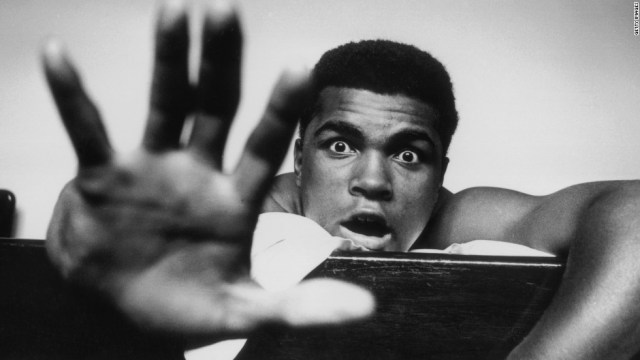
Muhammed Ali piece I wrote when the movie “Ali” came out

aliHe fought the law, and won.

He fought Liston and Frazier and Foreman and Terrell, the U.S. government and Malcolm X. He changed religions, renounced his name and dodged the draft.

He taunted, teased, boasted and bragged. He showboated, showed off, swapped shots with Cosell, rhymed and joked and rhymed again.

And he was hated. Oh, how he was hated.

“We tend to forget that,” says Aminah McCloud, who teaches religion at DePaul University. “When he fought Joe Frazier back in 1971, it was not just white America that hated him. African-Americans didn’t like him, for his bluster, for his changing religions.”

But now, 20 years after his retirement and more than a decade since Parkinson’s all but silenced him, the former Cassius Clay, now Muhammad Ali, finds himself revered, a beloved American icon and still one of the most recognized faces on earth.

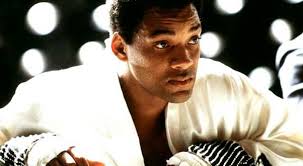
He was named “Athlete of the Century” by Sports Illustrated. Biographers from Norman Mailer (The Fight) to David Remnick (King of the World) have had to resist the urge to idolize him. He’s the subject of the hit Michael Mann/Will Smith movie version of the best 10 years of his life, Ali. He got a star on the Hollywood Walk of Fame last week.

And Wednesday night at 9 on CBS, the nation will get to celebrate his 60th birthday with him.

“He’s probably more important now than he’s ever been,” says George Schlatter, the veteran TV producer (Laugh-In) who has known Ali for years, who produced Ali’s 50th birthday TV celebration and who is producing the 60th birthday show for CBS. “I think the world has come to realize that one person can make a difference, whether it’s a fireman or a fighter.”

From a pariah, hated for his religion (Islam), for resisting the draft, fighting the government, for his bragging and a general inability to do anything quietly, Ali has become someone most Americans can get moist-eyed over when he lights an Olympic torch or appears on TV. How did that happen?

“As he gets older, he becomes this beloved figure who stood on his principles and faced the consequences and still didn’t just roll over and die,” says McCloud.

“I think much of the adoration since has been . . . for his courage and consistency, and a kind of collective apology,” says sportscaster Keith Olbermann, who just took over the ABC radio commentary show that longtime Ali friend Howard Cosell used to do. “And I think Ali benefited from, oddly enough, Watergate.

“As we began to realize that government could be used against individuals,” Olbermann says, Americans came to see that efforts to draft Ali years past the normal draft age were a form of persecution.

“Fighting the draft board made him transcend his sport,” Schlatter says, of Ali’s 1967 decision to refuse induction into the Army. “He didn’t run. He stood up for his beliefs. The U.S. Supreme Court backed him up. He was right. That makes him a hero. It just took the country a long time to catch up with that.”

The draft fight is when Giancarlo Esposito first became a fan. Esposito, who plays Cassius Clay Sr. in Ali, was a child actor when he met the young Ali, on the streets of New York.

“I ran into him, I must’ve been about 10, as he was holding this impromptu rap session at the corner of 50th Street and Broadway,” Esposito says. “He was talking to people on the street, telling them why he was fighting the draft. I looked at this guy and asked my mom, `Why won’t he go to war?’ And she explained, `Because he doesn’t want to go and kill other people.’ It wasn’t until years later, after he’d finally been allowed back into the ring, that I realized who it was that I’d met, and what he’d come to symbolize. . . . He’s a man of principles, someone who stood up for his beliefs.”

And if the rest of the country has finally found common ground with Ali, it’s not because Ali moved.

“I don’t think we love him because he’s made amends,” McCloud says. “We’ve come around to him because we realize that he stood on some of the principles on which the country was built. One can stand up, resist the majority, and win.”

And there’s also an element of pity too. Schlatter won’t be able to have “The Greatest” speak at his CBS birthday tribute, because the Parkinson’s has so slowed and slurred his speech that he would look terrible on TV.

“We feel sorry for him, I guess,” McCloud says. “We remember him before the Parkinson’s.”

Ali has also undergone quite a bit of image burnishing over the years. The Parkinson’s has meant that he isn’t on TV, hawking roach poison (as he once did). Documentary films such as When We Were Kings capture him at his most charismatic, in the early 1970s. And print interviews, such as one he did for Sports Illustrated when Ali came out, are generally flattering pieces written by fans.

ali2

The movie Ali is quite careful about the less heroic aspects of Ali’s life and career. We don’t see him beating the ancient Archie Moore (who was 49, at the time) to earn his shot at Sonny Liston. The movie makes Liston an obvious villain, giving credence to unsubstantiated claims that he had a substance put on his gloves to blind the challenger, Clay, in their first fight. And Ali doesn’t discuss the controversial “phantom punch” rematch in which Liston is alleged to have taken a dive, giving Ali that tainted fight in the first round.

Not much “honor” at that.

Ali’s womanizing is touched on in the film, but only in the most chaste terms.

And the film ignores Ali’s loss to Ken Norton in 1973, and ends before his often bizarre late 1970s fights, including an exhibition match against a sumo wrestler, and fights that he seemed to lose but somehow managed to win thanks to questionable judging.

His post-Parkinson’s public life has been largely laudatory tributes to his charity work. Schlatter puts a $1 billion figure on the ex-fighter’s contributions to various groups, including the Muhammad Ali Center in Ali’s native Louisville, Ky.

And while he remains a joker, “as sharp as he ever was,” Schlatter says, his Parkinson’s hasn’t kept Ali from occasionally embarrassing himself. He’s long been the benign face of the controversial Nation of Islam, the church founded by Elijah Muhammad, now led by Louis Farrakhan. The Parkinson’s means that Ali can’t finesse wisecracks that come off as racist or anti-Semitic (such as at a recent appearance in Washington, D.C.) with his old self-mocking twinkle.

And Ali’s public statements after Sept. 11 had a tolerance and understanding earned through advancing years. The militance left him long ago.

But none of that changes what he represents.

“Growing up, he was the only thing I could watch, the only black hero,” says Freddie Filmore, an Orlando resident who showed up at the film’s opening on Christmas Day.

“He challenged American religion and culture at the height of the civil rights movement,” says Michael Bryant, another Orlando fan. “To me, he just represented `change.’ ”

“When he refuses the draft, because he states that `I ain’t got no quarrel with the Viet Cong,’ he caused a lot of people in the African-American community to think,” McCloud says. “Young African-American men had seen the armed forces as a way out of poverty. Ali changed that mindset.”

As a high-profile draft resister, Ali affected white America’s attitudes toward the war as well. Schlatter remembers not just the draft fight, but the way Ali carried himself during it, as being something that impressed him.

Bryant notes that many other athletes followed Ali down the Islamic name-change road, from Kareem Abdul-Jabbar to Ahmad Rashad. But after Sept. 11, one has to wonder, “Will we see more?”

And while the TV special, with its emphasis on both athletes and stars of the movie will probably serve to drum up more interest in Will Smith’s film, the movie allows the man the courtesy of being inscrutable. For all his jawing, Ali has kept his counsel about what drove him to make the seemingly impulsive decisions that mark his life. Schlatter believes that is as it should be.

“One thing you could see about him, from the moment he entered the public stage, that here was a man who believed in himself, in his country and in his ability to make a difference here,” Schlatter says. “Sure, there were people who hated him. But he was a hero to a lot of people, right from the very start.”


Posted in Reviews, previews, profiles and movie news | Comments Off on Muhammed Ali piece I wrote when the movie “Ali” came out