
Movie Review: French couple constrained by the limits of “Just the Two of Us”

“Just the Two of Us” is a textbook domestic abuse melodrama, a French film with just enough mystery about it to make us wonder if it will transform into a thriller.

Based on a novel by Éric Reinhardt, Valérie Donzelli’s movie tells the story of a love affair, marriage and its breakdown from the woman’s point of view.

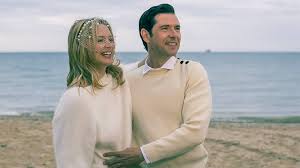
Virginie Efira from “Madeleine Collins” and “Benedetta” is Blanche, who meets the handsome and rakishly-named Grégoire Lamoureux (Melvin Poupaud of “Jeanne du Barry”) at a party her twin sister (Efira again) is throwing.

Actually, they “meet again.” They went to school together. He used to be “fat,” he says, as if such creatures ever turn up in French films. He’s tall, dark and handsome, a smoker with a name so poetic sounding she keeps repeating it.

He cultivates an air of mystery, but insists “Lamoureux” the banker “doesn’t want to keep secrets from” Blanche the high school French teacher. He quotes from “Brittanicus” (in French, with English subtitles), charms and seduces. A tumble into bed becomes a romance, a pregnancy and a marriage.

But the concern she expresses to her OB-GYN — “I haven’t known my partner very long.” — is our first tip that this isn’t what it seems.

He is charming, but controlling. The first lie she catches him in is a doozy. That “transfer” to a bank branch “in the boonies” far away from the coast and her family and friends wasn’t ordered. He asked for it. He wanted to get her away from her twin, her widowed mother and her school.

He doesn’t like the degree that she shares their lives with her sister.

“She’s my twin!”

“She’s not part of our relationship!”

Another baby comes, and the “control” ramps up. Her taking a job at a distant school, showing independence, isn’t his idea of a marriage.

The fact that we reconstruct much of what happens by virtue what Blance says to an interviewer (Dominique Reymond) tells us something went wrong. But is she talking to a lawyer? A counselor? A police interrogator?

The simple plot is decorated with tense moments, brittle arguments and textbook examples of manipulation and “abuse” that begin long before violence is threatened.

Efira makes Blanche understandable and sympathetic in classic “women’s melodrama” fashion. She cheats and she lies, but whatever reason she’s being “interviewed,” we trust it’s her side of the story that we will identify with.

Poupaud gives the game away by putting us on guard, right from that first seduction.

This French film never quite lapses into “Lifetime Original Movie” victimhood, but with every hint of stalking, badgering phone calls at work and every berating she endures, we know that whatever Blanche does to escape this is justified.

Still, it’d be nice if there was more to guess about, more suspense and more subtlety to the conflict. “Just the Two of Us” seems pre-ordained and predigested, with every emotion tugged at and every “trigger” and behavioral “tell” underlined so as to remove any doubt about what’s going on, who is the victim and who is to blame.

Rating: 18+, violence, sex, nudity

Cast: Virginie Efira, Melvil Poupaud, Bertrand Belin and Dominique Reymond

Credits: Directed by Valérie Donzelli, scripted by Audrey Diwan and Valérie Donzelli, based on a novel by Éric Reinhardt. A Music Box release on Amazon Prime.

Running time: 1:45

Posted in Reviews, previews, profiles and movie news | Tagged , , , , | Comments Off on Movie Review: French couple constrained by the limits of “Just the Two of Us”

Documentary Preview: A longer (full trailer) look at “Becoming Led Zeppelin”

It’s been a long lonely lonely lonely time. But that ends this Feb. “Authorized” and sanitized? Sure. Still looks fun.

Posted in Reviews, previews, profiles and movie news | Comments Off on Documentary Preview: A longer (full trailer) look at “Becoming Led Zeppelin”

Movie Review: Jackie Chan, in the silly present, in the fantastical past “A Legend”

Let the record reflect that Jackie Chan is more limber, nimble and in better faux fighting trim at 70 than you are at 60, 35 or 20, “Boomer,” “Xer,” Millennial or what have you.

Hong Kong’s king of martial arts clowns is still working, still slinging punches and taking falls, albeit with a little more help from stunt doubles, digital effects and wirework these days.

The fact that he’s making “Karate Kid” sequels in Hollywood and action fantasy foolishness like “A Legend” in China takes nothing away from his legacy. And while many of us would rather watch a clip-filled documentary of Jackie’s Greatest Hits, stunts and accidents titled “A Legend,” this Stanley Tong reincarnation spectacle is what we have on offer instead.

Chan plays two roles in this big budget boondoggle. There’s the fictive present, in which an archeologist (Chan) leads a team of young researchers in pursuit of a Hun Hoard, a hidden treasure trove of ancient Han China/Hun Invaders history. And there’s the Han Dynasty past, where a de-aged Jackie is a general, one of the leaders trying to turn the tide against the Huns via Chinese patriotism, Chinese ingenuity and Chinese might.

“The peace of our country and home is forged by heroes!” the cavalry shout, the sort of messaging we see in more than one Chinese film of the current era. It’s agitprop masquerading as entertainment, and one can only hope it isn’t any more meant to ready “the people” for World War III than a Hollywood “Top Gun” sequel, or a Chinese flag-waver in the “Top Gun” style.

In the present, our professor tries to give a clueless assistant (Zhang Yixing) hints that cute, always-mini-skirted-assistant (Peng Xiaoran) has a crush on him. That’s while they are researching this jade and gold amulet they found on a buried warhorse.

In the past, a dynasty hangs in the balance as the Han prepare to face down a ruthless new leader of the Huns (Max Huang).

Shamanism plays a role in events of the past and the present as the scientist and his aide start having dreams that insert them into this past of derring do and self-sacrifice.

The battles are vast in scale, on a par with “Spartacus,” Jet Li’s “Hero” and other overpopulated historical spectacles where waves of extras gallop across the screen.

But any hope that the ancient story will becoming gripping and immersive is frittered away every time writer-director and longtime Chan fight choreographer Stanley Tong (Chan’s “First Strike” and “Vanguard” are among his directing credits) takes us back to the designer-clothed silliness of “research” and clumsy flirting in the present.

You just know this thing will climax in an underground ice palace of Hun construction filled with stolen Han gold.

The rom-com stuff elements are piffle, as is the plot. The younger version of Chan is a lot more lean, leading man-looking than the Prince Valiant-coifed Jackie we remember from 40 years ago. The acting is adequate, nothing more.

But the fights still measure up. Kind of.

Rating: unrated, violence

Cast: Jackie Chan, Gülnezer Bextiyar, Yixing Zhang, Chen Li and Max Huang

Credits: Scripted and directed by Stanley Tong. A Well Go USA release.

Running time: 2:09

Posted in Reviews, previews, profiles and movie news | Tagged , , , , | Comments Off on Movie Review: Jackie Chan, in the silly present, in the fantastical past “A Legend”

Movie Preview: Donnie Yen’s a two-fisted cop who kicks more ass as “The Prosecutor”

Love that Donnie Yen.

Jan. 10.

Posted in Reviews, previews, profiles and movie news | Comments Off on Movie Preview: Donnie Yen’s a two-fisted cop who kicks more ass as “The Prosecutor”

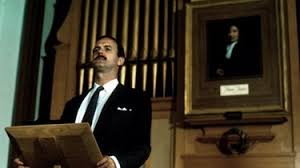
Classic Film Review: Cleese shows us Classic Comedy can be “Clockwise” (1986)

A person hellbent on maintaining his dignity in the face of everything thrown at him to deny it, and failing, is the essence of comedy. So it was with Keaton, and so it is with Cleese.

Somebody said that once. Maybe it was John Cleese himself, that paragon of British reserve, keeping up appearances, keeping calm and carrying on, and convulsing in barely-controlled fury when the world conspires to be uncooperative.

A tall, lean, business-suited sight-gag, Our Lord J.C. was long the tentpole who held up the canvas over “Monty Python’s Flying Circus” and the very picture of British reserve-upended as Basil Fawlty, hotelier from hell. And Torquay.

His greatest film outing, “A Fish Called Wanda,” illustrated this, with Cleese writing himself a posh upper-class barrister, stuffily-married, but outed as a man willing to throw character, ethics, morality and British reserve out the window the moment vamp outlaw Jamie Lee Curtis shows him a little leg.

But 1986’s “Clockwise” shows Cleese as his peers saw him. The English playwright Michael Frayn, hot off the success of the grand farce “Noises Off,” tried his hand at screenwriting a role tailor-made for Britain’s premier funnyman, still basking in the glow of “Fawlty Towers” himself.

Brian Stimpson would be the quintessence of Cleese, an officious, class-conscious over-achiever who runs Thomas Tompion Comprehensive School with a Big Brotherly iron fist. His eyes peering through all-seeing binoculars, his every bark betraying that he knows each and every student by name, his every utterance announcing their shortcomings.

“Right,” he snaps at each and every miscreant who isn’t toeing his narrow line. “9:20!”

That’s their appointment for a visit to his office for a very firm chewing out — “EXECUTION!” Because Stimpson’s every move is a “correction” aimed at turning out successful students destined to show-up the posh “elites” sent to the far pricier Eton, Harrow and Westminster.

On the day we meet him, Stimpson will lead the school through another singing of “He Who Would Valiant Be,” and then hop a train to Norwich for a meeting of the elite Headmaster’s Association. Brian Stimpson of downmarket Thomas Tompion is the newly-elected chairman of that group of his betters.

He’s a clock-watcher, scheduled down to the minute. His wife (Alison Steadman, who’d go on to glory in Mike Leigh’s “Life is Sweet” and “Topsy-Turvy” and TV’s definitive “Pride and Prejudice”) shows up early, and that’ll never do.

His tendency to snap “RIGHT” at the beginning of every sentence is about to be his undoing. A clock-conscious martinet is about to experience an existential crisis, a trip to Norwich that becomes a long, sunny stumble into tortured, tested tardiness.

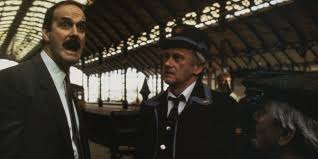
He goes “RIGHT” when the rail ticket collector keeps trying to tell him “left.” A train is missed, his wife is off to give little old ladies (including Ann Way and future Miss Marple Joan Hickson) from the nursing home a drive in the country.

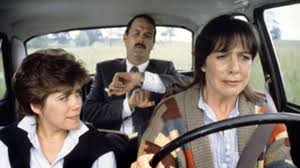
It’s 1986, when the film scores were synthesized and there was no cell service or cell-enabled ride-shares. Brian Stimpson, who left the “this is a historic day” speech he’d been rehearsing to give to the headmasters on the wrong train, sprints and scrambles and eventually arm-twists a star pupil (Sharon Maiden) into driving him 163 miles to Norwich.

“Call your parents,” before they set off in her family car, he orders. She doesn’t. She calls her beau to break up with him, leaving one and all in the dark.

Her parents panic at the stolen car, then at the missing daughter. Her “beau” turns out to be the creeper school music teacher (Stephen Moore of the BBC’s “Hitchhiker’s Guide to the Galaxy”). Stimpson’s neglected wife spies him chatting up student Laura as he fills up her parents’ Morris 1100.

All sorts of scandalous misunderstandings, threats of real justice and rough justice and reprisal pile up as our “couple” make their heedless, hapless way to scenic Norwich.

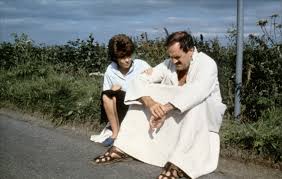
Parents, his wife, cops and that groomer-teacher are all in hot pursuit. But none of them, and no fender-bender, stuck car, smart aleck farmer, monastery full of not-utterly-silent monks, no Porsche-driving posh who resents being carjacked, British busybodies or a college girlfriend (Penelope Wilton, later a star of “Downton Abbey”) can keep Brian Stimpson from his date with destiny.

Cleese is marvelously self-absorbed as Stimpson, taking care to never show us the raging Basil Fawlty of his most recent series as Stimpson faces every fresh challenge with a panicked “adapt to our circumstances” logic. Brian is simply dismayed at each new obstacle to achieving his simple goal — that meeting, his speech and the glory and meaning it will give to his hyper-focused life.

“It’s not the despair, Laura. I can stand the despair. It’s the hope” that breaks him.

What Frayn, Cleese and director Christopher Moraham conspire to give us is the promise of a Cleese spitting, bug-eyed rage, looking for laughs in denying us what we crave — a meltdown for the ages.

This 90 minute picture is never rushed, ticking over clockwork fashion, logically and amusingly leading us from one barrier to the next, paying off with that big “meeting” with his more privileged (all white “old boys” of the original “Old Boys’ Network) where everything and everyone will come to a very English (reserved) boil.

The finale doesn’t wholly come off. But this picture plays, and Cleese sparkles in one of the only genuine big screen showcases he ever starred in, a slow-boil farce from a master at writing them paying tribute to an actor tailor-made to star in them.

Rating: PG, innuendo

Cast: John Cleese, Alison Steadman, Penelope Wilton, Sharon Maiden, Stephen Moore, Joan Hickson, Peter Cellier, Ann Way and Geoffrey Palmer

Credits: Directed by Christopher Morahan scripted by Michael Frayn. A Thorn EMI/Universal release on Freevee, Vizio, Mubi, Youtube, Amazon etc.

Running time: 1:36

Posted in Reviews, previews, profiles and movie news | Tagged , , , , , , , | Comments Off on Classic Film Review: Cleese shows us Classic Comedy can be “Clockwise” (1986)

Netflixable? Black Women serve in WWII — “The Six Triple Eight”

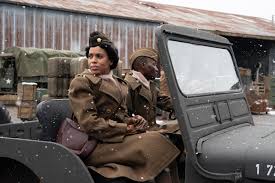
The only all-Black Women’s Army Corps united to serve in World War II n Europe is fondly remembered in Tyler Perry’s “The Six Triple Eight,” a polished, sentimental and old fashioned picture that points out to the culture at large an important piece of African American history.

World War II was a turning point in American civil rights, as Black troops and Black pilots were reluctantly celebrated in a country slowly coming to grips with the idea of “equal rights.”

Black women making the mail run to and from the combat zones played their part. And if that seems lower stakes than the myriad other Black contributions to the war effort, Perry’s film tries to remedy that. It’s not wholly successful.

Ebony Obsidian (“If Beale Street Could Talk”) stars as Lena, a Philadelphia high school teen courted by a Jewish boy (Gregg Sulkin) as he’s about to enter the Army Air Corps. When he’s killed in 1943, she resolves to finish high school and sign up for the WACs.

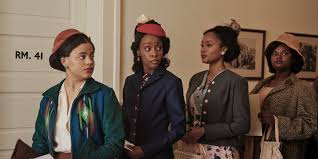
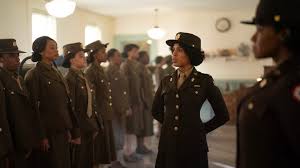
That’s where she meets Black women from all over America anxious to serve. Shanine Shantay, Pepi Sonuga, Sarah Jeffery, Jeanté Godlock and Moriah Brown play Lena’s comrades in arms, put through their basic training paces by Lt. Campbell (Milauna Jackson) and the 3888 Batallion’s commanding officer, the accomplished and driven Captain Charity Adams.

She’s the one determined to prove her more cynical volunteers’ fears wrong, that “They ain’t gonna let no Negro women NEAR Europe, much less Hitler.”

Captain Adams (Kerry Washington) clasps her hands behind her back and reminds them “We have the most to prove” as she warns the recruits about all the racists, in and out of the Army, who “do not want us to succeed.”

They can’t even get themselves assigned anywhere after completing basic training in Georgia.

But the movie’s opening scene has hinted at a logistics problem the war effort has failed to master. A pilot is killed, strafing a battlefield. A GI who finds him takes a bloodstained letter out of his jacket. All sorts of mail, to and from the front, is not making it to the troops fighting or the folks back home anxious to hear from them.

That’s a crippling “morale” problem that comes to the attention of first lady Eleanor Roosevelt (Susan Sarandon), and to Mary McLeod Bethune (Oprah Winfrey) a member of President Roosevelt’s “Black Cabinet,” the civil rights advisors who bargained for racial equality through participation in the conflict.

That’s where the Six Triple Eight will make its mark, straightening out the mess with the mail under the thumb of racist white officers bent on ensuring their fail and a white general (Dean Norris) determined to let the world know when they do.

The script strains to make this part of the war effort’s importance known and felt. The film’s resemblance to “Hidden Figures” is most obvious in the ingenious ways the WACs reason out where assorted units are on the fluid front lines.

But “The Six Triple Eight” stumbles as the characters are often stock “types” — the sassy one, the preacher’s daughter, etc. Liberties are taken with the timeline of events and Perry’s inattention to the militaria of it all bites him in the bum time and again.

The opening combat scene is clumsily conceived and staged, and the narrative bungles events in the action, which is mainly confined to the last months or even days of the war. Lena’s Jewish pilot is shown shot down in a P-51 Mustang many months before they were in service. The cockpit instrument panel shown is plainly for a more more modern (swept wing jet) aircraft. A V-1 “buzz” bomb air raid is inaccurately timed, and myriad other events are packed into the mere days between President Roosevelt’s death and the war’s end in Europe.

Washington is good in a role that asks for little more than stern stand-offs and speechifying, Obsidian has a moment or two and Shantay (of TV’s “Perfect Harmony”) stands-out as the mouthiest, most short-tempered member of the battalion, whose commanding general refers to as a “company,” at one point. A war zone love story is treated as an afterthought.

“The Six Triple Eight” illuminates the barriers these women faced, confronted by outright racism on occasion and reduced expectations at every turn. Perry’s sympathetic treatment of this history — stay through the credits — is laudable, and no one can ever say he can’t turn out slick to the point of immaculate melodramas. These ladies are so smartly made-up and prepped for their closeups that it calls to attention how tidy and sterile this cinematic war is. It barely looks lived-in, much less fought.

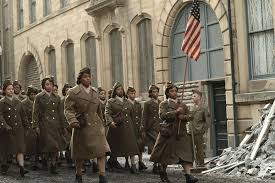
The best scenes are a parade march through bombed Glasgow, and an elaborately staged USO dance, a blast of jitterbugging that would best anything filmed in the musicals of the World War II era.

But Perry’s growth as a filmmaker peaked with his adaptation of the celebrated play “For Color Girls” back in 2010. Here, he’s blessed with material just as dramatic and important, and you’d swear from the evidence that he’s never seen a WWII movie, much less gotten his co-writer to cross his T’s and dot his I’s researching it to get the details right.

Rating: PG-13, violence, profanity

Cast: Kerry Washington, Ebony Obsidian, Shanice Shantay, Milauna Jackson, Kylie Jefferson, Susan Sarandon, Sam Waterston, Dean Norris and Oprah Winfrey

Credits: Directed by Tyler Perry, scripted by Kevin Hymel and Tyler Perry. A Netflix release.

Running time: 2″07

Posted in Reviews, previews, profiles and movie news | Tagged , , , , | Comments Off on Netflixable? Black Women serve in WWII — “The Six Triple Eight”

Movie Preview: A romance directed by Julia Stiles — “Wish You Were Here”

Hollywood has had its share of troubles making touching romances in recent years. But if you want somebody who knows the genre and has been in memorable movie romances, you could do a lot worse than giving Julia Stiles (“Ten Things I Hate About You,” “O,” “Hamlet,” “Save the Last Dance”) a shot at directing one.

Her feature debut is a bittersweet city romance involving graffiti and a love-testing illness.

Jan. 17, we see if she and her stars Isabelle Fuhrman (“The Novice,” “Orphan”), Mena Massoud (“Aladdin,” “Hotel for the Holidays”), Jennifer Grey and Kelsey Grammer deliver.

Having interviewed her a couple of times, I’d betting she pulls it off. The really smart ones pay attention to what works in a script, and what comes off on a set.

Posted in Reviews, previews, profiles and movie news | Comments Off on Movie Preview: A romance directed by Julia Stiles — “Wish You Were Here”

Movie Preview: James Gunn pulls out all the sentimental stops for his “Superman” teaser

Lex and Lois and Clark and a caped critter who barks.

Echoes of John Williams, a few names in the cast Brosnahan, Hoult, Gunn’s brother, a mwmber of the Reeve family and Wendell Pierce is “newspaper” editor Perry White.

Pushes the right buttons, right?  

July 11.

Posted in Reviews, previews, profiles and movie news | Comments Off on Movie Preview: James Gunn pulls out all the sentimental stops for his “Superman” teaser

Netflixable? Investigator meets a Murder Suspect and imagines herself “In Her Place (El lugar de la otra)”

The lone woman on a team investigating an instantly-notorious and very public murder finds herself understanding and even envying the murderess in “In Her Place,” a thriller with a message about the lot of women in 1950s South America, and the world.

Chile’s submission for the Best International Feature Oscar is based on a true story about a shooting in a swank hotel where Chile’s aristocracy gathered, a case that made headlines as a novelist faced prison for killing her lover, seemingly mimicking a more famous crime years before.

Elisa Zulueta plays Mercedes, a secretary to the judge (Marcial Tagle) charged with investigating this case and passing judgement. Mercedes is a wife and mother and the engine that makes that judge’s office run, a smart cookie in a patriarchal time in a very sexist culture.

Every man who calls her “Mechita” and “Mecha,” from her piggishly traditional husband (Pablo Macaya) to Judge Veloso is diminishing her and her status with a mere nickname. She must wait for the judge to leave his “club” before giving him his messages. “No women or salemen allowed.”

She keeps their cluttered, down-market apartment together and finishes each day by doing all the cooking while her failing portrait photographer spouse can’t be bothered to lift a finger, and her older teenage sons couldn’t imagine themselves pitching in.

The son who refers to her as “judge,” as if recognizing her career talents and importance, aspires to go to law school, become a lawyer and then a judge. But even he laughs when his sibling cackles “Mom could be your secretary (in Spanish, or dubbed into English).”

Something about this “crime of passion” that the judge seems inclined to minimize gets under Mercedes’ skin. She knows her boss has a “type,” rich, pretty women who do little time for their crimes. But she sees this case resembling one from years before.

She’s seen the suspect, Maria Carolina Geel (Francisca Lewin), her face covered in blood, led out of Santiago’s Hotel Crillón. She’s taken notes on every interrogation the judge conducts about the case, learning why that face was so bloody that the press has taken to nicknaming her “The Vampire.”

And whatever the judge and his aide Domingo (Gabriel Urzúa) think, whatever counter-arguments the persistent defense attorney (Pablo Schwarz) makes, in or out of the judge’s chambers, Mercedes sees clues that point to the “art” of it all.

Geel insists on going by her pen name and not her legal one, which might point to a dissassociative personality disorder that the male doctors who conduct her psychological evaluation could flag in her defense. The various witnesses, relatives and friends of the deceased paint a dark portrait.

The suspect treats the one other woman in all this, Mercedes, as a natural ally, but not one of the same class with the same privileges. Mercedes is the one sent to fetch Geel clothes and toiletries, to be delivered to her cushy incarceration in a convent. And in the suspect’s posh apartment, Mercedes tries on her lipstick, dabs on her perfume, and allows herself to sample this life of wealth, quiet contemplation and art.

Two-time Oscar-nominee (for best documentary) director Maite Alberdi immerses us in this world and underscores the sexism of that era, and even the patronizing benefits of it. No mere woman accused of such a “crime of passion” could possibly face the severest penalties. Especially a member of the elite.

Zulueta’s performance is a subtle transformation, from a functionary taken for granted by literally every man in her life to someone more made-up, better-dressed and more confident in the world thanks to her access to all the trappings in Geel’s apartment and the comfort of her life.

We feel little pity for the husband who apparerntly isn’t even as good a photographer as Mercedes. He’s using her inherited cameras to take these bridal photos, and can’t get the exposure time or the lighting right without her gentle manipulations.

Her “manipulations” of the judge are just as overt.

But much in this drama is left unsaid, so it’s up to Zulueta (“El fantasma”) to let us see what she’s feeling and thinking with just her eyes. She does.

It’s a terrific piece of work, and she and Alberdi and fellow screenwriters Inés Bortagaray and Paloma Salas have created in Mercedes a grand fictional conceit. This is a woman in man’s world who “gets it” and through her, we see this case as the prism it was, breaking down Chilean and Latin American society and sexism and illuminating a whole gender being ignored, past the moment a heinous crime was committed and into the “justice” that might be delivered by the men who ran that world, or thought they did.

Rating: PG-13, violence

Cast: Elisa Zulueta, Francisca Lewin, Marcial Tagle and Pablo Macaya

Credits:Directed by Maite Alberdi, scripted by Inés Bortagaray, Paloma Salas and Maite Alberdi, based on a book by Alia Trabucco Zerán. A Netflix Release.

Running time: 1:30

Posted in Reviews, previews, profiles and movie news | Tagged , , , , , , | Comments Off on Netflixable? Investigator meets a Murder Suspect and imagines herself “In Her Place (El lugar de la otra)”

Classic Film Review: Cary Grant Saunters into the Sunset, in his boxers — “Walk Don’t Run” (1966)

There’s an inspired silliness to the Technicolor bon bon “Walk Don’t Run,” the final film in Cary Grant’s legendary Hollywood career.

Surely a mere screenwriter — TV veteran (“Bewitched”) Sol Saks in this case — can’t have been the one to dream up tis all by his lonesome. The mere logistics of the picture hint that somebody or somebodies a lot higher up at Columbia Pictures had to be involved even before the pitch. There’s a bit of a “brain trust” feel to it.

Studios were remaking intellectual properties that they own the rights long before the phrase “intellectual property” was born. Columbia Pictures filmed and released the 1943 classic “The More the Merrier,” a rom-com where two-guys-and-a-woman are thrown together in a WWII housing shortage, with the older man matchmaking for the younger two. IThat story was always ripe for remaking.

But doing it in the more overtly sexy 1960s, setting it during the housing crunch at the 1964 Tokyo Olympics? Shooting sequences during those Olympics? Folding in the silliest track and field event of the games, the butt-twitching 50 km Race Walk?

Mocking British prudery, American provincialism, Soviet paranoia, apologetic Japanese manners and the cute culture shock of modern Westerners exposed to modern Japan, and ancient Japanese customs, mores and cuisine was merely a collection of clever finishing touches.

And trotting out Grant one last time, not destined to “get the girl,” but fit and over 60 and showing off comic timing polished during the Golden Age of Screwball Comedies is the cherry on top of it all. That was just the right level of “cute” and “quaint” this featherweight comedy needed. A very funny man lifts an amusing conceit into something that actually plays.

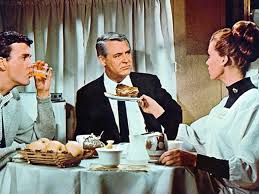
Grant is Sir William Rutland, an impatient industrialist who shows up at his regular Tokyo hotel, but not at the reserved time.

“Two days early” one clerk, then another and then a manager apologize, each bowing as they do. “OLYMPIC, you know,” they repeat, one after the other after the other. “Very sorry!”

Pinched for a place to stay, Rutland hits up the British embassy, gets the brush-off from a functionary with the too-too-British name Julius D. Haversack (John Standing), but then he finds an offer the share an apartment on the embassy’s bulletin board.

Next thing we know, he’s chauffered to this tiny upstairs flat with several tiny rooms and opaque paper walls. Next thing she knows, our young room-renter (Samantha Eggar, fun) is utterly buffaloed into letting him rent and stay there. With her.

One running gag begins. She simply can’t have this. Well, she needs the cash. So long as they leave “seperately.” So long as they have an understanding.

“You’re married?” she’s shocked/relieved to learn.

“Why not? I’m old enough!”

A second running gag, he drops this detail on his wife, by long-distance, and repeats it to business folk that he meets about this arrangement with “a young lady…a very attractive young lady.”

Everybody asks, “Relative?” As if Cary Grant didn’t have a shot.

Jim Hutton plays a long, lanky architect who has qualified for the Olympics in a sport he dares not mention by name. He, too, showed up early. He, too, has no place to stay.

Rutland makes the mistake of taking an interest in him — “You remind me of myself a few years ago. Well, quite a few years ago.”

We’re treated to the spectacle of the younger man buffaloing the older one into letting him share his “half” of the already crowded flat.

Christine may be engaged, to a stuffy fellow Brit — guess who? But all the brusque Yank and too-proper Brit need to make their love connection is Cary Cupid.

Grant is a delight all the way through this — scrambling up a (soundstage) gutter to get back into the apartment after he’s locked out, turning up unshaven, befuddled and annoyed, even stripping to his boxers and T-shirt to join in the Olympic 50 km Race-Walk to try and finish the (matchmaking) job in the film’s most famous scene.

One-liners are repeated as characters switch places, Hutton’s Steve Davis cracking “You remind me of myself a few years from now,” Grant’s Rutland turning Christine’s “I don’t think I LIKE tricky people” on Steve when the roles are reversed.

The picture’s a bit slow by modern standards. All this stuff about “bathroom scheduling” bogs down the opening act, and there’s a little too much of Rutland’s ongoing effort to distract Christine’s fiance so that Steve can make time with her.

But cute scene follows cute scene, many of them throwing “foreigners” into what had to seem exotic to audiences not that far removed from World War II — a bustling, modern Japan, a taste of Japanese dining out here, a visit to a public bathhouse there.

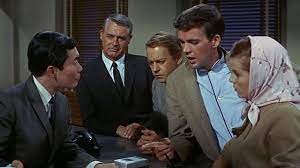
A WWII joke lands, the Russian Olympic Team’s easily fooled KGB man (Ben Astar) doesn’t. George Takei plays a Tokyo policeman trying to get to the bottom of Russian suspicions.

By this stage of his career, Grant had legions of comic impressionists joking about his suave accent, exaggerated phrasing and always-worth-a-laugh TIME-ing. He doesn’t make every line funny, but he gives it the Old Hollywood try. And that’s enough, in this case.

Director Charles Walters also helmed “The Unsinkable Molly Brown.” He didn’t take the right lessons from his best comedy, “Lili” (1953). It’s a half hour shorter than these later efforts, and pace is paramount in comedy, even when the comedy’s Columbia’s intellectual property.

Rating: TV-PG, innuendo

Cast: Cary Grant, Samantha Eggar, Jim Hutton, and George Takei.

Credits: Directed by Charles Walters, scripted by Sol Saks, loosely based on the script to “The More the Merrier,” by Frank Ross and Robert Russell. A Columbia Pictures release on Tubi.

Running time: 1:53

Posted in Reviews, previews, profiles and movie news | Tagged , , , , , | Comments Off on Classic Film Review: Cary Grant Saunters into the Sunset, in his boxers — “Walk Don’t Run” (1966)