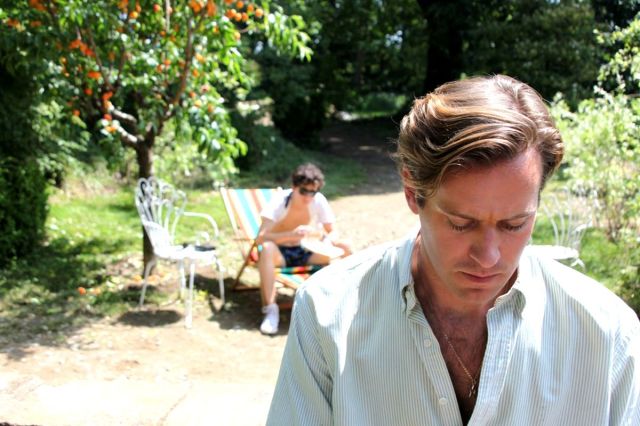
Catching a movie after its hype has peaked is always an exercise in “What’d others see in this?” “Mudbound,” far-removed from Sundance, “The Shape of Water” extracted from its fanboy fawnathon can feel empty, thin and lacking.
Remove the film festival groupthink hype. Abandon the scenic Italian locations from “Call Me by Your Name,” change the romance from gay to straight and strip away the Jewishness and its rather heavy-handed “ahead of their times” tolerance among the parents of the teen boy who falls for his father’s pretty summer grad student assistant.
What you’re left with is a soapy routine romance, teasing and melodramatic, a boy “discovering” himself and gaining “experience” in a sexual sense over a summer. With its rural Italian vistas, a house set in a fruit orchard with lots of lightly-pretentious people reading French poetry in German, debating the etymology of “apricot” and noting the origins of the water in a particular Italian swimmin’ hole, the term “overripe” enters the judgement.
Because there’s lots of swimming, cycling, shorts and shirtlessness. Of course.
It’s Bertolucci’s “Stealing Beauty” without Liv Tyler or Bertolucci, and being scripted by that languorous period-piece prince, James Ivory (“A Room With a View,” etc.), it’s 85 minutes of story in a two hour and 12 minute movie.
Throw in a curious, horny boy having sex with some of that overripe fruit and you’ve got notoriety, “American Pie” with less…baking.
Michael Stuhlbarg is the archaeologist patriarch of a family of “Jews with discretion,” Americans with a summer home in rural 1980s Italy. Amira Casar is his wife, who inherited the place and counseled their teenage son, Elio (Timothee Chalamet) on the whole “discretion” thing.
And he passes that on to their new house guest, Oliver (32 year-old Armie Hammer), an academic Adonis who’s come to help the professor with some work on ancient statuary newly recovered from the deep. Oliver wears a Star of David and has the confidence of the educated, monied and incredibly handsome.
Elio and Oliver share an adjoining bathroom, and the kid offers to show “the only other Jew to set foot in this town” around, by bike.
The skinny boy in the Ray Bans is an aspiring composer with growing confidence in his own right. He’s handsome and exotic (American) enough to warrant the attentions of a French teen (Esther Garrel) staying nearby, and naive and crass enough to figure sharing his sexual “progress” with her with his parents and their new houseguest is just being “open” and “honest.”
In Oliver’s case, he’s testing the waters. Engendering jealousy? Finding out which way the magazine-model blond swings?
And as “Let’s ride to town together” evolves into “Why don’t you and I take a swim?” he gets his answer, and a summer romance flowers. Kind of.

There’s little of the “forbidden fruit” of your typical gay coming-of-age romance, not with parents who seem not only to tolerate this inappropriate relationship, but to encourage it and even envy it.
They’re all etymologists. Don’t they know Ephebophilia when they see it? Oh, right, they’re in Europe. Draw your own conclusions as to why the author and screenwriter keep underlining their Jewishness.
I mean, it’s not “Summer of ’42” or “The Reader,” but we’re no longer venerating this “lover of experience” initiation ritual, or are we? If the gay community is ending Kevin Spacey’s career (assault, etc.) and we’re all turning our backs on all the literature, film (“L.I.E.”) and folk music (“Ode to a Gym Teacher”) about older lovers awakening/initiating the homosexuality of the young, then why is this affair excepted?
All the pains “Call Me by Your Name” goes to in declaring parental acceptance and having the kid the aggressor and Oliver’s many protests of “I want to be good” and the sun-drenched Italian scenery and age of consent don’t fundamentally excuse it, and actually calls to attention the idea that the filmmakers know “We shouldn’t be endorsing this.”
Last year’s justly-honored “Moonlight” offered the same lessons in embracing who you are and acceptance by adults without the overt, teased-out sexual rite-of-passage included. “Call Me” is rather flatly performed to boot, a gay fantasia of a 1983 when homophobia was abandoned and “bathroom bills” never saw the legislative light of day.
And for all the symbolism of curiosity, raging hormones and expanded horizons that having a boy masturbate with fruit might have had in Andre Aciman’s novel, on screen it’s just laughable, topped with a healthy dose of “ick.”
“Call Me by Your Name” isn’t so much a bad movie as a dull, bloated one, a tale of teen sexual intensity drawn out beyond the point of holding our interest, footnoted with all these spoken (repeatedly, by one and all) provisos — “This is OK because…”
That’s all well and good, but I found it lacking as drama, romance and period piece, a turgid potboiler overheated under the Tuscan sun.

MPAA Rating: R for sexual content, nudity and some language
Cast: Timothee Chalamet, Armie Hammer, Michael Stuhlbarg, Amira Casar, Esther Garrel
Credits:Directed by Luca Guadagnino script by James Ivory, based on the André Aciman novel. A Sony Pictures Classics release.
Running time: 2:12

 Early returns understated the beat-down “Jumanji” would deliver to “The Last Jedi” this weekend. Granted, everybody’s already seen the latest “Star Wars” movie. And nobody’s seeing it twice.



 “Star Wars: The Last Jedi” owned the top of the box office charts for three weeks. It made a boatload of cash on a helluva lot of screens.





 The WGA Nominations can be expected to honor movies (and TV series, movies, etc.) that have a writerly quality — to the dialogue, intricate story structure, character construction.