
Movie Review: “In Search of Fellini” finds whimsy, if few laughs

fellini1

Of all the attributes to strive to give your comic film, “twee” is the hardest to pull off.

It’s that delicate dose of daft — just shy of cloying  — that lets most efforts in this corner of the cinema down.  When you swing and miss at twee, the result can be tooth-achingly sweet or just plain dull because the silly sweetness you thought you were injecting into your story is too mundane to be magical.

“In Search of Fellini” fails to figure out twee, and more’s the pity, because the fellow who gave his name to the title perfected that — in decades of subtitled films made in his native Italy.

It’s about a young woman’s discovery of the cinema of Italy’s master satirist, farceuer and big screen bon vivant. Federico Fellini was larger than life and his films, from “La Strada” and “La Dolce Vita” to “Eight and a Half,” reflected that. They were brimming with giddiness, layered with oddball autobiography and filled-to-overflowing with a circus sideshow of the silly, the sad, the world-weary and the witty.

After an insanely sheltered life, growing up with a single mother (Maria Bello) in suburban Ohio, Lucy (screen newcomer Ksenia Solo) is ready for a little lunacy. She finds it when she stumbles into a Fellini Film Festival one day in 1993.

Lucy’s been protected from any of life’s harsh realities by Mom, who has gone so far to to send her post-cards from dead relatives or pets, letting her know they’re fine, just to keep the real world from breaking her heart.

And then Mom herself gets sick. A post card just won’t do, this time.

“How’s she going to take care of herself?” Mom’s sister Kerri (Mary Lynn Rajskub of TV’s “Brooklyn Nine-Nine”) wants to know. “Who would hire a 20 year-old who acts like a 13 year-old?”

That’s what sent Lucy into the Big City in the first place, a job ad aimed at luring nubile young women desperate to “work in the movie business.” That pornographic near-miss is how Lucy wound up at the Fellini Festival. And that’s when this fan — she already has the ’60s chic sunglasses, the striped shirt of Gelsomina, wandering waif of “La Strada,”  and (believe it or not) the Vespa scooter of countless Fellini films — finds her quest.

She will go to Italy and meet with the maestro. He’ll know what she should do with her life. A long distance call gets a Fellini assistant on the phone, and that lands her an appointment — or an Italian, Federico Fellini version of an appointment. She can’t take Mom, who is dying. This is all on her.

Unfamiliar with travel, not speaking the language, Lucy experiences a comedy of errors and botched arrivals, and blown Fellini appointments. But the Italian baker she stumbles into in Verona offers her that first taste of alcohol, and great Italian cooking — rum balls.

“Eat, drink, fall in love,” he tells her. So that’s just what she does.

fellini2

The cleverest conceit of this half-speed romantic farce is having Lucy hallucinate “signs” from Fellini that she’s on his trail, on the right life path, just by making him her quest. Characters from Fellini films — circus strong men like the one Anthony Quinn played in “La Strada,” beautiful people out of “La Dolce Vita,” the comic sideshow grotesques of almost all his movies — pop into view.

Look for Nancy Cartwright, the “Simpsons” voice actress who co-wrote this, in wig and “uniform” as one of those “Fellini-esque” folks. And have a laugh at Kerri’s description of Fellini  to her credulous sister.

He makes “Italian films, mostly. Nobody watches them. Humanity, togas, depraved orgies, asses…like, jiggling breasts. Lots of them. You know — art.”

Fellini quotes, about reality and realism and dreams, pepper the inter-titles between scenes. All of this serves to remind film buffs that he was a unique presence in the movies, never copied, never rivaled in sheer immersive weirdness and delight.

The rest of the picture? Not all that clever, a little light in the charm department. Lucy’s encounters with Italian men — ranging from romantics to rogues — fail to register.

Young Ms. Solo may look the part of the winsome gamine and manage the fish-out-of-water moments of awkward confusion well enough. But look back at “Letters to Juliet” for a hint of the tone they were going for here, a comparison which only makes that feather-light romance seem like Shakespeare’s lost masterpiece in comparison to “Search.”

Director Taron Lexton fails to get across the madcap sense of chaos Fellini generated, the lackadaisical Italian sense of”urgency” so common in Fellini’s later movies, filled with characters insisting they need it, they have it and that you must embrace it as well if you are to fulfill your life’s dreams, when actually they can’t fathom the meaning of the word.

Lucy’s quest withers even as her assignment, from that rum ball purveying baker, is fulfilled. And “In Search of Fellini” falters as it does, forever grasping at ghosts, never quite getting its arms around “twee.”

1half-star

MPAA Rating: R for sexuality/nudity and language

Cast: Ksenia Solo, Maria Bello, Mary Lynn Rajskub

Credits:Directed by Taron Lexton, script by Nancy Cartwright, Peter Kjenaas. An Ambi release.

Running time: 1:33

Posted in Reviews, previews, profiles and movie news | Comments Off on Movie Review: “In Search of Fellini” finds whimsy, if few laughs

Movie Review: Fanning can’t Fake Anything Fun in “Please Stand By”

stand1

An Autistic young “Star Trek” fanatic expands her horizons on her first-ever road trip on her own in “Please Stand By,” a picture whose picaresque premise holds more promise that its star or director deliver.

The heroine of the piece works at a Cinnabon and has written a script for “Star Trek” screenplay contest. She skips out of a group home in the San Francisco Bay area, with her Trek-attired chihuahua in tow, to deliver the tome, in person, to Paramount Pictures in Hollywood. You’d think there’d be some light moments in that — misadventures on the lam, getting robbed, surviving a bus wreck, confronting snotty studio functionaries.

But no. This is a “serious” road comedy about autism. Or at least it is in the hands of director Ben Lewin (“The Sessions,” “Paperback Romance”) and his star Dakota Fanning. The most ardent supporters of either would have to confess that “light” isn’t really in their repertoire. They conspire to throw the whole tone of the picture off, with only comic Patton Oswalt’s arrival in the third act providing so much as a smile.

And, well, the dog’s cute.

Fanning is Wendy, who has to treat every potential human interaction as a project, requiring her full attention. She must say “Welcome to Cinnabon. Would you LIKE a Cinnabon?” differently every time she tosses it at a potential customer.

Her therapist and coach at the halfway house (Toni Collette) has worked long and hard to get Wendy this far out into the world, working, practicing interpersonal skills.

“Can we try three seconds of eye contact?”

Wendy’s therapist is conveniently named “Scottie.” Because Wendy is deep into “Star Trek.” She clatters away at her epic script for the franchise, with plans to get it into the mail and into a contest Paramount is throwing for ardent fans of the series. We hear Wendy narrate scenes, and sometimes see space-suited characters wander the desert in a spot-on allegory for how someone “on the spectrum” might view the hostile world

Wendy hopes to win the contest and see her story produced. But her most fervent hope is that she’ll win, “be able to buy mom’s house back” and come off as “normal” enough for sister Audrey (Alice Eve) to bring her home so that she can start being an aunt to Audrey’s new baby. The occasional violent fit, which Scottie talks her out of with the calming phrase “Please stand by,” suggests that won’t happen.

please3

Events conspire to make Wendy miss her mailing deadline for the contest. There’s nothing for it but to make the trip to LA to hand-deliver it. Wendy rides the bus to work. There’s a bus to LA. Easy peasy, right?

Of course not.

And the fact that she didn’t tell anybody where she was going sends one and all into a panic.

We can trust Lewin, a rare disabled director, to treat any disability with the utmost sensitivity on screen, and he does. What we can’t trust him or the humorless Fanning to do is to make this fish-out-of-water road picture funny, to make Wendy anybody we want to spend time with or any of Wendy’s encounters (Marla Gibbs plays a senior citizen who “rescues” her) amusing or interesting.

Until, that is, Oswalt arrives.

More could have been made out of the “Star Trek” opus, comic parallels with Wendy’s own dilemma (the dog gets her kicked off the bus). A life this sheltered experiencing the big wide world for the first time can be “Rainman” fraught and funny. Not here.

Fanning makes Wendy a compulsive knitter, and is does the whole never-make-eye-contact thing with commitment and skill, but utterly without warmth. That’s a knock that’s dogged her throughout her career, so even the character’s suitability to her skill-set that works against her here.

Her co-stars have little to play. The trip itself is a fairly unsurprising and colorless affair, with Wendy finding allies and obstacles in the usual places.

Thus does the generally lifeless “Please Stand By” only discover signs of life when our heroine gets to LA, where everybody wants to be “in the business,” where every mailroom wannabe on a studio payroll is on a power trip and every police force has its share of native Klingon speakers.

1half-star

MPAA Rating: PG-13 for brief strong language

Cast: Dakota Fanning, Toni Collette, Alice Eve, Patton Oswalt

Credits:Directed by Ben Lewin, script by Michael Golamco. A Magnolia release.

Running time: 1:33

Posted in Reviews, previews, profiles and movie news | Comments Off on Movie Review: Fanning can’t Fake Anything Fun in “Please Stand By”

Box Office: “The Post” opens Strong, “Paddington” does not

box1I have been fretting that Fox is mishandling its potential Oscar contender, “The Post,” opening it wide well AFTER its peak hype (early last month). The Golden Globes and other awards nominations, where a very fine film is underperforming, seems to bear that out.

But this weekend, as it finally rolls out wide, Steven Spielberg’s grownup history about a watershed moment in the press’s holding a corrupt government accountable is opening at a healthy $21 million. Or better.  People want to see a movie with veteran film stars telling a story of an intrepid, responsible press going after the Pentagon Papers and their official government “secret” history of the Vietnam War.

Good news.

The bad news comes Warner Brothers’ way, as their latest very fine, delightful children’s film (with yuks for parents, too) “Paddington 2,” is underwhelming. Deadline.com tends to underreport kids’ films and Saturday’s take will be more telling, but $14.15 million is weak. Disney gets an automatic pass due to its reliable brand, Pixar doubles down on that. Both “Paddington” films have been wonderful, warm and mid-winter releases that underwhelmed.  Too British? Too Anglo? Who knows? Everybody should take their tykes to it, and they’re not.

“The Commuter” is doing similar numbers, but it’s not an all-star semi-animated delight for kids. $14 million for Liam Neeson fighting his way through a train.

“Proud Mary” isn’t delivering numbers, and seems like a classic Jan. “dumping ground” release. Screen Gems didn’t preview it for critics (not unusual for them, not at all unusual for a January film) so it has no hype. Taraji P. Henson isn’t that big a name, despite her resume. It won’t hit $10.

“Jumanji” is still the top dog at the box office, proving Kevin Hart can be kid friendly (again, after “Captain Underpants”). It’s heading towards $600 million worldwide.

“Darkest Hour” is the best performing Oscar contender in the top ten, “Three Billboards” got a nice Globes Bounce, “The Shape of Water” has done what it’s going to do and “Phantom Thread” still isn’t in many theaters.


It’s a m

Posted in Reviews, previews, profiles and movie news | Comments Off on Box Office: “The Post” opens Strong, “Paddington” does not

“Time’s Up” for Franco’s Oscar chances?

francoIt started with Ally Sheedy tweeting in protest about James Franco’s Golden Globes win for starring in “The Disaster Artist.”
Then others came forward, alleging sexual harassment and coercion on film sets. And now the LA Times has chased down several actresses and former acting students of the twinkly polymath Franco, women who tweeted their outrage, etc. at his “win.”

And that may be that for his chances of competing for the Best Actor Oscar.

Franco has courted this sort of always-grinning, intellectual “James Dean Reborn” image as an actor, director, poet,  novelist, what have you. He’s even teased that he might be gay or bisexual as a way of adding to his mystery, his allure even.

But this? As much as I loathe the “Guilt by Accusation” nature of this Hollywood scandal, an all out “#Metoo” war against every offense (Matt Damon is right, there are “degrees” to who has done what) ever committed in an industry that traffics in sex appeal, where no one should show up for work blind to the historic “skin trade” nature of “getting ahead” in the movie business, anybody with multiple accusers cannot dismiss or explain away that. Franco’s peak moment may have been Sunday night, and his Frat Pack days may be over.

Nobody should have to put up with this. Whatever women figure Casey Affleck got away with before winning the Best Actor Oscar last year just multiplies the outrage and “Never again/Enough already!” sentiment that is carrying the day.

The ugly truth, hinted at by one of Franco’s accusers, that he wanted an actress to play a scene nude in one of his movies for $100, is that thousands of times a year, there are women who say “Yes” to that contracted deal. It doesn’t matter that virtually nobody who is “nude stripper/pole dancer #3” winds up as a star, women have  participated in this exploitation to the point where one actress saying “No” just means she’ll be replaced by one who says “Yes, this is my BIG BREAK.”

It’s not. Ask the thousands of women who turn up in such scenes every year, the obligatory “strip club scene” in virtually every crime thriller/cop movie, really just a “producer or director wants to check out/audition/coerce the ‘talent'” opportunity.

If everybody says “No,” thanks to the courage of the women who are now making themselves heard above the Hollywood hype machine, then we can say “Well, that moment changed EVERYthing.” If not, then all these “lads” whose mothers and fathers never taught them how to respect women (Miriam and Max, I’m looking at you), all these sick people drawn to the business for its predatory prospects, this frat house mono culture of men in leadership positions striving to attain those positions for their access to coercable women will continue as before.

Franco? I review LOTS of movies with a fellow who is something of a major movie star that make one scratch one’s head over his presence in them. It’s not just the “challenge”of an indie project, the generosity of lending his name to a tiny film that needs star power to get made, the ego trip of filming his own material or difficult to film literary adaptations.

Looking at him in this new, creeper light, I see all the starlets attached to such movies, the pretty young things in bit roles. Women he could pressure, threaten, lord over and have his way with?

Go on Netflix, check out the haunted bank thriller (HAH) “The Vault.” Tell me that’s not why he made that one.


Posted in Reviews, previews, profiles and movie news | Comments Off on “Time’s Up” for Franco’s Oscar chances?

Documentary Review: “The Final Year” shows the calm, dogged competence of a White House that worked

final1

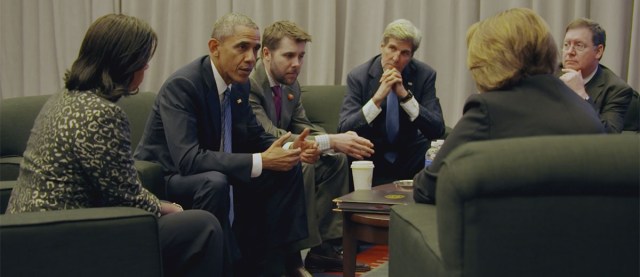
The first thing that hits you is the quiet. For all the movement, the rush from meeting to meeting, the urgency of the issues they seem to be dealing with, there’s no sign of discord, chaos or quarreling in this White House.

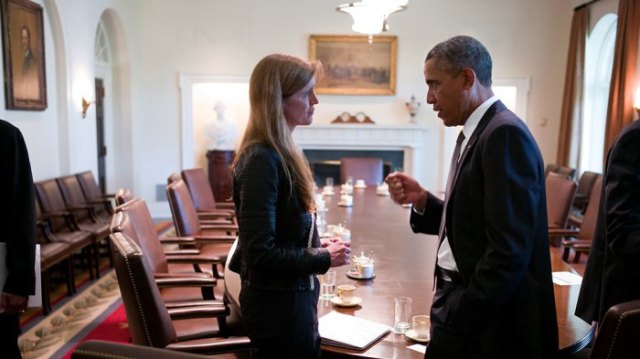
Everybody comes off as smart, articulate, on-task, hard-working and not prone to panic. There’s urgency to their tasks, as they know, as journalist turned United Nations Ambassador Samantha Power notes, “We’re all just passing through these jobs.”

So reaching a deal on Iran, trying every idea they can come up with to stop the fighting in Syria, grasping at straws in Nigeria or opening a door to Cuba, widening the open door to Vietnam, those things “we don’t want to leave hanging” occupied the top decision makers of the Obama Administration during “The Final Year.”

Greg Barker’s documentary filters in outside criticism here and there — news voices and those of political operatives on various broadcast media attacking Syria policy or “The Iran Deal” with various degrees of heat. And the film can be faulted for being an insider’s inside look at Obama Era foreign policy, focusing on President Barack Obama, Secretary of State John Kerry, U. N. Ambassador Power and Deputy National Security Adviser and speech writer Ben Rhodes.

But the overarching idea is the simple contrast of remembering what political, administrative competence looks like. For all the media and political talking heads hacks heat about “America’s standing in the world” and the ongoing struggle to manage the crisis in Syria, “The Final Year” is jaw-dropping in the nostalgia it creates for a time when “THIS is all we had to worry about.”

Most glaring of all is the movie’s one moment of scandal. Rhodes, a brash true-believer who exudes a sort of “smartest guy in the room” confidence, gave an interview to the New York Times Magazine about how the White House managed a DC press corps that was getting younger, greener and dumber thanks to the collapse of newspapers and other legacy media enterprises, making it easier to shape the Obama narrative and also, it is implied, creating the callow online headline-chasing coverage that led to the rise of Trump.

“All these newspapers used to have foreign bureaus,” Rhodes told The Times. “Now they don’t. They call us to explain to them what’s happening in Moscow and Cairo. Most of the outlets are reporting on world events from Washington. The average reporter we talk to is 27 years old, and their only reporting experience consists of being around political campaigns. That’s a sea change. They literally know nothing.”

That’s it. That’s what a “White House Scandal” used to look like, an adviser speaking bluntly about a “sea change” in the competence of the press covering the government.

final2

“The Final Year” isn’t a great film. It’s so “verite” — bouncing along with Kerry and Powers, Rhodes and Obama as they jet from Vienna to Nigeria, Vietnam to Cuba, fighting fires and tamping down future fires — that it can feel like hagiography.

The chilling and then deflating moments come when we see Trump convention coverage in the background of an historic Obama trip to Laos, hear Rhodes complaining about the staggering accomplishments on the foreign policy front that “final year” (with the glaring exception of Syria, Russian-meddled into a murderous quagmire), all ignored in favor “of something Trump tweeted.”

The documentary’s subjects start facing questions, “What’s going ON with America?” Troubled foreign folks who cross their path express worry about Brexit and what that could herald with America’s 2016 election. The rise of Trump, Rhodes notes, “is already having a cost,” even before the electorate lashes out and elects him.

Power, the daughter of Irish immigrants, has lovely moments of listening to Nigerian mothers weep and rage at losing their daughters to kidnappers of Boko Haram, or choking up, remembering her own story as she swears in new citizens taking the oath.

But the most revealing moments are simple, inside-voice conversations with all involved, especially the ones where Obama talks about the secret to his rise and his ongoing way of shaping messages — “story.” His “story,” told in the way he chose to tell it, got him elected. “America’s Story,” a great tale summarized by The Declaration of Independence, secured America’s place in the world’s consciousness.

Or at least it did until Jan. 20 of 2017.

3stars2

MPAA Rating: unrated, mild profanity

Cast: Barack Obama, Samantha Powers, John Kerry, Ben Rhodes

Credits: Directed by Greg Barker  A Magnolia/HBO Films release.

Running time: 1:33

Posted in Reviews, previews, profiles and movie news | Comments Off on Documentary Review: “The Final Year” shows the calm, dogged competence of a White House that worked

Documentary Review: Nature lends a hand in the art in Andy Goldsworthy in “Leaning into the Wind”

wind1

Andy Goldsworthy makes art where he finds it — in decaying forests, in snow-covered fields, on streets where he might lie down just as a light rain is beginning. His “ghost” is his dry body shape, which you see on the wet street after he gets up.

It is natural art — made of wood, clay, leaves, flower-petals spewed into the air, and stone — “site-specific” and often mind-bogglingly ephemeral, and not just the wet street he might decorate with what looks like with his dry spot.

He’s world-famous for his stone carvings and assemblages, fallen trees that he covers with yellow leaves, in season, snowballs when winter comes. And he’s something of a muse to art documentarian Thomas Riedelsheimer. Riedelsheimer has filmed or directed a number of documentaries about artists, including “Breathing Earth,” about Japanese “wind” artist Susumu Shingu, and the film that first brought Goldsworthy to the attention of many of us, “Rivers and Tides: Andy Goldsworthy Working with Time.”

“Leaning into the Wind” is their latest collaboration, following the artist from rural Brazil, admiring the sturdy, hand-built houses, the care with which an old woman patches and polishes a homemade floor out of clay and “bull-s–t,” to the fields and hills of his home in Scotland to the stone walls overrun with forest in the hills of New Hampshire.

A favorite — “Wood Line,” a minimalist wavy path of connected logs in the Presidio, San Francisco.

wind3

Riedelsheimer listens as Goldworthy talks about “trying to understand the process is how something is made” (the hovel in Brazil) and embraces the decay in a broken-down tree line. “This sliver of trees, a burn (creek) running through it” makes him appreciate the lifetime of work decorating the fallen elms (Dutch Elm Disease) he sees, art made by nature itself.

It takes a team of craftsmen — tree surgeons, New Hampshire stone-cutters — to realize Goldsworthy’s visions. His daughter Holly also pitches in, and Goldsworthy himself seems handy with all manner of stonesaws and chainsaws. “The farm” was what inspired him, long before art school, he admits.

One fascinating sequence lets us watch a dead tree dropped and scored, by chainsaw (by the artist himself) for an installation that will move that tree into a cottage which he will then coat in clay, the tree as well, which changes appearance as the clay dries and cracks.

There’s a limit to how much interest something as static as the creative process can create on film. Films like start to feel repetitive after an hour, even if we’re seeing static works of art in the process of creation. But Riedelsheimer manages a deft portrait of a creative mind in a simple scene that unfolds under the opening credits.

Split screens capture Goldsworthy as he notices a beam of light boring a spot on the floor of that Brazilian hut. He tosses dust in the air, outlining the beam all the way through the room, changing it from moment to moment.

The objects he assembles or carves out of stone will outlive him, but it’ll only be a hint of the mind that saw beauty in the destruction, decay and rebirth that nature itself was creating all around him.

3stars2

MPAA Rating: unrated

Cast: Andy Goldsworthy, Holly Goldsworthy

Credits:  Directed by Thomas Riedelsheimer. A Magnolia release.

Running time: 1:35

Posted in Reviews, previews, profiles and movie news | Comments Off on Documentary Review: Nature lends a hand in the art in Andy Goldsworthy in “Leaning into the Wind”

Today’s first screening — “In Search of Fellini”

On the one hand, you had me at “Fellini.” And then there’s sunny Italy, a boon to any film’s setting, especially an indie one. And Maria Bello, Earth Momma extraordinaire.

On the other hand, it’s yet another coming-of-age romance, and they’re about to join vampire movies and zombie pics on my “Enough already” list.

Can’t tell much about it from its trailer. But again, somebody was at least THINKING Fellini, so there’s that and there’s hope. Nancy Cartwright (“The Simpsons”) co-wrote “In Search of Fellini.”


Posted in Reviews, previews, profiles and movie news | 1 Comment

Movie Review: Liam Neeson IS…”The Commuter”

commuter2

Yeah, it’s just another Liam Neeson B-movie thriller.

Yes, we’ve seen “The Commuter” before. Hell, we’ve seen it starring Liam
Neeson and also directed by Jaume Collet-Serra. Only that film was set on a plane, not a train, and it was titled “Non-Stop.”

If you can’t guess where this is going by the presence of big-name actors showing up in the credits and in a brief opening scene, you must not get out much.

But this tale of an ordinary Joe being blackmailed to get somebody killed on his daily commute from NYC to Tarrytown, NY is an action picture whose aging hero we care about and root for, a thriller with tension and style, a B-movie Hitchcock would have been happy to call his own.

From its simple but effective prologue, a montage showing the daily routine of Irish ex-pat Michael MacCauley (Neeson), a married insurance agent with a ready-to-trade-houses wife (Elizabeth McGovern), a kid ready to enroll at pricey Syracuse U. and two mortgages, Collet-Serra (“Orphan,” “The Shallows,” “Run All Night”) demonstrates a spare storytelling style with a dazzling eye and a flair for cutting.

Mike’s daily trek includes whatever novel his kid is reading in English class (You don’t get into Syracuse without knowing your English lit), a smile for a train full of familiar, friendly faces (In New York?) and an honest effort to put in another honest day’s work.

Then he’s laid off, cut loose at 60, too broke to have a back-up plan, too horrified to tell his wife. He loses his phone getting onto the train.

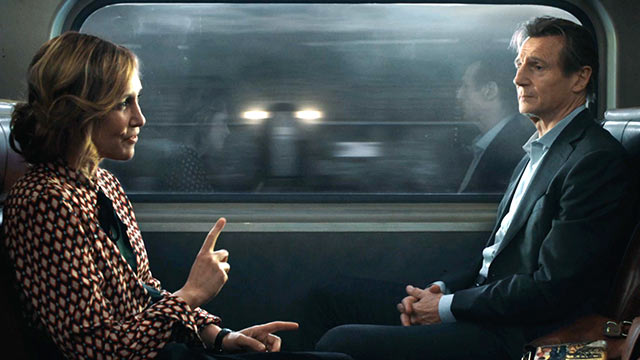
And that’s when the mysterious and sexy Joanna (Vera Farmiga) parks herself in the opposite, hum-brags about studying human behavior and posits a pop quiz.

“Someone on this train doesn’t belong,” she says. Could Mike figure out who? Suppose there was a $100,000 payoff if he finds this someone called “Prin?” Could he finger that person, accept a bag of cash and “never know the consequences of what you did?”

She says it’s all “hypothetical,” but we know better, even if Mike is slow to embrace that. “What kind of person are you?” she teases. He’s about to find out.

Mike, it turns out, is an ex-cop. He’s a curious sort who looks for the hidden envelope with the down-payment on the deed. And just as he’s about to do the smart thing, exit the train and maybe call old buddies on the force, the trap is sprung. He’s taken the cash and now he’s got to go through with whatever he’s agreed to.

Thrillers like this rely on a vast array of tech (spy cameras and/or microphones) and a seemingly endless supply of henchmen for unseen villains who can demonstrate their seriousness by pushing a fellow commuter in front of a bus at the next stop. They’re pulling the strings from afar. They’re on board with him, waiting for him to figure out who the mystery rider is for them. They’re armed and murderous.

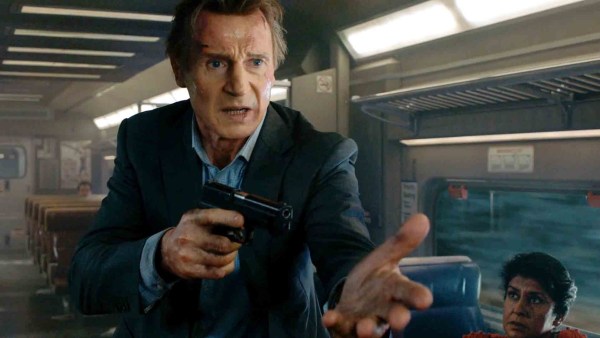
Seeing Neeson defy Father Time — sort of — has been one of the pleasures of B-movie watching these past several years. The ex-boxer is still convincing taking a beating in a brawl, still willing be that guy, bloodied and increasingly frantic, stalking the aisles of a commuter train, looking for whoever or whatever his tormentors tell him to find. They just might have his wife and son.

Collet-Serra sends his camera hurtling down the center aisle of all the cars in the train, keeps his camera hand-held and jittery when he’s not staging (with digital help) those suspense-building tracking shots. And with his help, Neeson’s Mike seems more manic, more “put this guy on a watch list” as he interrogates/confronts strangers and tries with little success to not come off as a stalker or cop-turned-terrorist.

comm.4

The train, like the Orient Express, is stuffed with types — the jerk broker who used to work for Goldman Sachs, the put-upon school girl, the frazzled nurse, the backslapping card player.

Farmiga is unfortunately largely off-camera, making threats via cell-phone — “Don’t make me hurt someone else,” and the like. Patrick Wilson plays Mike’s former partner and confidante, Sam Neill is the colleague who made it to Captain, and veteran character player Jonathan Banks is a grizzled fellow commuter of Mike’s acquaintance.

Yet “The Commuter,” like the  “Taken” movies and “Non-Stop” and others of his hair-dyeing action dotage, succeeds or fails on Neeson’s broad shoulders. He commits to these characters and, as blood spills and he suffers through tussle after tussle, cliff-hanger after cliffhanger — kinetically staged by Collet-Serra — we believe in him.

Even if we know what he’s got to do long before he does. Even if we know it’s just a formulaic B-movie, Neeson never lets on that he does, or that he’s giving anything less than his Oscar-deserving best.

2half-star6

MPAA Rating:PG-13 for some intense action/violence, and language.

Cast: Liam Neeson, Vera Farmiga, Patrick Wilson, Sam Neill, Elizabeth McGovern

Credits:Directed by Jaume Collet-Serra, script by Byron Willinger, Philip di Blasi, Ryan Engle. A Lionsgate release.

Running time: 1:43

Posted in Reviews, previews, profiles and movie news | 1 Comment

Movie Review: Verizon guy suffers and celebrates “Entanglement”

ent3

Thomas Middleditch is that lanky, likeable put-upon Canadian star of “Silicon Valley” and too many Verizon commercials to count. Maybe he can’t convince you to switch cell phone services, but his EveryShlump image makes him easy to pity and root for.

He’s the pleasantly suicidal center “Entanglement,” an amusing romantic comedy of limited ambition but an exceptionally light touch. He and it are just winsome enough to work.

We don’t have to read “Telefilm Canada” in the producing credits to taste the maple leaf syrup here. We meet Ben (Middleditch) as he is composing a suicide note. It’s apologetic — very Canadian. He’s just lost, a lovelorn loner trapped “inside the pattern” of his life, determined to “find a way to get out.”

Running a hose from his vintage Volvo’s tailpipe up into his apartment just gets his car stolen. He doesn’t have the right pills to pull off Plan B. You’ve got to plug the toaster in BEFORE you toss it into the tub with you. At least his pen knife is sharp enough to do the trick — slowly.

But in his most Canadian act of all, the buzzer rings for his apartment building and he’s too polite to leave the person standing at the door. He staggers out of the crimson tub to answer it and a package delivery guy saves his life.

Months later, he’s lying on the floor, talking to a shrink (Johannah Newmarch of “Supernatural”). He’s over “Claire,” the woman who broke his heart. He’s much better.

“Do you LIKE yourself?”

“As a friend? A friend with benefits?”

OK, she’s a child psychologist and this isn’t really her thing. Ben needs to sort out “where my life went wrong” for himself. And when his dad, panicked over a heart attack, tells him he and Ben’s mother adopted a girl only to give her up when mom had Ben, the suicidal son thinks he has his answer.

“I could have had a SISTER? You have any idea how FORMATIVE that is?”

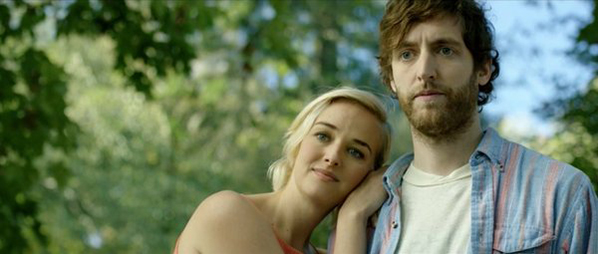
“Entanglement” is about tracking down, meeting (cute) that “sister,” and falling for Hanna (Jess Weixler) as she seems to answer his Big Life Questions for him, putting down the coincidence of their connecting to the universe and “Quantum Entanglement” — the idea that particles and people might be invisibly bonded in ways that seem like mere chance but feel like a grand design.

When you set out to keep your romantic comedy quick and to the point, the challenge is in making random moments funny in ways that advance the plot. How’s he find this “sister?” A stern social services employee who refuses to give out her name turns out to hate his job and can be corrupted for just $50.

Middleditch is forlorn in all the usual long-faced rom-com ways, and Weixler ( TV’s “The Good Wife,” “The Son”) makes a swaggering, forward flirt of the first order, great at snappy banter and a challenge to Ben’s self-absorbed wimpiness. She rides a man’s bicycle. Ben?

“You’re riding a girl’s bike!”

“It’s UNISEX!”

Then there’s Ben’s too-helpful neighbor, the sweet and supportive Tabby. Diana Bang plays her with a touching open-heartedness. We can feel her longing for Ben as he throws himself at the blonde with the boots, even as she’s giving the stereotypical Asian supporting character common sense lecture.

“She’s probably catfishing you!”

ent2

Even in a short and relatively brisk comedy like this, some ideas fall flat. Ben’s fantasy life is limited to seeing adorable puppet deer in the woods when he’s with Hanna, or glowing jellyfish in the city pool she breaks them into for a midnight swim. His would-be therapist uses a bear puppet, and sometimes the bear talks to him.

But the script has laugh-out-loud moments and zippy exchanges. Middleditch and Weixler give this smarts and just enough sexy sass to work. And Bang gives it heart.

Which adds up to an “Entanglement” that you’ll be in no hurry to rid yourself of.

2half-star6

MPAA Rating: unrated, with suicide attempts, profanity, adult situations

Cast: Thomas Middleditch, Jess Weixler, Diana Bang, Johannah Newmarch

Credits:Directed by Jason James, script by Jason Filiatrault . A Dark Star release.

Running time: 1:25

Posted in Reviews, previews, profiles and movie news | Comments Off on Movie Review: Verizon guy suffers and celebrates “Entanglement”

Movie Review: “Film Stars Don’t Die in Liverpool”

liver1

You don’t have to be a film buff to remember Gloria Grahame. We see her every Christmas, as Violet, the good-hearted Bedford Falls floozy in “It’s a Wonderful Life.”

An Oscar winner in “The Bad and the Beautiful,” a “Girl who cain’t say no” in “Oklahoma!,” a bit player in “Melvin and Howard,” she was a talented character actress who cut a wide and memorable swath across Hollywood in her day.

But like all of us, life caught up with her, demand for her services dropped and she found herself sick and in need of comfort and care, far from home. And that was going to be a problem. As everybody knows, “Film Stars Don’t Die in Liverpool.”

Her final days make for a sad, downbeat movie based on a self-serving memoir by the man who, with his family, cared for her at the end. Peter Turner’s book of that title recounts taking Grahame in (she was on tour) when she fell ill in Liverpool in the early ’80s, and recalls a 1979 May-November romance between himself, a struggling young actor, and the scandalous Grahame, who as they used to put it so quaintly back then, “liked’em young.”

Jamie Bell plays Turner in the film, a man we meet when he re-connects with Grahame (Annette Bening) upon her return to the Liverpool stage. She’s all aflutter and nostalgic. But she’s not well.

“I just had gas is all.”

A little mothering by Peter’s mom (Julie Walters) is all it’ll take to set her right. But as Peter takes her home and puts away her things, he sees prescriptions and medical records. This isn’t just “gas.”

We’re taken back to their flirtatious meeting a couple of years before, when Peter was in his early 20s and the fiftysomething Grahame first turned her feminine wiles and girlish voice on this strapping young working class actor with limited prospects.

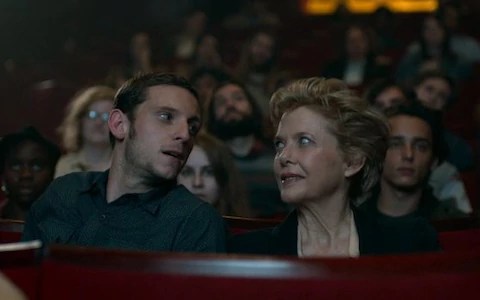
They court, visit her old movies at a cinema revival house and talk shop. Gloria wants to know how to get into the Royal Shakespeare Company. Whatever her screen persona, she wants to be taken seriously as an actress. She’s always wanted to try her hand at Juliet.

“You mean the Nurse, right?” is the worst thing he could have said. Accurate, but mean.

Peter is swept up in a Gloria’s little corner of the world, traveling to New York where they make themselves seen in the same restaurant Liza-with-a-Z haunts.

Hollywood means seeing how a four-times divorced fading star lives — well enough, but sans mansions and the finery of her peak earning power. Vanessa Redgrave plays Gloria’s indulgent mother. Her sister (Frances Barber) is the there to remind her of her failings, the scandal of taking up with one husband’s barely-teenage son, later marrying the kid.

But it’s in Liverpool, far from home, that Gloria feels the most special. When Peter first takes her out, a barman has to fill him in on her back story.

“Proper film star, she was. Won an Oscar, too, if memory serves.”

His mother, doting on her during her illness, is equally starstruck.

“You’re so bloody beautiful!”

“Well, I was.”

liver2

The film seems caught up in a scandalous affair that seems fairly mild by today’s standards. Peter confesses his omnivorous sexuality, inviting Gloria to admit to the same. The age difference? Eyebrow-raising, nothing more.

The real scandals that enveloped Grahame are closer to something ripped from today’s headlines, and just remind us how odd it is for any of us to act shocked at the predatory, indulgent kinkiness that has long been the currency of the movie business. Grahame derailed her career after allegedly having sex with a 13 year-old, won an Oscar for co-starring in a movie about a ruthless, manipulative user of a producer (Kirk Douglas) and spent much of her career playing tarts.

It’s chilling to recall how close Mira Sorvino came to impersonating Grahame’s almost childish sex-kitten voice and persona in her Oscar-winning turn for Woody Allen in “Mighty Aphrodite.”

Bell makes a sturdy, thoughtful foil suggesting more than a hint of bisexual about Peter. But what makes “Films Stars Don’t Die in Liverpool” is Bening’s performance, which is as one might expect is much more than mere impersonation. Having the same pointy chin as Grahame means that showing the real GG, in still photos and on the big screen, just makes it easier to believe this is how this aged starlet would have looked pushing 60. Bening gives her a hint of self-awareness, dignity and desperation. The great ones are always most worried about that next acting job, come health or high water.

Director Paul McGuigan’s sorry record on screen (“Lucky Number Slevin” was a low, “Wicker Park” a lower-low) partly explains why this picture doesn’t have the requisite highs that precede the lows. There’s never a giddy moment, never a hint of “My Favorite Year” nostalgia for her superstar past or in her recapture-my-youth-with-another-younger-man tale. Turner is seen having an affair with a woman who seems to be running from her shame rather than owning it.

So nothing in Bening’s spot-on interpretation can lift this glum, joyless film, even excepting the terminal illness hanging over it.

2stars1

MPAA Rating:R for language, some sexual content and brief nudity

Cast: Annette Bening, Jamie Bell, Julie Walters, Vanessa Redgrave, Kenneth Cranham

Credits:Directed by Paul McGuigan, script by Matt Greenhalgh, based on the memoir by Peter Turner. A Sony Pictures Classics release.

Running time: 1:45

Posted in Reviews, previews, profiles and movie news | Comments Off on Movie Review: “Film Stars Don’t Die in Liverpool”