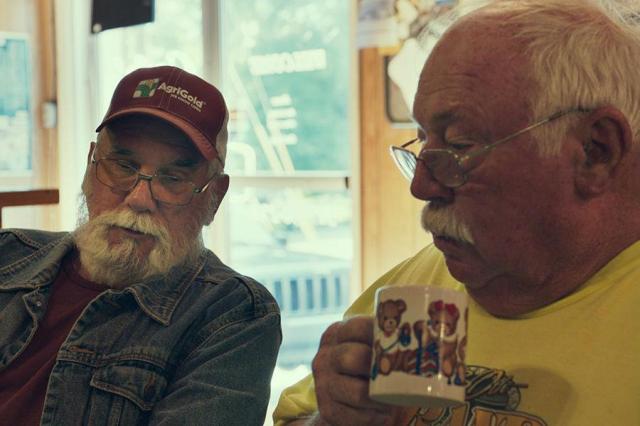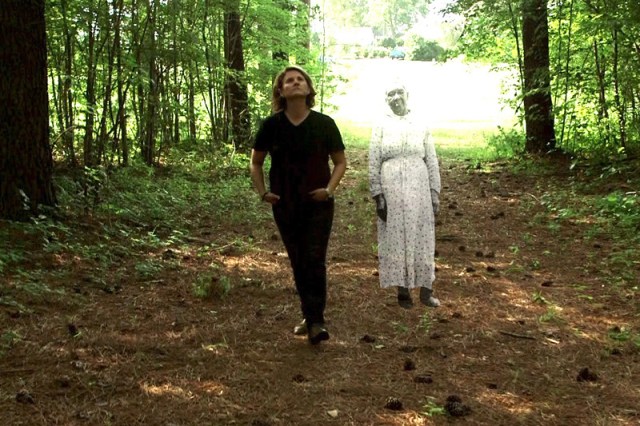
Preview, Christopher Lloyd time travels BACK…to take up with the love he lost long ago in “ReRun”

Bunch of good looking young actors dressing up in ’60s wear live out Lloyd’s character’s past in this romantic fantasy, which premiered at Woodstock.

As Rev. Jim, Lloyd’s most famous TV character would put it, “Okeydoke!”

No release date for this one yet, still traveling the film festival circuit. Keep an eye out, because truly, who doesn’t love Christopher Lloyd?

Posted in Reviews, previews, profiles and movie news | Comments Off on Preview, Christopher Lloyd time travels BACK…to take up with the love he lost long ago in “ReRun”

Preview, Tim Tebow presents “Run the Race,” sort of a faith-based “Friday Night Lights”

Those marketplace masters Roadside Attractions got their hands on this Tebow Brothers-produced football drama in the “Friday Night Lights” tradition.

Two Truett brothers, trying to ride athletics out of the dead-end town where they live, screw up and pursue second chances in this Chris Dowling (“Priceless,” “Where Hope Grows”) family drama.

Tanner Stine and Evan Hofer play the brothers, Dowling’s go-to athletic looking guy Kristoffer Polaha is the drunken dad they could never please.


Frances Fisher (as Grandma?). Myleti Williamson (as a coach) and Mario Van Peebles (A preacher!) also star.

“Run the Race” opens Feb. 22. 

Posted in Reviews, previews, profiles and movie news | Comments Off on Preview, Tim Tebow presents “Run the Race,” sort of a faith-based “Friday Night Lights”

Movie Review: The Old West was at its most violent when “The Sisters Brothers” showed up


sisters1

Most Westerns are, by default if not definition, “picaresque” in nature.

Our hero or anti-hero wanders and roams, an itinerant cowboy, gambler or gunfighter in the saddle, stirring up trouble or righting a wrong, often through the barrel of a six-gun.

Which is why “picarseque” in the Western sense is distinctive for its blood and bullets.

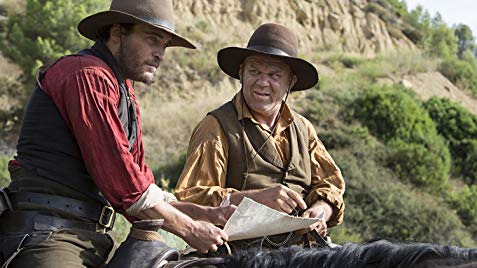
“The Sisters Brothers,” based on Patrick DeWitt’s novel, follows two amusing yet violent, pitiless and murderous rogues — guns for hire — as they pursue their prey down the West Coast in the Gold Rush Era 1850s.

All it takes is an order from the mysterious, never-explains-himself Commodore (Rutger Hauer) and they’re off, punishing, retrieving but mostly killing those this Oregon oligarch deems have “cheated” or otherwise wronged him.

But these siblings — Charlie and Eli (Joaquin Phoenix and John C. Reilly, King of the Buddy Picture) — just appear to be without conscience or remorse, dealing death wherever they go. They’re both undergoing a sort of existential crisis, wrestling with awful childhoods, fretting over the “bad blood” passed down from their drunken, violent father.

They have a lot of time to ponder that in between blasts of mayhem, mishaps on the trail, drunken visits to the brand-new towns springing up on their route and arguments about their past.

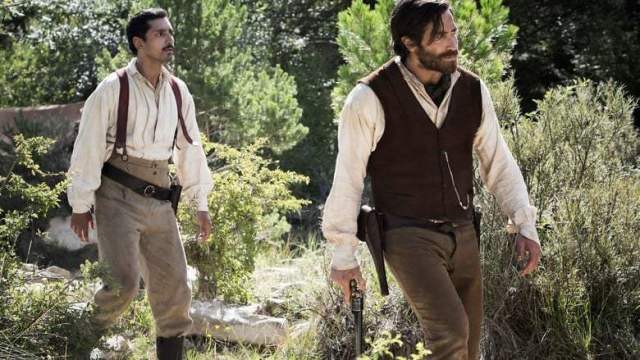
They’re hunting a chemist named Hermann Kermit Warm (Riz Ahmed of “Nightcrawler” and “Rogue One”). Actually, they’re following the tracker, John Morris (Jake Gyllenhaal) the Commodore also hired to do the difficult work of finding a thin, dark-skinned educated man in a world of white mountain men, miners, murderers and roughnecks.

Morris is also an educated man, and he recounts his tracking via journal entries and the occasional note he leaves behind for the brothers, who are to do the dirty work at the end of this quest. Their quarry, he relates, “made a precipitate departure,” in one note.

sisters2

Hotheaded, drunken Charlie isn’t suffering such “pretentious bull—t” gladly. Morris, whom he calls “Mau-RICE” in his rants, gets under his skin.

Eli? He’s just trying to survive the spider who crawled into his mouth and bit him, the grim injuries to his horse, the double-dealing madam Mayfield (Rebecca Root) who gave her name to the town they stop in, a place that could be their last stop ever.

Eli pines for the schoolmarm who gave him her shawl as a talisman while Charlie hunts for that next drink or hooker. Hermann, meanwhile, has connected with John Morris and enlisted him on his own quest for a less violent future financed by his chemical shortcut in the panning for gold process.

Director and co-screenwriter Jacques Audiard (“A Prophet, “Rust and Bone”) stages unforgettable gunfights. None of this old Hollywood “day for night” filming of late-night ambushes. The only thing illuminating the pitch-black darkness of pre-civilization is the flash of a firearm.

He goes to some pains to mimic DeWitt’s novel’s pacing; deliberative passages, comic exchanges and hilariously florid turns of phrase (via Morris) interrupted by carefully spaced-out spasms of violence. That tends to slow the picture. And in showing us the consequences of a .45 bullet to the head or the mauling of a horse, he’s giving us detail that is more unpleasant than most Westerns would include.

But the casting is startling in how spot-on it is, from the pairing of Reilly (producer of the film) with Phoenix to reuniting Gyllenhaal with his “Nightcrawler” co-star, to the mother of the brothers, a shockingly moving (and a tad funny) turn from Carol Kane, most recently seen as daffy neighbor to Netflix’s Kimmy Schmidt.

“The Sisters Brothers” sneaks its messages in the back door, how a world built on justifiable fear and firearms makes life cheap and souls hollow, how the amorality and violence numbed one and all and how lives back then could be just as angst-ridden as they are today, no matter how quick the “hero” is on the draw.

And if you spill enough blood, and “picaresque” just doesn’t cover it.

3stars2

MPAA Rating: R for violence including disturbing images, language, and some sexual content

Cast: John C. Reilly, Jake Gyllenhaal, Joaquin Phoenix, Riz Ahmed, Rutger Hauer, Carol Kane

Credits:Directed by Jacques Audiard, script by Jacques Audiard and Thomas Bidegain, based on the novel by Patrick DeWitt.  An Annapurna release.

Running time: 2:01

Posted in Reviews, previews, profiles and movie news | Comments Off on Movie Review: The Old West was at its most violent when “The Sisters Brothers” showed up

Movie Review: Can Thanksgiving survive “The Oath?”

oath1

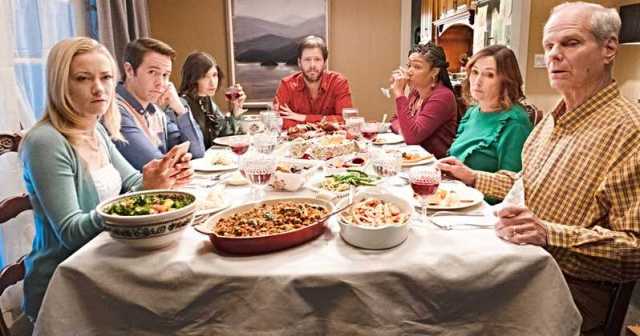
Ike Barinholtz’s “The Oath” is a filmgoing experience not unlike the nightmarish Thanksgiving dinner with relatives on the other side of the political divide that the film portrays — excruciating.

A satiric comedy that rarely lightens its shrill tone with anything like a laugh, it’s hardly a cinematic break for anybody looking to escape the tidal wave of cruelty, callousness, criminal stupidity and “America Worst” news to pour out of Washington these past few years. And for those not looking for a break? Heaven help you. The stress of endless “outrage” updates on your phone or on cable news is amped up by this miscalculated attempt at “The Movie America Needs to See.”

It’s not biting, it’s pummeling. And while it isn’t incompetent or terribly written, acted or shot, while its warning has the sting of “Yeah, we’re pretty close to that happening here,” it is just plain unpleasant to sit through.

Writer-director Barinholtz (TV’s “The Mindy Project”) stars as Chris, a hyper-sensitive, seriously-worked up LA marketing guy married to a like-thinker, Kai (Tiffany Haddish) and upset enough to declare “I will not ALLOW my daughter to grow up in a country like this!”

What he means by “like this” is a country that has leapfrogged a few steps down the ladder towards fascist totalitarianism and come up with a “Loyalty to my president” oath — promising perquisites for those who sign it, and rightly-feared penalties, harassment and worse for those who don’t.

Turn off Fox News for five minutes and accept that this idea has surely passed through the current chief executive’s head.

Kai is more concerned with “keeping my little girl safe,” and with keeping the peace. That’s the key to this upcoming Thanksgiving dinner. His parents (a clucking Nora Dunn and Chris Ellis) were quick to sign. He doesn’t even have to ask his “stupid” brother Patrick (Jon Barinholtz) or Patrick’s Eva Braun blonde girlfriend Abbie (Meredith Hagner, magnificently vile) if they signed.

Kai and Chris’s mother vow “No politics” at the weekend get together. Kai has to constantly remind Chris to step away from the TV.

It’s no use. His phone goes off with every fresh development — riots, civil rights violations by the newly formed CPU, “Citizens’ Protection Units.”

Chris shouts “LIES” at his car radio and finds himself trapped in one of the ugly situations a lot more commonplace these days — angry racist people (a road rager) emboldened by a bellicose bigoted bully in the White House, slashing tires and screaming “Get out of my country!”

His like-minded sister Alice (Carrie Brownstein) arriving with her sick-with-diarrhea husband (Jay Duplass) doesn’t balance the battle lines enough to suit Chris.

Dinner starts out with the old white people singing the praises of comic Bill Engvall, the knee-jerking Chris and Kai chortling that they prefer Chris Rock, whom Abbie and Pat describe as “racist.” Oh yeah?

“It’s racist to THINK Chris Rock is racist!”

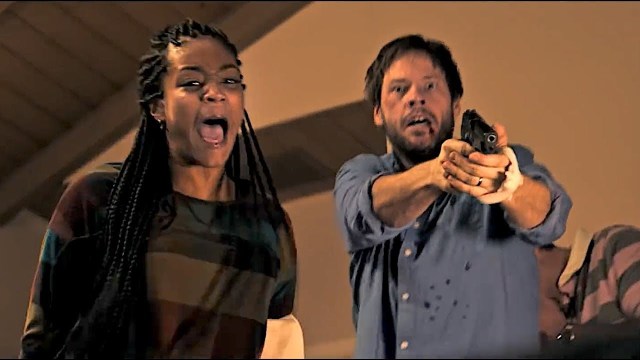
An epic meal is slipping into chaos when two CPU guys (John Cho and Billy Magnussen) show up at the door wanting to have a little talk with Chris. This is the movie’s most troubling moment. A gun-averse, thinker-not-fighter liberal is confronted with two guys — one specifically (Magnussen of “The Big Short”) — refusing to leave, refusing to acknowledge how laws all the way up to the United States Constitution require them to leave, baiting the mouthy guy whose politics they aim to suppress by dropping the hammer on him.

It’s just that the violence they, or specifically Mason (Magnussen) intends to mete out backfires.

How do you extricate yourself from the legal problems of resisting, injuring and disarming pseudo-legal authority? And once you’ve committed violence, how far can a non-violent person go with it?

Magnussen is like every scary encounter you’ve ever seen on the news or had in person with a no-neck racist musclehead who agrees with a third of this country that his might or gun or badge permits him to lord over “elites” in any way he wants?

oath2.jpg

There haven’t been any real laughs before this sequence, and after it “The Oath” descends utterly into darkness. For a short movie, a supposed quick take on this subject with satiric intent, “Oath” drags thanks to its lack of “funny but scary-true” observations.

It’s almost a waste to cast Comic of the Moment Haddish in the film, and while she has little “believable couple” chemistry with Barinholtz (totally out of his league), she does get away from her “Girls’ Trip” shtick and show us something new.

As the violence escalates and the blood flows, the sharp if not-funny observations give way to “How can we extricate these people from this scenario in a way that makes sense?”

And Barinholtz the writer-director lets his straining against incredulity show. He utterly loses his nerve with the finale.

If you want to see how this sort of movie is supposed to work, track down the 1995 Canadian satire “The Last Supper,” about liberals moved to betray their non-violent values when confronted by a power-abusing right-wing talk show host (Ron Perlman).

That was dark, bloody, biting and funny. Unlike “The Oath,” which manages half of those.

2stars1

MPAA Rating: R for language throughout, violence and some drug use

Cast: Ike Barinholtz, Tiffany Haddish, Nora Dunn, Meredith Hagner, Jon Barinholtz, Carrie Brownstein, John Cho, Billy Magnussen, Jay Duplass

Credits: Written and directed by Ike Barinholtz . A Roadside Attractions release.

Running time: 1:33

Posted in Reviews, previews, profiles and movie news | Comments Off on Movie Review: Can Thanksgiving survive “The Oath?”

Documentary Review: “Weed the People” tries to make the case for medical marijuana

weed1

There’s this odd, jarring anti-marijuana ad campaign running in the previews in cinemas where I live in Florida — “Marijuana: Know the Truth.” It’s a mother using the “gateway drug” argument against legalizing pot. I can’t locate who is paying for the campaign, but Big Pharma has been linked to such efforts in the past.

Because if one thing is made clear in the advocacy documentary “Weed the People,” it’s that Big Pharma is the enemy, because whatever race politics had to do with the demonization of marijuana over the past 80 years, drug companies fret over losing control of pain killing, appetite restoring and cancer battling to cheap, legally available weed. Fighting legalization, this film suggests, is putting blood on drug companies’ hands.

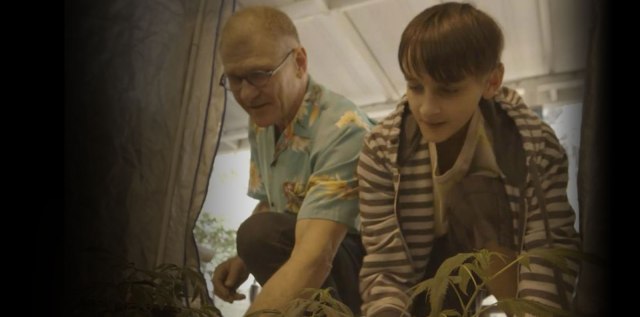
The film is an emphatic re-branding of the the “legalize pot” movement, putting suffering children’s faces front and center in the fight, with weeping parents and increasingly defiant doctors, most of them in states where medical and/or recreational marijuana is already legal, making case on the kids’ behalf.

“When your kid gets cancer, the rule book goes out the window.blameless children

We see babies in hospitals, mothers praying at bedsides, blameless children suffering from fatal cancers of most every description. They’re grasping at slim but not off-the-wall hopes. Whatever medical science says about pot’s chemical ability to bolster appetites and keep chemo-patients strong enough for the fight, there are other corners of research — entirely too anecdotal at this point — that suggest marijuana kills cancer cells and shrinks tumors.

Director Abby Epstein’s movie (she did the birth control doc “Sweetening the Pill”), produced by Ricki Lake, responsibly gets at the counter-arguments parked in advocacy’s path in the opening moments. There have been studies that showed marijuana-derived  cannabinoids killing cancer cells in test tubes, but human trials are another matter.

San Francisco oncologist Dr. Donald Abrams

“Is cannabis an anti-cancer agent?” San Francisco oncologist Dr. Donald Abrams asks, rhetorically. Perhaps. But there are suggestions, cases like several of the ones shown in the movie which argue that the government should be allowing and even underwriting testing. Still, Dr. Abrams adds, “The plural of anecdote is not ‘evidence.'”

We meet desperate families, some of whom will see success, others failure, as they pursue “alternative medicine” treatments for their dying children.

Bonni Goldstein, a pediatrician and medical marijuana treatment specialist speaking at a “Patients Out of Time/Medicalcannabis.com event, says that “To a family that’s suffering, it feels like a miracle. It’s really just science. It’s not fairy dust and it’s not voodoo. There are chemicals in the plant that work just like any other drug.”

Master herbalist (herbs, people, not “herb”) Angela Harris thumbs through 200 year-old manuals about how cannabis could be used to treat this or that malady in earlier eras, and makes the point that marijuana in assorted forms was “part of the pharmacopia well into the 20th century.”

No less august body that the American Medical Association, the AMA, recommended that pot not be banned back in the 1930s because of what they knew if could help with, and perhaps what they suspected were its other benefits. Xenophobia and anti-Mexican racism ruled the day and it was parked on a banned substance schedule likening it to heroin, where it remains to this day.

We see baby Sophie and her parents endure the roller-coaster of emotions, treating their child with conventional medicine (scans, chemo) and then cannabis oil, trying to battle the tumors ravaging her brain.

Little Cecilia givesher dolly a version of “the black medicine” (high dose cannabis oil) that she is being treated with for her lung cancer.

The movie is full of desperate, hopeful, upbeat parents, looking for a “miracle,” hoping for medical backing for those hopes, and finding it. Many look straight into the camera and say what doctors are often (but not always) reluctant to attribute to one treatment, that their child’s shrinking tumors “We believe was definitely due to the cannabis.”

Ethan Nadelmann of the Drug Policy Alliance complains about a reactionary Drug Enforcement Agency that blocks research, research that instead is happening in places like Spain and Israel, where the breakthroughs in how cannabis works on the body, on cancer cells, are coming from.

Parents complain about the under-researched, unregulated and unsupported by officialdom nature of cannabis treatments, leaving Angela, a Texas mother whose son Chris is knocking on death’s door when we meet them, “in the dark.”

Quacks and short-cut taking jerks are selling oils using rubbing alcohol as their solvent, doing more harm than good

A Chicago mom works the angles to establish California residency so she can get her child the treatment that might be his last hope.

And then there’s Mara Gordon, a California cannabis cooker who brings to mind every West Coast flake you’ve ever seen complain about child vaccines or extol the virtues of crystals.

“I don’t have medical training.  I have something that I think is more important — experience,” is not confidence inspiring.

But “Weed the People” watches Gordon in action, a process engineer turned Aunt Zelda’s founder, concocting oils, meeting parents, taking phone calls.

The parents are incredulous because the lack of research and Drug Agency and drug company resistance, the “stigma” attached to wood, means “the medicine we were relying on is made in somebody’s kitchen.”

“We’re lab rats!”

But Gordon, making few promises but vowing to launch a carefully monitored and documented treatment with doses that start small and grow, if necessary, with hospitals running the tests to see if tumors shrink, comes off as a genuine folk hero.

“Take care,” she says to one caller. “Help’s on the way.”

She leaves parents to do her evangelizing for her.

“I’m going to tell you what it did for my son…”
weed2

“Weed the People” works best in recounting history, covering the stigma long-attached to a plant that can grow most anywhere, is cheap to process and got its reputation, as Jimmy Buffett sang, “when only jazz musicians, were smoking marijuana.”

And it brilliantly rebrands a fight that is very blue state/red state hit-or-miss in a deeply divided America. That unkempt college kid standing outside your polling place, pleading for legalized marijuana, isn’t going to convince many.

That mother holding her cancer-ridden baby, comforting her dying teen or weeping with joy at the life “the demon weed” gave her child will.

Put her in ads that run with the coming attractions before movies, and this argument’s over.

3stars2
MPAA Rating: unrated, drug use subject matter

Credits:Directed by Abby Epstein. A Mangurama release.

Running time: 1:37

Posted in Reviews, previews, profiles and movie news | Comments Off on Documentary Review: “Weed the People” tries to make the case for medical marijuana

Movie Review: Remembering the loneliness of AIDS era America in “1985”

yen2

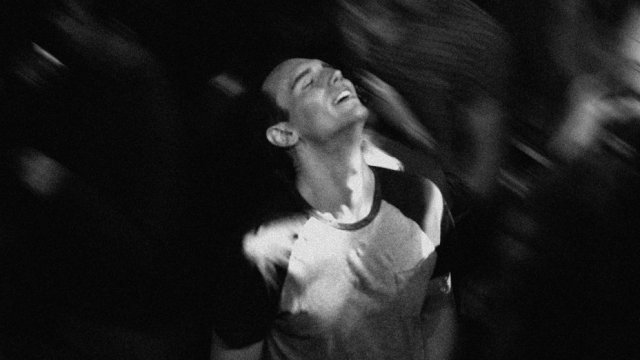
Filmmaker Yen Tan has made his mark telling sensitive if not exactly edgy stories about the gay experience — “Happy Birthday” and “Pit Stop” are his best known directing credits.

For his latest, he dabbles in what one hesitates to call “nostalgia” for a story set in the Reagan Era AIDS crisis, a time when “coming out” was more unusual, more difficult simply because “It gets easier” didn’t exist.

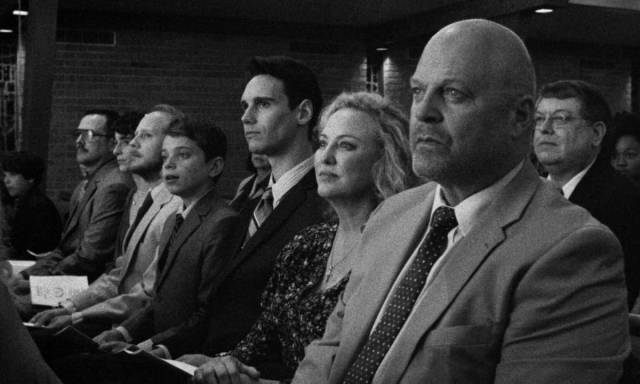
His “1985” mimics the look of many of the pioneering indie films of the genre labeled “queer cinema,” a grainy black and white melodrama that calls to mind “Liana,” “Go Fish” and “Coming Out.”

It’s a poignant reminder of how bleak things were in the earliest days of AIDS, with the country slow to mobilize against “the gay plague” while in the thrall of a president beholden to homophobic Christian Conservatives. Tan’s elegy suggests this might have been the loneliest, most hopeless period in recent history for homosexuals in America.

Especially in the American South. That’s where Adrian (Cory Michael Smith of “Gotham” and “Carol”) is from, Fort Worth, Texas. He moved to New York to “start over,” and now he’s returned to his working class Christian conservative home for the first time in three Christmases.

Adrian comes bearing extravagant and thoughtful gifts for his mom (the ever-luminous Virginia Madsen) and mechanic Dad (Michael Chiklis). He’s here to mend fences with the much younger brother (Aidan Langford) who felt abandoned and ignored.

And maybe, his mother hopes, he’ll catch up with old girlfriend Carly (Jamie Chung of TV’s “Real World,” “The Gifted” and “Gotham”).

As he wraps presents and takes part in the rituals of the season — in church, in the kitchen, at the dinner table — Adrian keeps it together. When he’s alone, he weeps. Adrian has secrets and we can guess what they are.

Dad grousing about “How three grown men can live together, like they’re still in college” tips us about his living situation. Mom’s “You’ve gotten so THIN” preface her repeated entreaties for him to call Carly seem to fall on deaf ears.

And the way he reacts when he nicks his finger chopping vegetables…

Mom keeps the radio tuned to the all-preaching/all the time station, so not talking might be the safest way to get through the week. But things need to be said.

“I have some news. Just been waiting for the right time to tell you.”

More importantly, Adrian is picking up on his acne-spotted kid-brother’s angst. He quit the football team and joined drama club. He hides his music from his parents, as they’re in a record-burning congregation.

“Since when are you into Madonna?”

yen3

Tan handles all this with a delicacy that mirrors how mainstream cinema was looking at gay lives in that pre-“Torch Song Trilogy” age. Don’t look for anything edgy, just sensitive scenes with Adrian fighting the urge to tell someone — ANYone — what his life is really like in the big city, who he really loves and what’s weighing heaviest on his heart.

There’s little that’s new here, but the performances give this time capsule picture heart, with Madsen, Smith and Chiklis taking their archetypal characters beyond “type.”

Smith’s scenes with Madsen shimmer with emotional life.

Maybe no one, gay or straight, should be nostalgic for “1985.” But Tan makes a good case for why it’s a period worth remembering, if only because “It GOT easier” in the ensuing decades.

2half-star6

MPAA Rating: adult themes, alcohol use, profanity

Cast: Cory Michael Smith, Virginia Madsen, Michael Chiklis, Jamie Chung, Aiden Langford

Credits: Written and directed by Yen Tan. A Wolfe release.

Running time: 1:25

Posted in Reviews, previews, profiles and movie news | Comments Off on Movie Review: Remembering the loneliness of AIDS era America in “1985”

Preview, Charlie Plummer’s “The Clovehitch Killer” ignores the Boy Scout Oath

Any Boy Scout knows what this one’s about just from the title.

All those knots you’ve got to memorize, one in particular standing out as having a particularly odd name — perfect for a serial killer?

As David Lynch (Eagle Scout, Missoula, Montana and I (Eagle Scout, southern Va.) can tell you, every troop has its guys a little too into knots and knives and what not.

Granted, they’re not going to use the official name “Boy Scouts” — the movies almost never do.

This IFC Midnight release “The Clovehitch Killer” gives Charlie Plummer another chance to go creepy. Samantha Mathis and Dylan McDermott also star, opening in limited release Nov. 16.

Posted in Reviews, previews, profiles and movie news | Comments Off on Preview, Charlie Plummer’s “The Clovehitch Killer” ignores the Boy Scout Oath

BOX OFFICE: Michael Myers slashes toward an October opening record, “Hate U Give” impresses, “Old Man & the Gun” cracks Top Ten

mikeyA couple of weeks ago, “Venom” sucked its way to an $80.2 million opening weekend, setting a new record for movies opening in October. “Astounding” we said. Considering the movie’s a misfire on several levels, the long-awaited “comic book fatigue” at the box office seemed imminent. Didn’t happen.

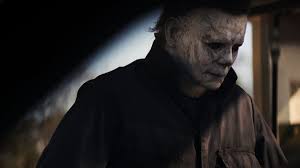
But the record could very well be short-lived in the extreme. A $7.7 million Thursday night and $33 million+ Friday have David Gordon Green’s reset of “Halloween” tracking towards a $79-81 million opening, per Deadline.com. 

A beloved franchise, born in the ’70s, thriving through the 80s and drifting into the ’90s and 2000s, “Halloween” is a proven brand and the horror audience is nothing if not reliable. But generations grew up with this nut-with-a-knife villain, and nostalgia’s reaching beyond the Friday night horror faithful. Bringing back Jamie Lee Curtis is the reason to see it (the ONLY reason) and was a master  stroke.

The revived Miramax, no longer connected with Harvey and Bob Weinstein, gets to collect part of the dough (Universal and Blumhouse have pieces of the pie) and Jamie Lee gets a nice third act career goosing.

“A Star is Born” is still pulling in Lady Gaga’s Monsters, $18-19 million, finally pushing it ahead of “Venom” on the charts. But Tom Hardy’s comic book anti-hero is over $170 million, or will be Sunday night. $200 million, all in? Close to it.

The higher minded, topical and at times powerful “The Hate U Give” opens wide and is doing really good business — over $7.

“The Old Man & the Gun” pairs up Robert Redford and Sissy Spacek in a tale of bank robberies in your AARP years, and looks to crack the top ten on its first weekend of wide release. Under $2 million.

“First Man” isn’t holding audience particularly well, a 44% drop projected by Deadline. It won’t make $9 million on its second weekend — an undeserving flop. 

Posted in Reviews, previews, profiles and movie news | Comments Off on BOX OFFICE: Michael Myers slashes toward an October opening record, “Hate U Give” impresses, “Old Man & the Gun” cracks Top Ten

Documentary Review: The Great Frederick Wiseman loses himself in “Monrovia, Indiana”

monro1


“Brevity is the soul of wit,” the Immortal Bard wrote.

Frederick Wiseman, the grand old man of documentary cinema and founding father of cinema verite, doesn’t go for wit, or brevity.

His classic fly-on-the-wall documentaries — “Titicut Follies,” shot at a mental hospital, “Boxing Gym,” “High School,” “Belfast, Maine” — often run on and on, patience-testing at well over two hours. He found almost three hours worth of images he couldn’t bear to pare down in “Central Park.”

You don’t mind when the camera captures something fascinating. But the films can be mesmerizing or maddening, depending on the subject.

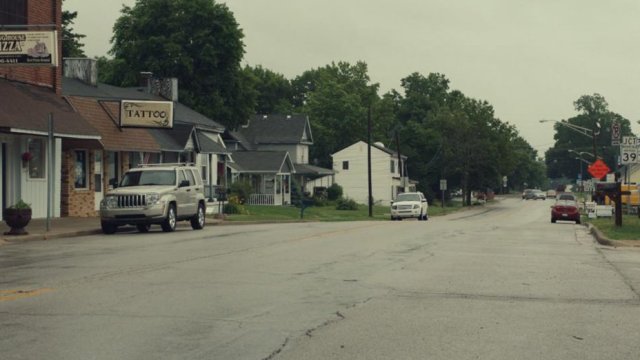
With “Monrovia, Indiana,” he gives us another slice of his version of “slow cinema,” eschewing graphics, voice-over narration or interviews that focus what people talk about in attempting a portrait of a small town America that is withering away as I type.

Conversations are overheard, extreme close-ups show us the work of hair dressers and veterinarians, pizza makers and butchers; tractors rake fields, pigs are sorted via spray cans and cattle stare forlornly from the feed lot into the camera.

Wiseman shows us repeated visits to what I take to be a town council (or planning board) meeting, tedious discussions of fire hydrants and what they look like in the big city some miles to the north and east — Indianapolis.

The Lions Club debates adding a second bus bench ad to boost membership for an eternity of screen time.

There’s a ceremony at Freemasons Monrovia Lodge 654, with natural stumbling, scripted platitudes, a scene that goes on well beyond any point it may have.

Wiseman takes us into a high school classroom where a teacher whom I suppose is also a coach tries to inspire the kids with the story of the community’s connection to basketball greatness. Two-time NCAA title-winning Indiana U. coach Branch McCraken came from there.

We glimpse the show choir rehearsing, see a dance team at a street fair and drop in on collectible car shows (all US makes, as indeed the town seems to drive Detroit by default), eavesdrop on a couple mattress shopping and see the wedding of two local 20somethings.

But the long funeral oration in the third act is more representative of the movie Wiseman put together. He’s 88 now, so its natural that he’d focus on the elderly — weathered, freckled balding men grousing about their latest surgery, cranking up an ancient steam-powered tractor for a public event, knowingly talking about the most pedestrian “collectible” old cars among one other.

It’s an overlong old man’s movie, an elegy to a vanishing way of life and a town whose population Wiseman seems to see as reflections of himself or just of America in general.

The demographics presented here don’t accurately reflect the town. Yes, Monrovia is almost comically monochromatic (over 97% white). We rarely see a black face — one, singing at a wedding, another the NBA’s Steph Curry caught on TV. Monrovia is mostly female, even if the movie settles on men far more often. “Monrovia” is an old people film, for the most part. That isn’t borne out by the census.

Little old ladies sit and listen to the preacher’s after-hours sermon at Women’s Circle, men 40, 50-and up get buzz cuts at Hot Rod’s Barber Shop, the aged proprietor of Guns & Ordnance talks about the gall bladder concerns of one customer to another customer.

Wiseman paints a picture of the small town pace of life, rural Americana concerns (No drugs, no crime, not in the movie, anyway.) and those left behind there. Will these teens we see trying to stay awake as they hear how “dominant” the school was in basketball in the ’20s and 30s want to stick around to work with cattle, pigs or at the lone market in town, the Cafe on the Corner or Main Street Bar & Grill?

Wiseman immerses us in the banality of life’s details — close-ups of a dog’s tail being removed, the first-stage water at the sewage treatment plant, cooking pizzas and pepperoni-stuffed breadsticks, the generally small and old wood frame houses, most in decent repair but nothing special, overgrown shrubbery.

You can muse about a nation disconnected from this recent past, several steps removed from those who supply its food. You can ponder how many dead-end towns just like this one have developed opioid or meth problems. You can guess how they voted.

If you’ve ever sat through a government meeting in a small town, or tried to stay awake covering the Borough Council in Kodiak, Alaska or an arts board in small town Florida (I have), you know that accurately capturing the moment (moments) isn’t going to produce anything entertaining or even that interesting.

Two films are worth considering for comparison here — the classic, eccentric Errol Morris visit to “Vernon, Florida” (less than half as long) and Alexander Payne’s old-man-on-a-deluded-quest dramedy “Nebraska.”

Not interviewing anybody dulls down the dialogue to the point of sleep-inducing. Morris had the good sense to chat and get stories out of the folks of “Vernon, Florida.”

I wonder, as we wander through a farm implement auction (the camera is usually planted, static) if Wiseman wouldn’t have been better served making a shorter, more pointed film about say, the gun shop. If you haven’t been in one lately, the sea change evident here, even in small towns — hunting weapons losing shelf space to mass mayhem “hobby” and self-defense firearms — is striking and seems like a movie.

He’s already done two documentaries on “High School,” but the kids here, facing a future that might entail most of them leaving, would have been more interesting to follow.

moro1

It’s very late in the game to be second-guessing one of our greatest filmmakers, but Wiseman’s long-ago assertion that if he stuck around long enough, people would forget the camera and be themselves, seems dubious as we watch Masons and preachers stumble with nerves while performing ceremonies they’ve been repeating for decades.

And what do you do when getting everybody to “be themselves” has them turn out to be as boring as most of us are in real life?

It starts well enough, shots held just a tad too long establishing the cattle, pig and grain farming nature of the land, the tiny block or so that constitutes Main Street.

But Wiseman has filmed and under-edited what amounts to a public record of a sliver of a village captured at one moment in time, playing up the boredom, celebrating the pace of life yet never noting its problems or discovering its charms.

2stars1

MPAA Rating: unrated

Cast: The people of Monrovia, Indiana

Credits:Directed by Frederick Wiseman. A Zipporah release.

Running time: 2:23

Posted in Reviews, previews, profiles and movie news | 1 Comment

Documentary Review: A filmmaker looks at “The Long Shadow” of racism in America

shadow1

Filmmaker Frances Causey was born in segregated Greensboro, N.C. in the early ’60s, “where white superiority was never questioned.”

But with family in N.C. and Mississippi, with ancestral ties to slavery era Virginia, as an adult she pondered what she and her family had seen and accepted in “the racist South of my childhood.”

Spurred by eruptions of violence like Dylan Roof’s murderous assault on an African American church Charleston, she wondered about her own family’s place in fomenting America’s racial divide, and being a documentarian she saw a movie in that.

“Our family history haunted me enough to make this film.”

“The Long Shadow” promised to be the race relations equivalent of her fellow North Carolinian Ross McElwee’s “Bright Leaves,” a personal essay and exploration (with expert testimony) about family connections to something unsavory — tobacco, in McElwee’s case, segregation and racism in Causey’s.

But while Causey does find historical connections between her family and America’s racial divide, her “Shadow” lengthens into a much broader look at racism in America, the tipping point moments. The film overreaches and loses some of its power-of-personal experience as it travels far and wide, from the first indentured African servants to arrive in America to their enslavement, from the rise of Jim Crow to the economic and social inequality and race resentment that hobbles the country to this day.

It’s not that her points and tidal wave of experts, collected interviews, archival footage and even recorded oral histories of former slaves aren’t factual or fascinating. Her notion of “unknown history” is a bit broad (lots of people know most of what’s reported here). It’s just that she tries to cram too much into an 87 minute movie that would have had more impact had it narrowed its focus.

Causey “discovered” via Gerald Horne, the author of  “The Counterrevolution: 1776” that “the reason the U.S. is such an advanced country” then and now “was the slave trade,” which was focused on the South but Northern financed — shipping, banking and insurance industries in the Northeast were in essence, built on the backs of slaves.”

She has Paul Kivel, author of “Living in the Shadow of the Cross,” connect America’s shifting, dehumanizing attitudes to the Africans being imported to the legal theft of Indian lands, and a rising sense among American colonists that “heathen/non Christians” such as Native Americans and Africans did not have to be treated as equals or even fellow human beings.

She visits Bruton Parish Church in Williamsburg, Virginia and recalls the class divisions deflected to racial divisions after the 1676 revolt in Virginia called “Bacon’s Rebellion,” when working class whites and blacks joined to protest and fight the super-rich oligarchs of the colony.

A College of William & Mary historian, Jody Allen, sees the blowback from that revolt as the birth of “divide and conquer,” the wealthy setting out to keep poor whites thinking that there was still one group “below them” and use that to re-direct their resentment.

As Causey visits family in Meridian, Mississippi and watches TV coverage of mass-murderer Dylan Roof, she blurts out “God, nothing ever changes here!”

She looks back on her ancestor Edmund Pendleton, a racist Founding Father and decries his role in setting up a Constitution that gave disproportionate power to the slave states, she questions if America’s landed classes sought independence from Britain because of Britain’s growing anti-slavery movement and ponders how that taints American politics to this day.

From the 3/5’s compromise to the resilience of slavery to Jim Crow, the rise of lynchings and the Ku Klux Klan, “Strange Fruit” to “The Solid South” that led to the GOP’s embrace of “The Southern Strategy,” Causey tries to cover all the corners of the origin story of how America got to where it is, and what that means to race relations even today.

She finds outliers, too, progressive landowners, church officials and others — one in Virginia, another in Canada.

What she needed more of were the personal stories, such the relative who loved her black nanny and cook and got her first taste of Grownup Jim Crow when she realized the woman couldn’t eat at the same lunch counter she brought her to as a child.

“The Long Shadow” isn’t a bad movie and has little that one could argue with its expert witnesses about in terms of the history of race in America (although Causey miscredits her ancestor Pendleton as “governor of the colony” of Virginia).

But it’s not the movie she promises in the opening minutes. And the movie she made is, while informative and provocative, not the personalized connection to America’s troubled racial history that would make every viewer ask the same hard questions she started to.

2half-star6

MPAA Rating: Unrated

Credits:Directed by Frances Causey. A Passion River release.

Running time: 1:27

Posted in Reviews, previews, profiles and movie news | Comments Off on Documentary Review: A filmmaker looks at “The Long Shadow” of racism in America