BOX OFFICE: “Ralph Breaks” another weekend, “Grinch” battles “Creed II” for Second

box“Ralph Breaks the Internet” could conceivably hit $30 million its second week, another impressive take for Disney’s “Wreck it Ralph” sequel. Deadline.com is projecting $28 as of Sat. am, and their track record is to underestimate children’s fare when it comes to the sorts of Saturdays they have.

Which is why we have to keep an eye on the second place chase, as “The Grinch” is within the kiddie film margin for error of passing “Creed II” by the time everything’s counted Sunday at midnight. “Creed II” should clear $17, but will “Grinch” earn more than another $16 a month into its release?

“Bohemian Rhapsody” will manage another $9.5 to $10, still not closing the gap domestically against its musical competition, the Oscar-buzzed “A Star is Born.” “Rhapsody” will be over $165-166, “Star” will be close to $210 Sunday night.

“Fantastic Beasts” will add another $13, but will any of the awards contenders already out — “Green Book,” for instance, make any headway with audiences?

The Screen Gems horror outing “The Possession of Hannah Grace” wasn’t previewed for critics, was barely advertised and seems to have “escaped” rather than been released (weekend after Thanksgiving is a dumping ground for orphaned films). It might hit $6 million by midnight Sunday.

Posted in Reviews, previews, profiles and movie news | Comments Off on BOX OFFICE: “Ralph Breaks” another weekend, “Grinch” battles “Creed II” for Second

Documentary Review — “Divide and Conquer: The Story of Roger Ailes”

ailes2

A former Fox News producer says they had a name for it; the network’s style, the “stories” favored there and the edict they were given from on high.

“We used to call it ‘Riling up the crazies,'” Joe Muto remembers in the documentary “Divide and Conquer: The Story of Roger Ailes.”

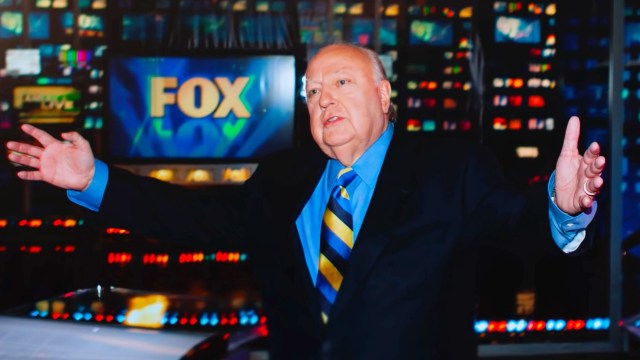
And that’s what Roger Ailes, the Nixon campaign media specialist who became first a GOP kingmaker, and then the king of cable news, did everywhere he went.

“Divide” is a damning film, with just enough new material to entice the curious.

Before he was drowned in a tidal wave of sexual harassment lawsuits right in the middle of the 2016 Republican presidential nominating convention, with his friend and Fox-fluffed candidate Donald J. Trump about to have his GOP coronation, Ailes figured out which hot buttons to push and repeatedly pushed them, forever dividing an America eager to be re-segregated and doing it through the power of TV.

Director/interviewer Alexis Bloom found a seemingly endless parade of former colleagues, journalists who covered Ailes and ex-employees to talk about his “Divide and Conquer” view of America. Even those hired to help him “manage” the abuse and harassment crisis that brought him down speak out.

You can say, “They didn’t exactly succeed in that task, did they?”

Before his fall, Ailes “made conspiracy theories mainstream” when he agreed with their politics, perfected the art of the smear by TV political commercial and gave America’s angriest and oldest a TV channel where every fear they want to believe in is given credence, every hatred they’ve harbored for life is justified.

Bloom, the Brit who made “We Steal Secrets: The Story of Wikileaks,” spends 100+ minutes exposing Ailes’ secrets, methods and meanness in a movie that is required viewing for anybody anxious to see the feature film on Ailes that’s in pre-production. John Lithgow is set to play Ailes, with Nicole Kidman, Charlize Theron, Margot Robbie and Alice Eve set to play assorted Fox News members of his “harem.”

Bloom takes us back to Ailes’ childhood in Warren, Ohio, son of a union-hating union man, fierce debater and high school charmer. The accomplished character actor Austin Pendleton (“Searching for Bobby Fischer”) was a classmate and paints a portrait of the teen who became the man.

“Roger lived his whole life in fear,” Pendleton asserts. Hemophilia did that to him, and made him the greatest “chicken hawk” of them all (no military service). This personal fear “allowed him to understand the fears of other people,” and to sell those via Fox News, 24/7.

Early colleagues remember Ailes’ angling his way up the ladder at Philadelphia’s syndicated “Mike Douglas Show” in the ’60s. A certain presidential candidate appeared on the show in 1968, and Ailes made his move.

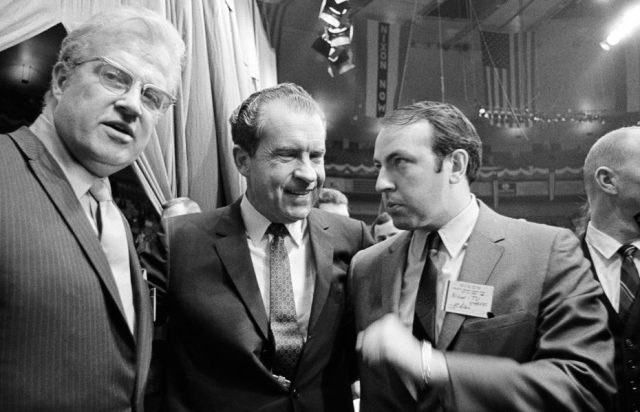
“The only person I ever saw Roger hit on was Nixon,” a fellow producer jokes. He became Nixon’s media guru, staging fake “town hall” meetings with pre-selected questions, shepherding Nixon’s TV campaign into the White House.

Ailes had the idea of a TV “network” of sorts — a means of “bypassing the critical press,” for Republicans — during the Nixon years. He wasn’t able to make that come to pass until the ’90s with Fox.
ailes4

In the intervening years, he made his name as a “king maker,” masterminding media image campaigns for generations of Republicans who wanted to go to Washington. The effort it took to get the effete Mitch McConnell elected to the Senate from Kentucky is worth a laugh or two.

The TV mogul’s former star, Glenn Beck, who has “seen the light” and renounced his divisive ways, psychoanalyzes his late employer as a man “with a real terror inside him…wanting to be liked.”

“It’s easy to make somebody into a monster,” says Beck, who admits he used to “perform” on Fox, and plainly still is performing. “It’s hard to see that you’re on that path, too.”

Ailes bugged the offices and even the elevators at Fox News, kept personal files on staff and hired a private investigator, Bo Dietl, to hunt for dirt on his enemies, a man who became the classic “Friend of Roger” Fox News guest “expert.”

An actor reading Ailes’ writing spits out rage at “The New York and Hollywood elites,” something he knew he shared in common with his viewers.

“Roger always knew the lowest common denominator for people,” more than one former employee says, in various forms.

The sexual harassing? Casting couch sessions with aspiring reporters, consultants and guests? “He picked on people who needed him, not just women,” but he was hunting for validation via sex, much of the time. “He needed a harem.”

Ailes learned his TV political “optics” from Leni Riefenstahl’s “The Triumph of the Will,” had a hand in every significant GOP victory from Nixon to Trump, and propositioned, bullied and coerced (often ruining those who turned him down) scores upon scores of women starting with his earliest days in TV.

Much of this isn’t new or “news,” as we’ve already heard from many of these voices — despite hundreds of millions in settlements, with the non-disclosure agreements that go along with that.

The early years, a 1960s profile by Mike Wallace, are balanced with telling later TV interviews (having a chuckle with Charlie Rose about drinking and womanizing TV journalists), all depicting a Hitchcock shaped “Master of Offense.”

Montages of the hate-filled bigotry Fox poured onto its shows about Barack Obama are hysterical, in every sense of the word.

The Willie Horton ad, the Clinton-Lewinsky Scandal, the first revelations about Fox star Bill O’Reilly’s loofah madness (in 2004), the red letter dates in Ailes’s public life get their moments in Bloom’s film.

But so do his efforts to manipulate the politics of Cold Harbor, New York, where he built a mansion, bought the tiny local newspaper and tried to bully one and all into submitting to his will and his hand-picked candidates to run the place.

That didn’t work out.

Several of those interviewed note how Ailes “needed enemies” to succeed, to drive him. And he did. That’s exactly how he earned his reputation for dividing America, the crux of Bloom’s film (opening Dec. 14).

But one former “enemy” remarks how glad she was when it all came apart “while he was still alive.”

And others marvel at how Fox is exactly the same attack machine it was the day he was ousted, pointing to the America and the government Ailes left behind.

“If (Trump) hadn’t been real, Roger Ailes would have created him,” onetime Fox producer Muto cracks.

3stars2

MPAA Rating: unrated, sexual discussion, profanity

Cast: Roger Ailes, Glenn Beck, Alyson Camerota, Pat Buchanan, many others

Credits: Directed by Alexis Bloom.  A Magnolia/A&E Indie Films release.

Running time: 1:47

Posted in Reviews, previews, profiles and movie news | Comments Off on Documentary Review — “Divide and Conquer: The Story of Roger Ailes”

Movie Review: “Sicilian Ghost Story”

sicilian1

Starkly beautiful, haunting and touching, “Sicilian Ghost Story” is an Italian “Endless Love,” a tale of first love and the fantasies that spin out of that when the one you’re smitten with goes missing.

Filmmakers Fabio Grassadonia and Antonio Piazza have found an arresting setting, a chilling true story and a dreamy, surreal way of approaching it in this serene and unsettling thriller.

Julia Jedlikowska is Luna, a 14 year-old with a crush on Guiseppe (Gaetano Fernandez), a sensitive, handsome and apparently rich boy from school.

She writes him love notes and they flirt in the woods on the way home. His teasing is age-appropriate, but prophetic.

“You’re not going to regret this, are you?”

He’s no sooner impressed her with his equestrian skills in the family corral, when he’s whisked away. Luna is so over the moon that she’s not quite sure what happened, but we’ve seen the cars with flashing blue lights in the background as she walks home.

Luna’s lovesickness amps up her teen revolt against her icy Swiss mother (Sabine Timoteo), but not her indulgent diabetic Dad (Vincenzo Amato). Her classmate Loredana (Corinne Musallari), the one she swaps flashlight Morse code messages, hillside home to opposite hillside home, is her only confidante.

And she needs Lore. Because Guiseppe isn’t at school. Days turn into weeks and Luna’s obsession only grows.

What happened to him? Why does his family not answer the door, or worse, chase her away? Tearful embraces from the boy’s mother are broken up, threats from Guiseppe’s grandfather are muttered.

“We’ve got nothing to do with those people,” her own mom warns (in Italian with English subtitles). “Don’t make the same mistake as me.”

Something happened involving Guiseppe’s dad. The word “supergrass”  crosses some people’s lips.

And then we see what happened to Guiseppe as the film shifts to his point of view. And it’s not a pretty scene.

What’s Sicily known for? Aside from pizza?

“Sicilian Ghost Story” plays out as a teen girl’s “Catcher in the Rye” fantasy about a love she’s never even kissed. In her dreams, she sees where he is, what happened and who did it. She can save him!

She and Loredana dye their hair blue and hand out “Where is Guiseppe?” flyers.

Time passes and Luna’s obsession only grows. In one telling moment, a hapless teacher stands by while the kids “sort” their conflicting loyalties and who gets Guiseppe’s empty desk. Knowing the people involved in his disappearance, it wouldn’t be safe to get too vocal about what happened and what’s really going on. Only Luna is brave enough to do that.

sicilian2

Young Jedilikowska makes Luna the sort of heroine we root for and fear for at the same time — fiery and furious, out of her depth, adamant that only she can solve this mystery and save her beloved, but losing her sanity by leaps and bounds.

The kidnapping half of the tale is all too-familiar in its cruelty and Italian state of hopelessness, and Fernandez brings a deflated despair to those scenes. Only in Luna’s mind, as she imagines him reading her plaintive love notes, is he allowed hope.

Movies set in Sicily are rare, and ones with this subject matter — cloaked in a “Ghost Story” or not — even rarer.

But Grassadonia and Piazza, who have teamed on Italian TV movies and the like, have used it to create a scenic, poetic, striking and moving thriller about Sicily’s “problem” viewed through the lens of youth and young love. The spooky overtones make its title an honest one, even if the frights are few. This is a “Ghost Story” well worth telling, and seeing.

3half-star

MPAA Rating: unrated, violence, sex, nudity, smoking and profanity

Cast: Julia Jedlikowska, Gaetano Fernandez

Credits: Written and directed by Fabio Grassadonia and Antonio Piazza, based on a Marco Mancassola short story. 

A Strand release.

Running time: 1:58

Posted in Reviews, previews, profiles and movie news | Comments Off on Movie Review: “Sicilian Ghost Story”

Movie Review: RBG earns notoriety “On the Basis of Sex”

sex2

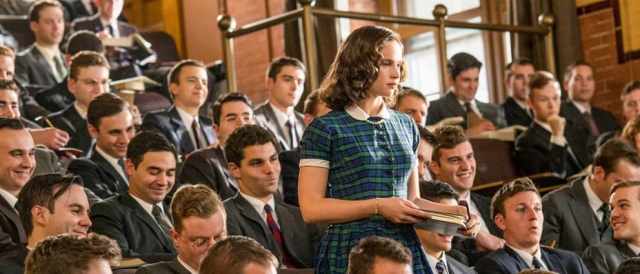
Our year of celebrating Supreme Court Justice Ruth Bader Ginsburg reaches a crescendo with “On the Basis of Sex,” a thrilling if somewhat conventional celebration of her early life and her path to the case and cause that made her reputation.

Mimi Leder’s brisk, upbeat film uses Ginsburg’s biography as a civics lesson, showing the courts as open to powerful arguments and reason (at least in the 1970s), as a reflection of a changing society — not so much leading social change as accepting it — and as Americans’ last line of defense against unfairness, injustice and despotism.

Timely? You bet. Seeing this you understand the fatal attraction of a political party wanting to steal Supreme Court seats and stack the courts to cover its tracks. Congresses and presidents are fleeting, the courts impact generations.

Felicity Jones looks little like the justice, but grows into the part as we watch this razor sharp Brooklynite rise to the occasion of her life’s work. By the time she’s making oral arguments, Jones (“Rogue One”) IS Ginsburg.

The hook that “On the Basis of Sex” hangs on, the thing that got Ginsburg’s cooperation with the film I dare say, is its depiction of a marriage of equals. She got into Harvard Law (and finished at Columbia) and onto the Supreme Court. But husband Marty Ginsburg (Armie Hammer) got into Harvard first, and a mid-law-school medical crisis put Ruth in a position of attending lectures for his courses as well as hers — doubling her education even as she was facing a crushing workload.

When Ruth, who became a law professor because no New York law firm would hire her, was hunting for the test case that might unravel sex (gender) discrimination in the nation’s courts, clever tax attorney Marty was the one who found the ingenious, back-door suit that, with his help, allowed her to change America forever.

“On the Basis of Sex” begins in the sexually-segregated 1950s, with Ginsburg’s first days at Harvard Law. Professors (Stephen Root) refuse to call on her in class. The welcome from the dean (Sam Waterston, perfect) to the nine women of her class repeatedly refers to them “taking a spot from a man.”

Ruth doesn’t need to state the obvious, but she does — “He’s not going to take me seriously.”

She’s a wife and new mother, and gives us a hint of the spitfire she will be as she outworks, out-argues and outflanks the rank sexism of hidebound Harvard.

Casting the tall, patrician Hammer hammers home Ruth’s diminutive stature and “non-traditional” marriage (by 1950s standards) they represented. Marty’s not just a sight gag or sidekick. He’s the better cook, the one who gets hired at a top firm and the one who requires nursing when he has a cancer scare. What doesn’t break Ruth makes her stronger.

The discrimination doesn’t end with her degree. One potential employer lays out the hopelessness of her pursuit of a job in New York law — “a woman, a mother and a Jew.” So she went into academia where by 1970, her protesting/rallying/agitating young students inspire her to get involved — legally — in the spirit of the changing times.

A nice parallel development — the outspoken legal academic discovers the rebel her teen daughter (Cailee Spaeny) has grown into, adding urgency to Ginsburg’s cause.

Veteran character actor Chris Mulkey (“Whiplash”) plays the skeptical litigant whose tax deduction lawsuit gets Marty’s attention, and then Ruth’s. His transformation from haggard taxpayer wronged by a sexist system into social justice warrior beautifully illustrates Ginsburg’s powers of persuasion.

Oscar winner Kathy Bates is the aged, jaded crusading attorney who has fought and lost gender discrimination suits for decades, and Justin Theroux transforms himself into Ginsburg’s pal since childhood who now runs the ACLU’s legal department, a key ally as they begin their assault on “tradition” that has kept women as second class citizens — but a hardcase who is sexist in ways he cannot see.

The villains may make what sound like reasonable arguments against “change” and “preserving the family” — arguments we hear echoed to this day. But Waterston and Root especially show how they deserve our hisses. Leder lets the courtroom arguments have the drama that comes naturally to the setting. Having mother and daughter argue at home over the ethics of Atticus Finch in “To Kill a Mockingbird” underlines the conventions this script is leaning on, to good effect.

“Women have been losing the same argument for 100 years!”

If there’s a knock “On the Basis of Sex” (opening Dec. 25), it’s that the script plays it awfully safe most of the time, relying on Ginsburg’s own words to make her arguments for her and to us. Hiring a totally untested screenwriter doesn’t so much harm the picture as limit its ambitions to the conventional “feel good” moments.

But Jones, luminous in support in such dramas as “The Theory of Everything,” carries this picture, delivers thrilling arguments thrillingly and puts a warm, human face on a legal figure who has become liberalism’s Obi Wan Kenobi, “our only hope.”

“On the Basis of Sex” shows Ruth Bader Ginsburg not as an icon, but as somebody who fought for herself and the rest of us and earned that distinction, one brilliant argument at a time.

3half-star

MPAA Rating: PG-13 for some language and suggestive content

Cast: Felicity Jones, Armie Hammer, Sam Waterston, Stephen Root, n Mulkey and Kathy Bates

Credits: Directed by Mimi Leder, script by Daniel Stiepleman.  A Focus Features release.

Running time: 2:00

Posted in Reviews, previews, profiles and movie news | Comments Off on Movie Review: RBG earns notoriety “On the Basis of Sex”

Movie Review: The Wild West of Chinese commerce is inviting to a “Ghostbox Cowboy”

ghostbox1

“Ghostbox Cowboy” is a trippy culture-clash comedy, an “innocent abroad” tale of an American rube out of his depth in the new Wild West, the free-for-all that counts as a marketplace in modern day China.

It’s willfully, defiantly cryptic and pretty much impossible to cozy up to, but writer-director John Maringouin (“Big River Man”) calls to mind the early deadpan fish-out-of-water films of Jim Jarmusch (“Mystery Train”) and similar ’80s indie roadtrip fare — “Leningrad Cowboys Go America” is the most obvious analog I can think of.

Not that “Ghostbox” makes as much sense as any of those hallucinogenic antecedents. Not in the least.

Our story opens at a Love’s Interstate service station in “The American Blank Region” where a 50ish doofus (David Zellner of “Kumiko, The Treasure Hunter”) wanders the aisles in age-inappropriate slacker-wear and notices that every useless toy and tchotchke he picks up has “Made in China” on its label.

The next scene, he’s in China, a tall Texan with no accent or boots, but a ten gallon hat that announces his presence to an entire country of hustlers, one-person manufacturing firms, entrepreneurs and rule-benders, every one of them asserting China is “open for business.”

He is Jimmy Van Horn of Van Horn Global, a title tells us. And he has an idea, a dream and a “prototype.” Ghostr is a gadget to talk with the dead, a “trans-dimensional communication device.” He is sure he can pitch this, get investors, get the Ghostr made on the cheap and make his mark in the world and his fortune.

“Everyone has a dead grandmother they want to communicate with,” is his pitch.

The Specialist (that’s the name he goes by in the credits, too) is an American ex-pat too much of a “genius” to make it in America, ready to walk Jimmy through the naked fever dream of Chinese capitalism.

Specialist speaks Chinese — badly and arrogantly. If he knew what the natives — taxi drivers and others, were saying about him…

He shows Jimmy this world of hustlers, a massive flea-market looking complex where “each little stand is a factory, every floor has about 10,000 factories. and there’s 50 floors.”

He will introduce Jimmy to the shakers and movers who puts such “factories” to work making 9volt lightbox junk like Ghostr.

A running gag — every Chinese person Jimmy meets is rude, starting with the indulgently contemptuous young Chinese-Americans who have brought their trust funds to the land of their forefathers to make their fortunes.  They’ve set up shop in the Next Big Thing Economy, and being from Cleveland, are prone to correcting Jimmy’s idiotic misuse of American colloquialisms.

“These will sell like THE hotcakes” is his pitch, they try not to roll their eyes as he Texas-splains what “hotcakes” are — to guys from Cleveland who know the expression is “sell like hotcakes.”

The sea of middlemen and go betweens Jimmy must navigate includes “Swamp Donkeys,” investors with more money than common sense. Aged hippie Bob Grainger (Robert Longstreet of “Sorry to Bother You”) will help with that. Bob is CEO of FreeDentures.com, false teeth that come with wifi receivers allowing your mouth to broadcast advertising to you — the cost of “free dentures.”

“I’m gonna fast-track you in there.,” the manic, seemingly-stoned 68 year old (“I LOOK 40!”) insists. “You’re going to meet the most influential 12 year old millionaires in China!”

Bob’s rules for the China trade? “Be young and interesting. And don’t fall in love with a beautiful hooker.”

Bob, Specialist and the Chinese business people they hook Jimmy up with drink and snort and party and take meetings and share bromides that they must have read on those framed posters they sell in airline magazines.

“The usefulness of a window is not in the frame, but in the empty space that lets the light through.”

“FEAR has two meanings. Forget Everything And Run, or Face Everything And Rise.”

Jimmy has tied his fate to irate Chinese nags and thieves (stealing his idea is Job One) and to clumsy American ex-pats who launch into stoner talking jags about Chinese gerbils slaughtering eagles and spontaneously combusting mellons.

Every idea is prime investment property — bathtub gargoyles? Free Dentures? Ghostr?

“You can’t walk down the street here and not make money,” The Specialist insists. Meanwhile, the Chinese are muttering “American devils” and “idiot” at them and not even covering their mouths when they do.

“Why don’t you speak Chinese?”

Jimmy is doomed to leave one Zombieland (“America is DEAD.”) for another, the “Blank Space” of Inner Mongolia, where his journey takes him to one of those vast, fraudulent Chinese megacities, never quite finished, with nobody living there.

“Prepare to be civilized,” a loudspeaker blares.

But don’t expect to be entertained. Not a lot, anyway. Maringouin fills the screen with not quite random images of desolation, loneliness, despair and capitalism run amok.

Jimmy’s journey is meandering and seemingly largely in his own mind, even as reality sets in — he loses his money — and he finds himself playing the part of “The American Investor” in staged photos of groundbreakings, meetings with Chinese investors who’d feel more confident if an it just looks like an American is involved.

I was fascinated, but I can’t say I liked “Ghostbox Cowboy” as much as I enjoyed the films it seems inspired by. As with the Ghostr, it’s not the production of the product (“I don’t care about quality.”) that is taken seriously, but the idea.

2stars1


MPAA Rating: unrated

Cast: David Zellner, Tax Ninja, The Specialist, J.R. Cazet, Robert Longstreet, Nan Lin

Credits: Written and directed by John Maringouin.  A Dark Star Pictures release.

Running Time: 1:48


Posted in Reviews, previews, profiles and movie news | Comments Off on Movie Review: The Wild West of Chinese commerce is inviting to a “Ghostbox Cowboy”

Preview, “Islam and the Future of Tolerance”

How do you debate the tolerance of a religion intolerant of criticism?

A central dilemma of our times, of the West dealing with the Islamic East.

Here’s a documentary about that issue and the core debate between Islam and the world — How can you characterize your faith as pacifist and tolerant when so much of the evidence points to the opposite being true?

Here’s an East meets and Debates West doc (Dec. 11, digital release) that promises to “go there.”


Posted in Reviews, previews, profiles and movie news | Comments Off on Preview, “Islam and the Future of Tolerance”

Next Screening? “On the Basis of Sex”

So Best Actress looks like a crowded field at the Academy Awards this awards season.

Glenn Close for “The Wife,” maybe one or both of the leads from “The Favorite” or “Mary Queen of Scots.”

But if this one works, Felicity Jones has got to have the inside track. America and Hollywood LOVES Ruth Bader Ginsburg.

This trailer for “On the Basis of Sex” finds some laughs in the very serious matter of gender equality. The film opens Christmas Day.  


Posted in Reviews, previews, profiles and movie news | Comments Off on Next Screening? “On the Basis of Sex”

Preview, “Godzilla: King of the Monsters” and the “Claire de Lune”

Second trailer. The Millie Bobby fans have been dying for this one. Pat yourself on the back if you get the “Frankie and Johnny” musical reference.

Posted in Reviews, previews, profiles and movie news | Comments Off on Preview, “Godzilla: King of the Monsters” and the “Claire de Lune”

Movie Review: “Mary Queen of Scots” and Elizabeth I fight each other and the Patriarchy

mary2

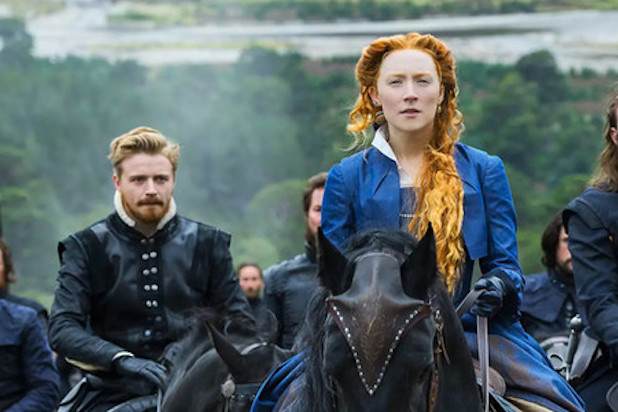
History’s most famous feuding redheads got at it again in “Mary Queen of Scots,” an engrossing, marvelously-acted account of the monarchical cousins that suggests their real enemy wasn’t each other — it was the grasping, pushy and ambitious men who surrounded each in her own court.

It’s more historical than “history,” and as the history itself is Byzantine in its complexity, stage director turned filmmaker Josie Rourke is hard-pressed to keep it all moving and not cast the viewer adrift in the process.

But stars Saoirse Ronan and Margot Robbie give performances of such textured subtlety, full of tenderness, vulnerability, fire and steel, that even when it drags “Mary” drags us along with it.

Newly-widowed Mary returns to her native Scotland having just buried her husband, King Francis of France. She was Queen of Scotland when she left, her homeland now ruled by regents. Now she’s back, speaking French without an accent and ready to stake her claim to her throne and assert her place in the English throne’s line of succession.

But she’s Catholic. Her half-brother Lord Moray (James McCardle), one of those ruling in her stead, is Protestant. And the firebrand Presbyterian John Knox (David Tennant, fierce) is openly contemptuous of Mary and her ambitions.

“Are we to abide a Papist and a WOMAN?”

There’s trouble in court at Holyrood Castle. And that’s nothing to the turmoil that’s roiling London, 400 miles to the South.

It’s 1561, and her cousin Elizabeth (Robbie) is just getting her footing, ruling a once-Catholic land which her father Henry VIII turned officially Protestant, navigating the treacherous shoals of English, Papal and global politics as an unmarried woman just making up her mind that she would not marry.

“I choose to be a man,” she tells her most trusted advisor, Sir William Cecil (Guy Pearce, all conspiratorial whispers). But Cecil and other members of her Privy Council (Ian Hart, Adrian Lester) are alarmed by Mary’s presence, with her having a legitimate claim to Elizabeth’s throne as well as her own.

The two queens? They act as if they can work this out without any mansplaining or man meddling. Elizabeth is most concerned with self-preservation and protecting the monarchy. Mary suggests. “Name us heir,” using the regal “we/us” of course.

And Elizabeth, whatever concerns swirl around her about a renewal of Catholic-Protestant hostilities and her own legitimacy (Daddy divorced Mommy by lopping off her head), is willing to hear Mary out.

Maybe she’ll fix the unmarried Mary up with her own Protestant suitor, the Earl of Leicester, Robert Dudley (Joe Alwyn), the suggestion being that with a Protestant husband and consort (or even king), the dueling faiths will keep the peace.

Mary’s counter offer is “This is a matter of the heart, not the state.” And as she gets more worked up, she sets her sights on a marriage of her own choosing that will produce an heir.

“I will be the woman she is not!”

But this feud never descends into the cat-fight other films on the subject tend to turn it into. These are reasonable women, abiding by each other’s demands, with scheming menfolk behind them itchy to start a plot or pull the trigger.

A Stuart uncle (Brendan Coyle of “Downton Abbey) gets his handsome Catholic son, Lord Darnley (Jack Lowden) in front of Mary, and that’s all she wrote — and married.

Now the threat is real and the scheming — men trying to strong-arm each queen into action or usurp Mary’s power — reaches a peak.

As the film opens with Beheading Day in 1587, we know how this is going to play out.

I like the way “Queen of Scots” deviates from the usual manner of depicting Elizabeth I as victim of “two Marys,” sister “Bloody Mary” before she took the throne, “Mary Queen of Scots” after she ascended. Cate Blanchett’s “Elizabeth” movies repeat it. Elizabeth is almost helpless against the first Mary, cold-hearted and ruthless against the second — typically.

Robbie’s Elizabeth has a touch of the temperamental (the Elizabeth I cliche), but a broken sadness about her. No sex, please, Dudley. Can’t risk having an heir — legitimate or otherwise. Mary’s unbending resolve rattles her, and she blinks. Ravaged by “the pox,” she fears she’s lost another advantage over her rival — her looks.

Robbie is transformed in this performance, making Elizabeth lash out at her advisors and flinch at Mary’s every move — a strong woman hobbled by doubt. Her makeup, even before “the pox” is startling enough to make one question those “The screen’s next great beauty” labels of just a couple of years before. That took guts.

Ronan’s Mary is both feminine and in charge of her own destiny, lecturing her husband when invaders approach that “these swords are NOT just for show, you know.” And yet she is brought low, betrayed and undone, labeled “a whore and adulteress” by the power-drunk preacher Knox.

mary1.jpg

I love the way Rourke uses each queen’s ladies in waiting as a gang, rousting the impertinent men out of court when privacy is called for, protecting their queen when they can, distraught outside the door to each woman’s bedchambers when they cannot.

Color-blind casting puts Asians and men of color in high positions in each queen’s retinue, and political correctness has Mary refusing to blame a gay minstrel for sleeping with her gay husband, because it is “your nature” and he didn’t betray that.

And there’s the much-discussed “meeting” scene between the two queens, which never happened. 

No one had the termity to tell stage-director Rourke that she wasn’t adapting Shakespeare and such liberties are jarring when you’re dealing with history and not fiction.

Those are minor quibbles, though. More historical accuracy might have been achieved in the flat, uncinematic lighting scheme of this digital production. Go back to Blanchett’s “Elizabeth,” 20 years ago, if you want to see vibrant colors and faces that don’t look washed-out by flat lighting. This looks…primitive.

There’s grit and gloom to the combat and marching into combat scenes. But even the gorgeous Scottish scenery, backdrops for romantic walks and horsebacks, lacks the majesty and visual pop that shooting on celluloid might have given it.

Surprised there’s not a “Technicolor” app for that. Yet.

But none of those failings undoes “Mary Queen of Scots,” because the director took her own film’s themes to heart. In the end, she leaves it in the most-capable hands of her two leading ladies and they do not disappoint. The stars outshine the production.

3stars2


MPAA Rating: R, graphic violence, sex and nudity.

Cast: Saoirse Ronan, Margot Robbie, Guy Pearce, Adrian Pierce, Ian Hart, Gemma Chan

Credits: Directed by Josie Rourke, script by Beau Willimon, based on John Guy’s “Queen of Scots: The True Life of Mary Stuart.” A Focus Features release.

Running time: 2:10

Posted in Reviews, previews, profiles and movie news | Comments Off on Movie Review: “Mary Queen of Scots” and Elizabeth I fight each other and the Patriarchy

Next screening? “Mary Queen of Scots”

On first and second blush, this film of history’s greatest “cat fight” would appear to have a contender or two in its cast.

Saoirse? Margot?

Stage director Josie Rourke, making her feature film directing debut, certainly knows a thing or two about working with actresses. That’s got to be a help when your stars are playing two of history’s greatest divas.

“Mary Queen of Scots” opens Dec. 7.


Posted in Reviews, previews, profiles and movie news | Comments Off on Next screening? “Mary Queen of Scots”